The Imperial discipline of Xenotaxa arose from a practical problem encountered during the early centuries of deep space exploration.As contact with new worlds increased, natural philosophers found themselves confronted by an ever-growing number of organisms that could not be comfortably classified within existing biological frameworks, yet nevertheless displayed obvious relationships to familiar evolutionary lineages.
Rather than continuously inventing new taxonomic categories for every world surveyed, the Imperial sciences adopted a system of expanded lineage classification. Under this methodology, organisms displaying recognizable ancestry or strong evolutionary convergence with established biological groups are incorporated into broader xenological branches while retaining local distinctions where necessary.
The Xenotaxic system therefore allows researchers to discuss familiar biological relationships while accounting for the immense diversity produced by planetary isolation, artificial intervention, convergent evolution, and deep evolutionary time.
Category: Guides [COSMIC SWORD & SORCERY]
-
Xenotaxa
-
A Part of the Natural World
One of the more persistent misconceptions among younger scholars is the belief that civilization exists apart from nature rather than within it. Such distinctions are often useful for administrative purposes, but become increasingly difficult to maintain when examined across the scales of time addressed within this volume.
The civilizations of Ran have endured for periods measured not in centuries, but in geological eras. Across such spans, cities become ecosystems, transportation networks become migration corridors, industrial districts become habitats, and entire species adapt themselves to the conditions created by intelligent life. The distinction between natural and artificial environments, while occasionally useful, is seldom absolute.
This volume is not concerned primarily with the history, governance, achievements, or institutions of the Ran Empire and its predecessor cultures. Such subjects are addressed extensively elsewhere. Nevertheless, it would be impossible to discuss the ecology of the system without acknowledging the influence of civilizations whose presence has shaped environmental conditions for millions of years.
Many organisms described within these records depend upon settlements, agricultural systems, transportation corridors, industrial infrastructure, or archological complexes for their continued existence. Others have adapted to avoid them entirely. Countless species now occupy ecological niches created by civilization itself, while some environments once regarded as artificial have become indistinguishable from naturally occurring habitats.
The reader should therefore understand that references to cities, settlements, archologies, industrial zones, transportation networks, and inhabited regions are not departures from the purpose of this work. They are components of the ecological reality being examined. Where such systems influence the distribution, behavior, evolution, or survival of life, they shall be addressed accordingly.
-
The Worlds of Ran
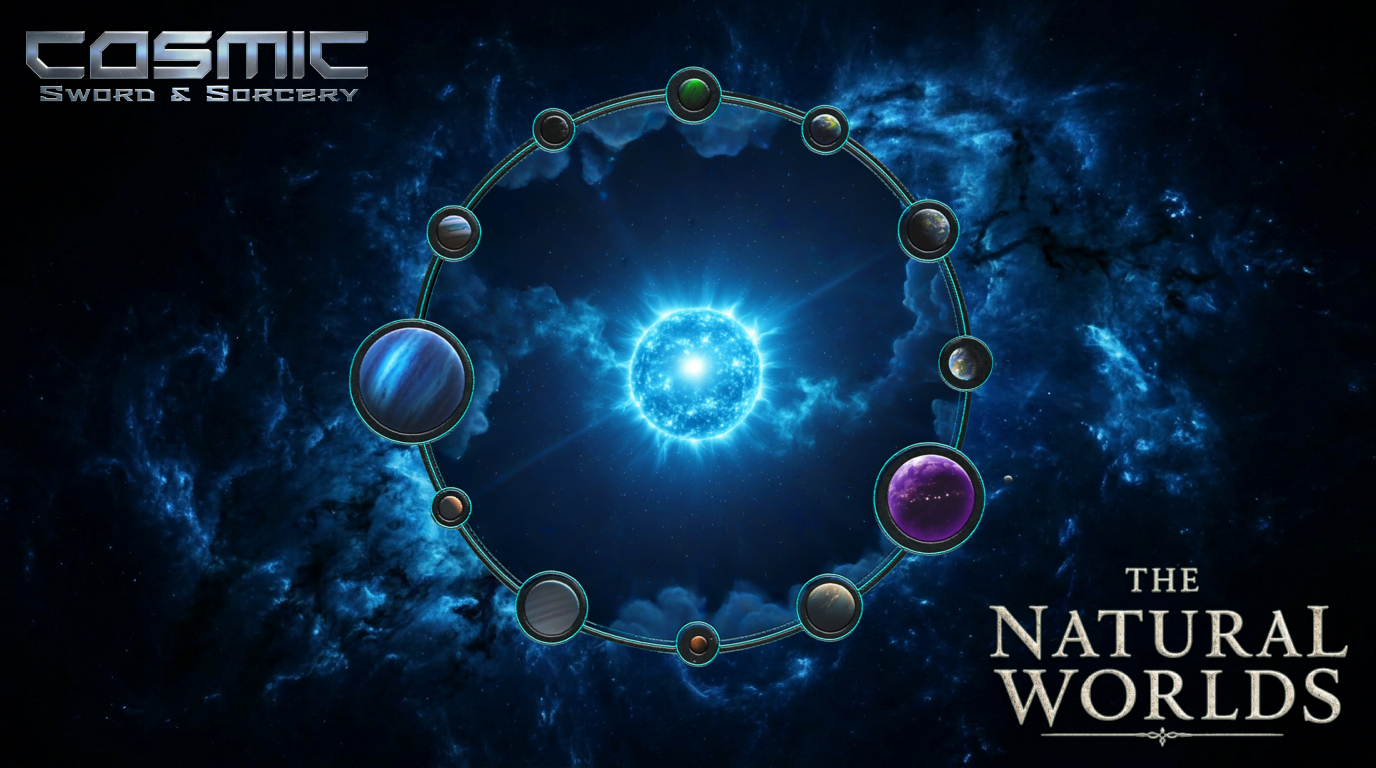
With the exception of Yalar, a poisonous anti-biological hellscape of toxic atmospheres, liquid metals, radiation, and the lingering scars of ages of mechanized warfare and Kalba, no longer recognized as a world of significance but instead a dying industrial debris field, the worlds of Ran present an extraordinary continuum of life and adaptation.
It is upon the second planet, Tyvex, that life first emerges in meaningful abundance within the outward progression of the system. Vast oceans, sprawling vineroot wetlands, amphibious coral forest labyrinths, shimmering grassland savannas, and surprisingly diverse polar steppe regions; have combined to produce one of the most ecologically productive worlds presently known.
Beyond Tyvex lies Illynar, a larger and more heavily forested world whose immense snowcapped mountain chains, strange equatorial bamboo jungles, blue stepped highlands, and great crystalline deserts have given rise to an astonishing variety of specialized lifeforms and isolated evolutionary regions.Further outward stands Vandyrus, often regarded as the Barbarous Line beyond which one enters the truly civilized worlds of Ran. Vast towering redwood forests, deep layered jungles, brutal frozen northern continents, and expansive inland regions; have made the planet one of the most extensively studied ecological spheres within the Imperial record.
Our Vandyrian Civilization does not stand entirely apart from The Natural worlds of Ran. Owing to the scale of both its biosphere and civilizations, the planetary status of each world and its peoples beyond Vandyrus shall be addressed prior to discussion of each worlds flora and fauna.Kydahn presents a markedly different case. Though rain-cursed, ruinous, and suffering severe ecological decline, the world continues to support a startling diversity of life. Much like the reputation of its inhabitants, Kydahn’s biology displays a remarkable refusal to surrender to adversity, clinging stubbornly to existence despite environmental pressures that would have extinguished many lesser ecologies.
The gas giant Pranja represents one of the system’s more unusual biological frontiers. Continental-scale cloud formations, atmospheric islands, and centuries of experimental intervention have produced strange aerial ecosystems unlike those found elsewhere within Imperial territory.Rethka shall be covered only briefly. Though the world once supported abundant life, approximately eighty-nine percent of known native species are now extinct. As a consequence, much of the surviving record concerns ecological collapse, adaptation, conservation efforts, and the growing list of recent removals from the extant register.
Unlike many worlds described within this volume, Farydahn possesses no indigenous biosphere. Nevertheless, its great floating megacities have become important centers of biological research, conservation, genetic archiving, and public education.Kalba is no longer classified as a world.
Titanum represents a unique form of war ecology. Though naturally hostile to complex animal life, centuries of military activity, black-market trafficking, escaped livestock, and accidental introductions have created a strange and often unstable biological landscape.
Orbiting Titanum are two worlds deserving independent treatment.
Thanator, the Jungle Moon and Throne World of the Ran Empire, ranks among the most biodiverse bodies in the known system. Its forests, jungles, mountains, wetlands, and countless isolated habitats contain such biological abundance that entire volumes could be devoted to its study alone.Jotun, though considerably smaller, displays a similarly remarkable richness of life. Forests, grasslands, wetlands, and temperate regions support ecosystems of surprising complexity and resilience for a body of its size.
The gas giant Daradahn hosts immense atmospheric ecosystems dominated by avian megafauna and vast drifting communities of aerial invertebrates, many of which spend their entire existence suspended within the upper atmospheric layers.
Finally, Rywar remains stable, heavily forested, and outwardly unremarkable. Yet beneath this appearance lies a world of considerable scientific interest. Its oceans appear to host the emergence of increasingly complex arthropodal and fish-like lifeforms. Furthermore, evidence suggests that this may not be the first biosphere to develop upon the planet. Some researchers have proposed that Rywar was captured from another stellar system in the distant past, carrying with it the remnants of a far older evolutionary history.From this point onward, each world shall be indexed through the guide’s internal reference matrix. Planetary entries, regional surveys, species records, environmental hazards, and associated ecological observations have been organized to allow rapid navigation between related subjects.
Readers are encouraged to consult these references frequently, as many organisms, habitats, and environmental conditions described within this volume occur across multiple worlds and continuity zones.
ARCHIVAL NOTE
In its original Imperial form, this indexing matrix was maintained through crystalline information systems capable of dynamically cross-referencing associated records in real time. As such technology is unavailable within the present edition, all reference links have been reproduced in simplified form. Relevant entries will appear at the conclusion of each page and may be selected directly to navigate to the associated record.
-
The Natural Worlds
ENTRIES
-
Introduction
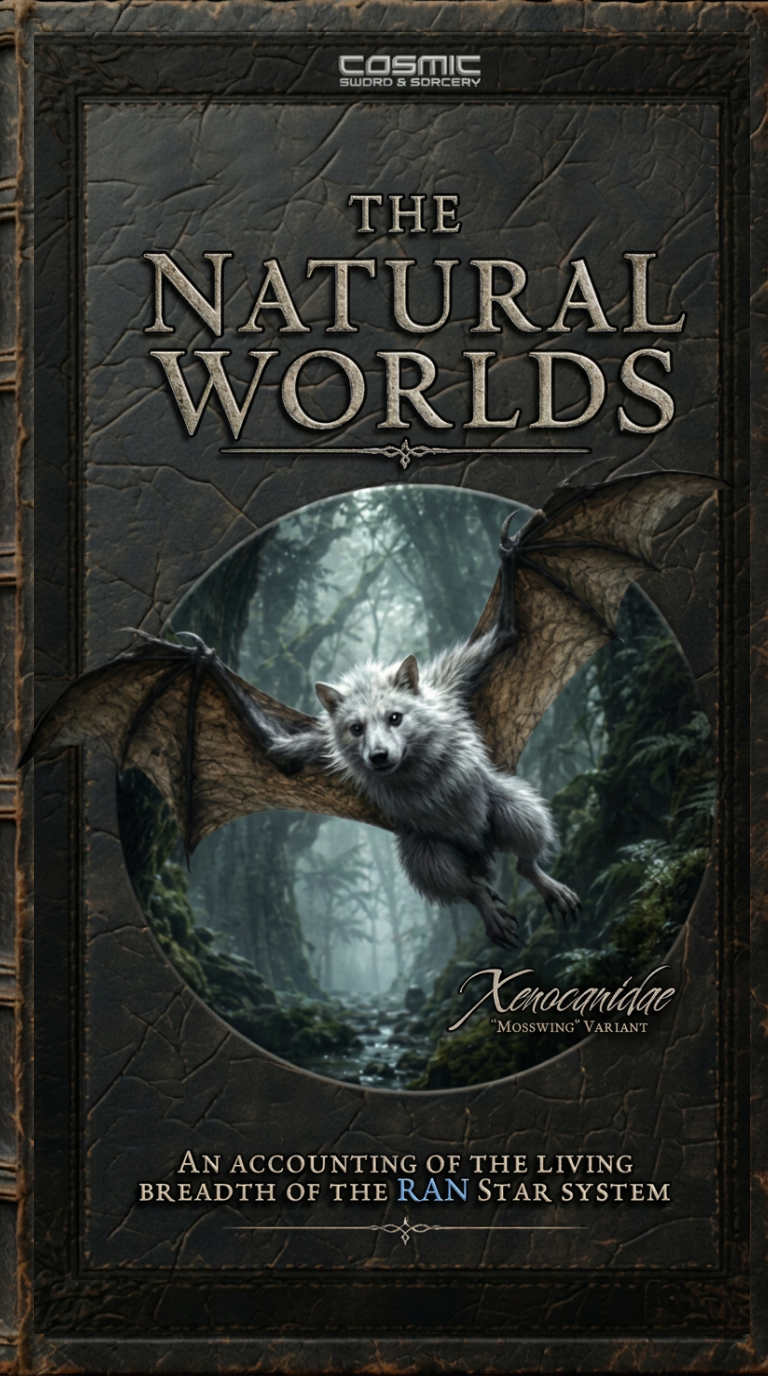
The volume now in hand belongs to a lineage of works issued unsparingly and with intent, each bearing the weight of revision rather than novelty. It is not the first accounting of the living breadth of the Ran system, nor does it presume to be the last. What it presents is a measured record of the current state of known environments, organisms, and conditions as they exist within Imperial reach and observation, compiled from survey logs, expedition journals, colonial reports, and verified encounters across multiple worlds and orbital strata.
The purpose of this guide is practical above all. It is meant to be carried, consulted, and relied upon in motion—whether that motion takes the form of sanctioned exploration, commercial transit, military deployment, or simple survival beyond the security of established settlements. The Ran system does not present its hazards uniformly, nor does it announce its thresholds with clarity. A valley that sustains life at dawn may strip it by dusk; a docile species in one region may prove territorial and lethal in another.
This guide will tell you what has been seen, how it behaved, and what followed. Those who rely upon this work are expected to exercise judgment equal to the information provided. No text, however thorough, replaces direct awareness. In this respect, it remains consistent with all Imperial instruments of record: it serves those who act, and is indifferent to those who do not. Carry it accordingly.