

Tyvexian Waters
The geological separation of the original supercontinent has exerted a lasting influence upon the evolutionary history of marine life. As the continental masses gradually withdrew from one another, expanding marine corridors established new routes of biological dispersal while simultaneously isolating populations within enclosed seas, coastal basins, and sheltered archipelagic environments. Organisms once distributed across comparatively continuous coastal regions became separated by increasingly substantial bodies of water, producing opportunities for regional specialization and evolutionary divergence. Conversely, the formation of new marine passages permitted the movement of species between environments previously divided by terrestrial barriers. The resulting biological record preserves numerous examples of related organisms occupying widely separated portions of the ocean, together with specialized populations whose anatomical and behavioral characteristics reflect prolonged geographical isolation. These relationships are of particular interest to Imperial xenobiologists, as they provide evidence concerning the sequence of continental fragmentation, the historical distribution of marine habitats, and the evolutionary changes accompanying the transformation of Tyvex into its present geographical arrangement.
The biological richness of the Tyvexian ocean extends across a considerable range of environmental conditions, from illuminated coastal shallows and densely vegetated underwater terraces to the colder, less productive regions of the greater oceanic depths. Marine vegetation, microbial communities, and numerous forms of aquatic invertebrate life provide the foundations of extensive food webs, supporting increasingly large and specialized organisms throughout the water column.
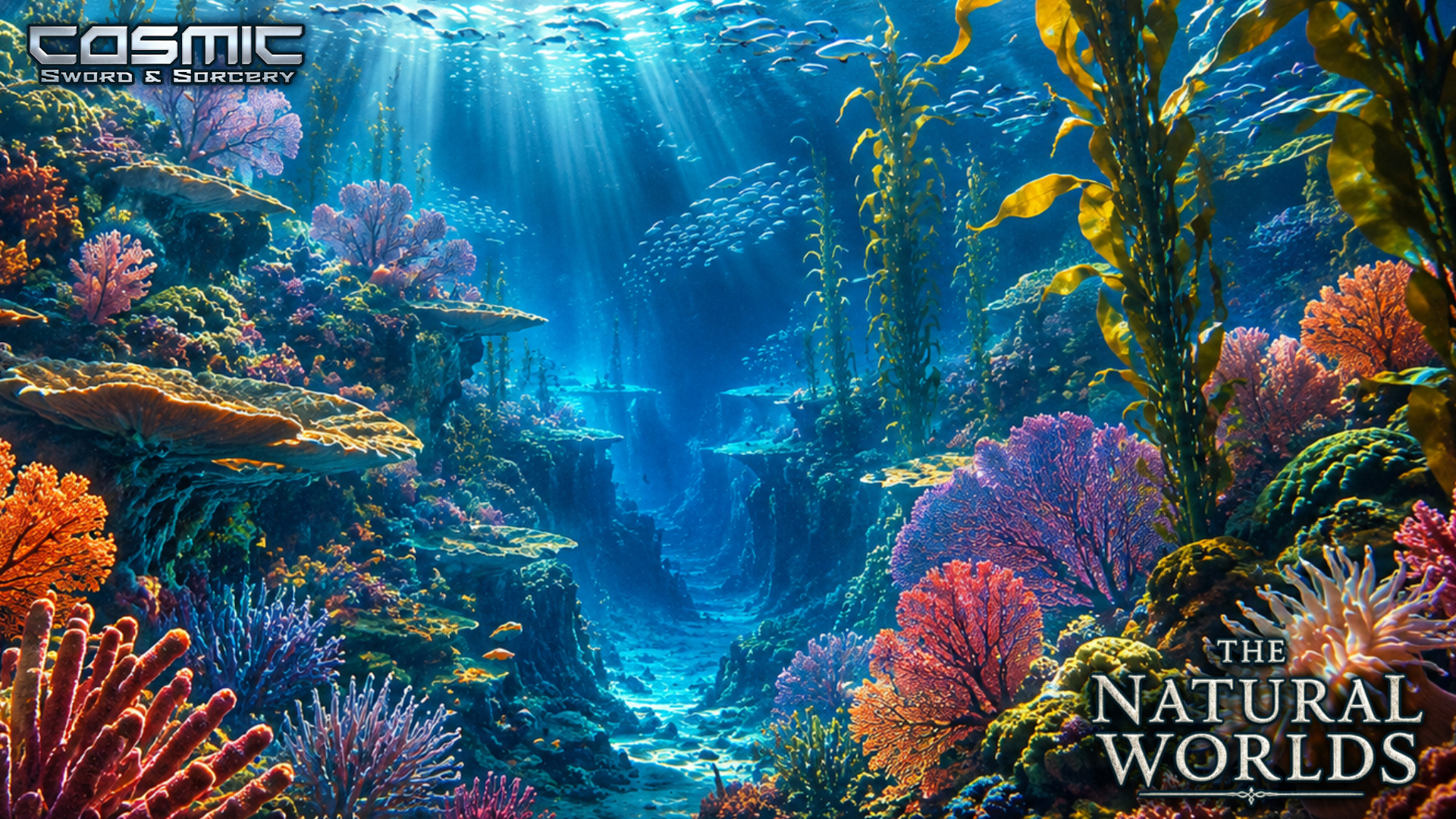
Among the most conspicuous inhabitants are the planet’s reptilian megafauna, whose evolutionary diversity reflects the abundance of aquatic habitats and the long continuity of marine ecosystems. These organisms occupy a variety of ecological positions, with anatomical specializations adapted to sustained swimming, maneuverability within complex coastal environments, and the pursuit of prey across substantial distances. Their distribution is influenced by the availability of food, suitable breeding environments, prevailing currents, and the environmental differences between the continental shelves and deeper oceanic regions. The presence of such large organisms is characteristic of Tyvex’s productive marine systems, although their abundance and behavior vary considerably between individual habitats. Particular attention must be given to the immense shallow-water environments surrounding the fragmented continents, where the interaction of sunlight, geological structure, and biological productivity supports some of the planet’s most elaborate marine communities. Submerged valleys and ancient coastal plains provide extensive regions of relatively sheltered water, while rocky uplands and surviving island chains interrupt marine currents and create localized environments of considerable ecological distinction. The mangrove supercolonies, whose extensive root systems occupy the boundaries between terrestrial and marine environments, further contribute to the complexity of these coastal regions by providing shelter and feeding grounds for numerous organisms during different stages of development.
The shallow seas are consequently not uniform expanses of water, but intricate associations of habitats whose biological relationships extend between open ocean, coastal wetlands, river mouths, and flooded continental margins. Their productivity also makes them important regions of predation, competition, and seasonal migration, with larger marine organisms frequently moving between habitats according to changing environmental conditions and the distribution of available prey.