
The Tyvexian Ocean
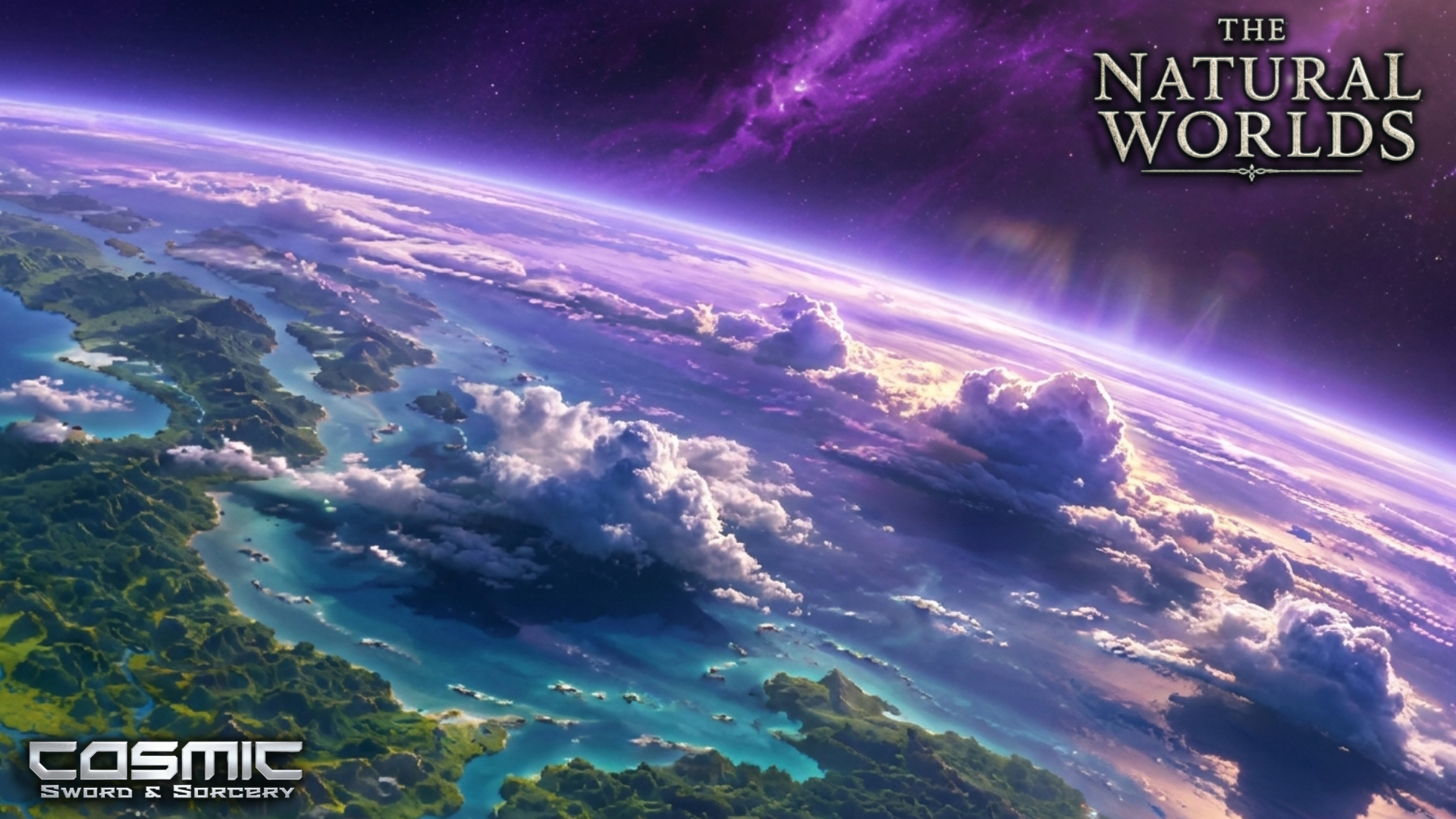
The great ocean of Tyvex encompasses approximately half the planetary surface, forming an immense and largely continuous body of water surrounding the three supercontinents of Vylanth, Cyolir, and Kruma. Although commonly regarded as the principal geographical division between these landmasses, the ocean is itself a complex geological and biological environment whose history remains inseparable from that of the continents it surrounds.
Evidence preserved within the continental margins indicates that the three great landmasses were once joined into a single supercontinental formation, subsequently divided through prolonged geological upheaval and the gradual reorganization of the planetary crust. The resulting separation produced enormous marine corridors, extensive continental shelves, and numerous submerged coastal regions, many of which retain the recognizable outlines of ancient terrestrial formations. Across these shallow waters, archipelagos, reefs, drowned valleys, and partially submerged uplands establish intricate transitional environments between the surviving continents and the greater oceanic depths. The present distribution of marine life reflects this ancient transformation, with numerous evolutionary lineages occupying habitats whose geological foundations predate the fragmentation of the original continental mass.
The comparatively shallow character of much of the Tyvexian ocean is among its most distinctive geographical features. Extensive continental shelves surround the principal landmasses, descending gradually through submerged coastal plains, reef complexes, and broad sedimentary basins before reaching the deeper waters of the open ocean. These environments are particularly prominent around Vylanth, where the fractured continental margins give rise to extensive shallow seas and archipelagic formations, and throughout the marine passages separating Cyolir from its neighboring continents. The submerged terrain varies considerably, encompassing broad underwater terraces, ancient river valleys, eroded escarpments, and isolated elevations whose summits remain exposed as islands. Such formations provide an extraordinary variety of marine habitats, supporting biological communities adapted to different depths, currents, temperatures, and degrees of sunlight penetration. The continental shelves also represent important regions of nutrient exchange, receiving sediments and organic material from the planet’s extensive river networks while supporting dense populations of marine vegetation, invertebrates, and larger aquatic organisms. In many regions, the transition from terrestrial wetland to shallow marine environment is gradual, producing extensive ecological boundaries that shift with seasonal flooding, sediment accumulation, and changes in local water levels.
The oceans of Tyvex are closely associated with the planet’s extraordinary hydrological productivity. Vast quantities of freshwater enter the marine system through the rivers, marshes, and inland seas of the three supercontinents, particularly across the seasonally inundated regions of Cyolir. During periods of extensive continental flooding, enormous volumes of water and suspended biological material are discharged into the surrounding seas, altering coastal salinity, sediment distribution, and nutrient concentrations across considerable distances. These seasonal exchanges influence the distribution of marine organisms, especially those inhabiting estuaries, shallow bays, and the extensive mangrove supercolonies along the continental margins. In such environments, freshwater and marine communities frequently overlap, creating habitats of exceptional biological complexity where organisms must contend with fluctuating salinity, variable oxygen concentrations, and the continual movement of organic material between land and sea.
The stability of Tyvex’s broader oceanic climate is therefore accompanied by considerable regional variation, with coastal conditions responding directly to the changing hydrological character of the adjacent continents.