

Oceanic Biodiversity
Beyond the continental margins, the greater ocean presents a different ecological character. Increasing depth, diminishing sunlight, and the gradual separation from terrestrial sources of organic material produce environmental conditions substantially different from those prevailing throughout the shallow coastal seas. Although the distribution of life within these deeper regions remains less extensively documented than that of the continental shelves, Imperial surveys have established the presence of specialized biological communities adapted to the physical conditions of the open ocean.
The immense distances separating continental margins also create extensive migration corridors, through which marine organisms may travel between widely separated feeding regions and reproductive habitats. Such movements contribute to the continuing exchange of biological populations throughout the planetary ocean, even where individual species remain strongly associated with particular coastal or continental environments. The deeper waters therefore constitute an essential component of Tyvexian marine ecology, connecting the more intensively studied biological communities of the shallow seas within a broader planetary system.
The Tyvexian ocean must consequently be understood as both a biological environment and a surviving record of the planet’s geological history. Its shallow continental shelves preserve the drowned margins of ancient landmasses, its marine corridors reflect the separation of the original supercontinent, and its living communities bear the evolutionary consequences of these transformations. The continual exchange of water, nutrients, and organisms between ocean and continent further ensures that the two cannot be examined as entirely independent ecological systems. From the vast migrations of marine megafauna to the microscopic organisms inhabiting coastal sediments, the ocean sustains an extraordinary range of life whose development has been shaped by the same geological and climatic processes governing the terrestrial environments of Tyvex.
The following survey examines a representative selection of Tyvex’s more distinctive organisms, organized according to the principal environments in which they occur. As with all planetary surveys contained within this volume, the classifications presented here reflect the current Imperial record, incorporating established observations and comparative Xenotaxic studies.
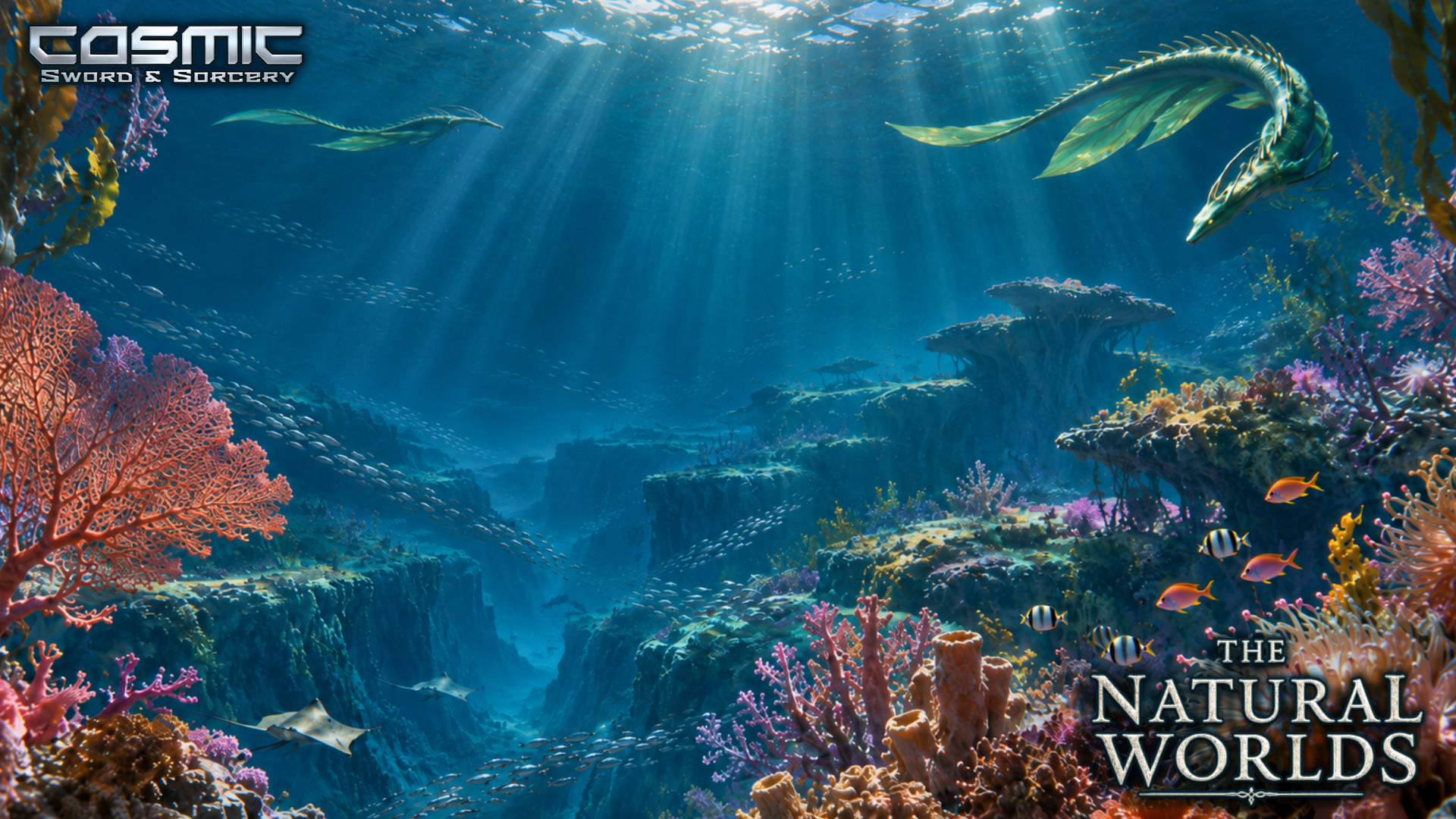
Our examination begins within the shallow oceans of Tyvex, whose ancient waters sustain some of the planet’s most remarkable reptilian megafauna.