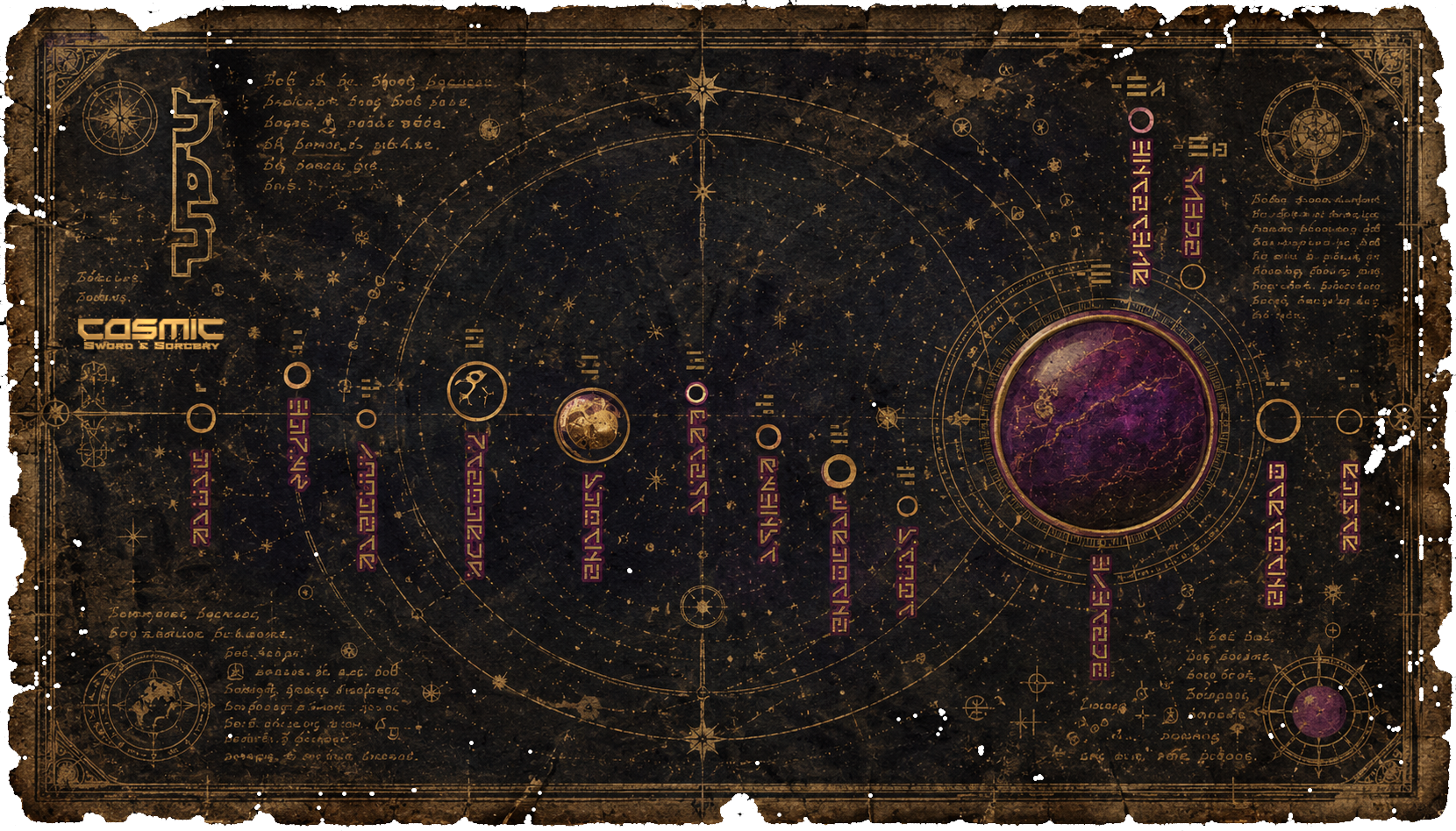
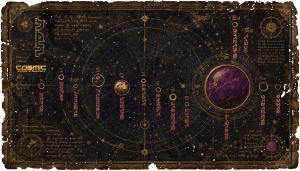
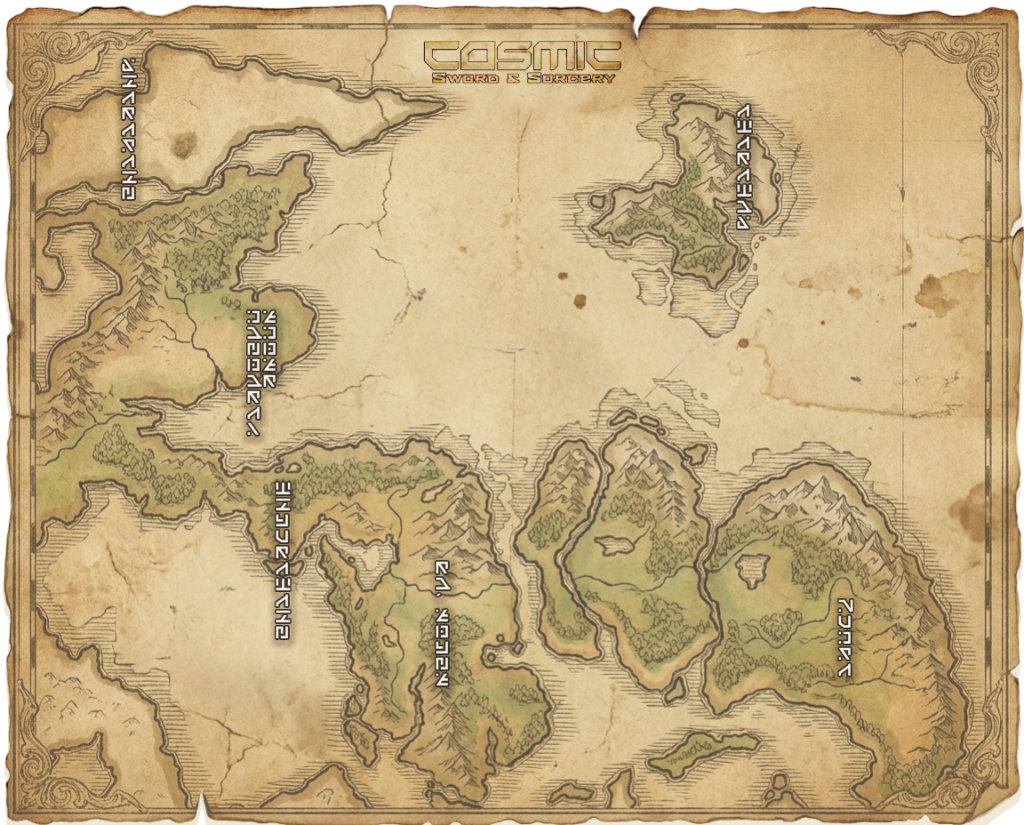
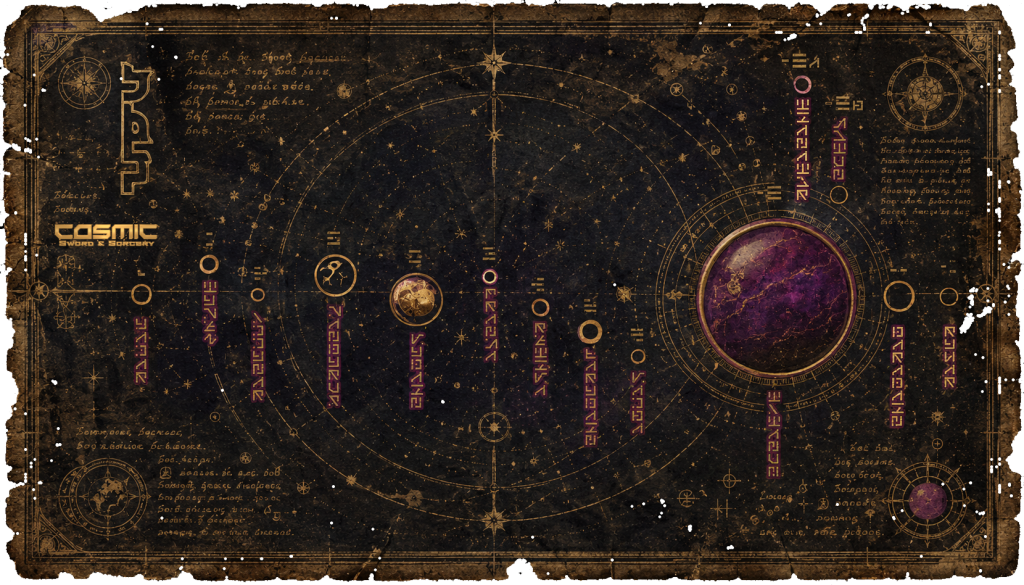
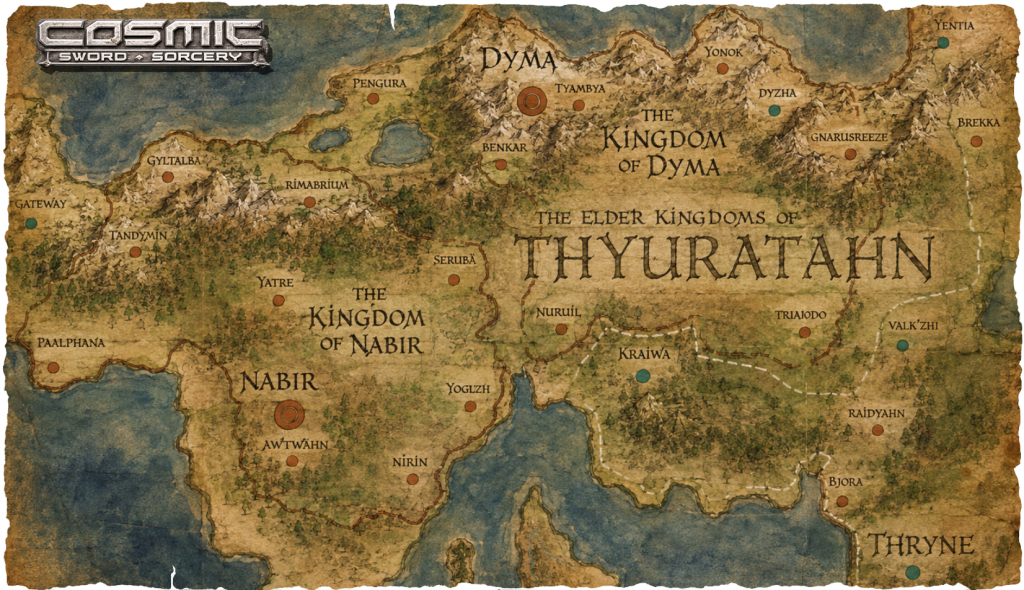
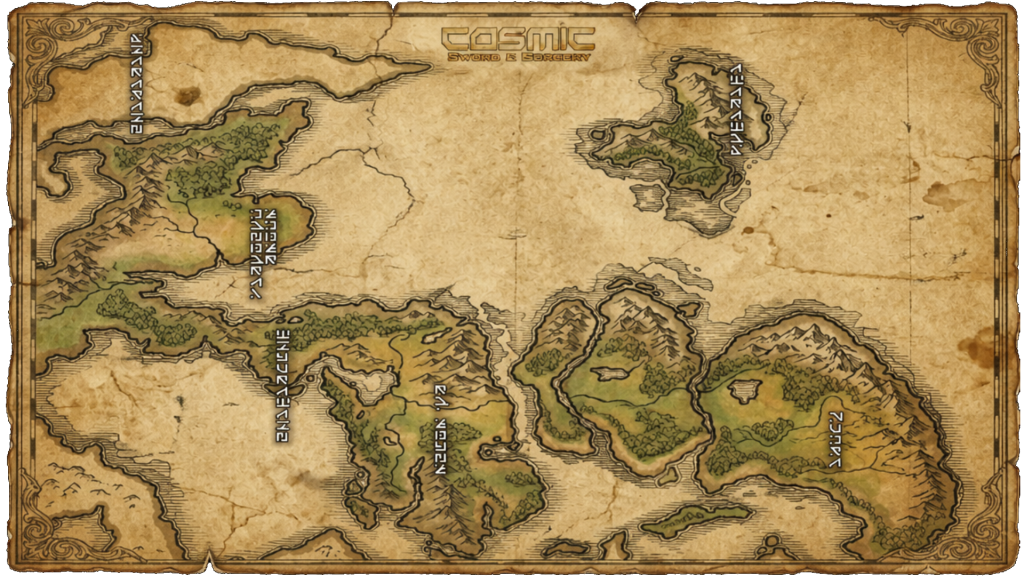
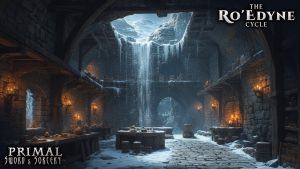
Ancient star charts recovered from the southern vaults of Ro’Edyne remained among the great unresolved mysteries of the early post-collapse ages. For centuries following the long restoration of literacy and astronomical study across Vandyrus, surviving observatories struggled to reconcile the positions recorded within the old imperial charts against the heavens visible in the modern era. Entire stellar reference paths appeared displaced. Seasonal tracking systems failed outright.
Ancient navigation tables produced impossible results when applied to the contemporary skies. At first, many scholars concluded the Ro’Edyne records themselves must have been ceremonial, symbolic, or corrupted through successive archival degradation. Others proposed that the imperial astronomers of the southern territories had employed alternative stellar conventions no longer understood by modern observers. Yet as more fragments emerged from drowned archives, collapsed observatories, and surviving orbital records, a far more disturbing conclusion gradually took shape. The skies themselves had changed.
Comparative astronomical reconstruction eventually demonstrated that Vandyrus no longer occupied the orbital alignment reflected in the oldest Ro’Edyne records. The planet’s axial orientation had shifted catastrophically at some point during the great collapse periods of antiquity, producing widespread climatic destabilization across the world. Seasonal durations altered. Oceanic circulation patterns failed. Entire continental weather systems reorganized themselves across subsequent centuries. This revelation resolved numerous long-standing historical contradictions preserved within older southern records.
Regions once described as humid subtropical territories now lay beneath snow and northern forest. Ancient accounts of warm coastal valleys, monsoon rainfall systems, jungle escarpments, and fern-covered mountain terraces conflicted sharply with the cold maritime climates occupying those same regions in the modern age. For generations such descriptions had been dismissed as exaggeration, poetic embellishment, or symbolic language inherited from lost religious traditions.
The star charts proved otherwise. Pre-collapse Vandyrus had been a warmer, wetter, and significantly more hydrologically active world than the one inherited by later civilizations. The great southern territories of Ro’Edyne existed beneath skies unfamiliar to the modern era, their climates stabilized by planetary conditions no longer present after the orbital disruption. The redwood expanses, frozen highlands, and northern fog systems characteristic of later Vandyrus appear to have expanded only gradually across the cooling world during the long centuries following the collapse.
Among the more unsettling implications of the reconstructed charts was the realization that many post-collapse cultures had unknowingly built their understanding of “natural” Vandyrus atop the aftermath of planetary trauma. Entire civilizations emerged believing the colder world to be the original state of creation itself, unaware that the forests, coastlines, and seasonal cycles surrounding them represented only the latest condition of a much older and radically transformed planetary body.
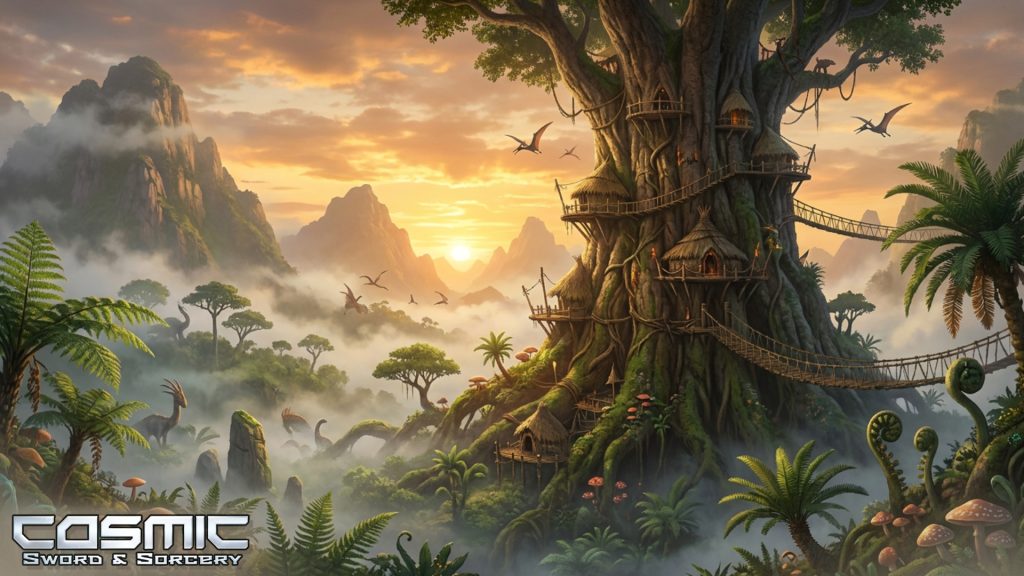
Before the Cataclysm, Ro’Edyne bore almost no resemblance to the colder continental territories that would later emerge from the long planetary collapse. The modern age remembers Ro’Edyne as a realm of pine-choked valleys, cold mountain rain, misted escarpments, and immense northern timberlands stretching across broken terrain shaped by geological violence and climatic instability. Yet the older Ages record an entirely different world. The southern territories of ancient Vandyrus existed beneath far warmer atmospheric conditions, their continental belts wrapped in immense humid jungles, sweeping inland grasslands, drowned mangrove deltas, and subtropical floodplains whose scale dwarfed many later kingdoms entirely.
The environmental conditions of the southern Ages produced ecosystems of extraordinary biological density. Vast herds of towering saurian megafauna migrated across the grasslands beyond the major metropolitan corridors, while predatory species dominated the river systems, marshes, and interior jungles. Diplodocus moved through the southern floodplains in migratory groups large enough to alter entire river courses through repeated passage alone. Stegosaurian species occupied the drier inland plains and elevated fern valleys. Spinosaurids and Baryonyx variants prowled the swamps, estuaries, and deep river channels where the dense vegetation concealed movement even from advanced aerial reconnaissance systems. Much of this megafauna vanished during the planetary instability surrounding the Cataclysm, surviving only within isolated ecological pockets hidden deep beyond the modern frontiers.
The Emerald Divide
The central territories of ancient Ro’Edyne became especially infamous throughout the later imperial periods due to the enormous equatorial jungles occupying the continental interior. These forests stretched for immense distances uninterrupted by civilization, forming layered canopies so dense that even advanced orbital imaging systems frequently failed to penetrate them with consistency. Atmospheric interference, thermal distortion, biological overgrowth, and strange electromagnetic anomalies rendered large portions of the interior effectively unreadable to long-range scanning technologies. Imperial surveys often described the jungles as resistant to observation itself. Mapping expeditions disappeared with enough regularity that the phenomenon became institutionalized within southern administrative planning.
Numerous patrols, scientific ventures, military reconnaissance groups, and exploratory expeditions entered the central jungles across multiple Ages seeking to determine the true extent of the interior territories. Many transmitted partial findings before vanishing entirely. Some recovered recordings described enormous unidentified lifeforms moving beneath the canopy layers, cyclopean ruins reclaimed by vegetation, collapsed transit systems buried beneath roots and mud, and isolated populations living wholly detached from greater imperial authority. Others simply ceased communication without explanation. The southern archives preserve hundreds of fragmented reports concerning the interior regions, though very few offer coherent conclusions.
Even during the height of Ro’Edyne’s technological sophistication, vast portions of the continent remained fundamentally unknown. The southern reaches beyond the major metropolitan zones were dominated not by cities but by unstable ecological regions shaped continuously by water movement. Great grasslands merged into drowned flood marshes and mangrove forests stretching toward the southern coasts where the land itself fractured into chains of unstable islands, tidal wetlands, and shifting mud territories.
These regions proved catastrophically difficult for large-scale naval invasion. Shorelines altered constantly through flooding, erosion, and tectonic instability, while thick mangrove systems rendered conventional landing operations nearly impossible. Foreign strategists throughout the imperial periods often concluded that the southern coasts functioned less as viable invasion corridors and more as natural defensive labyrinths hostile to organized military movement altogether.
The island chains themselves remained sparsely inhabited despite repeated attempts at settlement and development. Violent storms, unstable ground conditions, dense predator populations, and tidal irregularities prevented sustained urbanization across much of the southern archipelagos. Small ceremonial outposts, fisheries, weather stations, and military observation facilities existed intermittently, though many required continual reconstruction simply to remain operational.
Certain older records imply that portions of these southern islands submerged and re-emerged repeatedly across successive Ages, contributing to the widespread Ro’Edyne belief that Vandyrus itself was never geologically stable in the manner of the greater inner imperial worlds. The northern territories of pre-Cataclysmic Ro’Edyne more closely resembled fragments of the landscape recognized today, though even these regions existed in far more primeval forms. Great redwood forests occupied isolated northern mountain belts where colder climates prevailed along the highest elevations.
These forests, immense even by later standards, remained largely confined to northern highlands during the earlier Ages and had not yet spread southward across the continent. The colder climates that would eventually allow the pine forests of the modern era to dominate most of Ro’Edyne had not yet emerged. Instead, the northlands existed as transitional territories where alpine forests, stone highlands, river valleys, and elevated grass plains intersected beneath cooler skies.
Before the rise of the later imperial continuity-states, numerous highland kingdoms occupied these northern regions. Their settlements were often constructed atop cliffs, elevated plateaus, and fortified ridges overlooking the lower plains below. Unlike the immense metropolitan continuities of the southern civic belts, these northern polities developed around defensive isolation, mountain trade, and territorial autonomy. Great grazing beasts migrated seasonally from the southern grasslands into the northern elevations, shaping both the economy and military structures of many early highland cultures. Some of the oldest surviving northern myths speak of enormous horned herd-creatures darkening entire valleys during migratory seasons, accompanied by predators large enough to threaten fortified settlements directly. The climatic transformation that followed the Cataclysm permanently altered these ancient ecological balances. Cooling atmospheric systems, ash dispersal, tectonic upheaval, orbital instability, and long-term environmental collapse reshaped the continent over immense spans of time. The jungles receded. The southern wetlands collapsed or hardened into colder marsh territories. Redwood species expanded far beyond their former isolated northern ranges. Grasslands gave way to colder forests, rocky highlands, and harsher continental weather systems. Entire migratory ecosystems disappeared. River systems changed course. Inland seas receded or flooded. Mountain ranges fractured and rose where fertile valleys once stood.
Bones of the Elder World
By the later post-Cataclysmic eras, only fragments of the old southern world remained visible beneath the transformed landscape. Fossilized remains of gigantic saurian species emerged from canyon walls and frozen escarpments. Buried transit corridors surfaced beneath root systems kilometers from any known ruins. Ancient flood-control structures stood stranded high above dried valleys whose rivers had vanished tens of thousands of years earlier.
The people of later Vandyrus inherited a broken continent haunted constantly by evidence that the world itself had once been fundamentally different. For this reason, many later scholars of Ro’Edyne regarded the Cataclysm not merely as a civilizational collapse but as the death of an entire planetary age. The destruction was not limited to governments, empires, or cities. Whole climates vanished. Entire ecological epochs disappeared alongside the civilizations that once inhabited them.
The ancient warm south of Vandyrus — the jungled Ro’Edyne of the great Ages — survived afterward only in fragmented archive records, ceremonial songs, geological anomalies, and the impossible ruins buried beneath the forests of the modern world.
“Ere upon ages and eras of old, aye, upon these grey steel cliffs, these roving meadows of violet bloom and the scent of the towerpine borders, these waning isles of lore and leisure, these isles of the Ro’Edyne, nearer to the stars than I.”
Chapter 1
Tales of The Antique Ro’Edyne
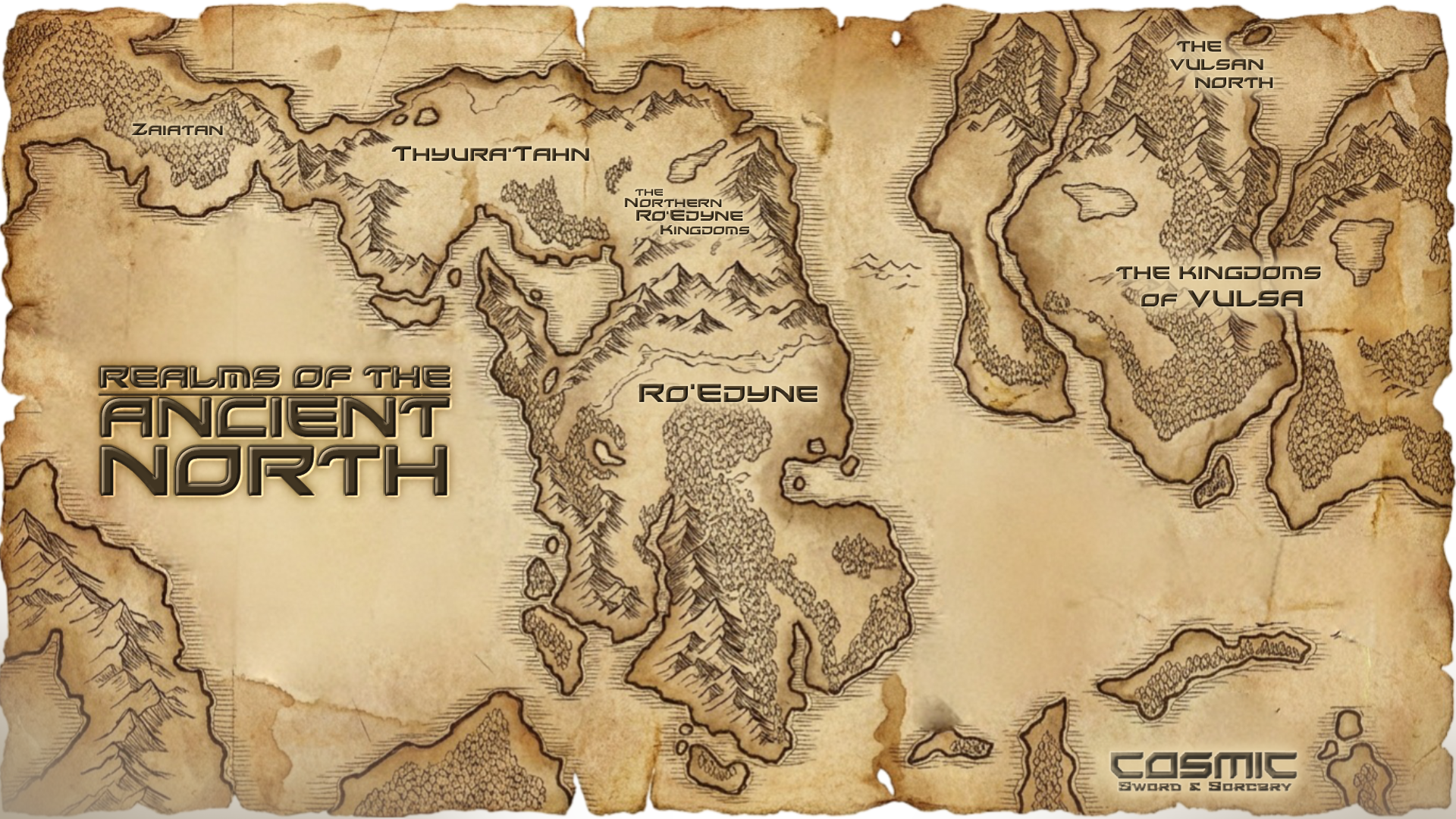
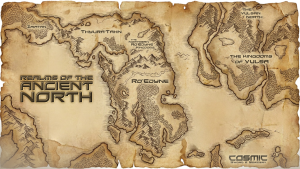
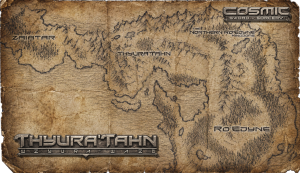
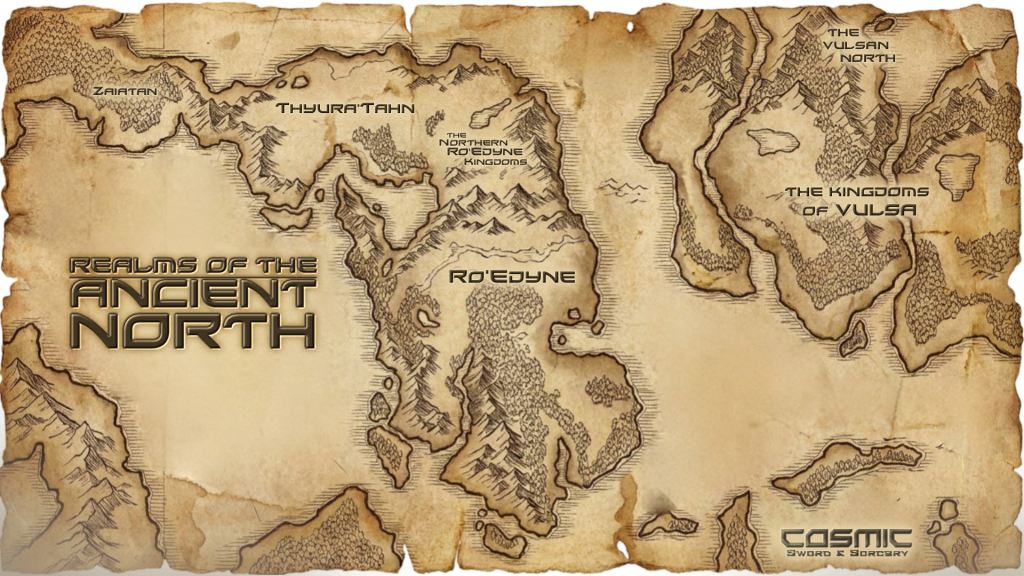
Ro’Edyne stands among the oldest civilized territories of southern Vandyrus, though the true age of its earliest foundations remains disputed even within the higher imperial archives. Long before the modern provincial cultures of Vandyrus emerged from tribal isolation, the southern continental belts of Ro’Edyne had already entered successive ages of hydraulic engineering, monumental construction, and interregional administration. The oldest preserved records of Tykon’Mach, the City of Steel, speak casually of caravan routes crossing territories now claimed by the Vulsan sea, suggesting that the continental arrangement of Vandyrus itself differed considerably during the earliest recognized periods of Ro’Edyne expansion. Unlike the harsher northern territories of Vandyrus, the Ro’Edyne regions developed within warm subtropical climatic belts fed by dense river systems, inland rainfall currents, and stabilized coastal weather patterns.
The Southern Gardens
Great fern valleys, mountain jungles, flooded terraces, acacia groves, and engineered watercourses dominated the southern reaches of the continent. Later foreign visitors frequently compared portions of Ro’Edyne to the old garden-worlds of the inner Vandyrian systems, owing to the unusual integration between civic infrastructure and surrounding ecological systems. Rivers, cliffs, terraces, and monumental architecture were rarely treated as separate domains within Ro’Edyne planning doctrine.
Ro’Edyne maintained uninterrupted alignment with the Greater Vandyrian Empire and its spheres across multiple recognized Ages, becoming one of the principal southern continuity-states upon Vandyrus. Though many lesser planetary cultures viewed the civilization as anomalous or impossibly advanced, such disparity was largely the result of uneven imperial integration across the world itself. While isolated northern and interior territories continued to experience cyclical collapse, localized warfare, and infrastructural decline, Ro’Edyne retained direct access to orbital commerce, interstellar administration, imperial transit networks, and offworld educational systems. Spaceports, aerial transit lanes, holographic civic systems, synthetic administrative intelligences, and orbital trade infrastructure were commonplace throughout the greater metropolitan corridors of the southern territories.
This disparity produced a considerable cultural divide between Ro’Edyne and the surrounding planetary civilizations. Contemporary accounts from outer provincial visitors frequently describe the southern cities as disorienting or unreal, comparing them less to conventional planetary capitals and more to independent imperial worlds transplanted onto the surface of Vandyrus itself. The common imperial citizen of Ro’Edyne possessed greater practical access to interstellar movement than many noble houses beyond the southern territories. Travel between worlds, off-system employment transfer, and imperial civil placement were regarded as ordinary aspects of metropolitan life.
The great cities of Ro’Edyne developed according to continuity principles preserved across immense spans of time. Monumental stepped pyramids, elevated water structures, white alloy civic towers, sacred administrative complexes, and vertically integrated terrace districts became recurring architectural constants throughout nearly every recognized Ro’Edyne Age. Rather than abandoning older forms during periods of technological advancement, the civilization continuously refined and re-integrated ancestral structural geometries into newer civic systems.
By the later imperial periods, spaceports themselves resembled ceremonial temple districts, while orbital administrative towers retained proportions and visual motifs traceable to some of the oldest surviving southern records. At the center of the southern territories stood Tykon’Mach, the City of Steel, oldest among the major Ro’Edyne metropolitan continuities and among the most historically significant urban centers ever established upon Vandyrus. Imperial archive estimates place portions of the city at over four hundred thousand years in age, though deeper geological and structural surveys conducted beneath the lower administrative strata suggest that sections of the region may predate even the earliest recognized Ranar imperial periods.
Ages Preserved
Successive civilizations rebuilt, expanded, and restructured the city repeatedly across the Ages until the distinction between original foundation and later construction became effectively impossible to determine. Ro’Edyne’s longevity profoundly shaped its cultural psychology. Unlike younger imperial worlds driven by expansionary ambition or dynastic competition, the southern territories increasingly viewed civilization itself as an act of preservation against time, erosion, and planetary instability. Historical memory, environmental continuity, cartographic preservation, and ancestral civic maintenance became central pillars of Ro’Edyne administrative culture. The civilization produced some of the most extensive archival systems in the known imperial spheres, preserving territorial, climatic, and demographic records stretching across periods many outer systems considered mythological.
Among the more unusual features of Ro’Edyne culture was the persistence of extremely ancient linguistic and ceremonial structures alongside highly advanced administrative systems. Ancient Vandyrian remained preserved within liturgical, musical, and governmental contexts long after regional dialects evolved into simplified provincial forms. Many of the oldest surviving ceremonial songs of the southern territories continued to be performed in archaic sung dialects whose grammatical structures were already considered ancient during the later imperial periods themselves.
Though formally aligned to the greater imperial structure, Ro’Edyne maintained considerable regional distinctiveness throughout its history. The southern territories developed reputations for philosophical conservatism, monumental civic aesthetics, environmental ceremonialism, and unusually long continuity traditions compared to younger imperial systems. Foreign administrators often remarked that Ro’Edyne behaved less like a frontier world and more like an ancient inner imperial state whose civilization simply happened to exist upon Vandyrus.
Once, long, long ago, back in the days, when people believed, before maps learned to lie, before memory learned to thin, there was a wager made in halls now lost, a boast called out, a promise kept in laughter and in stone.
Sing, sing, spirits of legends old— sing of the giants who walked the black waters, dragging the ships of Ro’Edyne ashore, their laughter shaking the bones of the world, their labor set in the mountain’s heart.
Sing—of hands that cut thunder into stone, of halls raised with ships for rafters, of swords not as threats but as covenants, set deep so the land would remember who built, who bled, and who left.
Sing—of the revel, of the mirth that shook the heights, of the horns that called the giants westward, of promises made not in fear, but in the joy of great work finished. And when the war-whistles sounded, sing how the giants turned, stone-faced and sure, stepping into myth as the mountains bowed low.
Sing—of those who remained: the daughters of Londorai, proud and wild, who lingered when their kin marched to their end, who gave and were given, weaving new blood into Roedon’s ereth, standing beside the folk who remembered, not the deed, but the story.
Sing—of the halls left behind, of the stones set by hands now dust, of ships buried as bones, of swords deep as vows, of the covenant never quite broken— that Ro’Edon would stand back to back with the world should war come again.
Once, long, long ago, back in the days, when people believed, the High Halls were raised, not for the keeping of kings or the counting of years, but to show the world that those who have no history can build their own, and name it true, and sing it so.
Now, as the halls of Vulsa ring with new voices, as banners rise that will not bow, the tale lingers—half jest, half prayer— a promise built on laughter, loss, and the stubborn refusal to let myth die.
So let them say Ro’Edon is a land with no past— the stones remember. The water remembers. And as long as the song is sung, the High Halls stand.
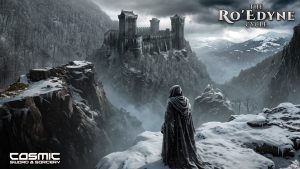
Of the many obscurities which attend the study of the Northern Provinces, there is none more perplexing than the matter of Ardenga and the lands that once lay beneath its authority. The city itself, so far as can now be determined from the surviving records, appears already to have entered a period of gradual decline in the century preceding its destruction. Trade routes altered their courses. Tributary settlements withdrew from its influence. The revenues recorded in such fragments as remain suggest increasing military expenditure accompanied by diminishing agricultural production. Such developments, though unfortunate, are neither remarkable nor uncommon in the annals of antiquity.
Yet here the familiar course of history appears to abandon us. For what befell Ardenga cannot readily be compared to the ordinary dissolution of kingdoms. Cities have fallen before. Provinces have been ravaged. Dynasties have vanished into dust. But in the northern territories there occurred a rupture of continuity so profound that one is tempted to speak not of destruction, but of erasure. The population vanished. The institutions vanished. The dependent settlements vanished. Even the memory of events appears to have become disordered with unusual haste.
We are left instead with contradictory chronicles, abandoned roads leading into wilderness, valleys marked by inexplicable scars, and a body of evidence whose fragments refuse to assemble themselves into any satisfactory whole. The legends speak with confidence. The evidence does not.
I have devoted no small portion of my life to the examination of these matters and can claim little success beyond this singular conclusion: that those who witnessed the end of Ardenga encountered something for which neither their language nor ours possesses adequate expression.
2
Ten millennia have passed since those events, yet the distance has yielded surprisingly little clarity. The disappearance itself appears to have occurred with astonishing rapidity. Entire districts vanish from the historical record within periods measured not in generations but in months. Settlement patterns cease abruptly. Administrative correspondence ends. Commercial accounts terminate. Population estimates collapse with a suddenness which exceeds any ordinary expectation. We possess examples elsewhere of cities ruined by war, by famine, and by pestilence. Ardenga seems, in some obscure manner, to have suffered all three at once, accompanied by phenomena which no accepted historical model adequately explains.
Particularly troubling are the vitrified escarpments situated north of the ancient river basin. Numerous expeditions have documented extensive glassing within exposed stone strata. Early theories attributed these formations to wildfire, but subsequent investigation rendered such explanations untenable. The temperatures required exceed those associated with any known forest conflagration, while the distribution of the affected regions follows no geological pattern presently understood. The damage conforms to no fault line. It corresponds to no volcanic activity.
It bears no resemblance to known impact formations. Instead, the scars appear concentrated around former population centres, military roads, and regions associated with the final years of Ardengan authority. Students are often eager to invoke the so-called Dark and Arcane Wars of late antiquity, a cycle of legends preserved in scattered northern traditions. Such stories are undeniably colourful. They are also unsupported. Unfortunately, so is every competing explanation.
Here we encounter the familiar difficulty which afflicts all inquiry into the Late Provincial Era. The Great Collapse deprived posterity not merely of records but of context. Archives perished. Languages drifted beyond recognition. Entire peoples vanished without descendants. Each generation recovers another fragment and mistakes it for a complete picture, only to discover that the new evidence has merely enlarged the boundaries of ignorance.
“I confess that age has not diminished my impatience with this circumstance. One cannot spend thirty years among ruined roads and broken foundations without developing a certain resentment toward antiquity.“
3
Particularly vexing are the military accounts. Several independent sources, originating from regions which possessed neither common allegiance nor common culture, describe armies increasing in number after engagements rather than diminishing. Such reports occur in Vulsan chronicles, surviving Zhurian maritime records, and fragmentary caravan narratives recovered from the northern passes. Historians have generally dismissed these accounts as literary embellishment, and under ordinary circumstances I would be inclined to agree. The difficulty lies not in their extravagance, but in their consistency.
The dates vary. The names vary. The numbers vary. The descriptions do not. The prevailing interpretation attributes these reports to panic, confusion, and the well-documented tendency of exhausted survivors to reconstruct events according to mythic expectations. Such an explanation remains satisfactory in most instances. Yet when the Ardengan material is considered as a whole, confidence begins to falter.
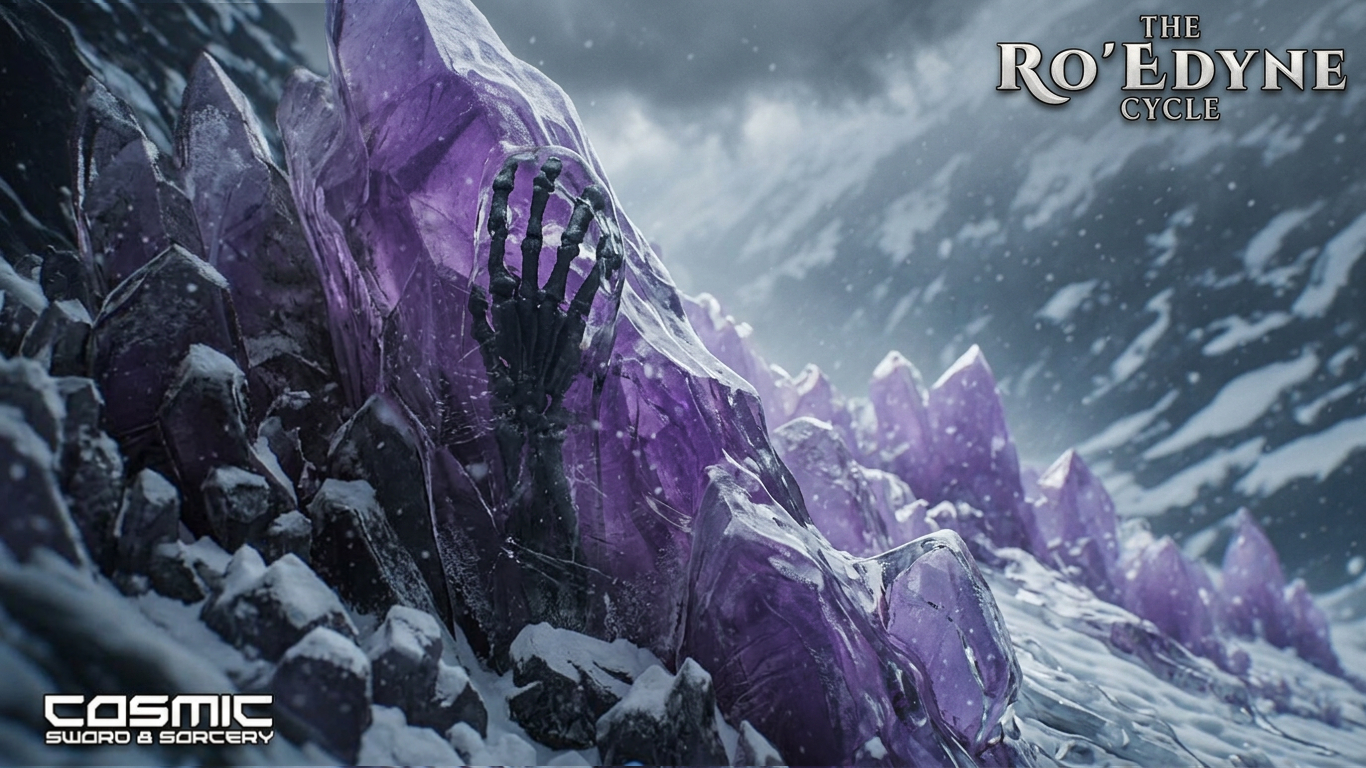
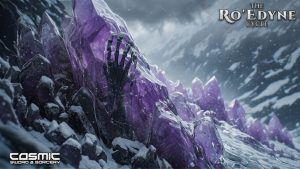
Nor are the vitrified escarpments the only anomaly associated with the region. In several deep folds of the northern valleys, particularly where erosion has exposed older strata, excavations have revealed deposits of peculiar amethyst-coloured glass intermixed with ash layers of uncertain origin. Unlike the larger formations previously described, these deposits appear irregular, often occurring in sheltered depressions and beneath collapsed forest beds where no known geological process would be expected to concentrate such material. More disturbing are the remains found within and around these layers.
Archaeological surveys have documented extensive distributions of skeletal fragments, frequently reduced to little more than dust-stained impressions, isolated teeth, fragments of skulls, and partial bone clusters whose original arrangement can only be inferred. In many locations the positioning suggests neither formal burial nor battlefield internment. Bodies appear to have fallen where they stood, leaving only the faintest traces of their passing. When settlement eventually returned to the region, giving rise to the lesser Province of Dengan—a polity respectable in its own right, though never approaching the scale or sophistication of its predecessor—the new inhabitants inherited a landscape already ancient in its ruin.
Village foundations repeatedly emerged atop older deposits, and throughout the centuries labourers, foresters, and builders reported uncovering strange concentrations of bones beneath the soil. Such discoveries naturally encouraged the development of local superstition. The primitive mind has often regarded these deposits as evidence of cursed or unholy ground, and one may forgive such conclusions given the circumstances. Yet what continues to command scholarly attention is not the folklore itself but the remarkable consistency of the underlying evidence.
Across hundreds of kilometres of forest, mountain hollow, and river valley, the pattern repeats with unsettling regularity. The deposits differ in scale, yet not in character. The remains differ in number, yet not in condition. Whatever occurred in those final years left marks upon the landscape so widespread and so uniform that even ten thousand years of weather, growth, collapse, and resettlement have failed to erase them entirely.
One encounters, again and again, the same sensation familiar to all students of the deep past: the uncomfortable suspicion that the witnesses themselves may have understood less of what they were observing than we would like to believe, and that the truths concealed beneath their accounts are stranger than either their legends or our theories permit. It is perhaps for this reason that the ruin of Ardenga continues to command such fascination. Not because we lack explanations, but because every explanation leaves behind a residue of evidence which refuses to be explained.
“The sea now covers Roedon, as it covers much of the world from which Dengan emerged. The Southern Isles are no more. The roads have vanished. The valleys have vanished. Even the escarpments whose strange scars perplexed earlier generations have long since passed beneath the waves. It may well be that the answers sought by so many historians passed beneath them also.“
Back in the days of Vandyrian Steel and Coveted Banded Lotus Spice imported from the furthest Moons of Kydahn…
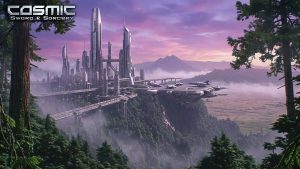
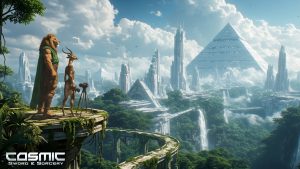
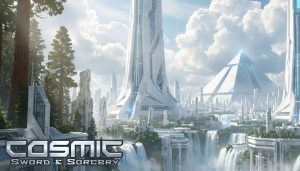
In the vast central regions in the Realms of Ro’Edyne the land descended in colossal green shelves drowned beneath mist, cataracts, and the eternal roar of falling water. Great white rivers thundered endlessly through vine-choked ravines older than empires while heat rolled upward from the jungle floor in silver veils thick enough to swallow entire caravans from sight. Vast reptilian cries echoed somewhere far below the hanging bridges and cliffside trade roads, answered now and again by the distant horn-calls of freight skiffs threading cautiously through the fog. Here and there amongst the greenery ancient stonework still protruded from the wilderness — collapsed arches, half-swallowed statuary, broken causeways from dynasties whose names no longer survived outside archival engines and priestly disputes. Yet even amidst all this savage immensity the eye was always dragged upward eventually, toward the impossible white geometries rising beyond the jungle horizon….
For there…stood
Tykon’Mach.
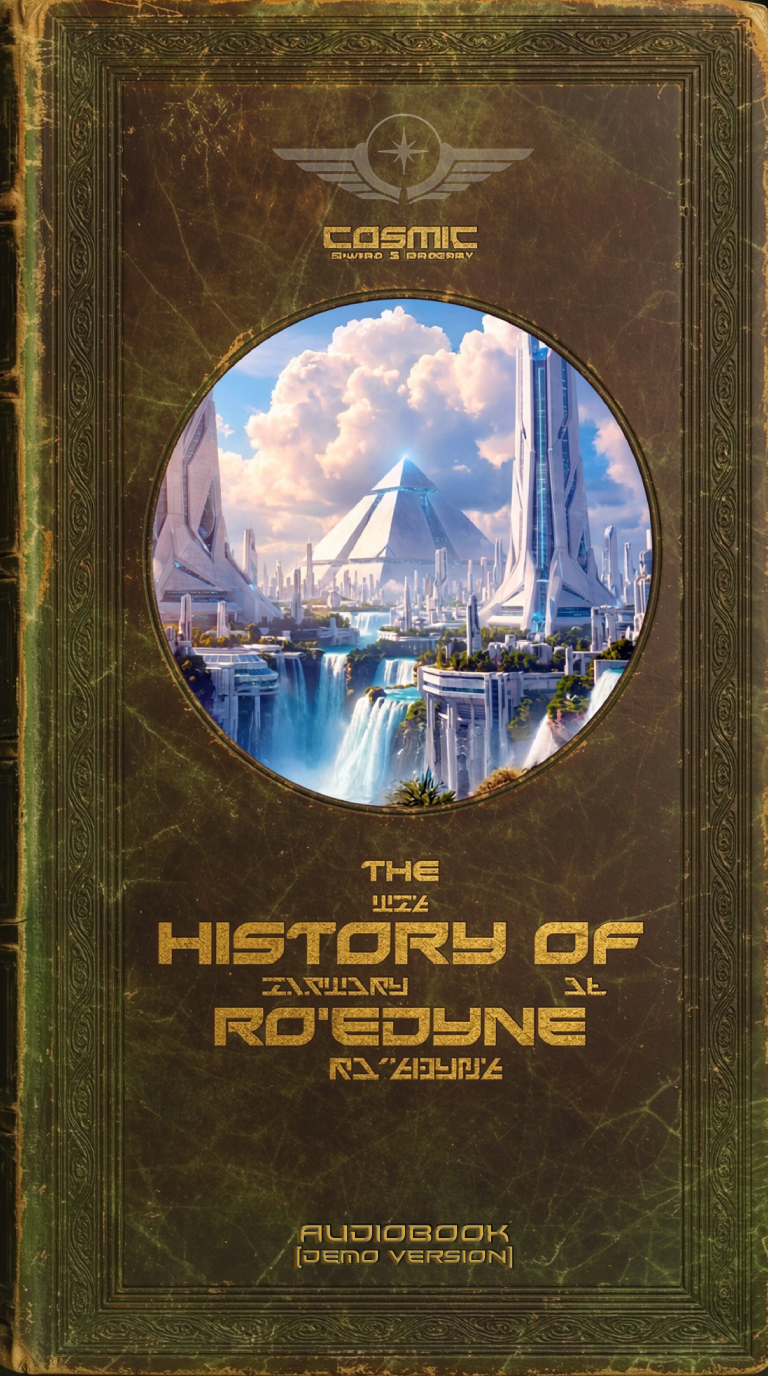
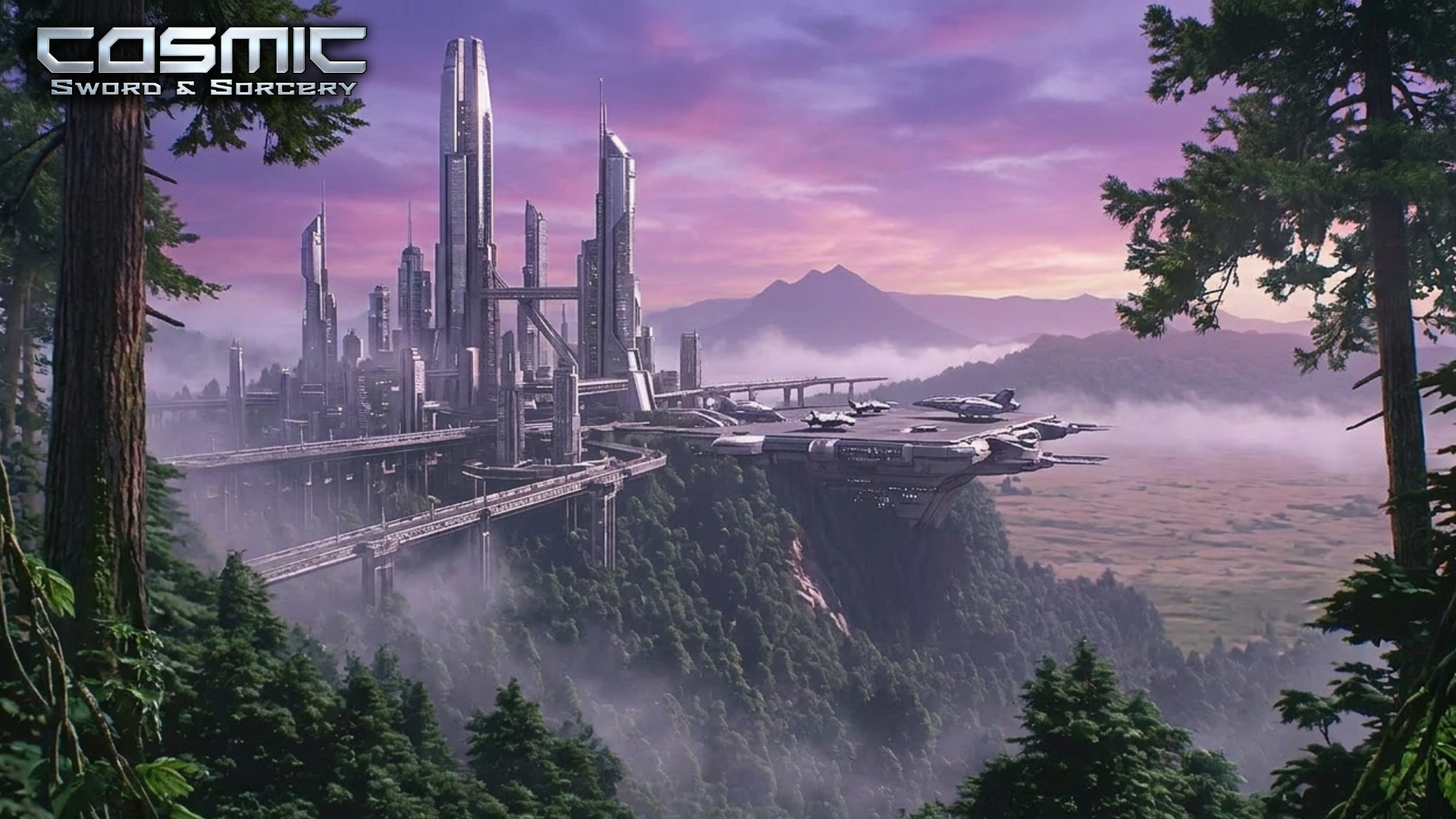
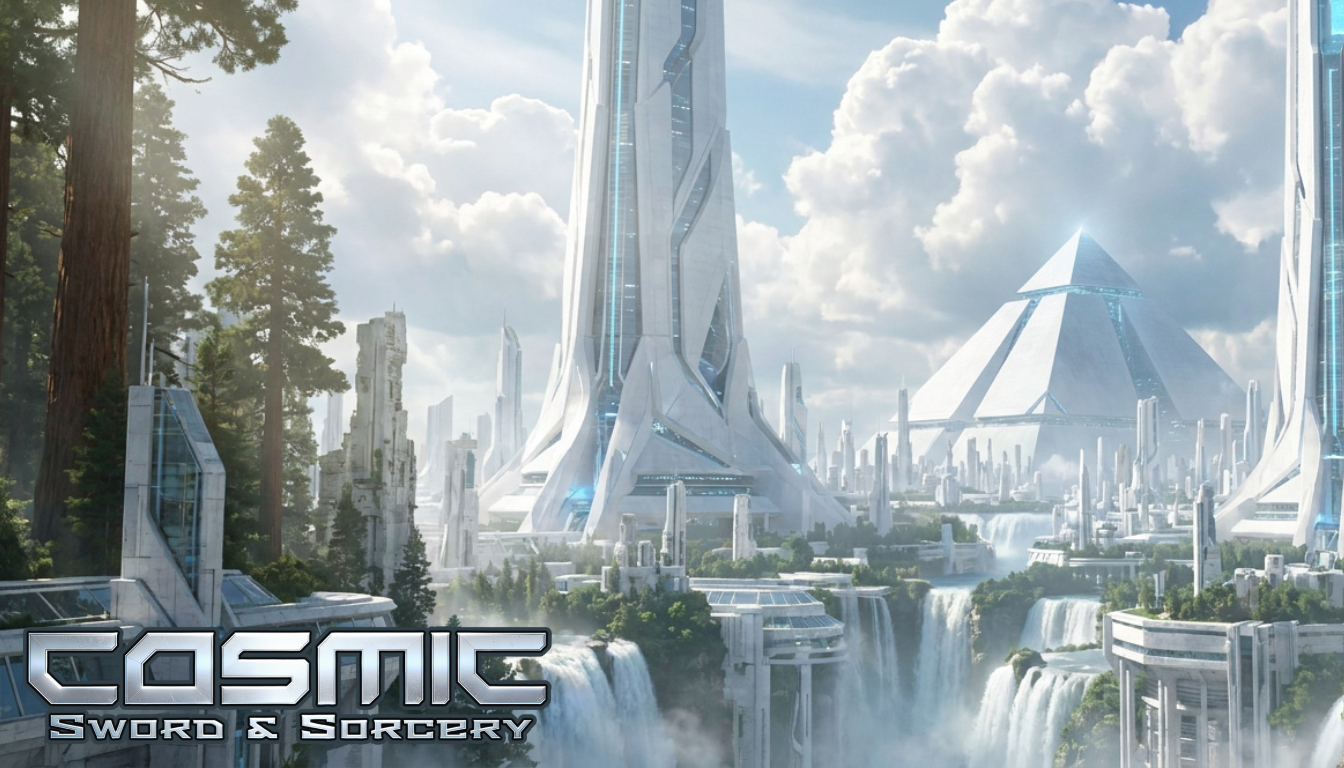
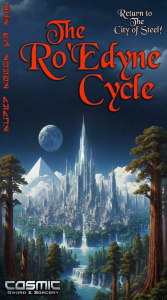
Not merely a city, but a continent of vertical civilization whose vast steel-and-crystal structures climbed into the heavens like the polished bones of dead gods. The twin pyramids dominated all things, their impossible mirrored faces reflecting cloudbanks, sunlight, waterfalls, and moving freight-lanes across hundreds of colossal terraces alive with constant movement. Around them rose forests of alabaster towers, elevated transit bridges, suspended ports, cargo lifts, docking spires, habitation arcs, administrative monoliths, and immense anti-grav causeways carrying uninterrupted streams of skiffs through the humid air. Water itself had been conquered here. Entire cataracts plunged directly through the lower city tiers and vanished into engineered canals beneath the foundations while hanging gardens and dense green districts sprawled between sectors of blinding industrial refinement.
Skeer and his father — a fat and prosperous boar merchant of arms and sanctioned ordnance — rode, slow and heavy through the lower canal roads of Tykon’Mach aboard a broad commerce-skiff burdened beneath stacked crates of rifles, slug-throwers, sealed powder tins, and sigiled ammunition drums stamped lawful beneath Imperial charter. Ahead of them rose the Capital Complex itself: one of the twin steel-and-crystal pyramids of the great city, colossal beyond sane proportion, its mirrored faces vanishing into haze and industrial vapor high above the suspended freight lanes. Across its immense terraces crawled caravans, skiffs, cargo-haulers, labor transit, elevated liftways, and streams of lesser merchants forever feeding the hungry machinery of the Pyramid State. Skeer himself was some breed of hound, though plainly not the old boar’s true son — one of those strange arrangements the merchant occasionally alluded to over roast bird and potatoes after too much drink and too many cigars. The boy had ceased asking years ago. In Tykon’Mach, lineage often mattered less than usefulness.
As the skiff neared the outer gate works, layered scanning lattices passed over them in pale bands of blue light. Sigils shimmered briefly across the cargo manifests before vanishing into the Pyramid registry systems while hanging slate-screens and hovering trade displays already carried the morning reports from the upper districts.
They were not first to arrive. Entire consignments had sold clean before dawn and vanished into the inner terraces while fresh caravans regrouped below beneath awnings of steel and canvas. Trade within Tykon’Mach never truly ceased. It merely changed elevation. Curiously absent amidst all of it was the operation of Hule Sanpho. That alone drew the old boar’s attention. As much as Skeer despised the ancient rat and his black-and-violet merchant concern, Hule’s clientele usually infested the lower trade districts by first light. Wherever firearms, transit rights, salvaged machinery, or suspect charter permits changed paws, Hule Sanpho was generally somewhere nearby grinning through cigar smoke. Yet today there was nothing.
The skiff drifted onward through the gate amidst congestion thick enough to stall smaller craft outright. Father and son exchanged an amused glance as they passed a cluster of outer-world gazelles displaying scoped and sight-locking crossbows to packs of local riffraff inspecting the weapons as though they were relics from forgotten dynasties. “Idiots,” muttered the boar through pipe smoke before pointing upward toward the canal lane ahead.
Towering over the traffic lumbered a vast Apatosaur draped in red and royal blue trade cloths, its immense spinal membranes fluttering lazily in the furnace-winds pouring down from the upper freight tiers. Thick catfish-like jowls swayed beneath its skull while caravan goats lounged atop the creature’s cargo platform smoking sloke and blowing grey rings downward toward a swarm of obnoxious monkeys screeching curses from the bridge railings below. “Look at the little bastards,” wheezed the merchant. The monkeys shrieked louder as the caravan passed beneath them.
The Yanatarian firearms drew attention almost immediately, as they always did. Half the crowd gathered for the weapons themselves while the other half stared openly at the topless silver-painted jackal female emblazoned across the lacquered crate panels, her glowing blue eyes and ceremonial gold markings promising death, luxury, and frontier prestige in equal measure. The old boar sniffed the air once. Then again. Skeer noticed the change immediately. “Not everyone is here,” muttered the merchant. “Hule?” asked the boy. The old boar shook his head slowly while reloading his pipe. “No. Thought perhaps it was him. Seems the rat’s become more discerning lately.” “Core-world business?” “He can keep it.” The boar shrugged dismissively though his tusks ground faintly at the mention of Hule’s increasingly stable trade access beyond the frontier sectors. “The prick.”
Then both of them caught the scent at once. Grilled gold-fruit. Without another word the skiff veered eastward through traffic toward the larvivore stalls, though by the time they reached them half the district and all its distant relations appeared already lined before the counters. Skeer settled instead for red lizard-on-a-stick while glaring murderously at the remaining queue.
it shrieked again while swooping downward and stealing half his meal. “What in all blazes does that even mean?” snarled Skeer. “No clue,” chuckled the old boar. “Some jackass trains the damn things to say it and hopes for profit.” He handed the boy another unlucky lizard-leg from his own portion.
Then the horns began. Not alarms. Arrival horns. Deep. Metallic. Monstrous. The entire district convulsed instantly. Somewhere above the lower freight clouds an Imperial freighter was descending toward the upper terraces seeking contracts, unloading rights, bulk exchange agreements, and enough commercial gravity to drain half the markets dry before sundown.
The streets exploded into chaos. Merchants screamed figures over one another while labor crews broke formation and caravan bells rang wildly through the smoke-thick air. Two camel brothers immediately descended into a fistfight beside a spice lift while three dock-runners vaulted directly into a canal trying to beat traffic toward the ascending cargo ramps. Everywhere curses erupted in twenty dialects at once. The old boar merely elevated the skiff slightly above the congestion and laughed through a cloud of smoke. Skeer looked over. The merchant grinned broadly. “Change of plans, boy-o.” The boy blinked. “Get the slug-shots. We’re going three layers up.”
Then it struck him. The idea. His idea. Last season they had discussed it quietly while drinking behind the Yaruma warehouses, wondering whether anyone else had realized the weakness in the local testing circuits. Nobody within Tykon’Mach was importing proper frontier slug-throwers from Barimus or Nawan. Nobody except them. Old Uncle Algus had secured favorable dealings with Vanios the smith and the route had remained quiet ever since. Somehow nobody else had noticed. “Doing the local guild proud,” Skeer grinned. The old boar barked laughter. Officially there was no guild. Only ledgers, rogues, smugglers, quarter-agreements, grudges, and favors written in disappearing ink.
The hanging screens all along the liftways flashed reports from some blasted Kydahni station called Pentyr. Riots. Losses. Gunfire. Labor dead. “A prison colony with an operator’s license,” grumbled the boar. “Dreadful place. Avoid it.” Skeer had reviewed the station files once through public codex access after hearing one of his father’s drunken tirades regarding the sector. The images alone had been enough: black corridors, industrial haze, fortress gantries vanishing into darkness. A miserable place by every account. His father tolerated uglier corners of civilization than Skeer yet cared to imagine.
By the unloading levels two Tyvexian laborers awaited them already. White-furred jackal lads wearing teal mesh tunics beneath matching visor hardware moved with clipped professional efficiency while organizing the crates into clean stacked rows beside the government inspection lifts.
One gave a thumbs-up as the final cargo lock disengaged before speaking rapidly in his native tongue. “’id ha aht jyt ’iya ’ae shay yeen…” Only then realizing his translator headset remained inactive, the jackal laughed awkwardly and adjusted the device. The Tyvexians knew scarcely a word of Imperial Tongue unaided though the headsets usually compensated well enough. “Apologies,” he said afterward. “If needed further, our signal remains active. My brother and I prepare now for transit negotiation.” “Aye, boy-o. Good luck,” replied the boar with a wave. “Chances are they won’t return,” he muttered afterward to Skeer. “Fine by me. Means fewer percentages.”
Above them entire divisions of imports descended from Thanator and distant Jotun alike, each shipment escorted beneath different heraldic codes and industrial seals. Jotun’s cargoes especially drew attention: dense machinery, ammunition caskets, strange alchemical cylinders, and polished steel assemblies smelling of furnace oil and black powder. Skeer’s father narrowed his eyes immediately. Now he understood. Chewing slowly upon a dark Ramwaza leaf-cigar from the southern reaches, the old boar counted silver while glaring across the platform toward a group of monitor lizards being escorted from an adjacent loading terrace beneath armed supervision. “Idiots,” he spat.
Profiteering beneath Imperial oversight was dangerous enough already. Doing so publicly while Pentyr still burned was outright lunacy. The Kydahni possessed ugly reputations at the best of times — cold, humorless, vindictive creatures liable to remember insults three generations after the speaker’s funeral. Best not to shout too loudly about Pentyr while losses were still being counted. “Lizards,” growled the merchant again while pocketing another five Imperial sands of silver. Still. Good profit.
Once the Jotun imports became visible the remainder fell neatly into place. “Barbarians,” the boar muttered approvingly. “Sturdy folk.” Skeer smirked. “Thought most of Vandyrus was barbarian according to you.” “It is. Jotun’s simply sober about it.” “Isn’t their neighboring moon the High Throne world?” “Exactly!”
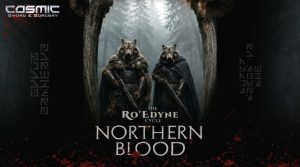
Not long afterward a tall wolf with cropped black mane and heavy beard delivered the official primer regarding the new Jotunese rounds — strange ammunition, hybridized craft-science, alchemical metallurgy fused with frontier practicality. His father watched for perhaps five minutes before moving. Approaching a distracted quartermaster agent, the boar casually requested verification on unloading placement charts. The overworked official handed him the slate without thought. “Right back,” muttered the merchant before crossing directly toward the Jotun unloading sector. The guards saw the black slate and waved him through unquestioned. There was conversation. Nods exchanged. Skeer waited. His father glanced back once and winked though the boy still did not entirely understand. Moments later the boar returned and handed the slate back to the quartermaster with perfect calm.
The official nodded absentmindedly and resumed listings without suspicion. Then the old merchant grinned broadly. “Can you believe nobody else noticed?”
Far below them upon the immense inner terraces of the Pyramid, merchants from Arkamar, Janvere, Tolpus, and Wan Warril still screamed accusations toward the Imperial testing boards while shaking fists over firearm imports. The old boar mocked them mercilessly in exaggerated Pranjan tones.
“‘OW DAAAAARE DEZE IMPERIAALS SELL GUNS IN DERE OWN REALMS! IIIREDEEMABAAAAAL!”
Skeer burst laughing. “They’re going red-faced all day.”
“Ready?” asked the boar. “For what?” “Here’s the rub, boy-o. Went over to the Jotun tag-cutter. Told him we had local guild testing selection ready for administrative review. Took longer getting here than expected, but now we’re available.”
Then Skeer understood completely. “You genius.” “Gods damn right.”
The testing demonstration annihilated the market. Every firearm sold. Every slug-round crate emptied. The Jotunese themselves elevated the entire operation onto the main demonstration dais beneath the Imperial seal, showcasing the frontier throwers beside their own imported ammunition systems as officially approved local commercial compatibility examples. Not only had the stock vanished clean, no percentages were owed to the core-world trade offices. Local business. Entirely legal. From a distance the city resembled less a constructed place than some vast celestial mechanism partially overtaken by jungle growth and still expanding despite the protests of nature itself. By dusk the lighter skiff drifted once more along the upper canal roads toward Yaruma where they intended to restock and repeat the operation again the following week. Crossing the bridgeways into the garden districts, they passed the same furious merchant factions still screaming conspiracy and corruption toward the Pyramid terraces far behind them.
And from this; Father and son laughed all the way home.