


1
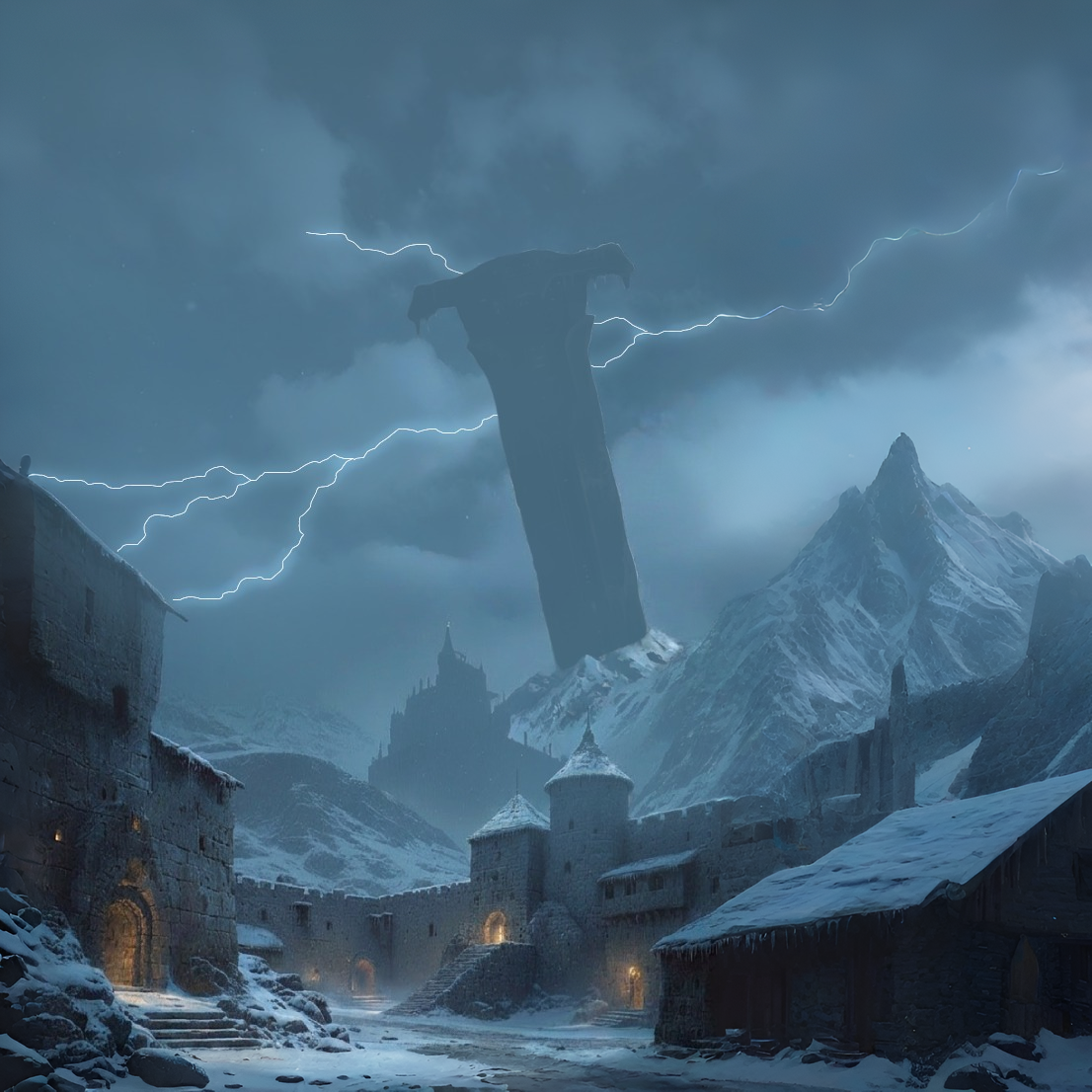
Of the many obscurities which attend the study of the Northern Provinces, there is none more perplexing than the matter of Ardenga and the lands that once lay beneath its authority. The city itself, so far as can now be determined from the surviving records, appears already to have entered a period of gradual decline in the century preceding its destruction. Trade routes altered their courses. Tributary settlements withdrew from its influence. The revenues recorded in such fragments as remain suggest increasing military expenditure accompanied by diminishing agricultural production. Such developments, though unfortunate, are neither remarkable nor uncommon in the annals of antiquity.
Yet here the familiar course of history appears to abandon us. For what befell Ardenga cannot readily be compared to the ordinary dissolution of kingdoms. Cities have fallen before. Provinces have been ravaged. Dynasties have vanished into dust. But in the northern territories there occurred a rupture of continuity so profound that one is tempted to speak not of destruction, but of erasure. The population vanished. The institutions vanished. The dependent settlements vanished. Even the memory of events appears to have become disordered with unusual haste.
We are left instead with contradictory chronicles, abandoned roads leading into wilderness, valleys marked by inexplicable scars, and a body of evidence whose fragments refuse to assemble themselves into any satisfactory whole. The legends speak with confidence. The evidence does not.
I have devoted no small portion of my life to the examination of these matters and can claim little success beyond this singular conclusion: that those who witnessed the end of Ardenga encountered something for which neither their language nor ours possesses adequate expression.
2
Ten millennia have passed since those events, yet the distance has yielded surprisingly little clarity. The disappearance itself appears to have occurred with astonishing rapidity. Entire districts vanish from the historical record within periods measured not in generations but in months. Settlement patterns cease abruptly. Administrative correspondence ends. Commercial accounts terminate. Population estimates collapse with a suddenness which exceeds any ordinary expectation. We possess examples elsewhere of cities ruined by war, by famine, and by pestilence. Ardenga seems, in some obscure manner, to have suffered all three at once, accompanied by phenomena which no accepted historical model adequately explains.
Particularly troubling are the vitrified escarpments situated north of the ancient river basin. Numerous expeditions have documented extensive glassing within exposed stone strata. Early theories attributed these formations to wildfire, but subsequent investigation rendered such explanations untenable. The temperatures required exceed those associated with any known forest conflagration, while the distribution of the affected regions follows no geological pattern presently understood. The damage conforms to no fault line. It corresponds to no volcanic activity.
It bears no resemblance to known impact formations. Instead, the scars appear concentrated around former population centres, military roads, and regions associated with the final years of Ardengan authority. Students are often eager to invoke the so-called Dark and Arcane Wars of late antiquity, a cycle of legends preserved in scattered northern traditions. Such stories are undeniably colourful. They are also unsupported. Unfortunately, so is every competing explanation.
Here we encounter the familiar difficulty which afflicts all inquiry into the Late Provincial Era. The Great Collapse deprived posterity not merely of records but of context. Archives perished. Languages drifted beyond recognition. Entire peoples vanished without descendants. Each generation recovers another fragment and mistakes it for a complete picture, only to discover that the new evidence has merely enlarged the boundaries of ignorance.
“I confess that age has not diminished my impatience with this circumstance.
One cannot spend thirty years among ruined roads and broken foundations
without developing a certain resentment toward antiquity.“
3
Particularly vexing are the military accounts. Several independent sources, originating from regions which possessed neither common allegiance nor common culture, describe armies increasing in number after engagements rather than diminishing. Such reports occur in Vulsan chronicles, surviving Zhurian maritime records, and fragmentary caravan narratives recovered from the northern passes. Historians have generally dismissed these accounts as literary embellishment, and under ordinary circumstances I would be inclined to agree. The difficulty lies not in their extravagance, but in their consistency.
The dates vary. The names vary. The numbers vary. The descriptions do not. The prevailing interpretation attributes these reports to panic, confusion, and the well-documented tendency of exhausted survivors to reconstruct events according to mythic expectations. Such an explanation remains satisfactory in most instances. Yet when the Ardengan material is considered as a whole, confidence begins to falter.
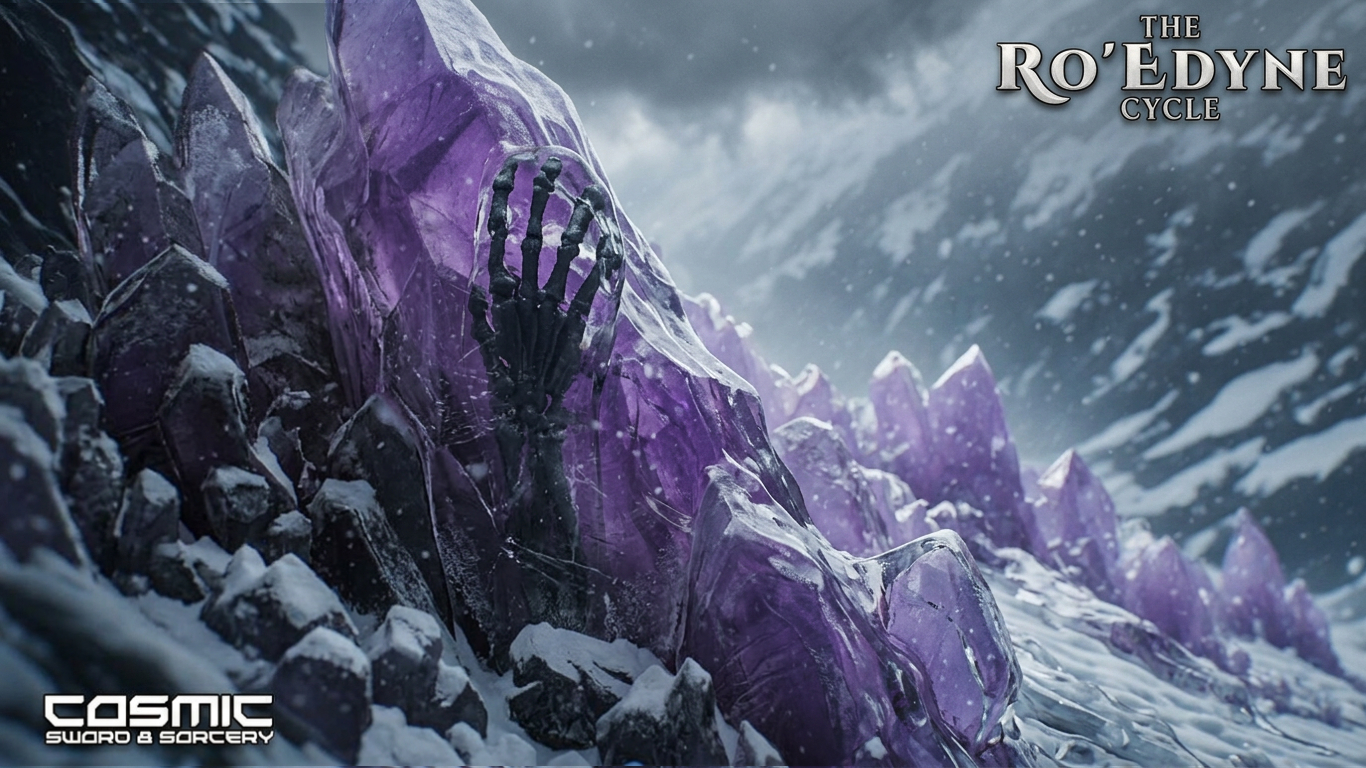
Nor are the vitrified escarpments the only anomaly associated with the region. In several deep folds of the northern valleys, particularly where erosion has exposed older strata, excavations have revealed deposits of peculiar amethyst-coloured glass intermixed with ash layers of uncertain origin. Unlike the larger formations previously described, these deposits appear irregular, often occurring in sheltered depressions and beneath collapsed forest beds where no known geological process would be expected to concentrate such material. More disturbing are the remains found within and around these layers.
Archaeological surveys have documented extensive distributions of skeletal fragments, frequently reduced to little more than dust-stained impressions, isolated teeth, fragments of skulls, and partial bone clusters whose original arrangement can only be inferred. In many locations the positioning suggests neither formal burial nor battlefield internment. Bodies appear to have fallen where they stood, leaving only the faintest traces of their passing.
When settlement eventually returned to the region, giving rise to the lesser Province of Dengan—a polity respectable in its own right, though never approaching the scale or sophistication of its predecessor—the new inhabitants inherited a landscape already ancient in its ruin.
Village foundations repeatedly emerged atop older deposits, and throughout the centuries labourers, foresters, and builders reported uncovering strange concentrations of bones beneath the soil. Such discoveries naturally encouraged the development of local superstition. The primitive mind has often regarded these deposits as evidence of cursed or unholy ground, and one may forgive such conclusions given the circumstances. Yet what continues to command scholarly attention is not the folklore itself but the remarkable consistency of the underlying evidence.
Across hundreds of kilometres of forest, mountain hollow, and river valley, the pattern repeats with unsettling regularity. The deposits differ in scale, yet not in character. The remains differ in number, yet not in condition. Whatever occurred in those final years left marks upon the landscape so widespread and so uniform that even ten thousand years of weather, growth, collapse, and resettlement have failed to erase them entirely.
One encounters, again and again, the same sensation familiar to all students of the deep past: the uncomfortable suspicion that the witnesses themselves may have understood less of what they were observing than we would like to believe, and that the truths concealed beneath their accounts are stranger than either their legends or our theories permit. It is perhaps for this reason that the ruin of Ardenga continues to command such fascination. Not because we lack explanations, but because every explanation leaves behind a residue of evidence which refuses to be explained.
“The sea now covers Roedon, as it covers much of the world from which Dengan emerged.
The Southern Isles are no more. The roads have vanished. The valleys have vanished. Even the escarpments whose strange scars perplexed earlier generations have long since passed beneath the waves. It may well be that the answers sought by so many historians passed beneath them also.“