The cabin was quiet, save for the low, steady hum of the skiff’s machinery and the occasional soft rattle of something that had not been properly secured in its compartment.
Beyond the windows, the distant lights of Tykon’Mach glimmered against the darkness, the great City of Steel still going about its business long after respectable folk had retired for the evening.
Roland sat comfortably at his little writing desk, cigar clenched between his tusks, a glass of something dark and pleasantly expensive resting beside a sheet of stationery. His jacket hung over the back of a nearby chair and the day’s accounts had already been put away. Across the cabin, Skeer slept soundly in his cot, one long ear hanging over the side and his blanket gathered about him in a most untidy fashion. The old boar regarded him for a moment, smiled around his cigar, and returned his attention to the letter he had been composing. He scratched his chin, considered the page, and began to write.
My Dear Antoine,
Well, old boy, if this letter finds you in good health, good spirits, and still in possession of all your worldly goods, I shall consider that a fine beginning. Particularly the last of those three, eh? Ha! I trust the southern weather hasn’t baked your whiskers off, nor has business been so dreadful that you’ve taken to selling the furniture. Though knowing you, I expect you’d make a handsome profit on the furniture before anybody realized it was theirs to begin with.
Roland chuckled to himself, took a long draw upon his cigar, and continued.
Things here in Yaruma have been rather agreeable, all considered. Business has been good, the markets have been lively, and we’ve managed to turn a respectable bit of silver without having to shoot anybody particularly important. That’s always a comfort, I find. The little bastard has been keeping the accounts, and I must say he’s getting rather good at it. Too bloody good, if you ask me.
Caught me out on a freight calculation the other morning, and then had the cheek to explain where I’d gone wrong. Imagine that! Twelve years old and already telling his father how to conduct business. I told him another performance like that and I’d put him in charge of the whole enterprise, whereupon he asked whether that meant he’d be entitled to a larger share of the profits. Ha! There’s gratitude for you.
He paused to look across the cabin again. Skeer shifted beneath his blanket, gave a sleepy little snort, and settled back into his pillow.
Mind you, I shouldn’t complain.He’s a good lad, Antoine.A damned good lad. Knows his figures, keeps his head when things get troublesome, and has a nose for a dishonest bargain that would put half the merchants in this city to shame. Still can’t keep hold of his supper if there’s something interesting happening on the other side of the street, but I suppose we must allow him a few shortcomings.
He’s been asking about the Northern caravans, incidentally. Wants to know how long the journey takes, whether the roads are dangerous, what sort of folk we’ll be meeting, and whether there’ll be any decent places to eat. That last question is becoming something of a recurring concern with him. Growing boy, you understand.
Eats like a bloody furnace.
You ought to see him now, by the way. I daresay you’ll scarcely recognize the little rascal after all these years. He’s shot up considerably since you last saw him, and acquired a few opinions of his own into the bargain. Quite a few, actually, and he’s seldom shy about sharing them. I expect he’ll remember you well enough once he’s had a moment to put the face to the name, though I wouldn’t be surprised if he asks whether you’ve brought him anything. He’s developed a remarkable interest in presents, particularly those that can be eaten or sold.
Roland grinned, shook his head, and reached for his glass.
Anyway, the long haul is nearly at an end, thank the stars, and I’ll be damned glad to see the last of it. There’s only so much time a fellow can spend arguing with freight clerks, inspecting cargo manifests, and explaining to otherwise intelligent creatures why a crate of ammunition ought not to be stored beside a heating conduit.
We’ve a few matters left to settle here, but nothing that should interfere with our departure. If all goes as expected, we’ll be heading south at the beginning of caravan season. I’ll send word once the arrangements are properly settled, and you can put the kettle on, dust off the good glasses, and prepare yourself for the arrival of your favorite younger brother.
…And before you say anything, yes, I know I’m your only younger brother. Don’t spoil the sentiment, you miserable old bastard
He laughed quietly at that, evidently quite pleased with himself, and tapped a little ash into the tray beside his elbow.
Speaking of which, I must thank you again for allowing us the use of Father’s vault. I know perfectly well you don’t care for having other folk’s merchandise cluttering up the place, especially when it comes in heavy crates and requires a good deal of shifting about. Still, it’s a damned sight more reassuring knowing the DrakeShot is sitting somewhere safe until we can collect it.
The magistrate’s people can have their own arrangements, and the Temple fellows can keep whatever peculiar treasures they’re trying to sell this season. All I ask is that our ammunition remains exactly where it belongs, preferably without some enterprising little thief deciding to improve his circumstances at our expense.
Roland stopped writing, puffed thoughtfully upon his cigar, and regarded the curling smoke.
Funny thing, that vault. I was thinking about it the other evening, and for the life of me I couldn’t remember when Father had the damned thing installed. Must have been before my time, surely. I can remember the shop well enough, of course, and that enormous mirror behind the counter, but I don’t recall anybody putting it there.
You always insisted you remembered the business, though I suspect that’s because you’ve been old since the day you were born. Ha! Still, Father certainly knew what he was doing. Whatever else one might say about the old boy, he understood the importance of keeping one’s valuables out of reach of the wrong sort of company.
And there’s a lesson in that, Antoine, one I’ve been trying to impress upon Skeer whenever the opportunity presents itself. Any fool can put something valuable behind a locked door. Give a fellow enough time, enough tools, and a sufficient interest in what’s on the other side, and sooner or later he’ll find a way through it. A bigger lock only tells him there’s something worth stealing. A thicker door tells him the same thing, only louder.
And a great iron strongbox sitting in the middle of a room might as well have a sign hanging over it announcing that the owner has something he doesn’t want anybody else to see. No, no, the clever fellow does things differently. He understands that folk are inclined to see precisely what they expect to see, and precious little besides.
Roland smiled around his cigar.
Father was rather good at that sort of thing, wasn’t he? Bloody infuriating when you were on the receiving end of it, mind you. I remember him telling me once that a merchant ought never to show a customer everything he has, and ought never to let a thief know how much he’s lost. I didn’t understand half of what he was talking about at the time, though I nodded along like a sensible little fellow.
You probably understood it immediately, being the insufferably clever little sod you always were.
But the older I get, the more I appreciate what he meant.There’s something to be said for leaving the most important things hidden in plain sight.
He paused again, considering the last few lines with an expression of considerable satisfaction.
Mind you, I expect I’m preaching to the converted. You’ve been dealing in antiques, curiosities, and other people’s forgotten valuables for longer than I care to remember, and I daresay you’ve had more than your share of fools wandering through that shop. Still, do keep your wits about you, old boy.I’ve heard a few unpleasant things concerning the southern routes of late, and while I don’t put much stock in every tavern tale carried north by a frightened caravan driver, there’s generally a grain of truth buried somewhere beneath all the exaggeration.
Bandits, smugglers, crooked brokers, and the usual assortment of ambitious little bastards who imagine a merchant’s livelihood exists solely for their convenience.
I’d rather not arrive to discover you’ve been robbed blind, beaten senseless, or otherwise inconvenienced by some damned fool with a pistol and an inflated opinion of himself. Particularly when you’ve got our merchandise sitting there. Not that I doubt your ability to look after yourself, of course.
You’ve always been a slippery old devil, and I expect anybody trying to get the better of you would have a thoroughly miserable afternoon of it. Nevertheless, do try to stay clear of those bloody southern troubles until we arrive. I’d like to enjoy a decent drink with my brother without first having to recover his possessions from the local criminal fraternity.
Roland set down his pen and flexed his fingers. The cigar had burned low, and he spent a moment examining its remains before consigning them to the ashtray. He reached for another, considered the hour, and decided against it. Across the cabin, Skeer stirred again, one hand emerging from beneath the blanket to scratch his muzzle before disappearing back into the warmth.
Roland’s expression softened as he watched the young hound settle once more, and for a little while he remained quite still, listening to the quiet machinery of the skiff.
Then he took up his pen again.
Well, that’s enough of my rambling for one evening. Give my regards to the usual crowd, assuming any of the old rogues are still alive and haven’t been carted off for cheating at cards. Tell them I’ll be along soon enough, and that I expect a proper welcome when I arrive.
Skeer sends his regards as well, though he’s presently fast asleep and therefore unable to object to my speaking on his behalf.
He’s looking forward to seeing you again, even if it’s been long enough that I suspect you’ll both need a moment to recognize one another. I’ll bring him around to the shop once we’ve settled the cargo. He’s got a good head on his shoulders, a respectable appetite, and a rather alarming talent for making money disappear from other people’s pockets without doing anything technically dishonest.
Father would have liked him, I think.
Roland rested his pen against the page for a moment, then added:
Anyway, look after yourself, Antoine. Keep the shop in one piece, keep the silver somewhere sensible, and for pity’s sake don’t let any of those southern bastards make off with the family fortune. I’ll see you at the start of caravan season, and we’ll have ourselves a proper drink.
Your loving brother,
Roland
P.S. If you happen to find that old bottle Father kept behind the counter, the one you always insisted was being saved for a special occasion, I should think the arrival of your beloved younger brother qualifies. And don’t tell me you’ve already drunk it. I know you.
Roland read the letter over, chuckling here and there at his own remarks. Satisfied, he folded the pages neatly, slipped them into an envelope, and addressed it to his brother in the south. He sat for another moment, listening to the quiet machinery and the distant sounds of the city beyond the cabin windows. Then he rose, stretched his broad shoulders, and crossed to Skeer’s cot, where he pulled the blanket back over the sleeping hound’s exposed shoulder.
“Sleep well, boy-o,” he murmured. “We’ve a long road ahead of us.”
Skeer made an unintelligible noise into his pillow, his long ear twitching once before settling against the blanket. Roland smiled to himself, gave a quiet little chuckle, and withdrew his hand.
“Heh, heh, heh.”
Roland extinguished the desk lamp, leaving the cabin in darkness save for the faint glow of the city outside.
Somewhere far to the south, beyond the markets and the roads and the long miles awaiting the caravans, his brother’s old antique shop stood with its enormous mirror behind the counter, just as it had in their father’s day.
Among the countless artifacts catalogued throughout the history of the Greater Vandyrian Civilization, none has accumulated more names while yielding fewer certainties than the object commonly designated The Black Unseeable.
The consensus shared by every surviving archival institution is remarkably narrow. It is not regarded as a spellbook, despite its outward resemblance to one. It is not classified as an enchanted manuscript, cursed tome, living grimoire, or demonic artifact. Such classifications imply that the object performs magic upon the reader. The Black Unseeable instead appears to perform something vastly more fundamental. It alters the nature of recorded information itself. Every surviving containment doctrine therefore begins with the same administrative conclusion: the object is not dangerous because it is read. It is dangerous because it exists in the presence of writing.
Descriptions remain unusually consistent across civilizations separated by millions of years. Witnesses invariably describe an ordinary volume bound in featureless black material possessing neither title, ornamentation, author, nor identifiable script upon its cover. Its dimensions fluctuate slightly between accounts, though never beyond what scholars once dismissed as ordinary errors of observation. Attempts to record its weight, page count, language, ink composition, or methods of manufacture have produced contradictory results even when performed simultaneously by observers standing beside one another. More troubling still, no surviving catalogue agrees upon where the volume was first discovered.
Every civilization possessing records of The Black Unseeable believed itself to be documenting the artifact’s initial appearance, only for older documents to emerge centuries later proving another institution had already reached the same conclusion. The object therefore occupies an unprecedented administrative category within Imperial archival doctrine. Its origin is officially listed as Unknown, while the location of first discovery is recorded simply as Disputed by Every Existing Record.
The first stage of contamination is deceptively subtle. The Black Unseeable exhibits no immediate hostility toward living observers. It does not emit light, produce voices, project illusions, or compel individuals toward obsessive study in the manner associated with lesser memetic hazards. Instead, it remains entirely inert until placed within practical proximity of written language. Distance thresholds remain poorly understood, varying according to environmental conditions, volume density, and perhaps factors not yet recognized by surviving scholarship. Once sufficient written material occupies its vicinity, the process begins.
Nearby books first exhibit minor textual inconsistencies. Individual words migrate between pages. Marginal notes appear in volumes whose authors insist they never wrote them. Cross-references begin citing chapters that do not exist. Entire catalogues quietly reorder themselves overnight without corresponding changes to shelving. Initially these alterations resemble commonplace archival corruption, transcription error, or inattentive scholarship. It is this apparent banality that renders the first stage so catastrophically effective.
The second stage begins when surrounding works cease merely changing and instead begin reproducing the contamination itself. Books nearest the artifact slowly lose their individual identity until each becomes an exact duplicate of The Black Unseeable. Shelves once containing histories, engineering manuals, poetry, astronomical charts, theological disputes, legal doctrine, and biological surveys gradually become occupied by identical black volumes.
Their bindings match perfectly. Their dimensions converge. Their pages increasingly resemble one another despite originating from entirely unrelated manuscripts. Removal of the duplicates proves ineffective, for the process continues among whatever written works remain. Burning affected books merely accelerates replacement if uncontaminated texts continue existing nearby. Destroying catalogues causes inventories to rewrite themselves elsewhere. Eliminating copies without eliminating writing itself has repeatedly proven futile throughout recorded history.
It is only during the third generation that scholars generally realize they are no longer confronting corrupted literature. The copies begin diverging. Bindings thicken into leathery structures possessing no recognizable animal origin. Pages fuse together before unfolding into layered organic membranes. Ink ceases behaving as pigment, instead spreading through volumes as branching vascular networks resembling veins more than calligraphy.
Shelves deform beneath increasing biological pressure while manuscripts swell into cocoon-like structures suspended from resinous growths extending through stone, timber, and metal alike. At this stage every newly transformed volume differs slightly from those preceding it, as though successive generations undergo accelerated evolution rather than simple duplication. Libraries cease functioning as collections of information and instead become ecological systems whose reproductive substrate happens to be recorded language.
Surviving eyewitness testimony consistently reports that the process eventually expands beyond books entirely. Inventories, wall inscriptions, engineering diagrams, legal decrees, correspondence, maps, paintings containing written captions, engraved monuments, crystalline data storage, enchanted recording matrices, illuminated murals, and even temporary notes scratched into dust become viable mediums of propagation.
The contamination demonstrates no apparent preference for language, script, material, or technology. Ink, carved stone, etched steel, woven tapestries bearing heraldry, magically preserved memory crystals, and electronically encoded archives have all succumbed under suitable conditions. The Black Unseeable therefore represents not a corruption of paper, but of symbolic permanence itself. It appears capable of recognizing the abstract existence of recorded information irrespective of medium.
Perhaps the most disturbing aspect of the phenomenon is its apparent indifference toward living organisms. Individuals entering contaminated archives frequently survive for extended periods, sometimes days, while remaining physically unharmed. Instead, they report increasingly severe failures in memory, chronology, and conceptual continuity. Archivists forget where shelves once stood despite standing before them. Librarians become unable to distinguish catalogues from histories or dictionaries from personal journals.
Written communication rapidly deteriorates because newly composed notes themselves become active participants within the contamination. Entire containment efforts have reportedly collapsed simply because commanders attempted documenting containment procedures, thereby introducing additional written substrate upon which the phenomenon could propagate. Several Imperial preservation doctrines therefore prohibited note-taking entirely once contamination exceeded designated thresholds, requiring all communication to occur verbally until evacuation concluded.
Imperial archival doctrine ultimately abandoned every proposed method of destruction after repeated civilizational failure. Fire proved ineffective. Alchemical dissolution failed. Dimensional exile merely transferred contamination elsewhere. Magical purification rituals frequently accelerated transformation by introducing additional symbolic frameworks into the affected environment. Even attempts to erase language entirely produced contradictory outcomes, with damaged inscriptions reportedly regenerating into unfamiliar scripts over time. It was during the later Imperial Ages that containment philosophy underwent its decisive shift.
The objective ceased being destruction and became isolation. Entire archives were abandoned beneath mountains of engineered stone. Libraries were converted into sealed geological prisons. Great pyramids, fortress vaults, and isolated subterranean complexes originally believed by later historians to be ceremonial monuments are now understood by several restricted Imperial departments to have served an entirely different architectural purpose. They were not built to honor knowledge. They were built to imprison it.
For this reason, possession of The Black Unseeable constitutes one of the few offenses in Imperial jurisprudence requiring no demonstration of hostile intent. Discovery alone authorizes immediate quarantine under Archivist Exceptional Preservation Statutes. Military intervention remains subordinate to archival authority, an almost unprecedented inversion of normal Imperial hierarchy reflecting the unique nature of the threat.
Specialized Librarian Orders historically exercised direct command over engineering corps, sorcerers, preservation specialists, and regional governors whenever credible reports suggested possible manifestation. Their operational doctrine remained brutally simple. No investigation beyond minimum confirmation. No experimentation beyond established thresholds. No transportation except under already sanctioned containment protocols. Above all, no additional written material enters the containment zone once contamination is suspected. Entire civilizations ignored those procedures exactly once. None are known to have repeated the mistake.
Whether The Black Unseeable possesses intelligence remains unanswered. Some surviving testimonies describe apparent responses to observation, while others insist the phenomenon behaves with complete ecological indifference. Scholars arguing for intelligence point toward increasingly coherent structural organization during advanced contamination, while opponents counter that no direct communication has ever been reliably verified. The only universally accepted conclusion is considerably more unsettling.
Every civilization that attempted understanding The Black Unseeable as a book ceased treating it as one before the end. Every civilization that survived instead concluded they had been asking the wrong question from the beginning. The Black Unseeable is not a volume containing something dangerous. It is something dangerous that merely resembles a volume.
The distinction, though deceptively small, has repeatedly marked the boundary between successful containment and the permanent disappearance of entire libraries from recorded history.
—From the Research Notes of the late Elder Archivist Maltahn of Tykon’Mach
The account which follows was compiled from the surviving correspondence of Elder Archivist Maltahn of Tykon’Mach,supplemented by the testimony of the Magistrate of Panultimir, members of the Civic Watch, and those scholars who remained beyond the Inner Archive during the events of the Fifth Day.
Certain names have since been removed from public record by decree of the Council of Archives, while others survive only within restricted crystal repositories maintained under permanent seal.
The substance of the incident, however, has been preserved in its original sequence, for no clearer account has since been assembled.
Chapter 1 — The Fifth Day
The morning had scarcely reached its second bell when the great bronze doors of the Hall of Civic Administration were thrown open with sufficient force to silence every clerk, petitioner, magistrate, and attending scholar gathered beneath its vaulted ceiling. Conversation ceased almost immediately, not because of the violence of the entrance, but because every soul present recognized the figure now striding across the polished stone toward the council chamber.
Elder Librarian Harodan of Tykon’Mach entered without ceremony. Though advanced considerably in years, the old eagle retained the bearing of one who had spent an entire lifetime commanding silence rather than requesting it. His white feathers had long surrendered to age, but neither his eyes nor his temper had softened with them. Heavy black robes fell beneath a mantle embroidered with the silver sigils of the Grand Archive, while the great brass Master Key suspended from his belt struck rhythmically against the head of his walking staff with every measured step. Before Harodan had spoken a single word, the Magistrate of Panultimir had already risen from the council table. His expression suggested neither surprise nor irritation, but rather the weary patience of one who had anticipated this exact confrontation for several days.
“You have delayed this matter long enough,” Harodan declared as he halted before the council table, dispensing with every courtesy ordinarily afforded between officers of comparable station. “Five days have passed since my apprentice sealed the Inner Collections. Five days have passed while contradictory correspondence has accumulated, increasingly urgent reports have emerged from within the archive, and no satisfactory explanation has been offered to the office charged with its care. I have not come here to debate procedure, Magistrate. I have come to open my library.”
The Magistrate of Panultimir neither flinched nor answered immediately. When he finally spoke, his voice remained as measured as ever. “I have delayed nothing, Elder Librarian. I have obeyed the law as it stands. Until Elder Archivist Maltahn returns from the northern council, the emergency statutes remain in force, and the authority exercised by your acting Master Archivist remains legally recognized. Whether either of us finds that arrangement agreeable is irrelevant beside the obligations imposed upon this office.” Harodan rested both claws upon the head of his staff before answering. “The law was drafted for orderly mornings governed by ordinary circumstances. This has ceased to be an orderly morning, Magistrate, and whatever now occupies my apprentice has long since abandoned the orderly conduct anticipated by those statutes. Procedure exists to preserve civilization. It was never intended to become a prison built around indecision.”
A subdued murmur drifted through the assembled clerks before disappearing almost as quickly as it had begun. For five days the Grand Archive had remained partially sealed. Messages had continued to emerge from within its walls, each increasingly urgent, yet none described any calamity recognized by existing administrative doctrine. There had been no fire, no structural collapse, no armed intrusion, no plague, nor any other disaster for which established civic procedure provided an immediate response. The Head Archivist, Maltahn, remained absent in the north attending the Council of Histories, leaving operational authority divided between his senior apprentice and the Magistrate of Panultimir. Until that week the arrangement had functioned without incident. It had ceased functioning five days earlier.
“The acting Master Archivist invoked emergency preservation statutes under his own authority,” the Magistrate of Panultimir continued after allowing the room to settle into silence once more. “The Inner Collections were sealed immediately thereafter. Since that hour no individual has entered those chambers without his explicit written authorization, and no order bearing your authority has yet arrived sufficient to override those measures. I have enforced the law exactly as it presently exists.” Harodan regarded him steadily before replying. “No individual has entered? You mean to tell me that an apprentice archivist has imprisoned the heart of the greatest repository of knowledge in Ro’Edyne, and every official within this city has accepted that decision without challenge? Against whom were these emergency measures enacted? What enemy was named? What accusation was offered? What danger was described that justified closing the doors of an institution which has remained open through flood, siege, famine, and civil unrest?” The magistrate remained silent for several moments before drawing a slow breath. “No accusation was ever presented. No criminal complaint was filed. No declaration of sabotage, espionage, theft, or treason accompanied the order. The acting Master Archivist submitted only memoranda, each more urgent than the last, and each requesting actions that became progressively more difficult to explain.” Crossing to a nearby table, the Magistrate of Panultimir gathered a neatly bound collection of folded correspondence secured beneath crimson archival cord before placing it carefully before the librarian.
“The first memorandum requested additional catalogues from the western vaults. The second requested specialists in comparative translation. The third instructed that the Inner Collections be isolated. The fourth directed that no further books, inventories, written correspondence, catalogues, research notes, or recording materials of any kind be delivered beyond the sealed doors under any circumstances.”
Those instructions were unusual, but they remained lawful.
“Every order fell within the authority temporarily vested in the acting Master Archivist, however extraordinary the reasoning behind them may have appeared. I questioned the wisdom of each request, Elder Librarian, but wisdom and legality have never been the same discipline.” Harodan rested one claw upon the bundle without immediately opening it. His eyes lingered upon the crimson archival cord for several moments before he looked once more toward the Magistrate of Panultimir. “If the fourth memorandum prohibited all further written correspondence from entering the archive,” he asked quietly, “then why does this collection contain five memoranda rather than four? Either my apprentice contradicted his own instruction, or someone ignored it. I would know which before we continue.”
The Magistrate of Panultimir did not change expression. “We did not deliver another,” he answered without hesitation. Reaching once more into the bundle, he withdrew a final folded page and offered it to the old eagle with deliberate care, as though reluctant even to touch it. “The fifth memorandum appeared yesterday morning upon the registry table. No messenger entered the building. No courier departed. None of the guards stationed outside the Grand Archive observed anyone approaching the entrance, and every shift has since repeated the same account under formal questioning. Nevertheless, shortly after sunrise this document was discovered lying where incoming correspondence is ordinarily received. No one has yet explained how it arrived.”
Harodan accepted the folded sheet without comment and carefully unfolded it. His eyes crossed the page once, then again, lingering upon the same line as though expecting further words to reveal themselves through closer examination. The document contained no signature, no official seal, no date, no annotation, nor any identifying mark whatsoever. It consisted entirely of a single sentence.
Thank you. Your assistance has proven most valuable.
Without changing expression, the old librarian folded the page once more and returned it to the bundle exactly as he had found it. He offered neither conclusion nor speculation, yet none proved necessary. A subtle unease settled across the chamber with almost physical weight. Those standing too distant to overhear the exchange nevertheless sensed that the discussion had crossed some invisible threshold beyond ordinary administrative disagreement. Faces that had entered expecting another dispute over jurisdiction now found themselves quietly contemplating the possibility that no existing regulation adequately described whatever had begun unfolding inside the Grand Archive.
Four members of the Civic Watch remained standing before the eastern doors. They were not ordinary constables assigned to municipal duty but Bill Guards, each encased in polished steel nearly a thumb’s breadth thick. Their long hooked polearms rested comfortably against armored shoulders while silver-bound swords remained peace-locked within enchanted scabbards whose seals had not been broken in years. Such soldiers seldom appeared within civic halls except during periods of extraordinary unrest. Their presence implied that the Magistrate of Panultimir had anticipated the possibility of violence rather than bureaucratic disagreement, yet despite the authority standing before them they remained immovable, forming a silent barrier between Harodan and the road leading toward the eastern district. The captain inclined his head respectfully before speaking. “No entry, Elder Librarian.
I recognize both your office and your authority, and under ordinary circumstances I would already have ordered the passage opened. My instructions, however, remain unchanged. Until relieved by the Magistrate, I cannot permit anyone to proceed beyond these doors, regardless of station.”
Harodan regarded the captain without anger, though neither did he attempt to disguise his growing impatience. “I possess the Master Key of the Grand Archive. I outrank every archivist presently breathing within this city, and no guard under heaven possesses greater authority over that institution than the Keeper entrusted with its care. You know this as well as I do. Therefore I ask again—not as a petitioner seeking favor—but as the lawful custodian of those collections, that you stand aside and allow me to enter the archive whose preservation has been entrusted to my office.”
The captain neither flinched nor lowered his eyes. “Everything you have said is true, Elder Librarian. Your authority remains unquestioned, and your office stands supreme within the Archive. Under ordinary circumstances these doors would already be open. These, however, are not ordinary circumstances. Until the Magistrate relieves me of my duty, I cannot permit anyone, including yourself, to pass beyond them. Should that decision ultimately prove mistaken, I shall answer for it personally. Until then, my orders remain.”
Before either the elder eagle or the captain of the Civic Watch could continue, another voice emerged quietly from the far side of the chamber. Its single word was spoken softly enough that it scarcely rose above conversation, yet it carried across the hall with startling clarity, drawing every eye present toward the shadowed colonnade from which it had come.
“Don’t.”
Every eye turned toward the speaker. Leaning heavily against one of the great stone columns stood a visiting archival scholar from Kydahn, a jackal whose reputation for relentless criticism, razor wit, and perpetual sarcasm had become familiar throughout the libraries of Tykon’Mach. Ordinarily he carried himself with the confidence—and occasional insufferability—of one who delighted in correcting an entire room without ever surrendering the faint smirk that inevitably accompanied the performance. Today that expression had vanished completely. His robes hung untidily from sleepless shoulders, his paws trembled visibly, and dark circles beneath his eyes suggested many nights had passed without meaningful rest. Whatever confidence had once defined him had been replaced by something far less comfortable to witness.
He crossed the chamber with slow, uncertain steps before stopping only a few paces from Harodan. His voice remained hoarse, forcing each word through a throat gone dry. “Seal it. Seal the entire archive before anything else leaves those walls.” The old librarian regarded him not with irritation but with measured curiosity. “You ask me to abandon the greatest archive in Ro’Edyne without explanation. Have you entered the Inner Collections yourself? Have you witnessed something sufficient to justify closing centuries of accumulated scholarship behind locked doors? If you expect me to condemn that institution, you must offer me more than fear.”
The jackal slowly shook his head. “No. I have not entered.” Harodan frowned, studying the scholar carefully before speaking again. “Then upon what authority do you make this request?” The jackal closed his eyes briefly before answering. “The authority of history. If you value this city, if you value every archive, temple, school, and library beyond these walls, then seal the building and leave it sealed until someone wiser than either of us can explain what has begun there. I do not ask because I understand it. I ask because fragments of older records suggest that others once failed to act quickly enough.” Harodan continued studying him in silence. The old eagle had known scholars who were frightened before. He had seen researchers shaken by discoveries, historians disturbed by forgotten wars, and translators unnerved by blasphemous inscriptions recovered from ruined temples. This was something altogether different. Whatever stood before him had exhausted fear itself and left behind only grim conviction. “You are frightened,” Harodan observed quietly. “I am,” the jackal answered without hesitation. “Of what?” The scholar’s gaze drifted toward the eastern windows where, beyond rooftops and towers, the great dome of the Grand Archive rose proudly above the skyline. When he finally answered, his voice had become scarcely more than a whisper. “Do not burn it.”
Harodan’s brow furrowed. “Burn what?” The scholar slowly shook his head. “It doesn’t matter.” The old eagle took another measured step forward. “Then explain yourself.” The jackal swallowed hard before replying. “I cannot explain what I do not understand. I possess fragments, damaged records, scattered rumors, and the mistakes of my own civilization. I possess no certainty. I possess no complete account. I possess only enough to know that destroying the wrong thing may complete the very disaster one believes oneself to be preventing.” “You refuse,” Harodan replied quietly. The jackal met his gaze without looking away. “I lack the knowledge necessary to refuse.” Silence settled across the chamber once again. At length the jackal raised his eyes to meet those of the elderly librarian. “My people made that mistake once. Whatever has begun inside your archive, do not repeat it. Do not burn it. Do not attempt to destroy it until you understand exactly what it is you believe you are destroying, because if our histories retain even a fragment of the truth, certainty arrives only after the mistake has already been made, and by then the decision cannot be recalled.”
He bowed once with the weary dignity of one archivist acknowledging another before turning without further explanation and disappearing into the adjoining corridor. Harodan watched him leave for several silent moments before slowly returning his attention to the waiting guards. His gaze lingered upon the sealed eastern doors, then upon the Magistrate of Panultimir, before finally settling once more upon the captain of the Civic Watch. When he eventually spoke, his voice had become quiet enough that those nearest instinctively leaned forward to hear it.
“The doors.” The captain looked toward the Magistrate of Panultimir, who remained motionless for several long moments before finally inclining his head in silent assent. Without another word the guards raised their polearms and stepped aside, clearing the passage leading toward the eastern district.
Harodan adjusted the weight of the Master Key upon his belt before beginning the long walk toward the Grand Archive of Tykon’Mach, a building he had entered nearly every morning for more than sixty years and whose halls he knew with greater familiarity than his own home. Within those walls rested the accumulated memory of civilizations, dynasties, discoveries, languages, treaties, genealogies, philosophies, and generations of patient scholarship gathered across centuries of careful preservation.
To every citizen of Ro’Edyne it represented permanence, reason, and the triumph of ordered knowledge over the inevitable erosion of time itself. On that morning, however, Elder Librarian Harodan approached its doors burdened by a realization no keeper of books should ever be forced to entertain—that whatever awaited within had already begun changing the purpose for which the archive itself had been built, and that before the day ended he might find himself responsible not for preserving the greatest library in the world, but for determining whether it should ever again be permitted to open its doors.
Chapter 2 — The Silent Archive
The streets surrounding the Grand Archive of Tykon’Mach had never before known silence. Even during the darkest winters, when snow settled upon the bronze roofs and scholars hurried beneath heavy cloaks from lecture hall to reading chamber, the district remained alive with conversation.
Apprentices carried stacks of newly copied manuscripts between annexes, messengers hurried beneath the elevated galleries with sealed memoranda tucked beneath their arms, professors argued loudly over translations whose authors had been dead for millennia, and merchants supplying parchment, inks, oils, preservation salts, and crystalline storage housings maintained a steady procession through the eastern service gates from sunrise until well after dusk. Learning possessed its own rhythm, and the Archive had served as its heart for generations. Yet as Harodan, the Magistrate of Panultimir, four Bill Guards, and several accompanying archivists entered the eastern district, that rhythm had vanished so completely that even the sound of their own footsteps seemed intrusive.
The great plaza before the Archive stood deserted beneath the pale afternoon light. Hundreds of stone benches circled ornamental fountains whose waters continued flowing exactly as they always had, while the banners of the Grand Archive drifted lazily above entrances through which no scholars now passed. Delivery wagons remained abandoned where they had been left several days earlier. One still carried tightly wrapped bundles of fresh parchment beneath waterproof canvas, while another bore sealed crates of imported crystalline recording matrices awaiting cataloguing. Neither had been unloaded. Nearby, a handcart lay overturned beside the eastern colonnade, its contents scattered neatly across the paving stones. Several bound journals rested where they had fallen, untouched despite five days of exposure to wind and rain, and Harodan found himself looking at them longer than he wished, for abandoned books in the open air offended him in a manner far deeper than disorder alone could explain.
Harodan paused only briefly before mounting the broad marble staircase leading toward the principal entrance. The immense bronze doors already stood open, and that detail troubled him immediately. The Grand Archive had never closed its public entrance during daylight hours except by direct order of the Elder Archivist himself, yet neither did the open doors suggest ordinary operation. No reception attendants greeted arriving scholars. No registrars occupied the great oak counters beyond the vestibule.
The entry hall, crowded from dawn until evening, appeared strangely vacant, as though every individual occupying the building had departed in the middle of some unfinished task without ever returning to complete it. Inside, the silence deepened, not as an absence of sound alone, but as a pressure settled upon the galleries, pressing down upon every lamp, desk, ledger, and breathing soul who crossed the threshold.
Rows of registry desks stretched across the entrance chamber exactly as Harodan remembered them, each piled high with accession records, inventory ledgers, untranslated manuscripts, and correspondence awaiting classification. Oil lamps continued burning above every station despite the broad afternoon light pouring through the high stained-glass windows. Wax had overflowed several brass holders, forming pale rivers across polished wood, suggesting that no attendant had replenished or extinguished them for many hours. Quills rested where they had been dropped. Open ledgers remained half-completed. Inkpots had long since dried where they stood. One chair lay overturned beside a writing desk, while another had been pushed back so abruptly that its rear legs rested against a neighboring table. Everywhere Harodan looked he found evidence not of panic, but interruption. The Magistrate slowly surveyed the chamber before speaking in a low voice. “There was no order to evacuate,” he said, as though reciting a fact already known to both of them but made more troubling by repetition. Harodan answered without looking away from the nearest ledger.
“No.” The magistrate’s gaze moved toward the overturned chair, then to the abandoned counters, then to the wide central passage leading deeper into the building. “No attack was reported.” Harodan lowered one claw to the registry book before him, where the final entry ended midway through a sentence and the ink simply stopped. “No.” The magistrate drew a slow breath. “and no alarm.” Harodan closed the ledger with more care than the moment seemed to require. “No,” he said once more, and without further discussion the party advanced deeper into the Archive.
The corridors beyond retained the familiar geometry Harodan had walked nearly every morning for six decades, yet subtle inconsistencies began revealing themselves almost immediately. Memoranda lay scattered throughout the galleries in steadily increasing numbers, some carefully folded and bearing official archival seals, others hastily scribbled upon scraps of cataloguing paper clearly written in moments of mounting urgency. Several remained pinned to notice boards where no one had returned to remove them. Others had simply fallen where exhausted paws had released them.
Every few dozen paces Harodan stopped to examine another page before silently placing it back exactly where he had found it, and each page seemed less like correspondence than a footprint left by thought retreating from something it no longer understood.
The earliest messages retained their professional tone. One requested additional comparative lexicons from Western Vault Three. Another asked that the Valusian transcription index be forwarded without delay. A third noted that several additional specialists would be required if the newly discovered material proved as difficult as preliminary examination suggested. The requests indicated little beyond scholarly enthusiasm. Someone had discovered an unusual document and wished to examine it properly. Such correspondence appeared hundreds of times each year within the Grand Archive, and under ordinary circumstances Harodan would have considered the matter routine, even promising, had the surrounding silence not already stripped every explanation of its comfort.
Farther inward the language began to change. Orders appeared directing ordinary catalogue operations to be suspended until further notice, instructing that no additional assistants enter without authorization, and requiring Collection Hall Seven to be sealed.
One memorandum specifically demanded that no further manuscripts be delivered to the working chamber, while another added inventories, reference catalogues, study notes, blank journals, and recording crystals to the prohibition. The handwriting remained recognizable, but the confidence behind it had begun to erode. What had first appeared as research had become containment, though no one had yet written the word plainly enough for the law to understand it.
Still farther inward the pages ceased resembling memoranda altogether. One sheet bore only the words, “Everything copies,” written three times in a hand that became less steady with each repetition. Another warned, “Do not answer written questions.” A third had been folded and unfolded so many times that the paper nearly separated along the creases, and upon it someone had written, “Destroy nothing. Nothing leaves. No more books.” The final pages bore almost no punctuation and less certainty. “No notes,” one read. “No records,” read another. The last, written in cramped script beside the dry smear of an overturned inkpot, said only, “Please stop sending paper.”
Harodan said nothing as he folded the final sheet and returned it gently to the floor. The Magistrate required no explanation. Together they had reconstructed nearly the entire progression of events without a single witness needing to speak. Whatever had begun five days earlier had first been approached as scholarship, then as an unusual preservation problem, then as an emergency requiring isolation, and finally as something for which no language possessed suitable administrative terminology. The deeper they traveled, the less the Archive resembled an institution overwhelmed by disaster and the more it resembled an institution that had attempted, piece by piece, to amputate its own functions in order to survive.
They continued toward the Inner Collections, passing through chambers where the evidence of increasingly desperate improvisation became impossible to mistake. Entire reading rooms had been stripped of blank paper. Cabinets ordinarily stocked with fresh journals stood empty. Storage rooms containing wax tablets, writing slates, and crystal recording prisms had been sealed from within using improvised barricades assembled from shelving and furniture. Every measure suggested not defense against intrusion, but the deliberate removal of anything capable of receiving additional written information. The pattern disturbed Harodan more profoundly than any corpse might have done, for every decision reflected careful reasoning rather than panic. Someone inside the Archive had arrived at conclusions so alarming that they had willingly dismantled the normal functioning of the greatest library in Ro’Edyne in order to obey them.
The first living scholar appeared without warning when the side door of a translation chamber burst open with startling violence and a young male ferret stumbled into the corridor with one paw pressed tightly across his mouth. He managed only three unsteady steps before collapsing beside one of the marble columns, where violent retching overtook him. Thick black fluid splattered across the stone floor before draining sluggishly into the grooves between the polished tiles. He remained there several moments, trembling violently, until at last he forced himself upright and lurched toward one of the decorative fountains occupying the central gallery. Without appearing to notice the newcomers, he plunged both paws repeatedly into the water, scrubbing them with frantic determination until the skin beneath his fur had become raw. Again and again he washed them, pausing only to stare at them in mute disbelief before beginning the process anew, as though whatever he believed remained upon them plainly refused to disappear beneath water.
Harodan approached slowly, careful not to startle him further. “My son,” the old eagle said, keeping his voice low. The ferret recoiled so violently that he nearly lost his footing, one wet paw striking the rim of the fountain as he stumbled backward. “No,” he gasped, his breathing coming in ragged, uneven bursts. “No, don’t come closer.” Harodan stopped at once and raised one claw in a gesture of restraint rather than command.
“Elder Librarian Harodan,” he answered calmly.
“You are safe. Tell me what happened.”
The ferret blinked several times without recognition. His eyes moved across the assembled guards, the Magistrate, the scholars, then back toward Harodan as though struggling to remember where he stood or why any of them had come. For several long moments he simply stared, and then his expression collapsed. “You shouldn’t be here,” he whispered. “You should have stayed outside.” Harodan remained where he stood, neither advancing nor retreating.
“What happened inside?” The ferret slowly shook his head. His mouth opened, closed, then opened again, as if every answer available to him had become unusable the moment he attempted to speak it. At length he managed, “It isn’t right anymore.” The words seemed inadequate even to himself. He looked desperately toward the Inner Collections before continuing in fragments that came from him like broken pieces of a single thought. “The shelves are changing. The words don’t stay. They don’t stay where they’re written.” He squeezed both eyes shut as though struggling against some memory that refused to remain coherent, while the water from his soaked paws dripped steadily onto the stone floor between them.
The Magistrate stepped forward only far enough to be heard. “How many remain inside?” he asked.
The ferret stared blankly, then answered, “I don’t know.”
The Magistrate’s voice remained level, but his expression tightened. “You were working there. How many remained when you left?” The question seemed to frighten the young scholar more than the corridor itself. “I knew,” he said, pressing both paws against the sides of his head. “I knew yesterday. I think yesterday. I don’t know what day it is.”
His breathing became rapid once more, and for a moment Harodan feared he would collapse entirely. The silence that followed proved heavier than anything yet encountered within the Archive, for the answer had revealed more than any count of survivors could have done. The building had not merely endangered its occupants. It had begun to compromise the order by which they understood their own memories. Finally the ferret lowered his trembling paws and looked directly toward Harodan with an expression emptied almost entirely of hope.
“Please,” his voice cracking beneath the effort of remaining coherent. “Please don’t go in there.”
Harodan regarded him quietly before asking, “Why?” The answer emerged almost involuntarily, stripped of ornament, doctrine, and explanation. “Because reality is coming apart.”
No one replied, and the ferret looked from one face to another before suddenly realizing that none of them understood what he meant. “I don’t know how else to say it,” he continued, taking several uncertain steps backward. “The library is forgetting how to be a library.” Without another word he turned and hurried down the adjoining corridor, calling hoarsely for additional guards as he disappeared into the distance. His voice echoed through the galleries for several long moments before silence reclaimed the building once again.
No member of the party attempted to follow him, for his warning had already performed whatever service remained within his power to offer. Instead Harodan continued walking, and the others followed because no official duty, no civic order, and no preservation statute now possessed any meaning unless someone could reach the sealed heart of the Archive and learn what had become of it. The corridors narrowed as they approached the oldest foundations of the Grand Archive. Here the architecture changed noticeably. Modern reading halls gave way to immense circular chambers constructed centuries earlier when the Archive itself had first been founded. Massive pillars supported vaulted ceilings lost within darkness above, while concentric galleries overlooked the central preservation vaults where the oldest surviving manuscripts of Ro’Edyne had rested safely for generations. At the far end of the final gallery stood the reinforced crystal security partition protecting the entrance to the Inner Collections.
The partition had been sealed, though the condition of the barrier suggested that sealing alone had not preserved it. The transparent crystal had become almost entirely opaque beneath spreading layers of glossy black resin clinging to its inner surface. Veins of the same substance threaded slowly outward beneath the heavy bronze doors before disappearing into the stone joints of the surrounding floor. Lamps positioned outside the partition still burned steadily, their warm light reflecting dimly across a surface that no longer behaved like crystal but resembled darkened glass submerged beneath layers of living varnish. Standing before the entrance, scarcely able to remain upright, waited Archivist Yabesa. The elderly giraffe’s normally immaculate robes had become stained with dried ink and dust, while every visible tremor passing through her hands suggested that whatever duty had kept her standing before the sealed doors had long ago exceeded the limits of endurance. She turned at the sound of approaching footsteps, saw Harodan, and whatever composure she had preserved over the preceding five days dissolved instantly.
Yabesa crossed the remaining distance toward him and stopped only because her legs threatened to fail beneath her. Tears had already begun to gather in her exhausted eyes. “Elder Librarian,” she said, though the title nearly broke apart in her throat before she finished it. Harodan caught her gently by the shoulders, steadying rather than restraining her. She glanced once over her shoulder toward the darkened partition and shuddered. “I tried,” she whispered. “I couldn’t leave him. I couldn’t leave any of them, but I couldn’t go back in. I heard him through the crystal. He kept calling for catalogues after he had no mouth left to speak with. I don’t know whether he was asking for help or whether something was using his voice because it remembered that voices are useful.” The words struck the gathered company with more force than any scream could have done, and even the Bill Guards shifted uneasily within their steel.
Harodan rested one feathered claw gently upon Yabesa’s shoulder before raising his eyes toward the great crystal barrier separating the Archive from whatever now occupied its innermost chambers. Without haste, he reached beneath his robes and withdrew the ancient brass Master Key entrusted to every Elder Librarian since the founding of Tykon’Mach.
The heavy wards surrounding the security partition recognized its presence immediately.
Deep within the surrounding stonework, mechanisms untouched for generations awakened one by one with slow metallic certainty. Bronze locking bars began withdrawing into the walls.
Ancient preservation sigils kindled softly beneath the floor. Somewhere beyond the darkened crystal, muffled and indistinct, something answered with a sound too distant to identify, though every soul present understood that it had heard them.
No one spoke.
No one moved.
As the final locking mechanism released with a resonant echo that rolled through the silent galleries, Harodan extended one claw toward the control lever set beside the crystal doors, and for the first time in five days, the Inner Collections began to open.
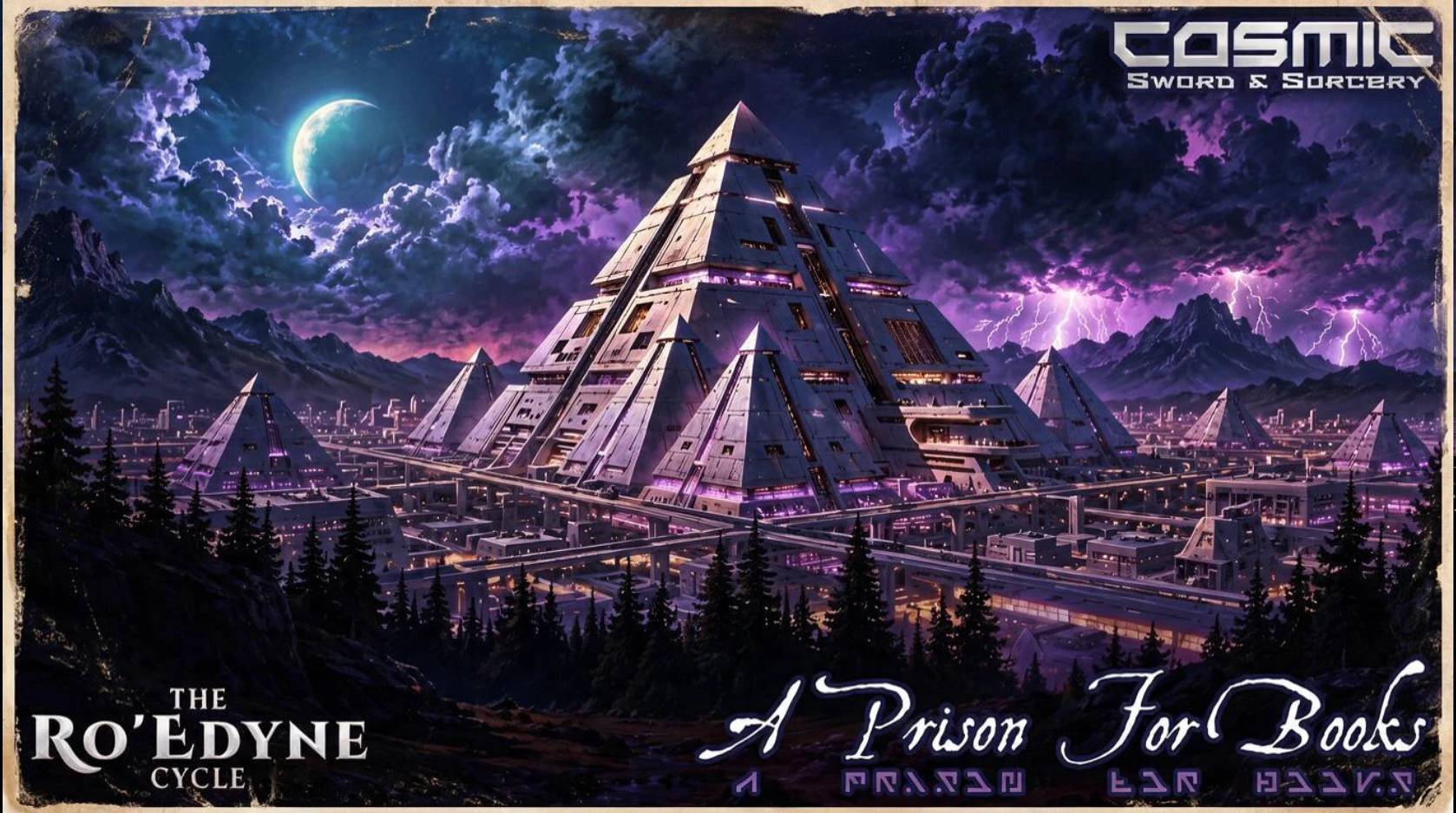
Chapter 3 — A Prison for Books
The security shutter descended only halfway before binding against some unseen obstruction. Thick strands of black resin, glistening beneath the lantern light, had crept upward from the seams of the floor and across the reinforced frame, sealing portions of the mechanism into an organic mass whose texture resembled neither wood nor flesh.
The observation glass beyond had long since become opaque, not through smoke or soot, but beneath countless overlapping layers of dark vascular growth that pulsed with faint violet luminescence somewhere deep within. Yabesa stood several paces behind the others, trembling uncontrollably despite every attempt to steady herself. The Head Librarian placed one weathered hand against the emergency release while the magistrate silently rested his grip upon the pommel of his sword. Neither expected what waited beyond. Both nevertheless understood that whatever answers remained in the archive existed only on the opposite side of that door.
The glass partition slid aside with a wet, reluctant groan. An odor unlike anything either scholar had encountered escaped immediately into the corridor. It carried no familiar scent of decay, smoke, blood, or alchemical contamination. Instead, it possessed the strange sweetness of damp paper left forgotten for generations, mingled with the metallic tang of fresh ink and something faintly botanical that no member of the party could identify. Before anyone spoke, before anyone crossed the threshold, every eye was drawn toward the impossible growth occupying what had once been the central reading chamber. The assistant archivist still lived.
Recognition came not because he remained unchanged, but because fragments of the scholar still persisted beneath the transformation. His robes had fused into black resin that anchored him against the far wall. His arms no longer supported his own weight, having disappeared beneath great fibrous cords that disappeared into shelves, desks, ladders, and countless swollen masses hanging throughout the chamber. His face retained enough of its former shape for the Head Librarian to recognize his apprentice, yet the eyes had become empty cavities filled only with drifting violet light. His mouth remained open in permanent agony, producing a low, ceaseless wail that echoed through the chamber not as speech, but as the slow exhalation of lungs that no longer belonged to him.
Then his back moved. The spine split silently from the base of the neck downward, not with violence but with the measured certainty of a flower opening beneath the morning sun.
Vertebrae unfolded one after another into layered structures resembling enormous black petals whose surfaces shimmered with countless lines of luminous script.
Between those impossible leaves flowed thick streams of dark resin carrying fragments of parchment, splinters of shelving, shattered bindings, and shredded pages that had become inseparable from the living structure itself. The Head Librarian watched in horrified silence as words slowly emerged beneath the archivist’s skin, climbing upward along his neck, disappearing across his jaw, and continuing into the flowering mass behind him until flesh, language, and vegetation had become impossible to distinguish from one another. The library itself had ceased to exist.
Shelves no longer stood as orderly repositories of accumulated scholarship. They had become the trunks of an expanding organism whose root-like tendrils passed effortlessly through stone, timber, glass, and iron alike. Thousands of books remained visible throughout the chamber, but none retained their former purpose.
Some had swollen into leathery pods suspended from resinous vines. Others had split open into layered cocoons whose interiors revealed structures resembling folded organs rather than paper. Entire walls had disappeared beneath overlapping sheets of black growth whose surfaces bore impressions of calligraphy that continuously shifted as though language itself had become vascular tissue. Everywhere the eye settled, knowledge had surrendered its former shape and entered some terrible new biology. A muffled crack echoed somewhere above.
One of the hanging pods slowly separated along its seam before unfurling like overripe fruit. From within emerged a creature roughly the size of a parrot, though no naturalist would ever have mistaken it for a bird. Six articulated limbs unfolded from a body armored in overlapping black plates whose joints resembled ancient book hinges fashioned from dark brass. Its wings stretched outward upon translucent membranes veined with branching patterns that looked disturbingly similar to illuminated script viewed through stained glass.
Where compound eyes should have rested sat polished spheres of obsidian reflecting the chamber in impossible distortions. It perched upon the flowering stalk for only a heartbeat before another pod opened, then another, until dozens of the silent arthropods began crawling carefully across the expanding organism, tending resinous growths, gathering drifting fragments of parchment, and disappearing into hidden passages woven throughout the living archive. They ignored the intruders completely. Their purpose lay elsewhere. Yabesa collapsed to her knees.
“What… what are we going to do?” she cried, her voice breaking beneath the impossible weight of what stood before them. “Please… tell me what are we going to do.” No answer came immediately. The magistrate slowly lowered his sword. The Head Librarian did not move toward the apprentice. He did not order the guards forward. He did not call for oil, torches, axes, or demolition charges. Every instinct learned through a lifetime of protecting books demanded that he preserve the archive before him. Every instinct learned through that same lifetime now told him the archive no longer existed. What remained was something altogether different, something that had merely chosen the likeness of scholarship as fertile ground. For several long moments he listened only to the mournful breathing of his apprentice and the quiet rustling of pages that were no longer pages.
Finally, the old eagle spoke. “We seal it.” The magistrate looked toward him in disbelief. “We do not burn it,” the librarian continued, his voice low and unwavering. “If fire could solve this, another civilization would already have solved it. We do not remove the book. We do not recover the collection. We do not preserve another page. We seal every entrance. Every corridor. Every vault. We abandon this archive today, and from this hour onward no scholar, no magistrate, no council, and no emperor shall ever again cross this threshold.” No one argued.
Epilogue
The order spread through Tykon’Mach before sunset. Stoneworkers replaced librarians, engineers replaced scholars, and architects replaced historians. Every resource the city could command was redirected toward a single purpose. The great library ceased to exist as an institution of learning and became instead the foundation of the largest containment structure the city had ever conceived. Layer upon layer of dressed stone descended over the abandoned archive, while reinforced galleries, inspection chambers, pressure vaults, and isolated maintenance passages were incorporated into a design intended not to honor what lay beneath, but to deny it passage back into the world above.
Public records spoke only of structural reconstruction following an unspecified disaster. The surviving crystal archives quietly absorbed what knowledge could safely be preserved, while the remaining documents vanished from official history. Questions received no answers, and rumors found no confirmation. Even the visiting Kydahni archivist departed without ever learning the fate of the apprentice whose desperate memoranda had summoned them home.
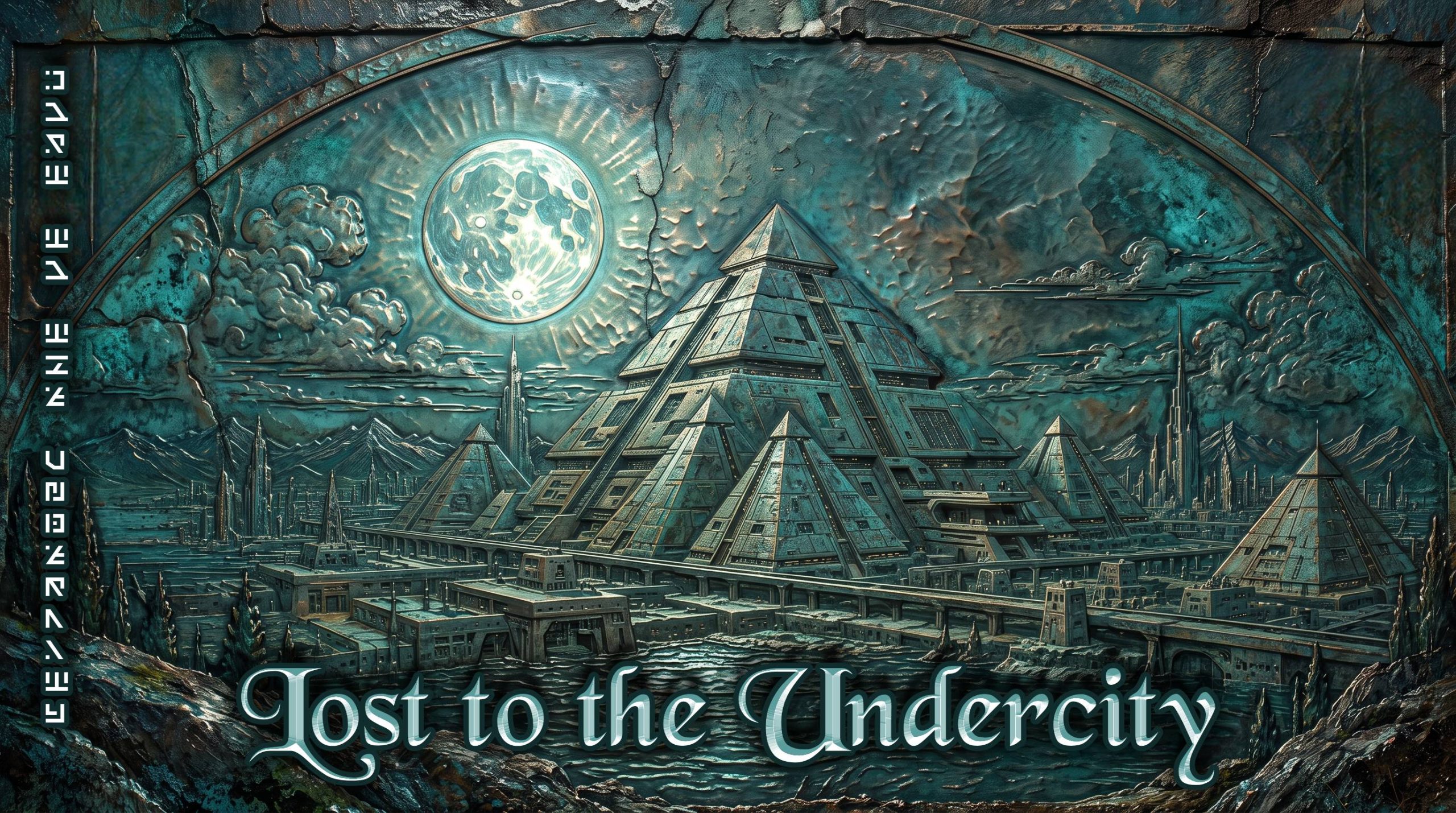
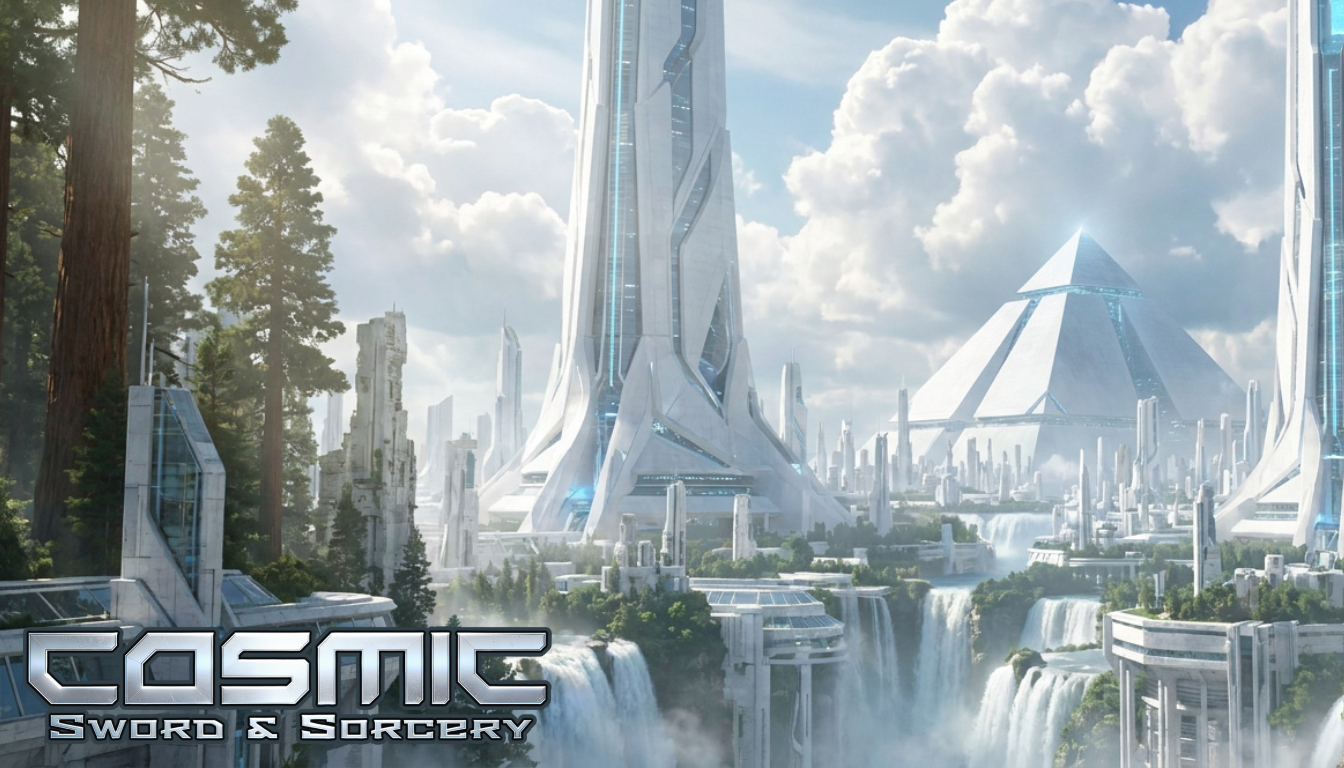
Many generations later, travelers would stand before the Second Great Pyramid of Tykon’Mach and admire only its impossible scale, elegant geometry, and monumental engineering. Scholars would attribute its construction to dynastic ambition, religious symbolism, civic prestige, or the familiar vanities that had produced so many other wonders throughout the history of the Greater Vandyrian Civilization. They would measure its foundations, debate its chronology, compare its architecture to neighboring pyramids, and fill countless shelves with competing theories regarding the motives of those who commissioned it. None would suspect that beneath millions of tons of carefully fitted stone rested neither king nor treasury, neither temple nor observatory, but a library whose final duty had become the imprisonment of its own contents.
The Book of Librion remained exactly where it had first been discovered, untouched by flame and undisturbed by those who had condemned its resting place to eternal darkness. It was never burned, nor was it ever removed. The archive had not been destroyed, but had simply been given a different purpose, becoming not the greatest house of knowledge in Tykon’Mach, but the first and largest prison ever built for books.
Nari and Yazha were quite certain that the afternoon had been altogether too brief, although neither could have said with any confidence how many hours had passed beneath the Surface.
Time, that most exacting of tyrants, had been little regarded in the warm and secluded waters of the subterranean pool, where the two young lovers had hidden themselves from the inquisitive eyes of the world above. There, among the ancient stones and beneath a ceiling lost in the perpetual twilight of the Undercity, they had passed the better portion of the day in embraces, affectionate whisperings, and those innumerable little follies which attend the private happiness of the young.
Now, however, the daylight beyond the narrow apertures of the ancient masonry had begun to diminish, and the unhappy necessity of returning to civilization could no longer be postponed. Their clothing lay in various states of disorder upon the stones, while the girls themselves, both nineteen years of age and entirely unwilling to surrender the afternoon, giggled and blushed as they attempted to make themselves respectable once more.
Yazha, a slender blonde fox of considerable intellectual accomplishment and decidedly less practical courage, was having particular difficulty arranging her garments while her black-haired wolf companion persisted in distracting her. Nari possessed the quick smile and mischievous disposition of one who regarded the greater portion of life’s obligations as unfortunate interruptions to more pleasurable pursuits. An aspiring bard, she carried a small lute upon her shoulder and entertained romantic notions concerning the great musicians of antiquity, whose compositions she maintained possessed a dignity and refinement almost entirely absent from the vulgar entertainments of her own generation. Yazha, for her part, reserved a comparable devotion for the mysteries of philosophical mathematics, an affection so profound that Nari occasionally professed herself jealous of equations. This accusation never failed to amuse the fox, who would solemnly assure her lover that mathematical truths, unlike musicians, were at least dependable. Yet there was little of either music or mathematics in their immediate conversation, which consisted chiefly of teasing suggestions that they abandon their clothing altogether and return to the delicious warmth of the pool.
Indeed, their choice of refuge had been inspired by considerations more immediate than either scholarship or artistic sentiment. The Undercity, despite the innumerable warnings attached to its name, offered one exceedingly attractive advantage: privacy. No meddlesome acquaintance was likely to wander among its deserted passages, no elderly neighbor would report their whereabouts, and, most importantly, there was little prospect of encountering Dija. This last consideration was of particular importance to both girls, for Dija was an obnoxious young male whose chief pleasures in life appeared to consist of stealing unattended clothing, pouring icy beverages upon unsuspecting victims, and reporting the indiscretions of his elders to their mothers. To escape his attentions for an afternoon was itself a small triumph, and the prospect of doing so in the company of one’s beloved had rendered the old warnings concerning the Undercity rather less persuasive than they might otherwise have been.
It was, of course, no ordinary ruin into which they had ventured. Beneath the ancient City of Steel extended a labyrinth of chambers, vaults, stairways, and galleries belonging to epochs whose very names had passed from common remembrance. Its foundations spread beneath the entire city and continued outward under the surrounding forests, though not so far as the distant Towerpine Borders.
Within those buried precincts lay the remnants of a civilization whose grandeur had become the substance of legend: libraries filled with mouldering scrolls, ceremonial halls deprived of their courts, chambers wherein the dust of dead centuries lay undisturbed, and armories containing swords of a workmanship no living smith could readily reproduce. Deeper still were the sepulchral halls of the ancient Ro’Edyne, where those who had served the city in life continued, by a covenant older than the present age, to serve it in death. Such matters were generally considered sufficient reason for sensible folk to remain aboveground, particularly after sunset. Nari and Yazha, having found the pool most agreeable, had elected to concern themselves with these warnings at some more convenient hour. That hour, regrettably, had arrived.
“We really must go,” Yazha murmured, although her arms remained entwined about Nari’s waist and her expression suggested that she considered the proposition thoroughly objectionable.
“Mother will have everyone searching for me if I am not home before supper, and I have no wish to explain why my books have remained unopened all afternoon.”
“Then we shall tell her that you were engaged in the most demanding of philosophical investigations,” Nari replied, fastening her belt with an air of innocence that convinced neither of them. “A rigorous examination of warmth, affection, and the properties of water.” “You are a dreadful scholar.” “And you are a dreadful distraction.”
Yazha laughed, and for another moment their departure was delayed by an embrace which threatened to become considerably longer. At last Nari retrieved her lute, settled its strap upon her shoulder, and bestowed a final kiss upon the fox’s cheek. Yazha took her hand, and together they abandoned the warm waters and their cherished solitude, making their way through the dim passage toward the stairway by which they believed they had entered. Neither looked back, though both would later remember the pool with an affection rather greater than that inspired by the remainder of their adventure.
Their route appeared simple enough. First to the left, then upward along a flight of worn stone steps, and thereafter to the right through a corridor terminating at a great wooden door. Nari remembered the door distinctly, for it was constructed of massive timbers darkened almost to blackness by age, and bore upon its surface iron fittings of a design no longer employed by the craftsmen of the upper city. She approached it with confidence, laid her hand upon the ancient latch, and pulled. The door remained unmoved. She pulled again, this time with considerably greater determination, and was rewarded only by the groaning complaint of the ironwork. Yazha watched her with an expression of gathering apprehension. “It is locked,” she said.
“So it would appear,” Nari answered, giving the door another vigorous tug. “But it was not locked before.” “I am quite aware of that.”
The wolf placed one foot against the stone threshold and strained with both hands upon the latch, producing a noise suggestive of a large and thoroughly uncooperative piece of furniture. The door did not yield so much as a finger’s breadth. Yazha joined her, and together they pushed, pulled, rattled the iron handle, and examined the surrounding masonry for some forgotten fastening. Their efforts were accompanied by several uncomplimentary remarks concerning the intelligence of ancient carpenters, the unnecessary thickness of old doors, and the peculiar enthusiasm with which the people of bygone ages had constructed everything to endure until the end of creation. At length, breathless and disheveled, they stood before the unyielding portal and regarded it in unhappy silence.
“I suppose,” Yazha said, slipping her arms around Nari from behind,“that we shall simply have to remain here forever.” “That would be inconvenient.”
“Would it? We have a pool, we have privacy, and we have each other. I can think of worse arrangements.” “We have no supper.”
“A minor consideration.”
“And no breakfast.”
Yazha reflected upon this objection with a seriousness altogether disproportionate to the circumstances.
“Perhaps,” she conceded, “we should endeavor to escape before breakfast.”
Nari smiled despite herself, but there was less confidence in the expression than she would have wished. The failing daylight had become noticeably weaker, and the long shadows gathered along the corridor with a patience she found increasingly disagreeable. Somewhere beyond the visible masonry lay an immensity of buried streets and sepulchral vaults, and within those vaults rested the Ro’Edyne dead. They were the ancient defenders of the city, warriors who had fallen in battle yet had not been released from their final obligations. In the days of their living service they had signed their souls to the nation in silver ink, kneeling before clerics, druids, and sorcerers to enter a covenant with the city itself. Should any enemy rise to threaten its peace, they would arise in turn, bearing cold Vandyrian steel against those who profaned the ancient precincts. How many centuries had passed since those oaths were sworn, neither girl could have said. It was enough to know that the covenant endured, and that the dead were said to be exceedingly particular concerning its observance.
“Are we quite certain,” Yazha ventured at last, “that this is the right door?”
Nari turned to regard her companion with an expression of such immediate disappointment that the fox almost regretted having spoken.
It was the look one reserves for a question so plainly foolish that its mere utterance constitutes an offense against reason. Yet even as Nari prepared to reply, a most unwelcome possibility presented itself to her mind. There had been another stairway, had there not? Or perhaps another corridor, rather like this one, though situated farther along the gallery. The more carefully she examined the door before them, the less certain she became that it was the particular door through which they had entered. “That,” she admitted after an uncomfortable silence, “is a very reasonable question.” Yazha’s ears drooped. “Oh, Nari.” “Come along. There was another passage below, and I distinctly remember seeing it.” “You distinctly remembered this one.” “Yazha.” “Yes, darling?” “Not another word.”
They descended the stairway together, their earlier levity gradually yielding to a watchfulness neither cared to acknowledge. The second corridor proved considerably longer than the first and descended by imperceptible degrees into a gloom that seemed almost substantial. Here the air possessed the dry, mineral stillness of places long withdrawn from the traffic of the living, and the walls were interrupted by recesses containing objects whose shapes were scarcely distinguishable in the failing light. Nari thought she could discern the outlines of ancient candle stands, ceremonial furnishings, and upright racks of weapons, though she deliberately refrained from examining them too closely. Far overhead, through narrow shafts cut into the masonry, the last illumination of evening struggled against the advancing night. The moon had begun to rise, and its pallid radiance touched certain portions of the corridor while leaving others submerged in a darkness seemingly indifferent to the existence of the sun.
At the farther end stood another great wooden door, so similar to the first that Nari felt a momentary return of confidence. “There,” she announced. “You see?” Yazha hurried forward and seized the handle. The door would not open. She tried again. Nari joined her, and the two resumed their struggle with increasing desperation, until at last even the wolf’s confidence had been worn to a very thin and brittle remnant. They stood panting before the sealed portal, listening to their own breathing and to the faint, unfamiliar noises of the Undercity. Somewhere in the distance a little trickle of water murmured through ancient stone. From another direction came a dry creaking sound which might have been timber settling beneath the burden of centuries, though neither girl was sufficiently reassured by that explanation to mention it.
“I do not like this place anymore,” Yazha whispered.
Nari took her hand. “We shall find another way.” “There are no other ways.” “There are always other ways.” “Then why have we not found one?”
Nari had no satisfactory answer.
The fox drew nearer, reaching blindly through the gloom for her lover’s arm. Her fingers encountered something cold and unfamiliar, and before she could withdraw them the object shifted from its resting place with a harsh metallic clatter. Instinctively she stooped to retrieve it, anxious to restore whatever she had disturbed before further misfortune attended her carelessness. “Yazha, no!” Nari’s cry came an instant too late. In the thin moonlight the fox found herself holding a sword. Its blade was long, narrow, and of a pale metallic substance whose surface possessed none of the common dullness of age. Though dust lay thick upon its hilt and guard, the weapon itself retained an almost unnatural perfection, and its edge caught the wan illumination with a cold and merciless brilliance. It was Vandyrian steel, the ancient substance of which so many terrible and marvelous accounts were told, and its preservation among the relics of the Undercity marked it unmistakably as an object belonging to the Ro’Edyne. For several dreadful moments Yazha could do nothing but stare. “Nari,” she whispered.
“Put it back.” “I did not mean—” “Put it back, Yazha!”
The fox turned hurriedly toward the recess from which the weapon had fallen and attempted to restore it to its original position.
Her trembling hands missed the rack, and the sword struck another blade with a clear, ringing note that carried along the corridor like the tolling of some diminutive funeral bell. The second weapon slipped loose, clattered against the masonry, and fell to the floor. Yazha gasped, snatched it up, and found herself standing with a sword in either hand, both of which she regarded as though they were venomous serpents. “Oh, no. Oh, no, no, no.” “Give me one!” Nari seized the nearest weapon and attempted to replace it, only to strike an ancient candle stand with her elbow. The thing toppled with majestic deliberation, struck the stone floor, and produced a clamor entirely disproportionate to its size. Both girls recoiled. For a moment they stood motionless, staring at the fallen stand as if expecting the whole Undercity to awaken in response.
Nothing happened. With movements of exaggerated caution they returned the weapons to their resting places, raised the candle stand, and arranged everything as nearly as possible in accordance with their imperfect recollection of how it had appeared before. Yazha’s hands shook so badly that Nari finally took the last sword from her and settled it carefully into the rack. There followed a period of silence during which the girls examined their handiwork with the anxious concentration of criminals attempting to conceal evidence of some appalling offense. “There,” Nari breathed at last. “Precisely as it was.” “Are you sure?” “Absolutely.”
They looked at one another, and for an instant the absurdity of their predicament threatened to provoke a nervous laugh.
Then they turned around.
Yazha screamed.
From the farther reaches of the corridor two figures advanced with the slow and solemn tread of beings to whom the passage of ordinary time had ceased to possess significance. They were enormous wolves, towering above the girls, clad in armor whose ancient plates were burdened with the dust of uncounted years. The flesh had long since departed from their faces and hands, leaving the gaunt architecture of their skulls exposed beneath the shadow of their helmets. Within those hollow crania burned pale lights of an unearthly whiteness, encompassed by a faint greenish vapor that shifted and trembled as they moved. Their garments hung in rotted tatters from beneath the steel, and at their sides rested swords whose blades had known battle in ages when the very kingdoms of the present world were yet unimagined.
They were the Ro’Edyne dead.
Their footsteps sounded upon the stone in measured intervals, accompanied by the faint creak of ancient armor and the dry movement of bones that had not known living sinew for centuries. Neither guardian displayed haste, nor did either appear troubled by the terror of the intruders. They advanced with the dreadful composure of soldiers accustomed to obedience, their empty gazes fixed upon the two figures standing amid the disturbed relics of the corridor. Yazha retreated behind Nari so quickly that she nearly upset the candle stand again. “Please,” she whispered, clutching the wolf’s arm. “Please tell me those are statues.” Nari swallowed. “Statues do not generally walk.” “Then tell me something else!” The ancient guardians continued forward.
Both girls knew the old song, as nearly everyone born within the shadow of the City of Steel knew it. They had heard its verses in childhood, whispered beside winter fires and sung by elderly relatives who remembered warnings passed down through generations. Its words belonged to a time when the northern isles still bore the scars of ancient calamities, and when the dead of Ro’Edyne were spoken of with an awe bordering upon religious dread.
Rowan red and iron bright, Bar the door and bless the night;
Heap the peat and bank the flame, Never call the lost by name.
Should you hear them cross the snow, Let them pass and let them go—
For the antique isles remember What the living must not know.
Neither dared give voice to the familiar refrain. It was a song of warning, not of welcome, and in their present condition its recital seemed perilously close to announcing themselves before powers from which sensible folk had always sought concealment. Yazha pressed her face against Nari’s shoulder, while Nari, whose own courage was diminishing with every ponderous footfall, searched desperately for some means by which they might escape. The door remained sealed behind them. The corridor offered little room for flight, and even if they could outrun the dreadful sentinels, there was no certainty that the passages beyond would lead anywhere but deeper into the subterranean city. Then, amid the confusion of her thoughts, Nari remembered something.
It was not the warning song, nor any childish charm against wandering spirits, but a melody belonging to a far older tradition. She had heard it in the study of ancient imperial compositions, where it survived among the remnants of ceremonial music attributed to the vanished courts of Ro’Edyne. Its opening measures were severe and stately, possessed of that peculiar dignity which Nari so admired in the music of antiquity, and she recalled that the composition had once been associated with those who had sworn themselves to rise in the city’s defense. Her hand flew to the lute upon her shoulder. “Nari?” Yazha whispered. “Be quiet.” “What are you doing?” “Trying something.” “Is it a spell?” “No.” “Are you certain?” “Yazha, please!”
Nari brought the instrument before her, adjusted its tuning with fingers made clumsy by terror, and bent her ear toward the strings. Never in her nineteen years had she tuned an instrument with such desperate haste, nor had the finer distinctions of pitch seemed quite so immediately consequential. The guardians drew nearer, their pale lights wavering through the gathering darkness. Yazha held her breath, scarcely daring to move, while the wolf tightened one string, loosened another, and silently cursed the stubborn little instrument for every moment it demanded of her.
At last she raised her hand.
‘Rise’
The first notes sounded thinly in the cavernous corridor, their delicate resonance almost swallowed by the immense stillness of the buried city. Nari steadied herself and continued, plucking the solemn measures with the precision of one whose entire existence had narrowed to the proper succession of a handful of notes. The melody unfolded with an austere grace alien to the songs of her own age, a fragment of ceremonial splendor preserved through the long decline of kingdoms and the oblivion of their courts. It was music composed for an authority no living sovereign now possessed, and for warriors whose obedience had endured beyond the death of those who commanded them. The shambling ceased.
Both guardians halted so abruptly that Yazha gave a little gasp and clapped a hand over her mouth. Before the astonished girls, the two skeletal wolves drew themselves erect, shoulders squared and heads raised, assuming with perfect solemnity the posture of soldiers standing before a superior authority. The pallid fires within their eye sockets diminished, and in their depths appeared another radiance, quieter and more remote, as though some long-buried recollection had stirred beneath the enchantments sustaining their ancient vigil. Nari continued to play. Behind the girls came the low, prolonged creaking of a massive wooden door.
Yazha yelped, turned, and nearly stumbled over her own feet. The great portal which had resisted their combined efforts now stood open, its heavy timbers drawn back by a third figure whose presence neither had perceived. This guardian was taller even than the other two, and his ancient armor bore upon its breastplate the worn insignia of an office whose meaning had long since departed from the knowledge of the living. His skull was bare beneath the shadow of his helm, yet about its ivory contours there gathered a wavering likeness of the face he had possessed in life. The spectral image hung upon his bones like a thin veil of moonlit vapor, revealing the stern muzzle and deeply set eyes of an aged wolf whose countenance had known little indulgence. He was not smiling. Indeed, there was nothing particularly kindly in those ancient features, and the girls had no inclination to test the limits of his patience. Yet the guardian stood aside, one gauntleted hand resting upon the opened door, and beyond him stretched a passage whose familiar incline and distant glimmer of evening light promised escape from the sepulchral labyrinth.
For several heartbeats neither girl moved. Then Nari lowered her lute. “Thank you,” she whispered. The sentinel inclined his head by the smallest perceptible degree. Yazha seized her lover’s hand. They hurried past the ancient wolf with all the dignity they could muster, which under the circumstances was very little indeed. Once beyond the doorway they broke into a run, their footsteps clattering wildly along the stones as they fled through the passage and toward the dim light of the world above. They did not stop when they reached the outer stairway, nor when the first breath of cool evening air touched their faces. Only when the buildings of the City of Steel rose about them once more did their terror begin to dissolve into the helpless laughter of those who have escaped some dreadful calamity and can scarcely comprehend their continued good fortune.
Hand in hand they ran through the streets, shrieking and giggling, alternately blaming one another for the adventure and swearing with extraordinary conviction that they would never again set foot within the Undercity. Yazha insisted that Nari had led them to the wrong door, while Nari maintained that the fox’s handling of the swords had been the principal source of their difficulties. Both accusations were advanced with considerable enthusiasm and little regard for consistency. Their quarrel ended beneath the lamps of the upper city, where Yazha embraced her lover with sufficient fervor to silence further argument, kissed her once, and hurried away toward the gates of her family’s residence.
Yazha reached home in time to slip unnoticed among the numerous members of her household, who were occupied with their own affairs and had paid little attention to her absence. Her books remained upon the table where she had left them, and she settled herself among them with an expression of such studious concentration that no one thought to inquire concerning the day’s activities. Nari was less fortunate. She arrived after supper had begun, offered an explanation concerning musical studies that satisfied no one, and was promptly sentenced to wash the dishes of the entire household. Thus did the two young lovers receive the full measure of worldly punishment for an afternoon spent trespassing among the ancient dead.
Far beneath the streets, where the lights of the living could not penetrate and the stones retained the silence of forgotten ages, the guardians returned to their appointed places. They went without haste, their armored feet descending stair after stair through the galleries of the Undercity. The pale fires of their eyes resumed their accustomed brilliance, and the spectral semblance that had briefly clothed the face of the elder sentinel faded once more into the naked austerity of bone. Past the ancient weapon racks they walked, past the candle stands blackened by centuries of neglect, and through the silent corridors where the swords of their fallen brethren remained undisturbed. There was no ceremony attending their return, no spoken command or solemn declaration, for theirs was a duty older than the memories of the living and requiring no witness to its observance.
At length they passed the warm subterranean pool. One of the guardians continued onward, his armor creaking softly in the stillness. The elder sentinel, however, paused beside the water, where a faint vapor rose toward the vault of ancient masonry. His hollow gaze rested upon the stone sconces bordering the pool, and there he perceived two pairs of linens, carelessly hung to dry by visitors who had departed in rather more haste than they had intended. For a little while the dead wolf stood regarding them. He had known another world once, in those distant centuries before silver ink and solemn oaths had bound his soul to the everlasting service of the city. He had known the laughter of the young, the little deceptions of growing children, the exasperations of a household, and the countless affectionate follies that attend the passage from youth into maturity.
These were memories almost extinguished beneath the immense burden of his years, yet not so utterly lost that the sight before him could awaken nothing of their former warmth. Long ago, when his flesh had still clothed his bones and his heart had beaten beneath his armor, he too had been a father. A dry, scarcely audible sound issued from the place where his lungs had once resided. It was not the groan of a restless spirit, nor the dreadful whisper of some sepulchral enchantment. It was a chuckle, faint and rough, such as an elderly father might utter upon discovering that two foolish youngsters had been engaged in precisely the sort of mischief that youngsters have practiced since the first days of civilization.
Then the old sentinel turned away from the pool and followed his companion into the darkness, his sword resting at his side and his ancient obligation unbroken. The echoes of their passage diminished among the buried halls, until once more the Undercity lay silent beneath the sleeping streets of the City of Steel. And above, in the comfortable ignorance of their households, Nari and Yazha slept soundly, neither knowing that the dead had found their afternoon adventure quite so amusing.
“Stalking out at dusk from Roedon, trench gun slung across my back Iron boots on broken flagstones, scent of blood along the track Gods who watch the black pine shudder old as rust and winter’s edge Why leave teeth beneath the heather why let nightmares cross the hedge
‘Fore I hunted shadowed valleys in the madness of my youth Tracked the thunder in the hollows never pledged my soul to truth Never knelt before a council never kissed the master’s ring Never prayed for peace or pardon steel’s the only song I sing
Roedon , Roedon , doomed old Roedon crown me king of claw and mire Let the sabers prowl the moorland let the night catch fire with fire Let the bones of friends and traitors bleach beside the haunted fen I have come to wake the monsters I have come to hunt again
Dreams are fangs in distant darkness flashing quick through fog and bone Hope is hot brass in the barrel roaring out across the stone If the halls are cold behind me and the moon rides high and red I will find my mercy hunting where the wild things are not dead
Wind may shriek through shattered towers mother’s whisper of the slain Let them talk of crowns and kinfolk I have loosed the dogs again I have gone to seek the hunter where the saber-tooth still go And the guns ring under starlight old Roedon need never know”
The beast had ruled the northern valleys for longer than many villages could remember. Among the upland settlements beyond the Great Ridge Mountains, where the forests grew thick with bamboo and mist and the roads narrowed into little more than game trails winding through ancient hills, stories persisted of a one-eyed sabertooth whose savagery had become legend. Entire generations had grown old hearing tales of the creature while shepherds vanished from isolated pastures, woodcutters disappeared along forgotten paths, and caravans traveling without adequate escorts occasionally failed to arrive at their destinations. Some believed the beast to be little more than an unusually large predator, while others claimed it possessed an unnatural cunning bordering upon malice. Whatever the truth, the result remained the same, as the northern marches of Thyuratahn had surrendered large stretches of wilderness to a single predator whose reign of terror had endured for decades.
The road leading northward climbed steadily into colder country where jagged peaks rose against the horizon like the broken teeth of sleeping gods, and dense Blackwood Pineborder forests cloaked the valleys beneath them in dark green shadow. Along that road traveled two hunters whose appearance alone was enough to draw attention wherever they passed. Both were wolves by blood, broad-shouldered and heavily built beneath weathered travel cloaks, with rifles slung across their backs in the easy familiarity of tools long mastered. Sidearms, knives, and various pieces of hunting equipment hung from belts and harnesses worn smooth by years of use, and nothing about either hunter suggested uncertainty. They moved with the quiet confidence of males who had spent much of their lives pursuing creatures capable of killing them and had survived long enough to make that pursuit their profession.
As the road crossed the border into the Northern Ro’Edyne Kingdoms of Thyuratahn, a small detachment of royal guards emerged from a fortified checkpoint overlooking the pass. Their captain, signaling for the travelers to halt, and the two hunters complied without complaint, for formalities remained formalities, particularly in frontier territory where strange things often wandered across borders without regard for law or kingdom. The captain studied them carefully, his gaze lingering first upon the rifles and then upon the scars visible beneath fur and armor alike, recognizing the quiet markers of experience that could not be easily hidden from another veteran. “What business takes you beyond the border?” he asked. The older of the two hunters adjusted the strap of his rifle and offered a faint grin that revealed the edge of a canine fang as he answered without hesitation. “We’re hunting.”
The captain raised an eyebrow at that. That much was obvious. The younger wolf allowed himself a quiet chuckle while the older continued in the same even tone, describing their quarry with the blunt precision of a professional recounting a contract rather than a story. “We’re after the sabertooth, the one with half its face torn away and only one eye left, the one with the foul temper and worse habits, the one that eats travelers, livestock, and anything else foolish enough to wander into its territory.”
A murmur spread among the nearby guards as the name of the beast, unspoken yet fully understood, passed through them like a cold wind. The captain’s expression shifted almost immediately, as what had begun as routine inspection became something more serious. The northern beast was no mere tale told to frighten children. It was a presence, a known terror, and nearly every soldier stationed along the frontier knew someone who had been lost to it.
“You intend to kill it?” the captain asked, his tone no longer casual. The younger hunter shrugged slightly, as though the matter required no further elaboration. “That’s generally how these things conclude when we’re involved.”
Several guards exchanged impressed looks while others simply stared at the weapons carried so casually by the two wolves. Neither hunter appeared particularly concerned by the reputation of the creature they intended to pursue, and there was no boasting in their voices nor any attempt to impress their audience. If anything, the calm certainty with which they discussed the hunt made the matter seem all the more serious, as though the outcome had already been decided and only the process remained. The captain stepped aside and motioned for the gates to be opened, conceding both authority and respect in the same gesture. “Then I won’t delay you. If anyone can put an end to that beast, perhaps it would be hunters carrying weapons like those.”
The older wolf inclined his head slightly in acknowledgment. “Appreciated.” The two hunters continued northward, passing through the checkpoint and following the winding road as it disappeared into increasingly rugged country, leaving behind the last structured presence of the kingdom. Behind them the guards watched in silence until the hunters became distant silhouettes against the hills, their figures gradually swallowed by the vastness of the northern landscape. Just as they crested the next rise and began their descent into the deeper wilderness, the captain suddenly called out after them with enough urgency to halt their progress.
“Wait!”
The hunters halted and turned as the captain hurried forward from the checkpoint. The urgency in his voice immediately drew their attention. For the first time since passing through the gate, the officer seemed genuinely concerned about something. He slowed as he approached and gestured toward the northern road stretching into the mountains beyond. “There was another hunter passed through here earlier today,” he said. “Went up the same road you’re taking. Is he traveling with you?”
Both wolves became noticeably still. The younger hunter frowned while the older narrowed his eyes slightly. “What hunter?” he asked. The captain pointed toward the distant peaks. “Huge bull! Biggest fellow I’ve seen in years. Looked like he could uproot a tree with his bare hands. Carried a shield, a sword, and enough confidence for three. Said his name was Valhuma.”
Neither hunter answered immediately. The silence lingered long enough for the captain’s expression to shift from curiosity toward uncertainty. The two wolves exchanged a brief glance, neither requiring words to understand the other’s thoughts. Both knew Valhuma. Both had hunted beside him before. They knew his strengths as well as his weaknesses. Valhuma was brave, skilled, and strong enough to contend with most warriors. Unfortunately, he was also reckless enough to challenge enemies that wiser hunters would avoid. Courage and strength were admirable qualities, but neither was a substitute for judgment. A predator that had survived decades of organized hunts, military patrols, bounty seekers, and professional hunters was not the sort of enemy that yielded to determination alone. The younger wolf slowly exhaled through his nose while the older hunter considered the mountains ahead.
“How long ago?” he finally asked.
“Several hours.” The answer settled heavily between them. The captain glanced from one hunter to the other. “Is something wrong?” The younger wolf adjusted the rifle hanging across his shoulder and looked toward the distant peaks. “No,” he replied quietly. “Nothing’s wrong.” The older hunter turned back toward the road. “But if Valhuma truly went ahead alone, he’s already committed himself to whatever happens next.” The captain waited for further explanation, but none came. The two hunters resumed walking and began making their way north once more. For a time only the sound of their boots disturbed the mountain road. Eventually the younger wolf glanced sideways toward his companion. “You thinking what I’m thinking?” The older hunter never took his eyes off the wilderness ahead. “Probably.” The younger wolf sighed heavily. “Poor bastard.”
Neither spoke again. Beyond the hills stretched hundreds of miles of forest, ravines, bamboo groves, and mist-shrouded valleys where the ancient sabertooth held dominion. Somewhere within that wilderness a bull hunter had gone searching for glory. Somewhere within that same wilderness an old predator waited among the shadows with one eye, half a face, and a reputation earned through decades of bloodshed. The mountains gradually swallowed the two wolves as they disappeared northward, leaving the kingdom behind and entering the hunting grounds of a monster that had devoured enough heroes to become a legend.
Chapter 2
By the following afternoon the mountains had swallowed the last traces of civilization. The roads had vanished hours earlier, leaving only narrow game trails winding through dense wilderness and steep upland ridges. Vasco and Salidahn traveled steadily northward through a vast bamboo forest whose towering stalks rose high overhead like the columns of some forgotten temple. Pale sunlight filtered through the canopy in thin green shafts while the endless sea of bamboo whispered and creaked softly beneath the wind. Ordinarily such forests teemed with life, but the deeper the hunters traveled into the beast’s territory, the quieter the wilderness became. Birds no longer called from the treetops. Small animals no longer darted through the undergrowth. The forest possessed the uneasy stillness of a place that knew a predator was near.
Neither hunter felt compelled to comment upon the silence. The signs were obvious enough. Years spent tracking dangerous creatures had taught them that wilderness spoke through absences as often as sounds. Every living thing within these hills understood the boundaries of the sabertooth’s domain. Even without tracks, blood, or carcasses, the silence itself served as warning. Somewhere ahead lurked a predator so feared that the lesser creatures of the region seemed determined to avoid every place it walked. The further north the hunters traveled, the more pronounced the feeling became. The wilderness no longer felt merely remote. It felt occupied.
Toward evening the bamboo forest began to thin, giving way to a series of rolling hills overlooking a narrow valley shrouded in shadow. Beyond the valley rose another ridgeline cloaked in mist and dark evergreen forests. Numerous game trails converged toward the region, some old and heavily worn, others faded and abandoned. The land itself revealed the influence of the beast. Predators shaped landscapes in subtle ways. Trails shifted. Migration patterns changed. Entire regions gradually transformed around the habits of a successful hunter. The sabertooth had ruled these hills for so long that the wilderness had adapted around its presence.
The two wolves established camp upon a defensible rise overlooking the valley below. The fire remained deliberately small, little more than a bed of glowing coals concealed behind a ring of stone. Supper consisted of dried provisions consumed with the efficiency of professionals who viewed food primarily as fuel rather than pleasure. Conversation remained sparse. There was little left to discuss. The journey was effectively over. What remained was the hunt itself.
Night settled gradually across the mountains. Darkness gathered first within the valleys before climbing the slopes and consuming the ridges one by one. The moon eventually rose above the distant peaks, casting pale silver light across the sea of bamboo stretching below. For several hours nothing disturbed the stillness. The wilderness seemed frozen beneath the weight of its own silence. Then, sometime after midnight, both hunters became aware of movement beyond the neighboring ridge. The sound arrived first. Branches snapped. Vegetation shifted. Loose stones rattled down unseen slopes. Whatever traveled through the darkness possessed tremendous weight. Neither wolf moved. Both listened. The noises continued for several moments before abruptly ceasing, leaving the night silent once more.
The silence lasted less than a minute before a scream shattered the darkness. The sound echoed across the valleys and hills before ending with startling suddenness. No struggle followed. No second cry. No desperate call for aid. The mountains absorbed the noise and returned to silence. Somewhere beyond the ridge, something had died. Neither hunter commented. There was little point. Both knew exactly what they had heard. The beast had fed.
The remainder of the night passed without further incident. Sleep came lightly and without comfort. Both wolves rested with rifles within arm’s reach and ears alert for danger. Experience had taught them that genuine rest became impossible inside a predator’s territory. Every unfamiliar sound demanded attention. Every shift in the wind invited consideration. Beyond the boundaries of the firelight the wilderness remained silent, as though the creature’s presence weighed upon the entire region.
Morning arrived beneath a blanket of dense fog. Moisture clung to fur, equipment, and clothing while the surrounding hills emerged only as vague silhouettes beyond the mist. Visibility extended little farther than a hundred paces in any direction. It was ideal hunting weather for an ambush predator. Distances became deceptive. Sounds traveled strangely. Shapes appeared suddenly where moments earlier there had been nothing. The world seemed reduced to shades of white and gray broken only by the dark forms of trees and stone.
The hunters broke camp quickly and without ceremony. Rifles were removed from travel slings and prepared for immediate use. Actions were checked. Ammunition inspected. Every motion occurred through habit developed across countless hunts. Familiar rituals possessed value. They steadied the mind and focused attention upon practical concerns rather than imagination. Once camp had been dismantled and equipment secured, the two wolves began climbing toward the upper ridges where local reports placed the creature’s lair.
For a time they traveled in silence through the fog. Eventually Salidahn remarked that perhaps this hunt might prove different from those that had come before. The observation earned immediate disapproval from Vasco, who informed him that such thoughts had no place this close to an objective. Whether born from superstition, experience, or simple habit, the older hunter maintained that inviting uncertainty into a hunt served no useful purpose. Salidahn found the reaction mildly amusing, but allowed the matter to drop. After several moments Vasco added that there was no reason to expect anything unusual. The hunt would unfold exactly as every successful hunt had unfolded before. They would find the beast, survive the encounter, kill the beast, collect the reward, and return home wealthier than when they had arrived. The statement carried neither arrogance nor bravado. It was simply the practical outlook of a hunter who had spent decades doing the same work.
The younger wolf nodded and the conversation ended there. Nothing more needed to be said. Somewhere beyond the fog lay the cave identified by local reports. Somewhere beyond the fog waited the one-eyed sabertooth that had terrorized the northern marches for a generation. The beast had fed during the night and could not be far away. Armed with heavy rifles and the confidence earned through years spent hunting creatures that most sensible folk fled from, Vasco and Salidahn continued their ascent into the mist and disappeared among the hills as they approached the lair.
Chapter 3
The cave revealed itself only at the last moment, its mouth cut into the mountainside like a wound in the stone and half-concealed by the rising fog and broken terrain that surrounded it, and the slope leading toward it bore the unmistakable signs of long habitation, though not in any civilized sense, as game trails converged and ended abruptly while bones lay scattered in half-buried clusters where scavengers had taken what they could and fled what remained. The ground itself had been churned and hardened over years of passing weight until it no longer resembled soil so much as a trampled threshold between the outer world and something claimed, something that had fed and endured long enough to shape the land around it.
At the very foot of the cave, they found what remained of Valhuma, and the evidence of his end required no interpretation, for the head lay several paces from the entrance, half-turned toward the slope as though the final motion of the body had been resistance rather than retreat, with one horn shattered and the eyes still open, while the top of the spinal column remained attached though little else did, the severance ragged and brutal rather than clean, and nearby the hand lay buried to the wrist in torn earth, the fingers curled inward as if they had been gripping the ground with all the strength the body possessed while the rest of him had been dragged into the darkness, and the position of the limb told its own story, one of defiance overcome by force rather than surrender, a struggle that had ended not in retreat but in consumption.
As the two wolves passed, the eye blinked once, a final reflex or the last echo of life lingering within a body that had already lost its claim to existence, and neither hunter stopped, for the distinction between life and death in that moment held no value, and the truth of the situation had already been made clear by what lay before them, as the bull had reached the lair and failed to leave it, and that conclusion required no further examination or commentary from those who understood the work well enough to recognize its outcomes without explanation.
Valhuma had been a capable hunter, possessed of strength, training, and the kind of experience earned in open battle where opponents announced themselves with steel and answered in kind, and he had been raised to fight enemies that could be seen, measured, and overcome through force, and that knowledge had carried him far across battlefields where courage and power decided the outcome, yet it had not carried him far enough here, for this was not a battlefield governed by honor or symmetry but a predator’s ground where patience, instinct, and cruelty determined the outcome, and sword and shield had their place in the world of ordered conflict, but here they were insufficient, and the proof of that insufficiency lay scattered at the threshold of the cave in pieces that once had been a warrior.
Vasco studied the entrance for several moments before speaking, his voice low and controlled as he measured distance, terrain, and shadow, and when he spoke his words carried the weight of decision rather than suggestion as he said, “We draw it out,” and Salidahn nodded once and moved immediately to gather what was needed, as their teacher had drilled the method into them long ago until repetition had turned instruction into instinct, and fire denied concealment while smoke denied patience, and a creature that relied upon ambush could be forced into the open if its lair became untenable, and while the method carried risk, it remained preferable to stepping blindly into darkness claimed by something that understood it better than any intruder could hope to.
They worked quickly, building a crude bundle of brush and damp vegetation near the entrance and positioning it where the smoke would be drawn inward, and the fog thickened around them as the morning pressed on, lending the entire scene a muted, distant quality as though the mountain itself observed without concern, and when Vasco struck the flame the fire began to take, the first tendrils of smoke curling upward before bending inward toward the cave mouth as the air shifted under its influence.
The beast did not wait, and it came out of the darkness with a violence that collapsed distance into impact, a mass of muscle, scar tissue, and ruined flesh erupting from the cave with a speed that defied its size and its apparent weight, and the one remaining eye burned with feral intensity that spoke not of thought but of immediate and absolute intent, and there was no hesitation, no warning, and no separation between emergence and attack as the creature committed fully to the kill in a single continuous motion.
Shots rang out almost instantly as both rifles spoke in overlapping thunder, the recoil driven into shoulder and bone through practiced control, and the rounds struck the creature square in the chest with visible impact even through its forward momentum, and flesh tore while blood followed, and for a fraction of a second the beast faltered beneath the force of the strikes, its body reacting to damage that would have ended lesser creatures and halted lesser predators in their tracks.
It did not stop, and the distance closed in less time than it took to draw breath, and Salidahn moved to adjust his position and bring his rifle to bear for a second shot, but the sabertooth reached him first, and its jaws closed around his arm with crushing force, teeth driving through plated armor as though it were little more than hardened leather, and the sound that followed was not a cry but the wet, breaking snap of bone yielding under pressure as the limb failed in multiple places at once, and the force of the bite alone would have been sufficient to cripple him, yet the beast did not merely hold.
It twisted, and the motion lifted Salidahn from his footing and cast him aside with brutal efficiency, his body thrown down the slope and across broken ground until he came to rest within sight but beyond immediate reach, separated from his weapon and struggling against the shock of the injury as his body fought to remain conscious under the sudden violence, and the sabertooth released him without hesitation and turned at once, its focus shifting with predatory precision as it sought the next threat before the first had even settled.
There was a sharp mechanical click followed immediately by the rising whir of a system engaging under load, and Vasco had already moved, the trench shotgun coming up with practiced certainty as the weapon’s mechanism cycled into full operation the moment the trigger was pulled and held, and the response was immediate and overwhelming as a rapid succession of heavy slugs erupted from the barrel in a sustained, controlled torrent, each round striking with concussive force as they tore into the creature’s head at point-blank range, and the sequence of impacts destroyed structure faster than the body could respond, as bone shattered under the first strikes while the second drove deeper and the third and fourth erased what remained, transforming skull and eye into a violent spray that painted the stone behind it in a broad arc of blood and matter.
The beast convulsed under the force of the assault, a wet surge of blood forced from what remained of its mouth as its body lost cohesion and momentum collapsed beneath the destruction of its skull, and it staggered once, then again, before slumping heavily to one side, its mass striking the ground with finality as the violence of its life ended in an instant of mechanical certainty, leaving behind only the echo of force and the stillness that followed.
Silence returned slowly, as though the mountain itself required time to accept what had occurred, and the air seemed to settle in the aftermath as the echo of the gunfire faded into nothing and the presence that had dominated the region for decades was reduced to a cooling carcass upon the ground.
By nightfall the work was done, and the aftermath of the hunt had taken on the quiet rhythm of survival rather than conflict, as Salidahn’s arm had been set and bound as best as could be managed in the field, the limb secured in a sling to prevent further damage while the worst of the pain dulled into something manageable, and the fire burned low beside them as darkness closed in once more, and between them rested a small flask of plum brandy whose contents were shared without ceremony as one measure was poured and taken and then another, while a third was poured and left upon the ground as an offering to the White Witch and to the memory of the one who had taught them how to endure such work.
Kyone’s lessons had carried them to this place and through what had awaited them there, and the proof of that success lay cooling behind them where the sabertooth had fallen, and the teeth were taken with care, each one a token worth more than most would see in a lifetime, and the reward agreed upon before the hunt would be paid in full, for three chests of Imperial silver awaited their return, heavy enough to matter and sufficient to justify the risk taken to claim it. Behind them the cave stood silent, its darkness emptied of threat and its claim broken, and within it nothing remained that would hunt again, and the valley that had once belonged to the beast would, in time, remember what it had been before fear took root within it.
Epilogue
Several days later the hunters finally reached the Highland City, where crowds gathered outside the gates long before the procession arrived.
News traveled quickly throughout the northern kingdoms, particularly when the news involved monsters. Hundreds waited along the streets as the wagon rolled through the city, and guards struggled to maintain order while citizens pushed forward for a better look at the fallen beast. The reaction was immediate. Some cheered. Others stared in stunned silence. Many simply stood and watched as the enormous carcass rolled past. Away from mountains and forests, surrounded instead by buildings, walls, and ordinary folk, the scale of the predator became impossible to ignore. It resembled less a natural animal and more some forgotten relic from an older age when monsters had ruled the world.
By the time the remains reached the ancient High Halls, plans were already being discussed regarding their preservation. The skeleton would be cleaned and assembled for display. The skull would be mounted above the great chamber. The hide would be preserved and hung among the banners of the northern kingdoms so future generations could look upon it and understand that the stories had been true. Long after the names of those who killed it faded into history, the beast itself would remain part of the city’s memory.
Several hours later, with payment received and formalities completed, Vasco and Salidahn finally began preparing for departure. The wagon carrying the trophies had been surrendered to the authorities, fresh supplies had been purchased, and Salidahn’s arm remained secured in a sling, though the worst of the pain had faded into something manageable.
The work was finished. All that remained was the road home.
They had just cleared the outer district when a voice called after them. Turning, they found a young fox sprinting down the street while clutching a narrow glowing tube in both paws. He looked no older than twelve summers and was entirely out of breath by the time he reached them. Vasco raised an eyebrow and asked what was so urgent, while the fox bent over with his hands upon his knees and struggled to recover enough air to speak.
After a moment he straightened, held up the device, and announced that he needed a picture. The request earned a puzzled look from Vasco, who asked what possible purpose such a thing could serve. The fox immediately pointed back toward the High Hall where the remains of the sabertooth now rested and explained that nobody was going to believe him. He had seen the beast with his own eyes. He had seen the head, the fangs, and the size of the carcass. Yet he already knew that everyone back home would assume he was lying the moment he tried to describe it.
Salidahn’s ears twitched with amusement as he asked whether the picture was intended as evidence. The fox nodded vigorously and declared that it was exactly that. The two hunters exchanged a glance before simultaneously shrugging. The request seemed reasonable enough. A creature that large stretched the limits of credibility even when its corpse was sitting in plain sight. Once the matter was explained, neither hunter could find a reason to object.
Several minutes later the fox positioned himself in the street and adjusted the glowing device while Vasco and Salidahn returned to stand beside the carcass one final time.
The resulting image captured the entire scene perfectly.
Two weathered wolf hunters stood before the fallen sabertooth, neither attempting to appear larger than they were nor positioning themselves in some absurd fashion to exaggerate the scale. There was no need. The beast itself occupied most of the image. Its body stretched across nearly the entire width of the frame, while the shattered remains of its skull remained immense enough to dwarf the hunters standing before it. The photograph required no embellishment. The truth alone was impressive enough.
When the fox finally lowered the device, he stared at the image for several moments before declaring it perfect. Vasco glanced at the result and snorted before asking whether anyone would believe the story now. The fox looked from the image to the enormous corpse behind them and grinned broadly. If they still refused to believe it after seeing the picture, he replied, then they were idiots. The hunters laughed, adjusted their packs, and resumed their journey. Behind them the Highland City celebrated the end of a nightmare that had haunted the northern valleys for generations.
Ahead of them stretched another road, another wilderness, and eventually another hunt. Such was the profession. Monsters died, kingdoms endured, and stories passed from one generation to the next. Long after the sabertooth’s bones had been mounted in the ancient High Hall and its hide hung among the banners of the north, folk would still point toward an old photograph and marvel that two hunters had stood before such a creature and returned alive to tell the tale.
“Nothing Comes Easy”
“Stalking out at dusk from Roedon, trench gun slung across my back Iron boots on broken flagstones, scent of blood along the track Gods who watch the black pine shudder old as rust and winter’s edge Why leave teeth beneath the heather why let nightmares cross the hedge
‘Fore I hunted shadowed valleys in the madness of my youth Tracked the thunder in the hollows never pledged my soul to truth Never knelt before a council never kissed the master’s ring Never prayed for peace or pardon steel’s the only song I sing
Roedon , Roedon , doomed old Roedon crown me king of claw and mire Let the sabers prowl the moorland let the night catch fire with fire Let the bones of friends and traitors bleach beside the haunted fen I have come to wake the monsters I have come to hunt again
Dreams are fangs in distant darkness flashing quick through fog and bone Hope is hot brass in the barrel roaring out across the stone If the halls are cold behind me and the moon rides high and red I will find my mercy hunting where the wild things are not dead
Wind may shriek through shattered towers mother’s whisper of the slain Let them talk of crowns and kinfolk I have loosed the dogs again I have gone to seek the hunter where the saber-tooth still go And the guns ring under starlight old Roedon need never know”
Of the many obscurities which attend the study of the Northern Provinces, there is none more perplexing than the matter of Ardenga and the lands that once lay beneath its authority. The city itself, so far as can now be determined from the surviving records, appears already to have entered a period of gradual decline in the century preceding its destruction. Trade routes altered their courses. Tributary settlements withdrew from its influence. The revenues recorded in such fragments as remain suggest increasing military expenditure accompanied by diminishing agricultural production. Such developments, though unfortunate, are neither remarkable nor uncommon in the annals of antiquity.
Yet here the familiar course of history appears to abandon us. For what befell Ardenga cannot readily be compared to the ordinary dissolution of kingdoms. Cities have fallen before. Provinces have been ravaged. Dynasties have vanished into dust. But in the northern territories there occurred a rupture of continuity so profound that one is tempted to speak not of destruction, but of erasure. The population vanished. The institutions vanished. The dependent settlements vanished. Even the memory of events appears to have become disordered with unusual haste.
We are left instead with contradictory chronicles, abandoned roads leading into wilderness, valleys marked by inexplicable scars, and a body of evidence whose fragments refuse to assemble themselves into any satisfactory whole. The legends speak with confidence. The evidence does not.
I have devoted no small portion of my life to the examination of these matters and can claim little success beyond this singular conclusion: that those who witnessed the end of Ardenga encountered something for which neither their language nor ours possesses adequate expression.
2
Ten millennia have passed since those events, yet the distance has yielded surprisingly little clarity. The disappearance itself appears to have occurred with astonishing rapidity. Entire districts vanish from the historical record within periods measured not in generations but in months. Settlement patterns cease abruptly. Administrative correspondence ends. Commercial accounts terminate. Population estimates collapse with a suddenness which exceeds any ordinary expectation. We possess examples elsewhere of cities ruined by war, by famine, and by pestilence. Ardenga seems, in some obscure manner, to have suffered all three at once, accompanied by phenomena which no accepted historical model adequately explains.
Particularly troubling are the vitrified escarpments situated north of the ancient river basin. Numerous expeditions have documented extensive glassing within exposed stone strata. Early theories attributed these formations to wildfire, but subsequent investigation rendered such explanations untenable. The temperatures required exceed those associated with any known forest conflagration, while the distribution of the affected regions follows no geological pattern presently understood. The damage conforms to no fault line. It corresponds to no volcanic activity.
It bears no resemblance to known impact formations. Instead, the scars appear concentrated around former population centres, military roads, and regions associated with the final years of Ardengan authority. Students are often eager to invoke the so-called Dark and Arcane Wars of late antiquity, a cycle of legends preserved in scattered northern traditions. Such stories are undeniably colourful. They are also unsupported. Unfortunately, so is every competing explanation.
Here we encounter the familiar difficulty which afflicts all inquiry into the Late Provincial Era. The Great Collapse deprived posterity not merely of records but of context. Archives perished. Languages drifted beyond recognition. Entire peoples vanished without descendants. Each generation recovers another fragment and mistakes it for a complete picture, only to discover that the new evidence has merely enlarged the boundaries of ignorance.
“I confess that age has not diminished my impatience with this circumstance. One cannot spend thirty years among ruined roads and broken foundations without developing a certain resentment toward antiquity.“
3
Particularly vexing are the military accounts. Several independent sources, originating from regions which possessed neither common allegiance nor common culture, describe armies increasing in number after engagements rather than diminishing. Such reports occur in Vulsan chronicles, surviving Zhurian maritime records, and fragmentary caravan narratives recovered from the northern passes. Historians have generally dismissed these accounts as literary embellishment, and under ordinary circumstances I would be inclined to agree. The difficulty lies not in their extravagance, but in their consistency.
The dates vary. The names vary. The numbers vary. The descriptions do not. The prevailing interpretation attributes these reports to panic, confusion, and the well-documented tendency of exhausted survivors to reconstruct events according to mythic expectations. Such an explanation remains satisfactory in most instances. Yet when the Ardengan material is considered as a whole, confidence begins to falter.
Nor are the vitrified escarpments the only anomaly associated with the region. In several deep folds of the northern valleys, particularly where erosion has exposed older strata, excavations have revealed deposits of peculiar amethyst-coloured glass intermixed with ash layers of uncertain origin. Unlike the larger formations previously described, these deposits appear irregular, often occurring in sheltered depressions and beneath collapsed forest beds where no known geological process would be expected to concentrate such material. More disturbing are the remains found within and around these layers.
Archaeological surveys have documented extensive distributions of skeletal fragments, frequently reduced to little more than dust-stained impressions, isolated teeth, fragments of skulls, and partial bone clusters whose original arrangement can only be inferred. In many locations the positioning suggests neither formal burial nor battlefield internment. Bodies appear to have fallen where they stood, leaving only the faintest traces of their passing. When settlement eventually returned to the region, giving rise to the lesser Province of Dengan—a polity respectable in its own right, though never approaching the scale or sophistication of its predecessor—the new inhabitants inherited a landscape already ancient in its ruin.
Village foundations repeatedly emerged atop older deposits, and throughout the centuries labourers, foresters, and builders reported uncovering strange concentrations of bones beneath the soil. Such discoveries naturally encouraged the development of local superstition. The primitive mind has often regarded these deposits as evidence of cursed or unholy ground, and one may forgive such conclusions given the circumstances. Yet what continues to command scholarly attention is not the folklore itself but the remarkable consistency of the underlying evidence.
Across hundreds of kilometres of forest, mountain hollow, and river valley, the pattern repeats with unsettling regularity. The deposits differ in scale, yet not in character. The remains differ in number, yet not in condition. Whatever occurred in those final years left marks upon the landscape so widespread and so uniform that even ten thousand years of weather, growth, collapse, and resettlement have failed to erase them entirely.
One encounters, again and again, the same sensation familiar to all students of the deep past: the uncomfortable suspicion that the witnesses themselves may have understood less of what they were observing than we would like to believe, and that the truths concealed beneath their accounts are stranger than either their legends or our theories permit. It is perhaps for this reason that the ruin of Ardenga continues to command such fascination. Not because we lack explanations, but because every explanation leaves behind a residue of evidence which refuses to be explained.
“The sea now covers Roedon, as it covers much of the world from which Dengan emerged. The Southern Isles are no more. The roads have vanished. The valleys have vanished. Even the escarpments whose strange scars perplexed earlier generations have long since passed beneath the waves. It may well be that the answers sought by so many historians passed beneath them also.“
Back in the days of Vandyrian Steel and Coveted Banded Lotus Spice imported from the furthest Moons of Kydahn…
In the vast central regions in the Realms of Ro’Edyne the land descended in colossal green shelves drowned beneath mist, cataracts, and the eternal roar of falling water. Great white rivers thundered endlessly through vine-choked ravines older than empires while heat rolled upward from the jungle floor in silver veils thick enough to swallow entire caravans from sight. Vast reptilian cries echoed somewhere far below the hanging bridges and cliffside trade roads, answered now and again by the distant horn-calls of freight skiffs threading cautiously through the fog. Here and there amongst the greenery ancient stonework still protruded from the wilderness — collapsed arches, half-swallowed statuary, broken causeways from dynasties whose names no longer survived outside archival engines and priestly disputes. Yet even amidst all this savage immensity the eye was always dragged upward eventually, toward the impossible white geometries rising beyond the jungle horizon….
For there…stood
Tykon’Mach.
Not merely a city, but a continent of vertical civilization whose vast steel-and-crystal structures climbed into the heavens like the polished bones of dead gods. The twin pyramids dominated all things, their impossible mirrored faces reflecting cloudbanks, sunlight, waterfalls, and moving freight-lanes across hundreds of colossal terraces alive with constant movement. Around them rose forests of alabaster towers, elevated transit bridges, suspended ports, cargo lifts, docking spires, habitation arcs, administrative monoliths, and immense anti-grav causeways carrying uninterrupted streams of skiffs through the humid air. Water itself had been conquered here. Entire cataracts plunged directly through the lower city tiers and vanished into engineered canals beneath the foundations while hanging gardens and dense green districts sprawled between sectors of blinding industrial refinement.
Skeer and his father — a fat and prosperous boar merchant of arms and sanctioned ordnance — rode, slow and heavy through the lower canal roads of Tykon’Mach aboard a broad commerce-skiff burdened beneath stacked crates of rifles, slug-throwers, sealed powder tins, and sigiled ammunition drums stamped lawful beneath Imperial charter. Ahead of them rose the Capital Complex itself: one of the twin steel-and-crystal pyramids of the great city, colossal beyond sane proportion, its mirrored faces vanishing into haze and industrial vapor high above the suspended freight lanes. Across its immense terraces crawled caravans, skiffs, cargo-haulers, labor transit, elevated liftways, and streams of lesser merchants forever feeding the hungry machinery of the Pyramid State. Skeer himself was some breed of hound, though plainly not the old boar’s true son — one of those strange arrangements the merchant occasionally alluded to over roast bird and potatoes after too much drink and too many cigars. The boy had ceased asking years ago. In Tykon’Mach, lineage often mattered less than usefulness.
As the skiff neared the outer gate works, layered scanning lattices passed over them in pale bands of blue light. Sigils shimmered briefly across the cargo manifests before vanishing into the Pyramid registry systems while hanging slate-screens and hovering trade displays already carried the morning reports from the upper districts.
They were not first to arrive. Entire consignments had sold clean before dawn and vanished into the inner terraces while fresh caravans regrouped below beneath awnings of steel and canvas. Trade within Tykon’Mach never truly ceased. It merely changed elevation. Curiously absent amidst all of it was the operation of Hule Sanpho. That alone drew the old boar’s attention. As much as Skeer despised the ancient rat and his black-and-violet merchant concern, Hule’s clientele usually infested the lower trade districts by first light. Wherever firearms, transit rights, salvaged machinery, or suspect charter permits changed paws, Hule Sanpho was generally somewhere nearby grinning through cigar smoke. Yet today there was nothing.
The skiff drifted onward through the gate amidst congestion thick enough to stall smaller craft outright. Father and son exchanged an amused glance as they passed a cluster of outer-world gazelles displaying scoped and sight-locking crossbows to packs of local riffraff inspecting the weapons as though they were relics from forgotten dynasties. “Idiots,” muttered the boar through pipe smoke before pointing upward toward the canal lane ahead.
Towering over the traffic lumbered a vast Apatosaur draped in red and royal blue trade cloths, its immense spinal membranes fluttering lazily in the furnace-winds pouring down from the upper freight tiers. Thick catfish-like jowls swayed beneath its skull while caravan goats lounged atop the creature’s cargo platform smoking sloke and blowing grey rings downward toward a swarm of obnoxious monkeys screeching curses from the bridge railings below. “Look at the little bastards,” wheezed the merchant. The monkeys shrieked louder as the caravan passed beneath them.
The Yanatarian firearms drew attention almost immediately, as they always did. Half the crowd gathered for the weapons themselves while the other half stared openly at the topless silver-painted jackal female emblazoned across the lacquered crate panels, her glowing blue eyes and ceremonial gold markings promising death, luxury, and frontier prestige in equal measure. The old boar sniffed the air once. Then again. Skeer noticed the change immediately. “Not everyone is here,” muttered the merchant. “Hule?” asked the boy. The old boar shook his head slowly while reloading his pipe. “No. Thought perhaps it was him. Seems the rat’s become more discerning lately.” “Core-world business?” “He can keep it.” The boar shrugged dismissively though his tusks ground faintly at the mention of Hule’s increasingly stable trade access beyond the frontier sectors. “The prick.”
Then both of them caught the scent at once. Grilled gold-fruit. Without another word the skiff veered eastward through traffic toward the larvivore stalls, though by the time they reached them half the district and all its distant relations appeared already lined before the counters. Skeer settled instead for red lizard-on-a-stick while glaring murderously at the remaining queue.
it shrieked again while swooping downward and stealing half his meal. “What in all blazes does that even mean?” snarled Skeer. “No clue,” chuckled the old boar. “Some jackass trains the damn things to say it and hopes for profit.” He handed the boy another unlucky lizard-leg from his own portion.
Then the horns began. Not alarms. Arrival horns. Deep. Metallic. Monstrous. The entire district convulsed instantly. Somewhere above the lower freight clouds an Imperial freighter was descending toward the upper terraces seeking contracts, unloading rights, bulk exchange agreements, and enough commercial gravity to drain half the markets dry before sundown.
The streets exploded into chaos. Merchants screamed figures over one another while labor crews broke formation and caravan bells rang wildly through the smoke-thick air. Two camel brothers immediately descended into a fistfight beside a spice lift while three dock-runners vaulted directly into a canal trying to beat traffic toward the ascending cargo ramps. Everywhere curses erupted in twenty dialects at once. The old boar merely elevated the skiff slightly above the congestion and laughed through a cloud of smoke. Skeer looked over. The merchant grinned broadly. “Change of plans, boy-o.” The boy blinked. “Get the slug-shots. We’re going three layers up.”
Then it struck him. The idea. His idea. Last season they had discussed it quietly while drinking behind the Yaruma warehouses, wondering whether anyone else had realized the weakness in the local testing circuits. Nobody within Tykon’Mach was importing proper frontier slug-throwers from Barimus or Nawan. Nobody except them. Old Uncle Algus had secured favorable dealings with Vanios the smith and the route had remained quiet ever since. Somehow nobody else had noticed. “Doing the local guild proud,” Skeer grinned. The old boar barked laughter. Officially there was no guild. Only ledgers, rogues, smugglers, quarter-agreements, grudges, and favors written in disappearing ink.
The hanging screens all along the liftways flashed reports from some blasted Kydahni station called Pentyr. Riots. Losses. Gunfire. Labor dead. “A prison colony with an operator’s license,” grumbled the boar. “Dreadful place. Avoid it.” Skeer had reviewed the station files once through public codex access after hearing one of his father’s drunken tirades regarding the sector. The images alone had been enough: black corridors, industrial haze, fortress gantries vanishing into darkness. A miserable place by every account. His father tolerated uglier corners of civilization than Skeer yet cared to imagine.
By the unloading levels two Tyvexian laborers awaited them already. White-furred jackal lads wearing teal mesh tunics beneath matching visor hardware moved with clipped professional efficiency while organizing the crates into clean stacked rows beside the government inspection lifts.
One gave a thumbs-up as the final cargo lock disengaged before speaking rapidly in his native tongue. “’id ha aht jyt ’iya ’ae shay yeen…” Only then realizing his translator headset remained inactive, the jackal laughed awkwardly and adjusted the device. The Tyvexians knew scarcely a word of Imperial Tongue unaided though the headsets usually compensated well enough. “Apologies,” he said afterward. “If needed further, our signal remains active. My brother and I prepare now for transit negotiation.” “Aye, boy-o. Good luck,” replied the boar with a wave. “Chances are they won’t return,” he muttered afterward to Skeer. “Fine by me. Means fewer percentages.”
Above them entire divisions of imports descended from Thanator and distant Jotun alike, each shipment escorted beneath different heraldic codes and industrial seals. Jotun’s cargoes especially drew attention: dense machinery, ammunition caskets, strange alchemical cylinders, and polished steel assemblies smelling of furnace oil and black powder. Skeer’s father narrowed his eyes immediately. Now he understood. Chewing slowly upon a dark Ramwaza leaf-cigar from the southern reaches, the old boar counted silver while glaring across the platform toward a group of monitor lizards being escorted from an adjacent loading terrace beneath armed supervision. “Idiots,” he spat.
Profiteering beneath Imperial oversight was dangerous enough already. Doing so publicly while Pentyr still burned was outright lunacy. The Kydahni possessed ugly reputations at the best of times — cold, humorless, vindictive creatures liable to remember insults three generations after the speaker’s funeral. Best not to shout too loudly about Pentyr while losses were still being counted. “Lizards,” growled the merchant again while pocketing another five Imperial sands of silver. Still. Good profit.
Once the Jotun imports became visible the remainder fell neatly into place. “Barbarians,” the boar muttered approvingly. “Sturdy folk.” Skeer smirked. “Thought most of Vandyrus was barbarian according to you.” “It is. Jotun’s simply sober about it.” “Isn’t their neighboring moon the High Throne world?” “Exactly!”
Not long afterward a tall wolf with cropped black mane and heavy beard delivered the official primer regarding the new Jotunese rounds — strange ammunition, hybridized craft-science, alchemical metallurgy fused with frontier practicality. His father watched for perhaps five minutes before moving. Approaching a distracted quartermaster agent, the boar casually requested verification on unloading placement charts. The overworked official handed him the slate without thought. “Right back,” muttered the merchant before crossing directly toward the Jotun unloading sector. The guards saw the black slate and waved him through unquestioned. There was conversation. Nods exchanged. Skeer waited. His father glanced back once and winked though the boy still did not entirely understand. Moments later the boar returned and handed the slate back to the quartermaster with perfect calm.
The official nodded absentmindedly and resumed listings without suspicion. Then the old merchant grinned broadly. “Can you believe nobody else noticed?”
Far below them upon the immense inner terraces of the Pyramid, merchants from Arkamar, Janvere, Tolpus, and Wan Warril still screamed accusations toward the Imperial testing boards while shaking fists over firearm imports. The old boar mocked them mercilessly in exaggerated Pranjan tones.
“‘OW DAAAAARE DEZE IMPERIAALS SELL GUNS IN DERE OWN REALMS! IIIREDEEMABAAAAAL!”
Skeer burst laughing. “They’re going red-faced all day.”
“Ready?” asked the boar. “For what?” “Here’s the rub, boy-o. Went over to the Jotun tag-cutter. Told him we had local guild testing selection ready for administrative review. Took longer getting here than expected, but now we’re available.”
Then Skeer understood completely. “You genius.” “Gods damn right.”
The testing demonstration annihilated the market. Every firearm sold. Every slug-round crate emptied. The Jotunese themselves elevated the entire operation onto the main demonstration dais beneath the Imperial seal, showcasing the frontier throwers beside their own imported ammunition systems as officially approved local commercial compatibility examples. Not only had the stock vanished clean, no percentages were owed to the core-world trade offices. Local business. Entirely legal. From a distance the city resembled less a constructed place than some vast celestial mechanism partially overtaken by jungle growth and still expanding despite the protests of nature itself. By dusk the lighter skiff drifted once more along the upper canal roads toward Yaruma where they intended to restock and repeat the operation again the following week. Crossing the bridgeways into the garden districts, they passed the same furious merchant factions still screaming conspiracy and corruption toward the Pyramid terraces far behind them.
And from this; Father and son laughed all the way home.