



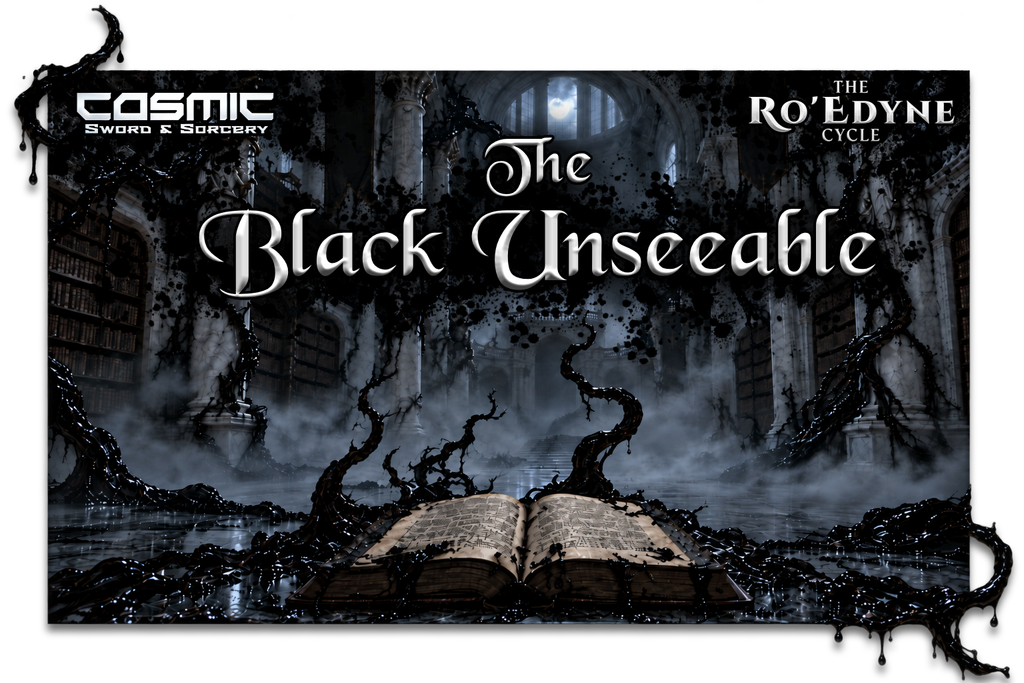
The Black Unseeable
The Black Unseeable
Among the countless artifacts catalogued throughout the history of the Greater Vandyrian Civilization, none has accumulated more names while yielding fewer certainties than the object commonly designated The Black Unseeable.
The consensus shared by every surviving archival institution is remarkably narrow. It is not regarded as a spellbook, despite its outward resemblance to one. It is not classified as an enchanted manuscript, cursed tome, living grimoire, or demonic artifact. Such classifications imply that the object performs magic upon the reader. The Black Unseeable instead appears to perform something vastly more fundamental. It alters the nature of recorded information itself. Every surviving containment doctrine therefore begins with the same administrative conclusion: the object is not dangerous because it is read. It is dangerous because it exists in the presence of writing.
Descriptions remain unusually consistent across civilizations separated by millions of years. Witnesses invariably describe an ordinary volume bound in featureless black material possessing neither title, ornamentation, author, nor identifiable script upon its cover. Its dimensions fluctuate slightly between accounts, though never beyond what scholars once dismissed as ordinary errors of observation. Attempts to record its weight, page count, language, ink composition, or methods of manufacture have produced contradictory results even when performed simultaneously by observers standing beside one another. More troubling still, no surviving catalogue agrees upon where the volume was first discovered.
Every civilization possessing records of The Black Unseeable believed itself to be documenting the artifact’s initial appearance, only for older documents to emerge centuries later proving another institution had already reached the same conclusion. The object therefore occupies an unprecedented administrative category within Imperial archival doctrine. Its origin is officially listed as Unknown, while the location of first discovery is recorded simply as Disputed by Every Existing Record.
The first stage of contamination is deceptively subtle. The Black Unseeable exhibits no immediate hostility toward living observers. It does not emit light, produce voices, project illusions, or compel individuals toward obsessive study in the manner associated with lesser memetic hazards. Instead, it remains entirely inert until placed within practical proximity of written language. Distance thresholds remain poorly understood, varying according to environmental conditions, volume density, and perhaps factors not yet recognized by surviving scholarship. Once sufficient written material occupies its vicinity, the process begins.
Nearby books first exhibit minor textual inconsistencies. Individual words migrate between pages. Marginal notes appear in volumes whose authors insist they never wrote them. Cross-references begin citing chapters that do not exist. Entire catalogues quietly reorder themselves overnight without corresponding changes to shelving. Initially these alterations resemble commonplace archival corruption, transcription error, or inattentive scholarship. It is this apparent banality that renders the first stage so catastrophically effective.
The second stage begins when surrounding works cease merely changing and instead begin reproducing the contamination itself. Books nearest the artifact slowly lose their individual identity until each becomes an exact duplicate of The Black Unseeable. Shelves once containing histories, engineering manuals, poetry, astronomical charts, theological disputes, legal doctrine, and biological surveys gradually become occupied by identical black volumes.
Their bindings match perfectly. Their dimensions converge. Their pages increasingly resemble one another despite originating from entirely unrelated manuscripts. Removal of the duplicates proves ineffective, for the process continues among whatever written works remain. Burning affected books merely accelerates replacement if uncontaminated texts continue existing nearby. Destroying catalogues causes inventories to rewrite themselves elsewhere. Eliminating copies without eliminating writing itself has repeatedly proven futile throughout recorded history.
It is only during the third generation that scholars generally realize they are no longer confronting corrupted literature. The copies begin diverging. Bindings thicken into leathery structures possessing no recognizable animal origin. Pages fuse together before unfolding into layered organic membranes. Ink ceases behaving as pigment, instead spreading through volumes as branching vascular networks resembling veins more than calligraphy.
Shelves deform beneath increasing biological pressure while manuscripts swell into cocoon-like structures suspended from resinous growths extending through stone, timber, and metal alike. At this stage every newly transformed volume differs slightly from those preceding it, as though successive generations undergo accelerated evolution rather than simple duplication. Libraries cease functioning as collections of information and instead become ecological systems whose reproductive substrate happens to be recorded language.
Surviving eyewitness testimony consistently reports that the process eventually expands beyond books entirely. Inventories, wall inscriptions, engineering diagrams, legal decrees, correspondence, maps, paintings containing written captions, engraved monuments, crystalline data storage, enchanted recording matrices, illuminated murals, and even temporary notes scratched into dust become viable mediums of propagation.
The contamination demonstrates no apparent preference for language, script, material, or technology. Ink, carved stone, etched steel, woven tapestries bearing heraldry, magically preserved memory crystals, and electronically encoded archives have all succumbed under suitable conditions. The Black Unseeable therefore represents not a corruption of paper, but of symbolic permanence itself. It appears capable of recognizing the abstract existence of recorded information irrespective of medium.
Perhaps the most disturbing aspect of the phenomenon is its apparent indifference toward living organisms. Individuals entering contaminated archives frequently survive for extended periods, sometimes days, while remaining physically unharmed. Instead, they report increasingly severe failures in memory, chronology, and conceptual continuity. Archivists forget where shelves once stood despite standing before them. Librarians become unable to distinguish catalogues from histories or dictionaries from personal journals.
Written communication rapidly deteriorates because newly composed notes themselves become active participants within the contamination. Entire containment efforts have reportedly collapsed simply because commanders attempted documenting containment procedures, thereby introducing additional written substrate upon which the phenomenon could propagate. Several Imperial preservation doctrines therefore prohibited note-taking entirely once contamination exceeded designated thresholds, requiring all communication to occur verbally until evacuation concluded.
Imperial archival doctrine ultimately abandoned every proposed method of destruction after repeated civilizational failure. Fire proved ineffective. Alchemical dissolution failed. Dimensional exile merely transferred contamination elsewhere. Magical purification rituals frequently accelerated transformation by introducing additional symbolic frameworks into the affected environment. Even attempts to erase language entirely produced contradictory outcomes, with damaged inscriptions reportedly regenerating into unfamiliar scripts over time. It was during the later Imperial Ages that containment philosophy underwent its decisive shift.
The objective ceased being destruction and became isolation. Entire archives were abandoned beneath mountains of engineered stone. Libraries were converted into sealed geological prisons. Great pyramids, fortress vaults, and isolated subterranean complexes originally believed by later historians to be ceremonial monuments are now understood by several restricted Imperial departments to have served an entirely different architectural purpose. They were not built to honor knowledge. They were built to imprison it.
For this reason, possession of The Black Unseeable constitutes one of the few offenses in Imperial jurisprudence requiring no demonstration of hostile intent. Discovery alone authorizes immediate quarantine under Archivist Exceptional Preservation Statutes. Military intervention remains subordinate to archival authority, an almost unprecedented inversion of normal Imperial hierarchy reflecting the unique nature of the threat.
Specialized Librarian Orders historically exercised direct command over engineering corps, sorcerers, preservation specialists, and regional governors whenever credible reports suggested possible manifestation. Their operational doctrine remained brutally simple. No investigation beyond minimum confirmation. No experimentation beyond established thresholds. No transportation except under already sanctioned containment protocols. Above all, no additional written material enters the containment zone once contamination is suspected. Entire civilizations ignored those procedures exactly once. None are known to have repeated the mistake.
Whether The Black Unseeable possesses intelligence remains unanswered. Some surviving testimonies describe apparent responses to observation, while others insist the phenomenon behaves with complete ecological indifference. Scholars arguing for intelligence point toward increasingly coherent structural organization during advanced contamination, while opponents counter that no direct communication has ever been reliably verified. The only universally accepted conclusion is considerably more unsettling.
Every civilization that attempted understanding The Black Unseeable as a book ceased treating it as one before the end. Every civilization that survived instead concluded they had been asking the wrong question from the beginning. The Black Unseeable is not a volume containing something dangerous. It is something dangerous that merely resembles a volume.
The distinction, though deceptively small, has repeatedly marked the boundary between successful containment and the permanent disappearance of entire libraries from recorded history.
