


The Great Highland City of the Northern Kingdoms
To understand Prandwir, one must first understand Panultimir. The modern city-state, proud though it may be, is little more than a distant echo of that ancient realm. Even the House of Prandwir, whose patronage, wealth, and determination rebuilt civilization upon these shores nearly seven centuries ago, would have seemed provincial beside the power of the Great Kingdom. The nobles who founded modern Prandwir deserve every honor afforded to them, for without their efforts the northern coast would likely remain abandoned ruin and seabird haunt. Yet in the measure of deep history, their accomplishments belong only to the most recent chapters of a story that began thousands of years earlier.
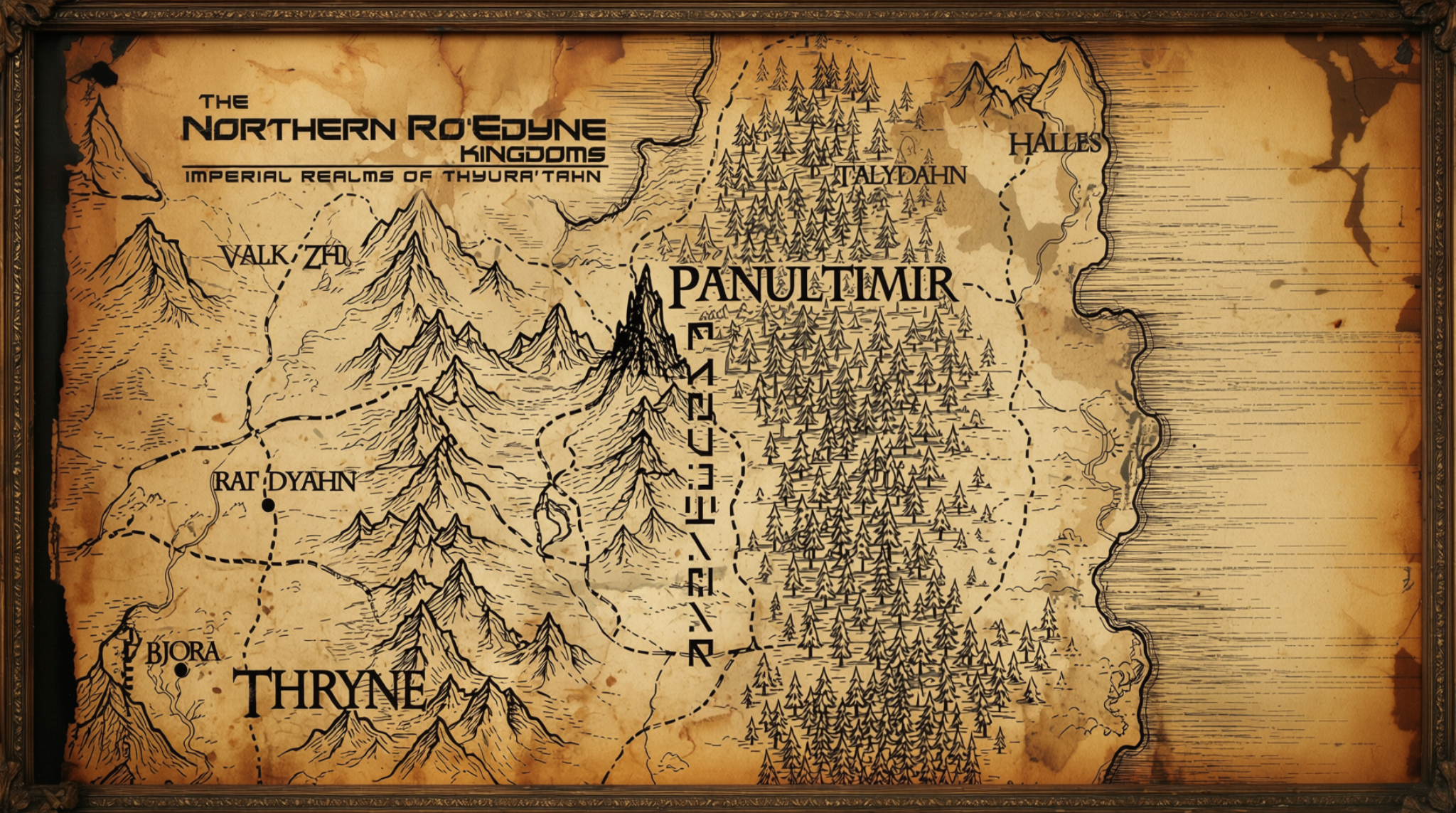
Long before the restoration of civilization, before the sinking of the northern realms, before the impacts that followed the Cataclysm, and indeed before the Cataclysm itself, this place stood at the heart of a kingdom whose scale is difficult for modern folk to comprehend. Panultimir was not merely a city, nor even a fortress realm. It was the greatest settlement of the Northern Ro’Edyne Kingdoms, a mountain-bound metropolis formed from three immense cities that gradually expanded until their walls, roads, markets, and districts merged into a single continuous urban landscape. From afar the kingdom appeared as a crown of black stone rising from the mountains, its towers visible for leagues across the northern territories.
In those distant ages the geography of the world was profoundly different. The northern seas had not yet swallowed the coastlands. Vast territories now lying beneath dark waters still stood above the waves. Great land bridges connected southern Ro’Edyne to the northern expanses and western kingdoms collectively remembered in surviving records as Thyuratahn. Roads stretched northward for hundreds of miles. Merchant caravans crossed fertile valleys that no longer exist. Entire provinces now known only through fragments of maps once flourished beneath the authority of Panultimir. The realms occupying these northern territories became known collectively as the Northern Ro’Edyne Kingdoms. There were many of them. Some ruled valleys. Some commanded coastlines. Others governed mountain passes or riverlands. Each possessed its own banners, traditions, noble houses, and ambitions. Yet among all these kingdoms there stood one power whose dominance was so complete that later historians often speak of the others only in relation to it. That power was Panultimir.
The ancient chroniclers referred to Panultimir simply as The Great Highland City. The title was not ceremonial exaggeration. Panultimir dwarfed its contemporaries in wealth, population, influence, and knowledge. While neighboring kingdoms measured prosperity through harvests, tribute, or military strength, Panultimir accumulated all three while also becoming the intellectual and cultural center of the entire northern world. Its markets attracted merchants from every direction. Its guild halls regulated crafts throughout the surrounding kingdoms. Its schools trained generations of architects, masons, navigators, scribes, engineers, and artisans whose works could be found across the breadth of Ro’Edyne.
The city possessed libraries so extensive that entire noble families dedicated themselves solely to copying and preserving manuscripts. Great archival halls extended beneath the mountains themselves, their vaults containing histories, legal records, maps, engineering treatises, genealogies, and works of philosophy gathered over centuries. Scholars traveled vast distances seeking access to collections unavailable anywhere else in the known world. The scribes of Panultimir became so respected that their copies of important works were often considered more valuable than the originals from which they were transcribed. Records from distant kingdoms were brought north for preservation. Merchant fleets deposited logs and charts within its archives. Noble houses entrusted dynastic histories to its librarians. It was said that if a thing was written anywhere within the northern world, a copy could eventually be found upon the shelves of Panultimir.
Nor was the kingdom devoted solely to scholarship. Panultimir stood equally as a center of industry and craftsmanship. Vast foundries burned day and night. Forges rang with the sounds of hammer and anvil. Master smiths produced arms, tools, architectural components, and ornamental works sought throughout the northern territories. Entire districts specialized in individual trades, from stonework and glassmaking to shipbuilding and metallurgy. The black stone architecture for which the kingdom later became famous was itself the product of generations of artisans refining techniques that allowed them to shape mountain rock into structures of astonishing scale and durability. The wealth generated by these industries flowed through guild halls, merchant consortiums, banking houses, and trade exchanges that connected nearly every significant settlement north of Ro’Edyne.
Magic and arcane study flourished alongside these pursuits. Surviving accounts speak of colleges dedicated to the examination of ancient forces, observatories constructed upon mountain peaks, and scholarly societies whose members debated the mysteries of creation beneath vaulted ceilings lined with silver and crystal. Much of this knowledge would later be lost during the disasters that followed, but fragments remain preserved within surviving archives, enough to hint at intellectual traditions whose sophistication exceeded anything found in the region today. The arts likewise enjoyed extraordinary patronage. Theaters, amphitheaters, galleries, music halls, and public forums occupied entire districts. Festivals lasting weeks drew visitors from across the northern kingdoms. Poets competed for noble sponsorship. Sculptors decorated plazas with monuments of black stone and silver. Musicians traveled between the three cities performing before audiences numbering in the thousands. Even centuries later, many surviving cultural traditions throughout northern Ro’Edyne can trace their origins directly to Panultimir.At the physical heart of the kingdom stood the Three Fortresses. Each occupied its own massive hillside district, and each functioned almost as a city unto itself. Constructed from black mountain stone, these colossal strongholds housed royal residences, military garrisons, industrial facilities, libraries, administrative halls, archives, and temples. Their walls rose above the surrounding city like mountains carved by deliberate hands. Generations of rulers expanded and reinforced them until they became among the most formidable structures in the northern world. The First Fortress served as the principal seat of governance, where kings, ministers, diplomats, and administrators directed the affairs of the kingdom. The Second Fortress dominated industry and military production, containing vast forges, workshops, warehouses, and armories. The Third Fortress became renowned for scholarship and preservation, housing some of the greatest libraries ever assembled within the northern realms. Though all three served overlapping functions, each developed its own identity, traditions, and institutions.
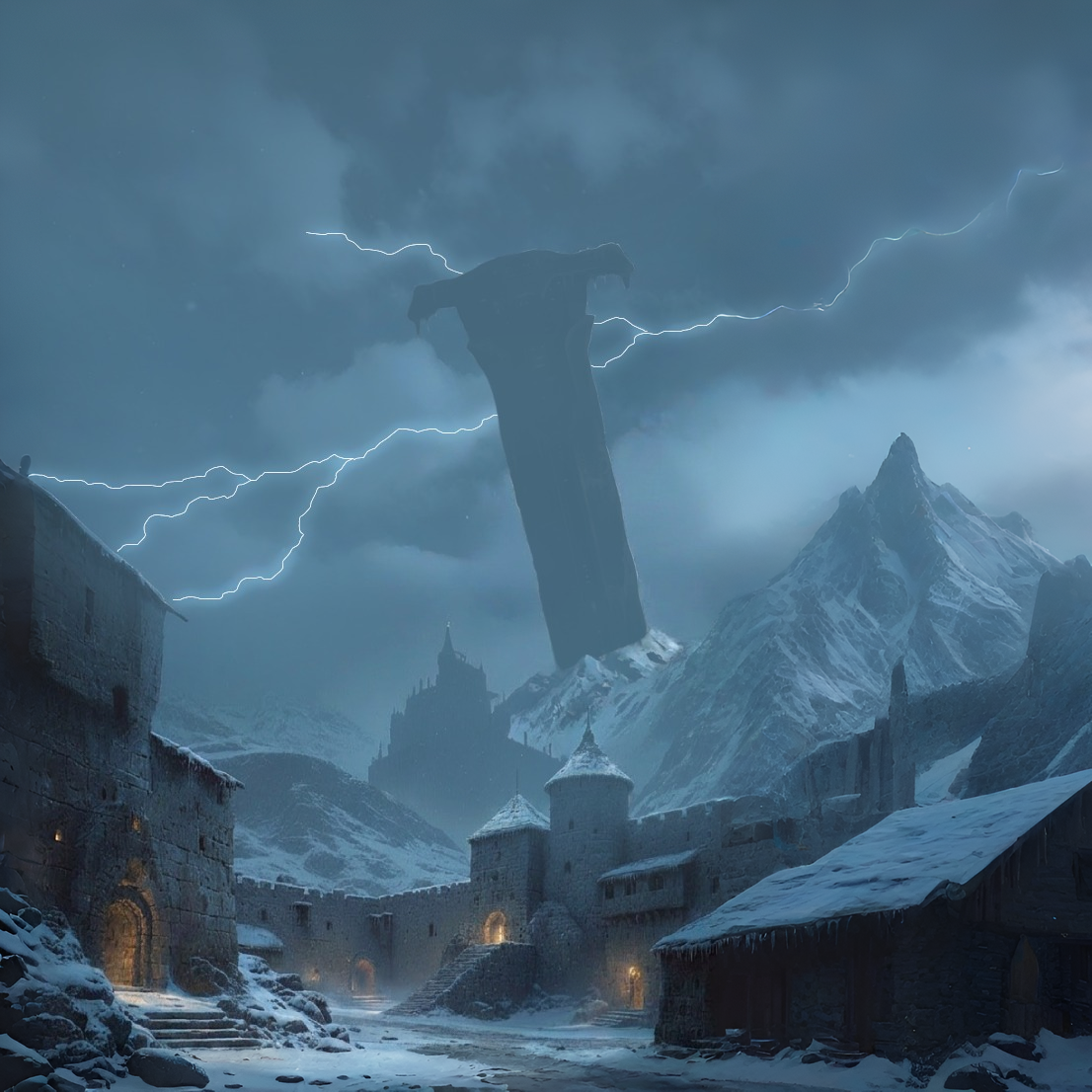
Above them all rose the Silver Tower. Modern historians continue to debate its exact height. Some descriptions undoubtedly exaggerate. Yet every surviving account agrees that it stood as the tallest structure in the northern kingdoms. Clad partially in reflective silver alloy, the tower could be seen from astonishing distances when sunlight struck its upper reaches. More remarkable still was the great docking platform constructed near its summit. There, according to numerous records, airships arrived from distant territories carrying merchants, dignitaries, scholars, and cargo. For many travelers the Silver Tower served as their first glimpse of Panultimir, appearing upon the horizon like a second mountain crowned in metal and light. To captains approaching from the south it became the symbol of arrival itself, a beacon announcing that they had reached the Great Highland City of the north.
The kingdom’s archives would ultimately become among its greatest legacies. As disaster gradually consumed the northern world, enormous efforts were undertaken to preserve what knowledge could be saved. Manuscripts, records, maps, and treatises were evacuated from endangered districts and relocated to increasingly secure repositories. Some found their way into isolated mountain strongholds. Others were dispersed among surviving kingdoms. Entire caravans were dedicated solely to the transport of books and records. Librarians became refugees. Archivists became explorers. Scribes became guardians of civilization itself. Centuries later, portions of these collections would eventually reach the libraries of modern Prandwir, where they remain among the city’s most treasured possessions. Though only a fraction of the original holdings survive, they constitute one of the most significant historical collections in northern Ro’Edyne.
Yet for all its greatness, Panultimir could not escape the fate that ultimately claimed the northern realms. The world changed. Seas advanced. Earthquakes shattered ancient roads. The Cataclysm brought devastation upon a scale beyond comprehension. Impacts followed. Coastlines disappeared. Entire provinces vanished beneath the waters. Trade routes collapsed. Kingdoms failed. One by one the neighboring realms of the north disappeared from history. Panultimir endured longer than most. Then it too began to fall. Its towers crumbled. Its districts emptied. Its population fled southward or vanished into the growing chaos of a changing world. The great roads became broken trails. The Silver Tower collapsed. Libraries burned or were abandoned. Fortresses once crowded with life became silent monuments overlooking a dying kingdom.
Today almost nothing remains visible upon the surface. Ruins lie scattered among the mountains. Foundations emerge from the earth where storms expose them. Forgotten tunnels descend into darkness. Fragments of walls appear upon lonely islands that were once hilltops overlooking inland valleys. The sea has claimed much. Time has claimed more. Yet Panultimir has never truly vanished. Its archives survive. Its roads linger beneath the soil. Its influence echoes through northern culture. Its memory remains preserved within songs, heraldry, traditions, and half-forgotten customs practiced by folk who no longer remember their origin.
Above all, Panultimir endures within Prandwir, the final settlement standing upon lands that once belonged to the Great Highland City. The modern city may be smaller. It may be poorer. It may possess only a fraction of the power once wielded by the ancient kingdom. Yet every library shelf, every recovered manuscript, every expedition into the ruins serves as a reminder that Prandwir is not merely built atop the bones of Panultimir. It is the last surviving heir of the greatest highland city the northern lands ever knew, a lone candle still burning long after the sun that lit it has vanished beyond the horizon.