Category: Cosmic Sword & Sorcery

  • The Great Flotillas

    The Great Flotillas

    The Great Flotillas

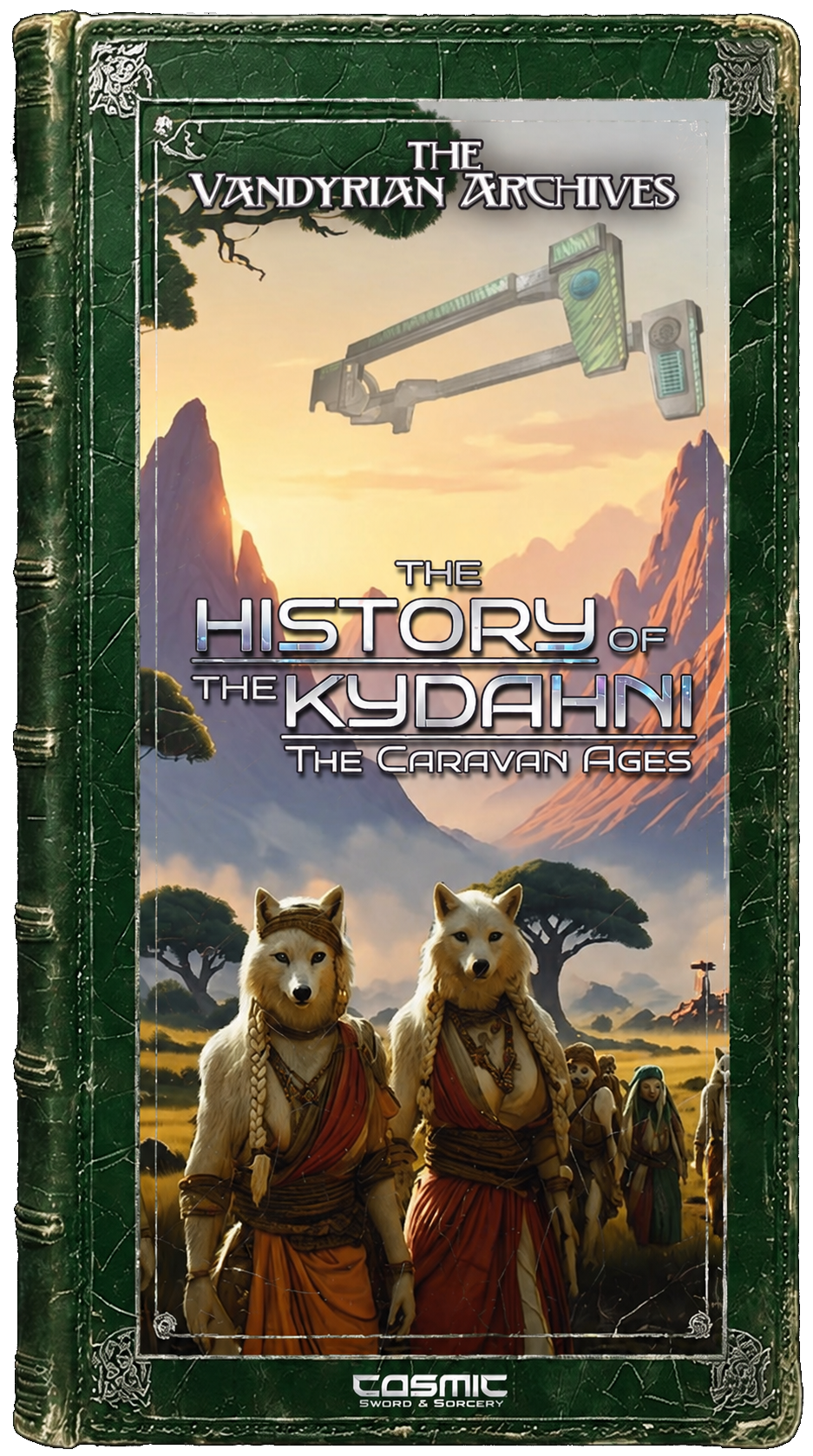
    As Kydahni caravan populations expanded in both number and geographic reach, the relatively modest migratory communities of the earliest ages gradually developed into immense traveling flotillas capable of supporting populations across generations. These formations were far more than collections of merchant vessels traveling under common protection. At their greatest extent, they functioned as mobile settlements in their own right, carrying workshops, markets, residences, storehouses, schools, archives, entertainment houses, medical facilities, repair yards, and the countless smaller institutions required to sustain communities that could not depend upon permanent access to foreign worlds.

    The flotilla became, in effect, territory made mobile. Where settled civilizations constructed cities upon planets and moons, the early Kydahni learned to construct much of the same social and economic complexity within communities capable of departing whenever circumstances demanded it.
    No single model defined the Great Flotillas. Some remained relatively compact commercial formations organized around specialized trades, while others grew into sprawling associations of vessels, families, guilds, merchants, laborers, entertainers, specialists, and dependent communities whose combined populations rivaled those of established settlements.

    Individual ships frequently served highly specialized purposes. Industrial vessels maintained machinery and fabricated replacement components. Agricultural and provisioning vessels extended the periods during which a flotilla could remain independent of planetary supply. Warehousing ships carried commodities intended for markets months or years farther along established routes. Residential vessels housed families whose members might be born, mature, raise offspring, and die without ever possessing a permanent planetary address. Larger formations could divide when commercial opportunities required it and reunite much later, allowing a single flotilla community to operate simultaneously across several neighboring regions without surrendering its collective identity.

    This mobility fundamentally altered the relationship between the Kydahni and the territorial powers through which they traveled. A conventional foreign enclave could be surrounded, taxed, confiscated, or expelled while leaving its accumulated infrastructure behind. A flotilla represented a considerably more difficult proposition. Its population, commercial inventory, records, specialists, machinery, and productive capacity could depart together. When political conditions deteriorated, the Kydahni did not necessarily abandon the principal mechanisms of their prosperity. They carried them away. A ruler might revoke docking privileges or close a market, but doing so increasingly meant watching an entire commercial ecosystem redirect itself toward a rival port. The ability to leave therefore became one of the earliest forms of collective Kydahni leverage. Mobility was no longer merely a means of escaping danger. It had become economic power.

    The flotillas consequently encouraged the development of internal authorities capable of functioning independently from the governments surrounding them. Disputes required arbitration while underway. Resources required allocation. Routes had to be negotiated, schedules coordinated, vessels maintained, births and deaths recorded, contracts witnessed, debts preserved, and collective decisions made concerning destinations and security.

    Foreign laws might govern Kydahni conduct while docked within recognized jurisdictions, but those laws could change dramatically after a single journey. The flotillas therefore required systems capable of preserving continuity as they crossed from one legal order into another. Early councils, route authorities, commercial arbiters, shipmasters, record keepers, and clan representatives emerged to meet these requirements. They did not yet constitute a territorial state, but neither were the Great Flotillas politically formless. They represented some of the earliest durable Kydahni experiments in governance without geography. Their economic importance expanded accordingly. Because flotillas moved continuously between otherwise disconnected markets, they could identify shortages in one region and surpluses in another with an efficiency unavailable to many sedentary powers. Goods were only part of this exchange. Skilled labor, technical knowledge, entertainment, financial services, messages, diplomatic correspondence, and news traveled alongside physical cargo.

    A flotilla arriving within an isolated system could bring information concerning political developments several jurisdictions away, introduce fashions and technologies previously unknown there, arrange contact with distant suppliers, and provide transportation to individuals whose own governments possessed no reliable means of reaching those regions. The Kydahni increasingly became not simply merchants operating upon existing trade routes, but connective infrastructure between civilizations whose political borders prevented them from developing equivalent networks themselves.

    The Great Flotillas also transformed Kydahni identity. Individuals born aboard different vessels might spend years separated from one another, yet shared institutions, genealogical records, contractual customs, festivals, professional relationships, and recurring rendezvous maintained continuity across distance. Flotillas divided, merged, exchanged populations, and reorganized according to economic and political circumstances without necessarily losing their identities. A community therefore ceased to require continuous occupation of a particular location in order to remain recognizably itself. The Kydahni increasingly understood that institutions could survive movement, that authority could survive distance, and that a people could possess continuity even when the ground beneath them changed constantly. This principle would become one of the defining achievements of the Caravan Ages.

    By the mature period, the largest flotillas had become institutions that neighboring powers could neither comfortably classify nor easily ignore. They were not sovereign worlds, yet they possessed populations, economies, internal authorities, productive systems, archives, and established relationships extending across multiple states. They were not conventional merchant houses, because entire communities traveled within them. They were not foreign governments, yet rulers negotiated with their representatives and frequently depended upon the services they provided. The Great Flotillas occupied the uncertain political space between commerce, community, and statehood, creating forms of organization for which the territorial civilizations of the period possessed few satisfactory equivalents.

    It was within these immense mobile societies that the conditions necessary for the first great Kydahni broker clans fully matured. The flotillas had created networks spanning jurisdictions, accumulated relationships across generations, and demonstrated that influence did not require possession of territory. What remained was for particular families and commercial lineages to learn how to coordinate those networks across distances greater than any individual caravan could travel. From that development emerged a new form of Kydahni authority: not command over land, but command over connections.
  • The First Caravan Polities

    The First Caravan Polities

    The First Caravan Polities

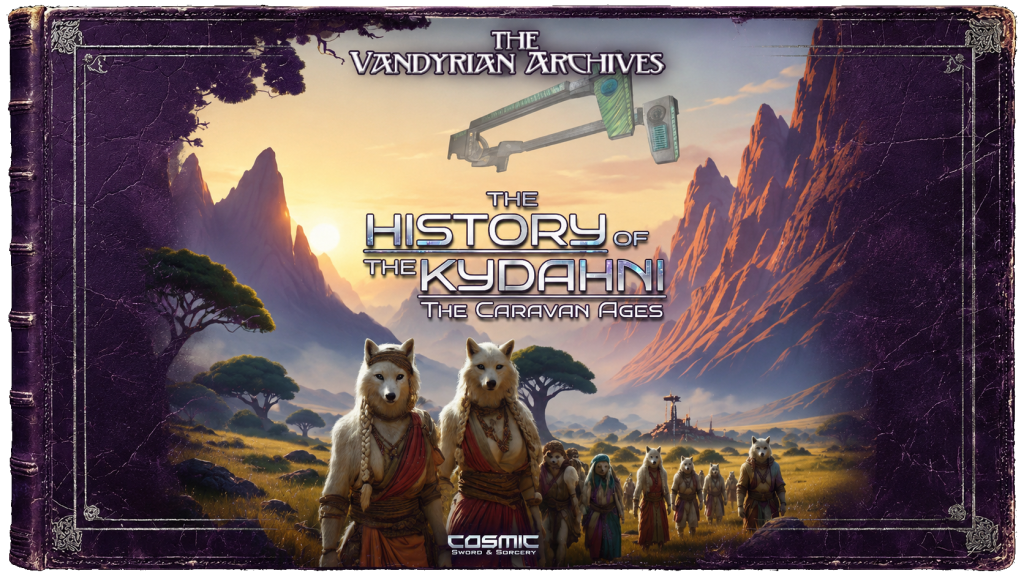
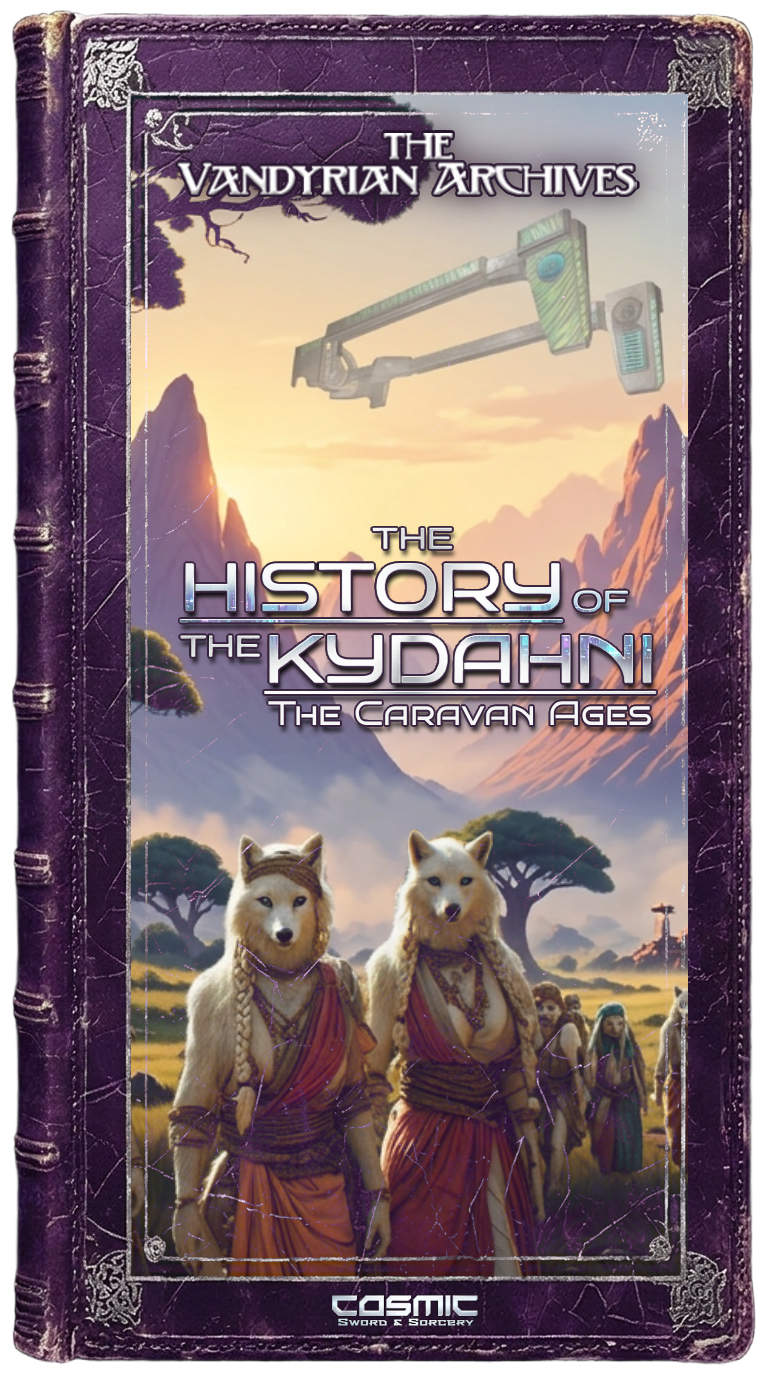
    The earliest known Kydahni populations existed as migratory caravan cultures operating throughout the older imperial territories of the Vandyrian spheres. These groups possessed no recognized Throneworld, no universally acknowledged homeland, and no permanent political center from which authority radiated outward. Instead, they moved continuously between established powers, operating along trade corridors, frontier routes, and peripheral systems often neglected by the greater dynasties.


    Their apparent lack of monumental cities or permanent territorial holdings led many contemporary civilizations to regard them as politically primitive, an interpretation repeated in surviving foreign records long after the Caravan Ages themselves had passed. This assessment fundamentally misunderstood the nature of Kydahni development. The caravans lacked fixed territory, but they did not lack civilization. Their political structures had simply developed around the management of populations, resources, relationships, and infrastructure that could not depend upon permanent geography.

    Their survival depended upon mobility. Entire populations traveled in immense commercial flotillas, mobile settlements, and wandering trade networks capable of relocating rapidly whenever political conditions shifted. This nomadic structure developed not from cultural preference alone, but from necessity. The Kydahni frequently found themselves tolerated only so long as they remained useful. A dynasty willing to welcome them during one generation might expel them during the next. Borders changed. Alliances collapsed. Governments fell. The caravans endured. Consequently, Kydahni infrastructure developed according to assumptions almost opposite those of settled civilizations.

    Workshops, archives, markets, administrative offices, educational institutions, communications systems, and industrial facilities were designed wherever possible around portability, redundancy, modularity, and rapid reconstruction. Technologies ordinarily associated with permanent urban centers were adapted for use aboard ships, temporary settlements, caravan stations, and distributed communities. What appeared from the outside to be a people perpetually rebuilding was, in many cases, a civilization specifically engineered to survive relocation.

    This produced considerable technological sophistication. Kydahni engineers became particularly adept at maintaining complex machinery under conditions where replacement components, specialized facilities, and established supply chains could not be assumed to exist. Infrastructure was designed to remain serviceable across enormous distances and under wildly different local conditions. Standardized components allowed equipment from separate flotillas to be repaired or exchanged during periodic rendezvous, while mobile fabrication systems reduced dependence upon the industrial centers of foreign powers.

    Energy, sanitation, storage, communications, navigation, environmental control, and transportation all received extraordinary attention because failures in these systems could threaten entire traveling populations. The resulting technologies were not always visually impressive by the standards of the great dynastic capitals, but they were durable, adaptable, and extraordinarily efficient. A monumental civilization could afford to build something that remained useful only where it stood. The Kydahni increasingly regarded such limitations as liabilities.


    Their sophistication was equally visible in social organization. A population moving continuously between foreign jurisdictions could not depend upon a single external legal system, currency, administrative language, or political authority. The earliest caravan polities therefore developed methods for maintaining internal continuity while accommodating radically different conditions outside themselves. Records followed families rather than territories. Obligations survived changes of jurisdiction. Professional associations extended between otherwise separated communities.

    Disputes required arbitration that remained meaningful after the participants had departed the world upon which the dispute originated. Authority increasingly attached itself to function: navigators governed matters of passage, commercial arbiters governed contracts, logistical authorities managed collective resources, and respected lineages maintained relationships extending far beyond any individual caravan. These arrangements remained less centralized than the governments surrounding them, but they were not less sophisticated. They represented an advanced form of distributed administration adapted to a civilization for which distance and political instability were permanent conditions.

    Within these migratory societies, adaptability became the primary virtue. Communities learned to function without guarantees of permanence. Economic flexibility, social cohesion, and information gathering became essential tools of survival. Kydahni populations developed reputations as traders, brokers, entertainers, transport operators, financiers, technicians, and intermediaries capable of functioning between rival civilizations that refused direct contact with one another. Their caravans moved goods, messages, luxuries, specialists, technologies, credit, and information across regions where conventional political structures often failed.

    This placed the Kydahni in contact with an extraordinary range of social systems, and they became accomplished students of foreign custom out of practical necessity. Knowing what another civilization valued, feared, prohibited, desired, or considered negotiable could determine whether a caravan departed enriched, impoverished, imprisoned, or expelled. What later Kydahni civilization would formalize into elaborate traditions of Appraisal had already begun here as an everyday requirement of movement between peoples who did not share the same assumptions.


    The caravan polities consequently became laboratories of social engineering as much as mobile commercial communities. Maintaining cohesion among populations scattered across enormous distances required deliberate mechanisms of identity, communication, recordkeeping, mutual obligation, and cultural continuity. Customs that could survive relocation were favored over those dependent upon particular landscapes. Institutions were designed to remain recognizable even when their physical surroundings changed. Genealogies, contracts, professional affiliations, ceremonial practices, shared histories, and recurring assemblies helped bind communities that might separate for years before meeting again.

    The Kydahni became increasingly capable of preserving a common civilizational identity without requiring continuous physical proximity. A settlement could disappear from one system and reconstitute itself elsewhere without necessarily suffering the institutional death that such displacement would have inflicted upon a territorially organized society. This distinction would become one of the defining achievements of the Caravan Ages.

  • The Caravan Civilization

    The Caravan Civilization

    The Caravan Civilization

    The history conventionally described as the Caravan Civilization begins approximately thirteen million years before the present age, in regions of the ancient Vandyrian spheres lying beyond the Core Worlds and far removed from the Ran system. This was not the beginning of the Kydahni people.

    Their own accounts extend considerably further backward, into the remote histories of Elder Imperial Space, though what fortunes befell their ancestors there, what powers they served or opposed, and under what conditions they departed those elder realms remain unknown beyond the histories retained by the Kydahni themselves. By the time they become sufficiently visible within surviving external records, they already call themselves Kydahni. No known ancestral planet bears that name, nor has any credible record established a lost Kydahni Throneworld from which the people supposedly took their identity. The name belonged to the people before it ever belonged to a world.


    This distinction is particularly important because the later planet of Kydahn can otherwise create a misleading impression of conventional origin. Kydahn was not the cradle from which the Kydahni emerged, nor was their civilization named after it. The sequence was precisely the reverse. The people existed first, carrying the Kydahni name across the ancient spheres for millions of years before their history brought them anywhere near the Ran system. When a world within Ran eventually became their great territorial home, that world was named Kydahn because it had become the world of the Kydahni. In this sense, even their eventual possession of a homeland preserved something fundamental from the Caravan Ages: the land did not define the people. The people defined the land.

    What lies before their emergence into the recoverable record remains one of the great closed regions of Kydahni history. Their traditions evidently reach into Elder Imperial antiquity, but the civilization has never provided outsiders with a continuous public chronology of those ages. Foreign archives provide little independent illumination, leaving no reliable means of determining where the ancestral Kydahni lived, how widely they were distributed, what political identity they possessed before the name by which they are now known, or what sequence of events preceded their appearance among the civilizations documented here.


    Consequently, the Caravan Ages should not be treated as an origin point. They represent an archival horizon: the period beyond which the Vandyrian Archives can acknowledge the existence of deeper history, but cannot responsibly describe its contents.

  • I. Origins of the White Wolves

    I. Origins of the White Wolves

    I. Origins of the White Wolves

    Popular histories, particularly those produced outside the Ran systems, often begin the story of Kydahn at the moment of its ascension, presenting the White Wolves as if they emerged fully formed into positions of power and authority.
    Such interpretations are fundamentally incorrect.

    The Kydahni did not originate as rulers, sovereigns, or inheritors of ancient thrones. Their earliest reliably documented history is instead one of displacement, mobility, exclusion, and survival. Kydahni traditions themselves claim histories extending considerably farther into the past, including accounts of populations, migrations, and ancestral associations predating the Caravan Ages described here. These traditions cannot simply be dismissed; fragments preserved within later Kydahni archives suggest that at least portions may descend from genuine historical memory. Yet their chronology is incomplete, their surviving evidence uneven, and much of the material remains entirely absent from contemporary Core World records.

    To reconstruct those unknown ages through assumption would therefore replace history with conjecture. For the purposes of the present history, the Caravan Ages represent not the unquestionable beginning of the Kydahni people, but the earliest period in which their development can be followed with sufficient continuity to support a meaningful historical account.

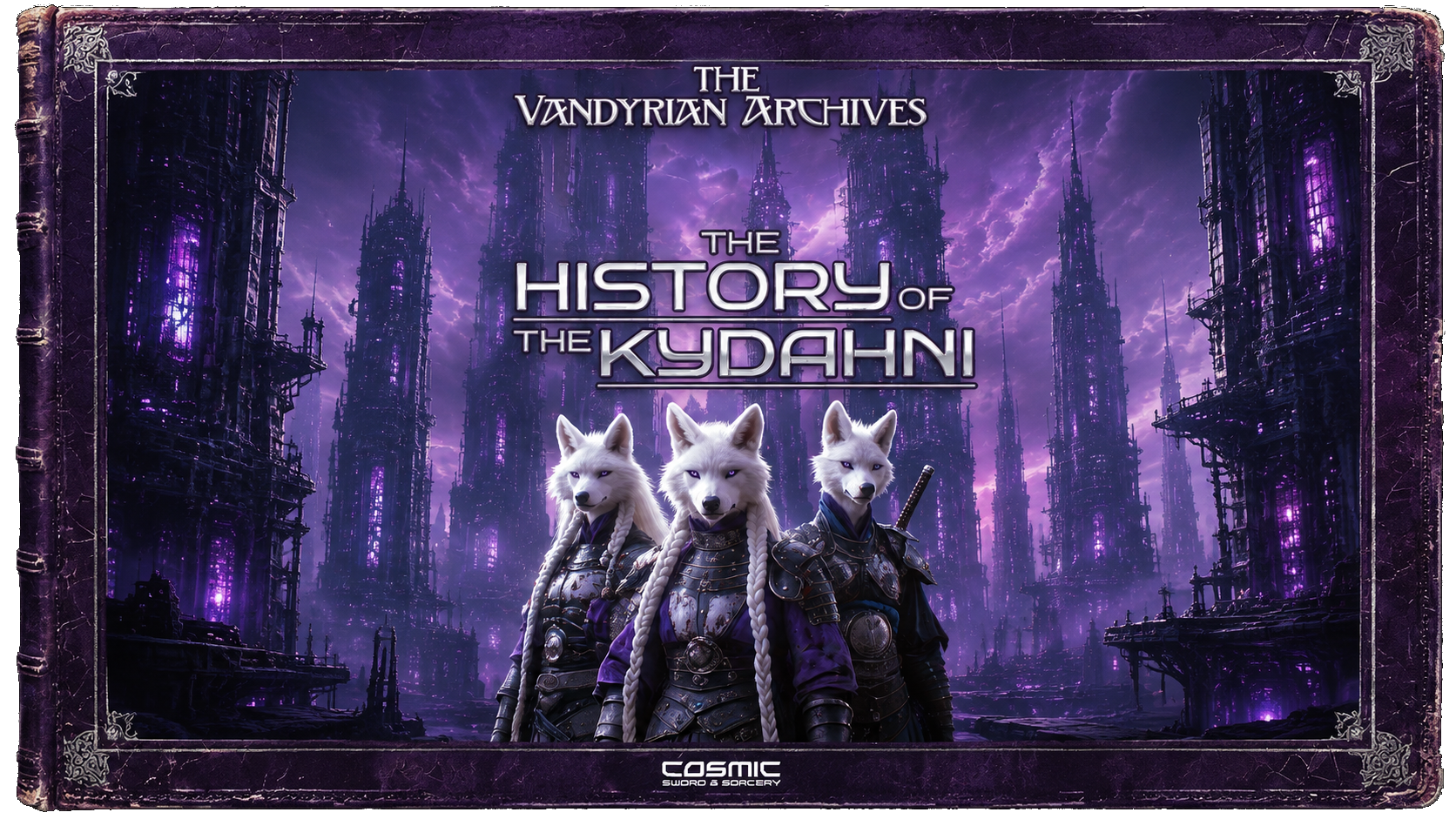
    Long before the black towers of Kydahn dominated the horizons of imperial space, the ancestors of the White Wolves existed as migratory populations moving through the margins of older civilizations that regarded them with suspicion, dependence, and contempt in equal measure.

    The formative centuries of documented Kydahni development were not spent constructing empires, but enduring them. Their identity emerged not from possession of territory, but from the absence of it. While neighboring powers established dynasties, codified borders, and claimed permanent worlds, the early Kydahni learned to survive without such guarantees. This condition would leave an indelible mark upon the species, shaping not only their political development, but the psychological architecture that would later define Kydahni civilization across millions of years of recorded history.

    Yet the Caravan Ages should not be understood merely as an extended prehistory preceding the emergence of Kydahn proper. It was during these ages that many of the institutions later regarded as characteristically Kydahni first assumed recognizable form. The requirements of continuous movement encouraged portable administration, distributed archives, extraterritorial law, sophisticated systems of credit and obligation, extensive information networks, mobile industry, diasporic communities, and commercial authorities whose influence could extend across political boundaries without possessing those boundaries themselves.

    Practices later associated with the Great Houses, Imperial Appraisal, Kydahni intelligence, logistical administration, and the extraordinary institutional continuity of the dynastic ages did not suddenly appear with the acquisition of sovereign territory. Their foundations had already been laid by generations of caravan populations required to preserve civilization while moving through worlds belonging to others.

    This was the central paradox of the Caravan Ages. The absence of a homeland remained a profound vulnerability, exposing Kydahni populations repeatedly to exclusion, confiscation, exploitation, and forced migration; yet the adaptations required to survive that condition gradually produced forms of resilience unavailable to many of the territorial civilizations surrounding them. Institutions learned to survive the loss of buildings. Law learned to survive the crossing of borders. Wealth learned to survive the fall of governments. Communities learned to survive separation, and historical memory learned to survive generations.

    Eventually, even authority itself became increasingly independent of geography. By the closing centuries of the age, the White Wolves had not yet acquired the Throneworld, dynasties, armies, or territorial dominion for which later Kydahn would become infamous. They had acquired something more fundamental: a civilization capable of remaining itself wherever its people went.


    Books within ‘The Caravan Ages’

    Updates

  • Introduction

    Introduction

    INTRODUCTION

    The history presented within this volume is not the work of any single scholar, chronicler, institution, or age. It represents the product of ages of research conducted across the vast archives of Vandyrian civilization, assembled from works whose authors were frequently separated from one another by extraordinary distances of time, geography, allegiance, and understanding:

    The earliest histories of the Kydahni are particularly resistant to simple reconstruction. Their movements crossed innumerable jurisdictions, their institutions were deliberately distributed, their records were frequently concealed, and much of what they considered private history was never intended for foreign examination.

    Consequently, what survives is scattered across caravan ledgers, dynastic chronicles, recovered correspondence, route records, commercial agreements, foreign observations, ancestral accounts, archaeological discoveries, and fragments preserved in archives whose original relationship to the White Wolves was sometimes forgotten long before their rediscovery.

    Many of these sources originate with the Kydahni themselves, though even these cannot be regarded as a single continuous tradition. Others survive among the civilizations they encountered during their migrations: rulers who employed them, merchants who traded beside them, officials who attempted to regulate them, populations who welcomed them, and governments that eventually expelled them. Their testimony ranges accordingly.

    Some remembered the caravans with gratitude and regarded their arrival as the beginning of prosperity, communication, or renewed contact with distant worlds. Others recorded them with suspicion, resentment, hostility, or naught but enduring disdain. Between these extremes survives the far greater body of mundane testimony produced by those for whom the Kydahni were simply neighbors, competitors, creditors, clients, travelers, entertainers, intermediaries, or familiar strangers passing repeatedly through their civilization.

    The resulting history is therefore an assembly rather than a singular chronicle. Deep-time routes of interest have been reconstructed from sources that were never intended to complement one another. Events remembered proudly in one archive survive as accusations in another. Kydahni accounts occasionally preserve details omitted by foreign chroniclers, while foreign records sometimes reveal circumstances the Kydahni themselves chose not to discuss beyond their own circles.

    Where these fragments converge, a larger history becomes visible: not an uninterrupted record, nor a claim that every uncertainty has been resolved, but the accumulated outline of a civilization whose presence can be traced through the histories of countless others.

    What follows is the Vandyrian Archives’ reconstruction of that long record—the history of the White Wolves as preserved by those who were Kydahni, those who knew them, those who depended upon them, those who despised them, and those who merely watched them pass.


    Next Book

  • The History of the Kydahni

    The History of the Kydahni


    INTRODUCTION

    Volumes:

    📚The Caravan Ages

    Books:


    COMING SOON


    Volumes


    Books within ‘The Caravan Ages

    Updates

  • VANDYRIAN STEEL [ALBUM]

    VANDYRIAN STEEL [ALBUM]


    Opening [Instrumental]
    Once Upon a Time
    Thanator [CROWN OF IRON]
    Fire Beyond the Stone
    Vandyrian Skies [Instrumental]
    Savage Sword
    Somebody Stop Me
    Evil Eyes
    When You Are all Gone
    The Halls of Panultimir [Instrumental]
    Take the Whole Wide World
    The Sorcerer
    “Kha’RamAzh’na” – [Final Decree]
  • Imperial System Lords

    Imperial System Lords


    “Among the highest appointments available within the Imperial administrative hierarchy, few offices carry greater responsibility than that of a System Lord.

    Contrary to the assumptions often made by frontier populations, a System Lord is neither a hereditary monarch nor an independent sovereign. The title denotes an Imperial steward entrusted with the administration, defense, and long-term prosperity of one or more strategically significant stellar systems. While individual personalities, governing philosophies, and military traditions differ considerably from one holder of the office to another, every System Lord ultimately serves as an extension of Imperial authority, exercising immense discretion while remaining accountable to institutions far older and greater than themselves.

    The scale of this responsibility cannot be adequately measured through military command alone. A competent fleet admiral may direct wars, and a capable governor may oversee a prosperous colony, yet a System Lord must integrate every major function of civilization into a coherent whole. Trade, infrastructure, colonization, industrial output, diplomacy, taxation, ecological preservation, strategic resource management, judicial oversight, frontier expansion, disaster response, and military readiness all fall within the sphere of their administration. Success is therefore measured less by victories upon the battlefield than by the continued stability of systems expected to endure for centuries without descending into stagnation, corruption, or dependency.

    Appointment to such a station is correspondingly uncommon. The office is neither purchased nor casually inherited, and few individuals spend their careers expecting to attain it. Those ultimately selected have generally accumulated extraordinary records across multiple branches of Imperial service, demonstrating not merely competence within a single discipline, but sustained excellence in administration, logistics, diplomacy, economics, and strategic command over the course of decades. By the time an individual assumes the mantle of System Lord, they have typically become one of the Empire’s most thoroughly evaluated public servants, their strengths and failures alike documented through an institutional memory spanning generations.”

    —The Sovereign Arcanum


    Related