



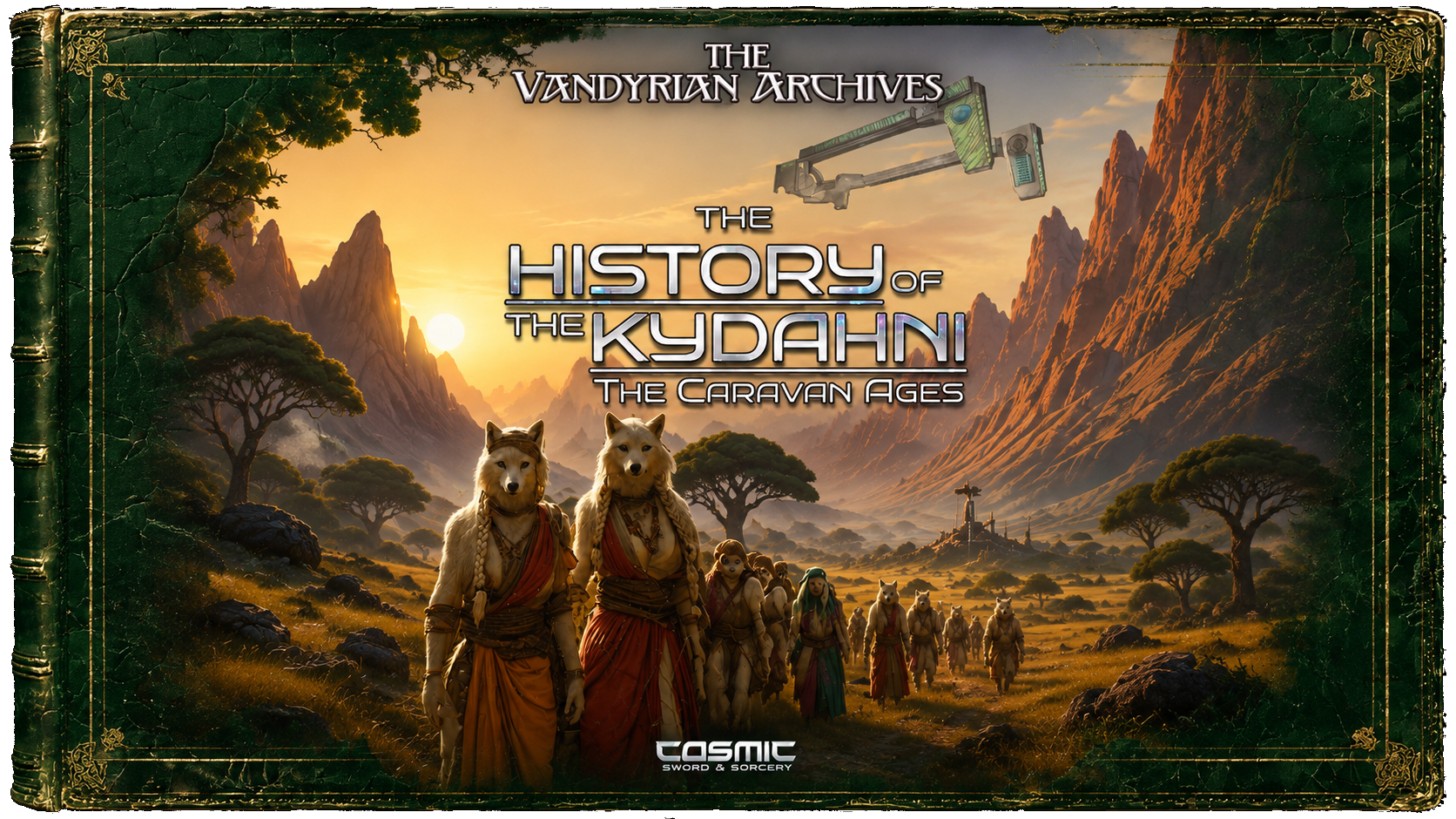
The Caravan Civilization
The history conventionally described as the Caravan Civilization begins approximately thirteen million years before the present age, in regions of the ancient Vandyrian spheres lying beyond the Core Worlds and far removed from the Ran system. This was not the beginning of the Kydahni people.
Their own accounts extend considerably further backward, into the remote histories of Elder Imperial Space, though what fortunes befell their ancestors there, what powers they served or opposed, and under what conditions they departed those elder realms remain unknown beyond the histories retained by the Kydahni themselves. By the time they become sufficiently visible within surviving external records, they already call themselves Kydahni. No known ancestral planet bears that name, nor has any credible record established a lost Kydahni Throneworld from which the people supposedly took their identity. The name belonged to the people before it ever belonged to a world.
This distinction is particularly important because the later planet of Kydahn can otherwise create a misleading impression of conventional origin. Kydahn was not the cradle from which the Kydahni emerged, nor was their civilization named after it. The sequence was precisely the reverse. The people existed first, carrying the Kydahni name across the ancient spheres for millions of years before their history brought them anywhere near the Ran system. When a world within Ran eventually became their great territorial home, that world was named Kydahn because it had become the world of the Kydahni. In this sense, even their eventual possession of a homeland preserved something fundamental from the Caravan Ages: the land did not define the people. The people defined the land.
What lies before their emergence into the recoverable record remains one of the great closed regions of Kydahni history. Their traditions evidently reach into Elder Imperial antiquity, but the civilization has never provided outsiders with a continuous public chronology of those ages. Foreign archives provide little independent illumination, leaving no reliable means of determining where the ancestral Kydahni lived, how widely they were distributed, what political identity they possessed before the name by which they are now known, or what sequence of events preceded their appearance among the civilizations documented here.
Consequently, the Caravan Ages should not be treated as an origin point. They represent an archival horizon: the period beyond which the Vandyrian Archives can acknowledge the existence of deeper history, but cannot responsibly describe its contents.