



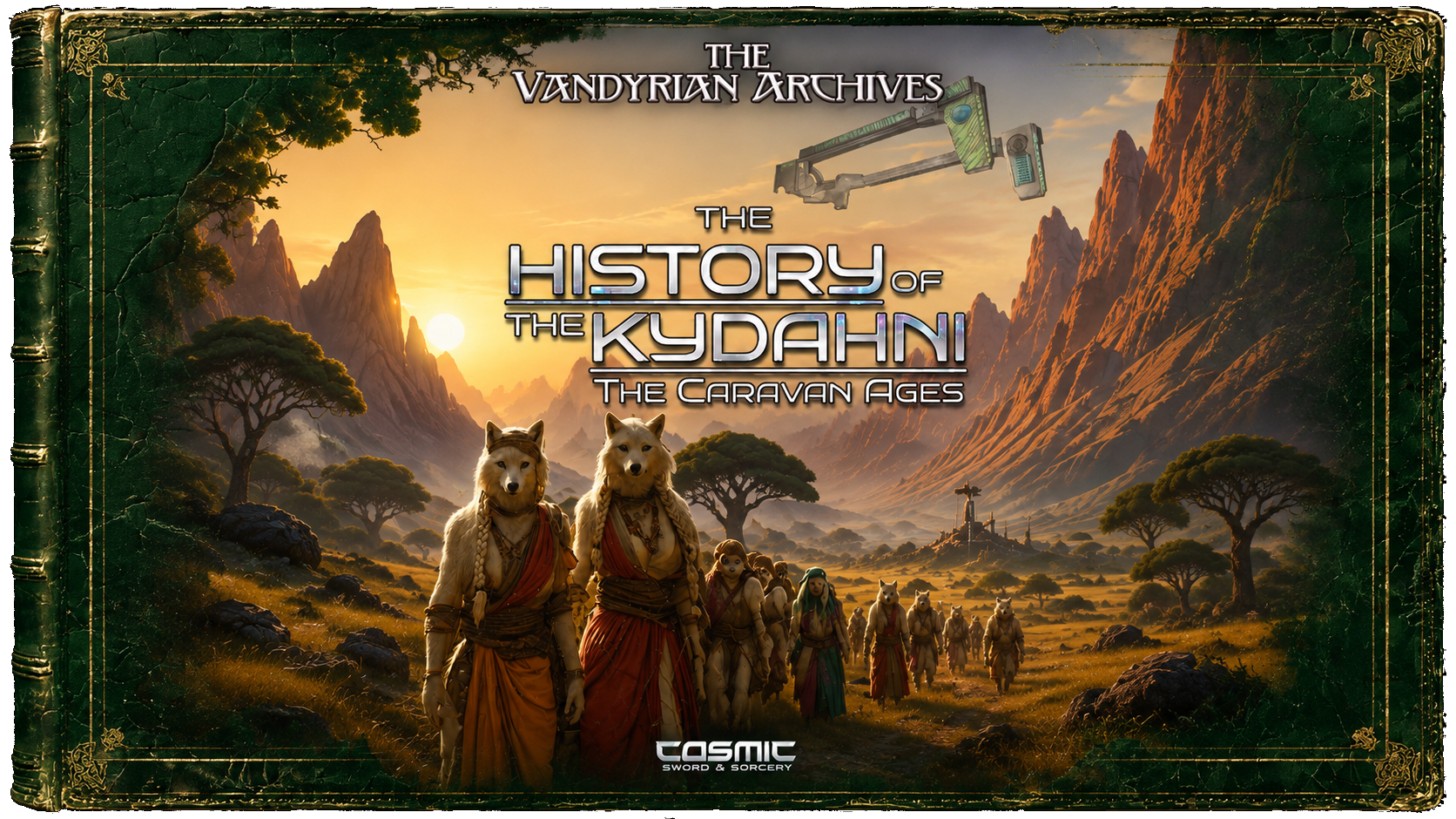
The First Caravan Polities
The earliest known Kydahni populations existed as migratory caravan cultures operating throughout the older imperial territories of the Vandyrian spheres. These groups possessed no recognized Throneworld, no universally acknowledged homeland, and no permanent political center from which authority radiated outward. Instead, they moved continuously between established powers, operating along trade corridors, frontier routes, and peripheral systems often neglected by the greater dynasties.
Their apparent lack of monumental cities or permanent territorial holdings led many contemporary civilizations to regard them as politically primitive, an interpretation repeated in surviving foreign records long after the Caravan Ages themselves had passed. This assessment fundamentally misunderstood the nature of Kydahni development. The caravans lacked fixed territory, but they did not lack civilization. Their political structures had simply developed around the management of populations, resources, relationships, and infrastructure that could not depend upon permanent geography.
Their survival depended upon mobility. Entire populations traveled in immense commercial flotillas, mobile settlements, and wandering trade networks capable of relocating rapidly whenever political conditions shifted. This nomadic structure developed not from cultural preference alone, but from necessity. The Kydahni frequently found themselves tolerated only so long as they remained useful. A dynasty willing to welcome them during one generation might expel them during the next. Borders changed. Alliances collapsed. Governments fell. The caravans endured. Consequently, Kydahni infrastructure developed according to assumptions almost opposite those of settled civilizations.
Workshops, archives, markets, administrative offices, educational institutions, communications systems, and industrial facilities were designed wherever possible around portability, redundancy, modularity, and rapid reconstruction. Technologies ordinarily associated with permanent urban centers were adapted for use aboard ships, temporary settlements, caravan stations, and distributed communities. What appeared from the outside to be a people perpetually rebuilding was, in many cases, a civilization specifically engineered to survive relocation.
This produced considerable technological sophistication. Kydahni engineers became particularly adept at maintaining complex machinery under conditions where replacement components, specialized facilities, and established supply chains could not be assumed to exist. Infrastructure was designed to remain serviceable across enormous distances and under wildly different local conditions. Standardized components allowed equipment from separate flotillas to be repaired or exchanged during periodic rendezvous, while mobile fabrication systems reduced dependence upon the industrial centers of foreign powers.
Energy, sanitation, storage, communications, navigation, environmental control, and transportation all received extraordinary attention because failures in these systems could threaten entire traveling populations. The resulting technologies were not always visually impressive by the standards of the great dynastic capitals, but they were durable, adaptable, and extraordinarily efficient. A monumental civilization could afford to build something that remained useful only where it stood. The Kydahni increasingly regarded such limitations as liabilities.
Their sophistication was equally visible in social organization. A population moving continuously between foreign jurisdictions could not depend upon a single external legal system, currency, administrative language, or political authority. The earliest caravan polities therefore developed methods for maintaining internal continuity while accommodating radically different conditions outside themselves. Records followed families rather than territories. Obligations survived changes of jurisdiction. Professional associations extended between otherwise separated communities.
Disputes required arbitration that remained meaningful after the participants had departed the world upon which the dispute originated. Authority increasingly attached itself to function: navigators governed matters of passage, commercial arbiters governed contracts, logistical authorities managed collective resources, and respected lineages maintained relationships extending far beyond any individual caravan. These arrangements remained less centralized than the governments surrounding them, but they were not less sophisticated. They represented an advanced form of distributed administration adapted to a civilization for which distance and political instability were permanent conditions.
Within these migratory societies, adaptability became the primary virtue. Communities learned to function without guarantees of permanence. Economic flexibility, social cohesion, and information gathering became essential tools of survival. Kydahni populations developed reputations as traders, brokers, entertainers, transport operators, financiers, technicians, and intermediaries capable of functioning between rival civilizations that refused direct contact with one another. Their caravans moved goods, messages, luxuries, specialists, technologies, credit, and information across regions where conventional political structures often failed.
This placed the Kydahni in contact with an extraordinary range of social systems, and they became accomplished students of foreign custom out of practical necessity. Knowing what another civilization valued, feared, prohibited, desired, or considered negotiable could determine whether a caravan departed enriched, impoverished, imprisoned, or expelled. What later Kydahni civilization would formalize into elaborate traditions of Appraisal had already begun here as an everyday requirement of movement between peoples who did not share the same assumptions.
The caravan polities consequently became laboratories of social engineering as much as mobile commercial communities. Maintaining cohesion among populations scattered across enormous distances required deliberate mechanisms of identity, communication, recordkeeping, mutual obligation, and cultural continuity. Customs that could survive relocation were favored over those dependent upon particular landscapes. Institutions were designed to remain recognizable even when their physical surroundings changed. Genealogies, contracts, professional affiliations, ceremonial practices, shared histories, and recurring assemblies helped bind communities that might separate for years before meeting again.
The Kydahni became increasingly capable of preserving a common civilizational identity without requiring continuous physical proximity. A settlement could disappear from one system and reconstitute itself elsewhere without necessarily suffering the institutional death that such displacement would have inflicted upon a territorially organized society. This distinction would become one of the defining achievements of the Caravan Ages.