


I. Origins of the White Wolves
Popular histories, particularly those produced outside the Ran systems, often begin the story of Kydahn at the moment of its ascension, presenting the White Wolves as if they emerged fully formed into positions of power and authority.
Such interpretations are fundamentally incorrect.
The Kydahni did not originate as rulers, sovereigns, or inheritors of ancient thrones. Their earliest reliably documented history is instead one of displacement, mobility, exclusion, and survival. Kydahni traditions themselves claim histories extending considerably farther into the past, including accounts of populations, migrations, and ancestral associations predating the Caravan Ages described here. These traditions cannot simply be dismissed; fragments preserved within later Kydahni archives suggest that at least portions may descend from genuine historical memory. Yet their chronology is incomplete, their surviving evidence uneven, and much of the material remains entirely absent from contemporary Core World records.
To reconstruct those unknown ages through assumption would therefore replace history with conjecture. For the purposes of the present history, the Caravan Ages represent not the unquestionable beginning of the Kydahni people, but the earliest period in which their development can be followed with sufficient continuity to support a meaningful historical account.
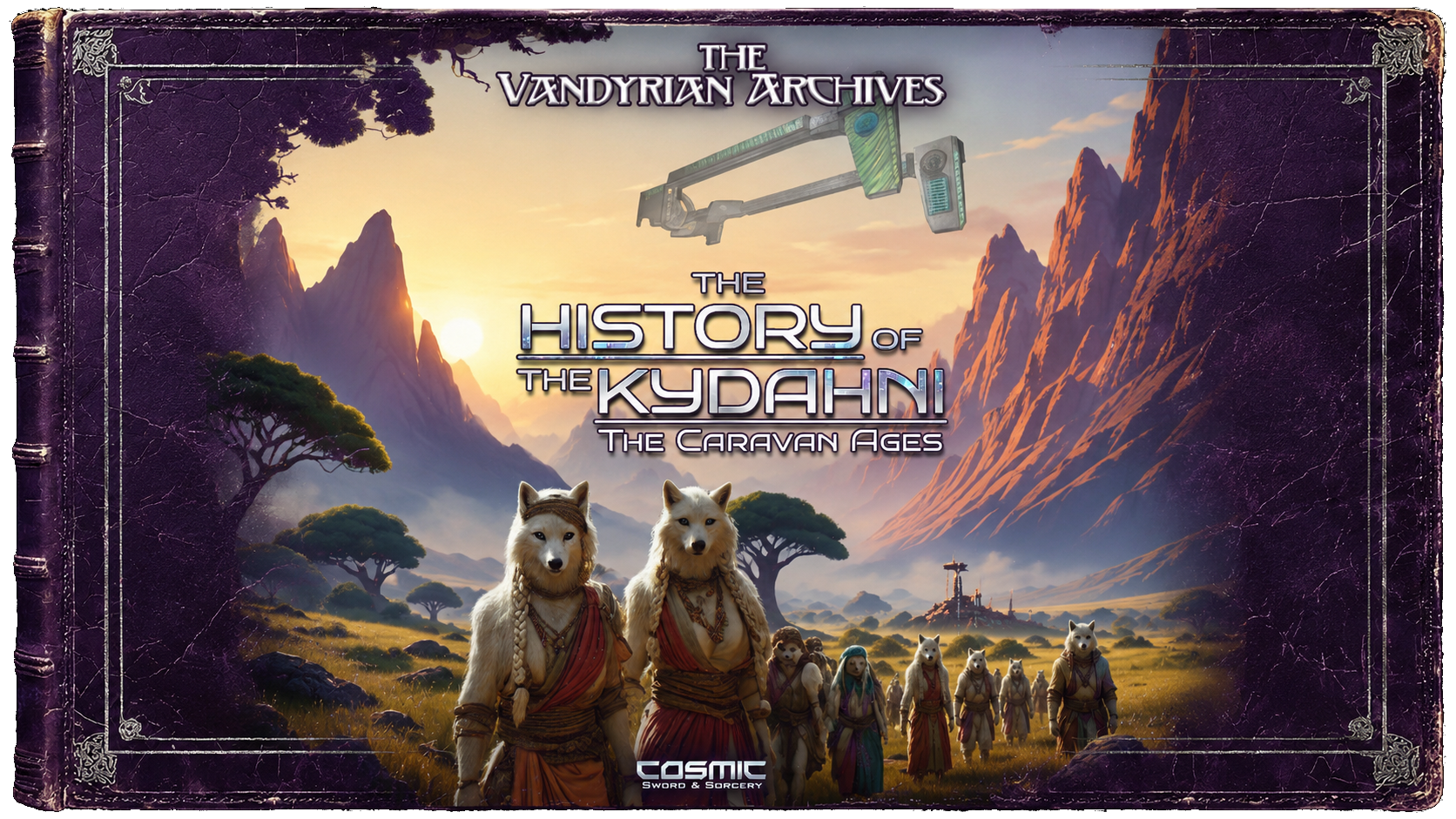
Long before the black towers of Kydahn dominated the horizons of imperial space, the ancestors of the White Wolves existed as migratory populations moving through the margins of older civilizations that regarded them with suspicion, dependence, and contempt in equal measure.
The formative centuries of documented Kydahni development were not spent constructing empires, but enduring them. Their identity emerged not from possession of territory, but from the absence of it. While neighboring powers established dynasties, codified borders, and claimed permanent worlds, the early Kydahni learned to survive without such guarantees. This condition would leave an indelible mark upon the species, shaping not only their political development, but the psychological architecture that would later define Kydahni civilization across millions of years of recorded history.
Yet the Caravan Ages should not be understood merely as an extended prehistory preceding the emergence of Kydahn proper. It was during these ages that many of the institutions later regarded as characteristically Kydahni first assumed recognizable form. The requirements of continuous movement encouraged portable administration, distributed archives, extraterritorial law, sophisticated systems of credit and obligation, extensive information networks, mobile industry, diasporic communities, and commercial authorities whose influence could extend across political boundaries without possessing those boundaries themselves.
Practices later associated with the Great Houses, Imperial Appraisal, Kydahni intelligence, logistical administration, and the extraordinary institutional continuity of the dynastic ages did not suddenly appear with the acquisition of sovereign territory. Their foundations had already been laid by generations of caravan populations required to preserve civilization while moving through worlds belonging to others.
This was the central paradox of the Caravan Ages. The absence of a homeland remained a profound vulnerability, exposing Kydahni populations repeatedly to exclusion, confiscation, exploitation, and forced migration; yet the adaptations required to survive that condition gradually produced forms of resilience unavailable to many of the territorial civilizations surrounding them. Institutions learned to survive the loss of buildings. Law learned to survive the crossing of borders. Wealth learned to survive the fall of governments. Communities learned to survive separation, and historical memory learned to survive generations.
Eventually, even authority itself became increasingly independent of geography. By the closing centuries of the age, the White Wolves had not yet acquired the Throneworld, dynasties, armies, or territorial dominion for which later Kydahn would become infamous. They had acquired something more fundamental: a civilization capable of remaining itself wherever its people went.