Category: Books [COSMIC SWORD & SORCERY]

  • The First Caravan Polities

    The First Caravan Polities

    The First Caravan Polities

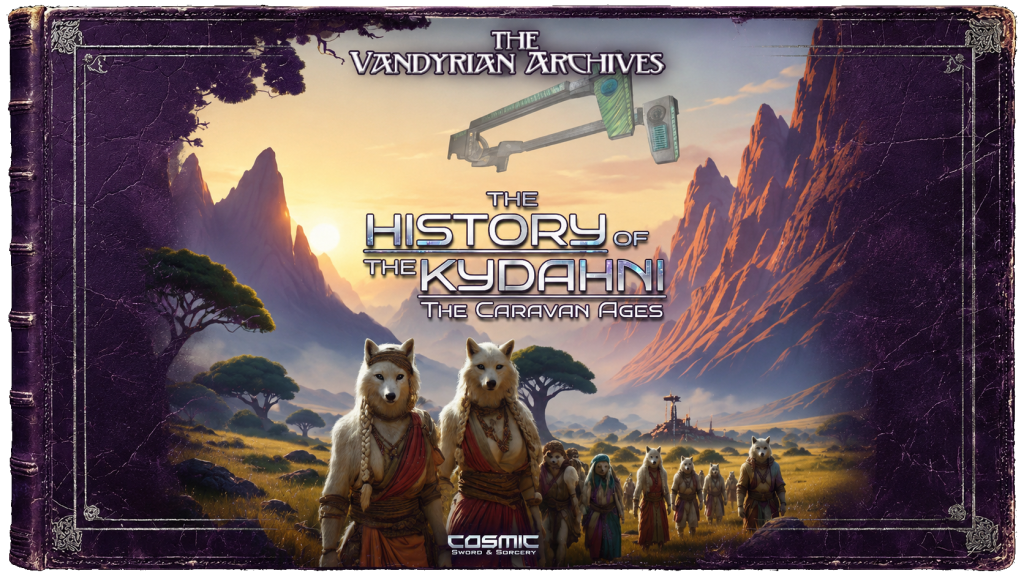
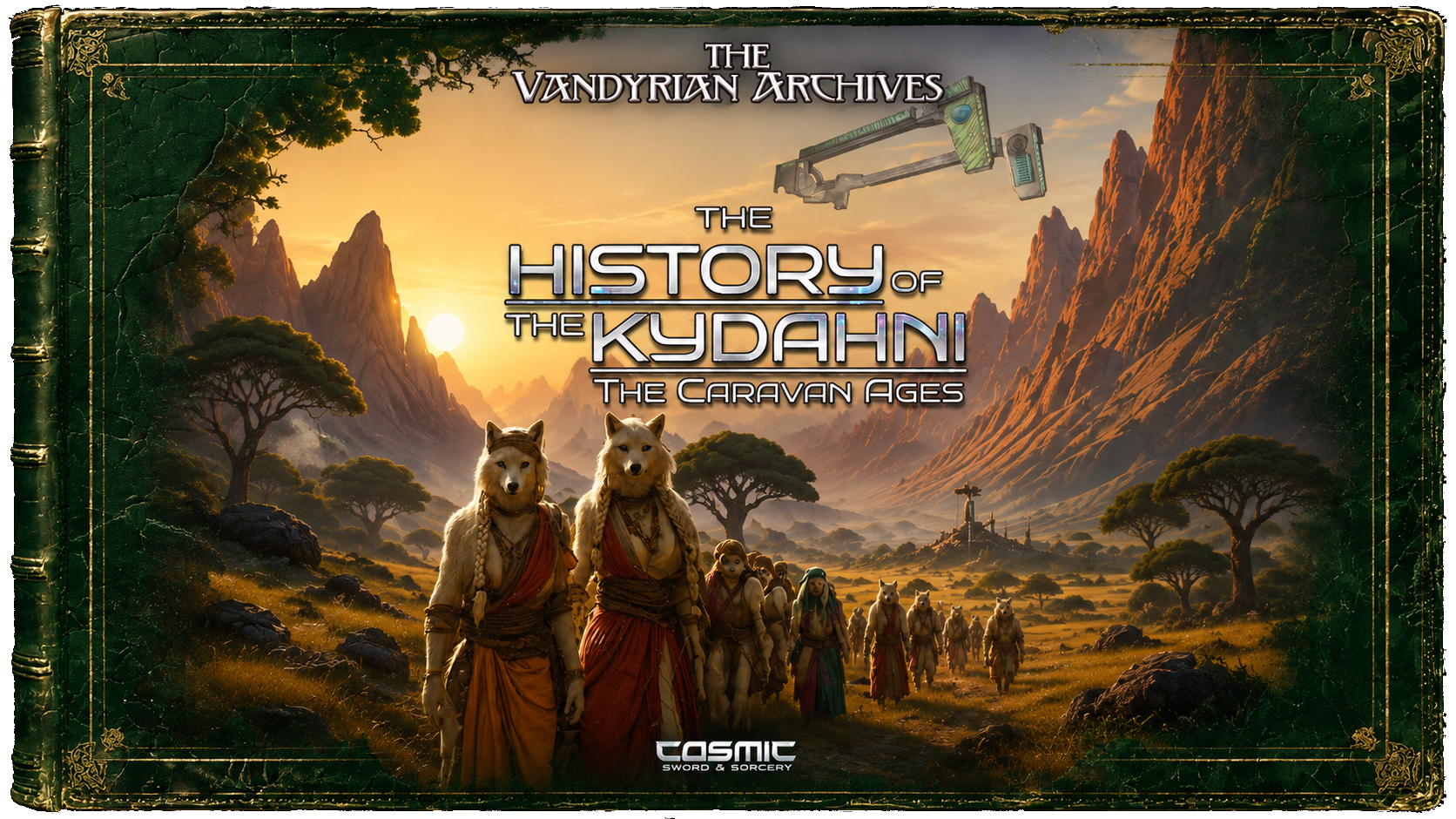
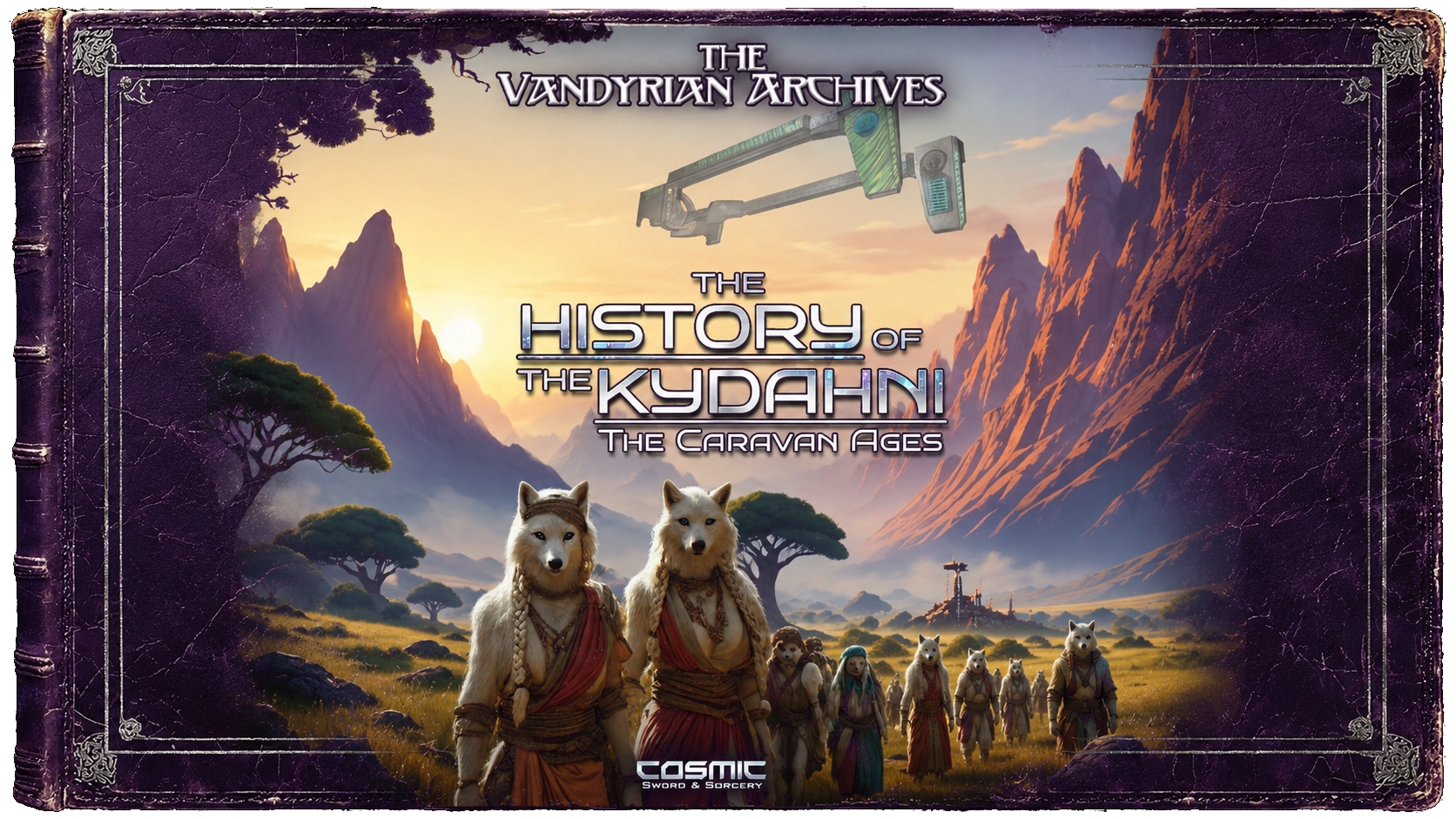
    The earliest known Kydahni populations existed as migratory caravan cultures operating throughout the older imperial territories of the Vandyrian spheres. These groups possessed no recognized Throneworld, no universally acknowledged homeland, and no permanent political center from which authority radiated outward. Instead, they moved continuously between established powers, operating along trade corridors, frontier routes, and peripheral systems often neglected by the greater dynasties.


    Their apparent lack of monumental cities or permanent territorial holdings led many contemporary civilizations to regard them as politically primitive, an interpretation repeated in surviving foreign records long after the Caravan Ages themselves had passed. This assessment fundamentally misunderstood the nature of Kydahni development. The caravans lacked fixed territory, but they did not lack civilization. Their political structures had simply developed around the management of populations, resources, relationships, and infrastructure that could not depend upon permanent geography.

    Their survival depended upon mobility. Entire populations traveled in immense commercial flotillas, mobile settlements, and wandering trade networks capable of relocating rapidly whenever political conditions shifted. This nomadic structure developed not from cultural preference alone, but from necessity. The Kydahni frequently found themselves tolerated only so long as they remained useful. A dynasty willing to welcome them during one generation might expel them during the next. Borders changed. Alliances collapsed. Governments fell. The caravans endured. Consequently, Kydahni infrastructure developed according to assumptions almost opposite those of settled civilizations.

    Workshops, archives, markets, administrative offices, educational institutions, communications systems, and industrial facilities were designed wherever possible around portability, redundancy, modularity, and rapid reconstruction. Technologies ordinarily associated with permanent urban centers were adapted for use aboard ships, temporary settlements, caravan stations, and distributed communities. What appeared from the outside to be a people perpetually rebuilding was, in many cases, a civilization specifically engineered to survive relocation.

    This produced considerable technological sophistication. Kydahni engineers became particularly adept at maintaining complex machinery under conditions where replacement components, specialized facilities, and established supply chains could not be assumed to exist. Infrastructure was designed to remain serviceable across enormous distances and under wildly different local conditions. Standardized components allowed equipment from separate flotillas to be repaired or exchanged during periodic rendezvous, while mobile fabrication systems reduced dependence upon the industrial centers of foreign powers.

    Energy, sanitation, storage, communications, navigation, environmental control, and transportation all received extraordinary attention because failures in these systems could threaten entire traveling populations. The resulting technologies were not always visually impressive by the standards of the great dynastic capitals, but they were durable, adaptable, and extraordinarily efficient. A monumental civilization could afford to build something that remained useful only where it stood. The Kydahni increasingly regarded such limitations as liabilities.


    Their sophistication was equally visible in social organization. A population moving continuously between foreign jurisdictions could not depend upon a single external legal system, currency, administrative language, or political authority. The earliest caravan polities therefore developed methods for maintaining internal continuity while accommodating radically different conditions outside themselves. Records followed families rather than territories. Obligations survived changes of jurisdiction. Professional associations extended between otherwise separated communities.

    Disputes required arbitration that remained meaningful after the participants had departed the world upon which the dispute originated. Authority increasingly attached itself to function: navigators governed matters of passage, commercial arbiters governed contracts, logistical authorities managed collective resources, and respected lineages maintained relationships extending far beyond any individual caravan. These arrangements remained less centralized than the governments surrounding them, but they were not less sophisticated. They represented an advanced form of distributed administration adapted to a civilization for which distance and political instability were permanent conditions.

    Within these migratory societies, adaptability became the primary virtue. Communities learned to function without guarantees of permanence. Economic flexibility, social cohesion, and information gathering became essential tools of survival. Kydahni populations developed reputations as traders, brokers, entertainers, transport operators, financiers, technicians, and intermediaries capable of functioning between rival civilizations that refused direct contact with one another. Their caravans moved goods, messages, luxuries, specialists, technologies, credit, and information across regions where conventional political structures often failed.

    This placed the Kydahni in contact with an extraordinary range of social systems, and they became accomplished students of foreign custom out of practical necessity. Knowing what another civilization valued, feared, prohibited, desired, or considered negotiable could determine whether a caravan departed enriched, impoverished, imprisoned, or expelled. What later Kydahni civilization would formalize into elaborate traditions of Appraisal had already begun here as an everyday requirement of movement between peoples who did not share the same assumptions.


    The caravan polities consequently became laboratories of social engineering as much as mobile commercial communities. Maintaining cohesion among populations scattered across enormous distances required deliberate mechanisms of identity, communication, recordkeeping, mutual obligation, and cultural continuity. Customs that could survive relocation were favored over those dependent upon particular landscapes. Institutions were designed to remain recognizable even when their physical surroundings changed. Genealogies, contracts, professional affiliations, ceremonial practices, shared histories, and recurring assemblies helped bind communities that might separate for years before meeting again.

    The Kydahni became increasingly capable of preserving a common civilizational identity without requiring continuous physical proximity. A settlement could disappear from one system and reconstitute itself elsewhere without necessarily suffering the institutional death that such displacement would have inflicted upon a territorially organized society. This distinction would become one of the defining achievements of the Caravan Ages.

  • The Caravan Civilization

    The Caravan Civilization

    The Caravan Civilization

    The history conventionally described as the Caravan Civilization begins approximately thirteen million years before the present age, in regions of the ancient Vandyrian spheres lying beyond the Core Worlds and far removed from the Ran system. This was not the beginning of the Kydahni people.

    Their own accounts extend considerably further backward, into the remote histories of Elder Imperial Space, though what fortunes befell their ancestors there, what powers they served or opposed, and under what conditions they departed those elder realms remain unknown beyond the histories retained by the Kydahni themselves. By the time they become sufficiently visible within surviving external records, they already call themselves Kydahni. No known ancestral planet bears that name, nor has any credible record established a lost Kydahni Throneworld from which the people supposedly took their identity. The name belonged to the people before it ever belonged to a world.


    This distinction is particularly important because the later planet of Kydahn can otherwise create a misleading impression of conventional origin. Kydahn was not the cradle from which the Kydahni emerged, nor was their civilization named after it. The sequence was precisely the reverse. The people existed first, carrying the Kydahni name across the ancient spheres for millions of years before their history brought them anywhere near the Ran system. When a world within Ran eventually became their great territorial home, that world was named Kydahn because it had become the world of the Kydahni. In this sense, even their eventual possession of a homeland preserved something fundamental from the Caravan Ages: the land did not define the people. The people defined the land.

    What lies before their emergence into the recoverable record remains one of the great closed regions of Kydahni history. Their traditions evidently reach into Elder Imperial antiquity, but the civilization has never provided outsiders with a continuous public chronology of those ages. Foreign archives provide little independent illumination, leaving no reliable means of determining where the ancestral Kydahni lived, how widely they were distributed, what political identity they possessed before the name by which they are now known, or what sequence of events preceded their appearance among the civilizations documented here.


    Consequently, the Caravan Ages should not be treated as an origin point. They represent an archival horizon: the period beyond which the Vandyrian Archives can acknowledge the existence of deeper history, but cannot responsibly describe its contents.

  • I. Origins of the White Wolves

    I. Origins of the White Wolves

    I. Origins of the White Wolves

    Popular histories, particularly those produced outside the Ran systems, often begin the story of Kydahn at the moment of its ascension, presenting the White Wolves as if they emerged fully formed into positions of power and authority.
    Such interpretations are fundamentally incorrect.

    The Kydahni did not originate as rulers, sovereigns, or inheritors of ancient thrones. Their earliest reliably documented history is instead one of displacement, mobility, exclusion, and survival. Kydahni traditions themselves claim histories extending considerably farther into the past, including accounts of populations, migrations, and ancestral associations predating the Caravan Ages described here. These traditions cannot simply be dismissed; fragments preserved within later Kydahni archives suggest that at least portions may descend from genuine historical memory. Yet their chronology is incomplete, their surviving evidence uneven, and much of the material remains entirely absent from contemporary Core World records.

    To reconstruct those unknown ages through assumption would therefore replace history with conjecture. For the purposes of the present history, the Caravan Ages represent not the unquestionable beginning of the Kydahni people, but the earliest period in which their development can be followed with sufficient continuity to support a meaningful historical account.

    Long before the black towers of Kydahn dominated the horizons of imperial space, the ancestors of the White Wolves existed as migratory populations moving through the margins of older civilizations that regarded them with suspicion, dependence, and contempt in equal measure.

    The formative centuries of documented Kydahni development were not spent constructing empires, but enduring them. Their identity emerged not from possession of territory, but from the absence of it. While neighboring powers established dynasties, codified borders, and claimed permanent worlds, the early Kydahni learned to survive without such guarantees. This condition would leave an indelible mark upon the species, shaping not only their political development, but the psychological architecture that would later define Kydahni civilization across millions of years of recorded history.

    Yet the Caravan Ages should not be understood merely as an extended prehistory preceding the emergence of Kydahn proper. It was during these ages that many of the institutions later regarded as characteristically Kydahni first assumed recognizable form. The requirements of continuous movement encouraged portable administration, distributed archives, extraterritorial law, sophisticated systems of credit and obligation, extensive information networks, mobile industry, diasporic communities, and commercial authorities whose influence could extend across political boundaries without possessing those boundaries themselves.

    Practices later associated with the Great Houses, Imperial Appraisal, Kydahni intelligence, logistical administration, and the extraordinary institutional continuity of the dynastic ages did not suddenly appear with the acquisition of sovereign territory. Their foundations had already been laid by generations of caravan populations required to preserve civilization while moving through worlds belonging to others.

    This was the central paradox of the Caravan Ages. The absence of a homeland remained a profound vulnerability, exposing Kydahni populations repeatedly to exclusion, confiscation, exploitation, and forced migration; yet the adaptations required to survive that condition gradually produced forms of resilience unavailable to many of the territorial civilizations surrounding them. Institutions learned to survive the loss of buildings. Law learned to survive the crossing of borders. Wealth learned to survive the fall of governments. Communities learned to survive separation, and historical memory learned to survive generations.

    Eventually, even authority itself became increasingly independent of geography. By the closing centuries of the age, the White Wolves had not yet acquired the Throneworld, dynasties, armies, or territorial dominion for which later Kydahn would become infamous. They had acquired something more fundamental: a civilization capable of remaining itself wherever its people went.


    Books within ‘The Caravan Ages’

    Updates

  • Introduction

    Introduction

    INTRODUCTION

    The history presented within this volume is not the work of any single scholar, chronicler, institution, or age. It represents the product of ages of research conducted across the vast archives of Vandyrian civilization, assembled from works whose authors were frequently separated from one another by extraordinary distances of time, geography, allegiance, and understanding:

    The earliest histories of the Kydahni are particularly resistant to simple reconstruction. Their movements crossed innumerable jurisdictions, their institutions were deliberately distributed, their records were frequently concealed, and much of what they considered private history was never intended for foreign examination.

    Consequently, what survives is scattered across caravan ledgers, dynastic chronicles, recovered correspondence, route records, commercial agreements, foreign observations, ancestral accounts, archaeological discoveries, and fragments preserved in archives whose original relationship to the White Wolves was sometimes forgotten long before their rediscovery.

    Many of these sources originate with the Kydahni themselves, though even these cannot be regarded as a single continuous tradition. Others survive among the civilizations they encountered during their migrations: rulers who employed them, merchants who traded beside them, officials who attempted to regulate them, populations who welcomed them, and governments that eventually expelled them. Their testimony ranges accordingly.

    Some remembered the caravans with gratitude and regarded their arrival as the beginning of prosperity, communication, or renewed contact with distant worlds. Others recorded them with suspicion, resentment, hostility, or naught but enduring disdain. Between these extremes survives the far greater body of mundane testimony produced by those for whom the Kydahni were simply neighbors, competitors, creditors, clients, travelers, entertainers, intermediaries, or familiar strangers passing repeatedly through their civilization.

    The resulting history is therefore an assembly rather than a singular chronicle. Deep-time routes of interest have been reconstructed from sources that were never intended to complement one another. Events remembered proudly in one archive survive as accusations in another. Kydahni accounts occasionally preserve details omitted by foreign chroniclers, while foreign records sometimes reveal circumstances the Kydahni themselves chose not to discuss beyond their own circles.

    Where these fragments converge, a larger history becomes visible: not an uninterrupted record, nor a claim that every uncertainty has been resolved, but the accumulated outline of a civilization whose presence can be traced through the histories of countless others.

    What follows is the Vandyrian Archives’ reconstruction of that long record—the history of the White Wolves as preserved by those who were Kydahni, those who knew them, those who depended upon them, those who despised them, and those who merely watched them pass.


    Next Book

  • Chapter 13

    Chapter 13

    ON THE ACQUISITION OF KNOWLEDGE


    THE COST OF IGNORANCE

    Military operations impose burdens upon every level of civilization. Fleets consume fuel, personnel, industrial output, transportation capacity, administrative effort, and strategic reserves. Campaigns require years of preparation, vast expenditures of resources, and the coordinated efforts of countless institutions. Even successful operations impose costs. Failed operations impose far greater ones.

    For this reason, ignorance is among the most expensive conditions a commander may permit. A civilization may spend decades constructing fleets, training personnel, expanding industrial capacity, and preparing for conflict. Yet a single decision made without sufficient knowledge may squander those investments within days. Resources consumed through ignorance are rarely recoverable.

    Hostile powers may compete for years while awaiting opportunities measured in hours. Entire campaigns may be decided by information obtained before the first deployment order is issued. To commit military force while remaining deliberately uninformed regarding the adversary, the environment, or the conditions of conflict is not economy. It is waste.

    The wise commander therefore understands that the acquisition of knowledge is not separate from warfare. It is among the foundations upon which warfare depends.


    THE NATURE OF FOREKNOWLEDGE

    Victory frequently appears mysterious to observers. They witness successful operations and attribute them to courage, intuition, fortune, or brilliance. More often, success results from knowledge unavailable to those observing from outside the decision-making process.

    Foreknowledge does not originate from speculation. It does not emerge from optimism. It does not emerge from ideology. It does not emerge from doctrine applied without evidence. Doctrine provides principles. Knowledge provides understanding.

    Neither can foreknowledge be derived entirely from historical experience. Conditions change. Technologies evolve. Institutions adapt. Adversaries learn. A commander relying exclusively upon the past may discover that reality has already moved elsewhere.

    Nor can foreknowledge be created through calculation alone. Calculations require information. Assumptions require verification. Models require evidence. Even the most sophisticated analysis becomes unreliable when founded upon incomplete understanding.

    Knowledge must therefore be acquired from reality itself.

    The commander who understands reality gains freedom of action. The commander who misunderstands reality becomes subject to it.


    SOURCES OF KNOWLEDGE

    Knowledge enters a System through many channels. Observers, scouts, analysts, diplomats, merchants, travelers, administrators, military personnel, technical specialists, communications networks, reconnaissance assets, industrial reporting systems, and intelligence organizations all contribute to the acquisition of understanding.

    No single source should be regarded as sufficient. Every source possesses limitations. Every observer possesses bias. Every report contains uncertainty. Every perspective reveals only part of a larger condition.

    For this reason, knowledge becomes increasingly reliable when information from multiple sources converges upon the same conclusion. A single report may be misleading. Numerous independent reports supporting the same assessment frequently reveal underlying reality.

    The purpose of intelligence collection is not the accumulation of reports. The purpose of intelligence collection is the reduction of uncertainty.


    INTELLIGENCE AND THE SYSTEMA

    Knowledge does not become useful merely because it has been collected.

    Information possesses value only when it can be interpreted, evaluated, distributed, and applied. Reports that never reach decision-makers possess little value. Reports that arrive too late possess little value. Reports that cannot be distinguished from falsehood possess little value.

    The acquisition of knowledge therefore depends not only upon collection, but also upon organization.

    A mature System establishes mechanisms through which information may be gathered, verified, analyzed, preserved, and communicated. Intelligence organizations exist for this purpose. Administrative reporting structures exist for this purpose. Reconnaissance systems exist for this purpose. Communications networks exist for this purpose.

    Knowledge is not merely gathered. It is managed.

    The effectiveness of a System frequently depends upon its ability to transform information into understanding more rapidly than its adversaries.


    THE CATEGORIES OF INTELLIGENCE

    Knowledge may concern many subjects.

    Military intelligence concerns the capabilities, readiness, organization, and intentions of hostile forces.

    Political intelligence concerns institutions, leadership structures, alliances, rivalries, and sources of authority.

    Industrial intelligence concerns production capacity, resource availability, transportation networks, and economic sustainability.

    Technical intelligence concerns technologies, infrastructure, scientific developments, and operational capabilities.

    Environmental intelligence concerns geography, climate, resource distribution, transit conditions, and all other external factors influencing operations.

    Civil intelligence concerns populations, demographics, social conditions, cultural factors, and public stability.

    No category exists independently of the others. Military decisions produce political effects. Political decisions produce industrial effects. Industrial conditions produce military effects. Effective understanding therefore requires the integration of multiple forms of knowledge.


    THE INTEGRATION OF INFORMATION

    Information gains value when connected to other information.

    A single observation may reveal little. A pattern of observations may reveal intent. A single anomaly may appear insignificant. Multiple anomalies occurring simultaneously may reveal preparation for action.

    The wise commander therefore seeks relationships rather than isolated facts.

    An increase in industrial production may indicate preparation. Increased transportation activity may indicate mobilization. Changes in communications patterns may indicate strategic realignment. Population movements may indicate instability. Economic disruption may indicate vulnerability.

    The purpose of intelligence analysis is not merely to observe events. It is to understand their meaning.

    Many individuals can collect information. Far fewer can recognize significance.


    COUNTERINTELLIGENCE

    The acquisition of knowledge requires the protection of knowledge.

    Every System seeks information. Every adversary seeks information. Every operation produces observable indicators. Every institution generates opportunities for infiltration, surveillance, deception, and manipulation.

    For this reason, commanders must concern themselves not only with what they know, but also with what others know about them.

    Information security, communications security, operational security, administrative security, and counterintelligence are therefore essential components of military effectiveness.

    The adversary who understands your intentions gains opportunities. The adversary who misunderstands your intentions may create opportunities for you.

    Knowledge denied to an adversary may possess value equal to knowledge acquired for oneself.


    THE USE OF DECEPTION

    Knowledge and deception are inseparable.

    The purpose of intelligence is the acquisition of accurate understanding. The purpose of deception is the creation of inaccurate understanding within the adversary.

    These activities support one another.

    An adversary acting upon false assumptions may commit resources inefficiently. An adversary reacting to fabricated threats may neglect genuine ones. An adversary uncertain of reality becomes increasingly vulnerable to influence.

    For this reason, deception should be regarded not as an alternative to intelligence, but as its companion. Accurate understanding of the adversary enables effective deception. Effective deception alters the adversary’s understanding.

    Thus information becomes both a source of knowledge and an instrument of influence.


    THE HUMAN ELEMENT

    Despite technological advancement, the acquisition of knowledge ultimately remains a human endeavor.

    Information must be collected by individuals. Reports must be evaluated by individuals. Decisions must be made by individuals. Trust must be established between individuals.

    For this reason, personnel engaged in intelligence work should be selected with great care. Competence, discretion, judgment, integrity, patience, adaptability, and intellectual discipline are of exceptional value.

    Information obtained through human sources frequently reveals conditions unavailable through any technical means. Likewise, technical systems frequently reveal patterns invisible to individual observers. Neither should be regarded as sufficient independently.

    The wise commander employs every available means of understanding reality.


    KNOWLEDGE AND DECISION

    The purpose of knowledge is action.

    Information that does not influence decisions possesses limited value. Intelligence exists not merely to describe reality, but to support effective choices.

    Commanders require knowledge in order to allocate resources efficiently. Governments require knowledge in order to establish policy. Military organizations require knowledge in order to prepare for future conditions. Civil institutions require knowledge in order to maintain stability.

    For this reason, intelligence should never be regarded as a separate activity conducted in isolation. It exists to support every other function of the System.

    ⦁ Knowledge informs preparation.

    ⦁ Knowledge informs adaptation.

    ⦁ Knowledge informs initiative.

    ⦁ Knowledge informs strategy.

    ⦁ Knowledge informs victory.


    CONCLUSION

    The acquisition of knowledge is among the highest responsibilities of any civilization seeking to preserve itself.

    The commander who acts without knowledge relies upon fortune. The commander who acts with knowledge relies upon understanding. One gambles. The other decides.

    For this reason, the wise commander continually seeks greater understanding of both adversaries and circumstances. He studies capabilities, intentions, environments, institutions, populations, technologies, and conditions. He values information because he understands the cost of ignorance.

    Military strength may secure territory. Industrial strength may secure prosperity. Administrative strength may secure stability. Yet none of these strengths can be applied effectively without knowledge.

    Thus the acquisition of knowledge stands among the foundations of strategic judgment. Through knowledge, uncertainty is reduced. Through understanding, decisions improve. Through informed decisions, civilizations endure.

    Such is the foundation of foreknowledge, and upon it rests the effective application of every principle contained within this work.

  • Chapter 12

    Chapter 12

    ON STRATEGIC INTERDICTION


    THE DISRUPTION OF CAPABILITY

    Military strength does not exist independently. Every fleet depends upon production. Every army depends upon sustainment. Every command depends upon communication. Every campaign depends upon transportation, information, administration, industrial support, and the countless Systems required to maintain operational effectiveness. For this reason, the destruction of military forces is not the only means by which military capability may be reduced. A force deprived of fuel becomes ineffective. A force deprived of information becomes ineffective. A force deprived of transportation becomes ineffective. A force deprived of sustainment becomes ineffective. The wise commander therefore recognizes that military capability may often be weakened more efficiently by disrupting the Systems supporting it than by confronting combat forces directly. Strategic interdiction concerns the deliberate disruption of those capabilities upon which military effectiveness depends. Such disruption may be directed against logistics, communications, transportation networks, industrial production, administrative infrastructure, information systems, energy generation, resource extraction, command structures, or any other capability essential to sustained operations.


    THE IDENTIFICATION OF CRITICAL SYSTEMS

    Not all targets possess equal value. Some capabilities may be replaced quickly. Others may require years to reconstruct. Some disruptions create inconvenience. Others create paralysis. The wise commander therefore seeks first to identify those Systems whose loss produces consequences disproportionate to the effort required to disrupt them. A transportation corridor supporting multiple operational theaters may possess greater strategic value than an isolated military installation. A communications network may possess greater value than the forces it coordinates. A fuel depot may possess greater value than the vessels it supplies. A production facility may possess greater value than the equipment already produced within it. Military effectiveness depends not merely upon strength, but upon the continued functioning of the Systems supporting strength. The commander who identifies those Systems correctly gains opportunities unavailable to those who focus only upon visible military forces.


    CONDITIONS AND TIMING

    The effectiveness of interdiction depends upon conditions. An action undertaken under favorable conditions may produce decisive results. The same action undertaken under unfavorable conditions may produce little effect. Therefore the commander must consider not only the target itself, but also the circumstances under which action occurs. Environmental conditions, political conditions, economic conditions, industrial conditions, technological conditions, and operational conditions all influence effectiveness. The disruption of a supply network immediately before a major offensive may produce greater results than its disruption during inactivity. The destruction of infrastructure during periods of scarcity may produce greater effects than the destruction of equivalent infrastructure during abundance. No operation exists independently of circumstance. Timing transforms action into effect. For this reason, commanders must understand both the target and the conditions surrounding the target before committing resources.


    THE EXPLOITATION OF EFFECT

    Interdiction does not end when disruption occurs. The disruption itself merely creates opportunity. A commander who damages an adversary’s communications network must be prepared to exploit the resulting confusion. A commander who interrupts logistical support must be prepared to exploit the resulting shortages. A commander who isolates a military formation must be prepared to exploit its vulnerability. Disruption without exploitation frequently produces only temporary inconvenience. Disruption followed by decisive action may produce strategic results. The wise commander therefore regards interdiction not as an isolated activity, but as one component of a broader operation. The objective is not damage itself. The objective is advantage.


    THE MULTIPLICATION OF EFFECT

    Certain actions possess effects greater than the resources required to execute them. A minor disruption may delay an entire campaign. A localized failure may affect multiple operational theaters. A single interruption within a critical System may create consequences extending far beyond the point of impact. The commander should therefore seek opportunities where limited effort produces disproportionate results. Such opportunities frequently emerge where multiple Systems depend upon a common capability. Transportation hubs, communications relays, command centers, logistical junctions, industrial bottlenecks, resource processing facilities, and other critical nodes often possess importance exceeding their apparent size. Military effectiveness is not determined solely by the quantity of force applied. It is determined by the effectiveness with which force is applied. The efficient commander seeks leverage rather than expenditure.


    THE DISCIPLINE OF RESTRAINT

    The existence of a target does not justify its destruction. Military force should not be employed merely because it can be employed. Every operation imposes costs. Every action carries consequences. Resources committed to one objective become unavailable for another. For this reason, commanders must distinguish between desirable action and necessary action. Not every opportunity should be pursued. Not every target should be attacked. Not every capability should be disrupted. Action undertaken without advantage produces waste. Action undertaken without purpose produces uncertainty. Action undertaken without necessity produces risk. The wise commander therefore evaluates every operation according to its contribution to strategic objectives rather than its immediate visibility or apparent significance.


    THE PRESERVATION OF VALUE

    The purpose of warfare is not destruction for its own sake. Capabilities destroyed unnecessarily cannot contribute to future stability. Infrastructure reduced to ruin cannot support future operations. Productive systems rendered unusable cannot strengthen the civilization that ultimately controls them. Whenever practical, commanders should seek outcomes that reduce the capabilities of an adversary while preserving assets of future value. Infrastructure may be captured rather than destroyed. Communications systems may be secured rather than dismantled. Industrial facilities may be incorporated rather than eliminated. The most efficient operation is often one which simultaneously weakens an adversary and strengthens the Systema. Destruction may be necessary. Preservation should remain preferable whenever it produces superior strategic outcomes.


    STRATEGIC PURPOSE

    Military operations must always remain subordinate to strategic objectives. Resources should not be committed because opportunities exist. Resources should be committed because objectives require them. Anger is not strategy. Pride is not strategy. Vengeance is not strategy. Impatience is not strategy. Civilizations may survive hardship. Civilizations may survive defeat. Civilizations rarely benefit from waste. The consequences of military action frequently persist long after the operation itself has concluded. Infrastructure may require generations to rebuild. Populations may require generations to recover. Institutions may require generations to restore. For this reason, commanders must exercise judgment before committing force. The destruction of capability may produce advantage. The unnecessary destruction of capability may produce future burdens greater than present gains.


    CONCLUSION

    Strategic interdiction concerns the disruption of those Systems upon which military effectiveness depends. The commander who understands only combat seeks victory through direct confrontation. The commander who understands interdiction seeks victory through the manipulation of conditions, capabilities, and dependencies. Such a commander weakens adversaries before battle begins, reduces resistance before force is applied, and creates opportunities before they become visible to others. For this reason, the wise commander studies not only armies and fleets, but also the Systems supporting them. Military capability emerges from those Systems, and through those Systems it may be strengthened, weakened, preserved, or destroyed. Thus the efficient application of force lies not merely in the ability to strike, but in the ability to identify where striking matters most.

  • Chapter 11

    Chapter 11

    ON COMMITMENT AND DECISIVE ACTION


    STRATEGIC CONDITIONS

    Military operations do not occur under uniform conditions. Every campaign unfolds within a unique combination of political realities, logistical constraints, territorial factors, organizational limitations, and strategic opportunities. Commanders who fail to recognize these conditions frequently apply appropriate solutions to inappropriate circumstances. Success therefore depends not merely upon strength, but upon understanding the environment within which strength must be applied.

    Some conditions permit freedom of action. Others restrict movement. Some reward caution. Others reward initiative. Some favor concentration. Others favor dispersion. No doctrine remains useful if applied without regard for circumstance. The wise commander therefore begins by identifying the strategic condition before determining the appropriate response.

    Conditions near the center of established authority differ from those at the limits of expansion. Conditions within secure territory differ from those within contested regions. Conditions supported by reliable logistics differ from those dependent upon uncertain supply. The character of a situation influences the range of actions available within it. To ignore this reality is to substitute assumption for judgment.


    THE NATURE OF COMMITMENT

    The degree of commitment invested within an operation influences the behavior of every organization participating in it. Personnel, fleets, infrastructure, industrial production, political authority, and logistical support all become increasingly difficult to withdraw as commitment increases.

    Organizations operating close to their centers of support frequently possess greater freedom to abandon objectives, redirect resources, or alter priorities. Organizations operating far from support possess fewer alternatives. The deeper a System commits itself to an undertaking, the more difficult disengagement becomes.

    For this reason, commanders must understand not only their own level of commitment, but that of their adversaries. A force that has invested heavily in a particular objective may behave differently than one possessing multiple alternatives. Strategic decisions are often shaped as much by commitment as by capability.

    The wise commander continuously evaluates which objectives remain optional, which have become necessary, and which have become inseparable from the survival of the System itself.


    COHESION UNDER PRESSURE

    Pressure affects organizations differently. Some fragment under strain. Others become more unified.

    When objectives are unclear, responsibilities uncertain, or confidence weak, adversity frequently produces confusion. Departments pursue conflicting priorities. Command structures become inconsistent. Coordination deteriorates. Resources are misallocated. Such Systems often suffer defeat before meaningful opposition is encountered.

    Well-organized Systems frequently experience the opposite effect. Shared objectives strengthen cooperation. Reliable leadership reinforces confidence. Clear responsibilities reduce uncertainty. Existing relationships become stronger rather than weaker.

    For this reason, cohesion should not be regarded as a product of favorable conditions. Cohesion must exist before favorable conditions disappear.

    The true measure of organizational unity is not how a System functions during stability. The true measure is how it functions during disruption.


    THE MANAGEMENT OF DEPENDENCIES

    No military operation functions independently. Every operation depends upon communications, logistics, transportation, industrial production, intelligence, administration, and political support. These dependencies create capability. They also create vulnerability.

    The wise commander understands the relationships connecting these elements. He strengthens those upon which success depends and seeks opportunities to weaken those upon which his adversary depends.

    A force deprived of logistics may retain courage while losing effectiveness. A force deprived of information may retain strength while losing direction. A force deprived of coordination may retain resources while losing the ability to employ them efficiently.

    Victory often emerges not through the destruction of capability, but through the disruption of the relationships that allow capability to function.


    THE VALUE OF STRATEGIC FLEXIBILITY

    Conditions evolve continuously. Plans therefore require adaptation.

    The commander who becomes excessively attached to a single course of action risks pursuing objectives long after circumstances have changed. A strategy that was appropriate yesterday may become harmful tomorrow. Opportunities emerge. Risks emerge. Conditions evolve.

    Strategic flexibility does not imply indecision. It implies the ability to modify actions while preserving objectives.

    A System that cannot adapt gradually becomes vulnerable to one that can. The purpose of planning is not to eliminate uncertainty. The purpose of planning is to prepare the System to function effectively despite uncertainty.

    For this reason, commanders should continuously reevaluate conditions and adjust accordingly. Adaptation preserves effectiveness when prediction proves imperfect.


    THE PSYCHOLOGY OF NECESSITY

    Organizations behave differently when alternatives disappear.

    When numerous options remain available, effort is often dispersed among them. Resources may be reserved. Risks may be avoided. Decisions may be delayed.

    When alternatives become limited, priorities become clearer. Effort becomes concentrated. Resources become focused. Decisions become decisive.

    This principle applies not only to military personnel, but to institutions, governments, industries, and populations. Necessity frequently produces levels of cooperation and determination that comfort does not.

    The wise commander recognizes both the advantages and dangers of such conditions. Necessity may generate extraordinary effort, but it may also produce extraordinary consequences if mismanaged.

    For this reason, commitment should be increased deliberately rather than accidentally.


    THE UNITY OF THE SYSTEM

    The most effective Systems operate as coherent entities rather than collections of independent components.

    Information gathered in one region benefits decisions made in another. Industrial production supports logistics. Logistics support mobility. Mobility supports initiative. Initiative supports strategic objectives. Every element contributes to the effectiveness of every other element.

    When one component encounters difficulty, others compensate. When one component advances, others support its progress. The System responds collectively rather than individually.

    The strength of a System therefore depends not solely upon the quality of its components, but upon the quality of the relationships connecting them.

    A fragmented organization possesses many strengths but little unity. A unified organization transforms many strengths into one.


    DECISIVE ACTION

    There are moments during every campaign when continued preparation produces diminishing returns. Conditions have been assessed. Resources have been assembled. Plans have been refined. Opportunities have emerged.

    At such moments, hesitation becomes more dangerous than action.

    Decisive action does not consist of recklessness. It consists of committing available capability when conditions justify commitment.

    The commander who acts prematurely risks failure. The commander who delays indefinitely risks forfeiting opportunity. Judgment consists of recognizing the moment at which preparation should give way to execution.

    When favorable conditions emerge, action should be rapid, coordinated, and purposeful. Opportunities rarely remain available indefinitely.

    The purpose of preparation is ultimately action.

    The purpose of action is ultimately advantage.


    CONCLUSION

    Strategic success depends upon understanding the conditions within which decisions are made. Different conditions impose different limitations, create different opportunities, and require different responses.

    The wise commander therefore studies commitment, cohesion, dependency, flexibility, necessity, and timing. He recognizes when circumstances favor caution and when they favor action. He understands that organizations under pressure reveal their true character and that victory frequently belongs to the System that adapts most effectively to changing conditions.

    For this reason, successful commanders do not merely apply doctrine. They apply doctrine appropriately to the conditions before them.

    Thus commitment creates responsibility, responsibility creates cohesion, cohesion creates capability, and capability applied at the proper moment creates victory.

  • Chapter 10

    Chapter 10

    ON OPERATIONAL CONDITIONS


    THE NATURE OF CONDITIONS

    Military operations do not occur under uniform circumstances. Every operation is shaped by the conditions within which it is conducted. Geography, infrastructure, communications, logistics, transit corridors, industrial support, political realities, resource availability, and distance all influence the effectiveness of military force. These conditions may create opportunities, hazards, limitations, or advantages. Regardless of their nature, they cannot be ignored. The wise commander therefore begins by understanding conditions before attempting to alter them. Force applied without regard for conditions frequently produces unnecessary expenditure. Force applied in accordance with conditions frequently achieves results disproportionate to the resources committed. The purpose of operational assessment is not merely to determine what is possible. It is to determine what is practical.


    ACCESSIBLE CONDITIONS

    Certain operational environments provide freedom of movement to all participants. Transportation corridors remain open. Communications remain reliable. Logistics remain sustainable. Reinforcements may arrive with relative ease. Such conditions permit initiative, maneuver, and flexibility. Under these circumstances, commanders should seek advantage through preparation, positioning, and readiness. Because mobility is available to all parties, success depends upon the ability to exploit opportunities more rapidly than an adversary. Accessible conditions reward competence and provide few excuses for failure. The commander who occupies favorable positions first, secures reliable sustainment, and establishes superior awareness frequently gains advantages before direct engagement becomes necessary. In accessible conditions, preparation often determines outcomes more effectively than force.


    COMMITTED CONDITIONS

    Certain operational environments permit rapid advance while making withdrawal difficult. Forces may enter such conditions easily but discover that disengagement, redeployment, or retreat becomes increasingly costly once committed. These conditions require caution. Opportunities may appear attractive and early gains may appear significant, yet a force that advances beyond its ability to sustain itself risks becoming trapped by the very success it seeks to achieve. Distance increases. Logistics become strained. Reinforcement becomes difficult. Flexibility declines. The wise commander therefore evaluates not only the benefits of entering such conditions, but also the consequences of remaining within them. Commitment should occur deliberately rather than accidentally. A force that enters committed conditions without preparation frequently discovers that success has become a requirement rather than an objective.


    NEUTRAL CONDITIONS

    Certain situations provide little advantage to either side. Neither participant benefits significantly from immediate action, nor suffers significantly from delay. Under such conditions, impatience becomes dangerous. An adversary may attempt to create artificial opportunities. Provocations may occur. Limited advantages may be presented deliberately in order to encourage premature action. Commanders who mistake movement for progress often commit resources unnecessarily. The wise commander recognizes that not every situation requires immediate resolution. When conditions provide no meaningful advantage, restraint frequently proves more valuable than action. Time remains a resource and should not be expended without purpose.


    RESTRICTED CONDITIONS

    Certain locations limit movement and concentrate activity. Transit corridors, orbital chokepoints, jump routes, planetary approaches, infrastructure bottlenecks, communications relays, transportation hubs, and strategic gateways all fall within this category. Restricted conditions possess disproportionate importance because they influence activity beyond their immediate location. Control of such positions frequently permits influence over larger operational regions. Loss of such positions frequently creates difficulties extending far beyond the immediate area. For this reason, restricted conditions should be assessed according to their strategic significance rather than their physical size. The wise commander understands that some locations matter because of what passes through them rather than what exists within them.


    DOMINANT CONDITIONS

    Certain positions confer substantial advantages upon those who control them. Superior observation, superior communications, superior logistics, superior mobility, superior defensive characteristics, or superior access to critical infrastructure may all create dominant conditions. When such positions are available, they should be secured before conflict requires them. When such positions are already occupied by an adversary, direct assault may prove costly and inefficient. Under such circumstances, commanders should seek methods of reducing the value of the position rather than attacking its strengths directly. Isolation, disruption, deception, and maneuver frequently produce better results than frontal confrontation. The wise commander seeks advantage. He does not seek unnecessary demonstrations of courage.


    EXTENDED CONDITIONS

    Distance imposes burdens upon every military operation. Communications delays increase. Reinforcement timelines increase. Sustainment requirements increase. Administrative complexity increases. Uncertainty increases. Extended conditions therefore magnify both competence and incompetence. Efficient Systems may continue functioning across great distances. Inefficient Systems frequently struggle even within favorable environments. For this reason, commanders must evaluate not only the objective being pursued, but also the distance separating that objective from the resources required to support it. A successful operation conducted beyond sustainable reach may ultimately produce less value than an operation conducted closer to supporting infrastructure. Distance should therefore be regarded not merely as a measurement, but as a multiplier affecting every aspect of military activity.


    THE CALAMITIES OF COMMAND

    Not all failures originate from environmental conditions. Many originate from deficiencies within the System itself. Military organizations may suffer defeat despite favorable conditions, and such defeats frequently result from failures of leadership, organization, judgment, or discipline rather than enemy action. The first calamity is overcommitment, wherein commanders commit insufficient forces to impossible objectives and invite failure through unrealistic expectations. The second calamity is insubordination, wherein authority becomes disconnected from execution and organizations lose coherence. The third calamity is organizational imbalance, wherein leadership becomes detached from the realities experienced by personnel. The fourth calamity is indiscipline among leadership, wherein commanders act according to emotion, ambition, pride, or resentment rather than strategic necessity. The fifth calamity is disorganization, wherein unclear responsibilities, conflicting authority, inconsistent procedures, and ineffective communication degrade military capability regardless of available resources. The sixth calamity is misallocation, wherein resources are committed without proper assessment and encounter conditions they cannot overcome. These failures arise from within and therefore remain the responsibility of those entrusted with command.


    THE RESPONSIBILITY OF COMMAND

    The commander bears responsibility not merely for action, but for judgment. He must evaluate conditions accurately. He must understand the capabilities of his own System. He must understand the capabilities of the adversary. He must understand the limitations imposed by environment, distance, logistics, readiness, and time. Failure to understand these factors does not eliminate their influence. It merely transfers their consequences to the organization. A commander may not choose the conditions under which conflict occurs. He may choose whether those conditions are understood. The wise commander therefore studies continuously. Assessment precedes action. Understanding precedes commitment.


    THE RELATIONSHIP BETWEEN AUTHORITY AND RESPONSIBILITY

    Authority exists to facilitate effective action. Responsibility exists to ensure that authority serves a purpose. The commander who seeks personal recognition becomes vulnerable to vanity. The commander who seeks only to preserve his position becomes vulnerable to hesitation. Neither serves the interests of the Systema. The effective commander advances when advancement produces advantage and withdraws when withdrawal preserves strength. He evaluates success according to outcomes rather than appearances. His purpose is not personal distinction. His purpose is the continued strength of the System. Personnel recognize such leadership. Confidence emerges when authority demonstrates competence. Discipline emerges when standards remain consistent. Loyalty emerges when personnel understand that decisions are made according to necessity rather than ego.


    THE COMPLETENESS OF UNDERSTANDING

    Partial understanding frequently creates partial success. A commander may understand his own capabilities while misunderstanding the adversary. A commander may understand the adversary while misunderstanding operational conditions. A commander may understand conditions while misunderstanding the readiness of his own forces. Each deficiency introduces uncertainty. Complete understanding requires the integration of all three. The commander must understand his own System. The commander must understand the adversary. The commander must understand the conditions within which both operate. Only then can decisions be made with confidence.


    OPERATIONAL CONDITIONS

    Operational conditions influence every military undertaking. Some create opportunity. Some create danger. Some create limitation. Some create advantage. None may be ignored. The wise commander therefore studies conditions continuously, evaluates positions carefully, understands the burdens imposed by distance, recognizes the dangers of poor leadership, and maintains awareness of both friendly and hostile capabilities. Victory does not emerge from force alone. Victory emerges from the successful alignment of force, conditions, readiness, leadership, and opportunity. A commander who understands only one of these elements understands only part of warfare. A commander who understands all of them possesses the ability to transform knowledge into advantage and advantage into victory. Such is the foundation of operational conditions.