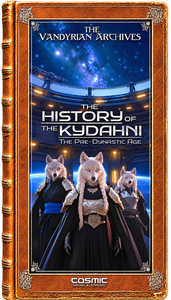
The rise of Kydahni influence cannot be understood without first examining the deterioration of the civilizations that preceded it. Across vast stretches of the Vandyrian territories, ruling dynasties that had governed for countless generations found themselves increasingly unable to adapt to changing political and economic realities.
Systems that had once functioned efficiently became burdened by bureaucratic inertia, hereditary incompetence, internal rivalries, and declining administrative flexibility. What had originally been strengths gradually transformed into liabilities. The institutions that had preserved stability during earlier ages increasingly prevented meaningful reform during later ones.
The decline was rarely dramatic. Few thrones fell in sudden revolutions. Instead, authority eroded incrementally across centuries. Provincial governments asserted greater independence. Commercial interests circumvented traditional administrative channels. Military forces became increasingly localized. Taxation systems weakened. Trade networks fragmented. Communication between distant regions became less reliable. The old powers remained formally intact long after their practical authority had begun to diminish.
Throughout this process the Kydahni occupied a unique position. Their commercial networks continued operating even as formal governments weakened. Their broker houses maintained communication between regions whose official institutions no longer cooperated effectively. Their transport systems carried goods through territories increasingly unable to manage their own logistics.
As older powers declined, Kydahni influence expanded naturally into the spaces they abandoned. What began as economic necessity gradually evolved into political leverage.
For millions of years the ancestors of the Kydahni had survived as intermediaries, brokers, transporters, financiers, and migratory populations operating within the margins of larger powers. They accumulated influence without sovereignty, wealth without territorial permanence, and institutional continuity without a centralized state.
By the beginning of the Elder Period, however, conditions throughout the greater Vandyrian spheres had begun to change dramatically. Ancient powers that had once appeared eternal entered prolonged periods of stagnation, fragmentation, and decline. Trade routes collapsed. Regional authorities lost legitimacy. Long-established dynasties became increasingly unable to maintain the systems upon which their power depended. Into this growing instability stepped the Kydahni, not as conquerors in the traditional sense, but as a civilization uniquely prepared to exploit the collapse of older structures.
Their ascent would permanently alter the balance of power throughout the region and establish the foundations of what would become one of the most influential civilizations in recorded history.
The black steel drone moved low and unhurried above the wreckage of the old front, its angular frame cutting a silent path through the thick haze that hung over the burned jungle. Craters opened beneath it like open mouths, their edges fused to glass where the heavier ordnance had struck, while the surrounding vegetation stood blackened and skeletal, still smoldering in places where the fires had found dry bamboo.
Ruined vehicles lay scattered across the uneven ground, their hulls split and collapsed, turrets twisted at unnatural angles. Some had burned so thoroughly that only the heavier structural members remained, rising from the ash like the ribs of great carcasses. The drone’s sensors swept continuously across the desolation, cataloguing the geometry of destruction without haste or commentary, its matte surfaces gathering a thin film of soot as it passed through the residual smoke.
Vandyrian scanner craft drifted at similar altitude some distance to the west, their broader silhouettes darker against the pale haze. These were low-flying machines of black steel and reinforced composite, their bellies fitted with clusters of spotlights that cut long, searching beams through the murk. The craft moved in loose pairs, engines muted to a low mechanical growl, while Combat Hunters stood upon the open side platforms, their striped forms braced against the railings. Optical sights and sensor arrays turned independently of the vessels, probing the broken ground below for any sign of movement that the automated systems might have missed. Thick haze reduced the horizon to a soft, shifting boundary, so that the hunters appeared and disappeared within the beams as the craft adjusted course around the taller stands of charred trees.
The terrain itself offered little concealment to anything still living. Where the jungle had once pressed close against the defensive lines, it now existed only as scorched stumps and drifting ash, the ground between them a patchwork of crater rims and the half-buried remains of armored transports. Some vehicles still held the shapes of their crews, the metal around them warped by heat into permanent contortions. Others had been overturned and left to settle into the soft mud, their tracks stripped or thrown clear, their interiors open to the haze. The drone passed directly over one such transport, its sensors registering the irregular heat signatures of cooling metal and the slower, cooler outlines of bodies that had long since ceased to generate their own.
Farther ahead, a battery of artillery pieces stood in a ragged line, barrels elevated or broken, their ammunition trailers reduced to blackened frames. The scanner craft continued their methodical passage, spotlights sweeping in overlapping arcs that momentarily illuminated curtains of fine ash suspended in the air. One of the Combat Hunters leaned outward, rifle resting against the railing, the striped fur of his forearms dusted with the same gray residue that coated the surrounding wreckage.
His companion on the opposite platform adjusted a handheld scanner, its display casting a faint green glow across the lower half of his face as he checked the readings against the larger arrays mounted beneath the craft. Neither spoke. The engines maintained their steady note, and the only other sound was the occasional soft clatter of settling debris when a beam of light disturbed some unstable fragment of burned vegetation. The haze thickened in places where the ground still released heat, reducing visibility to a few hundred meters and forcing the craft to rely more heavily on their instruments than on the hunters’ own eyes.
Beneath the drone, the pattern of the old front became clearer as the machine followed the former line of trenches. Sections of the crumbling works had collapsed inward, their reinforced walls breached by the same ordnance that had gouged the craters. Between them lay the smaller debris of infantry positions—broken crates, scattered personal equipment, and the occasional length of twisted wire that still caught the light when the scanner beams swept across it. The jungle beyond the trenches had fared no better. What had once been dense stands of bamboo and broad-leaved undergrowth was now a uniform field of blackened stalks, many of them snapped at mid-height, their interiors hollowed by fire.
The drone’s path carried it over a narrow road that had once served the forward positions; the surface was cratered and partially obscured by ash, with the burned remains of a supply vehicle lying across one of the deeper holes. The scanner craft adjusted their formation as they approached a broader expanse of open ground where several armored vehicles had been caught in the open. One of the machines had been reduced to little more than a scorched chassis, its turret lying several meters away, while another still retained enough of its hull to cast a long shadow when the nearest spotlight passed over it.
A Combat Hunter raised a hand briefly, signaling a momentary pause, and the craft slowed while he examined the vehicles through his sights. Nothing moved among the wreckage. The haze continued to drift across the scene, softening the edges of the ruined machines and reducing the distant tree line to a vague, darker band. When the hunter lowered his hand, the craft resumed their slow progress, spotlights once more sweeping the ground in steady, overlapping patterns.
Farther along the former front, the drone passed above a cluster of fortified positions that had been constructed from stacked logs and packed sand. Most of these had burned completely, their timber reduced to charred fragments that still smoldered in sheltered corners. One position retained a portion of its overhead cover, the blackened beams supporting a section of roof that had not yet collapsed. Beneath it, the outlines of equipment and bodies were visible to the drone’s sensors, their heat signatures nearly identical to the surrounding soil. The scanner craft remained some distance behind, their engines a muted presence in the haze, while the Combat Hunters continued their silent survey of the ruined terrain. The black steel of both the drone and the larger craft absorbed what little light penetrated the murk, so that the machines themselves seemed almost extensions of the burned landscape they traversed, their spotlights the only clear evidence of their passage through the thickening air.
The inner wetlands of Zemirga, among the last remaining holdouts of the Garavalpian front, made their condition known to any unfortunate creature foolish enough to seek refuge within their steaming confines.
There was no salvation here, nor any promise of sanctuary beneath the tangled green canopy, for the land had long since surrendered itself to rot, death, and the obscene abundance of things that fed upon both. Vast thickets of bamboo rose from the drowned terrain, their jointed stalks climbing toward a sky perpetually obscured by mist, while the twisted roots of ancient mangroves gripped the remains of a battlefield that had already been swallowed by the advancing swamp.
Beneath their interwoven branches lay the wreckage of armored vehicles, artillery emplacements, and transports that had once carried the pride of Garavalpian military industry into battle.
Four years earlier, these machines had been proclaimed the finest instruments of war their civilization could produce, their manufacture celebrated in public squares and their specifications recited with patriotic enthusiasm by officers who were now either dead or missing. Now their hulls lay broken and half-submerged beneath brown water, their metal flaking away in great orange scabs, their cabins filled with mud and the nests of creatures that regarded the works of civilization as little more than convenient shelter. Bamboo roots had penetrated shattered engine housings, mangrove tendrils had entered the compartments where crews had burned to death, and great colonies of insects inhabited the rusting machinery. Here the achievements of four years past were already ancient ruins, and the swamp, which had endured long before the first soldier set foot upon its banks, was busily reclaiming everything the war had left behind.
There had been six of them when the survivors first abandoned the shattered front, six Garavalpian hares in filthy tunics and waterlogged sandals, carrying what little remained of their weapons and ammunition. The sixth had been lost before they had managed to penetrate the outer wetlands, when a rusted bayonet, protruding from the submerged remains of a fallen soldier’s rifle, had driven through the sole of his sandal and laid open his foot almost to the bone. His scream had carried through the reeds with dreadful clarity, and before his companions could silence him or drag him clear of the water, a Vandyrian gunship had turned its searchlights upon the disturbance.
The answering barrage had been instantaneous, a murderous hail of heavy laser fire that tore through bamboo and mangrove alike, boiling the shallow water and reducing the surrounding vegetation to smoking fragments. The wounded hare had vanished beneath the bombardment, and his five companions had thrown themselves headlong into the filthy water, clawing their way beneath the wreckage of an overturned transport as the gunship passed overhead. They had remained there for what seemed an eternity, pressed against the mud with their long ears flattened against their skulls, scarcely daring to breathe while the water around them hissed with falling debris.
When at last the guns fell silent and the aircraft moved away, there had been no question of recovering their companion. Whatever remained of him lay somewhere behind them, among the blasted reeds and smoking pools, and the five who survived had continued into the interior with the knowledge that even a cry of pain might bring death raining from the heavens.
Deeper within Zemirga, the waters grew darker and the passage more treacherous, until the distinction between solid ground and flooded ruin became a matter of dangerous speculation. The hares were obliged to clamber across the exposed backs of sunken vehicles, dragging themselves over jagged armor plates and through compartments whose rusted edges threatened to open their flesh at the slightest careless movement. Beneath them, enormous catfish stirred in the flooded machinery, pale barbels sweeping the darkness as their heavy bodies pushed through openings that had once admitted technicians and engine crews. Some were large enough to wrench an arm from its socket, and the survivors had already seen the unmistakable drag marks left by creatures that had hauled the dead from the shallows into deeper water. Great hermit crabs occupied the hollow wreckage of vehicles and artillery housings, their armored limbs scraping against corroded steel as they waited among the corpses for the living to join them.
They were patient scavengers, indifferent to whether their meals had died from wounds, exhaustion, or disease, and more than one drowned soldier could be seen beneath the water with such creatures methodically pulling at his remains. Elsewhere, dark shapes moved just beyond sight, their passage marked by the brief emergence of sharp dorsal spines or the sudden disturbance of sediment beneath the surface. The water was the color of old blood mixed with peat, and no creature wading through it could know whether the next submerged obstruction was a root, a weapon, the bones of a comrade, or something living that had been waiting in the mud.
The survivors feared the bog scorpions most particularly, those enormous armored horrors that lurked beneath the vegetation, yet the possibility of disturbing one of Zemirga’s great serpents was scarcely less dreadful. Every movement through the water became an act of calculation, and every moment of stillness offered another opportunity for the swamp’s innumerable inhabitants to investigate the five exhausted creatures trespassing through their domain.
Nor were the inhabitants of Zemirga the only predators abroad in the drowned forest, for above the mist the Vandyrian patrol craft continued their tireless search, their engines sending a distant mechanical thunder through the stagnant air. At intervals, brilliant shafts of white light descended through the bamboo canopy, sweeping across the water and illuminating great curtains of insects that swarmed in the humid darkness. The airships passed slowly over the wetlands, their armored bellies carrying autonomous gun emplacements whose sensor arrays turned independently of the vessels themselves, searching for movement among the ruins.
Upon exposed firing platforms along their flanks lounged Vandyrian tiger sharpshooters, their striped faces half-concealed beneath helmets and optical sights, their long rifles resting against the railings while they searched the flooded wilderness below.
Boar pilots guided the great machines between the towers of vegetation, their silhouettes visible through the forward glazing whenever the craft descended beneath the hanging clouds. These were hunters equipped with instruments capable of finding and killing an enemy far beyond the reach of ordinary sight, while the fugitives beneath them possessed little more than knives, wet ammunition, and single-shot laser weapons whose mechanisms had become increasingly unreliable after days of immersion. A hare might survive the teeth of the swamp, the venom of its crawling abominations, and the treacherous iron of a submerged battlefield, only to be exposed by the movement of a reed and killed by a gunner who would never learn his name. Such was the character of the pursuit, a methodical extermination carried out by creatures who commanded the skies against enemies scarcely able to command the ground beneath their feet.
The five survivors pressed onward beneath that dreadful vigilance, their limbs trembling with exhaustion and their soaked garments clinging to bodies already swollen by insect bites and scored by the sharp growths of the marsh. Hummingbird-sized mosquitoes descended whenever they paused, their droning wings filling the humid air while fat leeches gathered upon their legs beneath the waterline. Sleep had become a luxury beyond consideration, for there was nowhere sufficiently dry to rest and nowhere sufficiently concealed to risk a fire. The wounded could not afford to cry out, the hungry could find little worth eating, and even thirst offered no relief when all around them lay an endless expanse of foul brown water crowded with corpses.
They had heard things moving through the reeds during the night, heavy bodies dragging themselves across the mud, and once the unmistakable grinding of armored limbs against the hull of a wreck beneath which they had taken shelter. Far above, the airships continued their patrols, their searchlights wandering across the mist like the eyes of some tireless mechanical god, and from time to time the darkness was broken by a distant burst of laser fire. Whether those weapons had found other fugitives or merely answered some movement in the swamp, none of the five could say. They knew only that the Garavalpian front lay in ruins behind them, the Vandyrians occupied the heavens above, and Zemirga offered no passage that did not demand its own payment in blood. Thus they went deeper into the drowned wilderness, five miserable hares beneath the hunting lights of an empire, with nothing ahead of them but darkness, stagnant water, and the promise of further death.
By the second day, the five survivors had managed to drag themselves onto something resembling dry land, though the distinction was a dishonest one, for the ground beneath their sandals remained saturated with the foul waters of Zemirga. Here the mangroves gave way to irregular hummocks of black soil, broken by waterlogged depressions and narrow creases in the ground that concealed pools of stagnant water beneath thin coverings of moss and decaying vegetation. The hares stumbled through these treacherous passages with their weapons held close, sinking without warning to their ankles or knees whenever the ground surrendered beneath them. Their tunics had stiffened with accumulated mud and dried blood, while the flesh of their thighs and lower limbs bore the swollen marks of innumerable leeches that had fed upon them during the previous night.
Those parasites had at last diminished in number, but the respite was a cruel one, for their place had been taken by swarms of monstrous mosquitoes nearly the size of hummingbirds. These abominations descended from the bamboo in whining clouds, their long bodies trembling upon translucent wings, their forked, syringe-like feeding apparatuses probing eagerly at every patch of exposed flesh. They made repeated attacks upon the eyes and muzzles of the exhausted hares, fastening themselves around the ears and throat with a persistence that bordered upon frenzy. To pull one from the neck was to invite a furious struggle, for the creatures twisted and sputtered as they were torn free, their segmented limbs clawing at the skin while their piercing mouthparts struck repeatedly at anything within reach. Even crushed beneath a trembling paw, they continued to twitch and sting, leaving behind bloody punctures that burned beneath the oppressive heat.
There was little conversation among the fugitives now, and what speech remained was reduced to muttered warnings and the occasional exhausted command. Their long ears hung heavy with moisture, their eyes were red from sleeplessness, and their movements had acquired the dull mechanical quality of creatures whose bodies continued onward long after their strength had been exhausted. By midday the uncertain ground had descended once more into flooded woodland, and the five were obliged to enter the brown water again, feeling blindly for submerged roots and fragments of wreckage beneath the surface.
None complained. None wept. Whatever objections they might once have entertained concerning the indignities of their retreat had been extinguished by the first night in the marsh. They moved in a ragged file between the bamboo stalks, each keeping close enough to follow the next through the murk, their progress accompanied by the sucking of mud and the faint splashing of water against their hips. Beneath the surface lay the remains of another abandoned defensive position, its barricades broken, its weapons rusting, and its ammunition scattered among the roots.
None of them noticed the faint metallic click that came from beneath the water. The unfortunate hare who had disturbed the buried mechanism barely had sufficient time to register the sensation beneath his foot before the mine detonated.
The explosion erupted from the shallows with a tremendous concussive roar, hurling a column of brown water, mud, and shattered vegetation high among the bamboo. The hare was thrown violently backward, his body turning in the air before striking the surface some distance from his companions. Both of his legs had been torn away below the knees, and what remained of them thrashed uselessly as he attempted to raise himself from the water. His screams rang through the woodland, shrill and terrible, carrying above the settling debris and the sudden frightened movement of creatures disturbed by the blast. For an instant the other four stood paralyzed, their ears flattened against the deafening reverberation, scarcely able to comprehend what had happened.
Then a shot came from somewhere beyond the trees. None saw the sharpshooter who fired it, nor the precise direction from which the weapon had been aimed, but the first impact struck the wounded hare through the head, scattering blood and fragments of skull across the water. Two more shots followed in such rapid succession that they seemed part of the same report, driving through his upper body and throwing his remains backward into the shallows. The screaming ceased at once.
Above the distant canopy came the low mechanical growl of an approaching patrol craft, and somewhere within the thick haze a searchlight began turning toward the disturbance. The four survivors needed no further encouragement, for the destruction of their companion had made sufficiently plain what awaited any creature foolish enough to remain.
They fled without attempting to recover the dead, crashing through flooded bamboo and over submerged obstacles with a desperation that rendered caution almost impossible. Behind them the marsh trembled beneath the passage of an airship, its searchlights cutting great white corridors through the mist while the distant chatter of weapons echoed between the trees. The hares ran until their lungs burned and their limbs threatened to fail, then continued onward through water deep enough to force them to swim, dragging their useless firearms above the surface whenever the flooded ground denied them footing.
They scrambled over fallen trunks and rusted vehicle hulls, stumbled across banks of sucking mud, and plunged back into the dark water whenever the approaching lights threatened to expose them. Once, the beams passed so close that the nearest survivor could make out the striped silhouette of a Vandyrian sharpshooter leaning over the railing of the aircraft, his rifle angled toward the swamp beneath him. The four pressed themselves beneath a tangle of roots and remained motionless until the vessel passed, while the enormous mosquitoes continued to feed upon their exposed faces and necks. Only when the machinery had faded into the distance did they dare move again, and by then the sky beyond the bamboo had already begun its slow descent into evening. They had lost another companion, another portion of their remaining ammunition, and much of what little strength the previous night had left them. Still they went onward, for there was no refuge behind them and no reason to believe that the enemy had abandoned its pursuit.
Night brought no relief, merely a repetition of the previous darkness with its oppressive heat, swarming insects, and ceaseless apprehension of things moving beneath the water. The surviving four made their way through the marsh beneath a sky concealed by low clouds, following whatever narrow passages the mangroves permitted and avoiding the deeper channels where great shapes disturbed the surface. From time to time the spotlights of the Vandyrian airships passed overhead, illuminating the upper reaches of the bamboo and casting long, shifting shadows across the drowned battlefield. Somewhere in the distance an automatic gun opened fire, its measured bursts briefly overpowering the nocturnal chorus before falling silent again. The hares could not know whether another band of fugitives had been discovered or whether some unfortunate creature of the swamp had attracted the attention of the patrols, and none possessed the inclination to investigate. They did not sleep. They scarcely rested, save for those miserable intervals when one of their number collapsed against a tree or a ruined vehicle and had to be pulled upright by the others.
By the hours before sunrise their movements had become slow and uncertain, their bodies trembling from hunger and fatigue, their faces swollen and disfigured by the feeding insects. Yet the eastern sky was still black when they resumed their stumbling passage through the wetlands, four exhausted hares who had entered Zemirga seeking escape and had found only another day of the same relentless hunt. Behind them the dead lay scattered among the machinery and the mud, while ahead the drowned forest continued without promise, its dark waters concealing whatever further miseries awaited them.
By sunrise, the four surviving Garavalpians had reached the meager sanctuary of a rocky cleft, where the land rose sufficiently above the drowned forest to offer some brief relief from the suffocating waters of Zemirga. Here, between great slabs of weathered stone, a narrow stream descended from higher ground, its current running cold and comparatively clear over a bed of smooth pebbles before disappearing once more into the brown stagnation of the surrounding marsh.
The shade was deep beneath the overhanging rocks, and for the first time in nearly two days the fugitives were able to withdraw their swollen feet from the water without immediately surrendering them to the attentions of leeches and other crawling abominations.
They drank greedily, washed the mud from their muzzles, and crouched beneath the stone with their ears hanging limp from exhaustion.
The youngest among them attempted to examine the sores along his legs, but his trembling paws could accomplish little beyond smearing the accumulated filth. Another sat with his back against the rock, staring vacantly at the stream as though he had forgotten the purpose of their flight altogether. For several precious minutes there was nothing but the quiet movement of running water and the faint rustling of vegetation beyond the cleft, and the absence of engine noise seemed almost miraculous. Then, somewhere above them, came the unmistakable barking of hounds, first one voice and then several more, their harsh cries rising and falling as they followed some hidden passage through the rocks. The four hares sprang upright in blind panic, scrambling for the descending streambed with no thought beyond putting distance between themselves and the approaching animals. One slipped upon the wet stone, struck another, and sent both plunging into the current, where the remaining two followed in a desperate attempt to escape the narrowing cleft.
The stream carried them down through a succession of narrow channels, its cold waters accelerating between the rocks until the hares were thrown helplessly against submerged ledges and battered by the force of the current. They struggled to keep their heads above the surface, clawing at passing roots and projections of stone that tore away beneath their weight or slipped from their exhausted grasp. At one point the water descended sharply between two great boulders, and all four were swept beneath the surface into a churning darkness where stone and water seemed determined to crush the life from them. They emerged farther below, coughing and gasping, only to be seized again by the current and carried through another winding passage that appeared to have no end. Whether the descent endured for minutes or hours none could afterward have said, for their senses had contracted to the immediate necessity of breathing whenever the waters permitted it.
At length the stream broadened into a sluggish channel bordered by black mud, and the four survivors were deposited upon a low bank among broken branches and heaps of rotting vegetation. They lay there for some time, scarcely moving, their bodies bruised and their clothing torn, while the water continued its indifferent passage toward the greater wetlands. One of the hares had dislocated a finger during the descent, and when he discovered the injury he folded a portion of his filthy tunic between his teeth and forced the crooked digit back into place with a sharp, sickening movement. His companions watched without comment as he shuddered, spat out the cloth, and drew several trembling breaths through his nose. There was no sign of the hounds now, but neither was there any certainty that the current had carried them beyond the reach of their pursuers. When at last they struggled upright, they found that the bank ended only a short distance ahead, and beyond it stretched yet another expanse of brackish water.
They entered the marsh once more, wading through the waist-deep murk with the numb resignation of creatures who had exhausted even their capacity for complaint. Here the mangroves grew farther apart, their roots descending into pools of dark water that reflected little of the pale daylight filtering through the haze. Great mats of floating vegetation drifted between the trunks, concealing submerged channels and the occasional movement of something heavy beneath the surface.
One of the older hares turned to examine a narrow opening between two roots and found himself staring into the hideous face of a bog scorpion, its enormous pincers raised beside a flattened head armored in overlapping plates of dark brown chitin. The creature appeared nearly the length of a canoe, its segmented body extending backward into the vegetation, and for one dreadful instant the hare could do nothing but stare into the monstrous arrangement of its eyes. He recoiled with such violence that he lost his footing and fell backward into the water, throwing up both paws as he struggled to suppress a scream. His companions turned upon him in alarm, weapons half-raised, until the nearest ventured close enough to see that the dreadful apparition was no living predator at all, but the empty exoskeleton of a bog scorpion that had recently shed its armor.
The hollow shell hung suspended among the roots, its plates separated along the back where the creature had emerged, leaving behind a grotesque likeness of itself almost perfectly preserved. Somewhere in the surrounding marsh, therefore, there existed a living specimen larger than the monstrous shell before them, its newly expanded body awaiting the hardening of its fresh armor. Nobody laughed at the frightened hare, nor did any of them linger to examine the discovery. The youngest, however, had suffered an additional indignity in his own moment of terror, and although the cloudy water concealed the evidence from sight, the unmistakable scent of his involuntary reaction brought a flush of embarrassment beneath the grime of his muzzle.
His companions looked away, granting him what little dignity could be preserved under such circumstances, and consequently none observed the small disturbance that passed beneath the water between his legs.
There came a sudden, intimate pain of such appalling intensity that the young hare convulsed where he stood, his jaws closing violently upon his own tongue before he could prevent it. Blood ran between his lips as his eyes widened, and the water around his groin darkened with a spreading crimson cloud. Some unseen parasitic horror had fastened itself upon him beneath the surface, penetrating vulnerable flesh with a persistence that transformed his embarrassment into immediate, overwhelming agony. He attempted to draw breath, but the effort produced only a strangled sound through clenched teeth, his body trembling as he fought against the pain.
Then the scream came, shrill and uncontrolled, echoing between the mangrove trunks with a violence that sent birds scattering from the branches overhead. The others turned in alarm, one of them lunging forward to seize the younger hare and silence him before the noise attracted another patrol, but the swamp had already answered. Beneath the spreading blood, an enormous shape moved through the brown water with terrible speed, its approach betrayed only by the sudden displacement of floating vegetation.
A great finned crocodilian erupted from the depths, its armored jaws closing about the screaming hare’s head and shoulders before his companions could reach him.
The impact drove him beneath the surface, and the creature immediately began to roll, twisting its immense body through the water as it dragged its victim away between the mangrove roots. For several moments the shallows erupted into a boiling confusion of mud, blood, and thrashing water, until the predator vanished into a deeper channel with its prey. When the surface finally settled, one severed arm remained afloat among the disturbed reeds, turning slowly in the current while the widening stain of blood dissolved into the marsh.
The three remaining Garavalpians stood motionless, their weapons forgotten in their paws, staring at the place where their youngest companion had disappeared. There was nothing to recover and no enemy upon which they might exact revenge, for the thing that had taken him was already gone, bearing its meal into waters too deep and treacherous for pursuit. The nearest hare lowered his outstretched arm, which had remained suspended since his failed attempt to silence the victim, and for a moment he seemed unable to comprehend why his companion was no longer there. No one spoke.
The swollen insects continued their droning passage through the humid air, and somewhere among the roots came the faint scraping of armored limbs against submerged wood. The three turned away at last and continued deeper into Zemirga, moving with the slow, defeated gait of creatures who understood that any further hesitation could only hasten their own deaths. As the hours passed, the character of the wetlands began to change, the dense accumulations of military debris giving way to older growth and broader expanses of undisturbed water. The wrecked transports, fallen artillery pieces, and half-buried fortifications that had accompanied their flight were no longer visible, and even the rusting fragments of abandoned equipment became increasingly rare. Ahead stretched a wilderness untouched by any familiar sign of Garavalpian civilization, its vast bamboo groves and flooded mangrove forests continuing toward a horizon obscured by the steaming haze. None of the three had ever ventured so far into the interior, nor had they known anyone who could claim reliable knowledge of what lay beyond the drowned battlefields.
They had fled the guns of the Vandyrians only to penetrate a country where their own people had established no lasting dominion, and where the creatures of the marsh recognized neither the distinctions of war nor the authority of distant kingdoms. Thus the last three survivors passed beyond the wreckage of the front and into the older desolation of Zemirga, leaving behind them the final recognizable remains of the world from which they had come.
As the sun began its descent beyond the western reaches of Zemirga, the three surviving Garavalpians became aware of a smell that seemed wholly foreign to the drowned wilderness through which they had wandered. It was smoke, thin but unmistakable, carried upon a faint evening breeze that stirred the upper branches of the mangroves. At first they feared another burning vehicle or some fresh devastation wrought by Vandyrian artillery, but the odor possessed none of the acrid bitterness of scorched machinery or fused armor. There was wood in it, and something faintly fragrant beneath the familiar scent of combustion. Following its passage through the reeds, they discovered that the flooded ground had begun to rise, the black mud giving way to increasingly firm banks upon which grasses and low shrubs had established themselves.
Beyond the last tangled barrier of mangrove roots lay the uncertain boundary of open grassland, its gently rolling surface broken by stands of tall trees whose branches caught the dying sunlight. With considerable effort the hares dragged themselves from the brackish water, their garments dripping and their long ears hanging heavily against their shoulders. They stood for some moments upon the muddy shoreline, scarcely believing that solid ground had returned beneath their feet, before cautiously venturing across the border between the marsh and the open country.
Behind them stretched the steaming desolation of Zemirga, while ahead the grasslands lay beneath a deepening amber sky, peaceful in appearance and almost offensively indifferent to the suffering they had endured.
They had gone only a short distance beyond the shoreline when a peculiar sound brought the foremost hare to an abrupt halt. His ears rose immediately, and he turned toward his companions with an expression of profound bewilderment. The others heard it a moment later, a distant succession of muffled voices and rhythmic noises emerging from somewhere among the trees ahead. It was not the barking of the Vandyrian hounds, nor the measured report of automatic weapons, nor any recognizable sound of machinery. The veteran among them slowly raised his battered rifle, gesturing for the others to follow his example, and the three began moving cautiously through the tall grasses toward the source of the disturbance. Their sandals made scarcely a sound upon the comparatively dry land, and the breeze stirred the vegetation sufficiently to conceal their passage.
As they drew nearer, the noises became more distinct, accompanied by occasional low growls and a female voice whose enthusiastic cries carried freely through the evening air. The three exchanged bewildered glances, unable at first to reconcile what they heard with the battlefield wilderness from which they had only just emerged.
Then, through the trunks of several great trees, they perceived a faint yellow illumination and the broad silhouette of a tentlike structure standing upon a sheltered rise. Its outer coverings had been drawn closed, but the glow of lamps within rendered portions of the fabric translucent, and against that illuminated surface moved the enormous shadows of three figures.
The three Garavalpians crouched low among the grasses, watching in astonishment as the shadows shifted and mingled behind the stretched fabric. There could be little doubt that the occupants were Vandyrians, for the breadth of their shoulders, the height of their bodies, and the unmistakable outlines of their lupine heads betrayed their kind even through the intervening canvas. Two were males, their deep voices rising in growling laughter and guttural exclamations, while the third was a female whose evident enthusiasm exceeded that of either companion.
The sounds of vigorous lovemaking carried into the surrounding trees, accompanied by the occasional scrape of furniture and the dull impact of some heavy object being knocked against the interior furnishings.
It was an astonishing spectacle to encounter at the edge of a battlefield, where only a few hours earlier the hares had been fleeing aerial gunfire and witnessing their youngest companion dragged beneath the waters of Zemirga.
Here, apparently, three enormous wolves had found both the leisure and the inclination to indulge themselves without the slightest concern for the horrors taking place beyond their temporary sanctuary. The veteran lowered his rifle a fraction and looked toward the others, who returned his stare with expressions hovering between disbelief and mounting apprehension. The tent stood without any visible guard, its occupants seemingly oblivious to the possibility of danger, and for one brief moment the fugitives might have believed they had encountered nothing more consequential than a trio of soldiers celebrating their victory. Then the third hare, whose attention had wandered toward the objects arranged outside the entrance, noticed the sword.
It stood planted upright in the ground beside the sheltered structure, a great weapon of unmistakable workmanship whose dark blade caught the last reddish light of the setting sun. Beside it rested the personal standard of its owner, and upon recognizing the familiar devices the young hare went rigid. His companions followed the direction of his stare, and the veteran’s expression changed with terrible suddenness as recognition overcame bewilderment.
They had seen that sword before, though never at such intimate proximity, and its reputation had spread throughout the broken armies of Garavalpi long before the present campaign had driven them into the wetlands. It belonged to the conqueror whose arrival from the heavens had brought ruin upon their people, the towering black-furred Valkyrie whose name had become inseparable from the slaughter of their armies and the destruction of their cities. The sounds from within the tent continued unabated, obscene in their cheerful indifference, while the three hares stared at the weapon and understood whose private shelter they had discovered.
“It is her,” one whispered, scarcely daring to shape the words. “The Dark Wolf Queen. Heathen Vandyrian witch.”
No one answered him. The veteran looked again toward the illuminated canvas, then toward the sword, and finally down at the battered rifle in his paws. Slowly, with the deliberate care of one who feared that even the smallest movement might betray him, he returned the weapon to his shoulder and drew a long dagger from its sheath.
Yet they did not advance, for the light had not entirely faded from the grasslands, and the prospect of approaching the shelter of the Wolf Queen while the surrounding country remained visible was more than even their desperation could bear. Instead the three withdrew beneath the deeper shadows of the trees, where they settled among the tall grasses and watched the tent as evening surrendered to night. The last amber light vanished from the western horizon, leaving the structure illuminated from within by the warm glow of its lamps, while the sword outside became a dark and motionless shape against the pale fabric. From time to time the shadows of its occupants moved across the coverings, and the sounds of their indulgence continued to echo through the woodland, mingling with the evening calls of insects and the distant murmur of the marsh.
The hares remained silent, their ears upright and their exhausted bodies held rigid by the effort of remaining concealed. They had endured the destruction of their front, the murderous vigilance of airborne patrols, the lethal inhabitants of Zemirga, and the loss of three companions, only to find themselves within striking distance of the very creature whose armies had inflicted so much of that misery upon them. The veteran rested his dagger across his knees and watched the entrance without speaking, while the other two kept their failing rifles close at hand. Whatever thoughts passed between them required no expression, for each understood the significance of the sword planted outside the tent and the extraordinary opportunity that darkness might afford. Thus they waited beneath the trees while the Wolf Queen and her companions continued their revelry, and the long night gathered over the grasslands at the edge of Zemirga.
The silence that at last settled upon the tent endured far longer than the remaining hours of night might reasonably have permitted, and still the three Garavalpians waited among the grasses until the lamps within had burned low and no further sound of movement reached them. The evening’s boisterous revelry had gradually diminished into occasional murmurs, the shifting of heavy furnishings, and finally a stillness so complete that the fugitives scarcely trusted it. For much of the night they had remained concealed beneath the trees, their exhausted bodies aching from the effort of remaining awake while the cool grass offered the first genuinely dry resting place they had encountered since abandoning the ruined front. The veteran had repeatedly forced his eyes open, fearful that sleep might rob them of the extraordinary opportunity lying scarcely a hundred paces away, while his companions watched the illuminated canvas with expressions that alternated between apprehension and desperate anticipation.
The great sword of the Wolf Queen remained planted upright in the soil beside the entrance, its dark blade motionless in the stagnant air, and her personal standard hung limp from the ridgepole. No sentry appeared to challenge them, nor did any patrol approach from the surrounding woodland, though the distant mechanical thunder of Vandyrian aircraft occasionally reached them from beyond the wetlands. At length the final lamp within the shelter flickered and diminished, leaving only a faint amber illumination behind the heavy fabric.
The veteran raised one hand toward his companions, waited until both acknowledged the signal, and slowly drew the long dagger from his belt. Whatever strength remained to them would now be committed to a single undertaking, and none of the three entertained any expectation of a second opportunity.
They advanced through the tall grasses with the deliberate caution of creatures whose survival had depended upon concealment for so many miserable days. Their sandals made scarcely a sound upon the comparatively firm ground, and the evening breeze stirred the surrounding vegetation sufficiently to conceal the occasional movement of their battered equipment. The veteran led the way, his dagger held close against his thigh so that no gleam of moonlight might betray the blade, while the remaining two followed with their unreliable rifles carried low and their ears inclined toward the silent structure. The contrast between the grasslands and the drowned wilderness behind them seemed almost obscene, for here the ground was dry, the air comparatively pleasant, and the trees stood without the tangled masses of rotting vegetation that had made every passage through Zemirga an ordeal. Yet none of these comforts offered reassurance as they approached the shelter of the creature whose armies had reduced their homeland to ruin.
The veteran paused beside the great sword, looking briefly upon the workmanship of its enormous blade and the familiar devices upon its fittings. He had seen reproductions of that weapon in military dispatches and heard its description repeated by soldiers who had witnessed the Wolf Queen upon the battlefield, but never had he imagined standing close enough to touch it. Its size alone exceeded anything he might reasonably have wielded, and the knowledge that its owner lay within only a few steps made his fingers tighten around the dagger. Without another word he passed the weapon, reached for the heavy entrance covering, and drew it aside.
Within lay the disordered remains of a different kind of campaign, one conducted with such extravagant disregard for the surrounding war that the three Garavalpians momentarily forgot the purpose of their intrusion. Dark glass bottles lay scattered and overturned underfoot among displaced cushions and overturned furnishings, their contents spilled across woven carpets whose elaborate patterns were scarcely visible beneath the disorder. The sharp scent of carbonated ale mingled with incense, warm fur, and the residue of prolonged coupling, while discarded garments and pieces of equipment had been thrown carelessly over chairs and storage chests. A broad table stood against one wall, crowded with drinking vessels, partially consumed provisions, and the remains of a meal whose abundance would have seemed unimaginable to soldiers who had spent days searching the marsh for anything fit to eat.
The fugitives stared at these surroundings with a mixture of disbelief and mounting resentment, for the comforts gathered within this temporary shelter exceeded anything they had enjoyed even before the destruction of their front. Here, within a short distance of a country littered with the dead, the Vandyrians had established a private refuge in which the war appeared to possess no greater significance than the distant weather. The bed itself stood empty, its coverings dragged partly onto the floor. Upon that floor the three Vandyrians lay tangled in the remaining sheets, the female between her companions, their immense frames pressed close and still joined, the fabric heavy and stuck where the bodies met, residual wet and the heat still rising from them so that any one of them could answer an intrusion without first rising or disentangling.
All three appeared deeply at rest, their breathing slow and regular, and nothing in their posture suggested the slightest awareness that armed enemies had entered their shelter.
For several moments the Garavalpians remained motionless, scarcely able to reconcile the terrible reputation of the Wolf Queen with the apparent vulnerability of the creature lying before them. She was enormous even at rest, nearly seven feet from crown to heel, with a breadth of shoulder and powerful musculature that made the veteran painfully conscious of his own slight proportions. Her dark mane spread across the bedding, and one great hand rested loosely upon the floor, its fingers relaxed beside an overturned drinking vessel. The green eyes that had become so notorious in the accounts of surviving Garavalpian officers were closed, leaving her face strangely peaceful beneath the shadows of the extinguished lamps. Beside her, the two males appeared no less formidable, their heavy frames occupying much of the available floor and their weapons lying beyond immediate reach. The veteran studied the arrangement carefully, measuring the distance between himself and the sleeping female while his companions remained near the entrance with their rifles trained upon the other two. Outside, beneath the trees, they had agreed upon the single objective: one decisive strike against the Wolf Queen, followed by immediate flight into the surrounding grasslands. There would be no attempt to confront her companions, no effort to recover trophies, and no lingering to establish whether their undertaking had achieved anything beyond the injury itself. The three had survived too much to entertain elaborate ambitions, and the veteran understood that even the smallest delay might bring the full strength of the Vandyrians upon them.
He advanced slowly across the carpet, placing each sandal with extraordinary care lest the scattered bottles or displaced furnishings betray his approach. The dagger remained low against his body, its darkened blade turned away from the faint moonlight entering through the open shelter, while his free hand trembled despite every effort to control it.
He could hear the breathing of the resting wolves, the occasional faint creaking of the structure, and the distant calls of nocturnal creatures moving through the grasslands beyond. His own heartbeat seemed intolerably loud, and he feared that the Wolf Queen might somehow hear it across the narrowing distance. Behind him the two surviving auxiliaries stood rigid beside the entrance, their fingers resting upon the firing mechanisms of weapons whose reliability had already been compromised by the waters of Zemirga. Neither dared speak, although both watched the veteran’s progress with the terrible concentration of creatures who understood that their lives now depended upon his success. He reached the edge of the bedding and paused, looking down upon the enormous female whose name had become inseparable from the destruction of Garavalpi.
For an instant the distance appeared closed and the strike possible, and the veteran permitted himself the smallest anticipation that the suffering of his companions might at last be answered.
Then he raised the dagger.
The Wolf Queen moved before the descending blade could reach her, her hand striking upward with such astonishing speed that the veteran scarcely perceived the motion. The dagger was knocked from his grasp and disappeared among the scattered furnishings, while the same enormous hand closed about his neck and arrested his movement completely. His feet left the floor as she drew him downward without rising, and the sudden pressure of her grip extinguished the cry that had begun forming in his throat. The veteran struggled desperately, his hands closing around her wrist while his legs kicked against the bedding, but the strength opposing him was so overwhelming that his efforts accomplished nothing.
Her broad palm rose to crush the orbit of one eye in a single contraction of the fingers. She drew him down, her lips locking over his open muzzle as he gasped and sputtered, the contact neither caress nor bite but a measured silencing. Only then did the green orbs open beneath the dark fur, half-lidded and luminous, fixing upon him as an eyebrow lifted. She turned her head a fraction toward the male beside her, as though confirming the nature of the interruption, then returned her attention to the hare. The thumb drove inward through the ruined socket while the remaining fingers closed, collapsing the entire side of the skull; the muffled sound that escaped him diminished at once into stillness.
By that moment the male nearest the entrance had already seized the second hare, dragging the shrieking auxiliary downward and wrenching the face free of the skull in a single tearing motion that continued through the neck until the spine came away with the remainder. The third was taken by the other male, the ribs buckling under the pressure of one hand before the body was lifted by head and neck and driven into the ground with sufficient force to reverse the orientation of the skull. The sound of the fracture carried beneath the low, cruel laughter of the female.
The violence had lasted only moments, and the silence that followed seemed almost absurd in comparison with the desperate importance the three fugitives had attached to their undertaking. The overturned bottles continued to roll slowly across the carpet, one coming to rest against the veteran’s discarded dagger, while the faint odor of discharged energy mingled with the incense and spilled ale. Beyond the open entrance the grasslands remained undisturbed, their tall vegetation swaying beneath the night breeze as though nothing of consequence had occurred within the shelter.
For a brief interval the final survivor registered the absence of response from his own limbs, the failure of every desperate effort to produce movement in a body that no longer answered.
The head, turned beyond any living capacity, offered no further command, yet vision remained long enough to register the cold, predatory disregard of the Vandyrians as they settled once more among the sheets. The laughter continued while the sounds of resumed conquest filled the tent, the blankets shifting about the Wolf Queen and her companions without further attention to the remains upon the floor. What remained of sight narrowed upon her face, the half-lidded green orbs already turning elsewhere, the indifference absolute as the grasslands beyond the cloth stayed undisturbed and the sword stood where it had been planted.
One of the males uttered a low remark, apparently concerning the extraordinary presumption of their visitors, and the female answered with a deep, amused laugh that carried through the fabric walls. There was no alarm, no summons for the guards, and no apparent concern that other Garavalpians might be waiting beyond the trees. The intruders had possessed neither the strength nor the weapons to threaten the occupants, and the evidence of their failed attack seemed to warrant little more than passing amusement.
The Wolf Queen settled back among the cushions, leaving the bodies where they had fallen, while her companions resumed their places beside her. Soon the quiet murmur of their voices and renewed laughter displaced the brief commotion, and the private revelry of the Vandyrians continued without further regard for the dead.
‘Drag Them To The Red River’
“I heard the engines rolling, Low above the trees, Saw the white lights turning, Cutting through the steam. Six went down to Zemirga, Five came through the fire, One cried out beneath the guns— And then OH! fed the burning mire.
Brown water to your belly, Black mud around your knees, Dead steel beneath the mangroves, Something moving underneath. Leeches drink the wounded, Big flies drink the rest, And somewhere through the bamboo A red-round finds your chest.
One stepped on old iron, Buried in the mire, Brown water jumped to heaven, Then came the rifle fire. No grave and no remembering, No prayer and no goodbye, Just four more hares in filthy water With black ships in the sky.
Hear those hounds behind you. Hear that gunship moan. Every mile you crawl ahead Takes you farther from your own. Cold creek through the high rocks, Drag yourself ashore— Then hear the barking overhead And hit that water once more.
Found a shell beneath the roots, Big as any boat, Empty eyes and hollow claws, Split along the coat. Something shed that armor. Something bigger walked away. Three looked hard into that water— Nobody chose to stay.
Then the youngest started screaming, Blood came through his teeth, Something little found him first, Something bigger underneath. Water broke around him, Armored jaws came through— Three stood staring at the ripples Where there once had been a crew.
Three came out of Zemirga. Three found solid ground. Three smelled smoke upon the wind And heard a stranger sound. Warm light through the canvas, Ale bottles by the door, Two wolves laughing with their Queen Like there weren’t no fucking war.
Then they saw the black sword. Then they knew the sign. There she lay beyond the canvas— The butcher of their line. Three had crossed the killing fields, Three had crossed the flood, Three had watched their brothers vanish Into smoke and teeth and mud.
Three thought night had brought them justice. Three OH LORD! thought wrong.
One hand caught the dagger. One hand crushed the throat. One wolf tore another down Before he fired a shot. Bones broke under laughter, Blood ran through the ale, Three days running through the swamp— Three heartbeats there to fail.
No horns called the soldiers. No guards came through the night. No great alarm went ringing out. No glorious final fight. They left them where they dropped them, Turned back to drink and sin, While somewhere over Zemirga The hunting lights began again.
The river doesn’t give a damn Which side you’re running from.
Six went into Zemirga. Five beneath the guns. Four beneath the searchlights. Three beneath the sun. Three came out of Zemirga. Three came for the Queen. Morning found the river running— Red through all that green.
Then came the orders of the dark one, Surly, cold and mean.
Drag them to the Red River! Drag them to the Red River! Drag them to the Red River! Where prey-like eyes can see!
Drag them to the Red River! Drag them to the Red River! Drag them to the Red River! Leave nothing for history!”
From the border of the grasslands the drone turned once more, descending briefly over the last firm ground before the terrain surrendered again to the waste swamps of Zemirga. The transition was abrupt. Tall grasses and scattered trees gave way to blackened mud, standing water, and the half-submerged wreckage of vehicles that had been driven or dragged into the wetlands during the final days of the front. Ash and residual smoke drifted low across the surface, mingling with the permanent haze that rose from the drowned forest.
The drone’s sensors registered the familiar signatures of cooling metal, scattered organic remains, and the slow thermal gradients of stagnant water, then adjusted its course upward. It climbed through successive layers of murk, the ground falling away beneath it until the individual craters, burned stalks, and ruined hulls resolved into a broad, irregular pattern of destruction stretching toward the horizon.
Higher still, the haze thinned enough for the drone to register the full extent of the battlefield. Columns of smoke rose from multiple points across the ruined front and the outer wetlands, their upper reaches catching the pale light that filtered through the upper atmosphere. The low-flying scanner craft remained visible far below as small, dark shapes marked by intermittent beams of white light, while the larger pattern of Vandyrian airships continued their systematic coverage of the terrain.
The drone maintained its ascent, sensors shifting from detailed surface mapping to the broader surveillance required at altitude. It was during this climb that the war-queen’s landing craft appeared on a reciprocal course, a larger black steel vessel rising from the grasslands with its engines at a controlled burn. The two machines passed within a few hundred meters of one another, the landing craft’s greater mass and deliberate trajectory causing the drone to adjust its own path automatically as the larger vessel locked onto its ascent vector toward orbit.
The landing craft continued upward without deviation, its silhouette growing smaller against the thinning haze as it left the lower atmosphere. The drone followed at a greater distance, its own systems confirming the rendezvous parameters with the black destroyer that had remained in orbit throughout the campaign. That vessel, nearly a mile in length, hung above the planetary curve as a dark, elongated presence, its surface broken by the regular lines of hangars, weapon mounts, and sensor arrays.
From this height the work of the Vandyrian empire was visible as a single continuous operation: the systematic reduction of the Garavalpian front, the methodical clearance of the surrounding wetlands and jungle, and the measured withdrawal of the principal forces toward the orbital platform that had directed them. The drone’s sensors recorded the final alignment of the landing craft with the destroyer’s approach corridor, then settled into its own holding pattern, continuing its survey of the ash, smoke, and haze that still marked the ground far below.
The cabin was quiet, save for the low, steady hum of the skiff’s machinery and the occasional soft rattle of something that had not been properly secured in its compartment.
Beyond the windows, the distant lights of Tykon’Mach glimmered against the darkness, the great City of Steel still going about its business long after respectable folk had retired for the evening.
Roland sat comfortably at his little writing desk, cigar clenched between his tusks, a glass of something dark and pleasantly expensive resting beside a sheet of stationery. His jacket hung over the back of a nearby chair and the day’s accounts had already been put away. Across the cabin, Skeer slept soundly in his cot, one long ear hanging over the side and his blanket gathered about him in a most untidy fashion. The old boar regarded him for a moment, smiled around his cigar, and returned his attention to the letter he had been composing. He scratched his chin, considered the page, and began to write.
My Dear Antoine,
Well, old boy, if this letter finds you in good health, good spirits, and still in possession of all your worldly goods, I shall consider that a fine beginning. Particularly the last of those three, eh? Ha! I trust the southern weather hasn’t baked your whiskers off, nor has business been so dreadful that you’ve taken to selling the furniture. Though knowing you, I expect you’d make a handsome profit on the furniture before anybody realized it was theirs to begin with.
Roland chuckled to himself, took a long draw upon his cigar, and continued.
Things here in Yaruma have been rather agreeable, all considered. Business has been good, the markets have been lively, and we’ve managed to turn a respectable bit of silver without having to shoot anybody particularly important. That’s always a comfort, I find. The little bastard has been keeping the accounts, and I must say he’s getting rather good at it. Too bloody good, if you ask me.
Caught me out on a freight calculation the other morning, and then had the cheek to explain where I’d gone wrong. Imagine that! Twelve years old and already telling his father how to conduct business. I told him another performance like that and I’d put him in charge of the whole enterprise, whereupon he asked whether that meant he’d be entitled to a larger share of the profits. Ha! There’s gratitude for you.
He paused to look across the cabin again. Skeer shifted beneath his blanket, gave a sleepy little snort, and settled back into his pillow.
Mind you, I shouldn’t complain.He’s a good lad, Antoine.A damned good lad. Knows his figures, keeps his head when things get troublesome, and has a nose for a dishonest bargain that would put half the merchants in this city to shame. Still can’t keep hold of his supper if there’s something interesting happening on the other side of the street, but I suppose we must allow him a few shortcomings.
He’s been asking about the Northern caravans, incidentally. Wants to know how long the journey takes, whether the roads are dangerous, what sort of folk we’ll be meeting, and whether there’ll be any decent places to eat. That last question is becoming something of a recurring concern with him. Growing boy, you understand.
Eats like a bloody furnace.
You ought to see him now, by the way. I daresay you’ll scarcely recognize the little rascal after all these years. He’s shot up considerably since you last saw him, and acquired a few opinions of his own into the bargain. Quite a few, actually, and he’s seldom shy about sharing them. I expect he’ll remember you well enough once he’s had a moment to put the face to the name, though I wouldn’t be surprised if he asks whether you’ve brought him anything. He’s developed a remarkable interest in presents, particularly those that can be eaten or sold.
Roland grinned, shook his head, and reached for his glass.
Anyway, the long haul is nearly at an end, thank the stars, and I’ll be damned glad to see the last of it. There’s only so much time a fellow can spend arguing with freight clerks, inspecting cargo manifests, and explaining to otherwise intelligent creatures why a crate of ammunition ought not to be stored beside a heating conduit.
We’ve a few matters left to settle here, but nothing that should interfere with our departure. If all goes as expected, we’ll be heading south at the beginning of caravan season. I’ll send word once the arrangements are properly settled, and you can put the kettle on, dust off the good glasses, and prepare yourself for the arrival of your favorite younger brother.
…And before you say anything, yes, I know I’m your only younger brother. Don’t spoil the sentiment, you miserable old bastard
He laughed quietly at that, evidently quite pleased with himself, and tapped a little ash into the tray beside his elbow.
Speaking of which, I must thank you again for allowing us the use of Father’s vault. I know perfectly well you don’t care for having other folk’s merchandise cluttering up the place, especially when it comes in heavy crates and requires a good deal of shifting about. Still, it’s a damned sight more reassuring knowing the DrakeShot is sitting somewhere safe until we can collect it.
The magistrate’s people can have their own arrangements, and the Temple fellows can keep whatever peculiar treasures they’re trying to sell this season. All I ask is that our ammunition remains exactly where it belongs, preferably without some enterprising little thief deciding to improve his circumstances at our expense.
Roland stopped writing, puffed thoughtfully upon his cigar, and regarded the curling smoke.
Funny thing, that vault. I was thinking about it the other evening, and for the life of me I couldn’t remember when Father had the damned thing installed. Must have been before my time, surely. I can remember the shop well enough, of course, and that enormous mirror behind the counter, but I don’t recall anybody putting it there.
You always insisted you remembered the business, though I suspect that’s because you’ve been old since the day you were born. Ha! Still, Father certainly knew what he was doing. Whatever else one might say about the old boy, he understood the importance of keeping one’s valuables out of reach of the wrong sort of company.
And there’s a lesson in that, Antoine, one I’ve been trying to impress upon Skeer whenever the opportunity presents itself. Any fool can put something valuable behind a locked door. Give a fellow enough time, enough tools, and a sufficient interest in what’s on the other side, and sooner or later he’ll find a way through it. A bigger lock only tells him there’s something worth stealing. A thicker door tells him the same thing, only louder.
And a great iron strongbox sitting in the middle of a room might as well have a sign hanging over it announcing that the owner has something he doesn’t want anybody else to see. No, no, the clever fellow does things differently. He understands that folk are inclined to see precisely what they expect to see, and precious little besides.
Roland smiled around his cigar.
Father was rather good at that sort of thing, wasn’t he? Bloody infuriating when you were on the receiving end of it, mind you. I remember him telling me once that a merchant ought never to show a customer everything he has, and ought never to let a thief know how much he’s lost. I didn’t understand half of what he was talking about at the time, though I nodded along like a sensible little fellow.
You probably understood it immediately, being the insufferably clever little sod you always were.
But the older I get, the more I appreciate what he meant.There’s something to be said for leaving the most important things hidden in plain sight.
He paused again, considering the last few lines with an expression of considerable satisfaction.
Mind you, I expect I’m preaching to the converted. You’ve been dealing in antiques, curiosities, and other people’s forgotten valuables for longer than I care to remember, and I daresay you’ve had more than your share of fools wandering through that shop. Still, do keep your wits about you, old boy.I’ve heard a few unpleasant things concerning the southern routes of late, and while I don’t put much stock in every tavern tale carried north by a frightened caravan driver, there’s generally a grain of truth buried somewhere beneath all the exaggeration.
Bandits, smugglers, crooked brokers, and the usual assortment of ambitious little bastards who imagine a merchant’s livelihood exists solely for their convenience.
I’d rather not arrive to discover you’ve been robbed blind, beaten senseless, or otherwise inconvenienced by some damned fool with a pistol and an inflated opinion of himself. Particularly when you’ve got our merchandise sitting there. Not that I doubt your ability to look after yourself, of course.
You’ve always been a slippery old devil, and I expect anybody trying to get the better of you would have a thoroughly miserable afternoon of it. Nevertheless, do try to stay clear of those bloody southern troubles until we arrive. I’d like to enjoy a decent drink with my brother without first having to recover his possessions from the local criminal fraternity.
Roland set down his pen and flexed his fingers. The cigar had burned low, and he spent a moment examining its remains before consigning them to the ashtray. He reached for another, considered the hour, and decided against it. Across the cabin, Skeer stirred again, one hand emerging from beneath the blanket to scratch his muzzle before disappearing back into the warmth.
Roland’s expression softened as he watched the young hound settle once more, and for a little while he remained quite still, listening to the quiet machinery of the skiff.
Then he took up his pen again.
Well, that’s enough of my rambling for one evening. Give my regards to the usual crowd, assuming any of the old rogues are still alive and haven’t been carted off for cheating at cards. Tell them I’ll be along soon enough, and that I expect a proper welcome when I arrive.
Skeer sends his regards as well, though he’s presently fast asleep and therefore unable to object to my speaking on his behalf.
He’s looking forward to seeing you again, even if it’s been long enough that I suspect you’ll both need a moment to recognize one another. I’ll bring him around to the shop once we’ve settled the cargo. He’s got a good head on his shoulders, a respectable appetite, and a rather alarming talent for making money disappear from other people’s pockets without doing anything technically dishonest.
Father would have liked him, I think.
Roland rested his pen against the page for a moment, then added:
Anyway, look after yourself, Antoine. Keep the shop in one piece, keep the silver somewhere sensible, and for pity’s sake don’t let any of those southern bastards make off with the family fortune. I’ll see you at the start of caravan season, and we’ll have ourselves a proper drink.
Your loving brother,
Roland
P.S. If you happen to find that old bottle Father kept behind the counter, the one you always insisted was being saved for a special occasion, I should think the arrival of your beloved younger brother qualifies. And don’t tell me you’ve already drunk it. I know you.
Roland read the letter over, chuckling here and there at his own remarks. Satisfied, he folded the pages neatly, slipped them into an envelope, and addressed it to his brother in the south. He sat for another moment, listening to the quiet machinery and the distant sounds of the city beyond the cabin windows. Then he rose, stretched his broad shoulders, and crossed to Skeer’s cot, where he pulled the blanket back over the sleeping hound’s exposed shoulder.
“Sleep well, boy-o,” he murmured. “We’ve a long road ahead of us.”
Skeer made an unintelligible noise into his pillow, his long ear twitching once before settling against the blanket. Roland smiled to himself, gave a quiet little chuckle, and withdrew his hand.
“Heh, heh, heh.”
Roland extinguished the desk lamp, leaving the cabin in darkness save for the faint glow of the city outside.
Somewhere far to the south, beyond the markets and the roads and the long miles awaiting the caravans, his brother’s old antique shop stood with its enormous mirror behind the counter, just as it had in their father’s day.
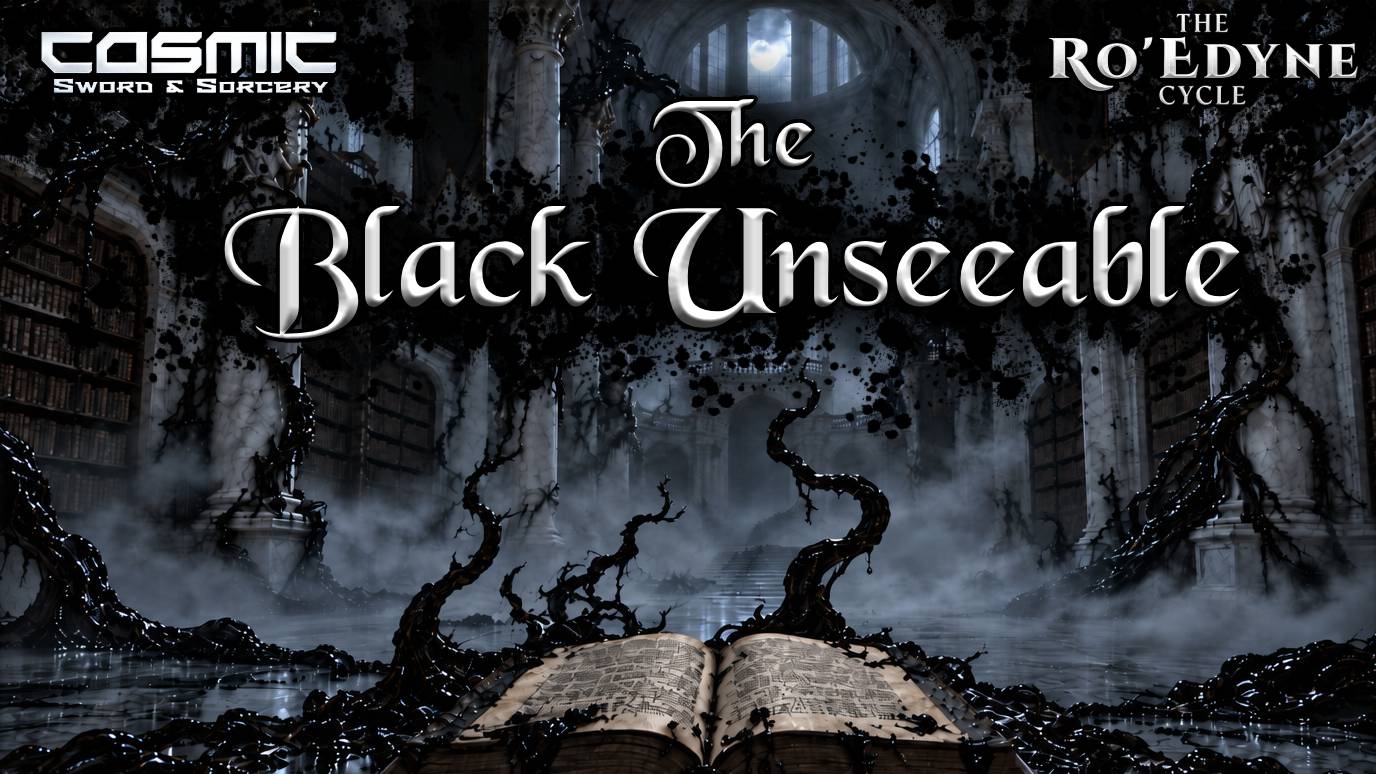
Among the countless artifacts catalogued throughout the history of the Greater Vandyrian Civilization, none has accumulated more names while yielding fewer certainties than the object commonly designated The Black Unseeable.
The consensus shared by every surviving archival institution is remarkably narrow. It is not regarded as a spellbook, despite its outward resemblance to one. It is not classified as an enchanted manuscript, cursed tome, living grimoire, or demonic artifact. Such classifications imply that the object performs magic upon the reader. The Black Unseeable instead appears to perform something vastly more fundamental. It alters the nature of recorded information itself. Every surviving containment doctrine therefore begins with the same administrative conclusion: the object is not dangerous because it is read. It is dangerous because it exists in the presence of writing.
Descriptions remain unusually consistent across civilizations separated by millions of years. Witnesses invariably describe an ordinary volume bound in featureless black material possessing neither title, ornamentation, author, nor identifiable script upon its cover. Its dimensions fluctuate slightly between accounts, though never beyond what scholars once dismissed as ordinary errors of observation. Attempts to record its weight, page count, language, ink composition, or methods of manufacture have produced contradictory results even when performed simultaneously by observers standing beside one another. More troubling still, no surviving catalogue agrees upon where the volume was first discovered.
Every civilization possessing records of The Black Unseeable believed itself to be documenting the artifact’s initial appearance, only for older documents to emerge centuries later proving another institution had already reached the same conclusion. The object therefore occupies an unprecedented administrative category within Imperial archival doctrine. Its origin is officially listed as Unknown, while the location of first discovery is recorded simply as Disputed by Every Existing Record.
The first stage of contamination is deceptively subtle. The Black Unseeable exhibits no immediate hostility toward living observers. It does not emit light, produce voices, project illusions, or compel individuals toward obsessive study in the manner associated with lesser memetic hazards. Instead, it remains entirely inert until placed within practical proximity of written language. Distance thresholds remain poorly understood, varying according to environmental conditions, volume density, and perhaps factors not yet recognized by surviving scholarship. Once sufficient written material occupies its vicinity, the process begins.
Nearby books first exhibit minor textual inconsistencies. Individual words migrate between pages. Marginal notes appear in volumes whose authors insist they never wrote them. Cross-references begin citing chapters that do not exist. Entire catalogues quietly reorder themselves overnight without corresponding changes to shelving. Initially these alterations resemble commonplace archival corruption, transcription error, or inattentive scholarship. It is this apparent banality that renders the first stage so catastrophically effective.
The second stage begins when surrounding works cease merely changing and instead begin reproducing the contamination itself. Books nearest the artifact slowly lose their individual identity until each becomes an exact duplicate of The Black Unseeable. Shelves once containing histories, engineering manuals, poetry, astronomical charts, theological disputes, legal doctrine, and biological surveys gradually become occupied by identical black volumes.
Their bindings match perfectly. Their dimensions converge. Their pages increasingly resemble one another despite originating from entirely unrelated manuscripts. Removal of the duplicates proves ineffective, for the process continues among whatever written works remain. Burning affected books merely accelerates replacement if uncontaminated texts continue existing nearby. Destroying catalogues causes inventories to rewrite themselves elsewhere. Eliminating copies without eliminating writing itself has repeatedly proven futile throughout recorded history.
It is only during the third generation that scholars generally realize they are no longer confronting corrupted literature. The copies begin diverging. Bindings thicken into leathery structures possessing no recognizable animal origin. Pages fuse together before unfolding into layered organic membranes. Ink ceases behaving as pigment, instead spreading through volumes as branching vascular networks resembling veins more than calligraphy.
Shelves deform beneath increasing biological pressure while manuscripts swell into cocoon-like structures suspended from resinous growths extending through stone, timber, and metal alike. At this stage every newly transformed volume differs slightly from those preceding it, as though successive generations undergo accelerated evolution rather than simple duplication. Libraries cease functioning as collections of information and instead become ecological systems whose reproductive substrate happens to be recorded language.
Surviving eyewitness testimony consistently reports that the process eventually expands beyond books entirely. Inventories, wall inscriptions, engineering diagrams, legal decrees, correspondence, maps, paintings containing written captions, engraved monuments, crystalline data storage, enchanted recording matrices, illuminated murals, and even temporary notes scratched into dust become viable mediums of propagation.
The contamination demonstrates no apparent preference for language, script, material, or technology. Ink, carved stone, etched steel, woven tapestries bearing heraldry, magically preserved memory crystals, and electronically encoded archives have all succumbed under suitable conditions. The Black Unseeable therefore represents not a corruption of paper, but of symbolic permanence itself. It appears capable of recognizing the abstract existence of recorded information irrespective of medium.
Perhaps the most disturbing aspect of the phenomenon is its apparent indifference toward living organisms. Individuals entering contaminated archives frequently survive for extended periods, sometimes days, while remaining physically unharmed. Instead, they report increasingly severe failures in memory, chronology, and conceptual continuity. Archivists forget where shelves once stood despite standing before them. Librarians become unable to distinguish catalogues from histories or dictionaries from personal journals.
Written communication rapidly deteriorates because newly composed notes themselves become active participants within the contamination. Entire containment efforts have reportedly collapsed simply because commanders attempted documenting containment procedures, thereby introducing additional written substrate upon which the phenomenon could propagate. Several Imperial preservation doctrines therefore prohibited note-taking entirely once contamination exceeded designated thresholds, requiring all communication to occur verbally until evacuation concluded.
Imperial archival doctrine ultimately abandoned every proposed method of destruction after repeated civilizational failure. Fire proved ineffective. Alchemical dissolution failed. Dimensional exile merely transferred contamination elsewhere. Magical purification rituals frequently accelerated transformation by introducing additional symbolic frameworks into the affected environment. Even attempts to erase language entirely produced contradictory outcomes, with damaged inscriptions reportedly regenerating into unfamiliar scripts over time. It was during the later Imperial Ages that containment philosophy underwent its decisive shift.
The objective ceased being destruction and became isolation. Entire archives were abandoned beneath mountains of engineered stone. Libraries were converted into sealed geological prisons. Great pyramids, fortress vaults, and isolated subterranean complexes originally believed by later historians to be ceremonial monuments are now understood by several restricted Imperial departments to have served an entirely different architectural purpose. They were not built to honor knowledge. They were built to imprison it.
For this reason, possession of The Black Unseeable constitutes one of the few offenses in Imperial jurisprudence requiring no demonstration of hostile intent. Discovery alone authorizes immediate quarantine under Archivist Exceptional Preservation Statutes. Military intervention remains subordinate to archival authority, an almost unprecedented inversion of normal Imperial hierarchy reflecting the unique nature of the threat.
Specialized Librarian Orders historically exercised direct command over engineering corps, sorcerers, preservation specialists, and regional governors whenever credible reports suggested possible manifestation. Their operational doctrine remained brutally simple. No investigation beyond minimum confirmation. No experimentation beyond established thresholds. No transportation except under already sanctioned containment protocols. Above all, no additional written material enters the containment zone once contamination is suspected. Entire civilizations ignored those procedures exactly once. None are known to have repeated the mistake.
Whether The Black Unseeable possesses intelligence remains unanswered. Some surviving testimonies describe apparent responses to observation, while others insist the phenomenon behaves with complete ecological indifference. Scholars arguing for intelligence point toward increasingly coherent structural organization during advanced contamination, while opponents counter that no direct communication has ever been reliably verified. The only universally accepted conclusion is considerably more unsettling.
Every civilization that attempted understanding The Black Unseeable as a book ceased treating it as one before the end. Every civilization that survived instead concluded they had been asking the wrong question from the beginning. The Black Unseeable is not a volume containing something dangerous. It is something dangerous that merely resembles a volume.
The distinction, though deceptively small, has repeatedly marked the boundary between successful containment and the permanent disappearance of entire libraries from recorded history.
—From the Research Notes of the late Elder Archivist Maltahn of Tykon’Mach
The account which follows was compiled from the surviving correspondence of Elder Archivist Maltahn of Tykon’Mach,supplemented by the testimony of the Magistrate of Panultimir, members of the Civic Watch, and those scholars who remained beyond the Inner Archive during the events of the Fifth Day.
Certain names have since been removed from public record by decree of the Council of Archives, while others survive only within restricted crystal repositories maintained under permanent seal.
The substance of the incident, however, has been preserved in its original sequence, for no clearer account has since been assembled.
Chapter 1 — The Fifth Day
The morning had scarcely reached its second bell when the great bronze doors of the Hall of Civic Administration were thrown open with sufficient force to silence every clerk, petitioner, magistrate, and attending scholar gathered beneath its vaulted ceiling. Conversation ceased almost immediately, not because of the violence of the entrance, but because every soul present recognized the figure now striding across the polished stone toward the council chamber.
Elder Librarian Harodan of Tykon’Mach entered without ceremony. Though advanced considerably in years, the old eagle retained the bearing of one who had spent an entire lifetime commanding silence rather than requesting it. His white feathers had long surrendered to age, but neither his eyes nor his temper had softened with them. Heavy black robes fell beneath a mantle embroidered with the silver sigils of the Grand Archive, while the great brass Master Key suspended from his belt struck rhythmically against the head of his walking staff with every measured step. Before Harodan had spoken a single word, the Magistrate of Panultimir had already risen from the council table. His expression suggested neither surprise nor irritation, but rather the weary patience of one who had anticipated this exact confrontation for several days.
“You have delayed this matter long enough,” Harodan declared as he halted before the council table, dispensing with every courtesy ordinarily afforded between officers of comparable station. “Five days have passed since my apprentice sealed the Inner Collections. Five days have passed while contradictory correspondence has accumulated, increasingly urgent reports have emerged from within the archive, and no satisfactory explanation has been offered to the office charged with its care. I have not come here to debate procedure, Magistrate. I have come to open my library.”
The Magistrate of Panultimir neither flinched nor answered immediately. When he finally spoke, his voice remained as measured as ever. “I have delayed nothing, Elder Librarian. I have obeyed the law as it stands. Until Elder Archivist Maltahn returns from the northern council, the emergency statutes remain in force, and the authority exercised by your acting Master Archivist remains legally recognized. Whether either of us finds that arrangement agreeable is irrelevant beside the obligations imposed upon this office.” Harodan rested both claws upon the head of his staff before answering. “The law was drafted for orderly mornings governed by ordinary circumstances. This has ceased to be an orderly morning, Magistrate, and whatever now occupies my apprentice has long since abandoned the orderly conduct anticipated by those statutes. Procedure exists to preserve civilization. It was never intended to become a prison built around indecision.”
A subdued murmur drifted through the assembled clerks before disappearing almost as quickly as it had begun. For five days the Grand Archive had remained partially sealed. Messages had continued to emerge from within its walls, each increasingly urgent, yet none described any calamity recognized by existing administrative doctrine. There had been no fire, no structural collapse, no armed intrusion, no plague, nor any other disaster for which established civic procedure provided an immediate response. The Head Archivist, Maltahn, remained absent in the north attending the Council of Histories, leaving operational authority divided between his senior apprentice and the Magistrate of Panultimir. Until that week the arrangement had functioned without incident. It had ceased functioning five days earlier.
“The acting Master Archivist invoked emergency preservation statutes under his own authority,” the Magistrate of Panultimir continued after allowing the room to settle into silence once more. “The Inner Collections were sealed immediately thereafter. Since that hour no individual has entered those chambers without his explicit written authorization, and no order bearing your authority has yet arrived sufficient to override those measures. I have enforced the law exactly as it presently exists.” Harodan regarded him steadily before replying. “No individual has entered? You mean to tell me that an apprentice archivist has imprisoned the heart of the greatest repository of knowledge in Ro’Edyne, and every official within this city has accepted that decision without challenge? Against whom were these emergency measures enacted? What enemy was named? What accusation was offered? What danger was described that justified closing the doors of an institution which has remained open through flood, siege, famine, and civil unrest?” The magistrate remained silent for several moments before drawing a slow breath. “No accusation was ever presented. No criminal complaint was filed. No declaration of sabotage, espionage, theft, or treason accompanied the order. The acting Master Archivist submitted only memoranda, each more urgent than the last, and each requesting actions that became progressively more difficult to explain.” Crossing to a nearby table, the Magistrate of Panultimir gathered a neatly bound collection of folded correspondence secured beneath crimson archival cord before placing it carefully before the librarian.
“The first memorandum requested additional catalogues from the western vaults. The second requested specialists in comparative translation. The third instructed that the Inner Collections be isolated. The fourth directed that no further books, inventories, written correspondence, catalogues, research notes, or recording materials of any kind be delivered beyond the sealed doors under any circumstances.”
Those instructions were unusual, but they remained lawful.
“Every order fell within the authority temporarily vested in the acting Master Archivist, however extraordinary the reasoning behind them may have appeared. I questioned the wisdom of each request, Elder Librarian, but wisdom and legality have never been the same discipline.” Harodan rested one claw upon the bundle without immediately opening it. His eyes lingered upon the crimson archival cord for several moments before he looked once more toward the Magistrate of Panultimir. “If the fourth memorandum prohibited all further written correspondence from entering the archive,” he asked quietly, “then why does this collection contain five memoranda rather than four? Either my apprentice contradicted his own instruction, or someone ignored it. I would know which before we continue.”
The Magistrate of Panultimir did not change expression. “We did not deliver another,” he answered without hesitation. Reaching once more into the bundle, he withdrew a final folded page and offered it to the old eagle with deliberate care, as though reluctant even to touch it. “The fifth memorandum appeared yesterday morning upon the registry table. No messenger entered the building. No courier departed. None of the guards stationed outside the Grand Archive observed anyone approaching the entrance, and every shift has since repeated the same account under formal questioning. Nevertheless, shortly after sunrise this document was discovered lying where incoming correspondence is ordinarily received. No one has yet explained how it arrived.”
Harodan accepted the folded sheet without comment and carefully unfolded it. His eyes crossed the page once, then again, lingering upon the same line as though expecting further words to reveal themselves through closer examination. The document contained no signature, no official seal, no date, no annotation, nor any identifying mark whatsoever. It consisted entirely of a single sentence.
Thank you. Your assistance has proven most valuable.
Without changing expression, the old librarian folded the page once more and returned it to the bundle exactly as he had found it. He offered neither conclusion nor speculation, yet none proved necessary. A subtle unease settled across the chamber with almost physical weight. Those standing too distant to overhear the exchange nevertheless sensed that the discussion had crossed some invisible threshold beyond ordinary administrative disagreement. Faces that had entered expecting another dispute over jurisdiction now found themselves quietly contemplating the possibility that no existing regulation adequately described whatever had begun unfolding inside the Grand Archive.
Four members of the Civic Watch remained standing before the eastern doors. They were not ordinary constables assigned to municipal duty but Bill Guards, each encased in polished steel nearly a thumb’s breadth thick. Their long hooked polearms rested comfortably against armored shoulders while silver-bound swords remained peace-locked within enchanted scabbards whose seals had not been broken in years. Such soldiers seldom appeared within civic halls except during periods of extraordinary unrest. Their presence implied that the Magistrate of Panultimir had anticipated the possibility of violence rather than bureaucratic disagreement, yet despite the authority standing before them they remained immovable, forming a silent barrier between Harodan and the road leading toward the eastern district. The captain inclined his head respectfully before speaking. “No entry, Elder Librarian.
I recognize both your office and your authority, and under ordinary circumstances I would already have ordered the passage opened. My instructions, however, remain unchanged. Until relieved by the Magistrate, I cannot permit anyone to proceed beyond these doors, regardless of station.”
Harodan regarded the captain without anger, though neither did he attempt to disguise his growing impatience. “I possess the Master Key of the Grand Archive. I outrank every archivist presently breathing within this city, and no guard under heaven possesses greater authority over that institution than the Keeper entrusted with its care. You know this as well as I do. Therefore I ask again—not as a petitioner seeking favor—but as the lawful custodian of those collections, that you stand aside and allow me to enter the archive whose preservation has been entrusted to my office.”
The captain neither flinched nor lowered his eyes. “Everything you have said is true, Elder Librarian. Your authority remains unquestioned, and your office stands supreme within the Archive. Under ordinary circumstances these doors would already be open. These, however, are not ordinary circumstances. Until the Magistrate relieves me of my duty, I cannot permit anyone, including yourself, to pass beyond them. Should that decision ultimately prove mistaken, I shall answer for it personally. Until then, my orders remain.”
Before either the elder eagle or the captain of the Civic Watch could continue, another voice emerged quietly from the far side of the chamber. Its single word was spoken softly enough that it scarcely rose above conversation, yet it carried across the hall with startling clarity, drawing every eye present toward the shadowed colonnade from which it had come.
“Don’t.”
Every eye turned toward the speaker. Leaning heavily against one of the great stone columns stood a visiting archival scholar from Kydahn, a jackal whose reputation for relentless criticism, razor wit, and perpetual sarcasm had become familiar throughout the libraries of Tykon’Mach. Ordinarily he carried himself with the confidence—and occasional insufferability—of one who delighted in correcting an entire room without ever surrendering the faint smirk that inevitably accompanied the performance. Today that expression had vanished completely. His robes hung untidily from sleepless shoulders, his paws trembled visibly, and dark circles beneath his eyes suggested many nights had passed without meaningful rest. Whatever confidence had once defined him had been replaced by something far less comfortable to witness.
He crossed the chamber with slow, uncertain steps before stopping only a few paces from Harodan. His voice remained hoarse, forcing each word through a throat gone dry. “Seal it. Seal the entire archive before anything else leaves those walls.” The old librarian regarded him not with irritation but with measured curiosity. “You ask me to abandon the greatest archive in Ro’Edyne without explanation. Have you entered the Inner Collections yourself? Have you witnessed something sufficient to justify closing centuries of accumulated scholarship behind locked doors? If you expect me to condemn that institution, you must offer me more than fear.”
The jackal slowly shook his head. “No. I have not entered.” Harodan frowned, studying the scholar carefully before speaking again. “Then upon what authority do you make this request?” The jackal closed his eyes briefly before answering. “The authority of history. If you value this city, if you value every archive, temple, school, and library beyond these walls, then seal the building and leave it sealed until someone wiser than either of us can explain what has begun there. I do not ask because I understand it. I ask because fragments of older records suggest that others once failed to act quickly enough.” Harodan continued studying him in silence. The old eagle had known scholars who were frightened before. He had seen researchers shaken by discoveries, historians disturbed by forgotten wars, and translators unnerved by blasphemous inscriptions recovered from ruined temples. This was something altogether different. Whatever stood before him had exhausted fear itself and left behind only grim conviction. “You are frightened,” Harodan observed quietly. “I am,” the jackal answered without hesitation. “Of what?” The scholar’s gaze drifted toward the eastern windows where, beyond rooftops and towers, the great dome of the Grand Archive rose proudly above the skyline. When he finally answered, his voice had become scarcely more than a whisper. “Do not burn it.”
Harodan’s brow furrowed. “Burn what?” The scholar slowly shook his head. “It doesn’t matter.” The old eagle took another measured step forward. “Then explain yourself.” The jackal swallowed hard before replying. “I cannot explain what I do not understand. I possess fragments, damaged records, scattered rumors, and the mistakes of my own civilization. I possess no certainty. I possess no complete account. I possess only enough to know that destroying the wrong thing may complete the very disaster one believes oneself to be preventing.” “You refuse,” Harodan replied quietly. The jackal met his gaze without looking away. “I lack the knowledge necessary to refuse.” Silence settled across the chamber once again. At length the jackal raised his eyes to meet those of the elderly librarian. “My people made that mistake once. Whatever has begun inside your archive, do not repeat it. Do not burn it. Do not attempt to destroy it until you understand exactly what it is you believe you are destroying, because if our histories retain even a fragment of the truth, certainty arrives only after the mistake has already been made, and by then the decision cannot be recalled.”
He bowed once with the weary dignity of one archivist acknowledging another before turning without further explanation and disappearing into the adjoining corridor. Harodan watched him leave for several silent moments before slowly returning his attention to the waiting guards. His gaze lingered upon the sealed eastern doors, then upon the Magistrate of Panultimir, before finally settling once more upon the captain of the Civic Watch. When he eventually spoke, his voice had become quiet enough that those nearest instinctively leaned forward to hear it.
“The doors.” The captain looked toward the Magistrate of Panultimir, who remained motionless for several long moments before finally inclining his head in silent assent. Without another word the guards raised their polearms and stepped aside, clearing the passage leading toward the eastern district.
Harodan adjusted the weight of the Master Key upon his belt before beginning the long walk toward the Grand Archive of Tykon’Mach, a building he had entered nearly every morning for more than sixty years and whose halls he knew with greater familiarity than his own home. Within those walls rested the accumulated memory of civilizations, dynasties, discoveries, languages, treaties, genealogies, philosophies, and generations of patient scholarship gathered across centuries of careful preservation.
To every citizen of Ro’Edyne it represented permanence, reason, and the triumph of ordered knowledge over the inevitable erosion of time itself. On that morning, however, Elder Librarian Harodan approached its doors burdened by a realization no keeper of books should ever be forced to entertain—that whatever awaited within had already begun changing the purpose for which the archive itself had been built, and that before the day ended he might find himself responsible not for preserving the greatest library in the world, but for determining whether it should ever again be permitted to open its doors.
Chapter 2 — The Silent Archive
The streets surrounding the Grand Archive of Tykon’Mach had never before known silence. Even during the darkest winters, when snow settled upon the bronze roofs and scholars hurried beneath heavy cloaks from lecture hall to reading chamber, the district remained alive with conversation.
Apprentices carried stacks of newly copied manuscripts between annexes, messengers hurried beneath the elevated galleries with sealed memoranda tucked beneath their arms, professors argued loudly over translations whose authors had been dead for millennia, and merchants supplying parchment, inks, oils, preservation salts, and crystalline storage housings maintained a steady procession through the eastern service gates from sunrise until well after dusk. Learning possessed its own rhythm, and the Archive had served as its heart for generations. Yet as Harodan, the Magistrate of Panultimir, four Bill Guards, and several accompanying archivists entered the eastern district, that rhythm had vanished so completely that even the sound of their own footsteps seemed intrusive.
The great plaza before the Archive stood deserted beneath the pale afternoon light. Hundreds of stone benches circled ornamental fountains whose waters continued flowing exactly as they always had, while the banners of the Grand Archive drifted lazily above entrances through which no scholars now passed. Delivery wagons remained abandoned where they had been left several days earlier. One still carried tightly wrapped bundles of fresh parchment beneath waterproof canvas, while another bore sealed crates of imported crystalline recording matrices awaiting cataloguing. Neither had been unloaded. Nearby, a handcart lay overturned beside the eastern colonnade, its contents scattered neatly across the paving stones. Several bound journals rested where they had fallen, untouched despite five days of exposure to wind and rain, and Harodan found himself looking at them longer than he wished, for abandoned books in the open air offended him in a manner far deeper than disorder alone could explain.
Harodan paused only briefly before mounting the broad marble staircase leading toward the principal entrance. The immense bronze doors already stood open, and that detail troubled him immediately. The Grand Archive had never closed its public entrance during daylight hours except by direct order of the Elder Archivist himself, yet neither did the open doors suggest ordinary operation. No reception attendants greeted arriving scholars. No registrars occupied the great oak counters beyond the vestibule.
The entry hall, crowded from dawn until evening, appeared strangely vacant, as though every individual occupying the building had departed in the middle of some unfinished task without ever returning to complete it. Inside, the silence deepened, not as an absence of sound alone, but as a pressure settled upon the galleries, pressing down upon every lamp, desk, ledger, and breathing soul who crossed the threshold.
Rows of registry desks stretched across the entrance chamber exactly as Harodan remembered them, each piled high with accession records, inventory ledgers, untranslated manuscripts, and correspondence awaiting classification. Oil lamps continued burning above every station despite the broad afternoon light pouring through the high stained-glass windows. Wax had overflowed several brass holders, forming pale rivers across polished wood, suggesting that no attendant had replenished or extinguished them for many hours. Quills rested where they had been dropped. Open ledgers remained half-completed. Inkpots had long since dried where they stood. One chair lay overturned beside a writing desk, while another had been pushed back so abruptly that its rear legs rested against a neighboring table. Everywhere Harodan looked he found evidence not of panic, but interruption. The Magistrate slowly surveyed the chamber before speaking in a low voice. “There was no order to evacuate,” he said, as though reciting a fact already known to both of them but made more troubling by repetition. Harodan answered without looking away from the nearest ledger.
“No.” The magistrate’s gaze moved toward the overturned chair, then to the abandoned counters, then to the wide central passage leading deeper into the building. “No attack was reported.” Harodan lowered one claw to the registry book before him, where the final entry ended midway through a sentence and the ink simply stopped. “No.” The magistrate drew a slow breath. “and no alarm.” Harodan closed the ledger with more care than the moment seemed to require. “No,” he said once more, and without further discussion the party advanced deeper into the Archive.
The corridors beyond retained the familiar geometry Harodan had walked nearly every morning for six decades, yet subtle inconsistencies began revealing themselves almost immediately. Memoranda lay scattered throughout the galleries in steadily increasing numbers, some carefully folded and bearing official archival seals, others hastily scribbled upon scraps of cataloguing paper clearly written in moments of mounting urgency. Several remained pinned to notice boards where no one had returned to remove them. Others had simply fallen where exhausted paws had released them.
Every few dozen paces Harodan stopped to examine another page before silently placing it back exactly where he had found it, and each page seemed less like correspondence than a footprint left by thought retreating from something it no longer understood.
The earliest messages retained their professional tone. One requested additional comparative lexicons from Western Vault Three. Another asked that the Valusian transcription index be forwarded without delay. A third noted that several additional specialists would be required if the newly discovered material proved as difficult as preliminary examination suggested. The requests indicated little beyond scholarly enthusiasm. Someone had discovered an unusual document and wished to examine it properly. Such correspondence appeared hundreds of times each year within the Grand Archive, and under ordinary circumstances Harodan would have considered the matter routine, even promising, had the surrounding silence not already stripped every explanation of its comfort.
Farther inward the language began to change. Orders appeared directing ordinary catalogue operations to be suspended until further notice, instructing that no additional assistants enter without authorization, and requiring Collection Hall Seven to be sealed.
One memorandum specifically demanded that no further manuscripts be delivered to the working chamber, while another added inventories, reference catalogues, study notes, blank journals, and recording crystals to the prohibition. The handwriting remained recognizable, but the confidence behind it had begun to erode. What had first appeared as research had become containment, though no one had yet written the word plainly enough for the law to understand it.
Still farther inward the pages ceased resembling memoranda altogether. One sheet bore only the words, “Everything copies,” written three times in a hand that became less steady with each repetition. Another warned, “Do not answer written questions.” A third had been folded and unfolded so many times that the paper nearly separated along the creases, and upon it someone had written, “Destroy nothing. Nothing leaves. No more books.” The final pages bore almost no punctuation and less certainty. “No notes,” one read. “No records,” read another. The last, written in cramped script beside the dry smear of an overturned inkpot, said only, “Please stop sending paper.”
Harodan said nothing as he folded the final sheet and returned it gently to the floor. The Magistrate required no explanation. Together they had reconstructed nearly the entire progression of events without a single witness needing to speak. Whatever had begun five days earlier had first been approached as scholarship, then as an unusual preservation problem, then as an emergency requiring isolation, and finally as something for which no language possessed suitable administrative terminology. The deeper they traveled, the less the Archive resembled an institution overwhelmed by disaster and the more it resembled an institution that had attempted, piece by piece, to amputate its own functions in order to survive.
They continued toward the Inner Collections, passing through chambers where the evidence of increasingly desperate improvisation became impossible to mistake. Entire reading rooms had been stripped of blank paper. Cabinets ordinarily stocked with fresh journals stood empty. Storage rooms containing wax tablets, writing slates, and crystal recording prisms had been sealed from within using improvised barricades assembled from shelving and furniture. Every measure suggested not defense against intrusion, but the deliberate removal of anything capable of receiving additional written information. The pattern disturbed Harodan more profoundly than any corpse might have done, for every decision reflected careful reasoning rather than panic. Someone inside the Archive had arrived at conclusions so alarming that they had willingly dismantled the normal functioning of the greatest library in Ro’Edyne in order to obey them.
The first living scholar appeared without warning when the side door of a translation chamber burst open with startling violence and a young male ferret stumbled into the corridor with one paw pressed tightly across his mouth. He managed only three unsteady steps before collapsing beside one of the marble columns, where violent retching overtook him. Thick black fluid splattered across the stone floor before draining sluggishly into the grooves between the polished tiles. He remained there several moments, trembling violently, until at last he forced himself upright and lurched toward one of the decorative fountains occupying the central gallery. Without appearing to notice the newcomers, he plunged both paws repeatedly into the water, scrubbing them with frantic determination until the skin beneath his fur had become raw. Again and again he washed them, pausing only to stare at them in mute disbelief before beginning the process anew, as though whatever he believed remained upon them plainly refused to disappear beneath water.
Harodan approached slowly, careful not to startle him further. “My son,” the old eagle said, keeping his voice low. The ferret recoiled so violently that he nearly lost his footing, one wet paw striking the rim of the fountain as he stumbled backward. “No,” he gasped, his breathing coming in ragged, uneven bursts. “No, don’t come closer.” Harodan stopped at once and raised one claw in a gesture of restraint rather than command.
“Elder Librarian Harodan,” he answered calmly.
“You are safe. Tell me what happened.”
The ferret blinked several times without recognition. His eyes moved across the assembled guards, the Magistrate, the scholars, then back toward Harodan as though struggling to remember where he stood or why any of them had come. For several long moments he simply stared, and then his expression collapsed. “You shouldn’t be here,” he whispered. “You should have stayed outside.” Harodan remained where he stood, neither advancing nor retreating.
“What happened inside?” The ferret slowly shook his head. His mouth opened, closed, then opened again, as if every answer available to him had become unusable the moment he attempted to speak it. At length he managed, “It isn’t right anymore.” The words seemed inadequate even to himself. He looked desperately toward the Inner Collections before continuing in fragments that came from him like broken pieces of a single thought. “The shelves are changing. The words don’t stay. They don’t stay where they’re written.” He squeezed both eyes shut as though struggling against some memory that refused to remain coherent, while the water from his soaked paws dripped steadily onto the stone floor between them.
The Magistrate stepped forward only far enough to be heard. “How many remain inside?” he asked.
The ferret stared blankly, then answered, “I don’t know.”
The Magistrate’s voice remained level, but his expression tightened. “You were working there. How many remained when you left?” The question seemed to frighten the young scholar more than the corridor itself. “I knew,” he said, pressing both paws against the sides of his head. “I knew yesterday. I think yesterday. I don’t know what day it is.”
His breathing became rapid once more, and for a moment Harodan feared he would collapse entirely. The silence that followed proved heavier than anything yet encountered within the Archive, for the answer had revealed more than any count of survivors could have done. The building had not merely endangered its occupants. It had begun to compromise the order by which they understood their own memories. Finally the ferret lowered his trembling paws and looked directly toward Harodan with an expression emptied almost entirely of hope.
“Please,” his voice cracking beneath the effort of remaining coherent. “Please don’t go in there.”
Harodan regarded him quietly before asking, “Why?” The answer emerged almost involuntarily, stripped of ornament, doctrine, and explanation. “Because reality is coming apart.”
No one replied, and the ferret looked from one face to another before suddenly realizing that none of them understood what he meant. “I don’t know how else to say it,” he continued, taking several uncertain steps backward. “The library is forgetting how to be a library.” Without another word he turned and hurried down the adjoining corridor, calling hoarsely for additional guards as he disappeared into the distance. His voice echoed through the galleries for several long moments before silence reclaimed the building once again.
No member of the party attempted to follow him, for his warning had already performed whatever service remained within his power to offer. Instead Harodan continued walking, and the others followed because no official duty, no civic order, and no preservation statute now possessed any meaning unless someone could reach the sealed heart of the Archive and learn what had become of it. The corridors narrowed as they approached the oldest foundations of the Grand Archive. Here the architecture changed noticeably. Modern reading halls gave way to immense circular chambers constructed centuries earlier when the Archive itself had first been founded. Massive pillars supported vaulted ceilings lost within darkness above, while concentric galleries overlooked the central preservation vaults where the oldest surviving manuscripts of Ro’Edyne had rested safely for generations. At the far end of the final gallery stood the reinforced crystal security partition protecting the entrance to the Inner Collections.
The partition had been sealed, though the condition of the barrier suggested that sealing alone had not preserved it. The transparent crystal had become almost entirely opaque beneath spreading layers of glossy black resin clinging to its inner surface. Veins of the same substance threaded slowly outward beneath the heavy bronze doors before disappearing into the stone joints of the surrounding floor. Lamps positioned outside the partition still burned steadily, their warm light reflecting dimly across a surface that no longer behaved like crystal but resembled darkened glass submerged beneath layers of living varnish. Standing before the entrance, scarcely able to remain upright, waited Archivist Yabesa. The elderly giraffe’s normally immaculate robes had become stained with dried ink and dust, while every visible tremor passing through her hands suggested that whatever duty had kept her standing before the sealed doors had long ago exceeded the limits of endurance. She turned at the sound of approaching footsteps, saw Harodan, and whatever composure she had preserved over the preceding five days dissolved instantly.
Yabesa crossed the remaining distance toward him and stopped only because her legs threatened to fail beneath her. Tears had already begun to gather in her exhausted eyes. “Elder Librarian,” she said, though the title nearly broke apart in her throat before she finished it. Harodan caught her gently by the shoulders, steadying rather than restraining her. She glanced once over her shoulder toward the darkened partition and shuddered. “I tried,” she whispered. “I couldn’t leave him. I couldn’t leave any of them, but I couldn’t go back in. I heard him through the crystal. He kept calling for catalogues after he had no mouth left to speak with. I don’t know whether he was asking for help or whether something was using his voice because it remembered that voices are useful.” The words struck the gathered company with more force than any scream could have done, and even the Bill Guards shifted uneasily within their steel.
Harodan rested one feathered claw gently upon Yabesa’s shoulder before raising his eyes toward the great crystal barrier separating the Archive from whatever now occupied its innermost chambers. Without haste, he reached beneath his robes and withdrew the ancient brass Master Key entrusted to every Elder Librarian since the founding of Tykon’Mach.
The heavy wards surrounding the security partition recognized its presence immediately.
Deep within the surrounding stonework, mechanisms untouched for generations awakened one by one with slow metallic certainty. Bronze locking bars began withdrawing into the walls.
Ancient preservation sigils kindled softly beneath the floor. Somewhere beyond the darkened crystal, muffled and indistinct, something answered with a sound too distant to identify, though every soul present understood that it had heard them.
No one spoke.
No one moved.
As the final locking mechanism released with a resonant echo that rolled through the silent galleries, Harodan extended one claw toward the control lever set beside the crystal doors, and for the first time in five days, the Inner Collections began to open.
Chapter 3 — A Prison for Books
The security shutter descended only halfway before binding against some unseen obstruction. Thick strands of black resin, glistening beneath the lantern light, had crept upward from the seams of the floor and across the reinforced frame, sealing portions of the mechanism into an organic mass whose texture resembled neither wood nor flesh.
The observation glass beyond had long since become opaque, not through smoke or soot, but beneath countless overlapping layers of dark vascular growth that pulsed with faint violet luminescence somewhere deep within. Yabesa stood several paces behind the others, trembling uncontrollably despite every attempt to steady herself. The Head Librarian placed one weathered hand against the emergency release while the magistrate silently rested his grip upon the pommel of his sword. Neither expected what waited beyond. Both nevertheless understood that whatever answers remained in the archive existed only on the opposite side of that door.
The glass partition slid aside with a wet, reluctant groan. An odor unlike anything either scholar had encountered escaped immediately into the corridor. It carried no familiar scent of decay, smoke, blood, or alchemical contamination. Instead, it possessed the strange sweetness of damp paper left forgotten for generations, mingled with the metallic tang of fresh ink and something faintly botanical that no member of the party could identify. Before anyone spoke, before anyone crossed the threshold, every eye was drawn toward the impossible growth occupying what had once been the central reading chamber. The assistant archivist still lived.
Recognition came not because he remained unchanged, but because fragments of the scholar still persisted beneath the transformation. His robes had fused into black resin that anchored him against the far wall. His arms no longer supported his own weight, having disappeared beneath great fibrous cords that disappeared into shelves, desks, ladders, and countless swollen masses hanging throughout the chamber. His face retained enough of its former shape for the Head Librarian to recognize his apprentice, yet the eyes had become empty cavities filled only with drifting violet light. His mouth remained open in permanent agony, producing a low, ceaseless wail that echoed through the chamber not as speech, but as the slow exhalation of lungs that no longer belonged to him.
Then his back moved. The spine split silently from the base of the neck downward, not with violence but with the measured certainty of a flower opening beneath the morning sun.
Vertebrae unfolded one after another into layered structures resembling enormous black petals whose surfaces shimmered with countless lines of luminous script.
Between those impossible leaves flowed thick streams of dark resin carrying fragments of parchment, splinters of shelving, shattered bindings, and shredded pages that had become inseparable from the living structure itself. The Head Librarian watched in horrified silence as words slowly emerged beneath the archivist’s skin, climbing upward along his neck, disappearing across his jaw, and continuing into the flowering mass behind him until flesh, language, and vegetation had become impossible to distinguish from one another. The library itself had ceased to exist.
Shelves no longer stood as orderly repositories of accumulated scholarship. They had become the trunks of an expanding organism whose root-like tendrils passed effortlessly through stone, timber, glass, and iron alike. Thousands of books remained visible throughout the chamber, but none retained their former purpose.
Some had swollen into leathery pods suspended from resinous vines. Others had split open into layered cocoons whose interiors revealed structures resembling folded organs rather than paper. Entire walls had disappeared beneath overlapping sheets of black growth whose surfaces bore impressions of calligraphy that continuously shifted as though language itself had become vascular tissue. Everywhere the eye settled, knowledge had surrendered its former shape and entered some terrible new biology. A muffled crack echoed somewhere above.
One of the hanging pods slowly separated along its seam before unfurling like overripe fruit. From within emerged a creature roughly the size of a parrot, though no naturalist would ever have mistaken it for a bird. Six articulated limbs unfolded from a body armored in overlapping black plates whose joints resembled ancient book hinges fashioned from dark brass. Its wings stretched outward upon translucent membranes veined with branching patterns that looked disturbingly similar to illuminated script viewed through stained glass.
Where compound eyes should have rested sat polished spheres of obsidian reflecting the chamber in impossible distortions. It perched upon the flowering stalk for only a heartbeat before another pod opened, then another, until dozens of the silent arthropods began crawling carefully across the expanding organism, tending resinous growths, gathering drifting fragments of parchment, and disappearing into hidden passages woven throughout the living archive. They ignored the intruders completely. Their purpose lay elsewhere. Yabesa collapsed to her knees.
“What… what are we going to do?” she cried, her voice breaking beneath the impossible weight of what stood before them. “Please… tell me what are we going to do.” No answer came immediately. The magistrate slowly lowered his sword. The Head Librarian did not move toward the apprentice. He did not order the guards forward. He did not call for oil, torches, axes, or demolition charges. Every instinct learned through a lifetime of protecting books demanded that he preserve the archive before him. Every instinct learned through that same lifetime now told him the archive no longer existed. What remained was something altogether different, something that had merely chosen the likeness of scholarship as fertile ground. For several long moments he listened only to the mournful breathing of his apprentice and the quiet rustling of pages that were no longer pages.
Finally, the old eagle spoke. “We seal it.” The magistrate looked toward him in disbelief. “We do not burn it,” the librarian continued, his voice low and unwavering. “If fire could solve this, another civilization would already have solved it. We do not remove the book. We do not recover the collection. We do not preserve another page. We seal every entrance. Every corridor. Every vault. We abandon this archive today, and from this hour onward no scholar, no magistrate, no council, and no emperor shall ever again cross this threshold.” No one argued.
Epilogue
The order spread through Tykon’Mach before sunset. Stoneworkers replaced librarians, engineers replaced scholars, and architects replaced historians. Every resource the city could command was redirected toward a single purpose. The great library ceased to exist as an institution of learning and became instead the foundation of the largest containment structure the city had ever conceived. Layer upon layer of dressed stone descended over the abandoned archive, while reinforced galleries, inspection chambers, pressure vaults, and isolated maintenance passages were incorporated into a design intended not to honor what lay beneath, but to deny it passage back into the world above.
Public records spoke only of structural reconstruction following an unspecified disaster. The surviving crystal archives quietly absorbed what knowledge could safely be preserved, while the remaining documents vanished from official history. Questions received no answers, and rumors found no confirmation. Even the visiting Kydahni archivist departed without ever learning the fate of the apprentice whose desperate memoranda had summoned them home.
Many generations later, travelers would stand before the Second Great Pyramid of Tykon’Mach and admire only its impossible scale, elegant geometry, and monumental engineering. Scholars would attribute its construction to dynastic ambition, religious symbolism, civic prestige, or the familiar vanities that had produced so many other wonders throughout the history of the Greater Vandyrian Civilization. They would measure its foundations, debate its chronology, compare its architecture to neighboring pyramids, and fill countless shelves with competing theories regarding the motives of those who commissioned it. None would suspect that beneath millions of tons of carefully fitted stone rested neither king nor treasury, neither temple nor observatory, but a library whose final duty had become the imprisonment of its own contents.
The Book of Librion remained exactly where it had first been discovered, untouched by flame and undisturbed by those who had condemned its resting place to eternal darkness. It was never burned, nor was it ever removed. The archive had not been destroyed, but had simply been given a different purpose, becoming not the greatest house of knowledge in Tykon’Mach, but the first and largest prison ever built for books.
Nari and Yazha were quite certain that the afternoon had been altogether too brief, although neither could have said with any confidence how many hours had passed beneath the Surface.
Time, that most exacting of tyrants, had been little regarded in the warm and secluded waters of the subterranean pool, where the two young lovers had hidden themselves from the inquisitive eyes of the world above. There, among the ancient stones and beneath a ceiling lost in the perpetual twilight of the Undercity, they had passed the better portion of the day in embraces, affectionate whisperings, and those innumerable little follies which attend the private happiness of the young.
Now, however, the daylight beyond the narrow apertures of the ancient masonry had begun to diminish, and the unhappy necessity of returning to civilization could no longer be postponed. Their clothing lay in various states of disorder upon the stones, while the girls themselves, both nineteen years of age and entirely unwilling to surrender the afternoon, giggled and blushed as they attempted to make themselves respectable once more.
Yazha, a slender blonde fox of considerable intellectual accomplishment and decidedly less practical courage, was having particular difficulty arranging her garments while her black-haired wolf companion persisted in distracting her. Nari possessed the quick smile and mischievous disposition of one who regarded the greater portion of life’s obligations as unfortunate interruptions to more pleasurable pursuits. An aspiring bard, she carried a small lute upon her shoulder and entertained romantic notions concerning the great musicians of antiquity, whose compositions she maintained possessed a dignity and refinement almost entirely absent from the vulgar entertainments of her own generation. Yazha, for her part, reserved a comparable devotion for the mysteries of philosophical mathematics, an affection so profound that Nari occasionally professed herself jealous of equations. This accusation never failed to amuse the fox, who would solemnly assure her lover that mathematical truths, unlike musicians, were at least dependable. Yet there was little of either music or mathematics in their immediate conversation, which consisted chiefly of teasing suggestions that they abandon their clothing altogether and return to the delicious warmth of the pool.
Indeed, their choice of refuge had been inspired by considerations more immediate than either scholarship or artistic sentiment. The Undercity, despite the innumerable warnings attached to its name, offered one exceedingly attractive advantage: privacy. No meddlesome acquaintance was likely to wander among its deserted passages, no elderly neighbor would report their whereabouts, and, most importantly, there was little prospect of encountering Dija. This last consideration was of particular importance to both girls, for Dija was an obnoxious young male whose chief pleasures in life appeared to consist of stealing unattended clothing, pouring icy beverages upon unsuspecting victims, and reporting the indiscretions of his elders to their mothers. To escape his attentions for an afternoon was itself a small triumph, and the prospect of doing so in the company of one’s beloved had rendered the old warnings concerning the Undercity rather less persuasive than they might otherwise have been.
It was, of course, no ordinary ruin into which they had ventured. Beneath the ancient City of Steel extended a labyrinth of chambers, vaults, stairways, and galleries belonging to epochs whose very names had passed from common remembrance. Its foundations spread beneath the entire city and continued outward under the surrounding forests, though not so far as the distant Towerpine Borders.
Within those buried precincts lay the remnants of a civilization whose grandeur had become the substance of legend: libraries filled with mouldering scrolls, ceremonial halls deprived of their courts, chambers wherein the dust of dead centuries lay undisturbed, and armories containing swords of a workmanship no living smith could readily reproduce. Deeper still were the sepulchral halls of the ancient Ro’Edyne, where those who had served the city in life continued, by a covenant older than the present age, to serve it in death. Such matters were generally considered sufficient reason for sensible folk to remain aboveground, particularly after sunset. Nari and Yazha, having found the pool most agreeable, had elected to concern themselves with these warnings at some more convenient hour. That hour, regrettably, had arrived.
“We really must go,” Yazha murmured, although her arms remained entwined about Nari’s waist and her expression suggested that she considered the proposition thoroughly objectionable.
“Mother will have everyone searching for me if I am not home before supper, and I have no wish to explain why my books have remained unopened all afternoon.”
“Then we shall tell her that you were engaged in the most demanding of philosophical investigations,” Nari replied, fastening her belt with an air of innocence that convinced neither of them. “A rigorous examination of warmth, affection, and the properties of water.” “You are a dreadful scholar.” “And you are a dreadful distraction.”
Yazha laughed, and for another moment their departure was delayed by an embrace which threatened to become considerably longer. At last Nari retrieved her lute, settled its strap upon her shoulder, and bestowed a final kiss upon the fox’s cheek. Yazha took her hand, and together they abandoned the warm waters and their cherished solitude, making their way through the dim passage toward the stairway by which they believed they had entered. Neither looked back, though both would later remember the pool with an affection rather greater than that inspired by the remainder of their adventure.
Their route appeared simple enough. First to the left, then upward along a flight of worn stone steps, and thereafter to the right through a corridor terminating at a great wooden door. Nari remembered the door distinctly, for it was constructed of massive timbers darkened almost to blackness by age, and bore upon its surface iron fittings of a design no longer employed by the craftsmen of the upper city. She approached it with confidence, laid her hand upon the ancient latch, and pulled. The door remained unmoved. She pulled again, this time with considerably greater determination, and was rewarded only by the groaning complaint of the ironwork. Yazha watched her with an expression of gathering apprehension. “It is locked,” she said.
“So it would appear,” Nari answered, giving the door another vigorous tug. “But it was not locked before.” “I am quite aware of that.”
The wolf placed one foot against the stone threshold and strained with both hands upon the latch, producing a noise suggestive of a large and thoroughly uncooperative piece of furniture. The door did not yield so much as a finger’s breadth. Yazha joined her, and together they pushed, pulled, rattled the iron handle, and examined the surrounding masonry for some forgotten fastening. Their efforts were accompanied by several uncomplimentary remarks concerning the intelligence of ancient carpenters, the unnecessary thickness of old doors, and the peculiar enthusiasm with which the people of bygone ages had constructed everything to endure until the end of creation. At length, breathless and disheveled, they stood before the unyielding portal and regarded it in unhappy silence.
“I suppose,” Yazha said, slipping her arms around Nari from behind,“that we shall simply have to remain here forever.” “That would be inconvenient.”
“Would it? We have a pool, we have privacy, and we have each other. I can think of worse arrangements.” “We have no supper.”
“A minor consideration.”
“And no breakfast.”
Yazha reflected upon this objection with a seriousness altogether disproportionate to the circumstances.
“Perhaps,” she conceded, “we should endeavor to escape before breakfast.”
Nari smiled despite herself, but there was less confidence in the expression than she would have wished. The failing daylight had become noticeably weaker, and the long shadows gathered along the corridor with a patience she found increasingly disagreeable. Somewhere beyond the visible masonry lay an immensity of buried streets and sepulchral vaults, and within those vaults rested the Ro’Edyne dead. They were the ancient defenders of the city, warriors who had fallen in battle yet had not been released from their final obligations. In the days of their living service they had signed their souls to the nation in silver ink, kneeling before clerics, druids, and sorcerers to enter a covenant with the city itself. Should any enemy rise to threaten its peace, they would arise in turn, bearing cold Vandyrian steel against those who profaned the ancient precincts. How many centuries had passed since those oaths were sworn, neither girl could have said. It was enough to know that the covenant endured, and that the dead were said to be exceedingly particular concerning its observance.
“Are we quite certain,” Yazha ventured at last, “that this is the right door?”
Nari turned to regard her companion with an expression of such immediate disappointment that the fox almost regretted having spoken.
It was the look one reserves for a question so plainly foolish that its mere utterance constitutes an offense against reason. Yet even as Nari prepared to reply, a most unwelcome possibility presented itself to her mind. There had been another stairway, had there not? Or perhaps another corridor, rather like this one, though situated farther along the gallery. The more carefully she examined the door before them, the less certain she became that it was the particular door through which they had entered. “That,” she admitted after an uncomfortable silence, “is a very reasonable question.” Yazha’s ears drooped. “Oh, Nari.” “Come along. There was another passage below, and I distinctly remember seeing it.” “You distinctly remembered this one.” “Yazha.” “Yes, darling?” “Not another word.”
They descended the stairway together, their earlier levity gradually yielding to a watchfulness neither cared to acknowledge. The second corridor proved considerably longer than the first and descended by imperceptible degrees into a gloom that seemed almost substantial. Here the air possessed the dry, mineral stillness of places long withdrawn from the traffic of the living, and the walls were interrupted by recesses containing objects whose shapes were scarcely distinguishable in the failing light. Nari thought she could discern the outlines of ancient candle stands, ceremonial furnishings, and upright racks of weapons, though she deliberately refrained from examining them too closely. Far overhead, through narrow shafts cut into the masonry, the last illumination of evening struggled against the advancing night. The moon had begun to rise, and its pallid radiance touched certain portions of the corridor while leaving others submerged in a darkness seemingly indifferent to the existence of the sun.
At the farther end stood another great wooden door, so similar to the first that Nari felt a momentary return of confidence. “There,” she announced. “You see?” Yazha hurried forward and seized the handle. The door would not open. She tried again. Nari joined her, and the two resumed their struggle with increasing desperation, until at last even the wolf’s confidence had been worn to a very thin and brittle remnant. They stood panting before the sealed portal, listening to their own breathing and to the faint, unfamiliar noises of the Undercity. Somewhere in the distance a little trickle of water murmured through ancient stone. From another direction came a dry creaking sound which might have been timber settling beneath the burden of centuries, though neither girl was sufficiently reassured by that explanation to mention it.
“I do not like this place anymore,” Yazha whispered.
Nari took her hand. “We shall find another way.” “There are no other ways.” “There are always other ways.” “Then why have we not found one?”
Nari had no satisfactory answer.
The fox drew nearer, reaching blindly through the gloom for her lover’s arm. Her fingers encountered something cold and unfamiliar, and before she could withdraw them the object shifted from its resting place with a harsh metallic clatter. Instinctively she stooped to retrieve it, anxious to restore whatever she had disturbed before further misfortune attended her carelessness. “Yazha, no!” Nari’s cry came an instant too late. In the thin moonlight the fox found herself holding a sword. Its blade was long, narrow, and of a pale metallic substance whose surface possessed none of the common dullness of age. Though dust lay thick upon its hilt and guard, the weapon itself retained an almost unnatural perfection, and its edge caught the wan illumination with a cold and merciless brilliance. It was Vandyrian steel, the ancient substance of which so many terrible and marvelous accounts were told, and its preservation among the relics of the Undercity marked it unmistakably as an object belonging to the Ro’Edyne. For several dreadful moments Yazha could do nothing but stare. “Nari,” she whispered.
“Put it back.” “I did not mean—” “Put it back, Yazha!”
The fox turned hurriedly toward the recess from which the weapon had fallen and attempted to restore it to its original position.
Her trembling hands missed the rack, and the sword struck another blade with a clear, ringing note that carried along the corridor like the tolling of some diminutive funeral bell. The second weapon slipped loose, clattered against the masonry, and fell to the floor. Yazha gasped, snatched it up, and found herself standing with a sword in either hand, both of which she regarded as though they were venomous serpents. “Oh, no. Oh, no, no, no.” “Give me one!” Nari seized the nearest weapon and attempted to replace it, only to strike an ancient candle stand with her elbow. The thing toppled with majestic deliberation, struck the stone floor, and produced a clamor entirely disproportionate to its size. Both girls recoiled. For a moment they stood motionless, staring at the fallen stand as if expecting the whole Undercity to awaken in response.
Nothing happened. With movements of exaggerated caution they returned the weapons to their resting places, raised the candle stand, and arranged everything as nearly as possible in accordance with their imperfect recollection of how it had appeared before. Yazha’s hands shook so badly that Nari finally took the last sword from her and settled it carefully into the rack. There followed a period of silence during which the girls examined their handiwork with the anxious concentration of criminals attempting to conceal evidence of some appalling offense. “There,” Nari breathed at last. “Precisely as it was.” “Are you sure?” “Absolutely.”
They looked at one another, and for an instant the absurdity of their predicament threatened to provoke a nervous laugh.
Then they turned around.
Yazha screamed.
From the farther reaches of the corridor two figures advanced with the slow and solemn tread of beings to whom the passage of ordinary time had ceased to possess significance. They were enormous wolves, towering above the girls, clad in armor whose ancient plates were burdened with the dust of uncounted years. The flesh had long since departed from their faces and hands, leaving the gaunt architecture of their skulls exposed beneath the shadow of their helmets. Within those hollow crania burned pale lights of an unearthly whiteness, encompassed by a faint greenish vapor that shifted and trembled as they moved. Their garments hung in rotted tatters from beneath the steel, and at their sides rested swords whose blades had known battle in ages when the very kingdoms of the present world were yet unimagined.
They were the Ro’Edyne dead.
Their footsteps sounded upon the stone in measured intervals, accompanied by the faint creak of ancient armor and the dry movement of bones that had not known living sinew for centuries. Neither guardian displayed haste, nor did either appear troubled by the terror of the intruders. They advanced with the dreadful composure of soldiers accustomed to obedience, their empty gazes fixed upon the two figures standing amid the disturbed relics of the corridor. Yazha retreated behind Nari so quickly that she nearly upset the candle stand again. “Please,” she whispered, clutching the wolf’s arm. “Please tell me those are statues.” Nari swallowed. “Statues do not generally walk.” “Then tell me something else!” The ancient guardians continued forward.
Both girls knew the old song, as nearly everyone born within the shadow of the City of Steel knew it. They had heard its verses in childhood, whispered beside winter fires and sung by elderly relatives who remembered warnings passed down through generations. Its words belonged to a time when the northern isles still bore the scars of ancient calamities, and when the dead of Ro’Edyne were spoken of with an awe bordering upon religious dread.
Rowan red and iron bright, Bar the door and bless the night;
Heap the peat and bank the flame, Never call the lost by name.
Should you hear them cross the snow, Let them pass and let them go—
For the antique isles remember What the living must not know.
Neither dared give voice to the familiar refrain. It was a song of warning, not of welcome, and in their present condition its recital seemed perilously close to announcing themselves before powers from which sensible folk had always sought concealment. Yazha pressed her face against Nari’s shoulder, while Nari, whose own courage was diminishing with every ponderous footfall, searched desperately for some means by which they might escape. The door remained sealed behind them. The corridor offered little room for flight, and even if they could outrun the dreadful sentinels, there was no certainty that the passages beyond would lead anywhere but deeper into the subterranean city. Then, amid the confusion of her thoughts, Nari remembered something.
It was not the warning song, nor any childish charm against wandering spirits, but a melody belonging to a far older tradition. She had heard it in the study of ancient imperial compositions, where it survived among the remnants of ceremonial music attributed to the vanished courts of Ro’Edyne. Its opening measures were severe and stately, possessed of that peculiar dignity which Nari so admired in the music of antiquity, and she recalled that the composition had once been associated with those who had sworn themselves to rise in the city’s defense. Her hand flew to the lute upon her shoulder. “Nari?” Yazha whispered. “Be quiet.” “What are you doing?” “Trying something.” “Is it a spell?” “No.” “Are you certain?” “Yazha, please!”
Nari brought the instrument before her, adjusted its tuning with fingers made clumsy by terror, and bent her ear toward the strings. Never in her nineteen years had she tuned an instrument with such desperate haste, nor had the finer distinctions of pitch seemed quite so immediately consequential. The guardians drew nearer, their pale lights wavering through the gathering darkness. Yazha held her breath, scarcely daring to move, while the wolf tightened one string, loosened another, and silently cursed the stubborn little instrument for every moment it demanded of her.
At last she raised her hand.
‘Rise’
The first notes sounded thinly in the cavernous corridor, their delicate resonance almost swallowed by the immense stillness of the buried city. Nari steadied herself and continued, plucking the solemn measures with the precision of one whose entire existence had narrowed to the proper succession of a handful of notes. The melody unfolded with an austere grace alien to the songs of her own age, a fragment of ceremonial splendor preserved through the long decline of kingdoms and the oblivion of their courts. It was music composed for an authority no living sovereign now possessed, and for warriors whose obedience had endured beyond the death of those who commanded them. The shambling ceased.
Both guardians halted so abruptly that Yazha gave a little gasp and clapped a hand over her mouth. Before the astonished girls, the two skeletal wolves drew themselves erect, shoulders squared and heads raised, assuming with perfect solemnity the posture of soldiers standing before a superior authority. The pallid fires within their eye sockets diminished, and in their depths appeared another radiance, quieter and more remote, as though some long-buried recollection had stirred beneath the enchantments sustaining their ancient vigil. Nari continued to play. Behind the girls came the low, prolonged creaking of a massive wooden door.
Yazha yelped, turned, and nearly stumbled over her own feet. The great portal which had resisted their combined efforts now stood open, its heavy timbers drawn back by a third figure whose presence neither had perceived. This guardian was taller even than the other two, and his ancient armor bore upon its breastplate the worn insignia of an office whose meaning had long since departed from the knowledge of the living. His skull was bare beneath the shadow of his helm, yet about its ivory contours there gathered a wavering likeness of the face he had possessed in life. The spectral image hung upon his bones like a thin veil of moonlit vapor, revealing the stern muzzle and deeply set eyes of an aged wolf whose countenance had known little indulgence. He was not smiling. Indeed, there was nothing particularly kindly in those ancient features, and the girls had no inclination to test the limits of his patience. Yet the guardian stood aside, one gauntleted hand resting upon the opened door, and beyond him stretched a passage whose familiar incline and distant glimmer of evening light promised escape from the sepulchral labyrinth.
For several heartbeats neither girl moved. Then Nari lowered her lute. “Thank you,” she whispered. The sentinel inclined his head by the smallest perceptible degree. Yazha seized her lover’s hand. They hurried past the ancient wolf with all the dignity they could muster, which under the circumstances was very little indeed. Once beyond the doorway they broke into a run, their footsteps clattering wildly along the stones as they fled through the passage and toward the dim light of the world above. They did not stop when they reached the outer stairway, nor when the first breath of cool evening air touched their faces. Only when the buildings of the City of Steel rose about them once more did their terror begin to dissolve into the helpless laughter of those who have escaped some dreadful calamity and can scarcely comprehend their continued good fortune.
Hand in hand they ran through the streets, shrieking and giggling, alternately blaming one another for the adventure and swearing with extraordinary conviction that they would never again set foot within the Undercity. Yazha insisted that Nari had led them to the wrong door, while Nari maintained that the fox’s handling of the swords had been the principal source of their difficulties. Both accusations were advanced with considerable enthusiasm and little regard for consistency. Their quarrel ended beneath the lamps of the upper city, where Yazha embraced her lover with sufficient fervor to silence further argument, kissed her once, and hurried away toward the gates of her family’s residence.
Yazha reached home in time to slip unnoticed among the numerous members of her household, who were occupied with their own affairs and had paid little attention to her absence. Her books remained upon the table where she had left them, and she settled herself among them with an expression of such studious concentration that no one thought to inquire concerning the day’s activities. Nari was less fortunate. She arrived after supper had begun, offered an explanation concerning musical studies that satisfied no one, and was promptly sentenced to wash the dishes of the entire household. Thus did the two young lovers receive the full measure of worldly punishment for an afternoon spent trespassing among the ancient dead.
Far beneath the streets, where the lights of the living could not penetrate and the stones retained the silence of forgotten ages, the guardians returned to their appointed places. They went without haste, their armored feet descending stair after stair through the galleries of the Undercity. The pale fires of their eyes resumed their accustomed brilliance, and the spectral semblance that had briefly clothed the face of the elder sentinel faded once more into the naked austerity of bone. Past the ancient weapon racks they walked, past the candle stands blackened by centuries of neglect, and through the silent corridors where the swords of their fallen brethren remained undisturbed. There was no ceremony attending their return, no spoken command or solemn declaration, for theirs was a duty older than the memories of the living and requiring no witness to its observance.
At length they passed the warm subterranean pool. One of the guardians continued onward, his armor creaking softly in the stillness. The elder sentinel, however, paused beside the water, where a faint vapor rose toward the vault of ancient masonry. His hollow gaze rested upon the stone sconces bordering the pool, and there he perceived two pairs of linens, carelessly hung to dry by visitors who had departed in rather more haste than they had intended. For a little while the dead wolf stood regarding them. He had known another world once, in those distant centuries before silver ink and solemn oaths had bound his soul to the everlasting service of the city. He had known the laughter of the young, the little deceptions of growing children, the exasperations of a household, and the countless affectionate follies that attend the passage from youth into maturity.
These were memories almost extinguished beneath the immense burden of his years, yet not so utterly lost that the sight before him could awaken nothing of their former warmth. Long ago, when his flesh had still clothed his bones and his heart had beaten beneath his armor, he too had been a father. A dry, scarcely audible sound issued from the place where his lungs had once resided. It was not the groan of a restless spirit, nor the dreadful whisper of some sepulchral enchantment. It was a chuckle, faint and rough, such as an elderly father might utter upon discovering that two foolish youngsters had been engaged in precisely the sort of mischief that youngsters have practiced since the first days of civilization.
Then the old sentinel turned away from the pool and followed his companion into the darkness, his sword resting at his side and his ancient obligation unbroken. The echoes of their passage diminished among the buried halls, until once more the Undercity lay silent beneath the sleeping streets of the City of Steel. And above, in the comfortable ignorance of their households, Nari and Yazha slept soundly, neither knowing that the dead had found their afternoon adventure quite so amusing.