



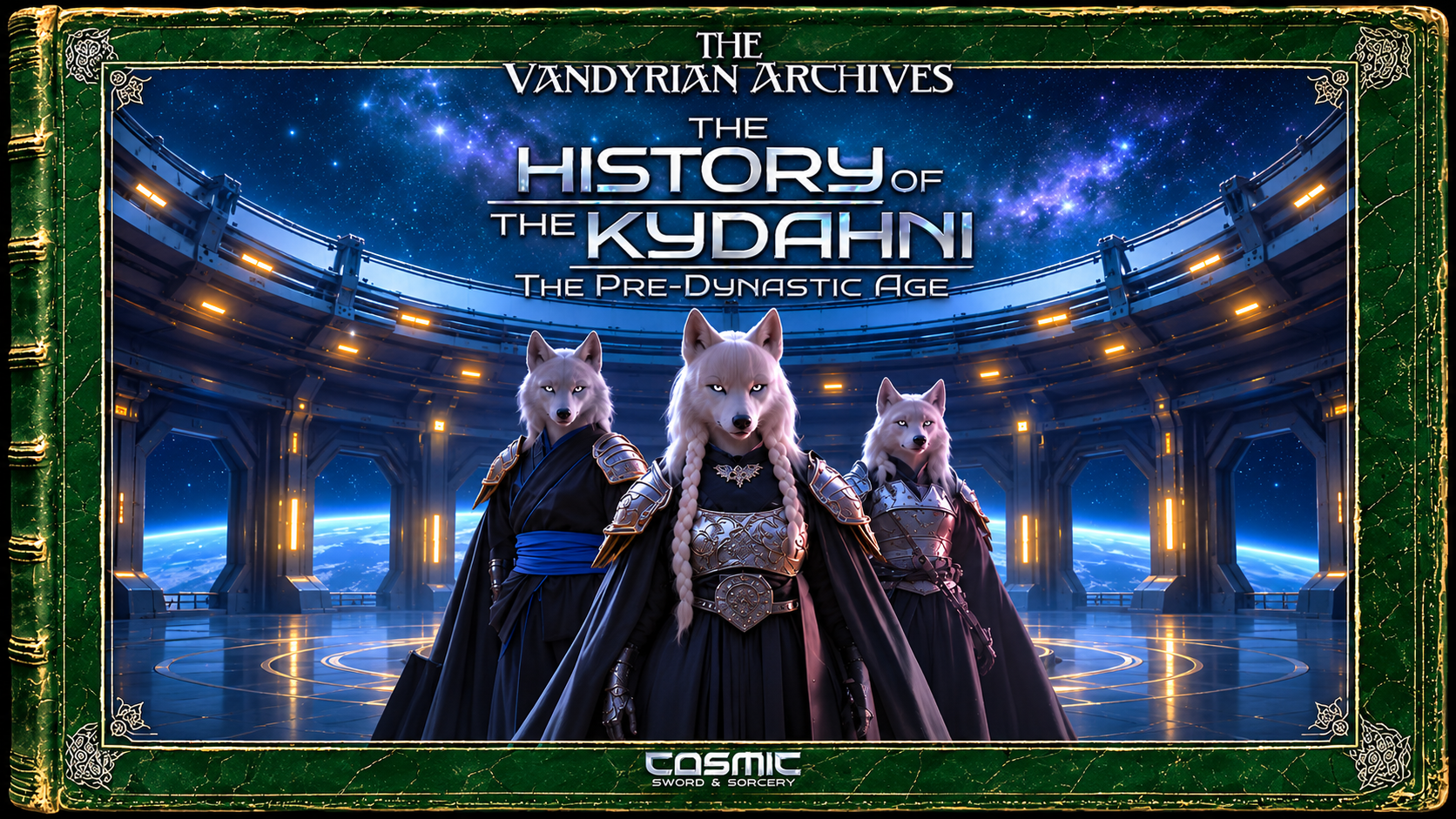
The Era of the Kydahnate Thrones
The term Kydahn considerably predates the establishment of the planetary homeland that would eventually bear its name within the Ran system.
Within the older Kydahni lexicon, Kydahn possessed both an abstract cultural meaning and a more practical interpretation, the latter particularly prevalent among the merchant classes, caravan lineages, and lower social strata of the White Wolves.
- In its abstract usage, Kydahn expressed the collective cultural identity of the Kydahni as a civilization, irrespective of their geographical distribution or the absence of a singular planetary homeland.
- In its more colloquial usage, the term referred to the central body of the enormous Core Kydahni Fleet, around which much of their commercial, logistical, administrative, and cultural activity had historically been organized.
As the Great Houses accumulated permanent territorial interests and increasingly coherent institutions of governance, the meaning of Kydahn expanded to encompass the political and territorial nucleus of the greater Kydahni civilization. By the opening of this period, contemporary records therefore employed Kydahn as a recognizable political designation, distinct from the broader ethnocultural designation of Kydahni and the increasingly specialized institutional designation of the Kydahnate. Kydahn was, in this respect, a civilization and a political entity long before it became the name of a world.
When Kydahni authority expanded beyond the territories traditionally associated with Kydahn itself, the political character of that expansion began to change. The Great Houses had initially risen through precisely the mechanisms that had made the White Wolves indispensable throughout earlier periods: commercial brokerage, logistical competence, military reliability, administrative flexibility, and an unusual capacity to impose functional order upon systems that had previously resisted efficient governance.
Yet the speed of their ascent increasingly distinguished them from the older houses, syndicates, and established regional interests with which they now competed. Kydahni institutions acquired funding, territorial responsibility, military resources, infrastructural mandates, and political access at a rate that many contemporary powers regarded with quiet alarm.
Such objections rarely translated into effective resistance, however, because the Kydahni record increasingly justified the confidence being placed in them. Systems assigned to Kydahni administration tended to stabilize; trade corridors expanded under their supervision; military responsibilities were fulfilled with consistency; and regions placed within their jurisdiction frequently returned greater strategic and economic value than they had under their previous arrangements. Their influence therefore did not rest exclusively upon court favor, inherited privilege, or accumulated wealth. It rested upon an increasingly difficult political fact: Kydahn had become useful at scales previously reserved for powers considerably older than itself.
This distinction is essential to understanding the emergence of the Kydahnate as something separate from Kydahn in the narrower dynastic or territorial sense. The term increasingly described the upper strata of Kydahni political, military, financial, and administrative power whose authority extended across the interconnected Great Houses and the systems entrusted to them. These interests remained Kydahni, but their responsibilities were no longer confined to the immediate prosperity or security of Kydahn. They administered portions of a much larger civilizational machine.
Their fleets defended interests beyond their ancestral territories; their financial houses underwrote enterprises whose consequences extended across multiple regions; their officials governed populations and infrastructures that had no direct connection to the old caravan lineages; and their aristocratic networks increasingly operated within the political vocabulary of imperial administration rather than merely Kydahni advancement. The resulting structure remained internally competitive, for the Great Houses were neither interchangeable nor politically uniform, but collectively their highest institutions had acquired sufficient coherence that outside observers could speak meaningfully of a Kydahnate interest.
By this period, therefore, Kydahn was no longer simply gaining influence within the imperial system. The imperial system had begun assigning Kydahni institutions responsibilities whose successful execution made them progressively more difficult to separate from the functioning of the system itself.
Garahannis regarded this development with considerably greater strategic interest than many of the older powers surrounding it. Having succeeded Skyria as the Throne World, Garahannis possessed responsibilities extending beyond ordinary dynastic governance and into the preservation of imperial continuity itself.
The question confronting the Throne World was therefore not simply which subordinate power remained most loyal, wealthy, or militarily formidable, but which political structures might continue functioning if Garahannis itself were ever incapacitated. No immediate transfer of sovereignty was contemplated, nor was Kydahn being prepared as a simple replacement Throne World. Rather, Garahannis increasingly regarded the upper Kydahnate as possessing several of the institutional qualities necessary for participation in a partial succession architecture: distributed administration, independent logistical capacity, military depth, enormous financial resources, proven regional governance, and enough internal redundancy to survive the loss of individual houses or territories without destroying the larger political structure. The very decentralization that occasionally troubled imperial observers consequently became an asset when viewed through the narrower problem of civilizational survival. Garahannis did not require another Garahannis to exist in miniature. It required institutions capable of inheriting selected functions of the Throne World should those functions suddenly lose their center.
The developing Garahannian solution was therefore dual rather than singular. Kydahn alone possessed considerable administrative and material strength, but its institutional character did not reproduce every quality Garahannis considered necessary for long-term imperial continuity. Yanatar represented the complementary half of the equation. Within its own sectors, Yanatar possessed old networks of authority, political experience, cultural reach, institutional memory, and forms of influence sufficiently different from those of Kydahn that the two powers could, in theory, compensate for one another’s structural limitations.
Garahannis consequently began considering a long-term succession strategy in which Kydahni and Yanatarian interests would be brought into deliberate convergence, producing neither a Kydahni empire nor a Yanatarian replacement for the existing order, but a curated successor apparatus approximating the functional breadth of Garahannis itself. The distinction between succession and replacement remained critical. Garahannis was not selecting an heir and surrendering the future to it. It was attempting to engineer the conditions under which several already powerful systems could be made to inherit different portions of imperial responsibility while remaining bound within an architecture designed by the Throne World. In this conception, Kydahn supplied much of the administrative, financial, infrastructural, and increasingly military machinery, while Yanatar supplied a second body of regional power whose traditions and interests prevented the successor structure from becoming merely an enlarged Kydahni state.
Yanatarian authorities wanted no meaningful part in this arrangement. From their perspective, participation threatened to subordinate Yanatarian interests to a succession model whose architecture had been conceived elsewhere and whose most rapidly ascending participant was a comparatively younger power already eclipsing established interests throughout several spheres of imperial administration.
The possibility that Kydahn’s extraordinary rise might eventually be institutionalized as part of the succession mechanism itself only sharpened those reservations. Yanatar could cooperate with the imperial order without desiring absorption into a political synthesis with the Kydahnate, and within its own sectors there remained substantial preference for preserving precisely the autonomy, traditions, and political relationships that had made Yanatar valuable in the first place. Yet these objections confronted the harder reality of imperial mandate. Garahannis did not regard the succession question as a voluntary association among equal regional powers negotiating whether cooperation suited their individual interests.
The continuity of the imperial system belonged to the jurisdiction of the Throne World, and where Garahannis possessed the authority to assign responsibilities, Yanatarian reluctance could complicate implementation without necessarily preventing it. The distinction would become increasingly important as the period progressed: Yanatar could object to the role envisioned for it, maneuver against particular implementations, protect its own institutions, and resist Kydahni encroachment, but it could not simply render the imperial succession problem irrelevant by declining to participate.
It was within this political environment that the Era of the Kydahnate Thrones acquired its historical character. The “thrones” were not merely aristocratic seats belonging to increasingly powerful houses, nor did the term describe a straightforward fragmentation of centralized sovereignty. They represented the elevation of multiple Kydahni power centers into an imperial stratum where their continued existence had become relevant to the survival of institutions beyond Kydahn itself. Formal sovereignty remained concentrated within the established dynastic and imperial apparatus, while practical authority flowed through Great Houses capable of administering territories, fleets, infrastructure, finances, and populations at extraordinary distances from any single center.
Garahannis retained legitimacy and mandate; the Kydahnate increasingly possessed executional capacity. This produced an unusual political architecture in which the central authority did not weaken simply because subordinate authorities became stronger. To the contrary, the Throne World deliberately exploited the strength of those subordinate institutions, distributing functions across powers capable of maintaining them while attempting to preserve the constitutional supremacy necessary to prevent distributed administration from becoming outright political dissolution.
The danger within the arrangement was nevertheless considerable. Every responsibility entrusted to a Great House increased the resources available to that house; every successful administration strengthened its reputation; every military command expanded its independent coercive capacity; and every regional dependency made the larger system progressively more reliant upon Kydahni participation. The same record of competence that persuaded Garahannis to contemplate the Kydahnate as part of a future continuity mechanism therefore accelerated the concentration of power that disturbed older interests. Houses that had once competed for access to established systems increasingly controlled those systems themselves. Broker clans became financial authorities. Caravan lineages became administrative dynasties.
Military retainers became permanent strategic forces. Networks originally developed to survive movement across hostile territories evolved into networks capable of governing enormous political spaces, while the Kydahni cultural preference for distributed relationships allowed these structures to expand without requiring every function to terminate at a single bureaucratic center. The Kydahnate consequently became powerful not because it reproduced the old centralized model more aggressively than its rivals, but because it could distribute enormous responsibility across multiple centers while retaining sufficient common identity and mutual interest to remain recognizable as a coherent civilizational force.
By the end of the period, the significance of Kydahn could no longer be measured by the territory of its ancestral homeland or by the formal titles possessed by its dynasts. Its importance lay in the degree to which Kydahni institutions had become embedded within the machinery of the greater imperial order. The White Wolves who had once survived through caravan networks and brokerage now occupied positions from which the interruption of their activities could destabilize entire regions, while their continued success had persuaded the Throne World itself to consider them part of the answer to the most severe constitutional question imaginable: what would remain capable of governing if Garahannis ceased to do so? The answer was deliberately incomplete.
Garahannis did not trust Kydahn alone with that inheritance, nor did it regard Yanatar alone as sufficient. Its emerging solution was an engineered convergence of powers, curated under mandate and intended to reproduce through combination what neither successor could reproduce independently. Yanatar resisted the premise, older interests feared the implications, and Kydahn continued accumulating the very responsibilities that made the question increasingly unavoidable.
The Era of the Kydahnate Thrones therefore marks more than the maturation of Kydahni imperial power. It marks the point at which Kydahn ceased merely to prosper beneath the imperial order and became one of the structures through which that order expected, if catastrophe demanded it, to survive.