Author: Primal Sword & Sorcery

  • A Tale of ‘The Bantos Uprising’

    A Tale of ‘The Bantos Uprising’

    There was no music in the Doglands that night, only the wind working through broken shutters, shivering the filth in the alleyways, and the slow splatter of rain against the cracked sign above “Red’s Hot & Mean”—the wind and the years had erased the letters, left only a streak of angry paint and the stink of badger rotgut strong enough to eat the enamel off your teeth. Inside, the tavern was a cave of sweat and sour smoke, sticky with spilled liquor and old fear.

    Sir Petyr of Aros, once of the old order, now just Pete to the drunks and orphans, hunched alone at a corner table, nursing a bottle he could barely afford, his sword at his boot, his name already half-forgotten. A rebel’s night had never been darker. The last rally had broken beneath him like old bone, another butchered band left bleeding in the dusk outside the gates, and the jackals were coming.

    The Barswine had warned as much, he knew. Everyone knew. That was the order of business. Fight back, fail, die trying. Stubborn old ‘Pete’, This one. The only other recognizable fighter in the area was there to guard the Jackals theft through tax, and even he had warned the old dog to sleep it off. “Seek tunnels, get lost, If you can walk the alleys then go, dog.”.

    “Not a chance.”

    Besides, it was too late for that now; They entered with the scent of oil and dust, half a dozen in all, in layered silks already muddy, their teeth bright, their eyes slits. Hacksbar and Vindurga took the lead—nobles by birth, predators by trade, each one bristling with knives, hooks, grenades, a few blackmarket pistols stuck in faded sashes. The room fell silent but for the rain. Aros had no more fighters, no more banners—only Pete, old and out of luck, drinking himself toward legend or oblivion. Hacksbar’s voice was all amusement, dripping with the false gentility of a merchant offering poisoned dates.

    “Sir Pete,” he said, letting the title hang like a noose, “it’s over. You know this. We can gut you here or give you an ending. Choose.”

    On the battered tabletop, they placed a brass cup. Poison, swirling oily and black, the same color as the rain that trickled down from Jantara’s rooftops, the same stink that haunted every ruined alley where the last resistance bled out. Pete watched the cup as if it were a mirror, as if he could see his old self in its surface.

    “Are you a knight?” he asked himself, aloud or not even he could tell. His mind, empty for months, finally answered back—a rasp of laughter, a pulse beneath the scarred ear.

    “No clue,” it said. “Let us find out.”

    He drank. The taste was nothing, just a flicker of rot behind the smoke and badger liquor in his throat. A hush followed, the jackals grinning with cruel expectation. The townsfolk huddled in corners, eyes fixed to their boots, praying not to be noticed, praying not to be next. Pete let his shoulders sag, let his head hang. Then, as if to chase down death itself, he grabbed the nearest bottle of Red’s Hot & Mean, sloshed half of it down his gullet, and felt the world tip. Fire in the gut, poison on the tongue, his heart kicked against his ribs like a dying stallion. But some old fire—the last coal of Aros—caught. He did not fall.

    Instead, he rose.

    There was a hush, then a table kicked aside, and the first jackal’s face split open in a rictus of shock as Pete’s broadsword, snatched from its resting place, crashed across his jaw. The blade was old, notched, broad as a shovel, but still murder in steel. Blood spat across the floor, red and black, and the tavern’s stink turned sharper. Pete was moving—no thought, just rage and the memory of younger days, hands and feet remembering the weight of war. Another jackal lunged, dagger flashing, but Pete’s left hand, still clutching the neck of the badger bottle, drove it into the dog’s teeth with a crunch and a shriek. Glass, blood, and spirits gushed over the table. A third came from behind—too late. Pete’s boot cracked a knee, spun him against the bar, and a second bottle of Hot & Mean, flung with perfect spite, shattered across his snout. The fire caught. Spirits, blood, and spit burned on the wooden counter, and in the sudden guttering light Pete saw Hacksbar closing in, scimitar drawn, eyes gone mean as a pit viper.

    Pete grinned—a broken thing, all jaw and shadow, Townshend’s own sneer born on a mongrel’s muzzle. He ducked the blade, twisted in, and the sword rose in his grip. The old steel was heavy, but Pete’s arms remembered the weight of banners lost, of fields surrendered. The flat of the blade smashed Hacksbar’s wrist, the scimitar dropped, and Pete drove the sword up—hard, pitiless—into the jackal’s groin. Hacksbar howled, white foam at his lips, as Pete shoved him backwards through a shower of glass, up onto the sill, and, with a final curse, pitched him bodily through the window.

    The street beyond was slick and shining. Hacksbar landed hard, bones shattering. He fumbled for his belt, clawing for a grenade—one of the old lion-make types, cobbled from scrap and cruelty—and as he yanked the pin, the wet fuse fizzed. In the next breath, the grenade and Hacksbar became a single red blossom, spraying shards across the cobbles. Two of his lieutenants, racing to help, caught the blast and folded, dying with their master. The crowd outside—silent, watching—staggered back.

    Inside, Vindurga tried to run, but Pete was already there. Poison, liquor, and old hate burned him hollow, but something in his spine kept him upright. He cut Vindurga across the arms, both wrists pinioned to the bar with twin daggers stolen from fallen jackals. The slaver-duke spat curses, writhing, but Pete, half-mad, tore a barstool from its place, swung it overhead, and with a roar drove it through the jackal’s skull, pinning him to a ceiling beam. Blood ran in a lazy spiral down Vindurga’s muzzle, his legs kicking, his eyes already swimming in another world.

    The townsfolk gaped—first in terror, then in awe, then in a strange, half-drunken elation. Pete, now more myth than hound, staggered back, hacking bile and blood onto the floor, the poison and Red’s Hot & Mean fighting for supremacy in his gut. He vomited green-black, dropped to one knee, then forced himself up with a snarl. In the corner, a barkeep whimpered. Pete raised a fist, sword still clutched, voice guttural as thunder. “Well? Who the hell are you?!” The people stared. Then, one by one, the axes and the shovels came out. Someone yelled his name, not “Petyr”, but “Sir Pete,” and the chant caught.

    “Sir Pete! Sir Pete! Sir Pete!” The call grew, swelled, battered the beams, swept through the streets as the news of Hacksbar’s death, Vindurga’s spectacle, and the ruin of the jackal enforcers caught fire. The failed rebellion—the one Pete had fought and lost and wept for—snapped into fury, the dam finally broken. The uprising began not in plan, not in law, not even in hope, but in a burst of tavern violence, an old dog’s last stand, and a moment when every soul in Aros remembered they still had teeth.

    Pete, already sagging, was hustled out the back, body wracked by poison, blood, and the last fumes of his badger liquor. He collapsed in the arms of a pair of healers, who dragged him off as the town exploded in riot and bloodshed. By dawn, the streets were awash with corpses and hope alike, and the jackal banners smoldered atop burning wagons.

    For a week, Pete drifted in fever, neither living nor dead, as the town he’d saved bled and crowned itself in fresh law. He woke once, to find himself swinging a club at raiders who’d tracked him to the healing house, then blacked out again, deeper than ever. When at last he came up for good, the Uprising was over. Calbara was being born in the ashes, and the bard’s scroll—half-written, half-burned—marked the beginning of Bantos, though Pete’s own name was already fading from the pages. He would pass into legend, his deed half-remembered, half-disbelieved, a question ringing out into the blood-soaked dawn.

    Related Media

    “Who Am I?!”

    Behind The Scenes

    ‘The Border War,
    ‘Quest For Identity’
    & ‘Sir Pete’s Uprising’
    Inspired by:
    ‘Who Are You’
    by The Who

  • The Later Jantaran Union

    The Later Jantaran Union

    Centuries later, pretenders arose.

    The Later Jantaran Union was a kingdom in name only, ruled for nearly sixteen centuries by the so-called Pheryn Dynasties—cold, calculating warlords and sorcerers who claimed lineage from Elder Jantara without possessing its discipline, doctrine, or restraint. They adopted the symbols of the old league but not its substance, wearing masks as intimidation rather than ritual, hoarding gold instead of circulating it.

    This was a civilization of ledgers and lies. Its histories were self-authored, exaggerated, and mutually contradictory. Guilds recorded grievances instead of laws. Faith was replaced with mysticism weaponized for control. Its end came abruptly.

    In a single mass poisoning—still unexplained—half a city died in one night. Thrones fell together. Rulers, courtiers, and priests collapsed in confusion and terror. The aftermath was not revolution, but slaughter. What followed was carved obsessively into frescoes for two centuries: betrayal, fire, beheading, and ritual humiliation of the dead.

    Yet even this did not birth Bantos.

    The usurpers who followed clung to the carcass of the Union for another three hundred years, until they too failed. Their fall left behind a vacuum, not a successor. For centuries after, the lands of ancient Jantara were little more than caravan corridors—crossed, exploited, and ignored by Zhuru’s wider powers.

    By this point, even the jackals themselves admitted the truth: Elder Jantara had been real. What came after were not heirs, but parasites.


    The History of Bantos

    • Old Jantara
    • The Bantos Rebellions
    • The Last Days of Old Jantara
    • The Bantos Uprising
      • The Border Wars
        • The Townshend Battles
          • “Tale of The Bantos Uprising”
        • The Battle of Northwall Cross
        • The Battle of the Barrier
        • The Ruination of the Jantaran Gates
    • The Burning of Jantara
    • The Rise of Bantos

    The Jackalands of Yorozh

    • New Jantara
  • The Tragedy of the Elder Jantaran Decline

    The Tragedy of the Elder Jantaran Decline

    The fall of the jackals is not tragic because they were defeated. It is tragic because they fell so far, and because the descent took so long that its end was barely noticed when it finally came. Elder Jantara did not die screaming beneath foreign blades, nor was it erased by some singular cataclysmic betrayal. It thinned. It softened. It dimmed itself over generations, trading vigilance for refinement, ritual for repetition, certainty for indulgence. By the time its last true heirs vanished, the world had already grown accustomed to the absence of jackal greatness.

    This is what makes the modern jackal such a bitter sight. The jackal grunt of the present age is a scavenger in rags, clutching a chipped blade, half-feral in speech and habit, bleeding on command for the amusement or favor of despotic kings who rule by terror rather than covenant. There is no philosophy left in him, no discipline beyond hunger, no loyalty beyond fear. He is used as expendable muscle, a body to be thrown at walls or into ambushes, promised scraps of plunder or access to rut as payment for obedience. He knows no law but dominance, no past but rumor, no future but the next wound.

    Against this stands the memory of Elder Jantara, and the contrast is almost unbearable. The jackals of that elder age were tall, composed, and unmistakably deliberate. They were mystics of trade and restraint, wielders of commerce as a civilizing force rather than a predatory one. Their discipline was not born of terror but of doctrine, reinforced by faith and symbol rather than lash. They governed themselves as much as they governed others, bound by internal codes that prized control over excess and reputation over conquest. Where the modern jackal lunges, the elder jackal measured.

    Nowhere was this more evident than in the Elder Jantaran blades. These warriors were not mere soldiers for hire, but mercenaries of singular renown, sought across the southern realms for a loyalty that exceeded coin. They were bound not only to their pay, but to the spoken word of the lord or baron they served.

    Once committed, an Elder Jantaran blade did not retreat. Accounts speak of them locking shields with their own bodies, standing firm beneath arrow fire to shelter those they had sworn to protect, dying in place rather than breaking oath. To hire them was to purchase certainty, not cruelty.


    So trusted were the institutions of Elder Jantara that neighboring kingdoms entrusted their own offspring to Jantaran Bardasi 💎, the merchant-philosophers of that age. Sons and daughters traveled with jackal caravans not merely to learn trade, but to absorb a worldview that balanced honor with guile, profit with restraint, curiosity with discipline.

    The Teachings of The Bardasi

    These youths returned changed, sharpened by exposure to a culture that treated commerce as both moral test and civic duty. That such trust once existed makes the present suspicion of jackals all the more damning.Even their physical presence has passed into near-myth.

    The Elder Jackals were said to be arrestingly beautiful, the females statuesque and severe, the males exemplars of southern canine grace—lean, powerful, and proportioned with an almost architectural harmony. Their bodies reflected the same restraint that governed their culture: nothing wasted, nothing excessive.

    Desire was acknowledged, not denied, and their society was open in its acceptance of bisexuality among both males and females. Love, rut, and pleasure were not treated as shameful impulses, but as forces to be understood, moderated, and woven into social order rather than allowed to dominate it.

    The relics they left behind only deepen the sense of loss. Elder Jantaran sapphires and swords are artifacts of a craft no longer replicated, not merely because of lost technique, but because the civilizational conditions that produced them no longer exist. A single sapphire of Elder Jantaran cut is worth a hundred times its weight in gold, not for rarity alone, but because it embodies an ethic as much as a material mastery. These were not ornaments of vanity, but anchors of moral identity, symbols of restraint forged into stone and steel. Their blades, too, carry a balance and permanence unseen in ten thousand years of declining returns.

    Thus the tragedy is complete. The jackals did not merely lose territory, power, or prestige. They lost continuity. What survives today is not a corrupted version of Elder Jantara, but a negation of it—a people stripped of memory, discipline, and form, left with only hunger and cruelty where philosophy once stood. The world mourns Elder Jantara not because it was perfect, but because it proved that jackals were once capable of something far greater than what now stalks the dust.


    The History of Bantos


    Related

    • Bantos
    • The Jackalands of Yorozh
      • New Jantara
    • The Black Jackal King
      • Throne of the Jackal King
  • Elder Jantara

    Elder Jantara

    The Ancient Jantaran League, sometimes called Elder Jantara, was real. Of this there is no longer serious dispute. Though poorly recorded and often mythologized, it existed as a concentrated jackal civilization spanning much of what is now central and southern Bantos, with reach into the easternmost margins of Bruwa.

    Unlike later jackal regimes, Elder Jantara was not defined by constant raiding or slaver economies. Contemporary accounts describe a people who were strange, insular, and ceremonial, yet broadly non-hostile.

    They wore gilded masks and long robes, spoke a language that resisted translation, and traded widely and fairly. Their caravans moved along stable routes, their camels bearing goods rather than captives.

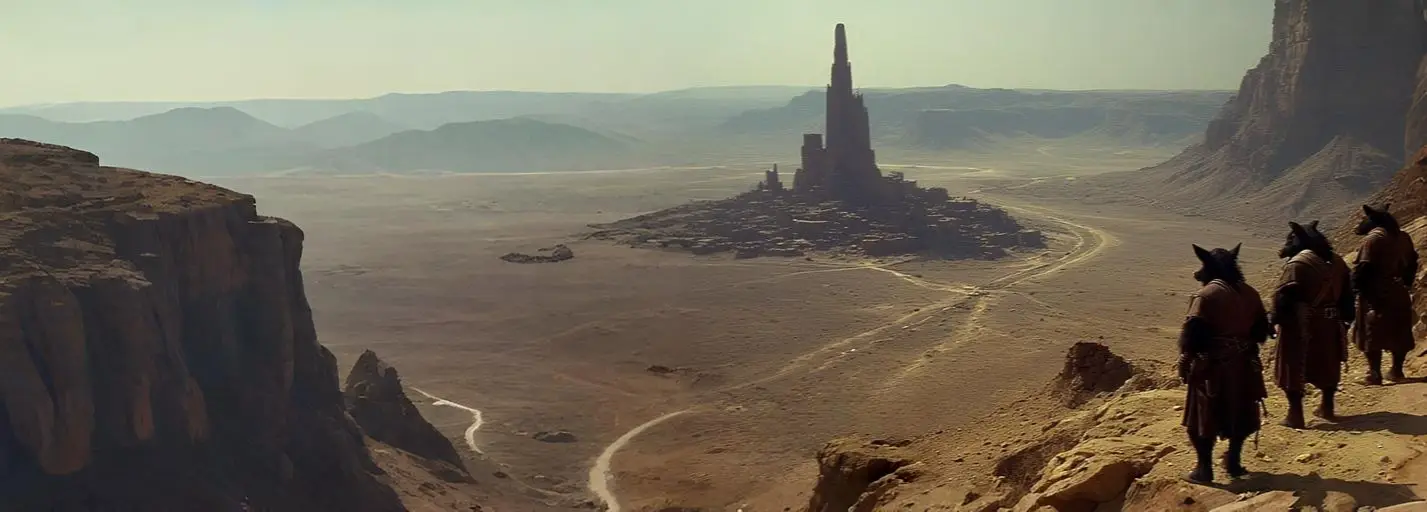
    Their southern settlements were built into rock formations closer to what would later become the Kartongan wastes, though the exact extent of these cities is lost.

    The Merchant Class of Jantara lived in comparative luxury to later descendants.

    Their rulers were described consistently: tall, piercing blue-eyed, deep-voiced figures whose presence commanded without brutality. They followed an esoteric religious order centered on gemstones, particularly sapphire, not as ornament, but as symbolic moral anchors. Later scholars argue this gemstone reverence functioned as a metaphysical restraint, a cultural doctrine that limited cruelty and enforced internal discipline. Whatever its nature, it worked.

    The Cerulean Palace of Elder Jantara

    Elder Jantara endured for roughly two thousand years after the Cataclysm, withdrawing gradually into decadent obscurity rather than collapsing in fire. Its neighbors prospered alongside it. Trade enriched surrounding regions. Stability followed jackal roads.

    Then it ended.

    The Western Border of The Elder Jantaran Realms

    No heirs survived into the modern age. No dynasties persisted. The culture vanished not with a final war, but with a long extinguishing—like embers smothered beneath their own excess. What remained was memory, and the temptation to claim descent from something greater.


    The History of Bantos

    The Jackalands of Yorozh

    • New Jantara
  • The Jackals of Jantara

    The Jackals of Jantara

    The lands now called Bantos were not born in peace, nor founded in idealism. They were carved out of a long failure, layered with lies, impostures, and the slow rot of a people who mistook cleverness for permanence.

    Once, the northern expanse between the Doglands and the wastes of Kartonga belonged to the jackals. They ruled it with thin hands and sharper minds, cunning traders, sly governors, and merciless raiders who mistook fear for dominion.

    To understand Bantos, one must first understand Jantara—not as a single nation, but as three successive conditions of jackal rule: the Elder Union, the Later Union, and the long, diseased husk known as Old Jantara. Only after these did the dogs rise, and only then did the land become something new.

  • Panjar

    Panjar

    Panjar rises in sharp ascent, its highlands standing shoulder to shoulder with Yir in height. The land is a labyrinth of forest and marsh, where bamboo thickets grow dense as walls and poison-forests writhe with venomous growth. Rivers swell into marshlands that drown the east in swamp.

    Its folk are no scattered tribes—they are one of Zhuru’s rare organized powers. Mongoose, jaguars, bears, and eagles dominate here, their claws and talons united against the serpents that infest their lands. The Panjari see themselves as born to strangle snakes, and their very culture is defined by this struggle: swift, merciless, unyielding.

    Panjar’s civilization is startlingly well-ordered. Timber flows from its forests, its navy patrols the seas that bear its name, and its armies march as disciplined hosts. The Panjari export wood, resin, and spices, but what they truly trade is fear: the knowledge that theirs is a people whose blades are sharp, whose walls are high, whose ships command the straits.

    Once, Panjar’s domain stretched further east, out into lands now claimed by the sea. From this wound comes their fierce naval tradition: they will not lose another inch of coast.

    Conflict is constant, but on their terms. Rich and defensive, they sharpen their blades against Bruwa’s lions to the west and against the shadow of Drael across the straits. In a continent of ruins, deserts, and scavenger states, Panjar is something rare: a land that has its house in order, and the will to keep it that way.

  • ATLAS: Yir

    ATLAS: Yir

    Yir is a kingdom of vapors perched high above the world. Cold rainforests sprawl across shattered uplands where the land itself rises in broken cliffs, thousands of feet above the grasslands below. Mazes of mangroves knot with drowned forests, and black pools yawn like mouths between their roots. Paths vanish overnight, swallowed by shifting waters, and the cliffs themselves bleed waterfalls that vanish into the mists beneath.

    The descend from Yir is near suicide. The plateau was not meant for escape, only endurance.

    The Ancient city of Ajeros, standing sentry at the gates of Yir.

    The folk of Yir are scattered and sparse. Small mammals dart through the undergrowth, preyed upon by tall, sharp-beaked bird clans who prowl with spear and arrow. Between them stalk the lizard-folk, chameleon-skinned and silent, hunters who thrive in ambush and camouflage. None bend to any empire, and all live uneasily amid ruins far older than themselves.

    Everywhere in Yir rise the shattered remains of temples—stone long claimed by moss and rot. Their carvings are worn, their rites forgotten, but still the swampfolk whisper of the beings once worshipped there. The old priests promised change, spoke of transformation as a gift. Yet the stories linger of shapes half-formed, of folk who shed their skins endlessly, never complete, never at peace. In the black pools, the locals say, something still waits.

    Conflict festers even in isolation. The Bird–Civit Wars rage, tall hunters clashing against nimble arboreal fighters in ambush and reprisal. In the drowned forests, the Arboreal Kingdoms feud endlessly, their skirmishes as frequent as the storms. For Yir is a land that breeds no peace; its folk are too busy surviving one another, too busy fearing the return of whatever once ruled here.

  • ATLAS coming online

    ATLAS coming online

    The Vandyrian Atlas is finally starting to come online. This wing of the project is massive by design, and it will continue to grow for years as we add new regions, maps, and features you can use directly in your own tabletop campaigns and roleplay adventures.

    We’re beginning with Zhuru, the vast and scarred heart-continent of Vandyrus. Over time, you’ll see its fractured realms come into focus through high-resolution maps, regional breakdowns, and long-form essays that dig into its kingdoms, border wars, trade routes, and haunted ruins. As each new area of Zhuru is detailed, it will be woven directly into both the Atlas and the Codex, so you can zoom from a continent-wide view down into a single city, coastline, or battlefield and then straight into the lore behind it.

    The Atlas and the Codex are built to work together, but they stand on their own just fine. The Codex uses the Atlas for regional context, while the Atlas regularly quotes and links back into Codex entries for deeper lore. As you explore the map, you’ll be able to move seamlessly into history, cultures, and myth; as you read the Codex, you’ll be able to jump straight back out into the wider world and see where it all lives.

    All of this is part of the long-term push toward the Unity-powered version of the Codex. What you’re seeing now is the groundwork: a living atlas and a structured lore archive, side by side, built to give you the clearest possible view into the world of Vandyrus.

  • ATLAS: Izhura

  • ATLAS: Zhuru

    ATLAS: Zhuru