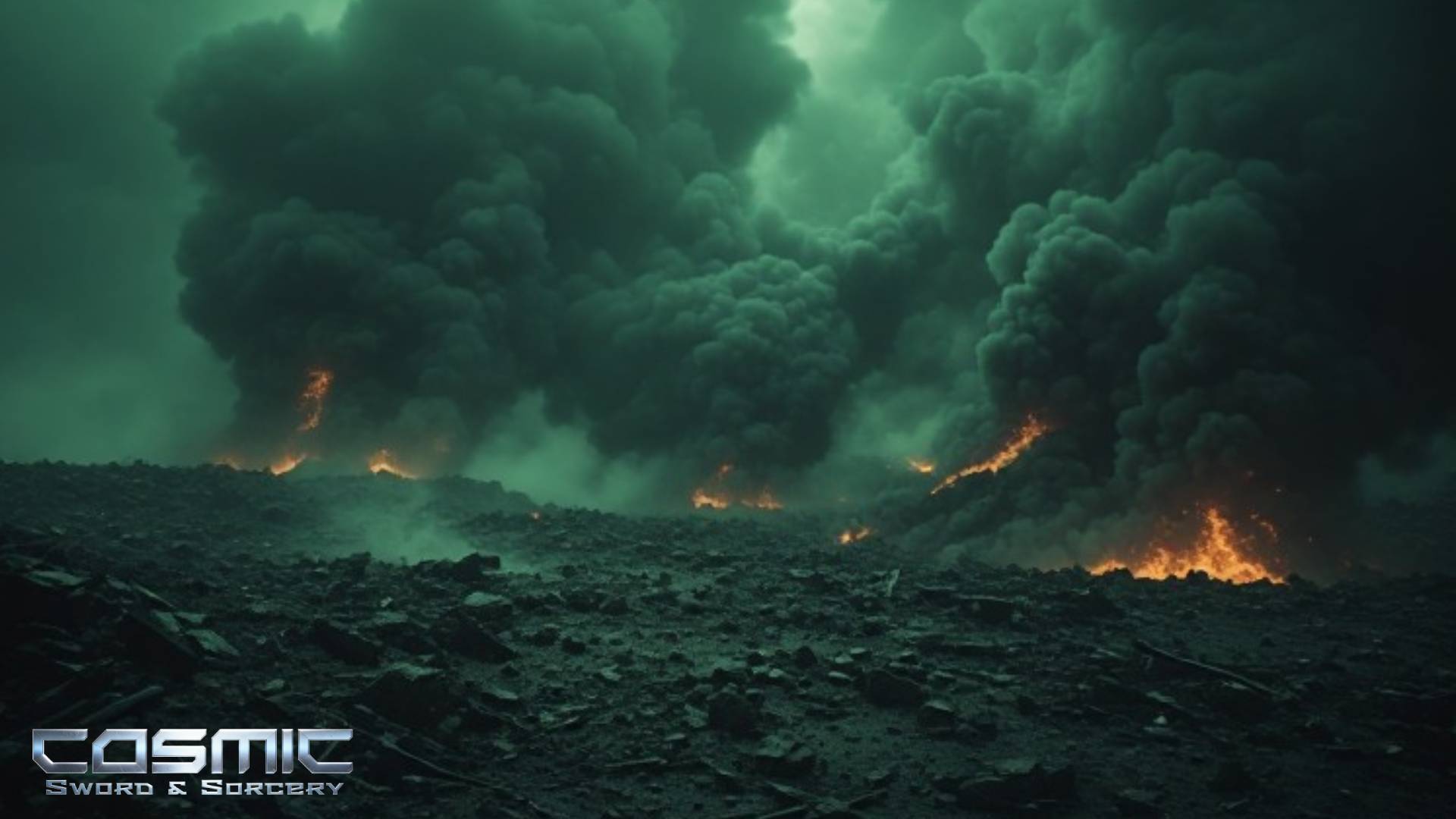
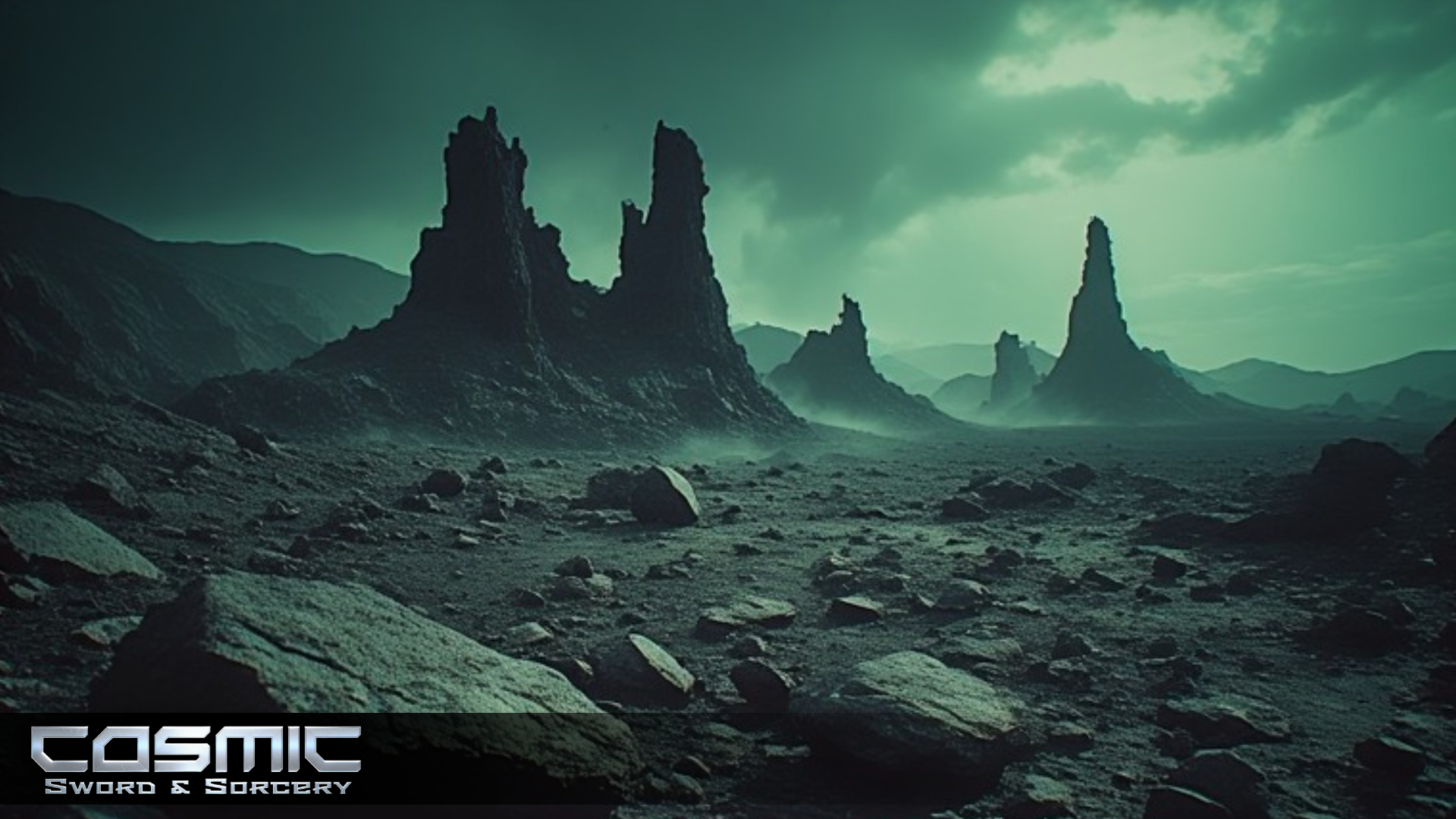
Yalar was never intended to be lived upon in the conventional sense, and so it never was. Its surface was left undeveloped by design, a final and deliberate cruelty disguised as administrative pragmatism. There are no habitable domes spanning its plains, no permanent arcologies rising above its poisoned crust, no atmospheric correction grids softening its hostility. The sky itself is a weapon. Those condemned to its wars arrive not as settlers but as sealed burdens, bound within environmental suits from the moment of deployment until death. The suit is not equipment; it is sentence.
Every combatant on Yalar lives on borrowed breath. The only reprieve from suffocation lies in the scattered liminal refill modules that dot the landscape—modular air stations of inconsistent reliability, some functioning, some drained dry, none clearly marked, none protected by universal law. They are not neutral sanctuaries. They are objectives. Armies clash not over territory in the traditional sense but over oxygen nodes. Skirmishes erupt around refill spires as convicts fight to prolong existence by minutes or hours. The air itself is rationed through violence.
The horror is systemic. Refill modules are drained by all sides, scavenged, sabotaged, hoarded. No authority guarantees their maintenance. No central registry tracks their depletion. They are simply present—enigmatic relics of a half-built infrastructure that was never completed because it was never meant to be humane. War on Yalar is not merely conflict; it is atmospheric attrition. To lose ground is to lose air. To be cut off is to suffocate slowly inside one’s own armor.
This design serves a dual function. It contains the inmate combatant population within a self-regulating ecosystem of desperation, ensuring that large-scale organization is perpetually undermined by resource scarcity. And it weaponizes dependency. The very air that convicts cannot breathe freely becomes a tool in broader theaters. Yalar’s atmospheric technologies—refinement, compression, destabilization—have been adapted into munitions capable of stripping breathable environments elsewhere. The same systems that ration survival on its surface can be inverted to annihilate it on another world.
Thus Yalar stands as both grave and laboratory. Its convicts are bound to their suits not because development proved impossible, but because development would have diminished the cruelty required for its purpose. The surface remains raw, unfinished, lethal. In that unfinished state lies its genius: an eternal battlefield where survival is temporary, where mercy is logistical failure, and where the most basic necessity—air—is converted into the sharpest blade in the imperial arsenal.
Yalar, in this schema, stands apart from the familiar horror of the slow death: it is the logic of churn, not the logic of rot. Yalar’s utility to the imperial order was neither subtle nor ambiguous.
In the calculus of the Administrates, it served as the empire’s most direct instrument for the liquidation of undesirables—a planetary mechanism for penal disposal rather than penal containment. Where Kalba, and in later ages, Rethka, functioned as open-air prisons or sites of indefinite exile, Yalar was never designed to be a place of lingering punishment or protracted suffering. Its surface, brutalized by climate and industry, was organized as a consumptive process: convicts, political dissidents, and other disposable populations were not warehoused for future negotiation but processed—stripped of utility, subjected to extractive labor or terminal assignment, and fed into the machinery of empire with little thought for their survival.
No lineage of convicts arose here, no tradition of prisoner society or culture; the turnover was too swift, the environment too lethal, the regime too pitiless to permit anything resembling continuity. Sentences were measured in productivity or in metric tons extracted, not in years survived. Those dispatched to Yalar rarely left an account of their experience, and the planet itself became the silent ledger of imperial waste—each cycle of dispossession erased by the arrival of the next, each rebellion extinguished by attrition and the indifference of administrators who viewed penal throughput as a matter of routine logistics.
Here, the only monument to those sent below the clouds is the relentless progress of imperial extraction, ore processed, atmospheres bled, quotas met. The fate of the convict is not to endure, but to vanish, swallowed by a planetary system engineered not for redemption, nor for memory, but for the efficient annihilation of the inconvenient.
Thanator’s position is the most direct. They consider machine-deployed or clandestinely installed reactors by Kydahn to be strategic threats. Their fleets prioritize precision bombardment of processing stacks, transmission relays, and stabilization towers. They rarely commit ground forces unless destruction requires confirmation. Preservation of their own aligned cores is handled through remote defense grids and rotating detachments of specialists who understand that the objective is not conquest but interruption. Yalar is a ledger of attrition, not a flag to plant.
Kydahn mirrors this logic, though with heavier reliance on automated protection. Their reactors are frequently integrated with machine sentry networks, allowing them to function even when surrounding convict formations collapse. The calculus is simple: if organic bodies are expendable, processing uptime is not. Rethka and Shride operate more fluidly, seizing or stripping whatever cores they can temporarily control, often lacking the capacity to defend them long term. Titanum’s interests drift in and out, harvesting atmospheric poison in bulk during windows when orbital attention is elsewhere. Every faction frames its activity as defensive. Every faction targets the reactors of the others.
The convicts fight over refill modules and survival corridors because that is their immediate reality. Above that chaos, reactors hum, siphoning toxins, refining compounds, compressing volatility into transportable mass. When Thanator strikes, it is not to liberate the condemned. It is to crater a rival core. When Kydahn deploys synthetic battalions, it is not to dominate the surface population. It is to shield a processing hub long enough to meet quota.
Rethka, though diminished, still fields opportunistic detachments to sabotage imperial-aligned cores when openings appear. Shride’s involvement is less overt but no less real; certain Shridian consortiums view Yalar as a proving ground for atmospheric destabilization technologies adaptable to other theaters. Titanum’s autonomous interests harvest toxin at intervals that technically violate standing edicts, yet enforcement is strategically selective. Each actor claims necessity. None admit ownership. Officially, no one is supposed to be there.
Yalar’s classification in imperial registers oscillates between “restricted hazard zone” and “unsanctioned extraction theater.” It is not designated a lawful colony. It is not recognized as sovereign territory. It is not cleared for civilian industry. The fiction is that any presence beyond penal deployment is incidental. The reality is that the resource reactors are too valuable to abandon and too controversial to legitimize. Thus the world exists in a permanent gray state: an open secret maintained by mutual hypocrisy.
Yalar is publicly framed as a penal sink and a disposal front for liabilities, but that is theater layered over the true contest. The convicts, dissidents, syndicate trash, and politically inconvenient are the visible fuel. The engines they burn around are the real objective. Beneath the permanent electrical storms and poison haze stand the resource reactors—atmospheric harvest cores, deep-crust taps, volatile compression stacks—owned, leased, or clandestinely installed by Kydahn, Thanator-aligned interests, Rethkan syndicates, Shridian reclamation houses, and even Titanum’s shadow complexes. Every faction denies formal presence. Every faction maintains infrastructure. The surface war is therefore not ideological. It is industrial denial.
Kydahn seeds Yalar with extraction reactors designed to stabilize and refine atmospheric compounds at scale. These cores are compact, shielded, and often embedded within modular bastions that resemble defensive outposts but function primarily as processing nodes. Thanator’s doctrine toward Yalar has hardened over the ages into a single priority: destroy hostile reactors, preserve friendly ones. It is not about holding territory; it is about preventing supply continuity. A reactor allowed to run uninterrupted for even a cycle too long alters the balance of munitions, chemical stockpiles, and black-market leverage across the Ran system.
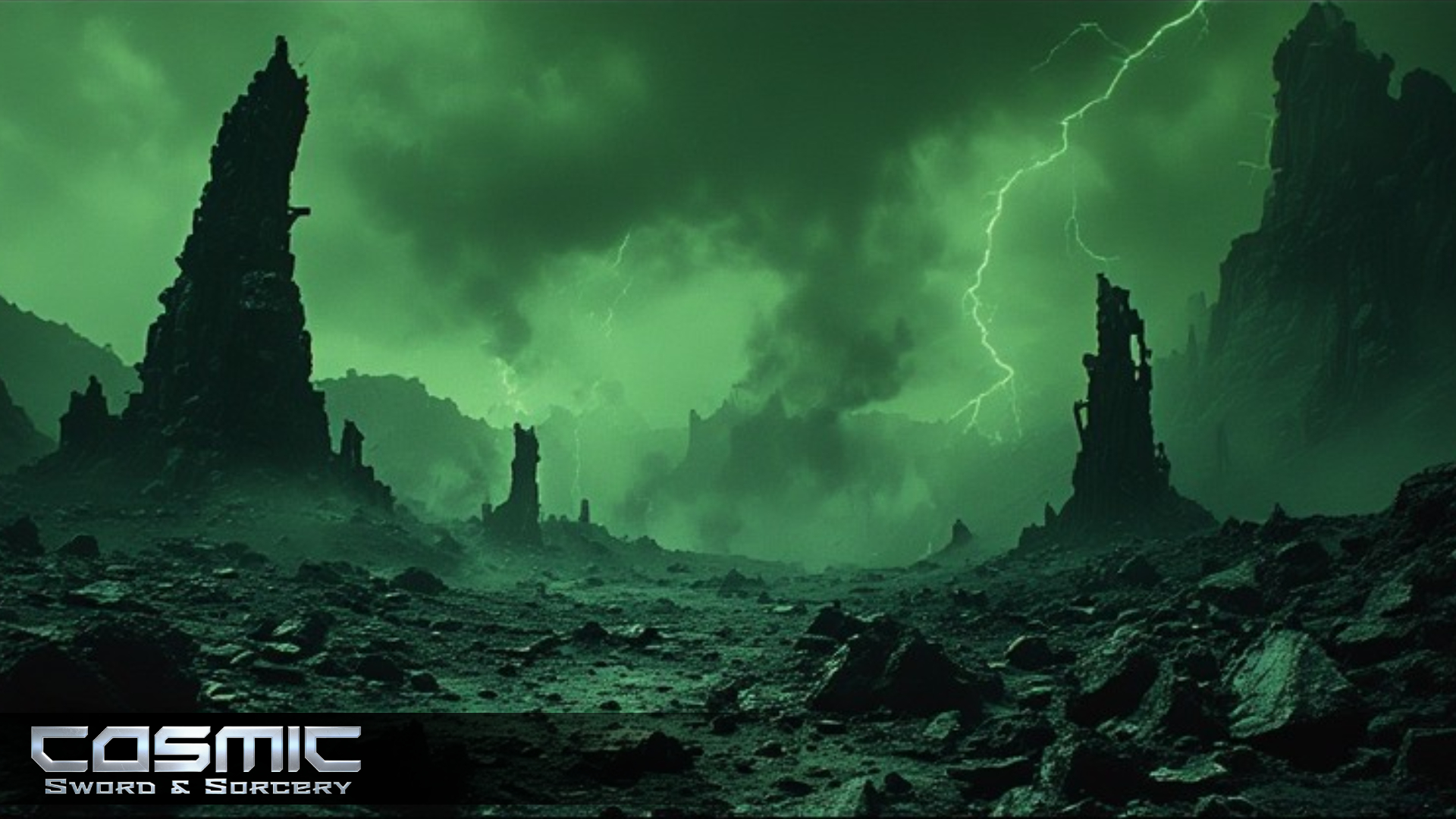
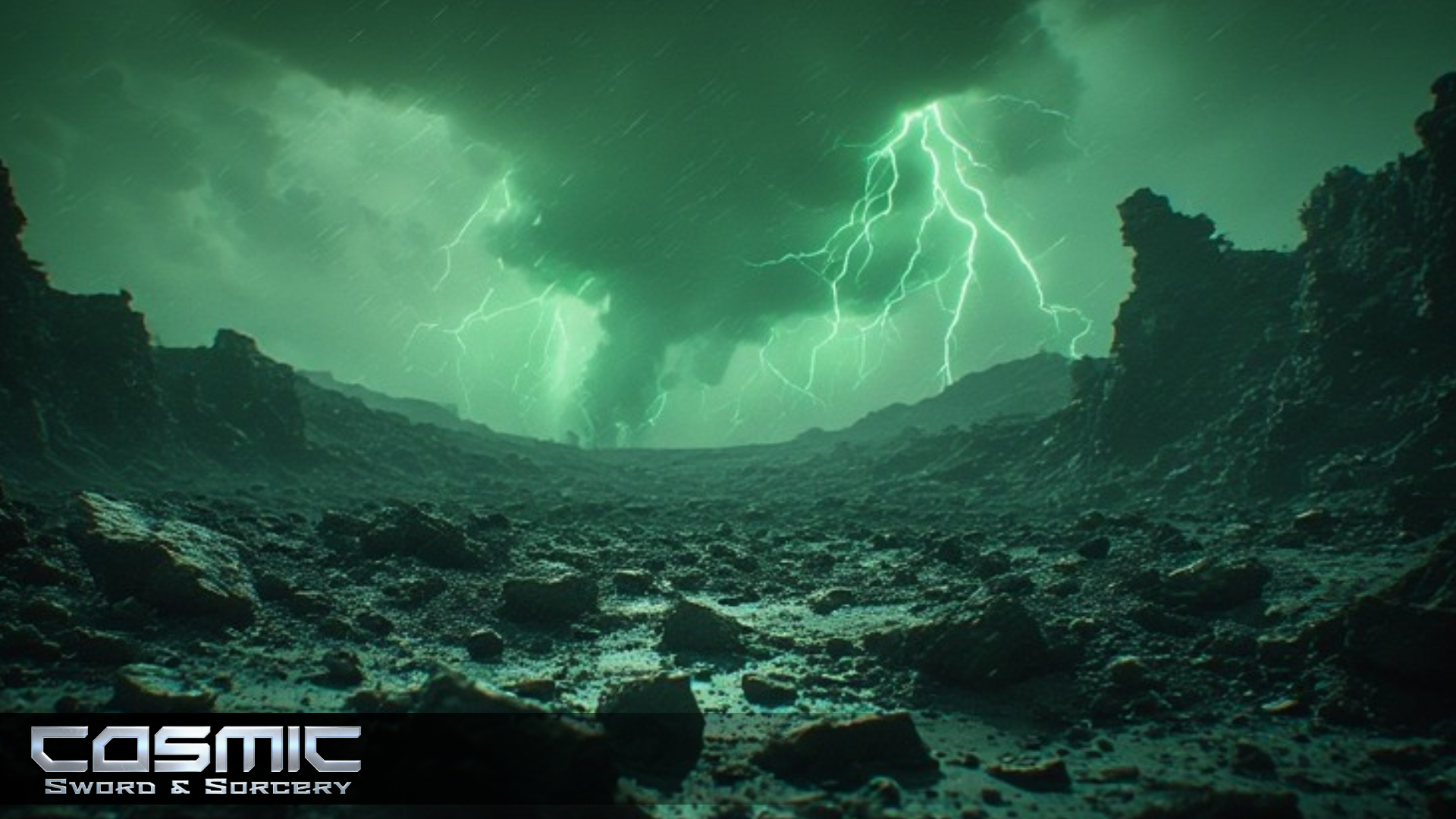
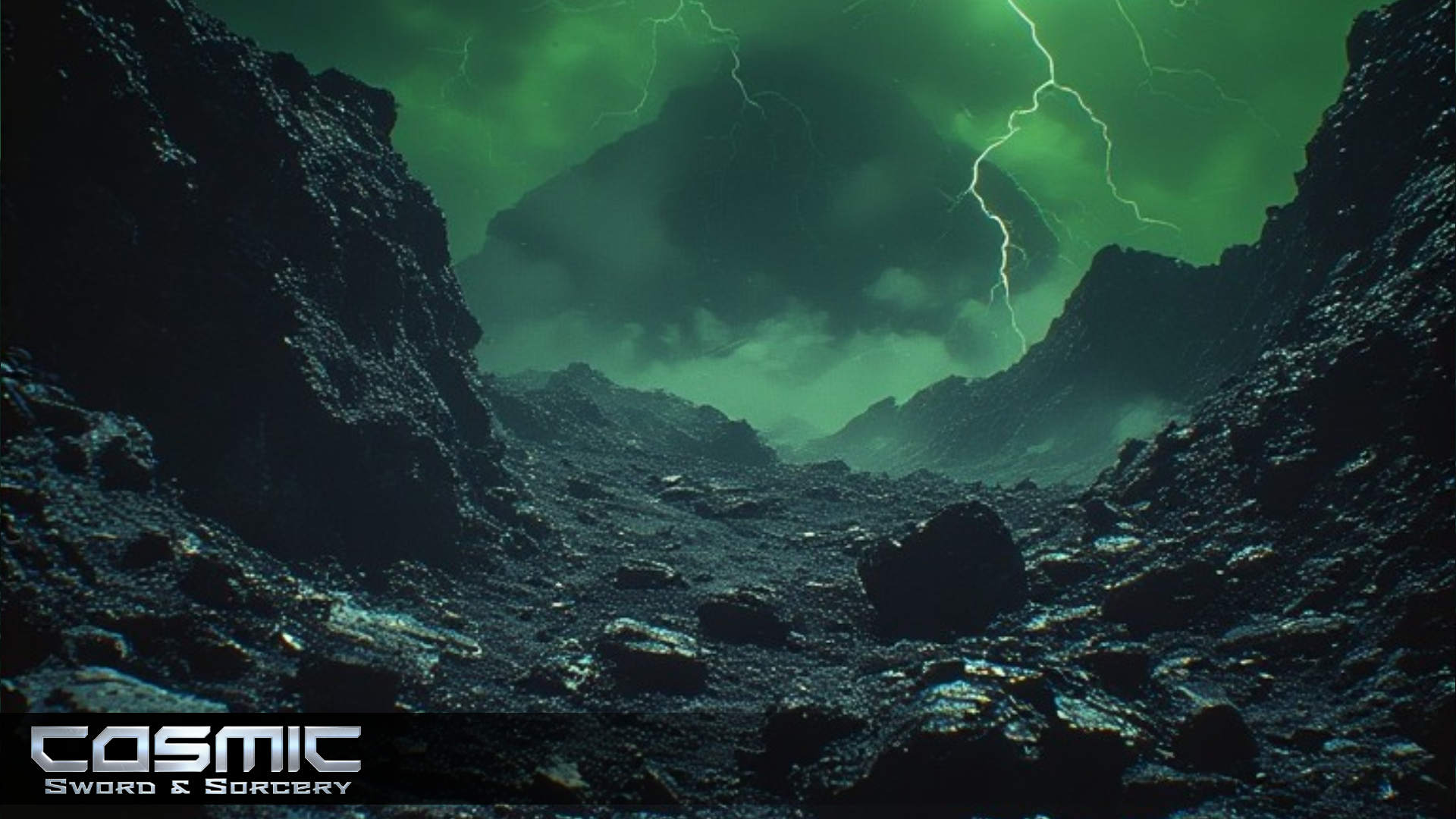
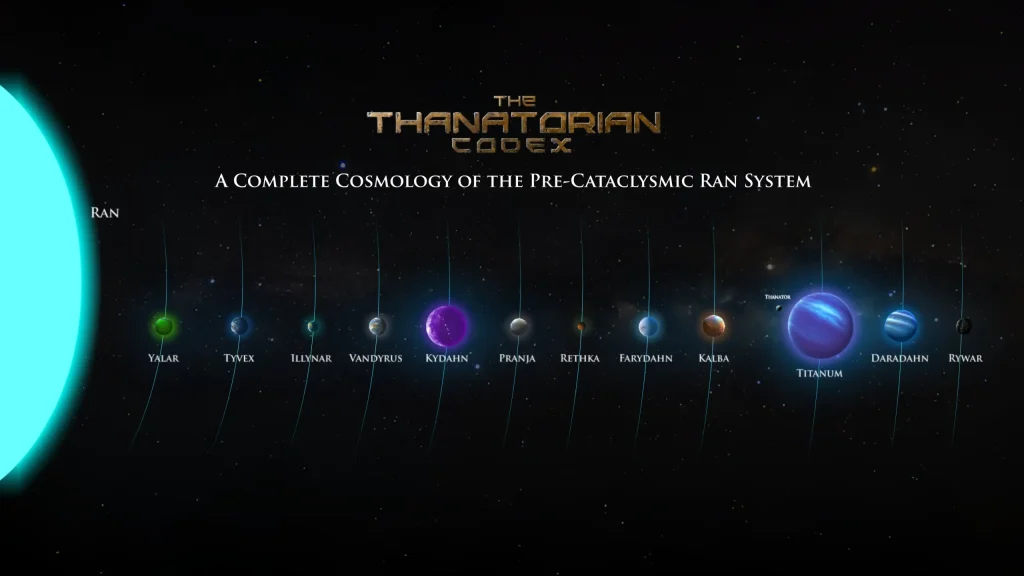
Yalar—the first planet of the Ran system—was never simply a sterile rock lost to imperial indifference. Its choking viridian atmosphere, laced with poisons and scoured by permanent electrical storms, rendered it utterly inimical to biology: no garden, no ancient seed, no native myth. Yet for all its chemical hostility, Yalar was never ignored. It was a world whose only worth was what could be extracted by force or cunning—a sphere of perpetual resource war, never civilization, always conflict. At first glance, Yalar offered little: a battered crust, skies awash in toxic green haze, surface pressure and composition that laughed at the prospect of organic settlement. But beneath its storm-wracked veneer, automated outposts clung to the blackened ground, mining what they could—helium in industrial volumes, hydrogen for the fleets, silver for circuit and coin, exotics for whatever the imperial technologists demanded that century. The economics were almost always a losing proposition; the plants ran at a deficit, held together by imperial decree and the inertia of ancient supply contracts, yet the fact of Yalar’s production ensured that someone, somewhere, would always see a margin worth fighting for.
This alone might have left Yalar a cautionary tale of resource overreach. Instead, it became the setting for some of the most brutal, least-memorialized conflicts in system history. For most of its ages, Yalar was not “ruled” by any civilization—no banners of Thanator, no statuary of Kydahn, no sigils of Rethka graced its surface except as brands upon machinery, quickly burned away by acid rain or erased by sabotage. Instead, three powers—Thanator, Kydahn, and the fractious nations of Rethka—waged a slow war of supply and denial, station against station, pipeline against relay, drone swarms clashing in the gloom, sometimes for centuries at a time. This was not the theater of heroes. It was an industrial hellscape: lightning-ripped black-green skies serving as a stage for the sudden flare of reactor sabotage, the violet pulse of weapons fire, the eerie teal glow that marked a lost plant or a failed breach. Outposts changed hands with monotonous regularity, rarely rebuilt, more often left to rot as a warning to the next would-be extractor. No settlements rose, only temporary barracks for engineers and conscripts condemned to serve out tours in a place whose only memory was the echo of failed ambitions and the constant thrum of extraction.
The battles for Yalar were not limited to Thanator and Kydahn. Rethka, though fractured, was for a time a true contender, its splintered nations mobilizing flotillas and sabotage teams in doomed attempts to cut off imperial supply lines or wrest a fleeting advantage. Their efforts, though valiant, proved disastrous; every campaign left Rethka weaker, its political unity further corroded by defeat and attrition, until the nations that once vied for Yalar’s spoils were themselves reduced to vassalage—a fate sealed not on the fields of glory but in the toxic mists of this merciless world.
For all this sacrifice, Yalar never transformed. It did not yield civilization; it absorbed hope, ambition, and flesh, repaying all equally with the same green-tinged oblivion. Even as the centuries turned and the wars ebbed, the automated plants continued their endless, near-pointless harvest, pulling gas from the poisoned air, bleeding silver and hydrogen for the now-consolidated imperial networks. The world remained, as it always had: an object lesson in the limits of conquest, a prize that punished every attempt to claim it with losses no faction could ever quite justify, yet none could ever abandon.
To this day, Yalar’s horizon is broken only by the silhouette of mining rigs and the distant flicker of arc lights, skies still streaked with storm and violence, still haunted by the memory of battles fought for a promise that never delivered. Each generation’s would-be conquerors convince themselves that “this time, things will be different,” only to leave the planet as they found it—strip-mined, contested, and perpetually consuming all who dared to believe they could force it to serve. Yalar endures, not as a world to be tamed, but as the system’s perennial open wound—a place where only necessity and delusion dare to linger.
The designation Book of Worlds belongs not to a singular work, nor to any singular collection of worlds, but to a continuing registry of stellar surveys maintained within the greater body of the Imperial Codex. Each volume concerns itself with a designated stellar system, regional stellar association, or otherwise recognized astronomical jurisdiction, recording those worlds, stations, settlements, populations, institutions, territories, and material relationships considered significant to an understanding of that region at the time of compilation.
The volume presently held is therefore one among an innumerable company of such works, each bearing the name of the stellar domain to which its contents pertain, and each constituting only one portion of a much greater cartographic and civilizational record. No individual volume should consequently be mistaken for a declaration of completeness beyond the jurisdiction named upon it.
The worlds contained herein are neither the totality of known worlds nor presumed representative of those lying beyond their stellar boundaries. They are, simply, the worlds belonging to the present account. Neither should The Book of Worlds be understood as a complete history of those worlds entered within its registry. Such histories belong properly to the chronicles, archives, archaeological records, dynastic accounts, institutional studies, local codices, and innumerable other works produced by the peoples to whom those histories belong. Historical material appears here where necessary to establish the origins, condition, relationships, or contemporary significance of a recorded place, but history itself is not the principal object of the work.
The Book of Worlds concerns itself foremost with the observable present: with the character of inhabited and significant worlds, the civilizations and populations established upon them, the jurisdictions by which they are governed, the economies by which they are sustained, the routes by which they are reached, and the relationships through which they participate in the greater stellar order. It is therefore a survey of a region as it exists within a particular period, preserving not an eternal description, but an ordered account of conditions recognized at the time represented by the volume.
This distinction is essential, for worlds are not immutable objects merely because their names survive them. Settlements rise and vanish, borders contract and expand, governments are replaced, populations migrate, routes of commerce change, industries exhaust themselves or become indispensable, and worlds once peripheral may become central to the affairs of civilizations that scarcely acknowledged them in preceding ages. For this reason, separate editions of The Book of Worlds may describe the same stellar domain differently without contradiction, each preserving the condition of that domain according to its own registered period. The chronological position applicable to the present volume is established in the sections immediately following this introduction and should be regarded as governing all subsequent entries unless an individual record explicitly states otherwise. References to earlier ages, vanished jurisdictions, extinct institutions, former names, or superseded conditions are included only insofar as they clarify the contemporary record.
Thus the title The Book of Worlds should be understood in its broadest and most literal Codex sense. Wherever worlds have been surveyed, wherever stellar regions have been entered into the greater registry, and wherever sufficient record exists to establish their contemporary condition, another such volume may stand beside this one. Its worlds may bear little resemblance to those described here. Its civilizations may possess different histories, different institutions, different measures of wealth and power, and entirely different relationships with the greater order surrounding them. Such difference is not an exception to the purpose of the registry, but the reason for its existence. No single stellar system can adequately represent the immensity of settled space, and no single volume could reasonably presume to contain it. Each Book of Worlds therefore records one portion of an incomparably greater whole: a stellar domain fixed for a moment in record, placed within the Codex, and preserved so that its worlds may be understood as they stood within their own time.
Classification of Stellar Type and Associated Phenomena
Ran is not catalogued under the pastoral classifications used by lesser worlds. It does not fall within the common hearth-spectrum stars that nurture agrarian biospheres and soft-cycle civilizations. Those stars—yellow, docile, metabolically conservative—are designated in older imperial registries as Hearth Class, suitable for early habitation, long-cycle ecological stability, and low-yield industrial uplift. Ran is not such a star.
Ran is formally designated within the Imperial Stellar Taxonomy as a High-Yield Industrial Furnace Star, a classification reserved for stars whose output, variability, and surrounding environmental conditions render them not merely sources of light and gravity, but engines of extraction, refinement, and large-scale energetic exploitation.
This classification is not based solely on spectral coloration, though Ran presents visually as a saturated cyan-blue when observed through standard imperial filters. Rather, it is determined by a convergence of factors: elevated radiative output relative to mass, persistent surface agitation patterns exceeding baseline stellar convection models, and—most critically—the presence of a structured, multi-layered stellar cloud environment capable of sustaining industrial harvest operations across extended radii. Ran’s light is not gentle. It is sharp, particulate, and saturating. Surfaces within direct exposure bands exhibit accelerated photonic stress, requiring shielding protocols well beyond those employed in Hearth Class systems. Even at distance, the star’s emission profile carries a density that lends itself to energy capture, amplification, and weaponization.
The defining feature of Ran, however, is not the star in isolation, but the system it sustains.
Encircling the star is the Ran Stellar Cloud, a vast, lotus-patterned formation of particulate gas, ionized matter, and radiative interference fields. This structure is not incidental debris nor diffuse nebular drift. It is a stable, repeating formation, exhibiting layered density gradients and petal-like distributions that extend across the inner system. The origins of this structure remain a subject of restricted speculation within higher Imperial circles; however, its utility is beyond dispute.
Within this Stellar Cloud resides a secondary, far more volatile region known formally as Ran’s Storm. Ran’s Storm is not a metaphor.
It is a persistent, high-energy plasma and electromagnetic turbulence field occupying a defined region within the inner cloud layers. The Storm is characterized by violent discharge events, including lightning structures of continental scale, capable of spanning distances greater than pre-Imperial urban centers. These discharges are not random. They follow shifting, semi-coherent pathways through the cloud medium, interacting with local particulate density and magnetic flux in ways that defy simple predictive modeling.
Vessels entering Ran’s Storm without specialized reinforcement are not destroyed in a conventional sense. They are unmade—structurally compromised at multiple points simultaneously as electrical and gravitational stresses exceed material tolerances. Hull integrity fails not from impact, but from saturation. For this reason, Imperial navigation protocols are unambiguous: Transit within the Ran Stellar Cloud is permitted under regulated conditions. Approach to Ran’s Storm is restricted to designated industrial and research fleets. Penetration of the Storm without authorization is classified as terminal negligence. Despite its lethality, Ran’s Storm is also the system’s greatest asset.
The energy density within the Storm enables extraction processes unattainable in calmer systems. Plasma harvesting, charged particulate capture, and exotic energy conversion operations are conducted at the periphery of the Storm by heavily shielded platforms. These installations operate in cycles dictated not by convenience, but by the Storm’s shifting behavior. Windows of relative stability are brief and must be exploited with precision.
Beyond the inner cloud layers, the Ran Stellar Cloud transitions into lower-density regions rich in long-range gases and radiation fields. These outer strata support autonomous collection platforms that harvest diffuse energy and material over vast spans of space. Unlike the violent immediacy of the Storm, these regions represent slow, continuous yield—an ocean of extractable value extending far beyond the star’s direct influence.
It is this combination—core stellar output, structured cloud environment, and internal storm system—that defines Ran’s classification.
A Hearth Class star sustains life.
A High-Yield Industrial Furnace Star sustains empire.
Ran has, across multiple Ages, served as a primary engine of production, research, and strategic dominance. Its dangers are not incidental obstacles to be overcome; they are integral to its value. The same forces that tear unprepared vessels apart provide the energy and material foundations upon which Imperial infrastructure is built.
Still, it is necessary that the observer be reminded—this system is not to be understood as a singular star with attendant worlds, but as a stratified dominion of energy, matter, and controlled hazard, within which each layer serves a function in the greater Imperial design. Ran is the engine, but the Storm, the Cloud, and the outer harvest fields are its limbs and arteries, extending its influence far beyond what lesser stellar models would permit. To approach Ran is not merely to enter orbit of a star, but to pass through successive thresholds of increasing consequence, where navigation, industry, and survival are governed not by distance alone, but by comprehension of the system’s ordered violence.
From the inner worlds held within the reach of Ran’s Storm, where extraction fleets contend with forces sufficient to unmake the unprepared, to the outer strata of the Ran Stellar Cloud, where autonomous platforms harvest the slow yield of drifting radiation and gas, each domain operates within a defined spectrum of risk and return.
Worlds such as Yalar, set within the margins of the Storm itself, exist not in defiance of these conditions, but because of them, shaped by proximity to energies that would render Hearth Class environments untenable. Beyond these, the broader system extends outward into regions of diminishing density yet persistent value, where trade routes, relay stations, and long-cycle industries bind the system together into a continuous field of production and exchange.
It is within this layered architecture that the worlds of Ran must be considered—not as isolated spheres, but as components within a greater machine whose function has endured across Ages, adapting to upheaval, catastrophe, and renewal without surrendering its fundamental character. What follows is not a singular narrative, but a catalog of states, conditions, and transformations observed across these worlds as they exist under the present Age.
The state of these worlds is hereby presented across the volumes.
The harbor tavern stood where the last dependable road surrendered to the Vulsan Straits, a broad, weather-darkened house whose foundations had endured so many storms that no one remembered whether the wind had bent its walls or the walls had learned to lean against the wind. Salt whitened every beam facing the docks, tar clung to the timbers near the entrance, and fishing nets hung beneath the eaves beside cracked shields, old harpoons, and anchors whose working years had ended long before their usefulness as decoration.
The place had survived raids, fires, failed harvests, and several owners who mistook generosity for accounting, yet it remained what travelers required at the end of an uncertain road: somewhere a warm meal, an honest drink, and a locked room could be purchased without explaining too much about the journey that made them necessary. Fisherfolk filled the front tables after dawn, smugglers preferred the rear benches nearest the service passage, caravan guards chose seats offering a view of both hearth and door, and sailors returning after months upon the straits generally occupied whatever space allowed them to drink before the floor developed opinions about balance.
Arguments occurred, knives occasionally entered furniture or flesh, and more than one patron had awakened outside without remembering who carried him there, but the tavern’s disputes usually ended in bruises rather than burials. Along a coast where many establishments offered neither guarantee, that distinction had earned a reputation.
Much of that reputation belonged to Zazari and Koth. The black she-wolf possessed a beauty too confident to appear delicate, and she had long since stopped pretending surprise at the attention that followed her through a room. During the early evening she sang the old northern ballads in a voice roughened pleasantly by smoke and salt air, giving the songs the warmth of weathered timber rather than the polished restraint admired in southern courts.
Afterward she received private clients in the rooms behind the common hall, earning during a prosperous night more silver than many fishing crews divided after a week upon dangerous water. Neither sibling disguised the arrangement, and neither regarded honesty as requiring apology. Respectable patrons sometimes frowned at Zazari’s profession before ordering another drink from Koth, while sailors who had spent half a year aboard crowded vessels discovered that their moral objections weakened considerably after landfall.
Behind the counter, Koth managed the house with the patience of a creature who knew the price of every bottle, chair, broken window, and avoidable quarrel beneath his roof. He poured without cheating, kept accounts without mercy, and treated merchant silks, patched mail, salt-stiffened work clothes, and stolen finery with the same professional courtesy so long as the creature wearing them paid. Trouble was stopped before it reached the expensive furniture whenever possible, removed through the rear yard when it could still walk, and deposited beside the road when negotiation failed. The siblings had prospered because their rule admitted no confusion: drink, eat, sing, gamble, couple, boast, and lie about the size of whatever one had caught, killed, stolen, or survived, but do not make another patron’s peace impossible beneath their roof. Most travelers considered the condition reasonable.
The evening had settled comfortably into its familiar noise. Dice moved across scarred tabletops, fishermen enlarged the morning’s catches with every cup, and a pair of caravan guards debated whether northern beer qualified as drink or disciplinary measure. Near the hearth, an elderly ram attempted to accompany Zazari’s song despite possessing a voice more useful for frightening predators away from livestock. His enthusiasm exceeded both rhythm and melody, but the room had heard worse from creatures who believed payment entitled them to sing.
Zazari finished the final verse, accepted the applause with a small bow, and disappeared behind the heavy curtain separating the common room from the private chambers, leaving Koth to refill cups while the old ram continued alone until laughter persuaded him that his performance had reached its natural conclusion.
Ranji waited behind the curtain with the anxious enthusiasm of a regular patron who feared familiarity might someday lessen his good fortune. The lanky spotted cat possessed more eagerness than elegance, but he paid without argument, washed before arriving, and never mistook purchase of an evening for ownership of the female providing it. Zazari considered those virtues sufficient to excuse several lesser failings. They had scarcely begun when the front doors burst inward with enough violence to throw rain across the first row of tables. Cold wind rushed through the common room carrying salt, wet leather, and six armed raiders who had crossed too much country to be mistaken for sailors seeking shelter.
Conversation died before anyone ordered it to stop. Dice remained where they had fallen, cups paused halfway to muzzles, and the elderly ram lowered his head with the chastened expression of a performer suddenly aware that the evening’s audience had changed. Experienced travelers did not reach immediately for weapons. They measured the six newcomers, counted visible blades, noted the creature standing nearest each exit, and shifted only far enough to prevent someone else’s quarrel from becoming their funeral. The raiders understood those movements and approved of them. Their leader closed the damaged doors behind him, looked across the room until every patron had accepted the new arrangement, and walked directly to the bar.
He was a heavy-jawed wolf with one torn ear, a dark leather coat reinforced beneath the shoulders, and the patient expression of a creature accustomed to receiving answers before politeness became inconvenient. Two larger enforcers followed him, each carrying enough iron to announce that subtlety belonged to other professions, while the remaining three spread through the room without drawing their weapons. One stopped near the entrance, another leaned against a support post commanding the passage to the rear yard, and the last wandered toward the hearth as if attracted by warmth. No one blocked an exit completely. They merely arranged themselves so that departure would require a decision.
The leader planted both paws upon the counter hard enough to rattle the bottles behind it. Zazari’s brother continued drying the mug in his hands, giving the newcomer the courtesy owed to any patron until conduct removed the privilege. The raider asked no price for drink and offered no greeting.
“I’m looking for a snow leopard female. Young. Name of Aura. She’s travelling north with a mercenary company—green little thing, frightened of her own shadow, with two brothers strutting around her as though either one of them could stop a blade. They come through here?”
Koth set the dry mug among the others. “Recruits, traders, pilgrims, hunters, caravan guards, wandering swords, failed husbands, successful thieves, and creatures who prefer not to explain themselves pass through here every week. You expect one honest publican to remember every frightened traveler who buys a bowl of stew?”
His tone remained courteous, but the patrons nearest the bar quietly moved their drinks out of reach of spilling.
The raider leader smiled. “Young snow leopard female. Northbound mercenary company. Patched supply wagons. Brown bear near the head of the column. Lynx officer holding the contract. Two snow leopard brothers who’ve managed to get themselves injured often enough to be remembered from one settlement to the next.”
He leaned a little closer.
“She was ill when we last saw her. Favoured one shoulder beneath her pack. Stayed near the wagons whenever the ground turned difficult.”
The smile remained.
“Aura. Has she passed through here?”
Koth folded the drying cloth once and placed it beside the mugs. “Sounds unfortunate,” he said. “But misfortune is common enough on the northern roads. Hardly much of a description. If she came through my house, she did nothing memorable enough to stand apart from the hundreds of faces I’ve seen since.” He looked back at the raider.
“I know nothing more.”
The leader’s smile remained upon his muzzle after it had departed from his eyes. One of the enforcers shifted closer to the counter, while the raider beside the rear passage turned just far enough to examine the heavy curtain concealing the private rooms. Around the common hall, chairs moved softly against floorboards. No patron stood, but several created a little more distance between themselves and whatever was about to occur. Koth saw every movement and kept his hands visible.
Honest officers searching for a criminal carried a warrant or enough soldiers to imitate one. Merchants pursuing stolen property described the property before the thief. Raiders who followed one young female through several settlements rarely intended a purpose improved by explanation. The creatures in the tavern understood this, and the leader understood that they understood, but common knowledge had never prevented violence when violence believed itself sufficiently armed.
Snow leopards were rare enough along the Vulsan Straits to be remembered whether they wished it or not. Their pale coats, mountain blood, and foreign features marked them immediately among the darker northern peoples, and a young female travelling without the protection of her own kind could attract precisely the sort of attention Koth had learned never to mistake for curiosity. Perhaps the raiders meant to sell this “Aura” somewhere farther south. Perhaps they meant to keep her for themselves. Perhaps they intended both, in whichever order pleased them.
Koth neither knew nor cared. Whatever value they had placed upon the girl had carried six armed males through rain, bad roads, and several settlements after her, and that alone was enough. They would receive no name, no direction, no confirmation, and not one damned word from him that might shorten the distance between their hands and her throat.
“If memory is the problem,” the raider said, glancing toward the curtain, “perhaps your sister might help you recover it.”
Koth’s expression did not change. “My sister has better uses for her time than remembering strangers on your behalf.”
“She sings here.”
“She does.”
“She receives company afterward.”
“When she chooses.”
The raider looked beyond him toward the private rooms.
“Then perhaps she has seen faces you missed.”
Behind the curtain, Ranji had heard enough of the exchange to lose interest in every pleasure for which he had paid. Zazari sat upright beside him, one ear turned toward the common room while Koth’s replies became quieter rather than louder. She knew that voice. It was the same measured calm he used when removing a drunk’s hand from a knife, calculating whether a broken table could be repaired, or informing a customer that the house would accept no further promises in place of coin. It meant the danger had already passed beyond argument even if no weapon had yet been drawn.
Koth reached beneath the counter. Several patrons tensed until his hand emerged holding nothing more threatening than another cloth. He turned toward the shelves, placing his body between the raiders and the curtain, and began wiping rainwater from bottles untouched by the storm. The movement allowed him one brief glance through the narrow gap beside the hanging fabric. Zazari saw his eyes and required no further warning.
She pushed Ranji away, gathered his clothes from the floor, and pressed them against his chest. Confusion delayed him until she pointed toward the service passage leading behind the kitchens. The spotted cat began dressing while moving, discovering that fear accomplished certain tasks more efficiently than modesty. Zazari fastened her own clothing with practiced speed, took a small purse from beneath the bed, and followed him into the narrow corridor.
In the common room, the raider leader drew a long dagger and laid it upon the counter rather than pointing it at anyone. The blade was clean, recently sharpened, and placed with enough care to make its purpose more offensive than an open threat. “We have travelled a long way,” he said. “We have spent money in villages where no one remembers anything. We have crossed bad roads, slept beneath rain, and followed a company that keeps moving north when every creature with sense is coming south. I would dislike discovering that your memory improves only after inconvenience.”
Koth looked at the dagger. “Travel is hard.”
“It has been.”
“Roads are poor.”
“They are.” “Then you should order a drink.”
The enforcer nearest the counter laughed once, but his leader did not. “Bring your sister out.”
Koth took up another mug. “No.”
The refusal crossed the room without emphasis, and its quietness settled more heavily than a shout. Near the rear passage, the waiting raider turned toward the curtain. Zazari and Ranji had not yet reached the outer door; the service corridor was narrow, the floor uneven, and Ranji continued struggling into one boot while hopping after her. Koth saw the curtain move and understood how little time remained.
He stepped backward as though reaching for a bottle from the lowest shelf, slipped through the curtain before the raiders decided whether to stop him, and found Ranji half-dressed beside the kitchen passage. Koth seized the spotted cat by one shoulder, pushed him after Zazari, and kept his voice low.
“Out the back. Take the yard, then the alley toward the docks. Do not stop until she tells you.”
Ranji opened his mouth.
“Do not argue.”
The cat closed it and ran. Zazari caught Koth’s hand once as she passed, pressing her claws against his fingers in the closest thing the moment allowed to farewell, then vanished through the kitchens after her client. The rear door opened, admitted a blade of cold rain, and closed behind them without a slam.
Koth returned to the common room before the raiders could decide that his absence had lasted too long. Their leader remained at the counter, but the dagger now stood buried point-first in the polished timber between them. The enforcer beside him watched the curtain. The three others had moved far enough from their original places to tighten the room without appearing to do so. Every patron had fallen silent.
Only the hearth continued speaking, accompanied by the distant thunder of the Vulsan Straits against the black coast below. The leader wrapped one hand around the dagger’s hilt and leaned across the bar.
“We will ask once more.”
Outside, somewhere beyond the rain-dark windows, heavy boots crossed the road toward the tavern.