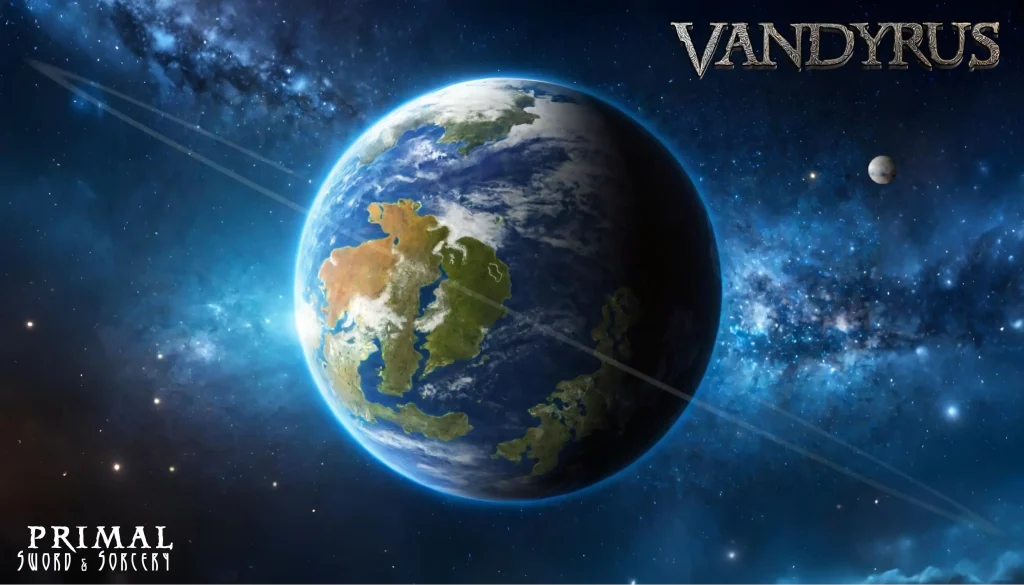
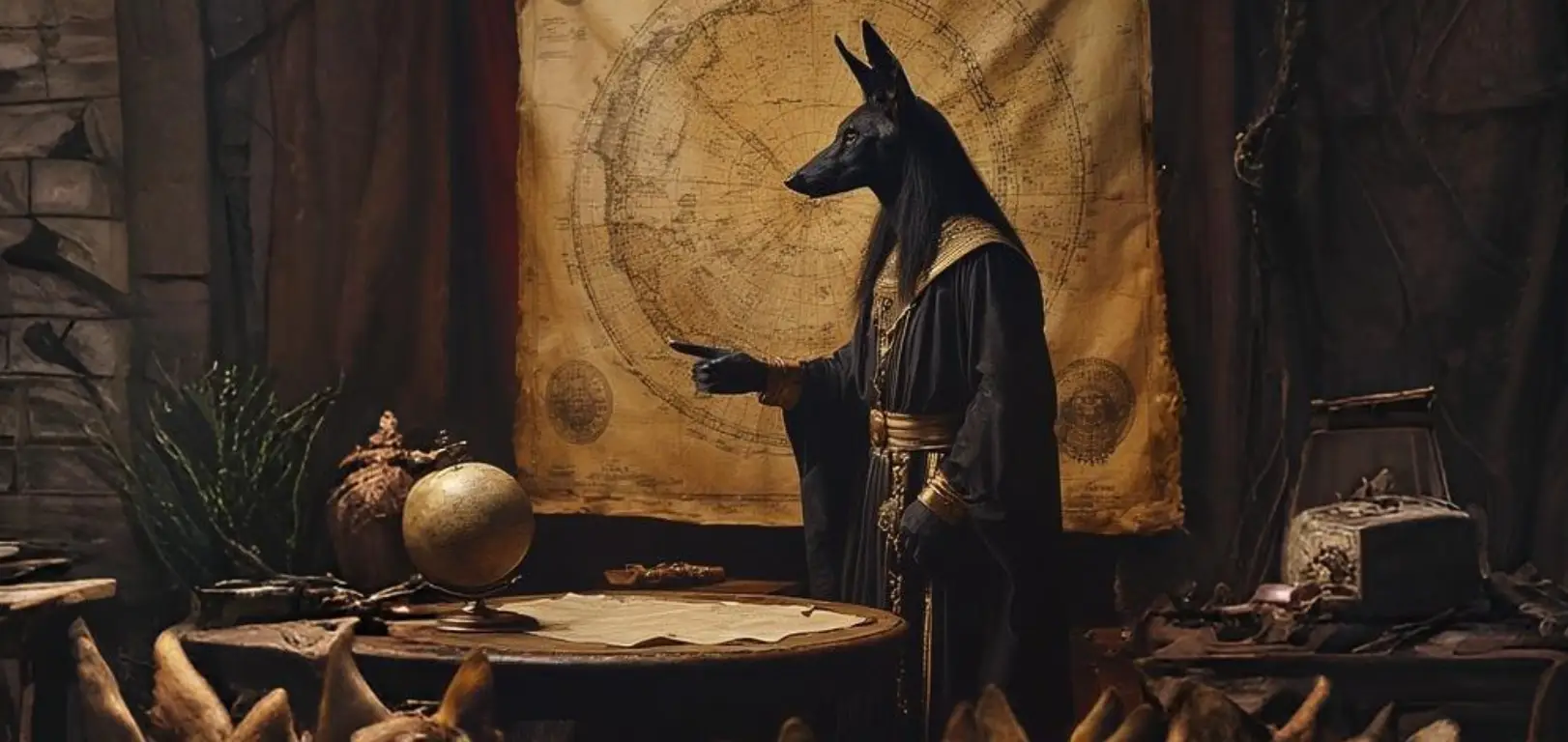
Vandyrus is not, and has never been, the Vandyrian homeworld.
Vandyrus is a frontier node, a foothold, a deployment site on the very rim of what once was their dominion. The serpent vaults beneath Drael may whisper with dread and alien intellect; the wolf dens of Vulsa may thrum with ancient reflexes of command; the lion courts may preserve fragments of imperial etiquette—but none of these are the cradle.
They are provincial holdings at best, experimental platforms at worst. If the Vandyrian ever possessed a single world of origin, that world has been lost for ages beyond counting—either consumed by their own engines of expansion or erased in the collapse that followed their disappearance.
If there ever was a singular homeworld, its name would be Vandyria—not Vandyrus. According to the conventions of their own language, “Vandyrus” translates roughly as “within the outer grasp of the Empire of Vandyria,” marking it as a frontier province rather than the imperial heart.
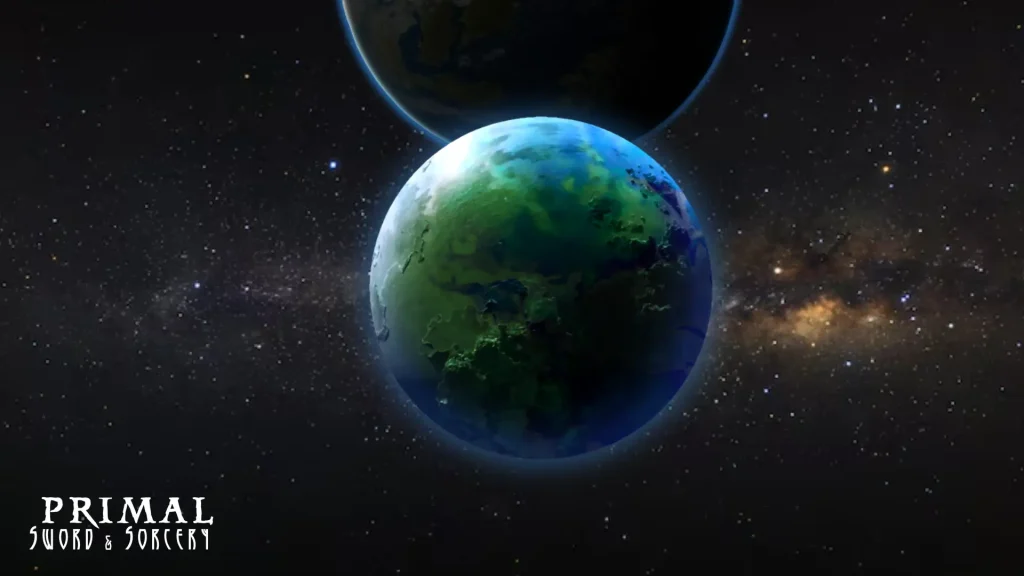
Before Doom’s arrival, only two worlds in the Ran system mattered.
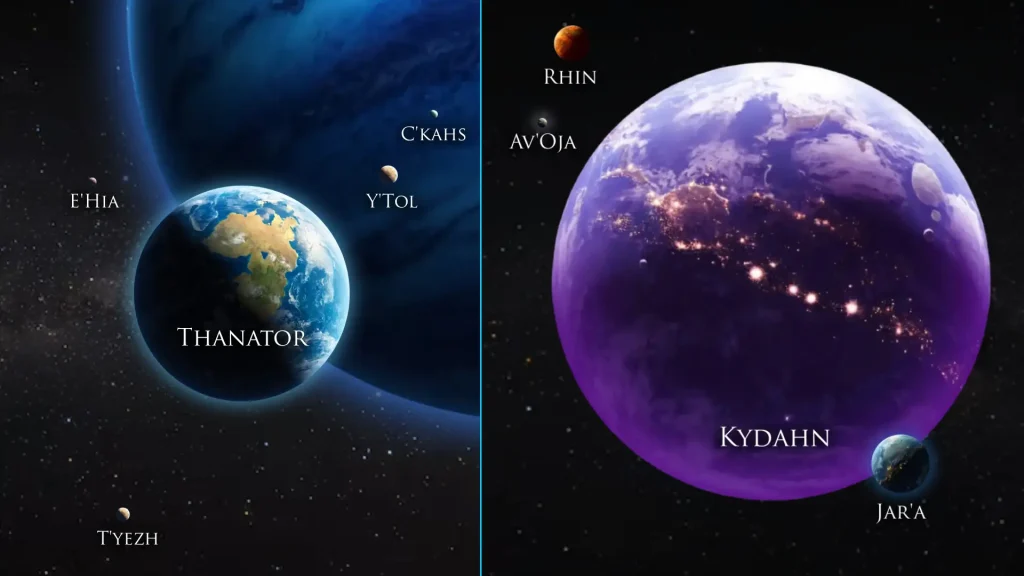
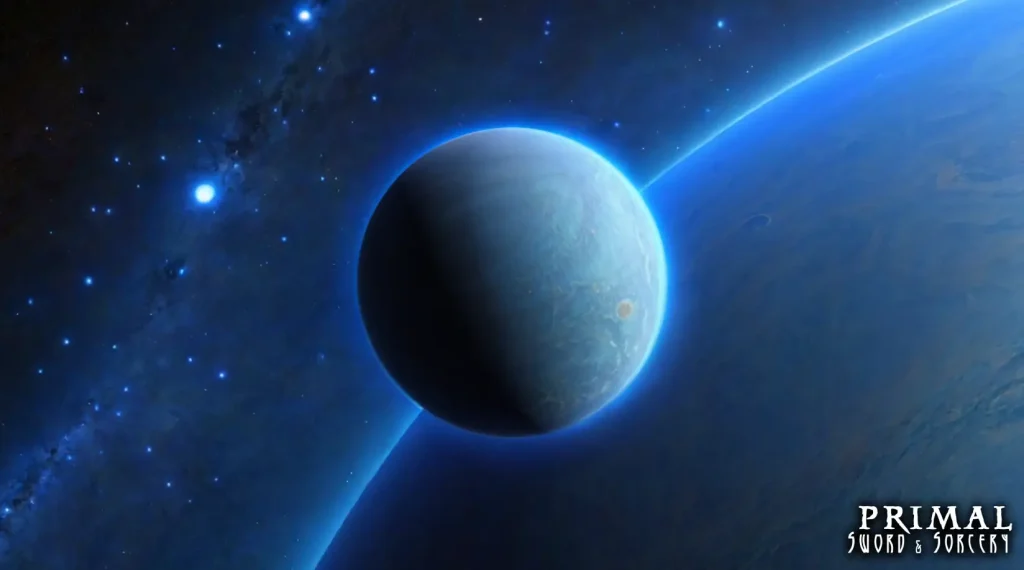
Thanator & Kydahn
These planets did not simply cultivate their own soils or histories; they radiated ambition, dominating their neighbors by design and force. Thanator’s society was relentless—a machinery of conquest, where the refinement of imperial law met a culture of violence that penetrated every institution, from the blood-sport of noble courts to the conscription of whole continents for war. Every festival was edged with cruelty; every law enforced with the threat of steel.
Kydahn, no less ruthless, secured mastery through intellect and precision. Where Thanator flexed, Kydahn calculated, applying superior artifice and administration with a cold authority that tolerated no defiance. Dissent was not crushed in public spectacle, but erased by systems so intricate that challenge became unthinkable. The rivalry between these twin powers dictated the fate of the system; the history of every lesser world was bent by the reach of their fleets and the legacy of defeat they imposed.
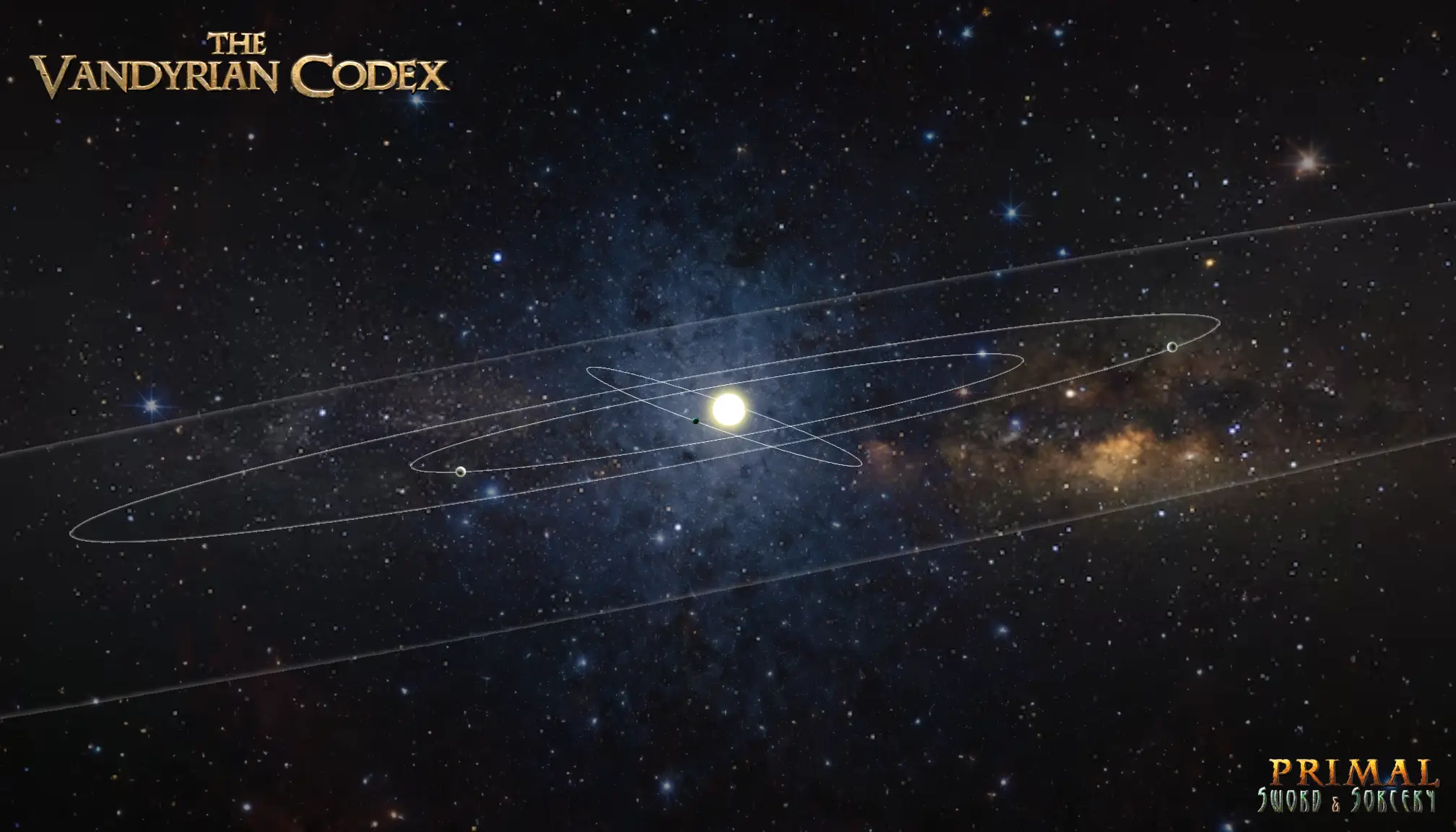
The other planets in the Ran system did not orbit only their star, but the gravitational pull of Thanator and Kydahn—the true axis of power. Their ambitions, wars, and bargains shaped the order of all things, and only the Cataclysm could render such striving meaningless. When Doom came, even the greatest designs were stripped of purpose, and dominion became just another memory lost in the dark.
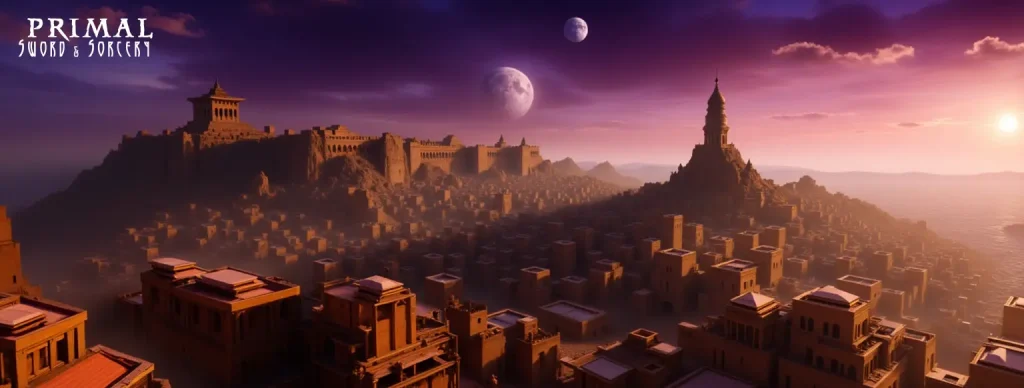
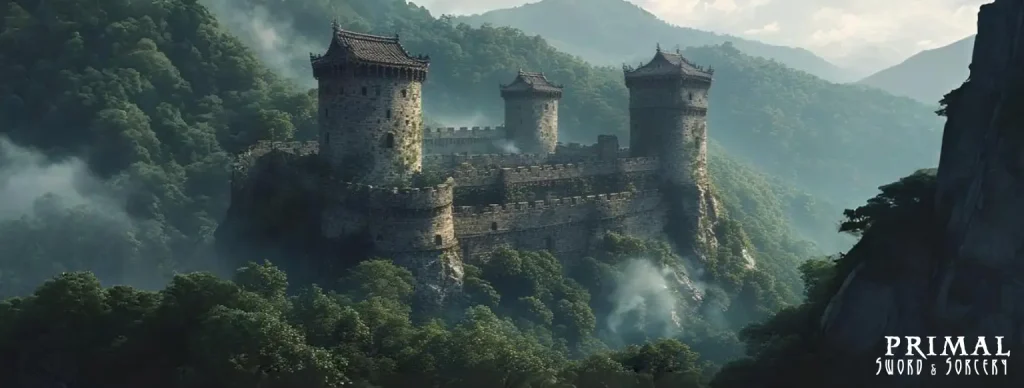
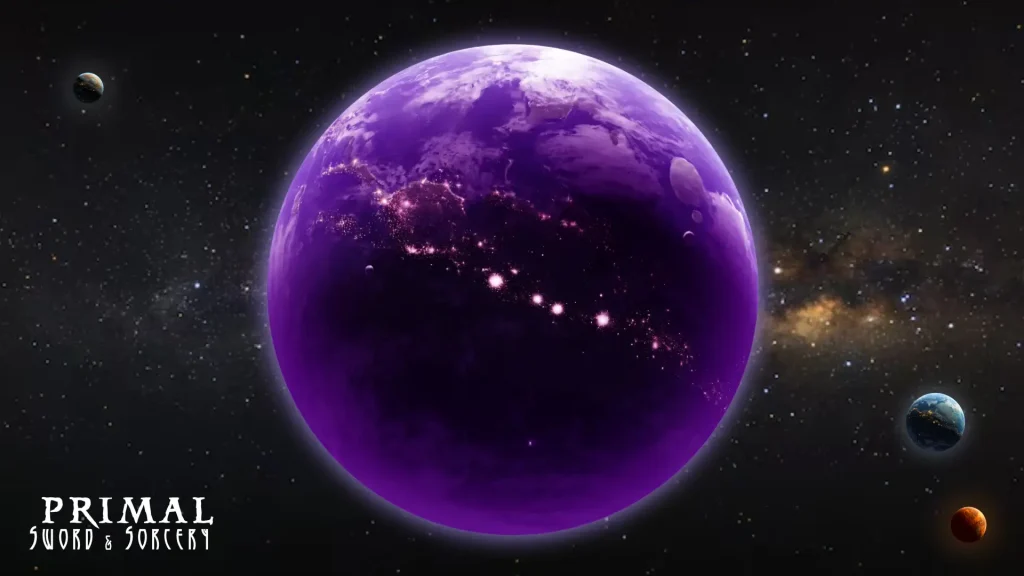
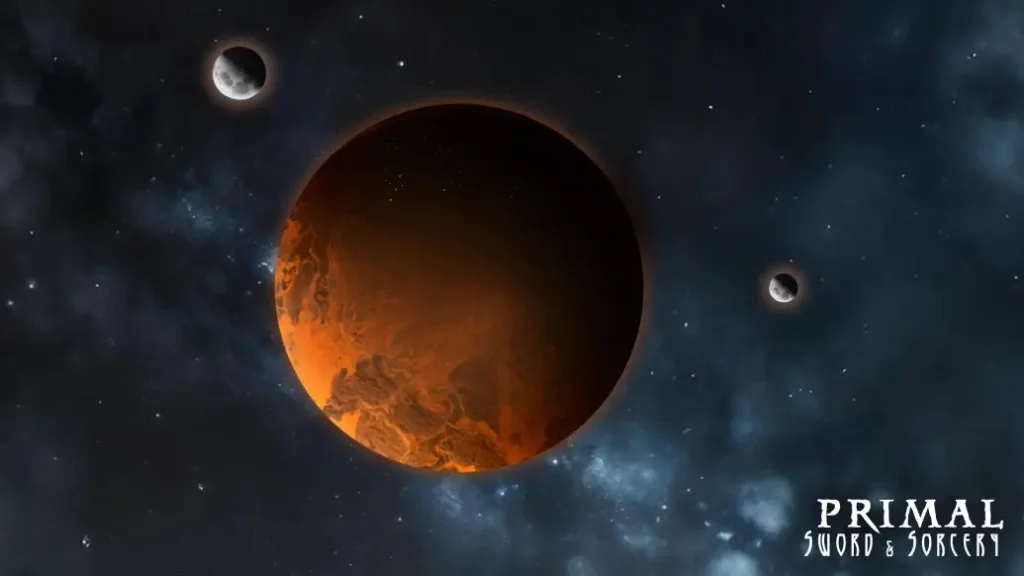
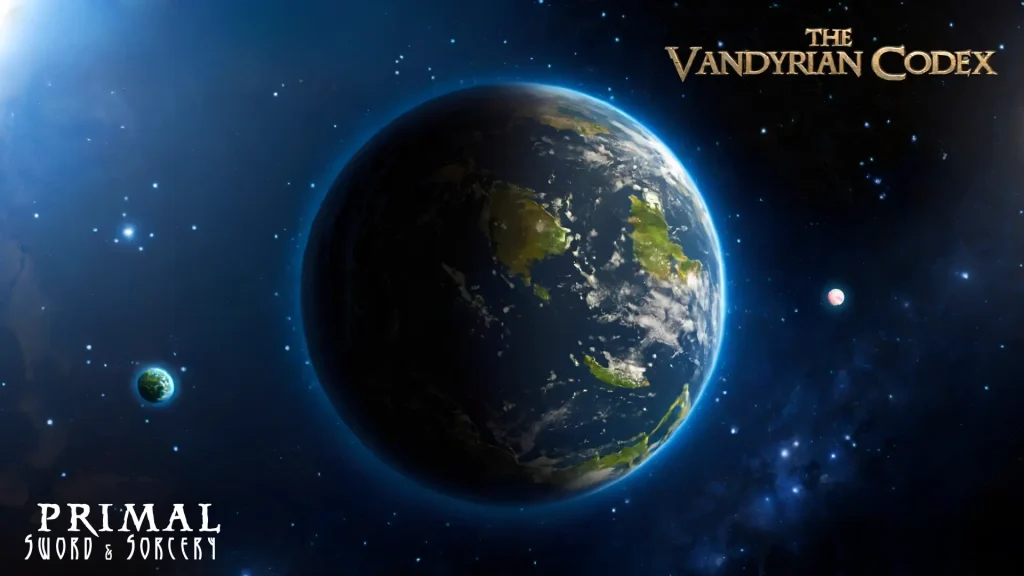
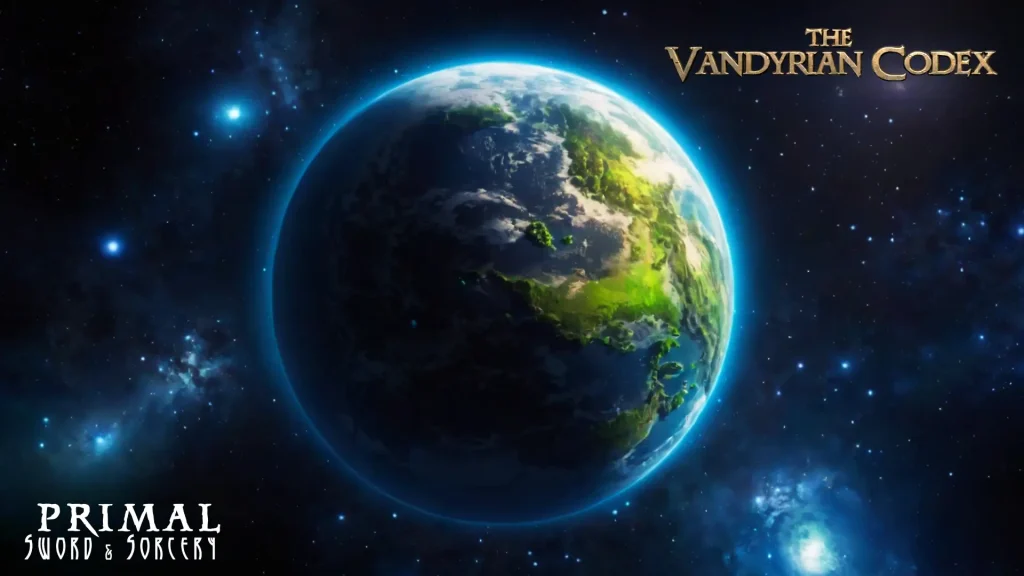
The fourth planet of the Ran system, Vandyrus was never the heart of empire. It was neither cradle nor capital, but a frontier—provincial, harsh, and unsettled. The planet’s surface was scarred by halls of stone, ziggurats raised to cruel gods, and fortress-cities clinging to the edge of survival. Wolf dens in Vulsa, the lion courts, the serpent vaults beneath Drael—all these were experimental holdings, not homelands.
Zhurian City States before the Cataclysm were the domain of sorcerer kings and overpopulation.
Vandyrus, even in its height, was a deployment site at the rim of greater dominion, a foothold within the outer grasp of the vanished Empire of Vandyria. If there ever was a true Vandyrian homeworld, its name and location have been lost beyond memory—consumed, perhaps, by their own engines of expansion or annihilated in the chaos that followed their collapse.
The Cataclysm:
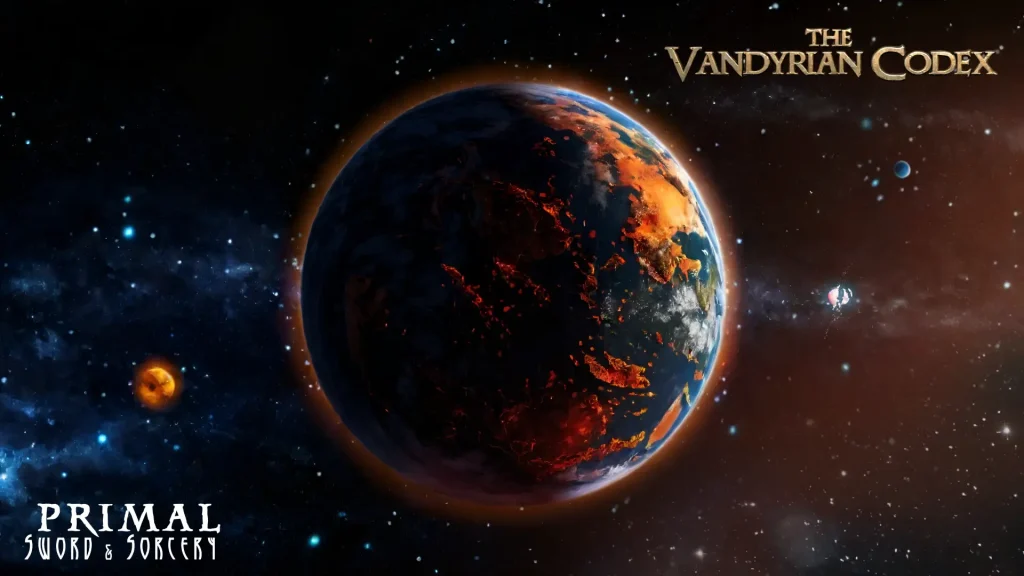
When Doom shattered the system, Vandyrus was not spared. Its provinces suffered—the sky torn, the cities battered, neighbors erased in fire and silence. Yet Vandyrus endured, not by virtue but by resilience: conquered twice in history—once by the imperial reach of Thanator, again by those same conquerors returned as raiders—but never truly tamed, never wholly broken. It was backward, brutal, and tough enough to weather the shock that unmade worlds more glorious.
Aftermath:
In the age that followed, Vandyrus persisted as the broken heart of a broken system. The survivors built new halls from the ruins of the old, adapted to the void left by lost neighbors, and made civilization from the scraps of disaster. No longer the outpost of empire, Vandyrus became a refuge for those too wretched, too adaptable, or too stubborn to die.
Present Day:
Vandyrus sits at the system’s axis not by right, but by survival. Its people endure, marked by scars, clinging to half-remembered rituals and relics of vanished overlords. The world is provincial still—a brutal province without illusions, bearing the name “within the outer grasp of the Empire of Vandyria.” Its only glory is that of persistence: battered, unbowed, and condemned to memory as the system’s harsh, undefeated core.
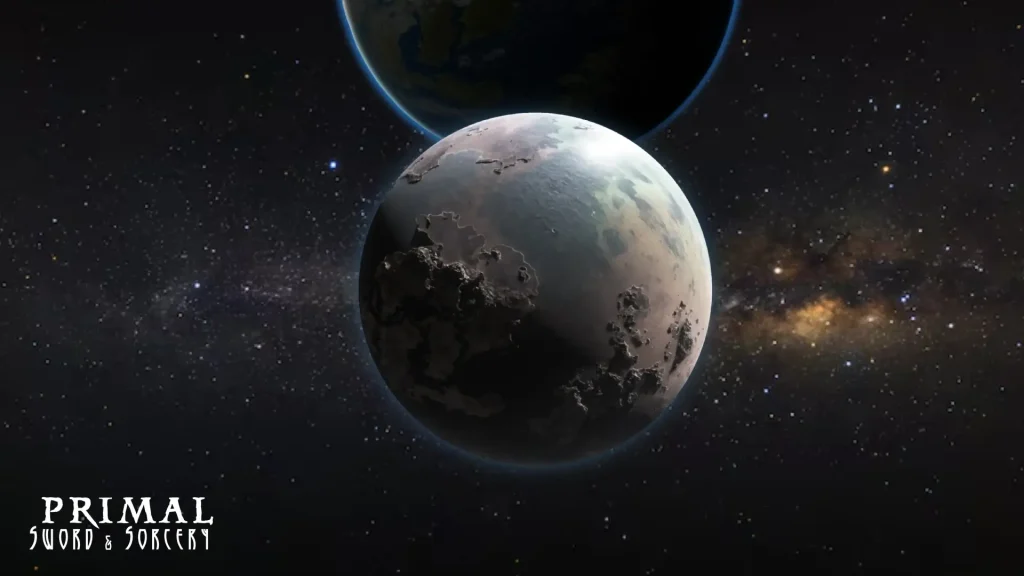
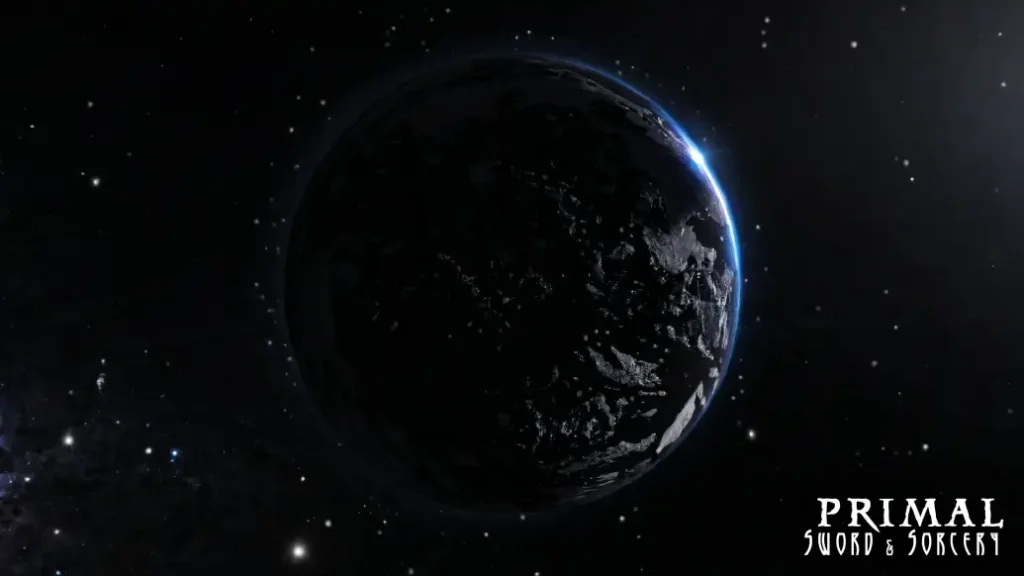
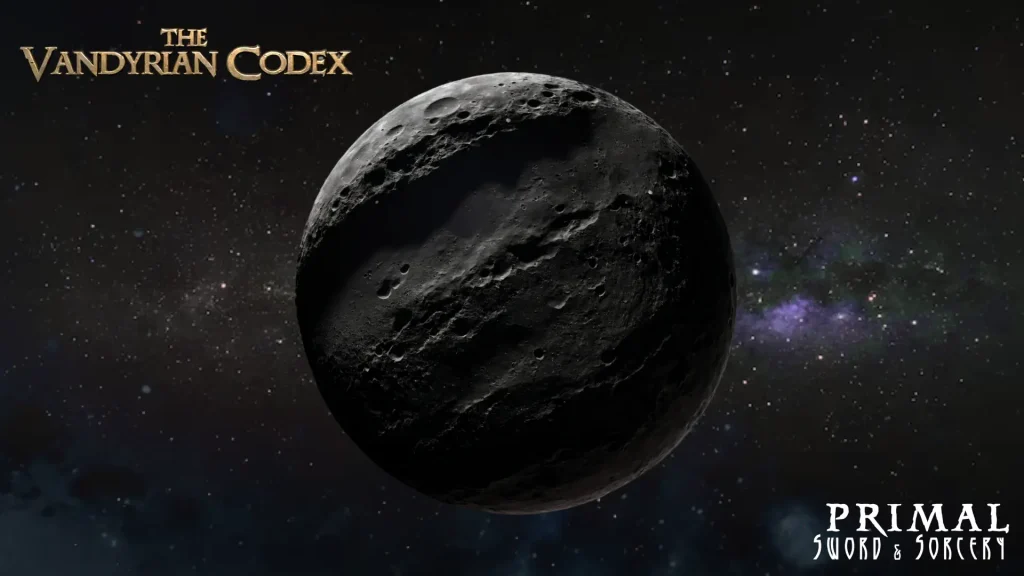
Artana, Vandyrus’s principal moon, was a world on the threshold. From the surface of Vandyrus, distant watchers sometimes saw faint glimmers—evidence of fire, movement, or the first stirrings of civilization. The moon’s surface was scarred and pitted, but some believed enclaves or primitive settlements were beginning to rise. To the Vandyrians, Artana was a mystery—an object of speculation, never fully understood or mapped.
The Cataclysm:
When Doom tore through the Ran system, Artana was battered almost beyond recognition. The lunar surface fractured, its lights vanished, and all hopes of contact or observation were lost in the greater violence engulfing the system. Where another, smaller moon once orbited, nothing remained but a ring of debris—Votah, a shining wound encircling Vandyrus.
Aftermath:
In the years that followed, Artana was written off as dead. No signal, no traffic, no reliable sign of life persisted. The Vandyrian record treated it as just another casualty, another monument to ruin and silence. The Votah ring, visible even from the battered surface below, stood as the only testament to what had been.
Present Day:
Yet even now, watchers claim to see faint lights flickering across Artana’s face—a rumor that will not die. Whether these are the sparks of survivors, the work of automated systems, or only tricks of the eye, none can say. To the Vandyrians, Artana remains an enigma, circling above as both scar and warning: a world just beyond knowing, haunted by possibility and loss.
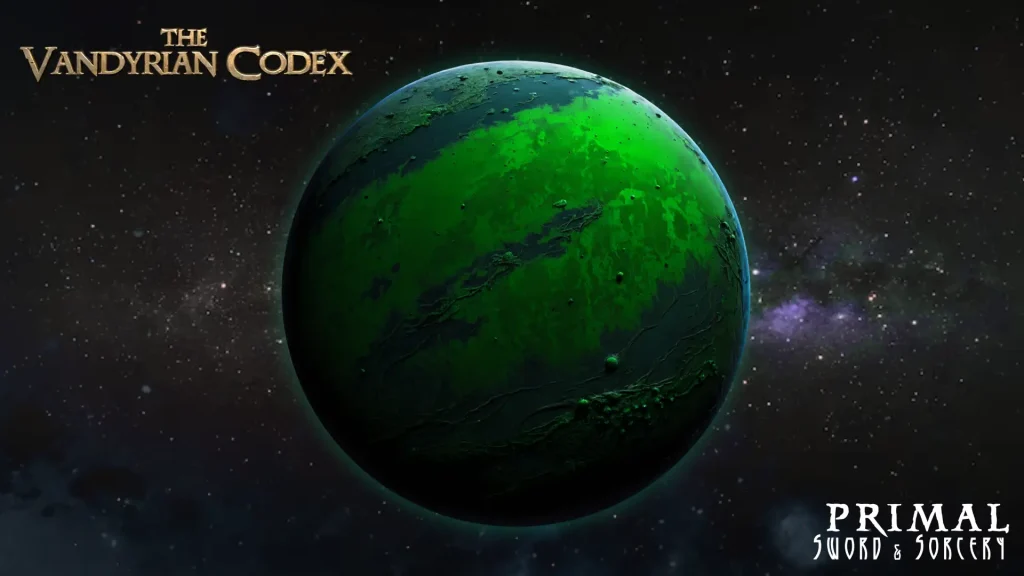
Kydahn, the fifth planet of the Ran system, was a power to rival Thanator—some say its better. The world stood apart: decadent, proud, and technologically sovereign, its cities towers of silent threat and intricate demonstration. Kydahn’s influence checked the ambitions of the system not through open conquest, but through mastery. Its authority was absolute; its reputation, a warning.
The Cataclysm:
Doom made no distinction. When the Cataclysm arrived, Kydahn was consumed utterly—its surface stripped, its core shattered, its substance drawn up and folded into the advancing shadow of destruction. Cities, archives, dynasties, and the very ground itself were all lost in one remorseless hour.
Aftermath:
Kydahn left nothing behind but dust and scattered mass, a memory kept alive only by those who once feared its power. Its silence was total; its authority, mocked by oblivion.
Present Day:
Kydahn exists now only as planetary debris and drifting cosmic dust—the aftermath of obliteration, the scene of a massacre scattered through the system’s empty lanes. Its name lingers in bitter stories, haunted by those who claim that, for a time after the Cataclysm, lights of civilization could still be seen flickering among the ruins. Raiders from Thanator, drawn by the hope of salvage, found only fractured ground and the echoes of a world bleeding out its last atmosphere. Whatever survivors endured, they did so in darkness and despair, and by the third generation, even the lights went out. Now, nothing persists but dust, memory, and the void where Kydahn once ruled.
Rethka was a planet defined by contempt. It served the Ran system as a penal world and industrial graveyard—a dumping ground for toxic waste, spent fuel, heavy metals, and those folk deemed too despised, too dangerous, or too inconvenient to be allowed to die anywhere else. Its surface was scarred by slag fields, poisoned seas, and sealed labor zones where survival itself was considered part of the sentence. Nothing was cultivated here except suffering and neglect.
The Cataclysm:
When Doom passed through the system, Rethka did not resist, nor was it spared. The planet was caught fully in the object’s path, its poisoned crust and buried dead offered up without distinction. It is said that the final prisoner looked skyward as annihilation came, smiling as the light rose, whispering thanks to forgotten gods for a death that required no sentence to complete.
Aftermath:
There was no aftermath. Rethka was consumed entirely—its crust, its wastes, its buried populations reduced to component particles. The planet’s mass was stripped apart and drawn into Doom’s shadow, scattered beyond recovery.
Present Day:
Rethka no longer exists as a world. It survives only as dispersed matter and as a cautionary name in the records of the Ran system. No ruin marks its passing, no debris field traces its orbit. Even contempt, in the end, was erased.
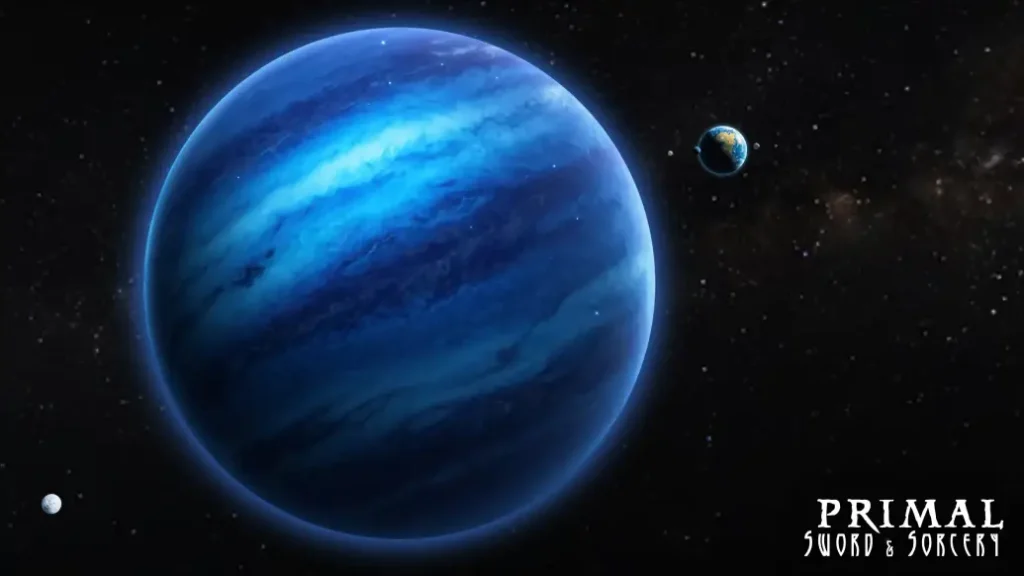
Titanum, the sixth planet of the Ran system, was a gas giant whose secrets eluded even the most ambitious empires. Its atmosphere roiled with storms of unimaginable violence, colored bands wrapping a world whose depths remained unmeasured. Some speculated at a hollow core, others at a rocky or even artificial heart, but no expedition ever returned with proof. Around Titanum orbited two major moons, Thanator and Jotun—each the seat of its own troubled history.
The Cataclysm:
The Cataclysm passed, and Titanum’s storms burned brighter, but the giant itself endured. Probes and landers sent into its depths vanished without a trace, their loss giving rise to tales of mutilation, distant chanting, and abduction by forces unknown. No empire, Vandyrian or otherwise, claimed dominion over the planet; every attempt at mastery was met with silence or disaster.
Aftermath:
Titanum’s mysteries deepened in the system’s ruin. The moons that once circled in orderly paths found their orbits changed, battered by debris and the shifting gravities of loss. Thanator and Jotun remained tethered, each altered, each made more perilous by proximity to the unanswerable depths.
Present Day:
Titanum stands untouched, the system’s enduring riddle. Its upper layers rage with storms, its heart unrevealed. Attempts to pierce its clouds are met with failure or madness; those who claim to have heard chanting or seen lights within are dismissed as mad or lost. Thanator and Jotun circle still, orbiting not only a planet but a question that no survivor has answered.
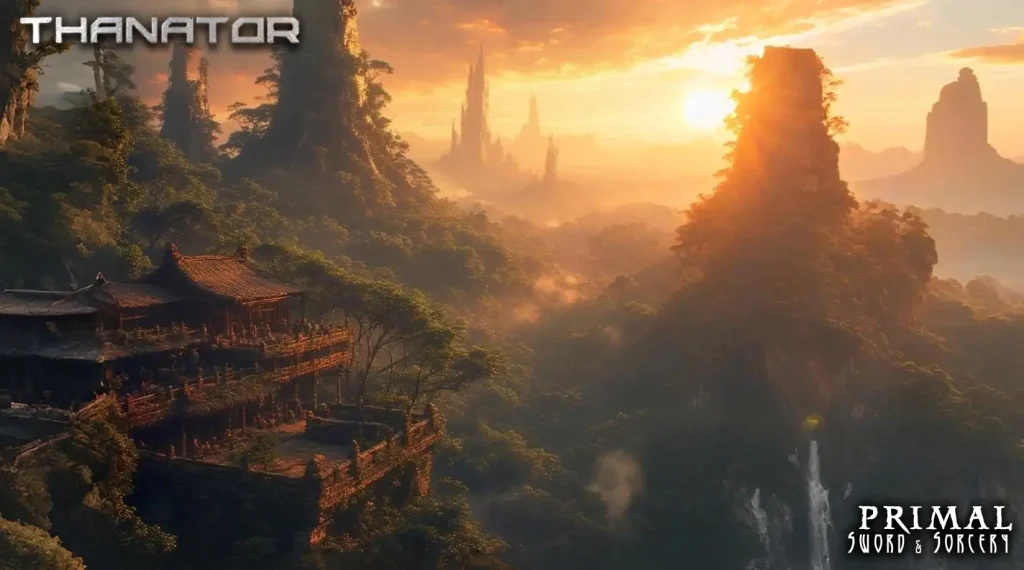
Thanator was the jewel of the Ran system—a moon-empire whose palaces soared above jungle canopies and whose civilization was both feared and envied.
Here, violence was refined into art, and debauchery became the science of courts and warlords. Thanator’s fleets ranged far; its reputation shaped the fates of worlds. Admired by some, abhorred by others, Thanator was never ignored.
The Cataclysm:
When Doom crossed the system, Thanator was not spared. The Cataclysm shattered the moon’s upper layers, boiling jungles to steam, burying cities in molten ruin, and drowning all pride beneath floods of silence. The seat of empire collapsed; glory was replaced by survival.
Aftermath:
Thanator’s core world persisted, scarred but unbeaten. Civilization dissolved into violence and hunger. What survived did so by adapting to new savageries—predation, ruin, and an unending struggle for dominance. The memory of empire lingered only as legend, tainted by blood and the taste of loss.
Present Day:
The dream of Thanator’s empire is dead, but the world itself endures—stripped of pretense, stubborn, and savage. No order holds for long.
The moon remains a theater of predation and despair, its civilization replaced by an engine of survival that refuses extinction.
Jotun, the outer moon of Titanum and sister to Thanator, was always the system’s outcast. Cold, sparse, and battered by distance and neglect, Jotun’s surface supported a thin, marginal existence. Its people—never numerous—endured through endurance alone, their societies shaped more by privation and retreat than by ambition or conquest. Even in the high age of Thanator’s empire, Jotun remained peripheral: an afterthought, a harsh frontier at the edge of the system’s true power.
The Cataclysm:
When Doom swept through the Ran system, Jotun was spared the worst of the violence. The moon’s distance and relative insignificance left it largely untouched by direct devastation. Yet the same event that erased so many worlds only highlighted Jotun’s own failures. Where Thanator descended into savagery and survival, Jotun faded into irrelevance and slow decline.
Aftermath:
In the centuries that followed, Jotun’s people diminished further, their cultures worn down by isolation and attrition. Once-thriving outposts collapsed or were abandoned, and the moon’s legacy became one of loss and diminishing return. No glory, no defiance—only the quiet, terminal slide toward silence.
Present Day:
Jotun stands as a graveyard in waiting. Its surface is marked by ruined settlements, abandoned halls, and the slow, steady retreat of what life remains. Generations from now, Jotun will be spoken of only in mourning: a reminder that some worlds are not destroyed by violence, but by the weight of neglect, disaster, and time.
Rywar was a distant, silent planet, its only features the colossal ruins of a civilization that vanished long before any known record in the Ran system. No living ecosystem ever emerged; the world’s surface remained an archive of emptiness, observed but never settled. In the golden ages of Thanator and Kydahn—millennia before Doom—expeditions from both worlds explored Rywar, uncovering glyphs and structures unmistakably marked by the Greater Vandyrian Empire.
These findings dated back nearly three hundred million years, predating the rise of Thanator or Kydahn themselves. Automated fleets—drones and colonial starter systems—had once landed here, mapping and surveying Rywar as a potential hub for Vandyrian expansion.
Vandyrus itself, it is now believed, was originally little more than a designated outpost—its name the legacy of imperial logistics, not of origin or birthright. By the time Thanatorian explorers set foot on Rywar, the automated presence of the Greater Empire had long failed, and what remained of the ancient installations was already decayed by time.
The Cataclysm:
Time began the ruin, but the Cataclysm finished it. When Doom swept through the system, half of Rywar’s crust was boiled into a sea of black glass, a hundred miles deep. The rest was drawn down by ancient vortices and encroaching silence. The ruins—already enigmatic and eroded—were further vitrified or swallowed. Surviving glyphs and structures were reduced to fragmented, scorched remnants, legible only in the rarest of circumstances.
Aftermath:
Following the Cataclysm, Rywar existed as the system’s furthest grave. Later scholars gave names to its scars—Vulcan Sea, Graveyard Coast—but these were nothing more than catalog entries. Rywar itself offered only mute evidence of entry, neglect, and extinction.
Present Day:
Rywar is the system’s farthest known tomb—a planet of black glass and ruins so ancient that even ghosts are a memory. Its negative legacy is clear: proof that Thanator and Kydahn were not the first, that the ambitions of the Greater Vandyrian Empire stretched here eons earlier. The world’s silence, and the worn glyphs beneath its fused surface, stand as the final reminder that even the greatest empires are reduced to dust, their claims unread, their history boiled away by time and catastrophe.
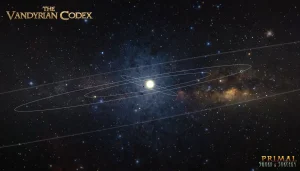
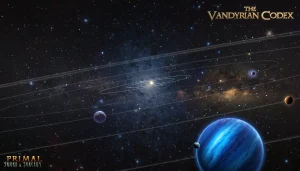
Before the coming of the Cataclysmic Object—called Doom by the survivors—Ran presided over a family of worlds in rough alignment.
The system boasted planets as varied as the ambitions of their folk: worlds of storm and chemical sea, of verdant forest and rising empires, of savage law and decadent peace. Some bore moons, others rings, some nothing at all but the weight of their own history.
Before the age of doom, Ran’s children moved in stately order, each world bearing its own silent ambitions.
Yalar
Before the Cataclysm:
The first planet of the Ran system was nothing more than a primordial sphere, wrapped in a choking viridian atmosphere—a world locked in chemical tumult, eternally hostile to biology. Nothing seeded, nothing stirred; the surface swam with toxic clouds and silence.
The Cataclysm:
When Doom arrived, it stripped Yalar of its shroud, peeling away atmosphere and memory in a single, wordless moment. What remained was black stone and vitrified quartz, the surface flash-melted and barren, history erased in an instant.
Present Day:
Yalar is not dead because it never truly lived. There is no record of seed or animal, no fossil or artifact, only heat fractures and the silent testimony of scorched glass beneath a star that now burns on nothing.
Tyvex
Before the Cataclysm:
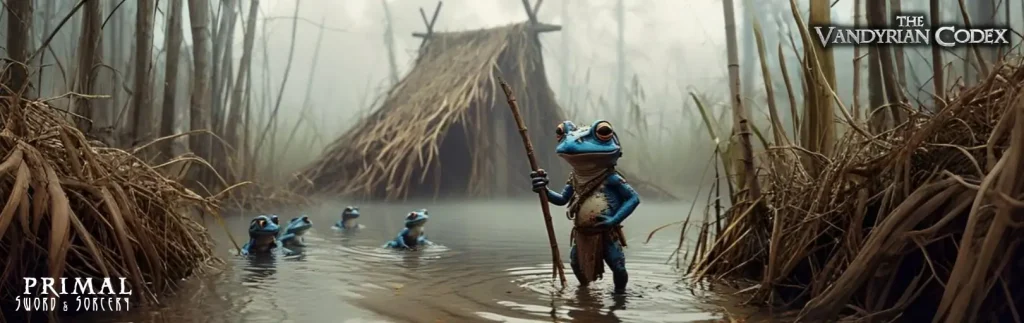
The second planet of the Ran system rose out of ancient swamps. In its earliest age, the lowlands seethed with amphibian life, forms poised at the brink of transformation—half-dreaming of legs, lungs, and dominion beyond the mire. The world’s hunger was primordial, its promise uncertain, its waters thick with unspent potential.
The Cataclysm:
Doom’s passing was both verdict and sentence. In an instant, Tyvex was broken—its teeming lowlands and ancient hunger seized by apocalyptic violence, the planet’s future smothered before it could emerge.
Aftermath:
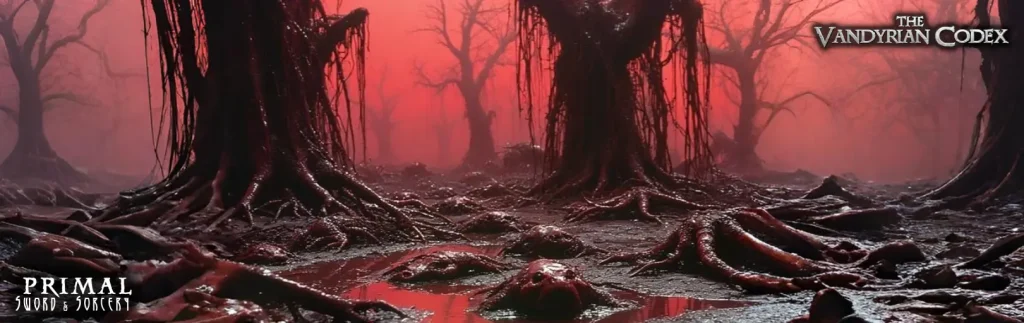
Radiation twisted the swamps into a catalogue of mutations. Creatures dissolved into the land itself; flesh and terrain intermingled, life that should have died stubbornly refusing extinction. Storms raged without end. The sky became a vault of poison, each cloud seeded with the memory of catastrophe.
Present Day:
Tyvex persists, but only as an abomination. The planet’s biology recoils from every memory of order. Nothing here is stable—nothing welcomes classification. What lives, does so in mockery of life: refusing extinction, refusing definition, the legacy of a world unable to die clean.
Illynar
Before the Cataclysm:
The third planet of the Ran system, Illynar was a garden world. Forests ran unbroken for leagues; river valleys bred life in profusion. Tribal cultures traced their beginnings along the watercourses, and two distinct peoples edged toward the first, uncertain glimmers of civilization. The world was green, vital, and poised for memory.
The Cataclysm:
The Cataclysm struck with finality. In a single, shuddering convulsion, Illynar’s core was shattered. Continents ground themselves to powder. The atmosphere was stripped and scoured, ripped from the planet’s surface and lost to the black. Civilization’s first sparks—names, records, beginnings—were erased at the root.
Aftermath:
There was no aftermath worth the name. The world was not simply broken; it was atomized. Dust finer than silt drifted across vacuum, too insubstantial even to seed the oceans of Vandyrus. Nothing of Illynar’s life, culture, or ambition survived the hour.
Present Day:
Illynar exists only as absence. There is no language left to mourn it, no relic to recover, no trace to unearth. Its history is a loss so complete it defeats memory, a blank in the record. The third world’s only legacy is its erasure—a silence so total that even Vandyrus’s scholars speak of it with unease.
The designation “Empire” does not appear in any surviving Vandyrian records. It is a label imposed almost exclusively by those who, finding themselves a mere fractal segment within the greater system, grasped for early classification.
What terrifies even the boldest chroniclers is this: ancient reconstructions suggest that “Vandyrian” most accurately translates to “Vanguard.” Not people. Not empire. Not race. Vanguard. A forward element. A spearpoint. A preparatory force, deployed in anticipation of something larger behind it.
If an empire of one hundred million systems named itself the vanguard, then the unspoken questions become unbearable:
A vanguard for what?
A vanguard for whom?
A vanguard against what adversary or toward what cosmic project so vast that even their colossal empire was merely its opening gesture?
For the originators, such boundaries were irrelevant—a vanguard is defined by function, not domain.
The Vandyrian Empire was not vast—it was impossible. No mortal arithmetic can encompass it. Across innumerable cycles of expansion, extinction, recursion, and renewal, the Vandyrian dominion is estimated to have encompassed on the order of one hundred million star systems.
Not worlds—systems. Entire solar families reorganized to serve military, industrial, or experimental purpose. Moons carved to factory-hollows. Asteroid belts reconfigured into supply nets. Star output harnessed, redirected, or extinguished to suit imperial necessity.
And yet the paradox: almost nothing remains. In the Ran system we see Thanator’s shattered titanic civilization, Kydahn’s engineered splendor, Drael’s scarified substrata—but these are embers scraped from a fire whose heat once reached across the firmament.
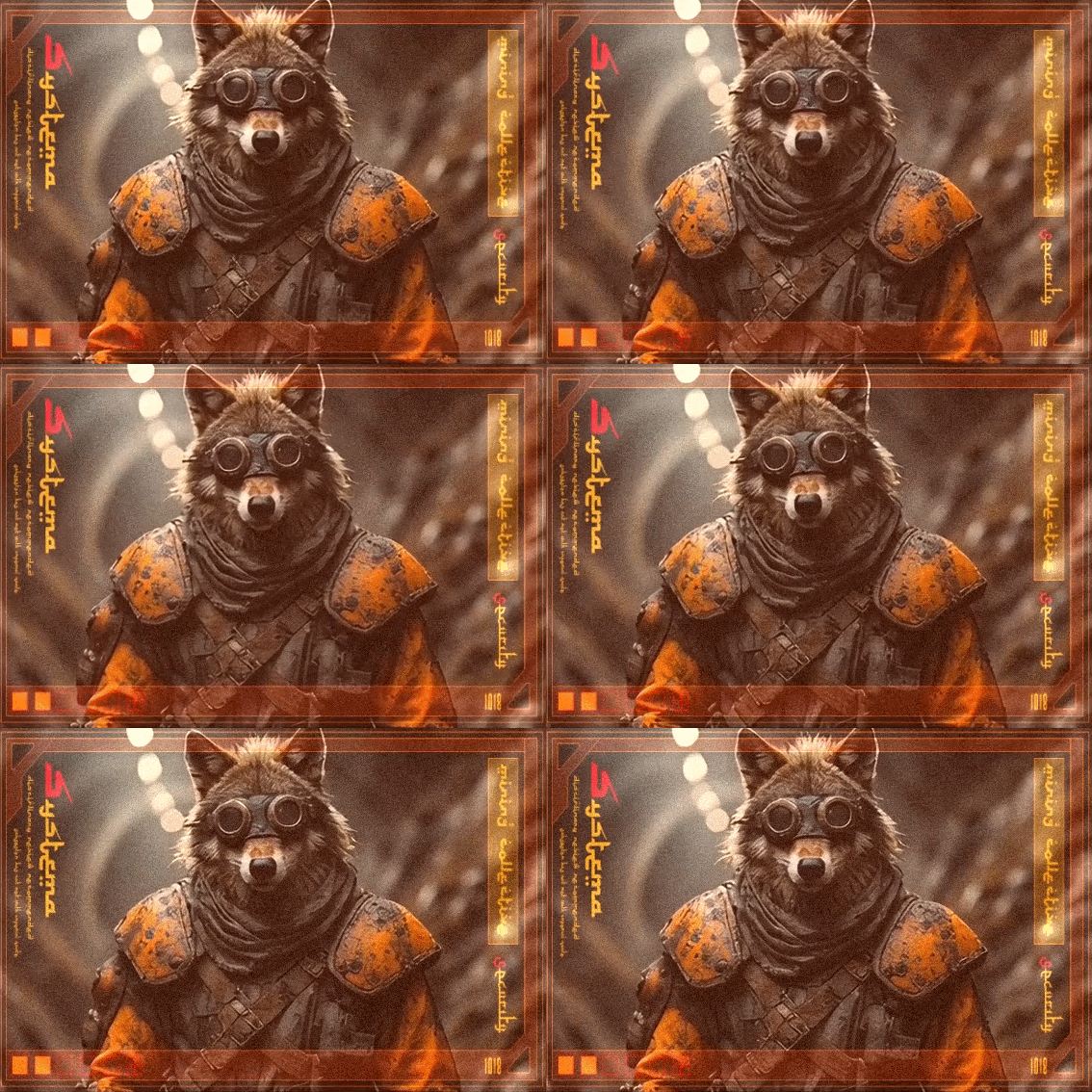
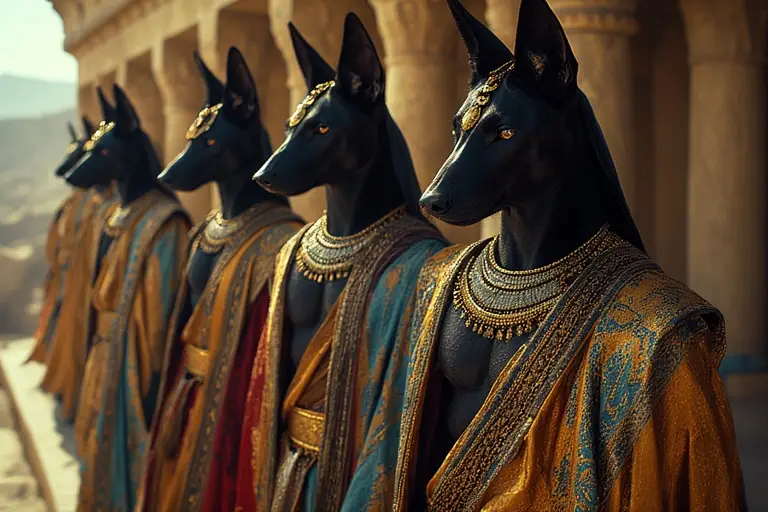
Concerning identity. The peoples who now claim the Vandyrian mantle—lion, wolf, ram, bear—are local survivals, nothing more. Their pride rests on instinctual memories, genetic impulses, or the psychological residue of ancient doctrine.
Whether they derive from true Vandyrian stock or were merely designed according to a Vandyrian template no longer matters. Their self-claims are provincial echoes ringing in the husk of a cathedral too vast for modern folk to comprehend.
To speak of the Vandyrian is to step onto a faultline older than memory, where every word fractures under a burden it was never shaped to bear. The question—what is a Vandyrian?—seems innocent, almost scholarly, until one begins to answer it.
For the Vandyrian is not a folk, nor a lineage, nor a culture, nor even a single empire in the paltry sense that lesser ages use the term.
The Vandyrian is a continental shadow cast across the galaxy, a residue left upon tens of millions of worlds, a design philosophy written into the very bones of every species that breathes beneath the Ran system’s suns.
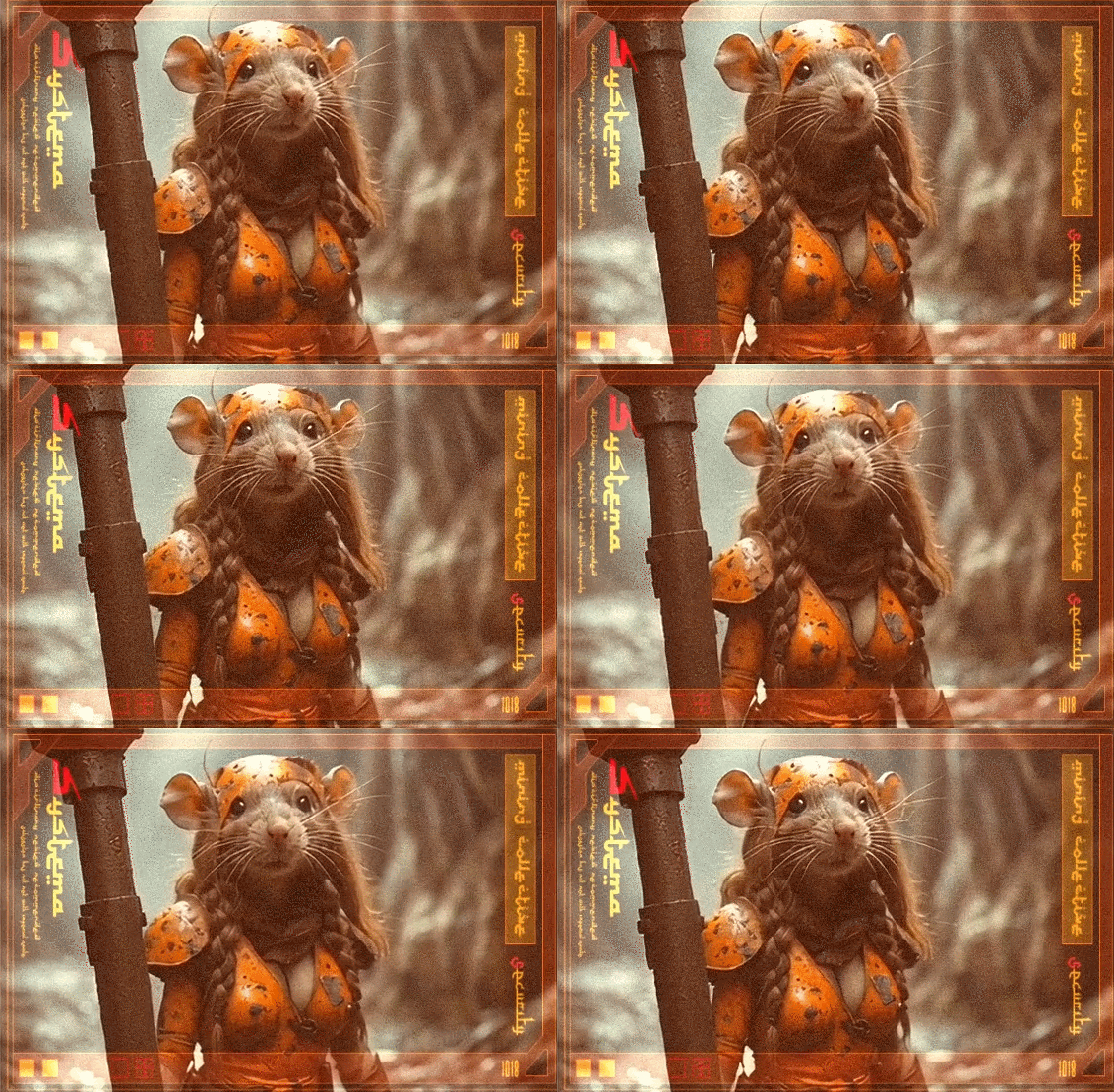
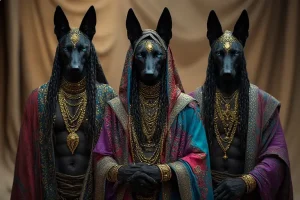
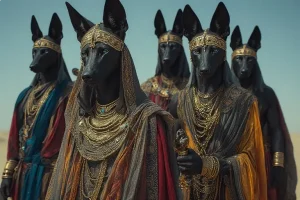
Lion and wolf, ram and bear; horsefolk of Zhuru, dogfolk of Vulsa, jackals of the wastes; otter, mouse, and every scaled carnivore that stalks the ash or surf—all bear the unmistakable signature of hands that once shaped, culled, reformed, redeployed, and finally abandoned them.
To ask what a Vandyrian is, then, is to ask why the ruins scattered across Vandyrus, Thanator, Kydahn, and their sister worlds share identical geometries, identical power-laws, identical genetic scaffolds; why the peoples themselves mirror one another’s instincts, hierarchies, and neural architectures; why war, order, stratification, and controlled brutality arise again and again as if imprinted not by culture but by inheritance.
The Vandyrian Codexexists to give game masters, writers, and players a dense, brutal, myth-driven setting they can lift directly into their own tabletop campaigns without permission, payment, or subscription. Inside are cultures, regions, wars, economies, religions, and power structures written to function at the table: places with motives, histories with consequences, and factions that collide whether the players intervene or not. Nothing here is locked behind a paywall, nothing is “lore-bait” for later purchase.
This is a working world meant to be looted from, expanded, broken, and played in.“
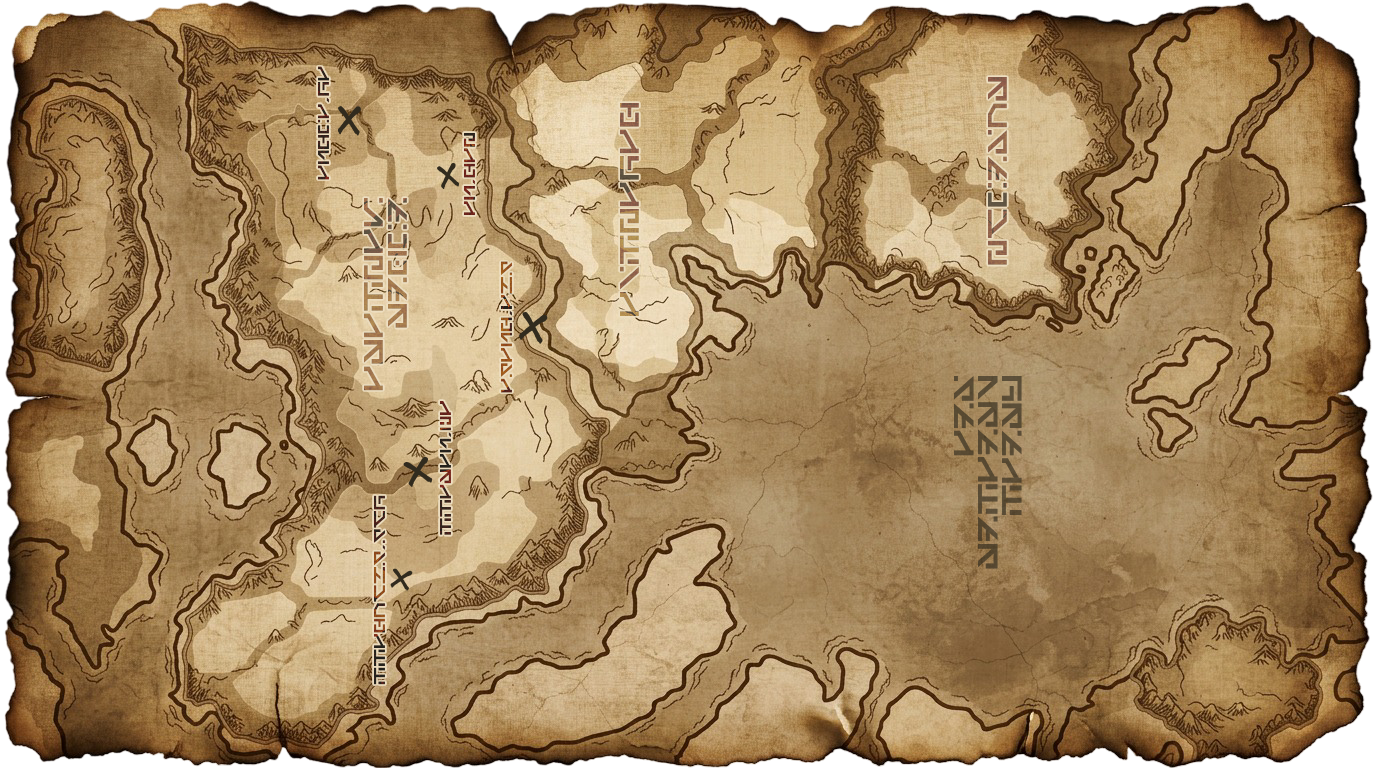
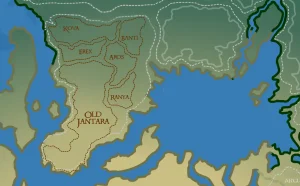
The true splendor of Elder Jantara is measured not in what endured, but in the magnitude of what was lost. Five cities once anchored the heartlands of the jackal civilization, each a distinct pole of culture, trade, or cunning. Today, all are ruins—picked over by centuries of scavengers, scholars, and memory-haunted dogs. Their names are seldom spoken outside the codex and their locations, though mapped and marked, are more legend than destination.
Ay’Albwa
The City of Arts & Science
Once the jewel of northern Jantara, Ay’Albwa was famed for its academies, scriptoriums, and marble halls lined with statues to dead philosophers. Legends claim its libraries rivaled anything in Ruselon, and its artisans minted coins and mechanical wonders that ended up as tribute in every court of Zhuru. The city was abandoned in the final purges, its great dome shattered, and now only fragments of stained glass and eroded sculpture remain, half-buried in the grass.
Nab’Wa
The City of Puzzles & Gardens
Built on a series of engineered terraces, Nab’Wa was a city of green walls and geometric courtyards, each section designed as a puzzle or labyrinth. Its rulers took pride in riddles, botanical grafts, and the artistry of living sculpture. The invaders who ended Nab’Wa’s reign left little but broken aqueducts and tangled stonework behind. Even the rivers were diverted, turning its gardens to dust.
Zha’Bwazha
The City of Birds & Ledgers
Sitting astride the central trade arteries, Zha’Bwazha served as Jantara’s ledger-keeper, mint, and post. The city’s aviaries sent messages by trained corvid and pigeon from stone towers. By the end, not even the birds stayed; the ledgers rotted and the market squares filled with mud. Bantos traders still pick over the old vaults, seeking lost coins and the secrets of Jantaran bookkeeping.
Am’Waratt
The City of Crystal & Desire
Am’Waratt was infamous even in its own time—a den of glass towers, pleasure houses, and revels that drew the jaded and powerful from across the continent. Here, the jackal lords mingled with visiting tigers, Ruseloni mystics, and every breed of vagrant prince. When Am’Waratt fell, its crystals were plundered, its lamps smashed, and its streets littered with the bones of both merchant and courtesan. The site is now haunted, dangerous, and cursed by any clan that remembers.
Yoz’Zhoubatt
The City of Lotus & Intrigue
Closest to the southern wastes, Yoz’Zhoubatt was a city of shadow, trade, and veiled plots. Alchemists brewed lotus extracts in cellars beneath the great ziggurat, and spies sold secrets to whoever could pay. The city’s collapse was absolute; no clan claims descent from it and no scavenger lingers long—strange lights and sickly blooms still appear in the ruins, and the wind carries the scent of poppy and death.
Within the Bardasi hierarchy, teacher was a tiered position, difficult to attain and not lightly bestowed. One did not become a teacher merely by age or experience, but by surviving review. Teachers were evaluated by their students’ later conduct, not by affection or loyalty. Above them stood professors, responsible not for instruction but for doctrine—the articulation of Jantaran commercial philosophy across generations. Above them again were adjudicators, empowered to resolve disputes between Bardasi, students, and foreign authorities alike, often with rulings that carried weight across borders. At the summit stood the civil proclamators, rare figures whose role was not to teach individuals, but to formalize Jantaran position in moments of crisis, transition, or foundational accord.
This structure ensured that the Bardasi did not merely produce clever traders, but shaped minds capable of operating without homeland, without sentiment, and without illusion. The student who completed such an apprenticeship did not return home wiser in the comforting sense. They returned sharper, quieter, and harder to deceive.
That other realms once accepted this transformation—once entrusted their offspring to jackal hands knowing they would not come back the same—is not a curiosity of the past. It is the measure of what Elder Jantara once was.
Pedagogically, the Bardasi rejected abstraction. A lesson was valid only if it could be tested on the road. Arithmetic was taught through loss and gain. Language through insult, negotiation, and apology. Ethics through exposure to consequence. A teacher might allow a student to misprice a good, offend a local official, or misjudge a rival merchant—so long as the error did not endanger the caravan as a whole. The resulting damage, whether economic or social, was never repaired on the student’s behalf. It was observed, recorded, and addressed later, often days after the event, when emotion had cooled and memory had sharpened.