Author: Primal Sword & Sorcery

  • via Mechanogenetic Expansion

    via Mechanogenetic Expansion

    The identification of Rywar as a site of imperial origin did not arise from revelation or accident, but from the slow exhaustion of doubt. For centuries, Rywar had occupied an ambiguous place in the imperial record—valuable, inhabited, strategically useful, yet curiously overdetermined in its infrastructure.

    Certain alignments, redundancies, and systemic efficiencies exceeded what local development alone could plausibly explain. These anomalies were long dismissed as coincidence, inherited genius, or the residue of forgotten empires. Only with the maturation of deep-spectrum orbital scanning and abyssal survey methods did the pattern resolve into certainty.


    The decisive evidence was found in two strata: above Rywar and beneath it. In high orbit, long-dead satellite husks were identified—machines whose metallurgy, architecture, and logic signatures predated all known Rywarian manufacture by millennia. These orbital relics were not defensive platforms nor communications relays in any recognizable post-imperial sense. They were survey nodes, traffic regulators, and resource coordinators: the peripheral organs of an autonomous fleet in its final operational phase.


    Below, beneath Rywar’s oceans, lay the second half of the truth. Vast debris fields, half-buried frameworks, and scuttled hull sections were detected embedded in the seabed, their mass too great to be accidental and too integrated with tectonic strata to be recent. Some bore the unmistakable signs of controlled disposal—reactors cracked and vented deliberately, cores dismantled, fuel assemblies separated and sunk. Others showed evidence of impact failure, suggesting that not all units completed their decommissioning as intended. The ocean became the fleet’s grave not through catastrophe alone, but through procedure.


    Recovered data from the orbital remains clarified the fleet’s terminal logic. The majority of its mass had not been destroyed, but recycled. Structural material, processors, and inert frameworks were broken down and repurposed directly into the earliest capitals—most notably Drodos—and into the foundational strata of the island nations that now form Rywar’s political and cultural core. City grids, substructural supports, and energy conduits were revealed to be direct descendants of autonomous construction logic, translated into habitable form. Rywar was not merely settled; it was assembled.


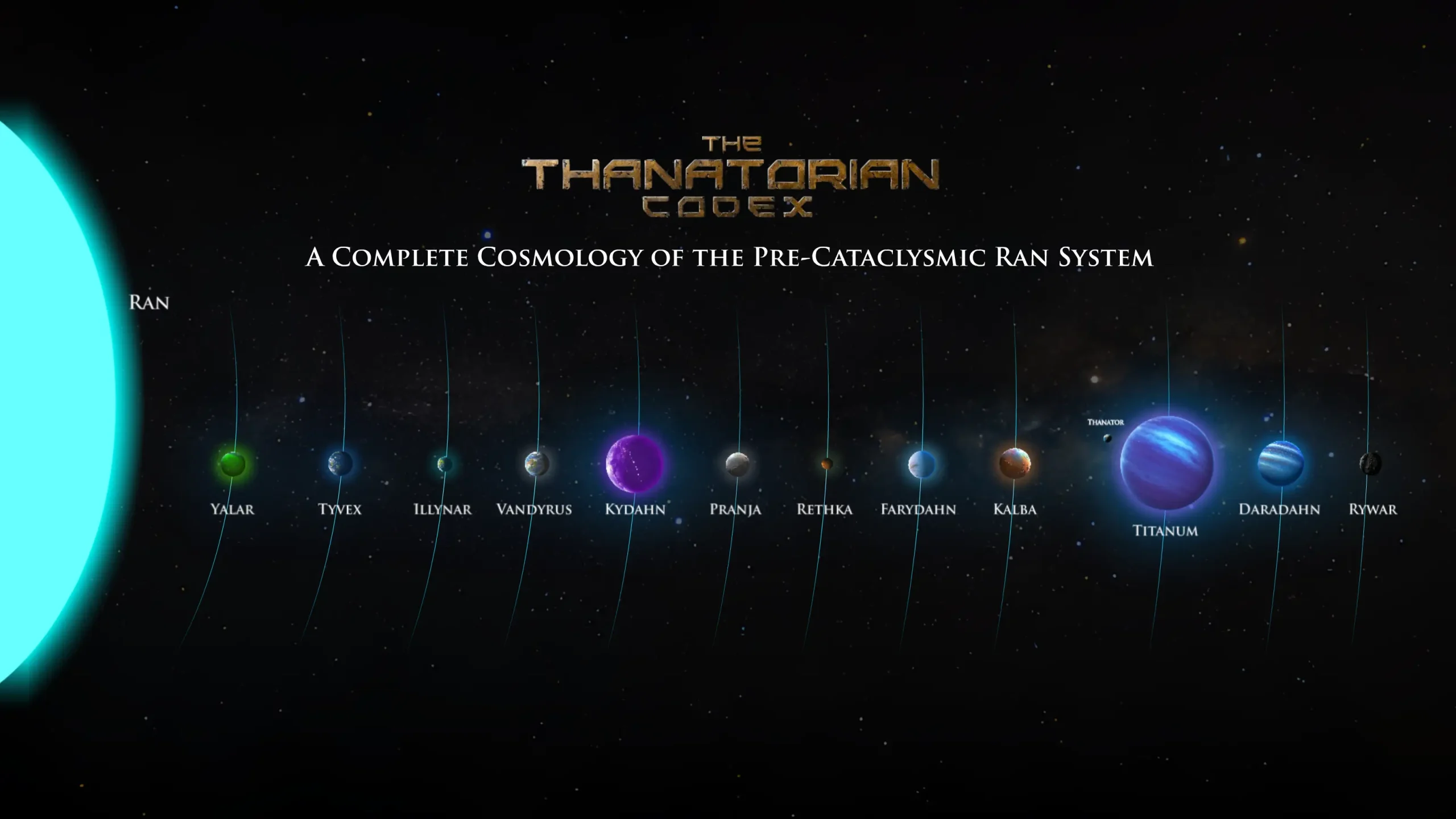
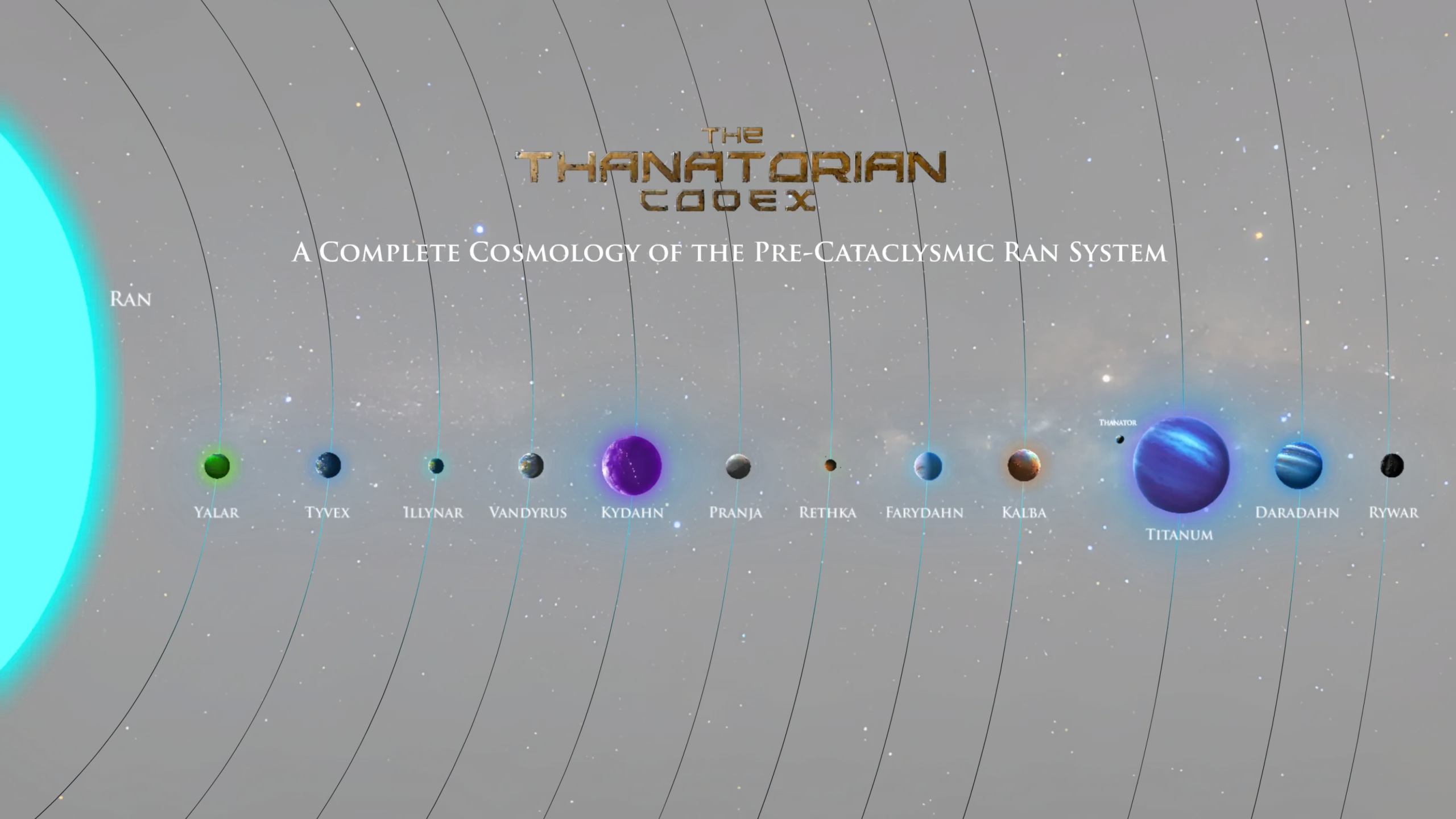
    This discovery forced a revision of system-wide chronology. The fleet’s arrival vector, reconstructed from residual navigation data, indicates that Thanator was not the primary origin world, but an initial staging and extraction point. Thanator appears to have served as a port of intake and processing—its position, gravity well, and material profile ideal for early industrial throughput. From there, the fleet advanced inward, establishing Rywar as the principal construction locus.


    It is now understood that all early civilization on Thanator and Kydahn traces its material ancestry to Rywar. Kydahn was built first, in an era so remote that even its own earliest ages register only as echoes. Thanator followed later, likely after Rywar’s primary construction cycle had stabilized and surplus capacity allowed for expansion. Thanator’s early role was not purely civic; evidence suggests it functioned intermittently as an extraction hub, logistics port, and transfer node during the fleet’s operational lifetime.


    The fleet’s final departure completes the picture. Having expended its primary construction mandate, it withdrew to eliminate its remaining liabilities—most critically, spent uranium fuel cells and other long-duration hazardous components. These were not left in orbit, nor buried within the biosphere, but carried outward and disposed of beyond the inhabited worlds. This act was neither mercy nor foresight in the moral sense, but compliance with a system constraint: contamination beyond tolerance thresholds would compromise the project.


    Rywar, then, is not merely a birthplace in the symbolic register of empire. It is the demonstrable mechanical womb from which the system’s civilizations were extruded. Thanator may claim the throne, and Kydahn may claim antiquity, but Rywar holds the origin that neither can deny. It is the place where machine logic first resolved into permanent habitation, where autonomous intent translated into living history, and where the line between preparation and civilization was irreversibly crossed.


    To know this is not to elevate Rywar above the others, but to fix its role with finality. Empires may rise elsewhere. Thrones may sit on other worlds. But the system’s beginning—its first committed act of construction—occurred here, in orbit and ocean alike, where the fleet finished its work, dismantled itself, and left the living to inherit what it had already decided was sufficient.
  • Politospermia

    Politospermia

    To speak of “foundations” in the history of empire is to court illusion. The self-congratulatory myth, repeated in a thousand civic temples and halls of remembrance, is that a world’s greatness is measured by its expansion, its conquests, or the calendar date inscribed upon its first banner. This is the cant of courtiers and conquerors, not of true chroniclers.

    The honest historian knows: the moment a civilization earns its place among the “great” is not in its outward reach, nor even in its mastery of self, but in its ability to name the hour of its own inception—the precise intersection of myth and machinery, when the veil of prehistory is pierced by the certainty of the autonomous fleet.


    The discovery of the autonomous fleet’s remains, or their encoded record, marks the difference between those who merely inherit power and those who comprehend their own genesis. For most worlds in the Vandyrian web, this is not a foregone achievement.

    The autonomous fleets—those tireless, pre-sapient architects of civilization—were not in the habit of leaving monuments to their own passing. Their work was to prepare, not to commemorate. On many worlds, the drones that shaped the land, seeded the air, and built the first cities or arcologies recycled themselves in the very act of creation. Their bodies became the substructure of the first habitable districts, their alloyed frames the pipes and pillars of the city’s underlayer. Generations later, the machines themselves would be remembered only as myths, their silence the first chapter in the local epic.


    In other cases, the autonomous fleet denied the future entirely. Should the equation of colonization fail—should the biosphere resist, or imperial directives be countermanded—the drones have been known to pilot themselves into the star, erasing all evidence, returning their composite mass to the origin of light and gravity. In yet rarer circumstances, the fleets depart of their own accord, leaving behind a world prepared but empty, awaiting the first step of the living. By the time the living Vandyrian populus claims its world, the machines are dust, rumor, or shadow—present only in the silent design of infrastructure, or the cryptic logic of the planetary grid.


    To uncover the “point of entry”—the physical or data-marked locus by which the autonomous fleet first breached the system—is, therefore, a triumph of civilization not easily won. Most never achieve it. The sum of empire is built on forgotten scaffolding, lost manuals, erasures rendered sacred by their very inaccessibility. The quest to locate this origin is not a mere archaeological ambition, but a long obsession, a generational campaign waged in archives, in subterranean dig sites, and in the decoding of signals half-absorbed by planetary crust.

    Only in rare cases have certain empires succeeded. And when they do, the event is not celebrated as simple fact, but as a moment of vertigo: to stand at the place where machine first met world is to see one’s civilization stripped of all flattering legend, rendered as a project, a sequence, a test imposed from outside and above.


    What does it mean to find such a place? The question is not academic. For the empires that achieve this feat, there is a before and after in their self-concept. No longer do they merely inherit the surface, the city, the stars—they possess the story of how world became world, how chaos yielded to system. In that knowledge lies both pride and dread. Pride, because only a handful of civilizations in all the Vandyrian ages have traced their genesis to its mechanical root; dread, because to do so is to admit the provisional nature of all empire. Every city, every law, every ritual of greatness is, in the final reckoning, an aftershock of the autonomous intrusion. All sovereignty is inherited. All glory is conditional.


    Only in these past centuries has the “civilizational entry point” of our own line been discovered. This is no mere local curiosity, but a fact that shifts the balance of myth and policy alike. The first trace of imperial purpose—be it a splinter of alloyed hull, a fossilized processor, or the deep-buried logs of an initial survey drone—is not simply a relic, but a mirror. It reflects the true face of history: not the smiling mask of heroes or thrones, but the cold, impersonal hand that shaped all that followed, and left the living to forget, until memory became mystery, and mystery became legend.

  • A Part of The Greater Empire

    A Part of The Greater Empire

    No single world in Ran was ever conceived as a sovereign anomaly. Each was raised, shaped, corrected, or broken according to something immeasurably older and vastly more complete than any local empire, dynasty, or planetary myth. These worlds were components, not centers—expressions of a greater civilizational architecture whose logic predates any one star, system, or epoch.

    The empires that arose within Ran did not emerge spontaneously, nor were they the product of linear cultural ascent. They were instantiations of a template: a repeatable, adaptable system of conquest, administration, extraction, and meaning-making that has been deployed across uncountable theaters of existence. This template is what later scholars would name the Vandyrian Systema—not a single empire, but an imperial grammar. Worlds differ in surface culture, biology, technology, and belief, yet beneath these variations the same structural bones recur with unsettling precision.

    Thanator was one such expression, no more exceptional than any other world that burned bright and fell hard within Ran. Its rise and collapse were not aberrations but expected outcomes within a system that treats planets as instruments rather than homes. The same is true of its sister worlds: each was calibrated to fulfill a role, endure a span, and then either be absorbed, diminished, or discarded as conditions demanded. Survival within the system was never proof of virtue, only of temporary utility.

    This is the deeper truth obscured by local histories and heroic chronologies. The Vandyrian Empires are not a lineage that can be traced cleanly from origin to end, but a civilizational machine that renews itself by repetition. It has crossed galaxies, nested itself within layered realities, and endured collapses that would have annihilated lesser structures. It does not remember worlds the way worlds remember themselves. It remembers only patterns that worked, and failures that instructed the next iteration.

    Thus, any world of the Ran system—Thanator included—must be read not as a tragedy in isolation, nor as a unique cautionary tale, but as a single verse in a composition written across deep time. To understand one world fully is to recognize how replaceable it always was, and how deliberately it was made so.

  • The Vandyrian Civilization

    The Vandyrian Civilization


    The Empire, The Thrones of High Thanator, in that 27th Imperial Age, no longer conceived of movement between worlds as conquest or aspiration; it had been rendered as habitual as the setting of the twin suns—a process subsumed into the cadence of governance itself. Interplanetary passage, so fabled in the mythologies of lesser epochs, was by then little more than a logistical inevitability, an extension of a state whose reach had exceeded the span of the old star charts and rendered the cosmos itself a terrain of the administrative mind. Each transit was a recitation of dominion, not discovery. Distance—once an adversary to be vanquished—became merely another measurement for the engineers of imperial intent to compress, transmute, or abolish.

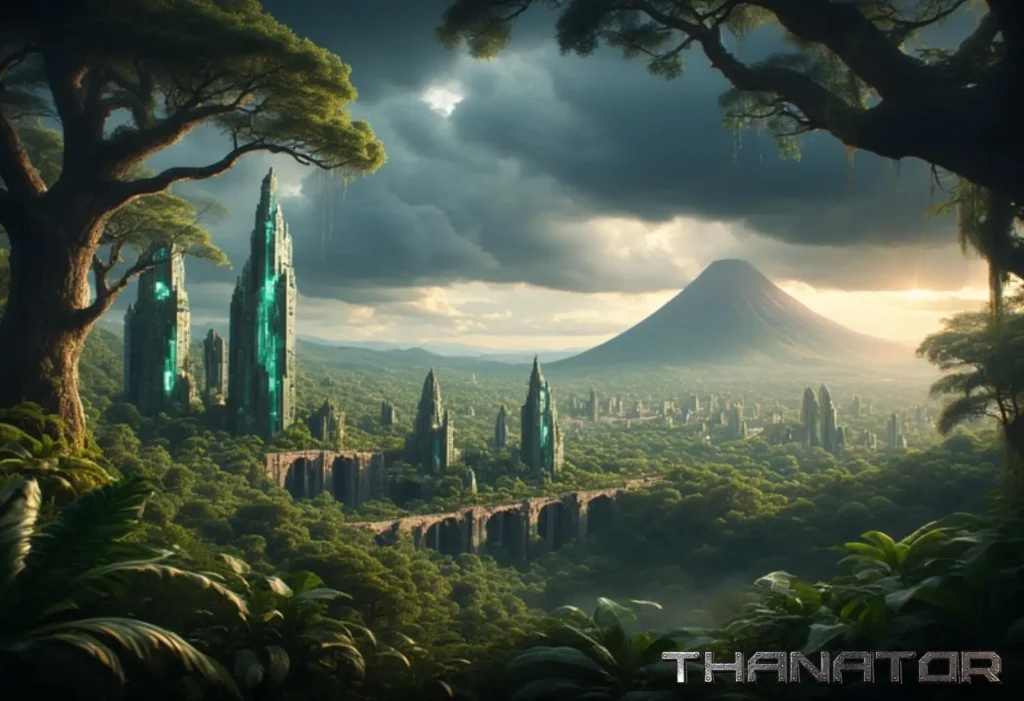
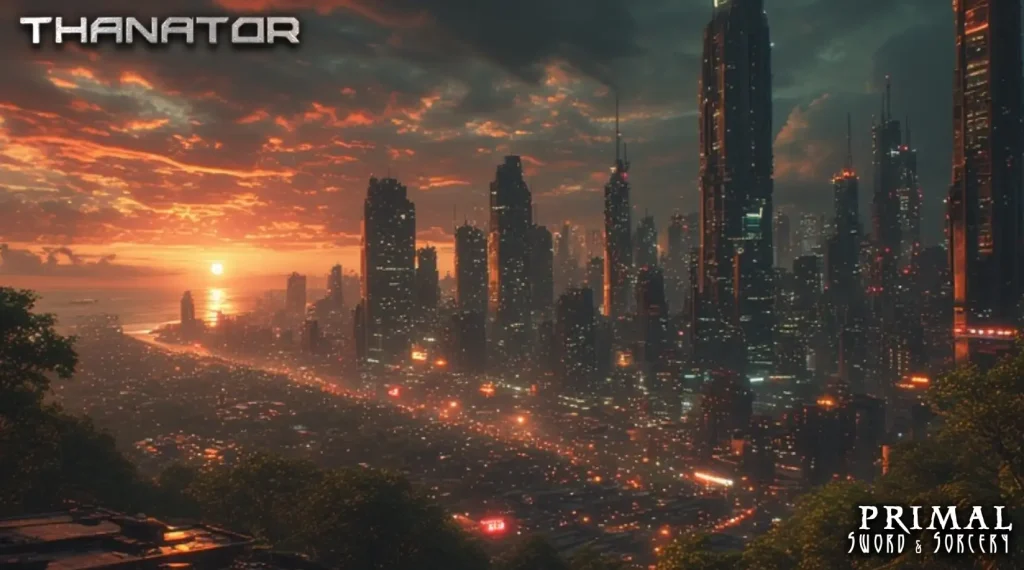
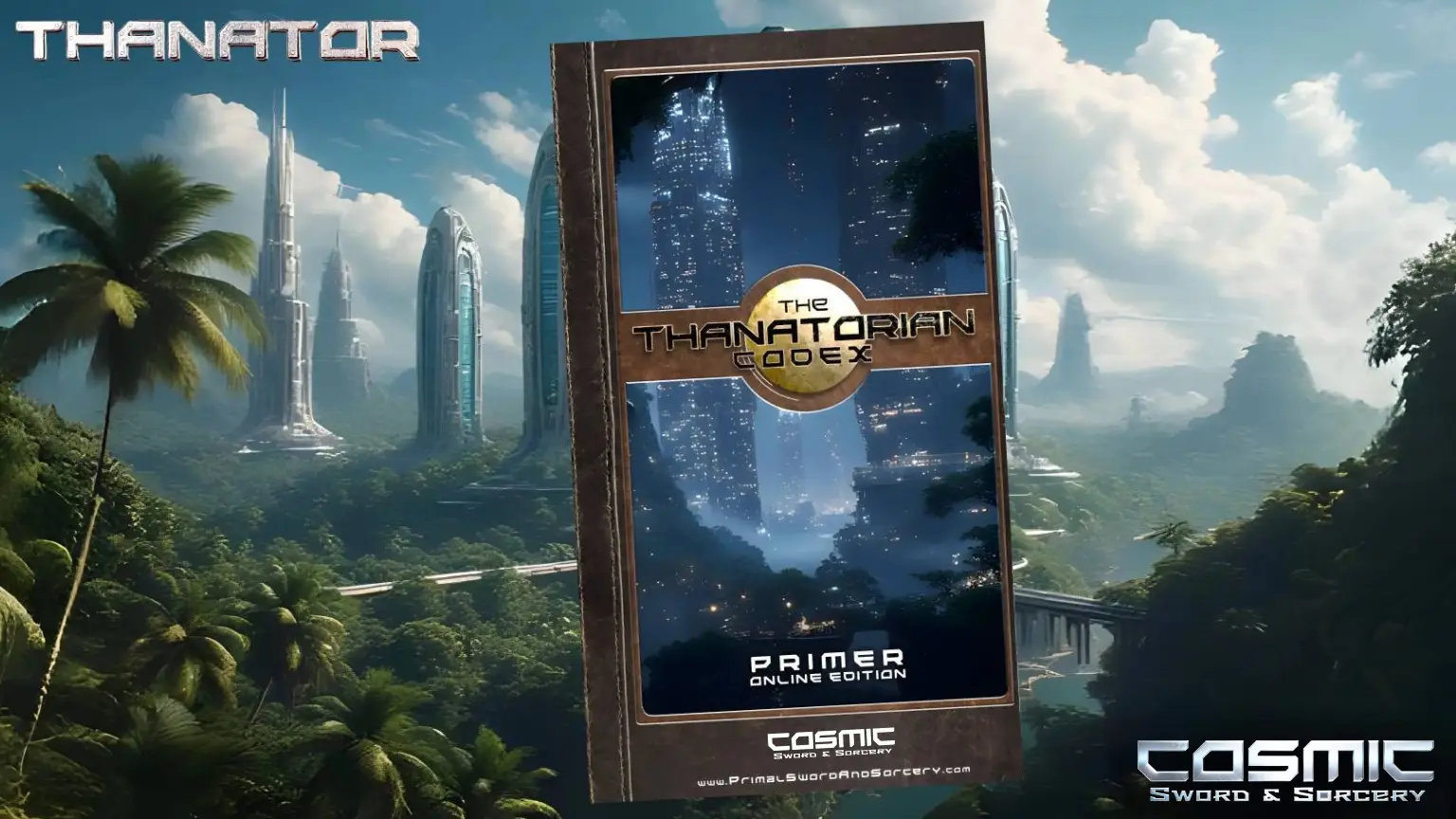
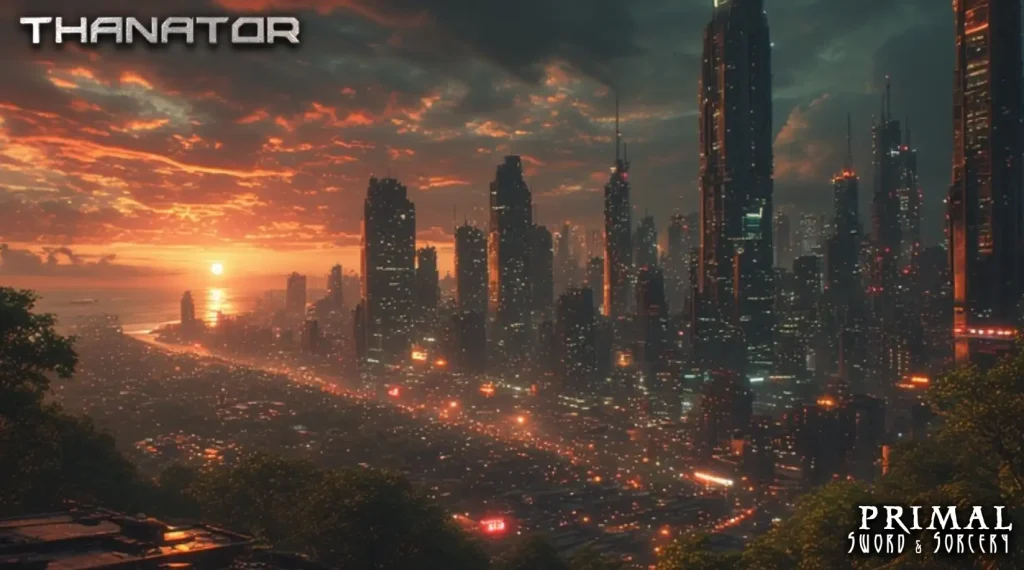
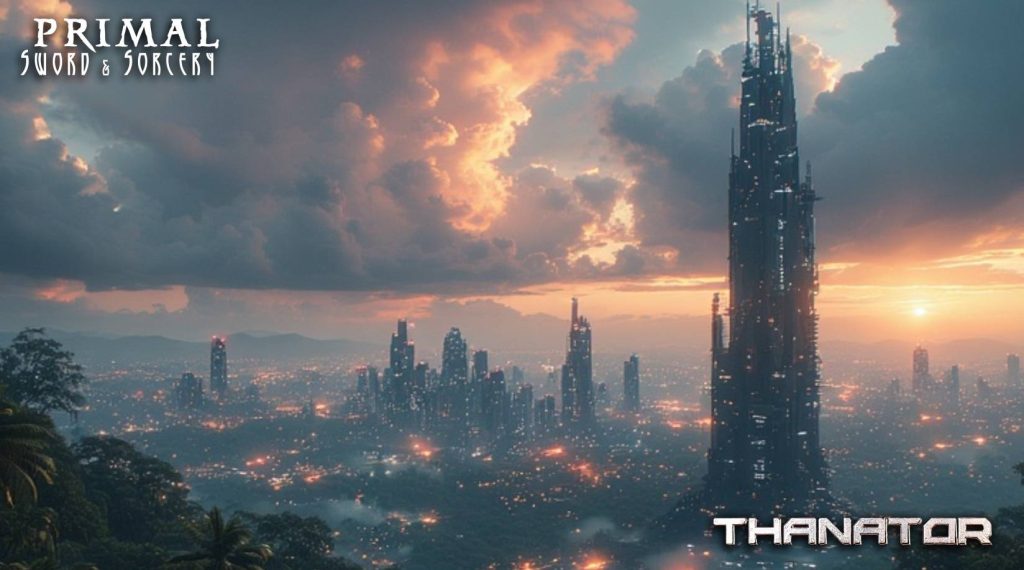
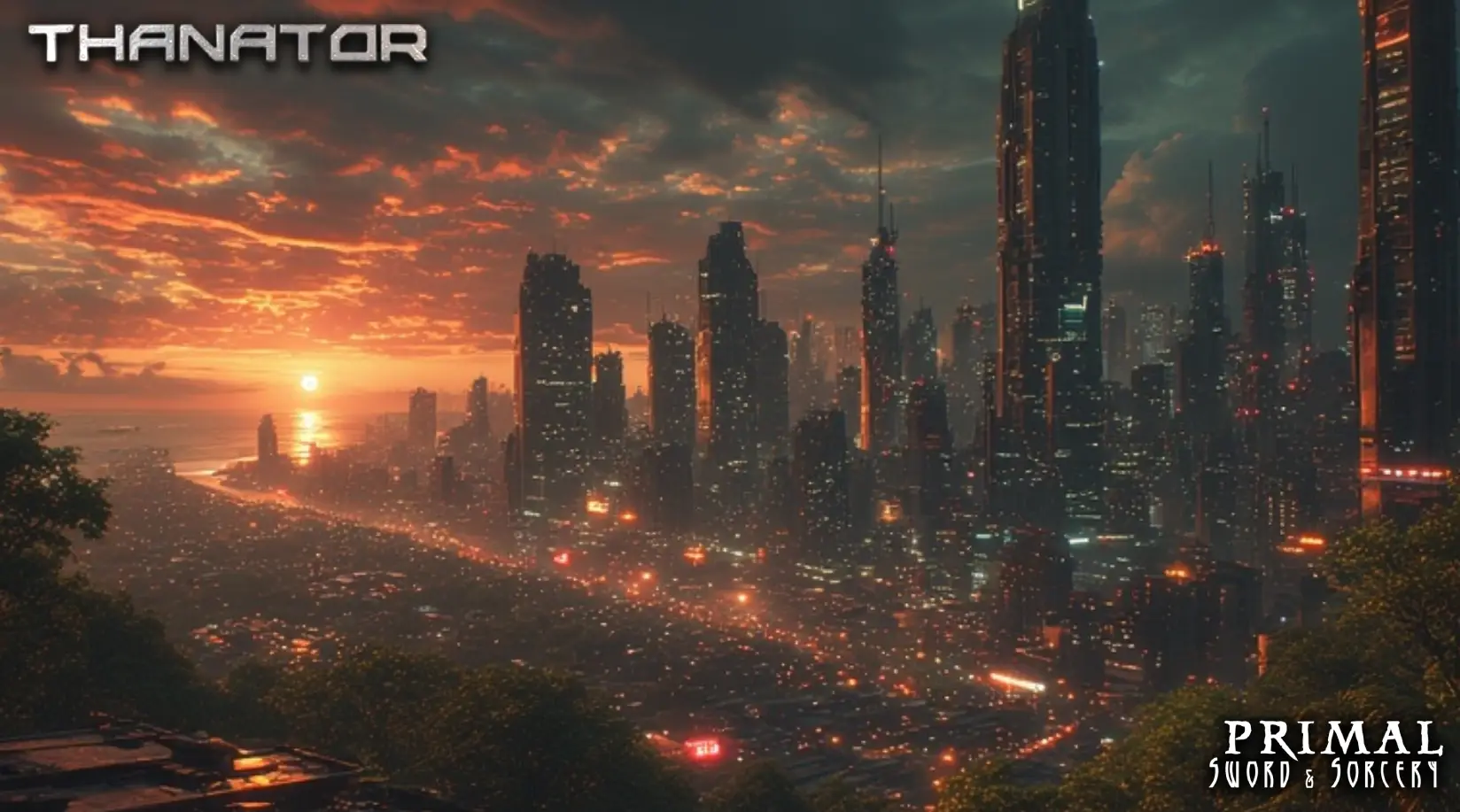
    The towers raised by Thanator’s hand rose not for spectacle, nor as declarations of pride, but as active instruments of world-reordering—an architecture of assertion so relentless that even the deepest jungles were not sanctuaries but substrates to be impaled, drained, and organized by the will of the Administrates. Their spires drove through canopy and cloud, broadcasting not simply technological prowess but the manifest certainty that organic chaos would, inevitably, yield to the geometry of command. These were not mere verticalities, but the bones of a new physics, altering airflow, diverting weather, reorienting the flora toward patterns of light and shadow determined not by chance, but by decree.


    Across the bent backs of continents, bridges of unbreakable alloy lashed the world’s broken lands together, their purpose not only to carry armies and commerce, but to render obsolete the very notion of separation. Thanatorian bridges were not the triumph of stone or steel over chasm and tide, but the death sentence of regional autonomy. Every crossing fused the land into a greater, indivisible organism, where the nerves of empire coursed—unimpeded, perpetual, as though the world itself had submitted to an invasive spinal graft. Oceans were not barriers but routes, and the craft that spanned them did so on wings of carved crystal, vessels so radiant and improbable that, to the uninitiated, they seemed divine. In reality, their grace was the byproduct of necessity: for the empire demanded speed, volume, and spectacle in a single vessel, and the resources of the imperial sun-furnaces permitted no lesser ambition. Where these ships passed, the sea was transformed, their wakes a signature not only of power but of a new kind of physics—surface tension giving way, old gods banished beneath the shadow of Thanator’s engineered wings.


    But even water’s dominion was parochial beside the Thanatorian void. Between stars, the empire’s ships moved with the serenity of inevitability, hulls laced with lightning harvested from annihilated storms and enslaved pulsars. Void and matter, light and dark, were their playthings: the void was no longer a threat or a mystery, but a negative space into which imperial architecture could be extruded, inhabited, and ruled. To cross the interstellar deeps was merely to extend the logic of empire across another axis; the physics of Thanator was not a study of what is, but an argument against the limitations of what had been.

    Central to this edifice of dominion was energy—the power of suns, harvested, enslaved, made to serve. The empire’s engineers, high among the Thrones and lower in their legions of acolytes, drew out the furies of the stellar heart and funneled them through conduits of logic and will. Suns were not worshipped, nor merely studied, but bent—forced into servitude to illuminate Thanator’s nights, to ignite the forges beneath her cities, to power the great drives that lifted her armies and traders alike into the ever-widening dark. The age of Thanator was not the age of miracles, but of thefts so colossal they became the new standard of possibility.

    Yet the greatest theft was of flesh itself. Where nature once dictated the limits of kin and beast, Thanator imposed her own vision—state-directed, explicit, refined with each passing generation. No form existed for its own sake; all were sculpted, edited, and enforced according to the imperial necessity. To be born within the empire was not to inherit a body, but to be issued a template: variable, provisional, correctable. Breeding, selection, even memory—none escaped the hand of state. The world itself, once a wilderness to be traversed, became a studio, the living shaped as unflinchingly as stone.


    Artifice replaced accident. The ancient dichotomy of flesh and will, of birth and ambition, was abolished—not by decree, but by process, system, and repetition. Where once it was said that desire outstripped the capacity of the body, the empire erased the boundary, made ambition itself a metric of fitness, and consigned the old boundaries to the realm of childish fable. The young, born to cities where the pulse of the administrative heart could be heard in the very walls, grew to adulthood never doubting that their bodies were meant to serve the mind’s command, and the mind to serve the empire’s.

    Benevolence, that antique virtue, found no purchase in the Thanatorian lexicon. Greatness was not a gift but a weapon, hammered sharp in the forges of perpetual contest. Gentleness was a luxury for the secure; for the empire, only force could secure tomorrow’s daylight. Every new age rose from the carcass of the previous, the empire’s appetite for conflict as endless as the night through which its ships prowled.

    Where the imperial hosts advanced, the world’s very matter was rewritten—geology twisted into fortification, river redirected to erase the memory of old borders, the bones of ancient forests crushed to make way for the rhythm of Thanatorian boots. The act of conquest was not a matter of lines drawn and surrendered, but of remaking the ground so utterly that the old geography became legend, the new reality inescapable.


    Opponents: Kydahn, Rethka, barbarous Jotun, and wild, most distant Vandyrus, are not remembered as peers, but as fuel for the empire’s combustion. Each was permitted to rise, not to threaten, but to provoke, to serve as a necessary crucible in which Thanator tested and refined her own potential. Their defeats were not mere victories, but structural improvements; their resistance, the whetstone against which imperial cunning and violence were honed to lethal brilliance.

    The empire’s armies were not uniform in kind or mode, but manifest in forms as various as the threats they faced. Legions wrought of living bronze, regiments of marrow and trained will—these were not affectations, but adaptive stratagems, each forged in answer to a unique challenge. Thanator’s hosts did not merely defeat the wild; they drowned it, subordinated it to a logic so patient and overwhelming that the wild’s own seasons, once a force beyond the reach of intention, became predictable, calculable, disposable.

    To rule, under the Thrones of Thanator, was to embrace ruthlessness as law: mercy not merely disfavored, but forbidden by the arithmetic of survival. To falter was not to err, but to forfeit—each failure recycled, each lost opportunity reabsorbed as a lesson, a resource, a mechanism for the elevation of the worthy at the expense of the weak. The engines of empire devoured the misstep as eagerly as they gloried in triumph.

    Within the echoing halls of Thanator, the names of conquered realms were not celebrated for their poetry, but recited for their utility. Each name was a variable added to the imperial calculus, each line a tally in the inventory of triumph and dominion. Sons and daughters were not simply citizens or slaves, but units of imperial mass, appended or subtracted as the wheels of power turned, as the cycles of succession ground onward. This was the pact of empire: that those who endured were not simply survivors, but claimants to the mantle of greatness—recipients of a legacy forged in the ruin of adversaries, in the detritus of dreams unfit for the world to come. Beneath the eternal scrutiny of the Administrates, amid the murmured calculations of the architects of fate, civilization itself was rendered an engine without horizon or respite. The forge never cooled, for the raw material of tomorrow was the conquest of today.


    The wisdom of the ages was not preserved in scroll or song, but fixed in infrastructure—in the sinew of cities whose every street encoded policy, in bridges whose spans defied entropy, in the shadows cast by departing ships, each voyage a data point, each trajectory a confirmation of Thanator’s growing mastery. History was written not with ink, but with power: with the controlled demolition of the old, with the ceremonial ignition of the new.

    This, finally, was their testament—not that they survived, for mere endurance is the birthright of the lesser. The empire’s boast was that it shaped the world, imposed order on the arbitrary, and, in the recursive process of that shaping, ascended to a power so total it rendered even the gods redundant. Thanator’s legacy was not the echo of existence, but the demonstration that existence itself could be commanded, crafted, and, at last, surpassed.


    High Thanator is Just The Beginning

    From here we enter The Age of Dread, followed by the present day, known to those trapped within as The Age of Terror.

    Also Available

  • Vol 1: Post-Cosmological Primer

    Vol 1: Post-Cosmological Primer


    A Part of The Greater Empire

    The Vandyrian Civilization


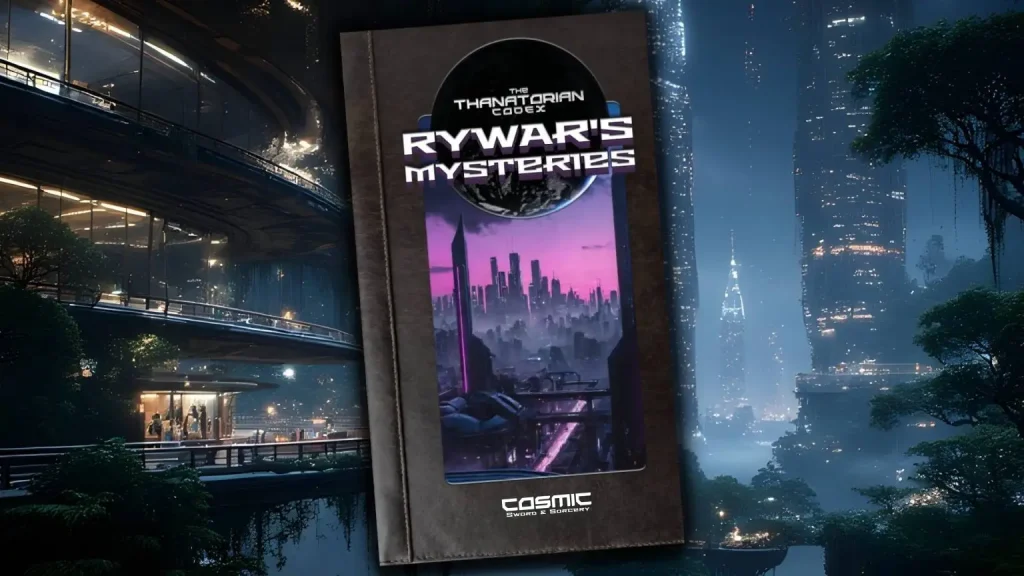
    Rywar’s Mysteries
    [Book]


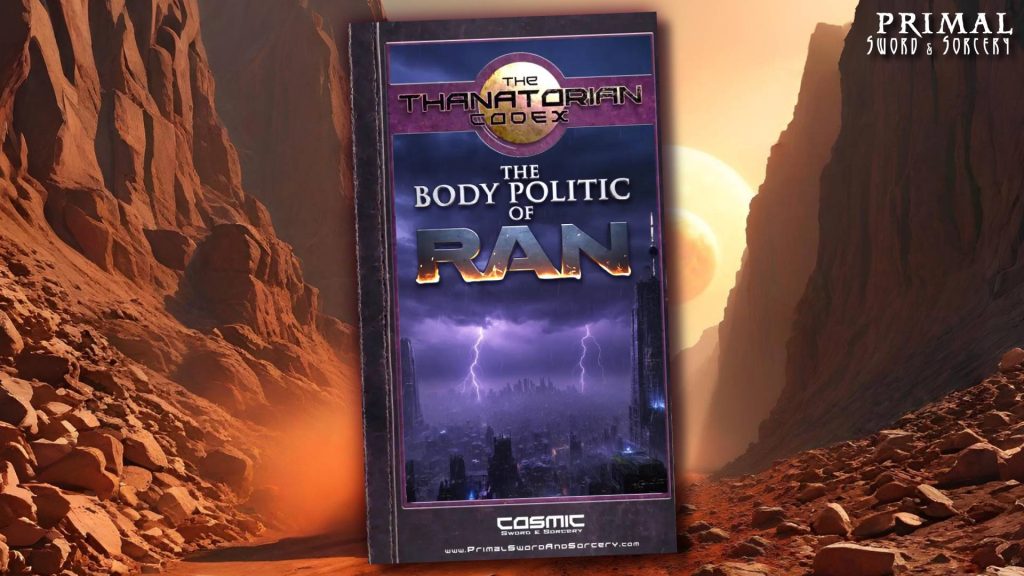
    The Body Politic of Ran
    [Archival Index]


    The Resource Vandaniums:

    • 1. Yalar
    • 2. Tyvex
    • 3. Illynar
    • 4. Vandyrus
      • 4a. Artana
      • 4b. Votah

    The Imperial Vandaxiums:

    • 5. Kydahn
      • 5a. Bryndi
      • 5b. Rowad
      • 5c. Urdyne
      • 5d. Jydica
      • 5e. Prytos
      • 5f. Yantara
    • 6. Pranja
    • 7. Rethka
    • 8. Farydahn
    • 9. Kalba
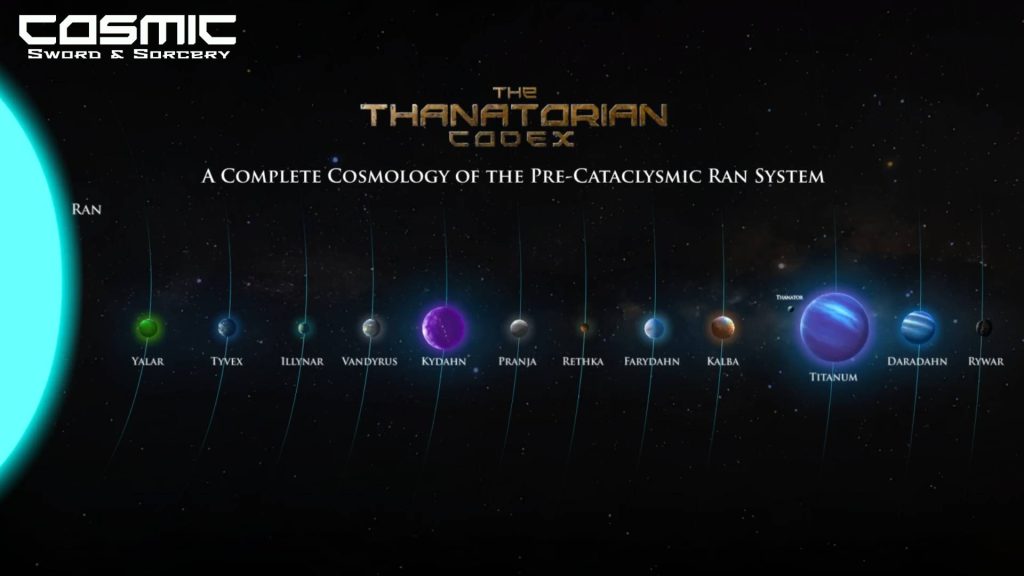
    • 10. Titanum
      • 10a. Thanator
      • 10b. Jotun
    • Daradahn
    • Rywar

    The Great Civilization

    The Guiding Hand of Empire

    The Children of Empire

    "Peace" In This Time

    The Grand Systema & Its Many Variants

    Stratagem


    Followed By

    Vol 1: The Post Civilization Age
    Vol 2: The Reign of Dread
    Vol 3: The Fall Into History
    Vol 4: Darkness of The Long Decline
    Vol 5: Coming of A Feral Age

    Vol 1: Dawn of the Age of Terror
    Vol 2: The Nightmare of Civilization
    Vol 3: Lost Empire
    Vol 4: Misty Tales & Lost Cycles
    Vol 5: The Jungle Moon of Terror

  • Panjar

    Panjar

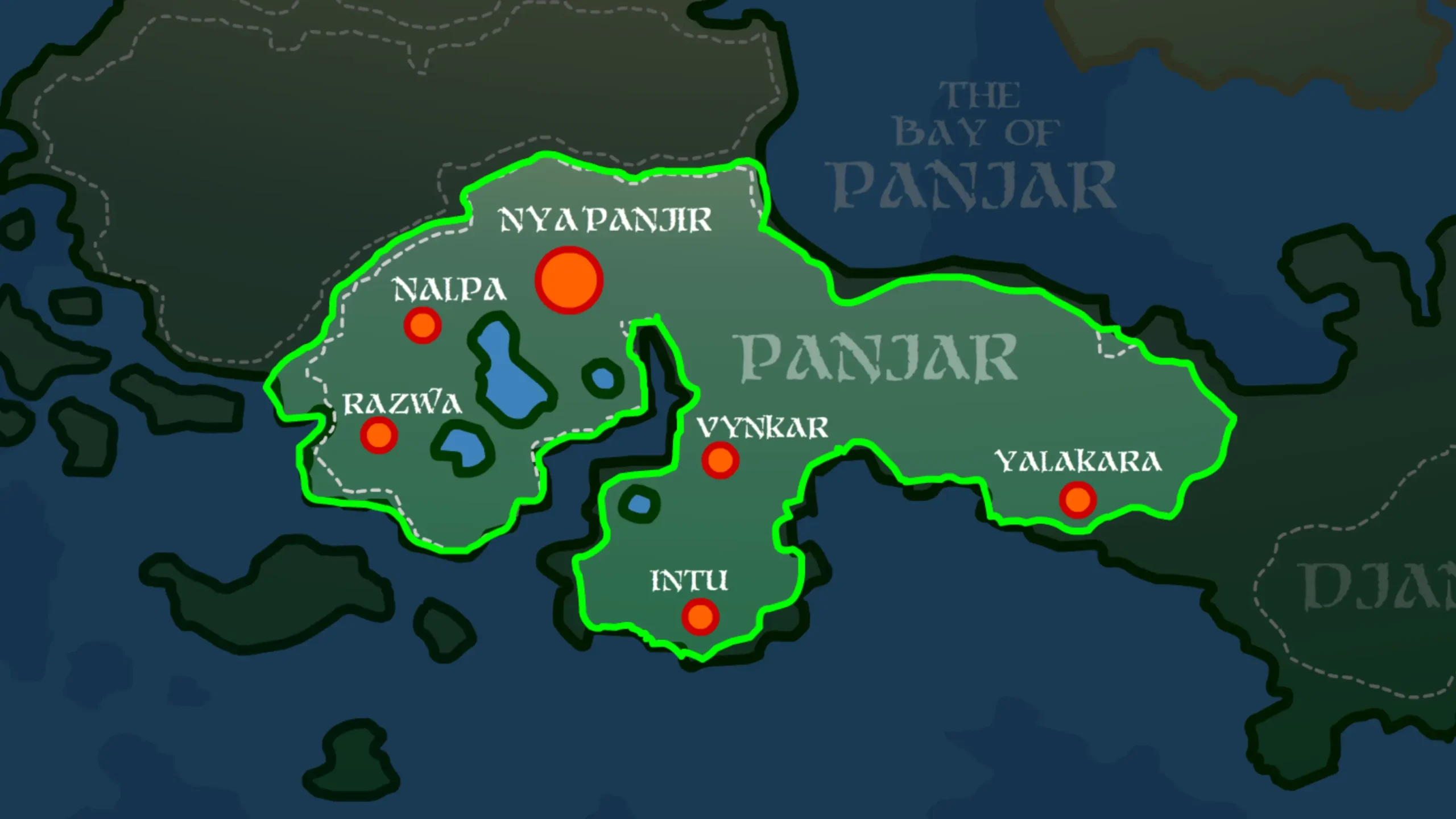
    Panjar rises in sharp ascent, its highlands standing shoulder to shoulder with Yir in height. The land is a labyrinth of forest and marsh, where bamboo thickets grow dense as walls and poison-forests writhe with venomous growth. Rivers swell into marshlands that drown the east in swamp.

    Its folk are no scattered tribes—they are one of Zhuru’s rare organized powers. Mongoose, jaguars, bears, and eagles dominate here, their claws and talons united against the serpents that infest their lands. The Panjari see themselves as born to strangle snakes, and their very culture is defined by this struggle: swift, merciless, unyielding.

    Panjar’s civilization is startlingly well-ordered. Timber flows from its forests, its navy patrols the seas that bear its name, and its armies march as disciplined hosts. The Panjari export wood, resin, and spices, but what they truly trade is fear: the knowledge that theirs is a people whose blades are sharp, whose walls are high, whose ships command the straits.

    Once, Panjar’s domain stretched further east, out into lands now claimed by the sea. From this wound comes their fierce naval tradition: they will not lose another inch of coast.

    Conflict is constant, but on their terms. Rich and defensive, they sharpen their blades against Bruwa’s lions to the west and against the shadow of Drael across the straits. In a continent of ruins, deserts, and scavenger states, Panjar is something rare: a land that has its house in order, and the will to keep it that way.


  • ATLAS: Elder Ruselon

  • ATLAS: Kartonga

  • ATLAS: Varduun

  • ATLAS: Bantos

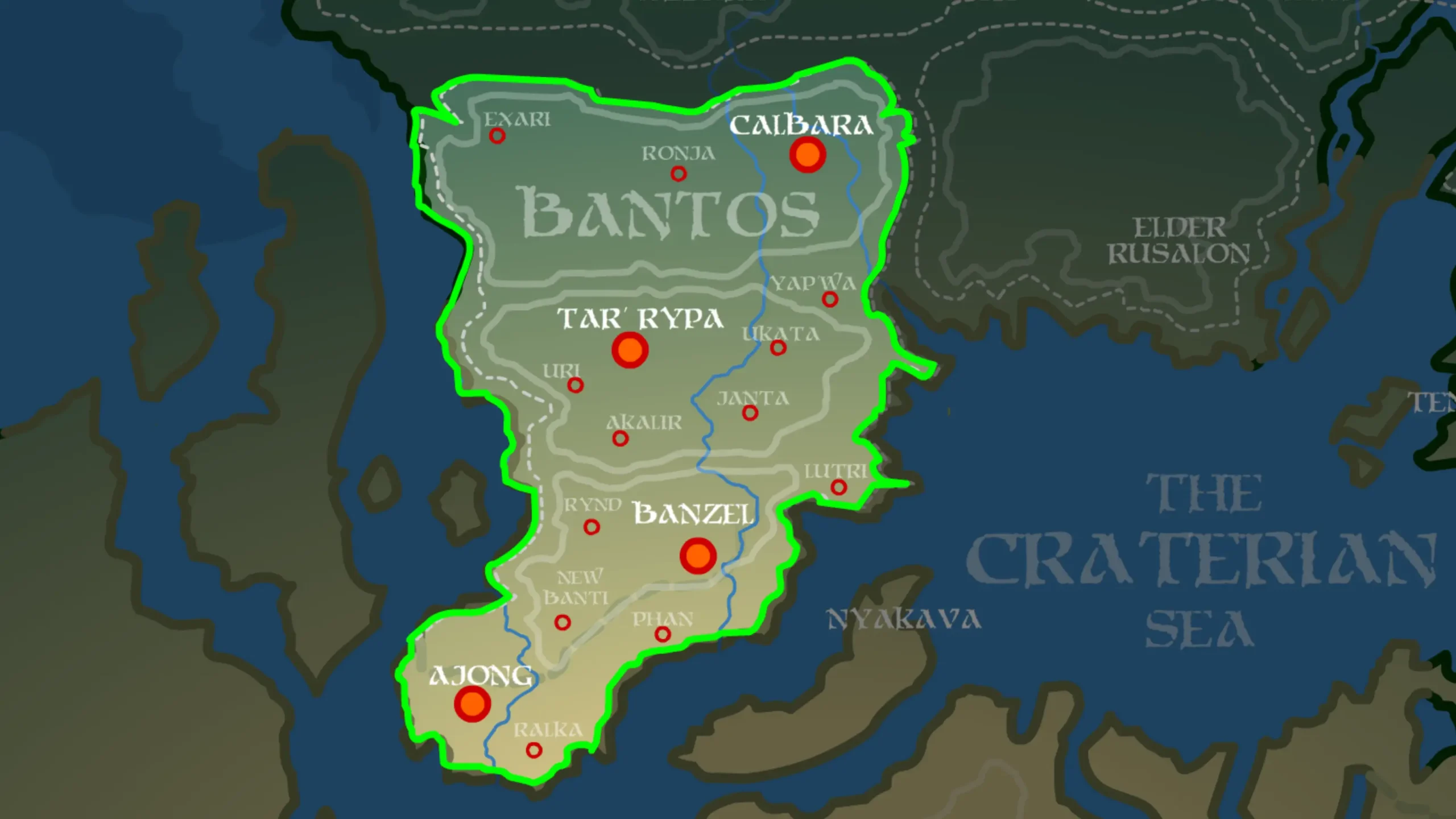
    ATLAS: Bantos