

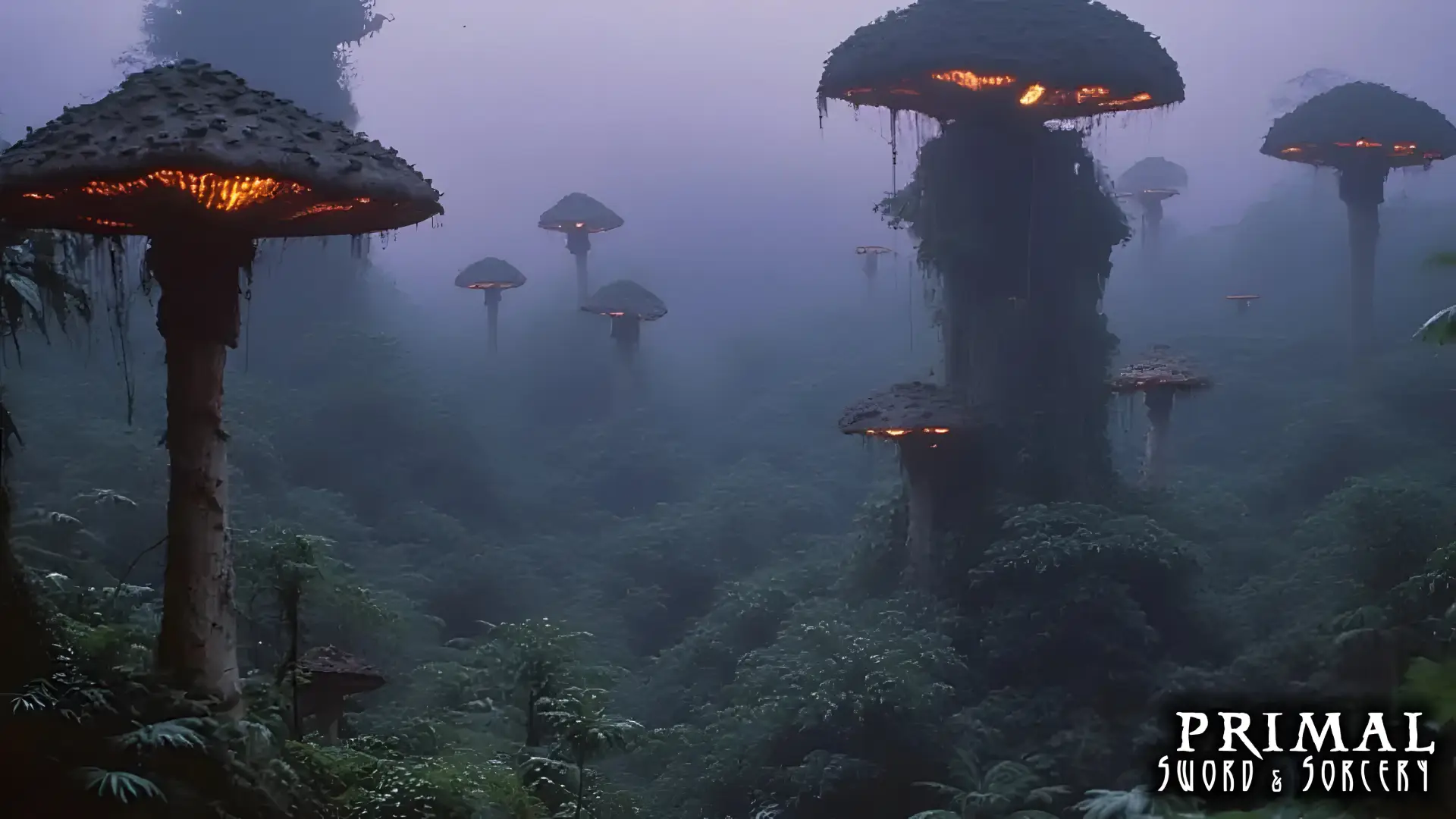
Gunran sprawls across the eastern rim of Zhuru, its boundaries less drawn by rivers or cliffs than by gradients of misery—when the biting flies give way to biting things, when the mud turns from black to bone-white, when the air grows thick with the stink of rot and alkali. This is not a green, life-affirming jungle; it’s a fever-dream of gnarled trees and choked undergrowth, where every step promises a new kind of suffering. Even the light here feels wrong—filtered through canopies of predatory vines, fractured by steam, infested with motes of insect wings and fungal spores. It’s the kind of land that refuses to be tamed or charted, a jungle-swamp labyrinth both lethal and lush, its perils as much ecological as social.
Only Gunrang City endures near the coast, a half-drowned relic perched at the edge of this mire. Once a tenuous refuge for exiles and the desperate, it survives more out of inertia than intent, its upper tiers lashed together atop rotting mangrove and fungus-choked foundation. Every season, another walkway collapses, another home is swallowed by the rising muck; the city’s lower levels are already lost to mold, biting insects, and the slow, relentless encroachment of the swamp. What remains of civilization there clings to the heights, even as the whole settlement sags, sinks, and rots, year by year, into the filth. Gunrang is no outpost of order, merely the last gasp of habitation before the jungle claims everything.
The region’s true natives are the red panda tribes—arboreal, cunning, ferociously territorial. These folk are not gentle tricksters; they are expert guerrillas, masters of ambush and sabotage, their villages strung high above the worst of the swamp’s dangers, woven into the upper boughs where even the largest predators struggle to follow. Their feuds are legendary, as much with one another as with outsiders, and every turn of the season is marked by new raids, arson, and the taking of captives as rivals clash and alliances shift in the shadows of the trees.
Travel in Gunran is a test of both will and wit. Roads are illusions; at best, they’re trails half-swallowed by the jungle, staked by lost traders, mercenary patrols, or the ruins of failed settlements. Raiders—often outcast mutts, desperate lion sons, or failed panda chiefs—prowl the margins, making alliances of convenience with whichever tribe holds the nearest high ground. It’s not uncommon for a caravan to pay toll to one warband at dawn and be bled dry by another by dusk.
The ruins are what remain of forgotten empires—stone causeways sinking into the mire, vine-draped temples that once channeled sacrifice and power, ziggurats now nesting grounds for spectral insects the size of a hound. Every expedition into the swamp uncovers something new—old gold, forbidden relics, or simply a quicker death. Disease is a certainty: fever, rash, rot, and worse. Swamp plagues that have no name outside Gunran, parasites that drive their hosts mad before devouring them, and fungal infections that bloom under the skin like white fire.