Category: The Vandyrian Codex: Book II: The Ancient Histories

  • III. Clan Rivalries & Commerce

    III. Clan Rivalries & Commerce

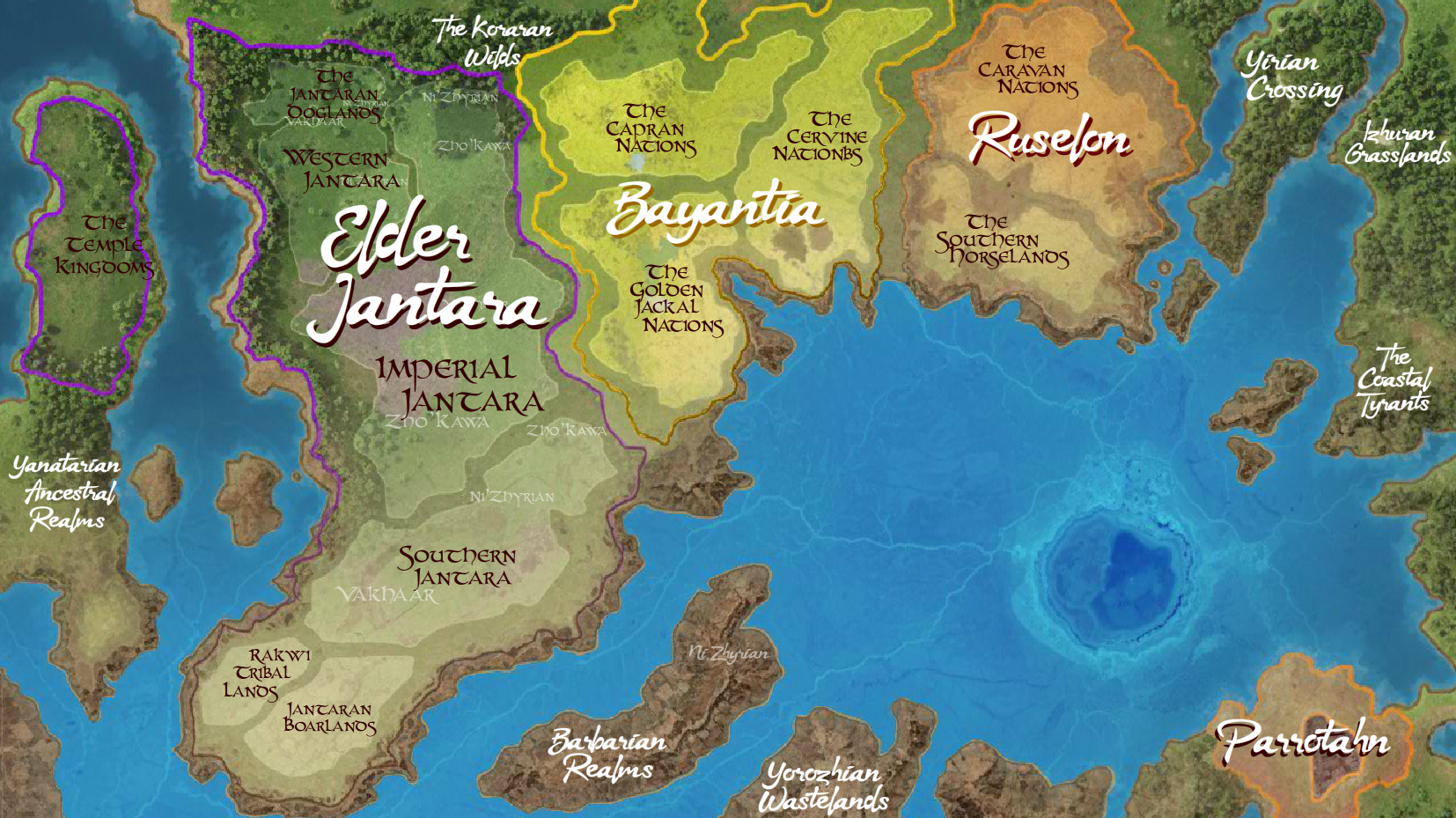
    Among the elder courts of the Jantaran Empire, territorial conflict was seldom conducted in the naked barbarism favored by frontier dynasts or famine kingdoms. Open war was considered costly, vulgar, and beneath the refinement expected of ancient imperial bloodlines whose authority rested as much upon continuity, spectacle, and social leverage as military capability. Rivalries instead manifested through prolonged campaigns of influence, inheritance manipulation, marital intrusion, commercial strangulation, courtly seduction, and ceremonial humiliation.

    Entire provinces changed hands not because banners were seized upon battlefields, but because the right lineage vanished beneath layers of engineered scandal, diluted succession, or deliberate social decay cultivated over generations. To lesser peoples this appeared theatrical, frivolous, or decadent. The Jantarans themselves understood it as warfare in its purest and most civilized form: conquest without the inconvenience of rubble. Entire regions could be conquered without a fortress ever falling. Among the high courts, influence itself became the battlefield, and the reshaping of dynasties became the preferred instrument of imperial expansion.

    Outsiders, particularly lesser border cultures lacking the sophistication to recognize these systems, often mocked such struggles as little more than theatrical vanity. “The warfare of matrons,” some sneered, imagining perfumed chambers full of idle intrigue detached from the machinery of state. Such assumptions were fatal. Jantaran political conflict operated through lineage placement, arranged companionship, ceremonial dependency, trade leverage, fertility manipulation, and the slow redirection of succession itself. These campaigns unfolded over decades, sometimes centuries, with patient precision impossible among younger civilizations still addicted to crude violence. A house destroyed by war might recover within generations. A bloodline rewritten from within was erased forever.

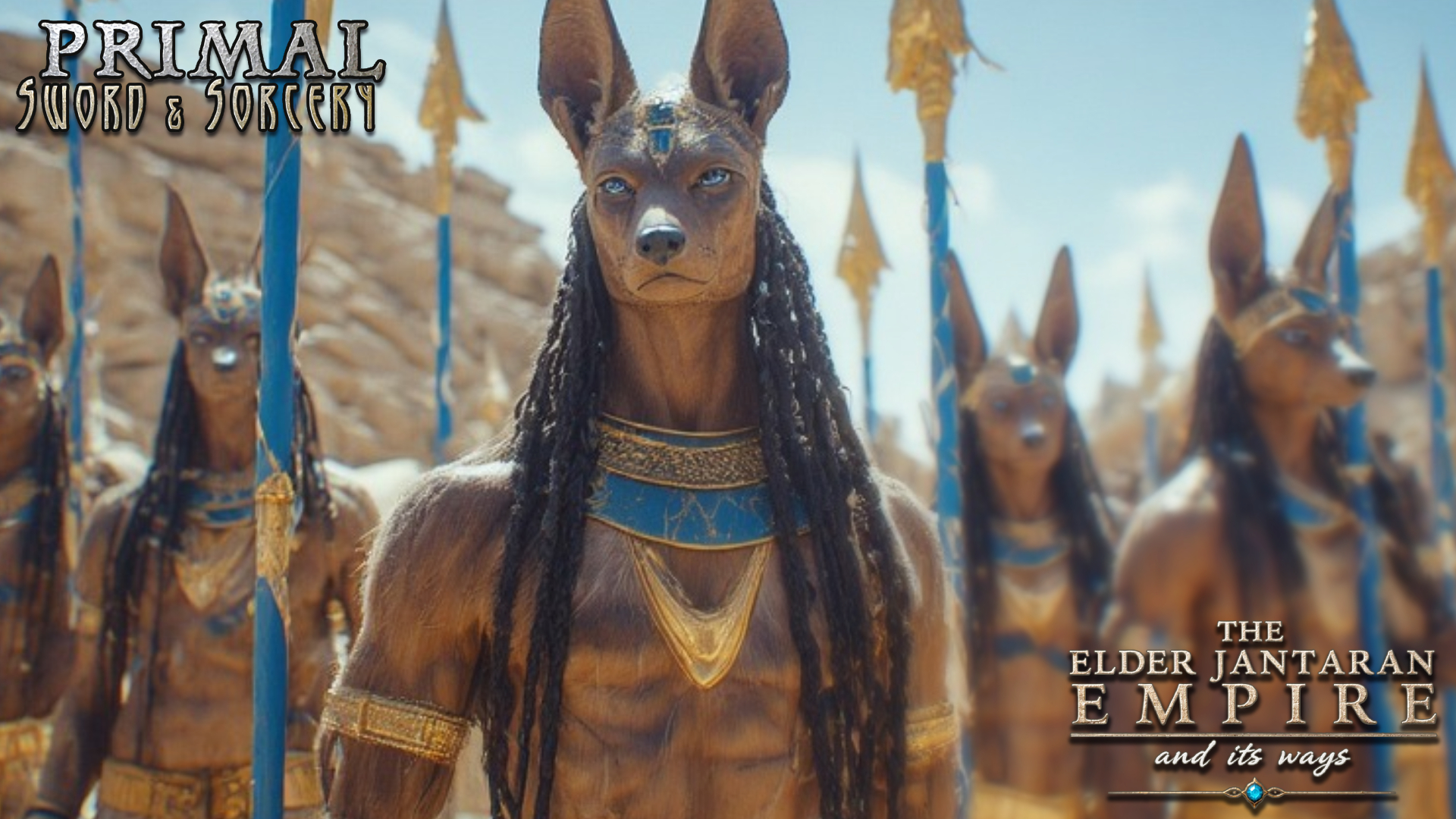
    The courts of Jantara became infamous for this invisible predation. A northern jackal duke might discover his halls increasingly occupied by soft-voiced eastern companions whose purpose extended far beyond pleasure. Merchant daughters, favored attendants, singers, scholars, and concubines arrived beneath banners of diplomacy or commerce while carrying the ambitions of entire dynasties behind painted smiles and warm silk. The thick seed of a rival lineage spilled quietly into noble chambers could alter inheritance chains more effectively than assassination ever could. Within a handful of generations, ancestral houses found themselves diluted, redirected, indebted, or entirely replaced while still believing themselves sovereign.

    Though practiced most ruthlessly among the imperial courts, the competitive guile and nature of Elder Jantara’s ruling elite and their instinct flowed downward through every layer of Jantaran society. Even among lesser trade districts and caravan quarters, ambition rarely confined itself to coin alone. Humble merchants, dock factors, caravan masters, spice brokers, and inn-bound guild families all pursued advancement through the quiet acquisition of influence, companionship, fertility, and bloodline attachment. Beneath lantern glow and perfumed low-light halls, entire family lines were subtly redirected by the eager appetites of caravan lords whose wealth traveled farther than law or banner. Daughters were wed upward, heirs quietly fostered abroad, household names absorbed into more prosperous lineages, and provincial customs replaced generation by generation beneath the velvet disguise of opportunity and desire. In this manner, even the common arteries of Jantara became theaters of dynastic competition, where lust, status, and commerce intertwined so completely that many bloodlines vanished without ever realizing they had been conquered.

    Trade itself became a weapon equal to bloodline infiltration. The eastern merchant courts mastered the art of dependency with terrifying elegance. Grain routes shifted. Luxury imports vanished. Debt contracts tightened around provincial rulers already softened by excess and prestige competition. The wealthiest houses learned to cultivate appetites before exploiting them. A rival noble weakened by vanity or indulgence often awakened too late to realize his retainers answered to foreign creditors, his heirs carried divided loyalties, and his household economy depended entirely upon outside interests. By the time open hostility emerged, the true conquest had usually concluded years earlier in private chambers and banquet courts.

    The consequences of these subtle wars shaped the entirety of later Jantaran history. Whole dynasties disappeared not beneath siege engines, but beneath seduction, inheritance displacement, and carefully cultivated dependence.

    Provinces changed character so gradually that many populations scarcely realized they had been conquered at all until their customs, rulers, and bloodlines no longer resembled those of their ancestors. Thus the elder empire developed its enduring reputation: not as a civilization of loud conquerors, but as one of patient devourers, where power entered through the bedchamber, the contract table, and the cradle long before it ever arrived with soldiers at the gate.
  • II. The Empire of Old

    II. The Empire of Old

    A second error, nearly as common as the first, is the tendency to reduce Elder Jantara to a caricature.

    Modern observers, accustomed to the blunt simplicity of frontier kingdoms and the tribal romanticism favored by popular histories, often imagine the empire as little more than an unusually successful collection of desert clans. Such thinking reveals more about the observer than the civilization being observed. Elder Jantara maintained itself across roughly two millennia.

    No society survives for such a span through luck, intimidation, or martial enthusiasm alone. Longevity of that scale demands administration. It demands social structures capable of surviving weak rulers. It demands institutions that function independently of individual personalities. Above all, it demands a population willing to participate in a shared system because they derive tangible benefit from its continuation.

    The reader will therefore encounter throughout this volume a bewildering array of castes, mercantile orders, ritual obligations, inheritance traditions, companion classes, merchant-philosophers, civic fraternities, regional identities, bloodline privileges, legal distinctions, ceremonial ranks, and social contracts. This complexity is not evidence of decadence. It is evidence of sophistication. Elder Jantara did not endure despite these systems; it endured because of them. The empire’s customs were not ornamental curiosities draped upon an otherwise primitive society.

    They were the machinery itself. What many modern commentators dismiss as eccentricity was often a carefully evolved solution to problems of governance, commerce, social stability, and regional integration developed over centuries.
    Perhaps most importantly, the reader must abandon the persistent fantasy that Elder Jantara was fundamentally a civilization of raiders. Raiders do not construct continental trade networks.

    Raiders do not establish commercial standards recognized by neighboring kingdoms. Raiders do not produce legal traditions respected beyond their own borders, nor do they create institutions whose reputation survives centuries after their disappearance. The archaeological evidence paints a remarkably consistent picture: goods moved more frequently than armies, contracts carried greater weight than threats, and influence was measured through dependency rather than destruction.

    The later jackal kingdoms would embrace plunder and slavery with almost embarrassing enthusiasm, but to project those habits backward onto Elder Jantara is historical malpractice. It is akin to mistaking a collapsed temple for the civilization that built it.

    Indeed, one of the great ironies confronting any serious student of Jantaran history is that many of the empire’s descendants spent centuries destroying the very qualities that had once made their ancestors powerful.

    • They inherited symbols of authority while abandoning the disciplines that created authority.
    • They remembered domination and forgot competence.
    • They remembered prestige and forgot responsibility.
    • They remembered that Elder Jantara had stood above its neighbors, but gradually lost all understanding of how and why that position had been achieved.

    In this respect, the empire’s imitators became the single greatest source of confusion surrounding its legacy, leaving modern scholars to sift through layers of self-serving mythology in search of the civilization that existed before the masquerade began.

  • I. Introduction

    I. Introduction

    There exists among modern historians a particularly stubborn falsehood: the belief that all things bearing the name Jantara belonged to a single continuous civilization. The persistence of this misconception has done more damage to our understanding of the ancient world than perhaps any other scholarly error presently in circulation.

    Every generation seems determined to repeat it. Every generation inherits the same romantic nonsense from the last. The raider-kings, slavers, desert tyrants, and self-proclaimed heirs of later centuries wrapped themselves in Jantaran titles, adorned themselves with stolen symbols, and recited fragments of traditions they scarcely understood. In doing so they succeeded in convincing much of the world that they represented a continuation of Elder Jantara.

    They did not.


    The civilization examined within this volume was not merely another jackal kingdom among many. It was the only true empire the jackal peoples ever produced upon Vandyrus. Its roads endured for centuries. Its trade networks crossed entire regions. Its contracts remained binding long after the deaths of those who signed them. Neighboring cultures measured distance by its caravan routes and measured trust by its standards of oathcraft. What followed its decline were not successor states in any meaningful sense, but scavengers inheriting the bones of a giant.

    The Later Union, Old Jantara, and the countless petty dynasties that claimed imperial descent preserved names, titles, heraldry, and fragments of ritual while steadily abandoning the disciplines and institutions that had made the original civilization remarkable.
    The archaeological record leaves little room for ambiguity. The deeper one digs beneath the accumulated debris of later centuries, the more obvious the distinction becomes. Elder Jantara traded where its imitators raided.

    It cultivated dependence through commerce rather than chains. Its influence expanded through reputation, negotiation, and economic leverage rather than through the crude predations that later regimes mistook for strength. Time and again excavated records reveal the same pattern: sophisticated administration buried beneath layers of barbarism masquerading as inheritance. The descendants remembered the ceremonies while forgetting the purpose behind them. They preserved the masks and discarded the philosophy.

    I make no effort within these pages to conceal my contempt for those later claimants.

    • They inherited monuments they could not build, institutions they could not maintain, and reputations they did not earn.
    • Their chroniclers filled libraries with fantasies of continuity while the evidence beneath their feet contradicted them at every turn.
    • They were grave robbers wearing imperial jewelry.
    • Their banners borrowed authority from ancestors whose accomplishments they neither matched nor comprehended.

    If this assessment appears harsh, I invite the reader to spend a decade cataloging ruined caravan archives, deciphering fractured trade ledgers, and excavating the foundations of cities older than any surviving kingdom. The facts become difficult to ignore.

    This volume therefore concerns itself with Elder Jantara alone: the civilization that actually existed behind the legends. Not the decadent husks that followed. Not the slaver principalities. Not the desert tyrants who proclaimed themselves heirs while reducing imperial memory to costume and theater.

    Those regimes belong to their own histories and deserve whatever judgments posterity assigns them. Here, our concern is the empire itself—the first, the greatest, and the last of its kind.

    No other Jantaran polity ever truly achieved empire. The evidence is overwhelming.

    Let the pretenders keep their borrowed titles.

    Glory to the Empire.

    Click Here The Latest Entries
  • The Second Coming of Thanator

    The Second Coming of Thanator

    The Second Coming of Thanator refers not to a return of dominion, but to the final, catastrophic failure of it, and it cannot be understood without first acknowledging the nature of Vandyrus under Thanatorian rule.

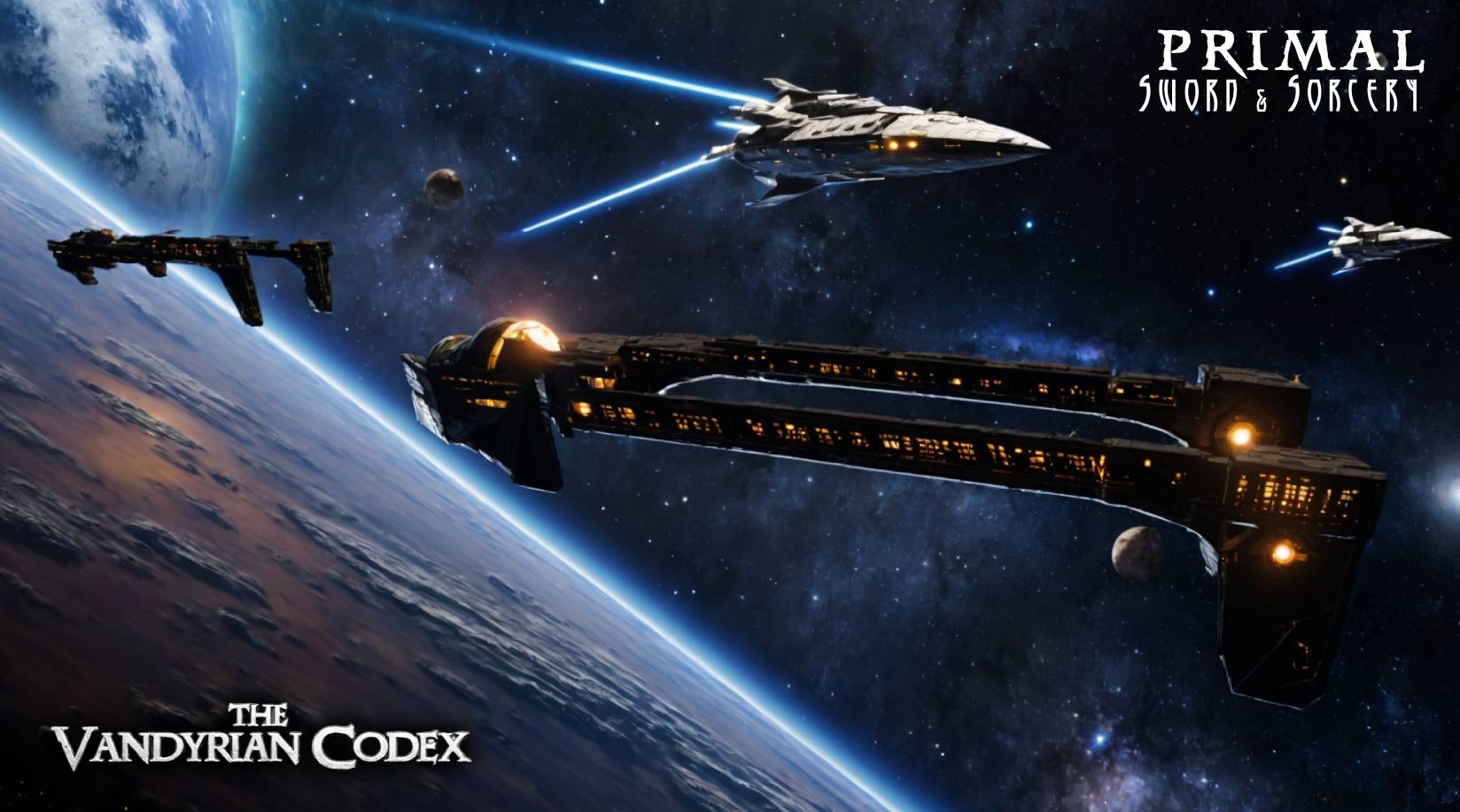
    Prior to the Cataclysm, Vandyrus was not a frontier world, nor a contested prize. It was a held asset. For many generations it existed within the Thanatorian system as a planet of extraction—its land mined, its populations harvested, its cultures bent into ritualized compliance rather than overt military occupation. Vandyrus was never conquered in the classical sense because it never resisted. When the sky split and the Thanatorian fleets descended, bearing colossal arrays of light, engines vast enough to bruise the heavens themselves, the peoples of Vandyrus made the only rational decision available to them. They submitted. No war was fought, no cities burned in conquest, because none were required. The threat alone was sufficient.

    What made Vandyrus anomalous within the Thanatorian portfolio was its scale. Resource worlds were common; worlds of this size were not. Ordinarily, extraction on the imperial periphery took place on dead rock—airless planets, hollowed moons, asteroid remnants stripped until nothing remained but slag and orbiting debris. A living world, with atmosphere, ecosystems, and an enduring biosphere, was an extravagance unless the resource being extracted justified it. Thanator does not waste effort without cause. The size of Vandyrus, coupled with the secrecy surrounding its yields, made it an object of unusual internal attention. Records speak obliquely of layered clearances, compartmentalized fleets, and ritualized disinformation campaigns designed not merely to obscure the planet from rival powers, but to conceal its true value from Thanator’s own administrative strata.

    Control of the population was achieved not through constant force, but through structure. Indigenous belief systems were redirected, hierarchies were codified, and ritual authority was elevated until obedience became cosmological rather than political. Espionage was constant. Manipulation was systemic. Abuse was frequent. This was Thanator at its most efficient and, as always, at its most arrogant. Pressure increased year by year, quotas rose, exemptions vanished, and the familiar pattern began to form—the slow tightening that always preceded revolt.

    That revolt never came.

    Long before the Cataclysm, and before any organized resistance could coalesce, Thanator withdrew. No declaration survives. No justification is recorded. The fleets simply departed, the administrative lattice collapsed, and Vandyrus was abandoned to the vacuum left behind. Whatever decision prompted this withdrawal was either erased from the record or never committed to it. What remains is absence, and absence on this scale is never benign.

    Into that vacuum stepped local powers: war-sorcerers, cult hierarchs, petty tyrants, and would-be gods, each attempting to seize fragments of the authority Thanator had discarded. None endured. The Cataclysm erased them as thoroughly as it erased the old world itself, leaving Vandyrus shattered but unclaimed.

    After the Cataclysm, Thanator attempted to return.

    The First Dread Thanatorian War was not a war in any meaningful sense. It was a scramble. Rival Thanatorian commanders, sensing an opportunity to reclaim a lost world and return bearing singular glory, turned on one another before planetary control could even be established. Betrayal unfolded at fleet scale. Orders conflicted. Alliances shattered mid-orbit. The result was total failure. Capital vessels were destroyed by their own escorts, surviving ships were captured rather than reinforced, and their crews were taken alive. Those who were not killed outright were tortured, studied, and erased. The expedition ended not in defeat by Vandyrus, but in self-annihilation.

    The Second Dread Thanatorian War lasted hours.

    A single surviving mega-cruiser made planetfall, attempting a direct assertion of dominance through orbital terror. It never achieved orbit again. Vulsan sorcerers, already ascendant in the post-Cataclysm world, dragged the vessel from the sky itself. The ship was broken, its crew hauled alive to ritual sites, and there subjected to execution rites of extraordinary brutality. Still-beating hearts were torn from living chests with onyx blades, lifted to the heavens, and consumed by shamans in acts meant to absorb strength, wisdom, and enemy essence.

    What none of them understood—what no record suggests they could have understood—was that in devouring Thanatorian flesh, they devoured more than organs. They consumed nanites. They ingested microscopic machinery designed to regulate blood, repair tissue, cleanse toxins, and preserve life far beyond natural limits. These systems were never meant to enter another biological context, let alone be metabolized through ritual cannibalism. Yet they were.

    In doing so, the Vulsans ate machines as gods.

    This event marks a visible inflection point in Vulsan power. Already formidable conjurers, necromancers, and elemental manipulators, their sorcery thereafter exhibited traits of precision, endurance, and scale previously unknown. Their magic became more direct, more kinetic, less symbolic. Where once ritual strained against physical limits, it now seemed to ignore them. The boundary between spellcraft and mechanism blurred, though none living at the time possessed the language to describe it as such.

    History records the outcome without embellishment: at least once, sword and sorcery reached into the heavens and dragged a star-born vessel screaming down upon Vandyrus.

    Thanator never returned after that. Whether through fear, calculation, or wounds too deep to risk reopening, the empire withdrew its gaze from Vandyrus entirely. The Second Coming did not restore imperial rule. It ended it, decisively, and in doing so ensured that Vandyrus would never again be treated as a silent asset.

  • The Vandyrian Collapse

    The Vandyrian Collapse

    The survival of Vandyrus after the Cataclysm was not an accident of fortune, but the consequence of neglect. Where other worlds in the Ran system had grown dependent on centralized power, layered infrastructure, and the brittle assurances of imperial logistics, Vandyrus remained functionally primitive by comparison. Its civilizations—kept deliberately stunted through oppression, misrule, or internal fracture—possessed no spacefaring capacity, little electrical infrastructure, and in many regions not even the reliable distribution of water. By the standards of Thanator’s throne, Vandyrus was a resource backwater: underdeveloped, ignored, and considered expendable. That very condition insulated it from total collapse.

    When the Cataclysm tore the system apart, Vandyrus lost cities, coastlines, and entire continental spines, but it did not lose the habits of survival. Its folk were already adapted to scarcity, to migration, to rebuilding from ruin rather than maintaining fragile complexity. This endurance was compounded by withdrawal.

    Long before the Cataclysm, Thanator abandoned Vandyrus for reasons that remain unrecorded. The retreat was not gradual and it was not benevolent. Imperial forces pulled back abruptly, scuttling installations, poisoning systems, and rendering their remaining technologies unusable. What they left behind were sealed ruins, broken engines, and inert monuments—structures that would haunt Vandyrus as puzzles rather than tools.

    In the post-cataclysmic age, these sites became magnets for speculation and danger: places of research, superstition, and failed reclamation. Their meanings were never recovered, only layered over with myth and blood. Compounding this legacy, several starships—derelicts, refugees, or weapons without command—impacted the planet in the centuries following the Cataclysm, long before the first and second Thanatorian Wars. These crashes were not conquests. They were accidents of a system tearing itself apart, scattering debris and survivors across a world already struggling to stay intact.

    The planet itself was broken nearly beyond recognition. Continents fractured, coastlines vanished, and populations were forced into long cycles of relocation as the ground continued to betray them. Yet large swaths of the population endured. They migrated, adapted, and fragmented into cultures defined less by origin than by the routes they survived.

    For generations, history ceased to be written. What remains from the early post-cataclysmic era is largely oral: half-legends, distorted genealogies, and records so vague they function more as warnings than accounts. Precision did not survive; memory did.

    Beyond Vandyrus, the rest of the Ran system descended into prolonged violence. Thanator itself fractured inward. Its nations, no longer restrained by imperial necessity or shared threat, turned on one another without limit. For centuries they expended stockpiles, shattered fleets, and annihilated resources that could have been preserved or repurposed. Old scores were settled at planetary scale.

    This internecine collapse explains, in part, the absence of sustained conflict between Thanator and Vandyrus even in later ages. By the time order began to reassert itself, Thanator’s capacity for outward domination had been bled dry by its own wars. The slaver gates that still connect the worlds operate only intermittently, constrained by orbital mechanics and seasonal alignment, opening and closing like wounds that refuse to heal. They are not instruments of conquest so much as remnants of a violence both worlds no longer fully control.

    The Vandyrian Collapse, then, was not a single fall but a prolonged refusal to vanish. Vandyrus did not rebuild what was lost; it learned to live without it. Its history after the Cataclysm is not one of recovery, but of persistence under continuous failure—a civilization shaped by abandonment, forced to survive amid the debris of greater powers that destroyed themselves trying to remember what they once were.

  • The Post-Cataclysmic Age

    The Post-Cataclysmic Age

    Where civilization collapsed, barbarism flooded in. Folk learned to raid and kill for grain, to trade in flesh and steel, to build power out of violence and hunger. Wolves became mercenaries, equine tribes turned fertility and milk into contract and leverage. Lion kingdoms rose and fell, always hungry, always reaching for what could not be kept. The den-cities of Vulsa and Roedon are monuments to collapse, law and pride standing only as long as the next disaster allows.

    The Cataclysm’s legacy is a living wound. The crust of Vandyrus is riddled with voids, rifts, and buried collapse. Valleys fall away in a night; seas vanish into cracks; entire cultures disappear when the ground betrays them. No one trusts the ground, the sky, or even the promise of peace. Superstition grows out of soil that devours the dead—and sometimes the living.

    The present is an age of desperate alliances, petty kingdoms, and doomed banners waving over future sinkholes. This constant ruin has shaped Vandyrus into a world of the haunted and the hungry. To be born here is to expect collapse, to risk everything and trust nothing.

    Yet even in the ruins, not all is decay. The old slaver gates, impossible artifacts, still link Vandyrus and Thanator—arteries pumping misery, trade, and ambition between two dying worlds. Raiders, slaves, exiles, and cults pass through them still, shaping the little that remains. Vandyrus endures—not because it remembers, but because it refuses to be erased. Cultures rise from necessity; folk define themselves by survival in the face of extinction, knowing the next age may be the last. History here is a tapestry of gaps, a string of endings dressed up as legacy.

    Vandyrus will never match Thanator for splendor, ambition, or mythic pride. What it has instead is stubbornness, a grim pleasure in surviving every collapse. Its only gift from the Cataclysm is unending ruin: a world that never finishes dying, that never forgets how to bleed, and that grants peace only in the silence that follows its latest fall.

  • Known Ruins of Elder Jantara

    Known Ruins of Elder Jantara

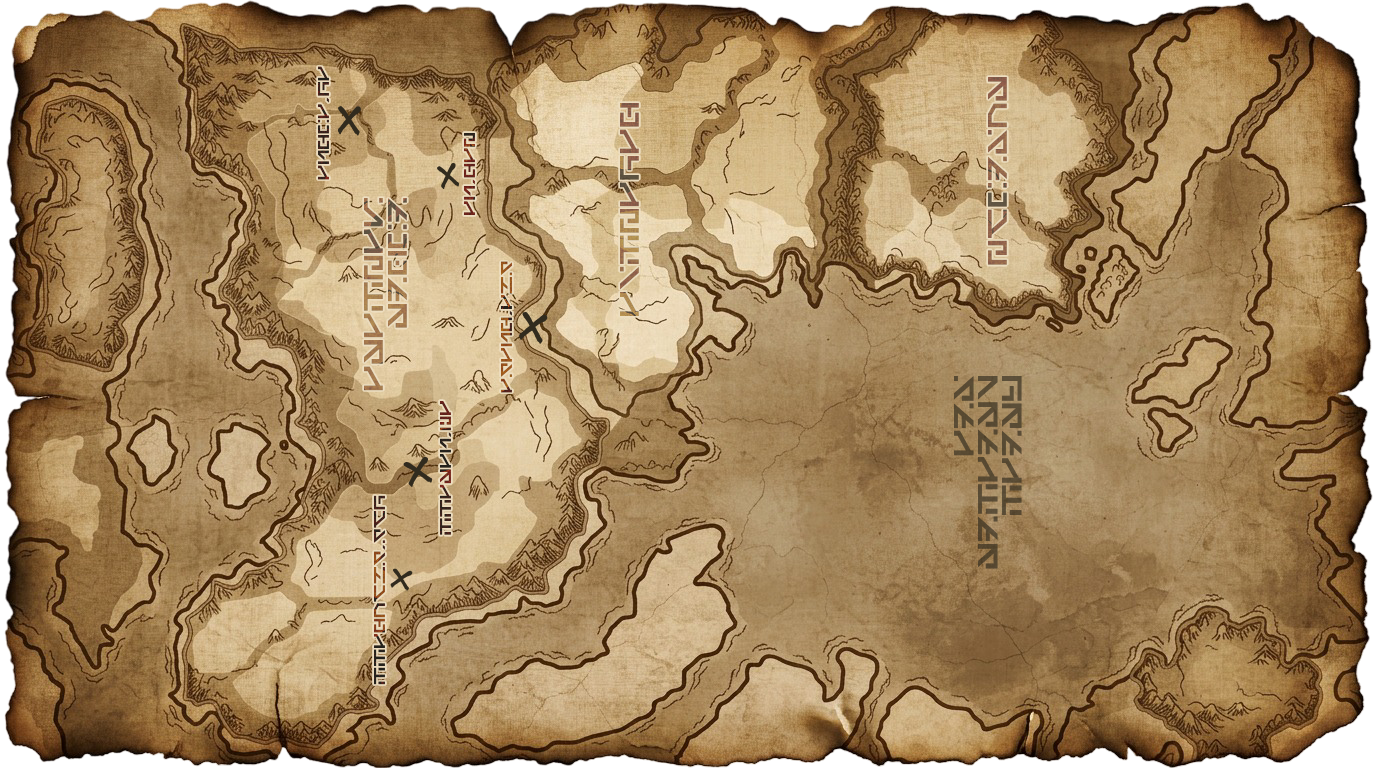
    The true splendor of Elder Jantara is measured not in what endured, but in the magnitude of what was lost. Five cities once anchored the heartlands of the jackal civilization, each a distinct pole of culture, trade, or cunning. Today, all are ruins—picked over by centuries of scavengers, scholars, and memory-haunted dogs. Their names are seldom spoken outside the codex and their locations, though mapped and marked, are more legend than destination.

    Ay’Albwa

    The City of Arts & Science

    Once the jewel of northern Jantara, Ay’Albwa was famed for its academies, scriptoriums, and marble halls lined with statues to dead philosophers. Legends claim its libraries rivaled anything in Ruselon, and its artisans minted coins and mechanical wonders that ended up as tribute in every court of Zhuru. The city was abandoned in the final purges, its great dome shattered, and now only fragments of stained glass and eroded sculpture remain, half-buried in the grass.

    Nab’Wa

    The City of Puzzles & Gardens

    Built on a series of engineered terraces, Nab’Wa was a city of green walls and geometric courtyards, each section designed as a puzzle or labyrinth. Its rulers took pride in riddles, botanical grafts, and the artistry of living sculpture. The invaders who ended Nab’Wa’s reign left little but broken aqueducts and tangled stonework behind. Even the rivers were diverted, turning its gardens to dust.

    Zha’Bwazha

    The City of Birds & Ledgers

    Sitting astride the central trade arteries, Zha’Bwazha served as Jantara’s ledger-keeper, mint, and post. The city’s aviaries sent messages by trained corvid and pigeon from stone towers. By the end, not even the birds stayed; the ledgers rotted and the market squares filled with mud. Bantos traders still pick over the old vaults, seeking lost coins and the secrets of Jantaran bookkeeping.

    Am’Waratt

    The City of Crystal & Desire

    Am’Waratt was infamous even in its own time—a den of glass towers, pleasure houses, and revels that drew the jaded and powerful from across the continent. Here, the jackal lords mingled with visiting tigers, Ruseloni mystics, and every breed of vagrant prince. When Am’Waratt fell, its crystals were plundered, its lamps smashed, and its streets littered with the bones of both merchant and courtesan. The site is now haunted, dangerous, and cursed by any clan that remembers.

    Yoz’Zhoubatt

    The City of Lotus & Intrigue

    Closest to the southern wastes, Yoz’Zhoubatt was a city of shadow, trade, and veiled plots. Alchemists brewed lotus extracts in cellars beneath the great ziggurat, and spies sold secrets to whoever could pay. The city’s collapse was absolute; no clan claims descent from it and no scavenger lingers long—strange lights and sickly blooms still appear in the ruins, and the wind carries the scent of poppy and death.


  • The Northern Doglands

    The Northern Doglands

    The Northern Doglands were never a kingdom of their own, nor did they emerge from a single lineage or heroic age. They existed as the battered remnant of Old Jantara’s conquests—a stretch of land marked by devastation, forced migration, and a patchwork of ruined subkingdoms, each with its own bitter history of betrayal, humiliation, and subjugation.

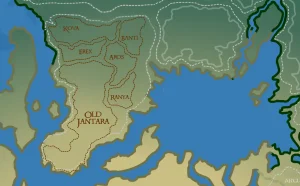
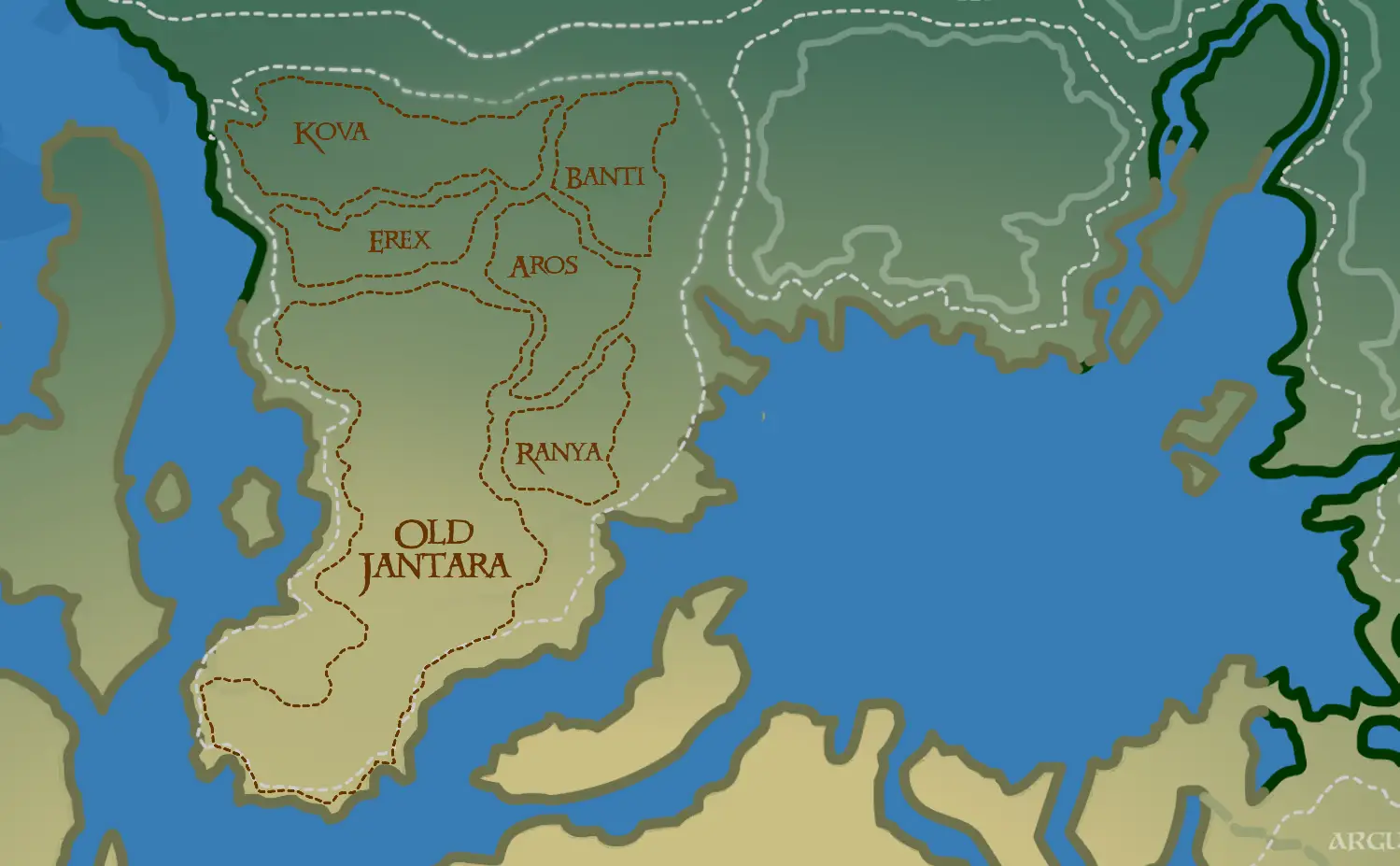
    In the last centuries of Old Jantara’s rule, the region was divided between five subject realms:

    Kova, Erex, Aros, Banti, and Ranya. These were not allies, nor even stable rivals, but desperate neighbors—each doomed in their own way as the jackal lords tightened their grip and the machinery of oppression ground out every last ounce of resistance or hope.


    Kova had been the first to fall. Once a loose alliance of three small kingdoms, its leaders failed to unite against the oncoming jackal hosts. Jackal armies overwhelmed them in less than a year. The leaders of Kova were slaughtered, their resistance shattered, and their people cast into servitude or scattered to the wind.


    Erex collapsed next, and not by force of arms, but through treachery. Its ruling council, promised mercy in exchange for surrender, capitulated—only to be burned alive in public squares, their families chained and sent south to serve as living reminders of jackal “leniency.” The betrayal of Erex became a lesson repeated in Dogfolk stories for generations: every promise from a jackal lord was a noose.


    Aros did not fall in battle, but through famine. Jackal governors poisoned wells, burned stores, and blockaded the valleys until hunger drove the defenders to submission. Even then, those who surrendered were offered no clemency. The armies of Aros, mustered as a show of fealty, were ambushed and slaughtered; their homes, already emptied, were burned behind them.


    Ranya stood longest in the south, a land of fortified valleys and river towns held together by desperation. The folk of Ranya endured repeated assaults, losing ground village by village until, at last, the survivors were hunted down or driven out. Their names and stories survived only in the genealogies of later Dogfolk clans, and in the ruins they left behind.


    Banti was the outlier, the last and most stubborn of the northern realms. Backed quietly by the Ruseloni beyond the border, Banti’s people waged a persistent, bloody resistance, using their forests and hills as shelter for generations. Some claimed Banti never truly surrendered, and that it remained a thorn in the jackal’s side, the heart of Dogfolk defiance, even as the rest of the region fell to ruin.


    As these kingdoms fell, the jackal conquerors did not simply absorb their lands. They relocated and broke apart entire populations—not by lineage, but by labor needs and convenience. Folk from every subkingdom found themselves uprooted, resettled in tent cities, makeshift camps, and squalid shantytowns. The old ties of kin and place unraveled, replaced by a new, shared identity built on the trauma of dispossession.

    These grim settlements were the cradle of what would become the Northern Doglands: a land of exiles and survivors, ruled not by law but by the logic of necessity. The traditions of Kova, Erex, Aros, Ranya, and Banti endured only in fragments—songs half-remembered, rituals practiced in secret, grudges passed down with each telling. In time, these broken peoples forged a kind of solidarity, not through shared history, but through the stubborn will to outlast their oppressors.

    The History of Bantos:

    The Jackalands of Yorozh

    • New Jantara
  • Old Jantara

    Old Jantara

    The era known as Old Jantara marks the true moral nadir of jackal rule.

    This was not a continuation of the ancient league, nor a legitimate successor state. It was a slaver kingdom formed by the bastard remnants of failed usurpers, ruling for nearly a thousand years through degradation alone. It is here that Jantara became a curse word among jackals themselves.

    Old Jantara’s economy was built on enslavement, with dogfolk as its primary victims. The jackals of this age took particular cruelty in subjugating dogs, not merely for labor but for sport. New canine breeds were discovered, catalogued, and abused. Rebellion was answered with starvation, mutilation, and public degradation.

    A grim biological fact shaped this cruelty: black jackals could not reproduce with female dogs. To the jackals, this was a missed opportunity. To the enslaved females, it was a narrow mercy. Better an unwilling plaything than a forced breeder to monsters.

    Physically, the jackals of Old Jantara towered over their captives, averaging over six feet, while keeping subjugated races deliberately stunted through malnutrition. Power was enforced not just with chains, but with size, spectacle, and ritualized humiliation.

    It was during this era that the Bantos Rebellions began.


    The History of Bantos

  • The Later Jantaran Union

    The Later Jantaran Union

    Centuries later, pretenders arose.

    The Later Jantaran Union was a kingdom in name only, ruled for nearly sixteen centuries by the so-called Pheryn Dynasties—cold, calculating warlords and sorcerers who claimed lineage from Elder Jantara without possessing its discipline, doctrine, or restraint. They adopted the symbols of the old league but not its substance, wearing masks as intimidation rather than ritual, hoarding gold instead of circulating it.

    This was a civilization of ledgers and lies. Its histories were self-authored, exaggerated, and mutually contradictory. Guilds recorded grievances instead of laws. Faith was replaced with mysticism weaponized for control. Its end came abruptly.

    In a single mass poisoning—still unexplained—half a city died in one night. Thrones fell together. Rulers, courtiers, and priests collapsed in confusion and terror. The aftermath was not revolution, but slaughter. What followed was carved obsessively into frescoes for two centuries: betrayal, fire, beheading, and ritual humiliation of the dead.

    Yet even this did not birth Bantos.

    The usurpers who followed clung to the carcass of the Union for another three hundred years, until they too failed. Their fall left behind a vacuum, not a successor. For centuries after, the lands of ancient Jantara were little more than caravan corridors—crossed, exploited, and ignored by Zhuru’s wider powers.

    By this point, even the jackals themselves admitted the truth: Elder Jantara had been real. What came after were not heirs, but parasites.


    The History of Bantos

    • Old Jantara
    • The Bantos Rebellions
    • The Last Days of Old Jantara
    • The Bantos Uprising
      • The Border Wars
        • The Townshend Battles
          • “Tale of The Bantos Uprising”
        • The Battle of Northwall Cross
        • The Battle of the Barrier
        • The Ruination of the Jantaran Gates
    • The Burning of Jantara
    • The Rise of Bantos

    The Jackalands of Yorozh

    • New Jantara