

There exists among modern historians a particularly stubborn falsehood: the belief that all things bearing the name Jantara belonged to a single continuous civilization. The persistence of this misconception has done more damage to our understanding of the ancient world than perhaps any other scholarly error presently in circulation.
Every generation seems determined to repeat it. Every generation inherits the same romantic nonsense from the last. The raider-kings, slavers, desert tyrants, and self-proclaimed heirs of later centuries wrapped themselves in Jantaran titles, adorned themselves with stolen symbols, and recited fragments of traditions they scarcely understood. In doing so they succeeded in convincing much of the world that they represented a continuation of Elder Jantara.
They did not.

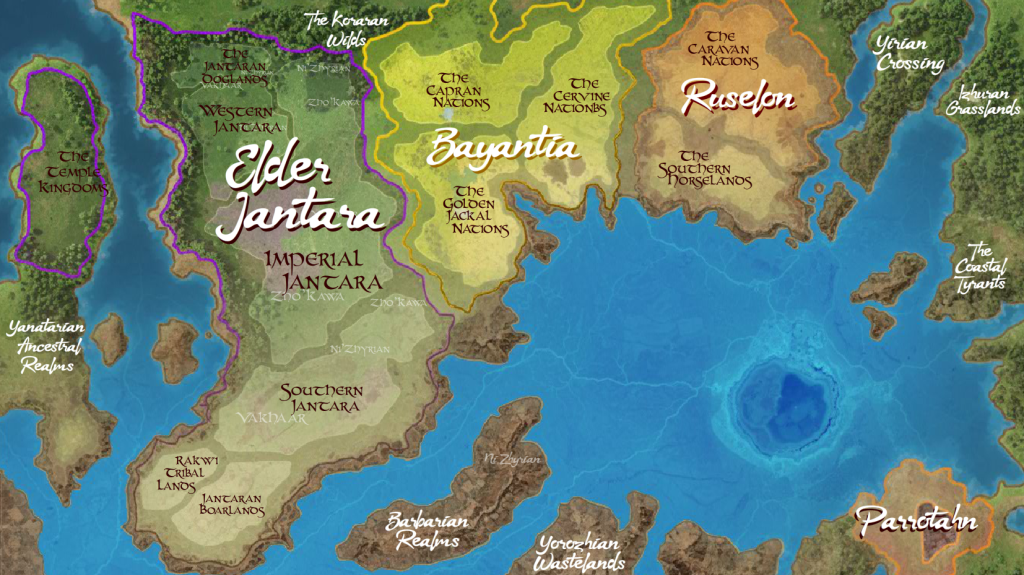
The civilization examined within this volume was not merely another jackal kingdom among many. It was the only true empire the jackal peoples ever produced upon Vandyrus. Its roads endured for centuries. Its trade networks crossed entire regions. Its contracts remained binding long after the deaths of those who signed them. Neighboring cultures measured distance by its caravan routes and measured trust by its standards of oathcraft. What followed its decline were not successor states in any meaningful sense, but scavengers inheriting the bones of a giant.
The Later Union, Old Jantara, and the countless petty dynasties that claimed imperial descent preserved names, titles, heraldry, and fragments of ritual while steadily abandoning the disciplines and institutions that had made the original civilization remarkable.
The archaeological record leaves little room for ambiguity. The deeper one digs beneath the accumulated debris of later centuries, the more obvious the distinction becomes. Elder Jantara traded where its imitators raided.
It cultivated dependence through commerce rather than chains. Its influence expanded through reputation, negotiation, and economic leverage rather than through the crude predations that later regimes mistook for strength. Time and again excavated records reveal the same pattern: sophisticated administration buried beneath layers of barbarism masquerading as inheritance. The descendants remembered the ceremonies while forgetting the purpose behind them. They preserved the masks and discarded the philosophy.
I make no effort within these pages to conceal my contempt for those later claimants.
- They inherited monuments they could not build, institutions they could not maintain, and reputations they did not earn.
- Their chroniclers filled libraries with fantasies of continuity while the evidence beneath their feet contradicted them at every turn.
- They were grave robbers wearing imperial jewelry.
- Their banners borrowed authority from ancestors whose accomplishments they neither matched nor comprehended.
If this assessment appears harsh, I invite the reader to spend a decade cataloging ruined caravan archives, deciphering fractured trade ledgers, and excavating the foundations of cities older than any surviving kingdom. The facts become difficult to ignore.
This volume therefore concerns itself with Elder Jantara alone: the civilization that actually existed behind the legends. Not the decadent husks that followed. Not the slaver principalities. Not the desert tyrants who proclaimed themselves heirs while reducing imperial memory to costume and theater.
Those regimes belong to their own histories and deserve whatever judgments posterity assigns them. Here, our concern is the empire itself—the first, the greatest, and the last of its kind.
No other Jantaran polity ever truly achieved empire. The evidence is overwhelming.
Let the pretenders keep their borrowed titles.
Glory to the Empire.