One of the more persistent misconceptions among younger scholars is the belief that civilization exists apart from nature rather than within it. Such distinctions are often useful for administrative purposes, but become increasingly difficult to maintain when examined across the scales of time addressed within this volume.
The civilizations of Ran have endured for periods measured not in centuries, but in geological eras. Across such spans, cities become ecosystems, transportation networks become migration corridors, industrial districts become habitats, and entire species adapt themselves to the conditions created by intelligent life. The distinction between natural and artificial environments, while occasionally useful, is seldom absolute.
This volume is not concerned primarily with the history, governance, achievements, or institutions of the Ran Empire and its predecessor cultures. Such subjects are addressed extensively elsewhere. Nevertheless, it would be impossible to discuss the ecology of the system without acknowledging the influence of civilizations whose presence has shaped environmental conditions for millions of years.
Many organisms described within these records depend upon settlements, agricultural systems, transportation corridors, industrial infrastructure, or archological complexes for their continued existence. Others have adapted to avoid them entirely. Countless species now occupy ecological niches created by civilization itself, while some environments once regarded as artificial have become indistinguishable from naturally occurring habitats.
The reader should therefore understand that references to cities, settlements, archologies, industrial zones, transportation networks, and inhabited regions are not departures from the purpose of this work. They are components of the ecological reality being examined. Where such systems influence the distribution, behavior, evolution, or survival of life, they shall be addressed accordingly.
With the exception of Yalar, a poisonous anti-biological hellscape of toxic atmospheres, liquid metals, radiation, and the lingering scars of ages of mechanized warfare and Kalba, no longer recognized as a world of significance but instead a dying industrial debris field, the worlds of Ran present an extraordinary continuum of life and adaptation.
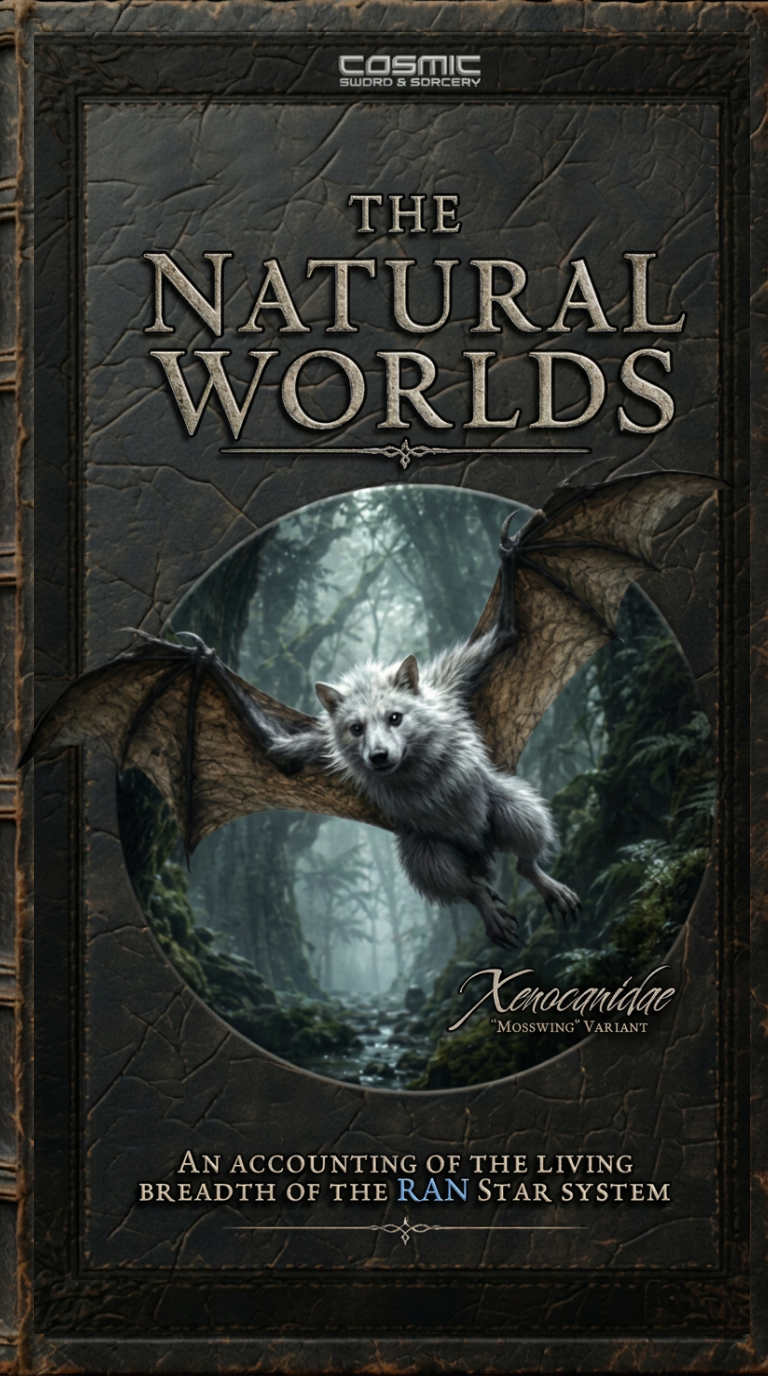
It is upon the second planet, Tyvex, that life first emerges in meaningful abundance within the outward progression of the system. Vast oceans, sprawling vineroot wetlands, amphibious coral forest labyrinths, shimmering grassland savannas, and surprisingly diverse polar steppe regions; have combined to produce one of the most ecologically productive worlds presently known. Beyond Tyvex lies Illynar, a larger and more heavily forested world whose immense snowcapped mountain chains, strange equatorial bamboo jungles, blue stepped highlands, and great crystalline deserts have given rise to an astonishing variety of specialized lifeforms and isolated evolutionary regions.
Further outward stands Vandyrus, often regarded as the Barbarous Line beyond which one enters the truly civilized worlds of Ran. Vast towering redwood forests, deep layered jungles, brutal frozen northern continents, and expansive inland regions; have made the planet one of the most extensively studied ecological spheres within the Imperial record. Our Vandyrian Civilization does not stand entirely apart from The Natural worlds of Ran. Owing to the scale of both its biosphere and civilizations, the planetary status of each world and its peoples beyond Vandyrus shall be addressed prior to discussion of each worlds flora and fauna.
Kydahn presents a markedly different case. Though rain-cursed, ruinous, and suffering severe ecological decline, the world continues to support a startling diversity of life. Much like the reputation of its inhabitants, Kydahn’s biology displays a remarkable refusal to surrender to adversity, clinging stubbornly to existence despite environmental pressures that would have extinguished many lesser ecologies. The gas giant Pranja represents one of the system’s more unusual biological frontiers. Continental-scale cloud formations, atmospheric islands, and centuries of experimental intervention have produced strange aerial ecosystems unlike those found elsewhere within Imperial territory.
Rethka shall be covered only briefly. Though the world once supported abundant life, approximately eighty-nine percent of known native species are now extinct. As a consequence, much of the surviving record concerns ecological collapse, adaptation, conservation efforts, and the growing list of recent removals from the extant register. Unlike many worlds described within this volume, Farydahn possesses no indigenous biosphere. Nevertheless, its great floating megacities have become important centers of biological research, conservation, genetic archiving, and public education.
Kalba is no longer classified as a world.
Titanum represents a unique form of war ecology. Though naturally hostile to complex animal life, centuries of military activity, black-market trafficking, escaped livestock, and accidental introductions have created a strange and often unstable biological landscape. Orbiting Titanum are two worlds deserving independent treatment. Thanator, the Jungle Moon and Throne World of the Ran Empire, ranks among the most biodiverse bodies in the known system. Its forests, jungles, mountains, wetlands, and countless isolated habitats contain such biological abundance that entire volumes could be devoted to its study alone.
Jotun, though considerably smaller, displays a similarly remarkable richness of life. Forests, grasslands, wetlands, and temperate regions support ecosystems of surprising complexity and resilience for a body of its size. The gas giant Daradahn hosts immense atmospheric ecosystems dominated by avian megafauna and vast drifting communities of aerial invertebrates, many of which spend their entire existence suspended within the upper atmospheric layers. Finally, Rywar remains stable, heavily forested, and outwardly unremarkable. Yet beneath this appearance lies a world of considerable scientific interest. Its oceans appear to host the emergence of increasingly complex arthropodal and fish-like lifeforms. Furthermore, evidence suggests that this may not be the first biosphere to develop upon the planet. Some researchers have proposed that Rywar was captured from another stellar system in the distant past, carrying with it the remnants of a far older evolutionary history.
From this point onward, each world shall be indexed through the guide’s internal reference matrix. Planetary entries, regional surveys, species records, environmental hazards, and associated ecological observations have been organized to allow rapid navigation between related subjects.
Readers are encouraged to consult these references frequently, as many organisms, habitats, and environmental conditions described within this volume occur across multiple worlds and continuity zones.
ARCHIVAL NOTE
In its original Imperial form, this indexing matrix was maintained through crystalline information systems capable of dynamically cross-referencing associated records in real time. As such technology is unavailable within the present edition, all reference links have been reproduced in simplified form. Relevant entries will appear at the conclusion of each page and may be selected directly to navigate to the associated record.
The volume now in hand belongs to a lineage of works issued unsparingly and with intent, each bearing the weight of revision rather than novelty. It is not the first accounting of the living breadth of the Ran system, nor does it presume to be the last. What it presents is a measured record of the current state of known environments, organisms, and conditions as they exist within Imperial reach and observation, compiled from survey logs, expedition journals, colonial reports, and verified encounters across multiple worlds and orbital strata.
The purpose of this guide is practical above all. It is meant to be carried, consulted, and relied upon in motion—whether that motion takes the form of sanctioned exploration, commercial transit, military deployment, or simple survival beyond the security of established settlements. The Ran system does not present its hazards uniformly, nor does it announce its thresholds with clarity. A valley that sustains life at dawn may strip it by dusk; a docile species in one region may prove territorial and lethal in another.
This guide will tell you what has been seen, how it behaved, and what followed. Those who rely upon this work are expected to exercise judgment equal to the information provided. No text, however thorough, replaces direct awareness. In this respect, it remains consistent with all Imperial instruments of record: it serves those who act, and is indifferent to those who do not. Carry it accordingly.
Thanator’s position is the most direct. They consider machine-deployed or clandestinely installed reactors by Kydahn to be strategic threats. Their fleets prioritize precision bombardment of processing stacks, transmission relays, and stabilization towers. They rarely commit ground forces unless destruction requires confirmation. Preservation of their own aligned cores is handled through remote defense grids and rotating detachments of specialists who understand that the objective is not conquest but interruption. Yalar is a ledger of attrition, not a flag to plant.
Kydahn mirrors this logic, though with heavier reliance on automated protection. Their reactors are frequently integrated with machine sentry networks, allowing them to function even when surrounding convict formations collapse. The calculus is simple: if organic bodies are expendable, processing uptime is not. Rethka and Shride operate more fluidly, seizing or stripping whatever cores they can temporarily control, often lacking the capacity to defend them long term. Titanum’s interests drift in and out, harvesting atmospheric poison in bulk during windows when orbital attention is elsewhere. Every faction frames its activity as defensive. Every faction targets the reactors of the others.
The convicts fight over refill modules and survival corridors because that is their immediate reality. Above that chaos, reactors hum, siphoning toxins, refining compounds, compressing volatility into transportable mass. When Thanator strikes, it is not to liberate the condemned. It is to crater a rival core. When Kydahn deploys synthetic battalions, it is not to dominate the surface population. It is to shield a processing hub long enough to meet quota.
Rethka, though diminished, still fields opportunistic detachments to sabotage imperial-aligned cores when openings appear. Shride’s involvement is less overt but no less real; certain Shridian consortiums view Yalar as a proving ground for atmospheric destabilization technologies adaptable to other theaters. Titanum’s autonomous interests harvest toxin at intervals that technically violate standing edicts, yet enforcement is strategically selective. Each actor claims necessity. None admit ownership. Officially, no one is supposed to be there. Yalar’s classification in imperial registers oscillates between “restricted hazard zone” and “unsanctioned extraction theater.” It is not designated a lawful colony. It is not recognized as sovereign territory. It is not cleared for civilian industry. The fiction is that any presence beyond penal deployment is incidental. The reality is that the resource reactors are too valuable to abandon and too controversial to legitimize. Thus the world exists in a permanent gray state: an open secret maintained by mutual hypocrisy.
Yalar is publicly framed as a penal sink and a disposal front for liabilities, but that is theater layered over the true contest. The convicts, dissidents, syndicate trash, and politically inconvenient are the visible fuel. The engines they burn around are the real objective. Beneath the permanent electrical storms and poison haze stand the resource reactors—atmospheric harvest cores, deep-crust taps, volatile compression stacks—owned, leased, or clandestinely installed by Kydahn, Thanator-aligned interests, Rethkan syndicates, Shridian reclamation houses, and even Titanum’s shadow complexes. Every faction denies formal presence. Every faction maintains infrastructure. The surface war is therefore not ideological. It is industrial denial. Kydahn seeds Yalar with extraction reactors designed to stabilize and refine atmospheric compounds at scale. These cores are compact, shielded, and often embedded within modular bastions that resemble defensive outposts but function primarily as processing nodes. Thanator’s doctrine toward Yalar has hardened over the ages into a single priority: destroy hostile reactors, preserve friendly ones. It is not about holding territory; it is about preventing supply continuity. A reactor allowed to run uninterrupted for even a cycle too long alters the balance of munitions, chemical stockpiles, and black-market leverage across the Ran system.
Once, long, long ago, back in the days, when people believed, before maps learned to lie, before memory learned to thin, there was a wager made in halls now lost, a boast called out, a promise kept in laughter and in stone.
Sing, sing, spirits of legends old— sing of the giants who walked the black waters, dragging the ships of Ro’Edyne ashore, their laughter shaking the bones of the world, their labor set in the mountain’s heart.
Sing—of hands that cut thunder into stone, of halls raised with ships for rafters, of swords not as threats but as covenants, set deep so the land would remember who built, who bled, and who left.
Sing—of the revel, of the mirth that shook the heights, of the horns that called the giants westward, of promises made not in fear, but in the joy of great work finished. And when the war-whistles sounded, sing how the giants turned, stone-faced and sure, stepping into myth as the mountains bowed low.
Sing—of those who remained: the daughters of Londorai, proud and wild, who lingered when their kin marched to their end, who gave and were given, weaving new blood into Roedon’s ereth, standing beside the folk who remembered, not the deed, but the story.
Sing—of the halls left behind, of the stones set by hands now dust, of ships buried as bones, of swords deep as vows, of the covenant never quite broken— that Ro’Edon would stand back to back with the world should war come again.
Once, long, long ago, back in the days, when people believed, the High Halls were raised, not for the keeping of kings or the counting of years, but to show the world that those who have no history can build their own, and name it true, and sing it so.
Now, as the halls of Vulsa ring with new voices, as banners rise that will not bow, the tale lingers—half jest, half prayer— a promise built on laughter, loss, and the stubborn refusal to let myth die.
So let them say Ro’Edon is a land with no past— the stones remember. The water remembers. And as long as the song is sung, the High Halls stand.
Of the many obscurities which attend the study of the Northern Provinces, there is none more perplexing than the matter of Ardenga and the lands that once lay beneath its authority. The city itself, so far as can now be determined from the surviving records, appears already to have entered a period of gradual decline in the century preceding its destruction. Trade routes altered their courses. Tributary settlements withdrew from its influence. The revenues recorded in such fragments as remain suggest increasing military expenditure accompanied by diminishing agricultural production. Such developments, though unfortunate, are neither remarkable nor uncommon in the annals of antiquity.
Yet here the familiar course of history appears to abandon us. For what befell Ardenga cannot readily be compared to the ordinary dissolution of kingdoms. Cities have fallen before. Provinces have been ravaged. Dynasties have vanished into dust. But in the northern territories there occurred a rupture of continuity so profound that one is tempted to speak not of destruction, but of erasure. The population vanished. The institutions vanished. The dependent settlements vanished. Even the memory of events appears to have become disordered with unusual haste.
We are left instead with contradictory chronicles, abandoned roads leading into wilderness, valleys marked by inexplicable scars, and a body of evidence whose fragments refuse to assemble themselves into any satisfactory whole. The legends speak with confidence. The evidence does not.
I have devoted no small portion of my life to the examination of these matters and can claim little success beyond this singular conclusion: that those who witnessed the end of Ardenga encountered something for which neither their language nor ours possesses adequate expression.
2
Ten millennia have passed since those events, yet the distance has yielded surprisingly little clarity. The disappearance itself appears to have occurred with astonishing rapidity. Entire districts vanish from the historical record within periods measured not in generations but in months. Settlement patterns cease abruptly. Administrative correspondence ends. Commercial accounts terminate. Population estimates collapse with a suddenness which exceeds any ordinary expectation. We possess examples elsewhere of cities ruined by war, by famine, and by pestilence. Ardenga seems, in some obscure manner, to have suffered all three at once, accompanied by phenomena which no accepted historical model adequately explains.
Particularly troubling are the vitrified escarpments situated north of the ancient river basin. Numerous expeditions have documented extensive glassing within exposed stone strata. Early theories attributed these formations to wildfire, but subsequent investigation rendered such explanations untenable. The temperatures required exceed those associated with any known forest conflagration, while the distribution of the affected regions follows no geological pattern presently understood. The damage conforms to no fault line. It corresponds to no volcanic activity.
It bears no resemblance to known impact formations. Instead, the scars appear concentrated around former population centres, military roads, and regions associated with the final years of Ardengan authority. Students are often eager to invoke the so-called Dark and Arcane Wars of late antiquity, a cycle of legends preserved in scattered northern traditions. Such stories are undeniably colourful. They are also unsupported. Unfortunately, so is every competing explanation.
Here we encounter the familiar difficulty which afflicts all inquiry into the Late Provincial Era. The Great Collapse deprived posterity not merely of records but of context. Archives perished. Languages drifted beyond recognition. Entire peoples vanished without descendants. Each generation recovers another fragment and mistakes it for a complete picture, only to discover that the new evidence has merely enlarged the boundaries of ignorance.
“I confess that age has not diminished my impatience with this circumstance. One cannot spend thirty years among ruined roads and broken foundations without developing a certain resentment toward antiquity.“
3
Particularly vexing are the military accounts. Several independent sources, originating from regions which possessed neither common allegiance nor common culture, describe armies increasing in number after engagements rather than diminishing. Such reports occur in Vulsan chronicles, surviving Zhurian maritime records, and fragmentary caravan narratives recovered from the northern passes. Historians have generally dismissed these accounts as literary embellishment, and under ordinary circumstances I would be inclined to agree. The difficulty lies not in their extravagance, but in their consistency.
The dates vary. The names vary. The numbers vary. The descriptions do not. The prevailing interpretation attributes these reports to panic, confusion, and the well-documented tendency of exhausted survivors to reconstruct events according to mythic expectations. Such an explanation remains satisfactory in most instances. Yet when the Ardengan material is considered as a whole, confidence begins to falter.
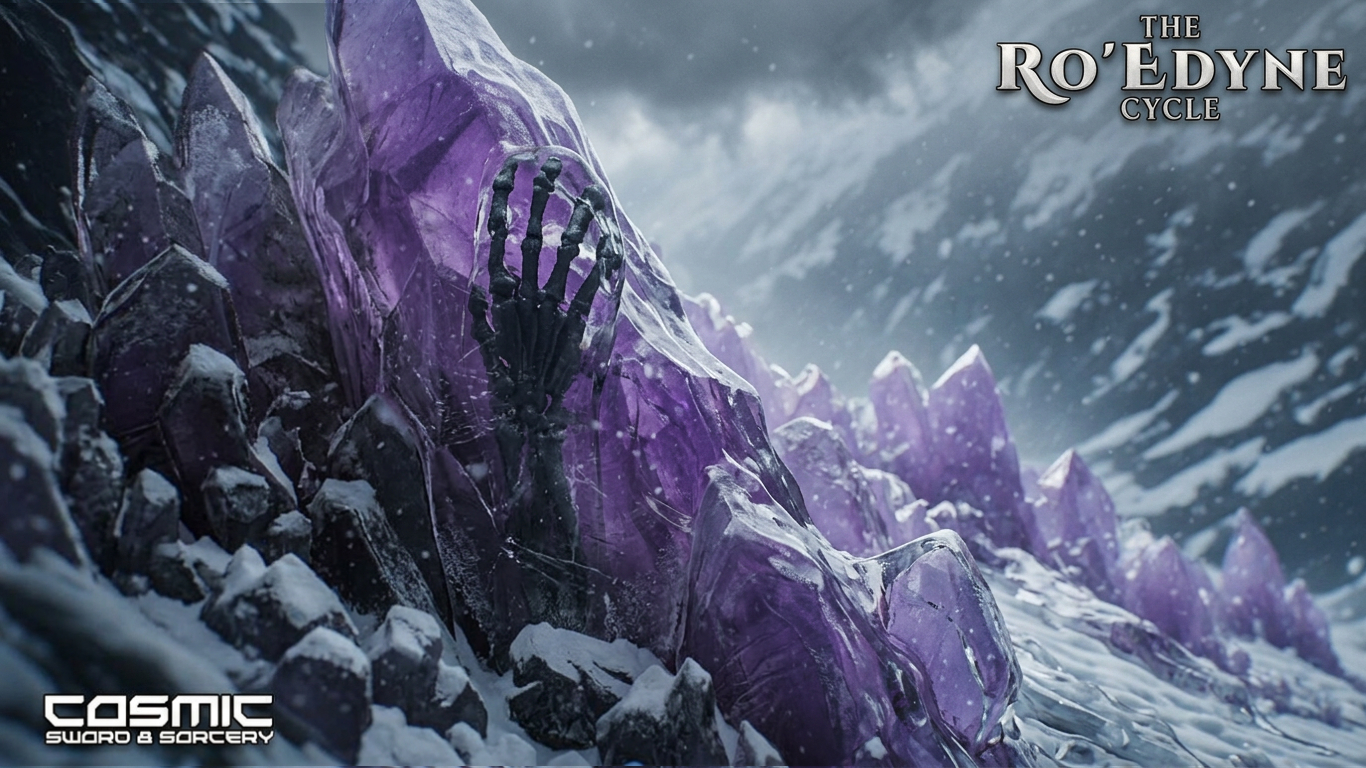
Nor are the vitrified escarpments the only anomaly associated with the region. In several deep folds of the northern valleys, particularly where erosion has exposed older strata, excavations have revealed deposits of peculiar amethyst-coloured glass intermixed with ash layers of uncertain origin. Unlike the larger formations previously described, these deposits appear irregular, often occurring in sheltered depressions and beneath collapsed forest beds where no known geological process would be expected to concentrate such material. More disturbing are the remains found within and around these layers.
Archaeological surveys have documented extensive distributions of skeletal fragments, frequently reduced to little more than dust-stained impressions, isolated teeth, fragments of skulls, and partial bone clusters whose original arrangement can only be inferred. In many locations the positioning suggests neither formal burial nor battlefield internment. Bodies appear to have fallen where they stood, leaving only the faintest traces of their passing. When settlement eventually returned to the region, giving rise to the lesser Province of Dengan—a polity respectable in its own right, though never approaching the scale or sophistication of its predecessor—the new inhabitants inherited a landscape already ancient in its ruin.
Village foundations repeatedly emerged atop older deposits, and throughout the centuries labourers, foresters, and builders reported uncovering strange concentrations of bones beneath the soil. Such discoveries naturally encouraged the development of local superstition. The primitive mind has often regarded these deposits as evidence of cursed or unholy ground, and one may forgive such conclusions given the circumstances. Yet what continues to command scholarly attention is not the folklore itself but the remarkable consistency of the underlying evidence.
Across hundreds of kilometres of forest, mountain hollow, and river valley, the pattern repeats with unsettling regularity. The deposits differ in scale, yet not in character. The remains differ in number, yet not in condition. Whatever occurred in those final years left marks upon the landscape so widespread and so uniform that even ten thousand years of weather, growth, collapse, and resettlement have failed to erase them entirely.
One encounters, again and again, the same sensation familiar to all students of the deep past: the uncomfortable suspicion that the witnesses themselves may have understood less of what they were observing than we would like to believe, and that the truths concealed beneath their accounts are stranger than either their legends or our theories permit. It is perhaps for this reason that the ruin of Ardenga continues to command such fascination. Not because we lack explanations, but because every explanation leaves behind a residue of evidence which refuses to be explained.
“The sea now covers Roedon, as it covers much of the world from which Dengan emerged. The Southern Isles are no more. The roads have vanished. The valleys have vanished. Even the escarpments whose strange scars perplexed earlier generations have long since passed beneath the waves. It may well be that the answers sought by so many historians passed beneath them also.“








![I. The Ro’Edyne Cycle [1977]:
Instrumental DEMO](https://www.primalswordandsorcery.com/wp-content/uploads/2026/06/The-RoEdyne-Cycle-1977DEMO.jpg)