Author: Primal Sword & Sorcery

  • Upon The Knotwork Throne

    Upon The Knotwork Throne

    Before the southern trade wars, before the Bantos rose to prowl the silver valleys and the Lion Imperium unfurled its banners across the steppe, there was Elder Jantara—land of golden dusk, jackal princes, and cities hewn straight from the bones of the ancient desert. This was an age not of beginnings, but of grand returns: a time when the sun beat down upon avenues lined in sapphire and bronze, and the air itself shimmered with the promise of secrets half-whispered in the heat.

    Here, the jackal folk walked with a confidence only centuries of mastery can breed—suave, sharp-eyed, their pelts as varied as the stones in their opulent markets. The tribes of Elder Jantara were not merely merchants or mercenaries, but magicians of commerce, poets of intrigue, architects of excess. Gold and spices flowed like water through a thousand bazaars. Every stone archway was carved with ancestral script, every garden blooming with forbidden fragrances from the heart of vanished empires. The matriarchs of the north—clad in silks, draped in veils of iridescent coin—met their rivals not only at the bargaining table, but in shadowed alcoves and jeweled courts, where a glance could ruin a dynasty or ignite a legend.

    To walk the grand thoroughfares of Zharun or Irza was to be swept into a delirium of color and noise: dancers with tails braided in gold spun for warlords and courtesans alike, while beneath every mask or turban flickered ambitions as old as the Cataclysm itself. Psychic secrets changed paws for gemstones whose luster could turn a merchant’s luck for a lifetime—or doom a careless scion to exile. Nobles courted fortune in the thrill of risk, never trusting the dice nor the lips that kissed their rings, but trusting in fate, and in their own unyielding will.

    This was not a civilization of innocence, but of appetite—diplomacy as seduction, treachery as an art form, pleasure inseparable from peril. Even the poorest street vendor wore the remnant of royal blood in the cock of her brow, the flash of his teeth. Under the indigo banners and heat-hazed domes, jackal kind wrote their names in the annals of survival and audacity, their every pleasure and humiliation recorded in the glint of gemstones and the scent of sweat-drenched sand. In Elder Jantara, the night itself was another mask, and behind it, the folk of gold and shadow danced, bartered, and claimed the world.


    Upon The Knotwork Throne


    The matron of the Vakhaar tribes came cloaked in pearl-grey, her paws caked with the thin dust that drifted from ’s walls at dusk. She passed beneath vaults banded in copper and aquamarine, scenting the city’s bustle—papyrus, sweat, caged birds and coins, old incense trampled under hurried footpads. Above, the crows wheeled through the ledger-towers, their voices lost beneath the endless market chorus and the creak of wooden scales. Zha’Bwazha, City of Birds and Ledgers: her destination, and her battlefield. She was not unknown here. Eyes followed her, quick and calculating, weighing silk, muscle, the flick of her tail—an older female, seasoned but still dangerous, silver rings tapping against her knuckles as she strode the market colonnades. Among the stall-keepers, her name was spoken in whispers: not fear, not quite respect, but wariness, as one might give a jackal whose teeth had earned both blood and bargains.
    Her own pelt, graphite under the city’s golden haze, marked her as neither purebred nor foreign; her lineage was muddied by trade, like every power worth fearing.
    At the heart of the old city, past blue flags and the calls of pigeoneers, lay the southern lord’s manse. Its doors stood open, guarded not by spears but by reputation and gold. She entered as the hour grew thick with heat, led by silent attendants through halls lined with clay tablets and great cages where the courier birds drowsed, untroubled by the world’s intrigues. She caught glimpses of herself in polished copper—hips still round, thighs sturdy, bosom cinched in chains and violet wraps. She carried her widowhood like a birthright: neither ashamed nor inviting pity. If she was past bearing, it only freed her from risk.


    He waited in the atrium, sprawled on a low throne, jet-black from snout to tail-tip, bracelets stacked to the elbow, mane plaited with gold wire and tiny, flashing stones. He was younger—old enough to own a city block, young enough to swagger. She felt the old pulse quicken, an ache not quite forgotten. Their rivalry was legend; their first bargains inked before his voice had dropped, her children not yet grown. Yet always, it was here, in the pulse between market and moon, that they measured their fortunes.
    He rose to greet her, one eyebrow lifted, mouth quirking with a private joke. “North comes south, bearing ledgers and hunger. What does the widow of Qerrat desire from Zha’Bwazha?”
    She did not bow. “I desire what is owed to me. I hear you possess a certain stone—a sapphire, cut for the brow, not the neck. A gem with weight enough to tip the balance in any hand.”
    He spread his claws over the lacquered arm of the throne, lazy. “You think I trade away such luck on a whisper from the north?”
    She smiled, slow and unyielding. “I think you are a jackal who knows the value of a rival’s gratitude—and the price of refusing it.”
    The silence between them thickened; behind her, servants withdrew, the doors falling shut with the hush of expectation. The city’s heartbeat receded, replaced by something old, dangerous, sharply intimate. He gestured for her to approach. “Is this what you truly want?”
    She met his gaze, letting him see the hunger behind the mask. “Yes. More than anything.”
    He did not move at first. Then, with the casual authority of a king, he snapped his fingers—guards faded into the pillars, eyes respectfully averted. He rose, unfastening the sash at his waist, letting it fall to reveal the full, potent arrogance of his body. Cock already swelling, defiant and dark as obsidian. She tasted salt on her tongue—old memory, new shame, the thrum of rivalry shifting to something raw.
    He lounged back, legs spread, tail curled. “On your knees, merchant. Show me the price of your ambition.”
    She knelt, as one might kneel at an altar, palms on his thighs, feeling the heat and weight of him—a body that knew victory, that had bested her before but never claimed her utterly. She heard her own breath, thick and unsteady, as she leaned in. When she took him into her mouth, it was not with meekness but with hunger, the velvet press of her tongue a silent oath: I will take what is mine, in gold, in trade, in flesh.
    He groaned, head tipped back, claws raking her ears as his hips flexed. He was young but not untested; he knew how to hold back, to tease, to make her work for every inch. His taste was bitter, heat pulsing against her palate, and the pulse of his need thrummed through her jaws and down her spine. She let him feel the skill of older tongues, the rhythm that unseated kings.
    By the time he spilled, it was not in victory but surrender—his howl muffled by the domes above, body quaking under her hands. She swallowed, throat raw, gaze never leaving his face. When he slumped back, sated, she rose, mouth gleaming, pride intact.
    He panted, grinning now, chest heaving. “You play for high stakes, widow.”
    She wiped her lips, steady. “I play to win.”
    Outside, the market sang and the ledgers tolled. In the hush between acts, two rivals measured each other, each knowing the game had only begun.


    Time loosened its grip in the heat of the atrium. What followed was not negotiation but ritual, bodies arranged into an obscene geometry older than either bloodline. He hauled her up with effortless strength, seating himself bare on the throne while turning her, lifting, locking her into a headstand against his chest. Her thighs framed his muzzle; her tail hung slack, twitching with every breath. His hands cupped her rump, thick and heavy, the flesh yielding and rebounding in his grip, not soft with age but perfected—Jantaran breeding honed for balance, for endurance, for the pleasures that lived between muscle and fat. Smooth-cut, no dimpling, no slackness; a matron’s body kept honest by heat, walking, and appetite.
    She took him back into her mouth as if she had never left it, lips slick, jaw aching, pride swallowed with the salt of him still lingering in her throat. He groaned again, low and dangerous, and drove his tongue into her sex with intent, not gentle, not reverent, tasting her as one tastes a sacred fruit stolen from a guarded grove. His muzzle buried deep, breath hot, tongue working her with practiced hunger. She shuddered, the inversion pulling blood to her head, making the room swim, her own sounds torn from her despite herself. Her worry crept in then—quiet, sharp. This was more than display. This was the prelude to mating, and she was not here to be claimed.
    The throne creaked beneath them. Her rump jiggled helplessly in his grasp as he held her there, using her, enjoying the way her body answered despite every calculation that had brought her south. She sucked him harder, faster, hoping to spend his need, to keep this in the realm of foreplay and power-play rather than binding. His claws flexed against her ass, not cruel, not gentle—possessive enough to make her breath hitch.
    At the edge of the chamber, two guards had drifted close, half-hidden by the pillars. Both were erect, silent, eyes fixed. One murmured, barely audible, noting how supple she was, how her age only seemed to sharpen the appeal. The other answered without looking away: that was why the light tribes kept to their oases, why their females endured so long. Sex fed their sorcery, and sorcery fed their sex. The words alone were enough to make the younger guard’s cock leak, a thin line down his shaft. He shifted his weight, already planning the end of his shift, the crowded whore-rows of Zha’Bwazha, a grey-furred female who would remind him of this vision without making him foolish enough to speak of it.
    The sounds took over then—wet, rhythmic, breath and flesh and the low animal noises neither rival bothered to restrain.
    The city beyond the walls faded to nothing.


    With the sapphire clenched between her teeth, the chain biting into her gums, he drove into her from behind, relentless, his black fur slick with sweat. Her caution came too late. She had come south for leverage, and left herself open to appetite—now the price was being paid in breathless gasps and the raw, undeniable heat in her body. He did not bind her—not truly; no claim, he swore into her ear—but the fullness of him, the sheer insistence of every thrust, overwhelmed whatever careful distance either had meant to keep. She felt reckless, overreached—a matron who had gambled too freely with her own hunger.
    He took her hard, fast, hands locked on her hips, cock buried to the root, driving until her thoughts scattered like startled birds. When he came, it was with a rough sound dragged from his chest, hips snapping forward as his release pulsed deep inside her—hot, excessive, leaking around the throbbing knot she hoped he would not mention, mind racing, staining the moment with a finality she could not undo. She bit down on the chain, refusing to cry out, tasting sweat, and blood and sapphire and victory all at once.
    All she could think as the seed spilled into her was that, altered or not, she had received the Jantaran Sapphire first.


    Before dawn, she slipped from Zha’Bwazha’s gates, sex swollen and aching, a vivid, hot pink reminder beneath sweat-matted fur. The desert trails took her back in silence. Sand cooled her feet; the night breeze dried the sheen on her body; the gemstone—heavy, cold, triumphant—swung from the circlet on her dark grey brow.
    She would win the trade war.
    That much was certain.
    What lingered was the ache, and the memory of how near desire had come to unmaking her.


    Behind her, in the hush after conquest, he lounged on his throne, hookah smoke curling lazily above his head. He chuckled, hips twitching with aftershocks, a slow leak at his tip as his balls settled. He licked his lips, savoring both taste and outcome.
    At his signal, a blond, gold-furred northern attendant appeared, carrying a large chest. The lid opened, revealing a gleam that lit the chamber—sapphires by the hundred, all cut alike, set in rings, circlets, chains, even the hilts of knives. The jackal lord peered in, his smirk deepening.
    The servant hesitated, unable to hide his curiosity. “Master… are we to consider ourselves sly? Or… was that the true sapphire?”
    The jackal leaned in, voice low with amusement. “That’s the best part. They’re all real sapphires.”
    He straightened, eyes gleaming as he gazed into the trove. “They just all believe only they possess the true Jantaran Sapphire.”
    Laughter—low, sly, satisfied—filled the stone chamber, while the city of ledgers slept, none the wiser.


  • I. Planetary Classification

    I. Planetary Classification

    The Imperial Rival

    Among the great worlds of the Ran system, few possess a history as extensive, influential, or burdened as that of Kydahn. Long before the rise of High Thanator, long before the modern imperial order assumed its present form, Kydahn stood as the acknowledged center of regional civilization. Throughout dozens of planetary ages its institutions directed commerce, diplomacy, scholarship, military doctrine, and administrative governance across vast portions of the system. Entire civilizations measured themselves against Kydahni standards. Dynasties rose seeking its approval. Trade routes were designed around its markets. Political legitimacy was frequently judged according to proximity with its customs, traditions, and educational systems. By the beginning of the Sixty-Seventh Age, Kydahn possessed a historical continuity so immense that many of its citizens regarded primacy not as a privilege but as the natural state of existence.

    The physical manifestation of this antiquity could be observed across the planet itself. Towering arcological complexes dominated vast stretches of the surface, their foundations resting atop the accumulated layers of countless previous civilizations. Entire districts existed beneath newer districts. Transportation corridors crossed through structures older than many neighboring worlds. Libraries preserved records extending backward through periods so remote that modern scholars frequently debated whether certain documents described historical events or civilizations that had already become mythological by the time later records were compiled. Kydahn was not merely old. It was a world constructed from age itself, every generation building upon the remnants of those that preceded it until the distinction between history and infrastructure had become increasingly difficult to identify.


    Yet the decline of Kydahn did not originate from foreign invasion, ecological collapse, or technological stagnation. The source of its deterioration emerged from within. While external rivals frequently challenged Kydahni authority throughout its long history, no enemy inflicted greater damage upon the world than the Kydahni themselves. Across successive ages the planet became increasingly prone to cycles of internal fragmentation. Political coalitions hardened into rival power blocs. Economic disputes evolved into constitutional crises. Regional authorities accumulated military power independent of central governance. Noble houses, industrial consortiums, ideological movements, military factions, and hereditary administrative orders developed competing visions of Kydahn’s future. Over time these disagreements ceased to be political contests and became existential conflicts regarding the ownership of civilization itself.

    The result was a succession of civil wars that reshaped the world repeatedly across multiple ages. While historians continue to debate the precise classification of several major conflicts, traditional Kydahni reckoning recognizes sixteen planetary civil wars of sufficient magnitude to alter the course of civilization. Each conflict left scars deeper than the last. Governments collapsed and reformed. Alliances shifted. Entire populations were displaced. Economic systems required reconstruction. Military institutions fractured and reassembled under new leadership. Every war concluded with promises of stability and reconciliation, yet each settlement merely postponed the emergence of the next crisis. The cumulative effect was devastating. Although Kydahn survived every civil conflict, survival itself became increasingly expensive. Resources that might have strengthened the world against external threats were consumed by internal struggles whose consequences lingered for centuries after formal hostilities ended.


    By the dawn of High Thanator’s ascendance, the dust of the Sixteenth Civil War had only recently settled by Kydahni standards. Nearly a thousand years had passed since the final settlements were signed, yet the wounds remained visible throughout every level of society. Distrust persisted between regions. Ancient grievances survived within family histories. Political institutions continued to operate under emergency frameworks originally implemented during the conflict. Entire sectors of government remained dedicated to preventing the reemergence of conditions that had produced the war. Although peace technically existed, peace had become less a condition of confidence than a temporary exhaustion shared by all surviving factions.

    It was during this period of weakness that Kydahn found itself confronting a problem it had neither anticipated nor welcomed. Throughout previous ages Thanator had existed as a persistent rival, a recurring adversary whose ambitions repeatedly collided with Kydahni interests across economic, military, and political fronts. Their relationship had never been one of genuine cooperation. Border disputes, proxy conflicts, trade competition, diplomatic hostility, and direct military engagements had occurred frequently enough that mutual distrust became embedded within the identities of both civilizations. Entire generations were raised upon historical narratives portraying the opposing world as aggressive, arrogant, dangerous, or fundamentally misguided. The rivalry endured not because either side required conflict for survival, but because both civilizations had accumulated so much historical resentment that reconciliation gradually became impossible to imagine.

    The critical difference was that while Kydahn spent centuries struggling against itself, Thanator spent those same centuries hardening. The environments that shaped the two civilizations produced dramatically different outcomes. Kydahn increasingly directed its energy inward, attempting to preserve institutions, manage factional disputes, and maintain the immense bureaucratic structures required to govern an ancient world. Thanator, by contrast, remained engaged in continual adaptation to harsher conditions, producing administrative systems, military organizations, and social expectations oriented toward performance, resilience, and practical results. The divergence was gradual but profound. By the time the balance of power began shifting decisively, both civilizations still possessed tremendous capabilities, yet they approached governance from fundamentally different assumptions regarding authority, legitimacy, and survival.


    Contrary to later romanticized interpretations, the transition of influence from Kydahn to Thanator was never a dignified handover. No grand consensus emerged regarding the future of the system. No ceremonial acceptance of historical necessity took place behind closed doors. Kydahn did not prepare the throne for its successor, nor did it willingly assist in the construction of Thanator’s new order. Such interpretations emerged primarily from later scholars attempting to impose elegance upon a process that was, in reality, bitter, contentious, and deeply humiliating for much of the Kydahni establishment.

    The truth was considerably less graceful. Kydahn lacked the strength necessary to prevent Thanator’s rise, but it possessed more than enough resentment to oppose it wherever possible. Administrative resistance became common. Political delays multiplied. Regional authorities discovered endless procedural obstacles capable of slowing implementation of imperial directives. Diplomatic negotiations became exercises in frustration. Requests for cooperation frequently disappeared into bureaucratic labyrinths. Projects requiring coordination between the two worlds advanced only through extraordinary effort. Every concession extracted a price. Every agreement carried hidden complications. Every interaction reflected a civilization unwilling to acknowledge that its age of unquestioned supremacy had ended.

    This behavior was not merely political calculation. It was cultural. Generations of rivalry had conditioned Kydahn to view Thanatorian success as inherently threatening. Even as the balance of power shifted beyond recovery, many Kydahni leaders remained psychologically committed to frameworks established during earlier ages when resistance still appeared viable. The result was a civilization trapped between realities. It could no longer dominate the system, yet it remained unwilling to fully participate within structures increasingly shaped by its rival. The contradiction produced paralysis across substantial portions of the governing apparatus.

    What made the situation particularly tragic was that Kydahn retained immense strengths even during this period of decline. Its arcologies continued to house populations numbering in the hundreds of millions. Its universities remained among the finest educational institutions in the system. Its scientific communities preserved expertise accumulated across dozens of ages. Its industrial infrastructure retained enormous productive capacity. Its archives contained historical records unmatched anywhere within the region. The problem was never a complete loss of capability. The problem was the inability to unify those capabilities behind coherent strategic objectives. Kydahn remained powerful enough to matter, yet increasingly incapable of converting potential into decisive action.

    This condition might have persisted indefinitely had history confined itself to the rivalry between Kydahn and Thanator. Unfortunately for both civilizations, larger forces were already beginning to reshape the political landscape. The emergence of Rethka and the expansion of associated extremist movements introduced challenges fundamentally different from the traditional conflicts that had dominated previous ages. These new threats cared little for ceremonial prestige, dynastic legitimacy, historical grievances, or established balances of power. They targeted infrastructure, populations, communication networks, transportation systems, and political confidence itself. Their objective was destabilization rather than conquest, disruption rather than governance.


    The consequences for Kydahn proved severe. Decades and centuries of obstructionist policy suddenly revealed an uncomfortable reality. Many of the institutions best positioned to respond effectively to emerging threats increasingly operated under Thanatorian leadership or influence. Security frameworks, intelligence networks, military coordination systems, and interplanetary response mechanisms all reflected the new distribution of power. Kydahn discovered, often reluctantly, that the civilization it had spent ages attempting to frustrate had become one of the primary barriers separating the system from escalating instability.

    The resulting political atmosphere became poisonous. Every successful Thanatorian intervention highlighted Kydahni weakness. Every terrorist attack exposed vulnerabilities left unresolved by centuries of internal conflict. Every request for assistance carried implications many Kydahni leaders found difficult to accept. Public discourse increasingly divided between those advocating practical cooperation and those insisting that dependence upon Thanator represented a humiliation worse than the threats themselves. Old rivalries collided with new realities, producing tensions that reverberated throughout every level of society.

    Yet the historical significance of this era derives not from Kydahn’s weakness alone but from what followed. Despite widespread predictions of irreversible decline, the world endured. The arcologies remained populated. The institutions survived. The archives continued to grow. The educational systems persisted. Beneath the frustration, bitterness, and exhaustion, the foundations of Kydahni civilization remained intact. The same historical depth that burdened the world also granted it extraordinary resilience. Civilizations with lesser traditions might have collapsed entirely beneath comparable pressures. Kydahn instead entered a prolonged period of painful adaptation.

    For this reason, modern historians frequently describe the late Sixty-Seventh Age not as the death of Kydahn’s greatness but as the closing chapter of one historical cycle and the difficult beginning of another. The world had lost primacy. It had squandered enormous portions of its strength through centuries of internal conflict. It had been surpassed by a rival long regarded with suspicion and hostility. Yet none of these developments erased the immense reservoirs of experience, knowledge, infrastructure, and cultural continuity accumulated across its vast history. Kydahn remained diminished, but it remained alive.

    The greatest mistake made by contemporary observers was assuming that decline and extinction were synonymous. Kydahn was undoubtedly descending from its ancient summit, but civilizations measured in dozens of ages rarely disappear according to simple narratives. Beneath the storms, within the colossal arcologies that had witnessed the rise and fall of generations beyond counting, the old throne still endured. Exhausted, embittered, and wounded by its own history, it nevertheless retained enough strength to dream of resurgence. In the centuries that followed, that dream would grow steadily larger until it became the foundation for one final and extraordinary attempt to reclaim a place among the great powers of the age.

  • The Shadow of Dread Kydahn

    The Shadow of Dread Kydahn

    The Shadow of Dread Kydahn


    I

    c. 80,000 PC

    “Hearken, and I shall tell you of the blackest and most fearsome world, known as Kydahn—once the hated high throneworld of the antique codes, where trays of silver tribute gleamed before mighty kings and sorcerers among the ancient stars.
    The White Wolves of Elder Kydahn ruled the galaxy for eons uncounted.

    Antinomian and glacial beyond mortal comprehension, they were the coldest minds of that aged Vandyrian Race. The stars themselves whispered curses against their names, yet the Wolves answered only with laughter like cracking ice, setting their boots upon the throats of foreign kings and making cruel sport of heathen queens. In their hubris, they damned the very name of the Kydahni. And For a time, Kydahn waged merciless war upon the worlds of Ran.
    Thanator and Kydahn loosed the hounds of carnage together, yet in the end Kydahn was broken and hewn asunder. Thanator rose victorious from that cosmic slaughter and carved a vengeance both terrible and precise upon its fallen rival.
    And so, To the victor went the spoils.


    II

    c. 3750 AC

    “Yet all triumphs prove fleeting before greater powers. In time, Thanator, Kydahn, Farydahn, Rethka, barbarous Vandyrus, pitiful Jotun—even the blue beast of Titanum—were all shaken to their roots by the wake of Doom, that cataclysmic harbinger which reset the clock of civilization and shattered every imperial dream to dust. Kydahn’s world was reduced to utter ruin.
    Its molten core bled into the void. Its once-proud cities toppled, and colossal structures were hurled from the scarred surface into the black, destined to drift as silent crypts once the last breath of air fled. That death came slowly, over a full generation—a slow, maddening unraveling. Yet it was those wretched souls who clung to survival upon the poisoned surface who suffered the truest curse.
    Thus began a cruel and twisted age. Elder Kydahn slipped first into myth, then into whispered legend, and at last into the oblivion of forgotten memory.
    Though the sciences clawed their way back into the light, the civilizations of Vandyrus were forced to confront those buried histories once more. The world of Darkest Kydahn was rediscovered in the farthest reaches of the outer void—shattered, starved of Ran’s light, lying deeper into the abyss than even Rywar by our reckoning.”


    III

    c. 95,000 AC

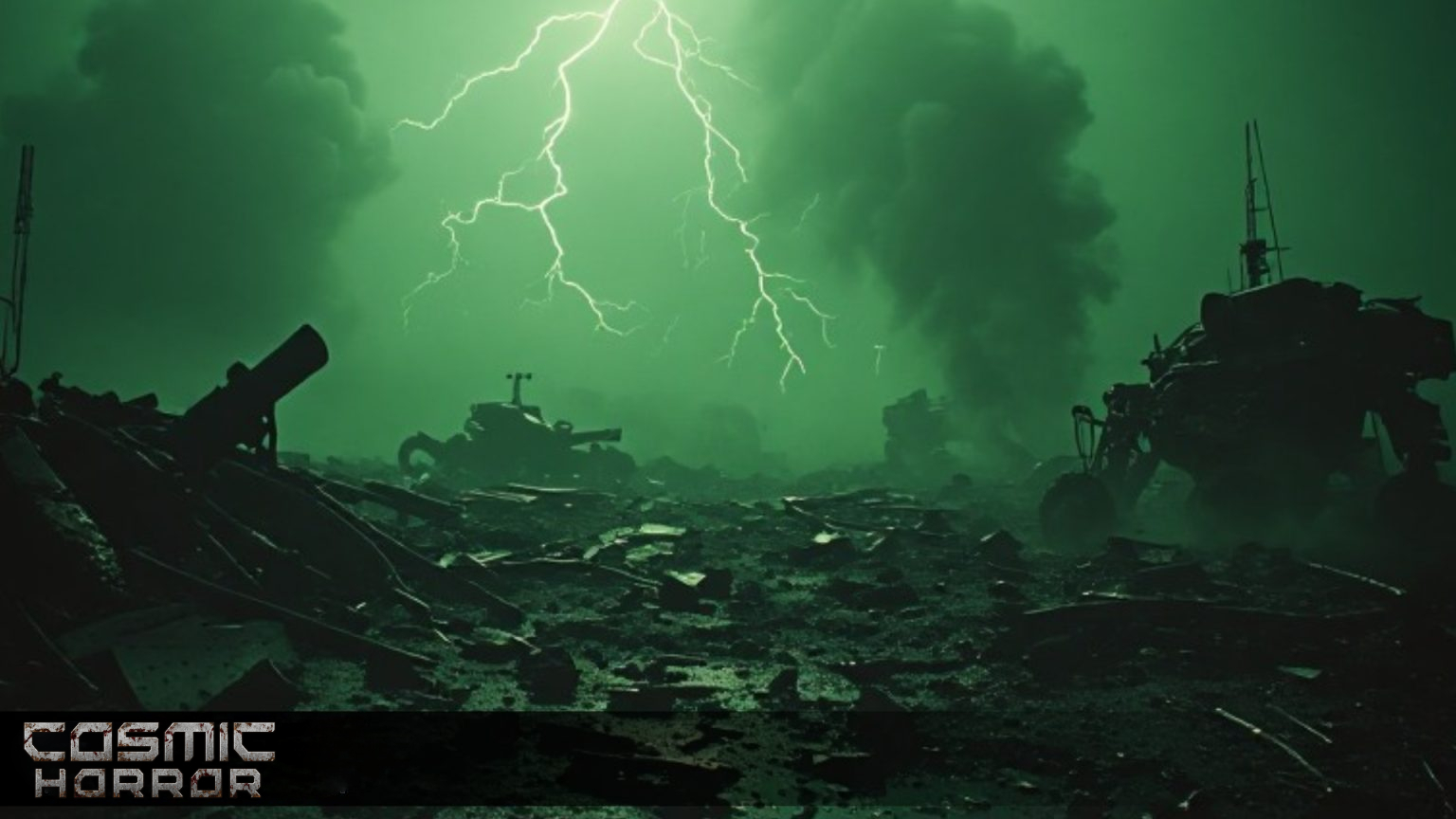
    “It was however by some vicious whim of fate or fury, Kydahn refuses to perish entirely. Even now, probes sent into its upper atmosphere return grainy images of ash-haunted lost imperial ruins. Between the shattered spires glide bat-winged shapes, colossal insects scuttle on jointed limbs, and frail, scurrying things best left unnamed dart through the gloom. Audio feeds capture the raw cries of mammalian throats, the wet clicking of massive mandibles, the heavy leathery snap of wings—and, most harrowing of all, the unmistakable screams of Vandyrian predation, echoing as though the old hunters still stalk their prey.
    Just as Vandyria once existed, its memory and absence still haunting us, so too did Elder Kydahn. But where Vandyria offers only ghosts of what was lost, Kydahn delivers something far worse: the living horror of what remains.
    Out there, far beyond Ran’s cold blue light and its hollow promise of civilization, something yet stirs in the dark.
    Beware that place.
    For it remains well and truly cursed.”


    Related

  • 5. Kydahn

    5. Kydahn

    5. Kydahn


    INDEX

    BY ESSAY

    All books in the project will be updated with New Entries:
    Check back for additional content


  • I. Planetary Classification

    I. Planetary Classification

    The Imperial Threshold

    Vandyrus occupied a unique position within the greater imperial structure, not because it controlled the fleet yards that surrounded it, but because it hosted them. The orbital anchorages, drydocks, refit stations, and naval infrastructure belonged to the Empire itself. Their command chains ran outward toward the throne worlds and central administrations, not downward toward the planet below. Vandyrus supplied the raw materials, labor, and strategic location upon which those installations depended, while much of its native population observed the constant traffic of warships and industrial fleets from settlements that remained comparatively primitive by imperial standards. The contrast was striking: vast orbital industries of steel and administration hanging above a world where brick-built towns, tribal domains, and regional kingdoms continued much as they always had.

    Within imperial records, Vandyrus was recognized as a threshold world. This designation arose not from its ecology, population, or cultural significance, but from its position within the practical machinery of imperial governance. Beyond Vandyrus the density of administration diminished noticeably. Patrol routes became less predictable. Communication delays lengthened. Supply networks became increasingly dependent upon local arrangements and regional initiative. Vandyrus therefore represented the last point at which the Empire could reliably assume the presence of its own institutions without substantial qualification. It marked the transition between direct administration and the vast frontier beyond. The importance of the world was therefore concentrated less upon its surface and more upon what surrounded it. The orbital fleet yards served as one of the Empire’s principal logistical and military staging grounds at the edge of consistently governed space. Administrators, quartermasters, naval officers, and commercial authorities passed through its stations in enormous numbers. To many within the bureaucracy, Vandyrus represented the final outpost of dependable order before the scattered frontier worlds beyond. Ships departing its anchorages moved outward into regions where imperial authority often became a matter of local interpretation rather than immediate enforcement.

    On the surface, however, the imperial presence was remarkably limited. The Empire maintained strategic strongholds rather than comprehensive control.
    The greatest of these was Ro’Edyne, whose administrative, commercial, and diplomatic functions made it the true center of imperial activity upon the planet. Far to the north stood Ataratoz, a secondary but significant center devoted to scientific inquiry, regional diplomacy, and the continued expansion of imperial understanding regarding the northern realms beyond Thuratahn. Together these enclaves provided the Empire with what it required: ports, intelligence, research, trade access, and stable points of contact. The vast majority of the planet existed outside direct administration. This arrangement reflected both necessity and intent. Vandyrus was an immense and hazardous world whose geography, climate, and ecosystems imposed severe practical limits upon expansion. Large portions of the planet remained difficult, dangerous, or economically unnecessary to occupy. The Empire had little interest in transforming the world into another core province when the resources it desired could be obtained through a comparatively small network of fortified administrative centers. The objective was utility rather than assimilation.

    As a result, much of Vandyrus remained culturally distinct from the worlds that governed it. The populations of the interior and frontier regions were aware of imperial authority, traded with imperial interests, and occasionally served imperial purposes, yet rarely regarded themselves as participants in a larger imperial identity. The throne worlds existed as distant centers of power whose influence arrived through merchants, officials, explorers, and warships rather than through daily governance.
    For many communities, the Empire was something encountered at ports, markets, and administrative compounds rather than something experienced as a continuous presence.

  • 4. Vandyrus

    4. Vandyrus

    4. Vandyrus


    INDEX

    BY ESSAY

    All books in the project will be updated with New Entries:
    Check back for additional content


  • I. Planetary Classification

    I. Planetary Classification

    Agrarian Continuity

    Illynar occupies an unusual position within the Ran system. Though commonly classified as an agricultural world, this designation often creates a misleading impression of uniform farmland and predictable production. The reality is considerably more complex. Much of the planet consists of unstable terrain where broad floodplains, shifting waterways, rugged mountain regions, and extensive grasslands compete for dominance across the landscape.
    The great floodplains remain the foundation of Illynar’s agricultural output. Rich soils deposited through centuries of seasonal inundation produce substantial harvests and support much of the food export upon which neighboring Vandaxium worlds rely. These regions are among the most valuable territories on the planet, not because they are easy to cultivate, but because their fertility consistently outweighs the difficulties imposed by the environment itself.

    Beyond these fertile belts, the terrain becomes far less predictable. Mountain regions frequently interrupt settlement patterns, creating isolated communities separated by difficult travel routes and irregular terrain. Many of these upland areas remain only lightly developed, serving instead as grazing territory, timber sources, mineral extraction zones, or natural barriers between larger agricultural districts. The result is a world whose productive regions are fragmented rather than continuous, forcing settlement and cultivation to adapt to the landscape rather than reshape it.
    The great grasslands further complicate the planetary pattern. Vast stretches of open country break apart the floodplain networks and create natural divisions between population centers. These regions support extensive herding operations and contribute significantly to local food production, yet they also reinforce Illynar’s tendency toward dispersed settlement. Rather than drawing populations into large urban concentrations, the land encourages communities to spread outward along productive corridors wherever soil, water, and terrain permit.

    This geography has had profound effects upon Illynar’s social and political development. Population centers emerged where conditions allowed rather than according to any singular planetary design. Agricultural communities, river settlements, grazing territories, and mountain holdings developed according to local circumstances, producing a patchwork of regional identities that remain visible even in the modern era. The planet’s structure favors practical cooperation over centralized control, as no single region possesses complete dominance over the others. For this reason Illynar’s agricultural classification should not be interpreted as evidence of simplicity or developmental delay.

    The world serves as one of the principal food-producing regions of the Vandaxium sphere precisely because its inhabitants learned to exploit a landscape that is productive without ever becoming entirely predictable. Flood, drought, erosion, and shifting waterways remain constant realities, and generations of experience have produced cultures adapted to managing these conditions rather than attempting to eliminate them. The result is a world whose importance rests not upon industrial concentration or urban expansion, but upon its ability to transform a geographically inconsistent environment into a reliable source of food, livestock, and agricultural exports for the surrounding systems.

  • I. Planetary Classification

    I. Planetary Classification

    Cultural Misperception

    Tyvex, for much of imperial memory, has lived in the shadows of condescension—a world whose surface image lingers in the popular imagination as a mosaic of swamps, marshes, and muddy hamlets, its folk portrayed as simple frog-tribes, perched on stilts above the bog, clutching spears tipped with cork and bone. This myth is not entirely invention: for thousands of years, Tyvex was a place of slow-moving rivers, mist-wreathed reed beds, and sprawling grass huts, its people living in close harmony with the planet’s watery pulse. Yet to mistake this as the sum of Tyvex is to miss the deeper current. Beneath the stereotype of provincial humility lies a culture of restless exploration and cunning adaptation—a people who, despite never developing indigenous spaceflight, carved for themselves a place among the stars by wit, alliance, and shrewd diplomacy.

    The persistence of this stereotype is neither accidental nor wholly imposed. Peripheral classification within the imperial registry favored visible metrics—fleet tonnage, megastructural output, mineral yield—over distributed intelligence or diplomatic penetration. Worlds that did not project force were categorized as rustic; worlds without indigenous void fleets were deemed dependent. Tyvex’s wetlands, lacking monumental skyline or heavy industry, reinforced this visual shorthand. The image of stilted hamlets proved easier to circulate than the record of negotiated treaties, embedded envoys, and cross-system brokerage. Misperception became administrative convenience.

    The systemic implication is strategic camouflage. Underestimation lowers scrutiny. Worlds perceived as simple are rarely subjected to aggressive restructuring or direct extraction mandates. Tyvex’s classification as provincial afforded it operational latitude. While attention fixated on industrial cores and war-worlds, Tyvex refined internal cohesion and external alliances. Cultural misperception thus became a defensive layer—an atmospheric distortion that shielded complexity beneath.
    The true genius of Tyvex was never in its engines, but in its negotiators.

    The world’s societies, more complex than outsiders ever cared to study, produced generations of envoys and intermediaries able to curry favor with both Thanator and Kydahn, often playing one against the other in ways that belied any suggestion of provincial naivety. The Tyvexian clans—frogfolk, gazelles, flying foxes, and the enigmatic white jackal breed with their sinewy necks and cybernetic inclinations—wove a network of allegiances and obligations that bound them to the centers of power without ever surrendering their own identity. The jackals, in particular, became infamous for their silver-cultures: artisans, financiers, and cyberneticists whose value in trade and intrigue made them prized agents and guests at imperial courts. If Tyvex as a planet lagged behind in technical terms, its people as individuals more than compensated—adopting and even improving upon the technologies of their patrons, migrating as trusted retainers, merchants, and specialists across the system.

    Diplomatic specialization emerged from structural necessity. Lacking indigenous void fleets, Tyvex could not impose its will through projection; it instead embedded itself within the machinery of those who could. Clan hierarchies emphasized linguistic mastery, cultural literacy, and adaptive protocol over territorial expansion. Envoys were trained not merely in etiquette but in leverage calculus—understanding which concessions could be offered without eroding autonomy and which alliances would outlast a regime’s current favor. The white jackal silver-cultures formalized this into trade guilds and cybernetic consultancies, ensuring Tyvexian presence in financial and technological corridors across imperial space.

    The doctrinal consequence is influence without provocation. Tyvex does not command fleets, yet it shapes decisions through proximity and indispensability. Its citizens ascend within foreign hierarchies, carry back knowledge, and extend informal networks that bind distant centers of power into reciprocal obligation. This model produces stability rather than spectacle. The Empire interacts with Tyvex not as a rival, nor as a dependent, but as a mediator embedded within its own apparatus. In long-duration calculus, such positioning yields continuity of relevance even when formal rank remains modest.


    BACK

  • 3. Illynar

    3. Illynar

    3. Illynar


    INDEX


    NEXT