
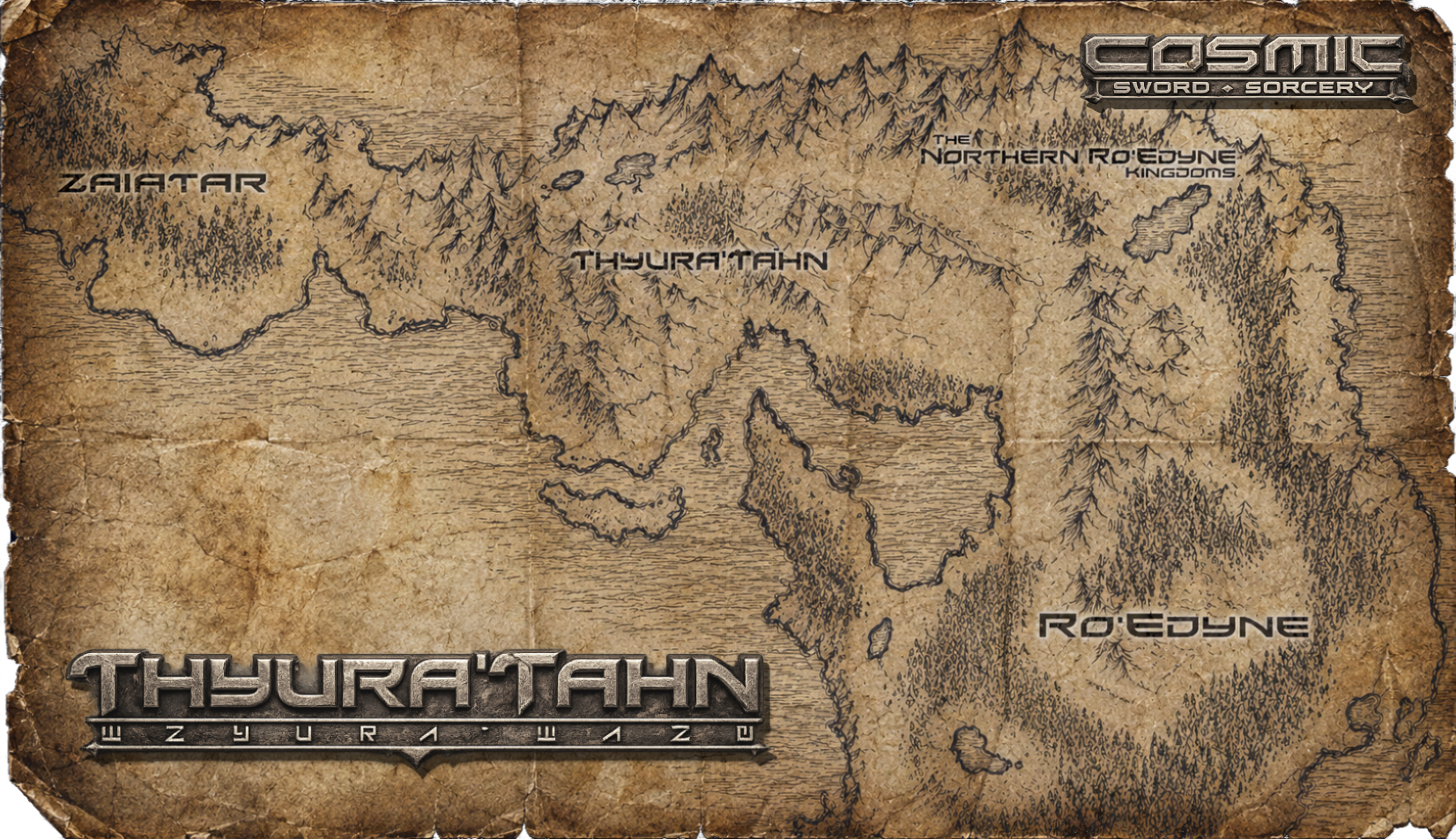
Even among the oldest surviving southern records, references persist to a northern continental dominion known variously as Thyuratahn, the Central Dominion, or in certain later Londorai reconstructions, simply the Lost North. The antiquity of these accounts greatly exceeds that of most surviving native historical traditions upon Vandyrus.
Certain preserved records attributed to the later Ro’Edyne archive periods already describe Thyuratahn as ancient, suggesting the kingdom had passed partially into legend even during the height of the southern imperial ages. The surviving references are made stranger still by the geography they describe. Numerous records speak casually of northern overland crossings between Ro’Edyne and regions now separated entirely by the Vulsan sea. At first these passages were dismissed by restoration scholars as symbolic, mythological, or ceremonial in nature. Yet successive discoveries of older navigational charts and fragmented territorial records complicated such interpretations considerably. Some among these materials appear to predate even the oldest linguistically understood Ro’Edyne dialects currently known to modern scholarship.
This remains among the more troubling aspects of the Thyuratahn material. Ro’Edyne itself already represents one of the deepest and most difficult linguistic continuities in surviving Vandyrian history, yet portions of the northern records appear to originate from structures older still. Certain inscriptions recovered from drowned northern shelf regions do not conform fully to any recognized Ro’Edyne linguistic family, though partial symbolic overlap remains sufficient to suggest some degree of ancestral relation.
Accounts concerning Thyuratahn vary considerably between surviving cultural traditions: surviving records portray Thyuratahn less as a singular kingdom and more as a vast continental sphere containing numerous aligned polities, trade federations, dynastic territories, and ceremonial states spread across the central northern expanses. Unlike many later northern civilizations which emerged in relative isolation following the collapse periods, the peoples of Thyuratahn appear to have maintained direct cultural and administrative contact with both Greater Londorai and the southern continuities of Ro’Edyne across immense stretches of time. The oldest surviving descriptions portray the dominant populations of the region as physically imposing even by Vandyrian standards, their ruling castes frequently described within southern records as “high blooded” or “sky-allied” owing to extensive offworld admixture among the upper dynastic lines.
Imperial genealogical fragments recovered from later Ro’Edyne archives suggest that portions of the Thyuratahn aristocracy possessed direct ancestral links not only to the greater Vandyrian imperial spheres, but to colonial bloodlines originating beyond Vandyrus itself. Certain northern houses reportedly maintained ceremonial kinship ties to Jotunic colonial administrations, while others traced their ancestry to interstellar dynastic lines associated with the core worlds of the greater imperial systems. Though much of this material remains fragmentary, the surviving evidence strongly suggests that Thyuratahn functioned not as an isolated northern kingdom, but as a heavily integrated frontier continuity-state positioned between multiple spheres of imperial influence.
Related
Folklore
Music