
Once, Long Ago…
Back in the days of Vandyrian Steel and Coveted Banded Lotus Spice imported from the furthest Moons of Kydahn…
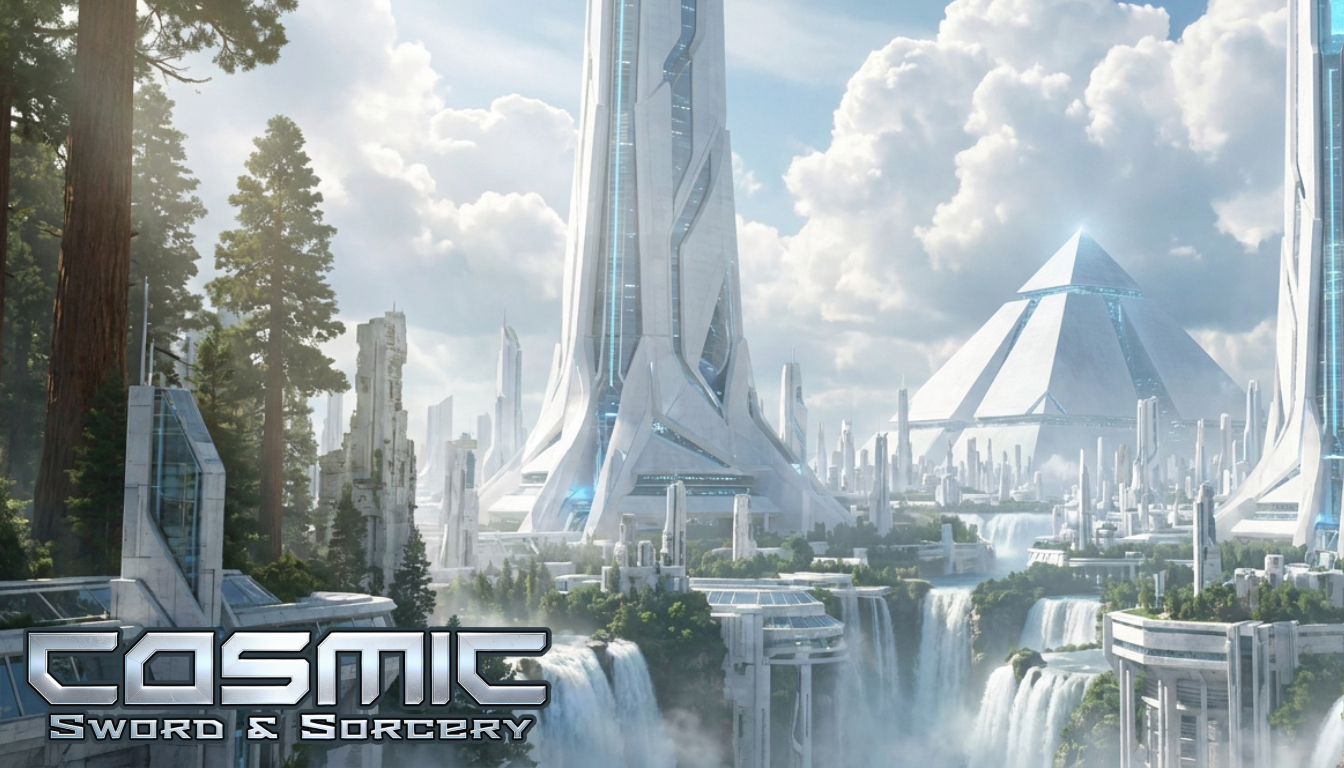
In the vast central regions in the Realms of Ro’Edyne the land descended in colossal green shelves drowned beneath mist, cataracts, and the eternal roar of falling water. Great white rivers thundered endlessly through vine-choked ravines older than empires while heat rolled upward from the jungle floor in silver veils thick enough to swallow entire caravans from sight. Vast reptilian cries echoed somewhere far below the hanging bridges and cliffside trade roads, answered now and again by the distant horn-calls of freight skiffs threading cautiously through the fog. Here and there amongst the greenery ancient stonework still protruded from the wilderness — collapsed arches, half-swallowed statuary, broken causeways from dynasties whose names no longer survived outside archival engines and priestly disputes. Yet even amidst all this savage immensity the eye was always dragged upward eventually, toward the impossible white geometries rising beyond the jungle horizon.
For there…stood
Tykon’Mach.
Not merely a city, but a continent of vertical civilization whose vast steel-and-crystal structures climbed into the heavens like the polished bones of dead gods. The twin pyramids dominated all things, their impossible mirrored faces reflecting cloudbanks, sunlight, waterfalls, and moving freight-lanes across hundreds of colossal terraces alive with constant movement. Around them rose forests of alabaster towers, elevated transit bridges, suspended ports, cargo lifts, docking spires, habitation arcs, administrative monoliths, and immense anti-grav causeways carrying uninterrupted streams of skiffs through the humid air. Water itself had been conquered here. Entire cataracts plunged directly through the lower city tiers and vanished into engineered canals beneath the foundations while hanging gardens and dense green districts sprawled between sectors of blinding industrial refinement.
Skeer and his father — a fat and prosperous boar merchant of arms and sanctioned ordnance — rode, slow and heavy through the lower canal roads of Tykon’Mach aboard a broad commerce-skiff burdened beneath stacked crates of rifles, slug-throwers, sealed powder tins, and sigiled ammunition drums stamped lawful beneath Imperial charter. Ahead of them rose the Capital Complex itself: one of the twin steel-and-crystal pyramids of the great city, colossal beyond sane proportion, its mirrored faces vanishing into haze and industrial vapor high above the suspended freight lanes. Across its immense terraces crawled caravans, skiffs, cargo-haulers, labor transit, elevated liftways, and streams of lesser merchants forever feeding the hungry machinery of the Pyramid State. Skeer himself was some breed of hound, though plainly not the old boar’s true son — one of those strange arrangements the merchant occasionally alluded to over roast bird and potatoes after too much drink and too many cigars. The boy had ceased asking years ago. In Tykon’Mach, lineage often mattered less than usefulness.
As the skiff neared the outer gate works, layered scanning lattices passed over them in pale bands of blue light. Sigils shimmered briefly across the cargo manifests before vanishing into the Pyramid registry systems while hanging slate-screens and hovering trade displays already carried the morning reports from the upper districts.
They were not first to arrive. Entire consignments had sold clean before dawn and vanished into the inner terraces while fresh caravans regrouped below beneath awnings of steel and canvas. Trade within Tykon’Mach never truly ceased. It merely changed elevation. Curiously absent amidst all of it was the operation of Hule Sanpho. That alone drew the old boar’s attention. As much as Skeer despised the ancient rat and his black-and-violet merchant concern, Hule’s clientele usually infested the lower trade districts by first light. Wherever firearms, transit rights, salvaged machinery, or suspect charter permits changed paws, Hule Sanpho was generally somewhere nearby grinning through cigar smoke. Yet today there was nothing.
The skiff drifted onward through the gate amidst congestion thick enough to stall smaller craft outright. Father and son exchanged an amused glance as they passed a cluster of outer-world gazelles displaying scoped and sight-locking crossbows to packs of local riffraff inspecting the weapons as though they were relics from forgotten dynasties. “Idiots,” muttered the boar through pipe smoke before pointing upward toward the canal lane ahead.
Towering over the traffic lumbered a vast Apatosaur draped in red and royal blue trade cloths, its immense spinal membranes fluttering lazily in the furnace-winds pouring down from the upper freight tiers. Thick catfish-like jowls swayed beneath its skull while caravan goats lounged atop the creature’s cargo platform smoking sloke and blowing grey rings downward toward a swarm of obnoxious monkeys screeching curses from the bridge railings below. “Look at the little bastards,” wheezed the merchant. The monkeys shrieked louder as the caravan passed beneath them.
The Yantarian firearms drew attention almost immediately, as they always did. Half the crowd gathered for the weapons themselves while the other half stared openly at the topless silver-painted jackal female emblazoned across the lacquered crate panels, her glowing blue eyes and ceremonial gold markings promising death, luxury, and frontier prestige in equal measure. The old boar sniffed the air once. Then again. Skeer noticed the change immediately. “Not everyone is here,” muttered the merchant. “Hule?” asked the boy. The old boar shook his head slowly while reloading his pipe. “No. Thought perhaps it was him. Seems the rat’s become more discerning lately.” “Core-world business?” “He can keep it.” The boar shrugged dismissively though his tusks ground faintly at the mention of Hule’s increasingly stable trade access beyond the frontier sectors. “The prick.”
Then both of them caught the scent at once. Grilled gold-fruit. Without another word the skiff veered eastward through traffic toward the larvivore stalls, though by the time they reached them half the district and all its distant relations appeared already lined before the counters. Skeer settled instead for red lizard-on-a-stick while glaring murderously at the remaining queue.
screamed a brightly feathered parrot overhead, causing the boy nearly to tumble from the skiff outright.
it shrieked again while swooping downward and stealing half his meal. “What in all blazes does that even mean?” snarled Skeer. “No clue,” chuckled the old boar. “Some jackass trains the damn things to say it and hopes for profit.” He handed the boy another unlucky lizard-leg from his own portion.
Then the horns began. Not alarms. Arrival horns. Deep. Metallic. Monstrous. The entire district convulsed instantly. Somewhere above the lower freight clouds an Imperial freighter was descending toward the upper terraces seeking contracts, unloading rights, bulk exchange agreements, and enough commercial gravity to drain half the markets dry before sundown.
The streets exploded into chaos. Merchants screamed figures over one another while labor crews broke formation and caravan bells rang wildly through the smoke-thick air. Two camel brothers immediately descended into a fistfight beside a spice lift while three dock-runners vaulted directly into a canal trying to beat traffic toward the ascending cargo ramps. Everywhere curses erupted in twenty dialects at once. The old boar merely elevated the skiff slightly above the congestion and laughed through a cloud of smoke. Skeer looked over. The merchant grinned broadly. “Change of plans, boy-o.” The boy blinked. “Get the slug-shots. We’re going three layers up.”
Then it struck him. The idea. His idea. Last season they had discussed it quietly while drinking behind the Yaruma warehouses, wondering whether anyone else had realized the weakness in the local testing circuits. Nobody within Tykon’Mach was importing proper frontier slug-throwers from Barimus or Nawan. Nobody except them. Old Uncle Algus had secured favorable dealings with Vanios the smith and the route had remained quiet ever since. Somehow nobody else had noticed. “Doing the local guild proud,” Skeer grinned. The old boar barked laughter. Officially there was no guild. Only ledgers, rogues, smugglers, quarter-agreements, grudges, and favors written in disappearing ink.
The hanging screens all along the liftways flashed reports from some blasted Kydahni station called Pentyr. Riots. Losses. Gunfire. Labor dead. “A prison colony with an operator’s license,” grumbled the boar. “Dreadful place. Avoid it.” Skeer had reviewed the station files once through public codex access after hearing one of his father’s drunken tirades regarding the sector. The images alone had been enough: black corridors, industrial haze, fortress gantries vanishing into darkness. A miserable place by every account. His father tolerated uglier corners of civilization than Skeer yet cared to imagine.
By the unloading levels two Tyvexian laborers awaited them already. White-furred jackal lads wearing teal mesh tunics beneath matching visor hardware moved with clipped professional efficiency while organizing the crates into clean stacked rows beside the government inspection lifts.
One gave a thumbs-up as the final cargo lock disengaged before speaking rapidly in his native tongue. “’id ha aht jyt ’iya ’ae shay yeen…” Only then realizing his translator headset remained inactive, the jackal laughed awkwardly and adjusted the device. The Tyvexians knew scarcely a word of Imperial Tongue unaided though the headsets usually compensated well enough. “Apologies,” he said afterward. “If needed further, our signal remains active. My brother and I prepare now for transit negotiation.” “Aye, boy-o. Good luck,” replied the boar with a wave. “Chances are they won’t return,” he muttered afterward to Skeer. “Fine by me. Means fewer percentages.”
Above them entire divisions of imports descended from Thanator and distant Jotun alike, each shipment escorted beneath different heraldic codes and industrial seals. Jotun’s cargoes especially drew attention: dense machinery, ammunition caskets, strange alchemical cylinders, and polished steel assemblies smelling of furnace oil and black powder. Skeer’s father narrowed his eyes immediately. Now he understood. Chewing slowly upon a dark Ramwaza leaf-cigar from the southern reaches, the old boar counted silver while glaring across the platform toward a group of monitor lizards being escorted from an adjacent loading terrace beneath armed supervision. “Idiots,” he spat.
Profiteering beneath Imperial oversight was dangerous enough already. Doing so publicly while Pentyr still burned was outright lunacy. The Kydahni possessed ugly reputations at the best of times — cold, humorless, vindictive creatures liable to remember insults three generations after the speaker’s funeral. Best not to shout too loudly about Pentyr while losses were still being counted. “Lizards,” growled the merchant again while pocketing another five Imperial sands of silver. Still. Good profit.
Once the Jotun imports became visible the remainder fell neatly into place. “Barbarians,” the boar muttered approvingly. “Sturdy folk.” Skeer smirked. “Thought most of Vandyrus was barbarian according to you.” “It is. Jotun’s simply sober about it.” “Isn’t their neighboring moon the High Throne world?” “Exactly!”
Not long afterward a tall wolf with cropped black mane and heavy beard delivered the official primer regarding the new Jotunese rounds — strange ammunition, hybridized craft-science, alchemical metallurgy fused with frontier practicality. His father watched for perhaps five minutes before moving. Approaching a distracted quartermaster agent, the boar casually requested verification on unloading placement charts. The overworked official handed him the slate without thought. “Right back,” muttered the merchant before crossing directly toward the Jotun unloading sector. The guards saw the black slate and waved him through unquestioned. There was conversation. Nods exchanged. Skeer waited. His father glanced back once and winked though the boy still did not entirely understand. Moments later the boar returned and handed the slate back to the quartermaster with perfect calm.
The official nodded absentmindedly and resumed listings without suspicion. Then the old merchant grinned broadly. “Can you believe nobody else noticed?”
Far below them upon the immense inner terraces of the Pyramid, merchants from Arkamar, Janvere, Tolpus, and Wan Warril still screamed accusations toward the Imperial testing boards while shaking fists over firearm imports. The old boar mocked them mercilessly in exaggerated Pranjan tones.
“‘OW DAAAAARE DEZE IMPERIAALS SELL GUNS IN DERE OWN REALMS! IIIREDEEMABAAAAAL!”
Skeer burst laughing. “They’re going red-faced all day.” “Ready?” asked the boar. “For what?” “Here’s the rub, boy-o. Went over to the Jotun tag-cutter. Told him we had local guild testing selection ready for administrative review. Took longer getting here than expected, but now we’re available.”
Then Skeer understood completely. “You genius.” “Gods damn right.”
The testing demonstration annihilated the market. Every firearm sold. Every slug-round crate emptied. The Jotunese themselves elevated the entire operation onto the main demonstration dais beneath the Imperial seal, showcasing the frontier throwers beside their own imported ammunition systems as officially approved local commercial compatibility examples.
Not only had the stock vanished clean, no percentages were owed to the core-world trade offices. Local business. Entirely legal.
From a distance the city resembled less a constructed place than some vast celestial mechanism partially overtaken by jungle growth and still expanding despite the protests of nature itself.
By dusk the lighter skiff drifted once more along the upper canal roads toward Yaruma where they intended to restock and repeat the operation again the following week. Crossing the bridgeways into the garden districts, they passed the same furious merchant factions still screaming conspiracy and corruption toward the Pyramid terraces far behind them.
And from this; Father and son laughed all the way home.