



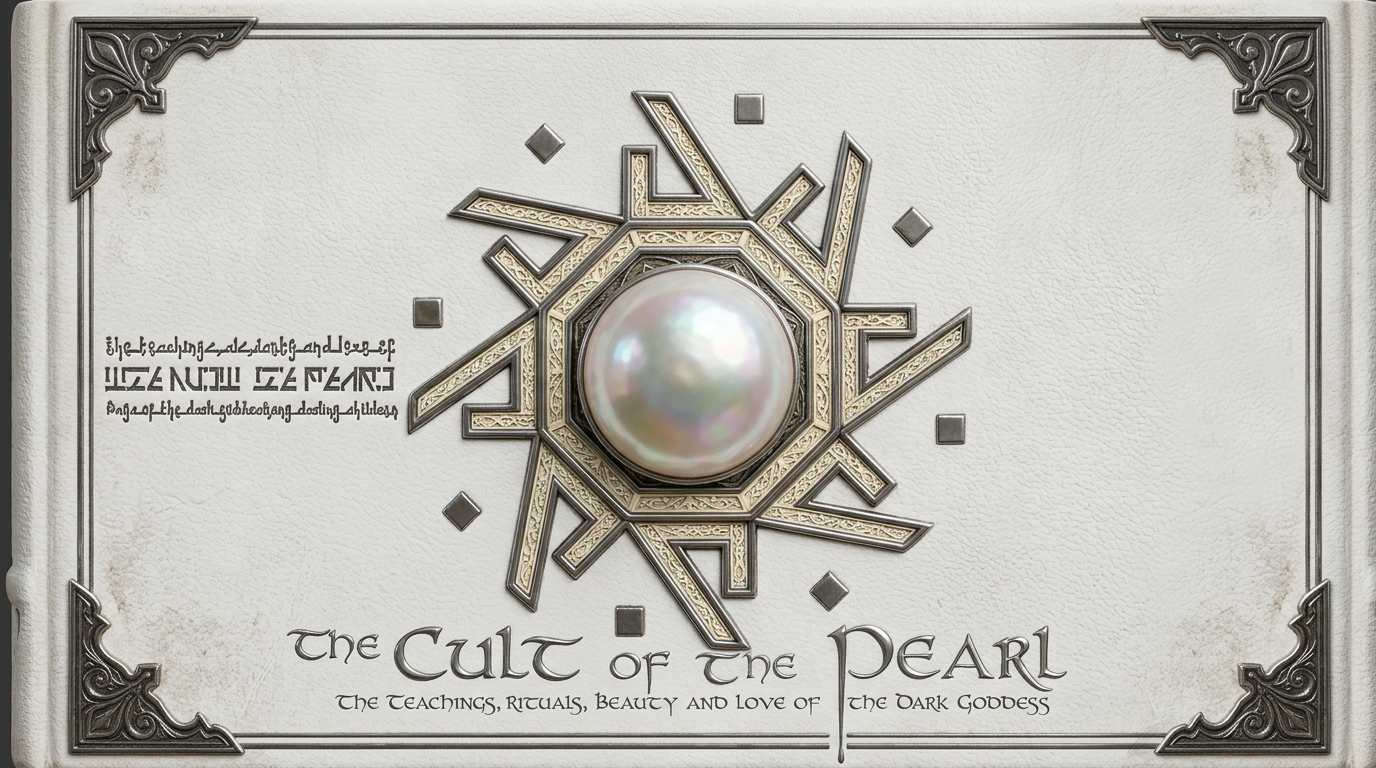

The Dark Goddess is not regarded as a jealous deity, ruler of creation, or divine monarch. Indeed, many among the faithful would object to describing her as a “being” at all, at least not in the manner one speaks of kings, spirits, saints, or the lesser gods of the world. To the followers of the Pearl, she is not a throne-bound authority issuing commands from some distant celestial court. Rather, she is understood as the Night Above, the endless sky stretching beyond the reach of mortal sight, the darkness between the stars and the stars themselves.
To speak of The Dark Goddess is often to speak not of a person, but of principles. Beauty, abundance, wonder, desire, pleasure, creation, potential, and connection are all counted among Her Ways, while the force that moves through these things—the unseen current which binds life to life and draws creatures together beneath the heavens—is called Her Magik. Thus the faithful concern themselves little with questions of cosmic origin or divine genealogy. Whether she created the world, whether she existed before the stars, or whether she shall endure after them are matters considered less important than understanding the world which presently exists and the blessings that may be found within it.
The Pearl teaches that all life possesses beauty. Not merely the beautiful, nor solely the fertile, strong, wealthy, or admired, but all life. Every creature possesses value. Every creature possesses potential. Every creature possesses a place beneath the stars. Because of this belief, the faith rarely speaks in terms of sin, corruption, or inherent unworthiness. Instead it speaks of neglect. Neglect of beauty. Neglect of affection. Neglect of joy. Neglect of companionship. Neglect of one’s own nature. To the Pearl, suffering often arises not because life itself is flawed, but because creatures deny themselves that which nourishes the spirit. Thus the religion places great emphasis upon self-discovery, emotional honesty, companionship, celebration, and the pursuit of meaningful fulfillment. Followers are encouraged to seek lives that feel complete rather than lives that merely conform to the expectations of others.
Marriage is respected within the faith but is not required. Love is celebrated but is not required. The Pearl teaches that these things possess sacred value when they occur naturally and sincerely, yet it does not insist that all folk must pursue identical paths through life. Some become devoted mates. Others remain wanderers. Some raise large families. Others dedicate themselves to art, scholarship, music, exploration, or service. The faith does not demand that creatures love, marry, reproduce, or bind themselves to a single path. Rather, it teaches that beauty may be found in many forms and that fulfillment cannot be imposed from without. What matters is that one lives honestly, appreciates the wonders of existence, and allows life to flourish where it may.
The central principle of the faith is Acceptance. This concept appears so frequently within Pearl teachings that many outsiders mistakenly assume it to be the religion’s sole doctrine. Yet among the faithful, Acceptance is understood not as passive tolerance but as active recognition of value. Their oldest sayings summarize this philosophy in three simple declarations: We Accept. We Worship. We Adore. We accept beauty wherever it may be found. We worship life wherever it flourishes. We adore creation in all its forms. Such phrases appear engraved upon temple walls, embroidered into ceremonial garments, sung within hymns, and repeated throughout countless blessings offered by priests and priestesses. To many followers these words represent the purest expression of the Pearl’s worldview.
The faithful believe that every star in the sky shines equally upon all creatures. The Dark Goddess does not choose favorites. The stars do not discriminate. Neither should those who walk beneath them. This belief forms the foundation for the religion’s reputation for hospitality and openness. Travelers are often welcomed within Pearl temples regardless of origin.
Orphans, widows, laborers, merchants, artists, nobles, wanderers, and foreigners alike may find shelter beneath the symbol of the Pearl. Music, art, companionship, storytelling, affection, and celebration are considered sacred pursuits, not because they distract from life, but because they deepen one’s appreciation of it. A beautifully sung song, a well-crafted sculpture, a heartfelt embrace, a night spent among friends beneath a starlit sky—these are regarded as acts which bring the faithful closer to understanding Her Ways.
Among the countless sayings attributed to the Pearl, none is more common than the phrase “Look Upward.” It appears in prayers, temple inscriptions, hymns, and common conversation alike. To outsiders the expression may seem simple, even naive, yet to the faithful it encapsulates the entire philosophy of the religion. Every star above serves as a reminder that beauty exists even in darkness. Every point of light is proof that wonder may be found in the most distant places. Every creature, no matter how small, humble, lonely, or forgotten, shares the same sky. To look upward is therefore to remember that one is part of something greater than oneself—not through fear, obligation, or submission, but through participation in the endless beauty of existence. In this way the Pearl teaches that no creature truly walks beneath the heavens alone.