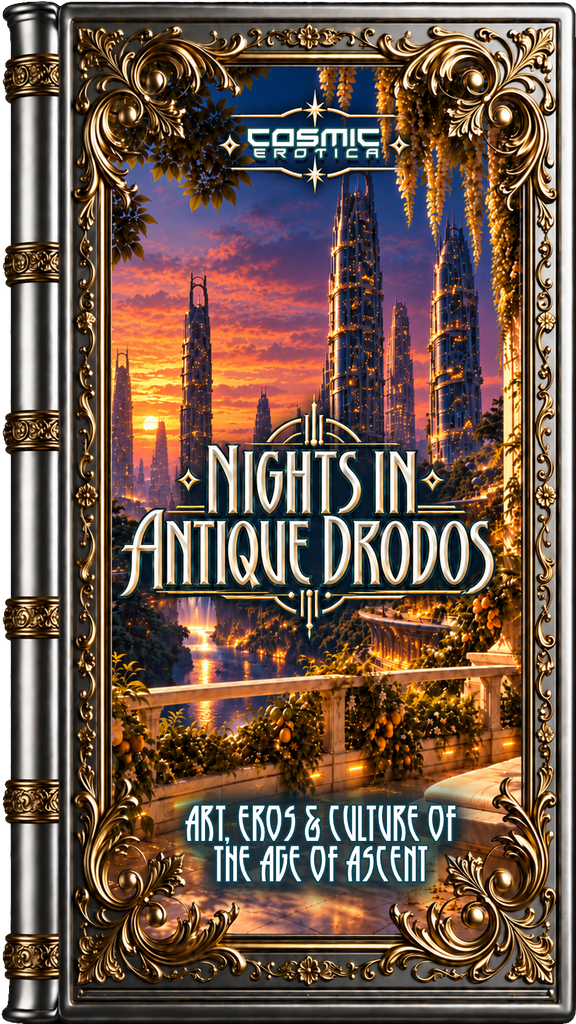




The Ancient City of Drodos
Classification:
Ancient Metropolitan Arcology Complex
Location:
Thanator, Ran System
Historical Periods:
Precolonial Construction Era; Early Colonial Period; Age of Ascent; Ascension Wars; Golden Age of Thanator; Imperial Age
Civilizational Significance:
Principal Center of Commerce, Prosperity, and Cultural Development
I. Historical Origins and Precolonial Construction
Among the great metropolitan centers of Thanator, few possessed an antiquity, continuity of habitation, or enduring civilizational significance comparable to the ancient city of Drodos. Its origins extended millions of years before the arrival of the first colonial populations, placing its earliest foundations within the immense precolonial construction programs undertaken by the autonomous engineering fleets responsible for establishing much of the original habitation infrastructure throughout the Ran System.
These extraordinary mechanical enterprises, operating across periods of time almost incomprehensible to the civilizations that would eventually inherit their works, erected vast metropolitan structures in anticipation of future settlement.
Drodos was among the most important surviving achievements of this endeavor, distinguished by the completion of three colossal arcology spires prior to the arrival of the colonists. Each tower represented an independent metropolitan structure of extraordinary capacity, incorporating reinforced structural systems, vast transparent façades, internal agricultural facilities, residential districts, industrial infrastructure, and extensive provisions for environmental isolation and security.
Together, these three completed spires constituted one of the earliest fully operational urban foundations available to the emerging civilization of Thanator, establishing an architectural and infrastructural inheritance whose importance would persist across millions of years of subsequent development.
The arrival of the first colonial populations transformed Drodos from an ancient construction achievement into one of the principal foundations of permanent settlement upon Thanator. At this early stage, the small moon remained overwhelmingly dominated by its native jungles, a vast and remarkably productive biosphere inhabited by formidable reptiles, immense predatory birds, subterranean arthropods, and numerous other dangerous organisms.
Foremost among the threats confronting the earliest inhabitants were the enormous horned chameleons, some exceeding twenty feet in length, whose climbing abilities, speed, predatory intelligence, and extraordinary projectile tongues allowed them to threaten exposed residents even upon the elevated terraces of fortified metropolitan structures.
Against such conditions, the preexisting security of Drodos was invaluable. Its immense structural strength, exceptionally resilient glass, controlled approaches, and successive defensive barriers furnished the colonists with an established refuge from which permanent habitation, agriculture, commerce, and industrial development could proceed.
Although its fortifications would undergo substantial refinement as the settlers confronted the realities of their environment, the city provided a degree of immediate security and metropolitan organization that the young colony could not otherwise have readily reproduced.
II. The Age of Ascent and Metropolitan Expansion
During the Thanatorian Age of Ascent, Drodos emerged as one of the foremost centers of colonial prosperity, commercial development, and architectural expansion. This comparatively peaceful period was characterized by sustained industrial growth and the establishment of the second phase of great arcologies, constructed through the increasingly sophisticated engineering capabilities of the colonial population itself. The distinction between these later structures and the original precolonial spires was of considerable historical importance, representing the transition from a civilization primarily inhabiting an inherited metropolitan infrastructure toward one increasingly capable of reproducing and extending such achievements through its own resources.
At Drodos, this transformation became especially visible through the construction of two additional arcology spires, whose immense frameworks rose beyond the three completed towers and gradually altered the skyline of the ancient settlement. The continued expansion of the metropolis reflected the growing population, productive capacity, commercial demands, and technological confidence of the developing Thanatorian civilization.
The city itself developed into an increasingly elaborate environment of interconnected metropolitan districts, elevated thoroughfares, cultivated terraces, residential galleries, commercial establishments, and extensive botanical installations. Great architectural bands encircled the immense spires, providing foundations for agricultural gardens, flowering vegetation, and landscaped public spaces suspended hundreds of feet above the surrounding jungle.
Within these protected environments, urban life flourished in marked contrast to the dangerous wilderness beyond the city’s fortified boundaries. Commercial activity expanded alongside the growth of residential populations, while the concentration of specialized industries, skilled labor, administrative services, and increasingly complex markets established Drodos as a principal center of economic exchange. Its importance was not limited to the production and distribution of material goods, for the city’s accumulated infrastructure also supported the development of cultural institutions, ceremonial traditions, recreational activities, and an increasingly sophisticated metropolitan society.
The great fertility celebrations associated with the upper gardens and public precincts of Antique Drodos belonged to this wider tradition of communal observance, illustrating the relationship between the city’s agricultural foundations, social identity, and cultivated prosperity.
III. The Commercial Heart of Thanator
The enduring economic importance of Drodos derived from its exceptional combination of antiquity, infrastructure, productive capacity, and accumulated institutional continuity. Unlike the many settlements founded during successive periods of colonial expansion, Drodos possessed a metropolitan foundation already established upon the arrival of the first inhabitants, allowing commercial institutions and supporting industries to develop around an unusually durable concentration of urban resources. Over successive generations, its residential districts, agricultural systems, manufacturing establishments, transport facilities, and markets became increasingly interdependent, forming a metropolitan economy whose influence extended far beyond the immediate boundaries of the original three spires.
As additional settlements appeared throughout Thanator, Drodos retained a privileged position within the developing commercial order, serving as a focal point for the exchange of manufactured goods, agricultural products, technical expertise, specialized services, and the accumulated wealth of an expanding civilization. Its prosperity was therefore neither confined to a single industry nor dependent upon one period of political ascendancy, but arose from the sustained concentration of economic activity across an exceptionally long historical continuum.
The significance of Drodos as the commercial center of Thanator was strengthened by the city’s equally important cultural influence. Wealth accumulated within the metropolis supported increasingly elaborate forms of public architecture, private consumption, leisure, artistic production, and civic ceremony, establishing standards of metropolitan refinement that extended outward into the wider colonial society. The city’s luxurious elevated residences, cultivated botanical environments, ornamental goods, distinctive fashions, and sophisticated consumer industries represented the material expression of this prosperity. Such developments also demonstrated the increasingly pronounced distinction between the raw conditions of early colonial survival and the mature urban society that emerged during the Age of Ascent.
Drodos was no longer simply a fortified settlement from which the surrounding wilderness might be confronted. It had become a major center of consumption, cultural production, commercial sophistication, and social prestige, whose population could enjoy the benefits of an extraordinarily advanced urban environment while the civilization beyond its ancient foundations continued expanding across Thanator.
IV. Cultural Primacy and Civilizational Continuity
Throughout its long development, Drodos occupied a position of exceptional cultural significance within Thanatorian society. Its extraordinary antiquity furnished the metropolis with a historical authority unavailable to most younger settlements, while its sustained prosperity allowed successive generations to preserve, reinterpret, and expand the traditions associated with the earliest periods of colonization. The relationship between the ancient structures and their inhabitants became a defining feature of the city’s identity, for its population occupied an urban environment whose original engineering history extended millions of years beyond the recorded experience of the colonial civilization itself.
In this respect, Drodos embodied both inheritance and achievement: the monumental infrastructure of an earlier technological undertaking, and the cumulative accomplishments of the Ranar populations who transformed that inheritance into a flourishing cultural and commercial center. Its architecture, ceremonial observances, consumer traditions, artistic life, and metropolitan customs consequently acquired a continuity extending far beyond the duration of individual political administrations or periods of economic development.
The preservation of this cultural identity was particularly significant as Thanator approached the great conflicts that would conclude the Age of Ascent. The outbreak of the Ascension Wars terminated the preceding period of relative peace and introduced the opening struggles of what would eventually become System War One, fundamentally altering the political and military circumstances of the Ran System.
Yet the historical importance of Drodos was not confined to the comparatively prosperous era immediately preceding these events. Its deeper significance rested upon the extraordinary duration of its metropolitan development and its established role as a center of Thanatorian economic and cultural life. The political transformation of the system, the emergence of increasingly powerful institutions, and the eventual expansion of Thanatorian authority into a far greater imperial structure belonged to historical developments occurring upon foundations already centuries and millennia old.
Drodos had been an ancient city before those struggles began, and its commercial and cultural traditions constituted an essential part of the civilizational inheritance carried into the succeeding ages.
V. Drodos and the Golden Age of Thanator
By the emergence of the Golden Age of Thanator and the subsequent expansion of its imperial civilization, Drodos already possessed a metropolitan history of extraordinary duration. Its commercial importance, architectural sophistication, and cultural influence had been established long before the Empire attained the immense technological, industrial, and territorial scale that would characterize its mature development. In the wider historical record, the city consequently represented a rare continuity between the earliest habitation of Thanator and the vastly greater civilization that ultimately arose from the Ran System.
The immense industrial enterprises, monumental engineering projects, and expanding imperial institutions of later ages belonged to a society whose historical foundations included the agricultural terraces, commercial districts, fortified spires, and cultivated public spaces of Antique Drodos. Although the scale of subsequent Thanatorian development would eventually surpass the circumstances of the original colonial metropolis by extraordinary orders of magnitude, the antiquity of Drodos and the durability of its institutional inheritance continued to distinguish it from later urban centers.
The city was thus more than an architectural relic, a colonial capital of commerce, or an enduring monument to precolonial engineering. It represented one of the central continuities of Thanatorian civilization, maintaining its association with prosperity, cultural refinement, economic exchange, and metropolitan achievement across an immense sequence of historical transformations. Its three original spires, inherited from the autonomous construction fleets, stood at the beginning of this history; the later expansion of its arcologies, commercial institutions, and cultural establishments reflected the growing capabilities of the civilization that occupied them.
From the dangerous jungles of the earliest colonial period through the relative prosperity of the Age of Ascent, the conflicts preceding imperial consolidation, and the subsequent grandeur of the Golden Age, Drodos remained inseparable from the historical identity of Thanator itself. Long before the Empire extended its authority across distant worlds, before its industrial achievements attained their greatest scale, and before its political institutions acquired the dimensions of an interstellar civilization, Drodos had already stood for millions of years as an enduring center of Thanatorian commerce, prosperity, and culture.