




To comprehend the full aberration that is Thanator. its singular ferocity, outlier status, and the paradox of its ascendency, one must begin by dismissing any comforting notion of cosmic justice or proportionality. Thanator was never large by the standards of empire, nor particularly blessed in mass, resource, or natural position. It does not stand, when mapped against the grand register of imperial holdings, among the giants; its dimensions are modest, its gravities unimposing, its origin unremarkable save for what followed. In the dry taxonomy of the Administrate, Thanator belongs alongside other small Vandaniums, system-anchored satellites like Rethka and the barren, largely forgotten Kalba—bodies whose only contribution to the imperial engine was the occasional consignment of strategic mineral, a stream of uranium or silver that never altered the fate of a single great fleet.
By the onset of the 27th age, Thanator had begun to acquire the gravitational authority that precedes true centrality. No longer a predatory node on the rim, it was now named—sometimes with venom, sometimes with awe—as the de facto capital of the Ran system.
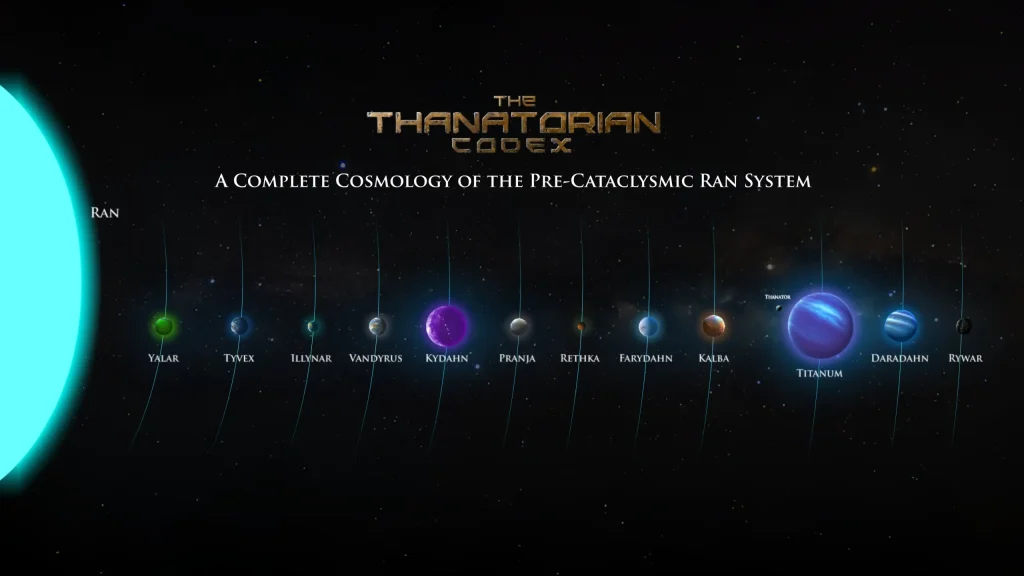
The old imperial cartographers still marked Kydahn as the ancestral heart, its palaces and archives reminders of a more decorous era, but in practice, the flows of power and tribute vectored toward Thanator. In war councils, in the movement of mercenary bands, in the scheduling of grain and isotope convoys, Thanator’s priorities overrode precedent. Even before the first golden age unfurled, its ascendency was less an event than an accumulating fact: the other worlds had ceased to debate Thanator’s dominance and had begun instead to calibrate their ambitions—and their obedience—to the reality of its reign.
Worlds such as these are classed by pattern, not by promise. Their destiny is to persist, to serve as waystations or resource nodes, the backdrop for more consequential dramas. The empire’s ledgers record them as appendices, footnotes, variables stable enough to be omitted from the central equations of expansion. The machinery of conquest neither expects nor rewards greatness from such places; they exist as placeholders, scaffolding for greater structures. Yet it is precisely in this field of the expected and the expendable that the possibility for anomaly germinates.
Thanator, even within its own solar context—circling the Ran star, dwarfed by more massive kin—carried the unassuming profile of a world destined for mediocrity. It lacked the planetary gravitas to make a fitting throne, the breadth to sustain a population of titans, the lush redundancies to tempt early imperials with dreams of plenty. That it should rise, not merely to defy these odds, but to rule its system and break the knees of any who refused the ring, stands as a violation of the universal ledger, a statistical heresy no imperial census could ever predict.
What makes Thanator’s ascendancy truly disturbing is not that it succeeded by means of raw abundance or positional advantage, but that it rose through a violence of will and an inventiveness of cruelty that the greater worlds never required. Its emergence as a capital was a consequence of policy sharpened to a knife’s edge, of identity forged through perpetual threat and ruthless selection. Its systems of governance and warfare—lean, intolerant of excess, bred to hunt and to punish—became not just survival mechanisms, but the template for an entire system’s submission.
It must be understood that Thanator was in no sense a tamed world. Its landscapes remained perilous, its weathers hostile, its native ecologies unforgiving to the unwary. Civilization did not arise in spite of this savagery, but because of it. That anything resembling an ordered society could not only survive but thrive amid such conditions stands as a rebuke to conventional wisdom. Where most worlds of its stature were domesticated by slow accretion—broken to the yoke by the patient hand of imperial will—Thanator remained feral beneath its banners, and its rulers thrived not by pacifying their world, but by mastering the art of enduring and weaponizing its hazards. The fact that Thanator could project dominion outward, command allegiance, and shape the fate of neighboring worlds speaks less to geographic accident than to the singular and merciless character of those who called it theirs.
The civilization that took root on Thanator did not sprawl in the manner of lesser, softer worlds. Instead, its cities rose as engineered fortresses—megacities of deliberate scarcity and unyielding density, their footprints measured and constrained by necessity, their interiors riotous with compressed opulence. These were not the horizontal conurbations of imperial tradition, but vertical palaces: archologies sheathed in shimmering steel and silvered glass, latticed with transparent titanium and veined with crystalline adamantine composites. From a distance, they appeared as monumental spires and terraces stacked with luxuriant precision, every square meter speaking to both mastery and paranoia. Within these citadels, the privileged and the powerful moved through corridors of engineered abundance, insulated from the hostile world beyond by walls that were both fortress and gallery, every inch reflecting the will of a civilization that learned to cultivate not the land, but itself—intensively, relentlessly, and always with an eye to the perpetual siege of Thanator’s wilds.
Lesser worlds may persist for eons, never noticed, their fortunes rising and falling with the tide of imperial audits. Thanator, small and initially inconsequential, inverted this logic. By the time of its 27th age, it had bent its neighbors, compelled oaths from the haughty and the hopeful alike, and extracted fealty with a precision that bordered on ritual humiliation. Its authority, never grounded in geography, was secured instead by the fear it inspired and the certainty with which it enforced its precedence. Civilization on Thanator was not the result of fortune or gentle progress, but a kind of stubborn miracle, a testament to the ruthlessness and ingenuity of its architects—creatures for whom survival was a covenant of dominance, and whose vision for order began and ended with their own unyielding rule.
UPCOMING LORE:
- Regime
- Chronology
- Legacy
- Origin
- Decline
- Ecology