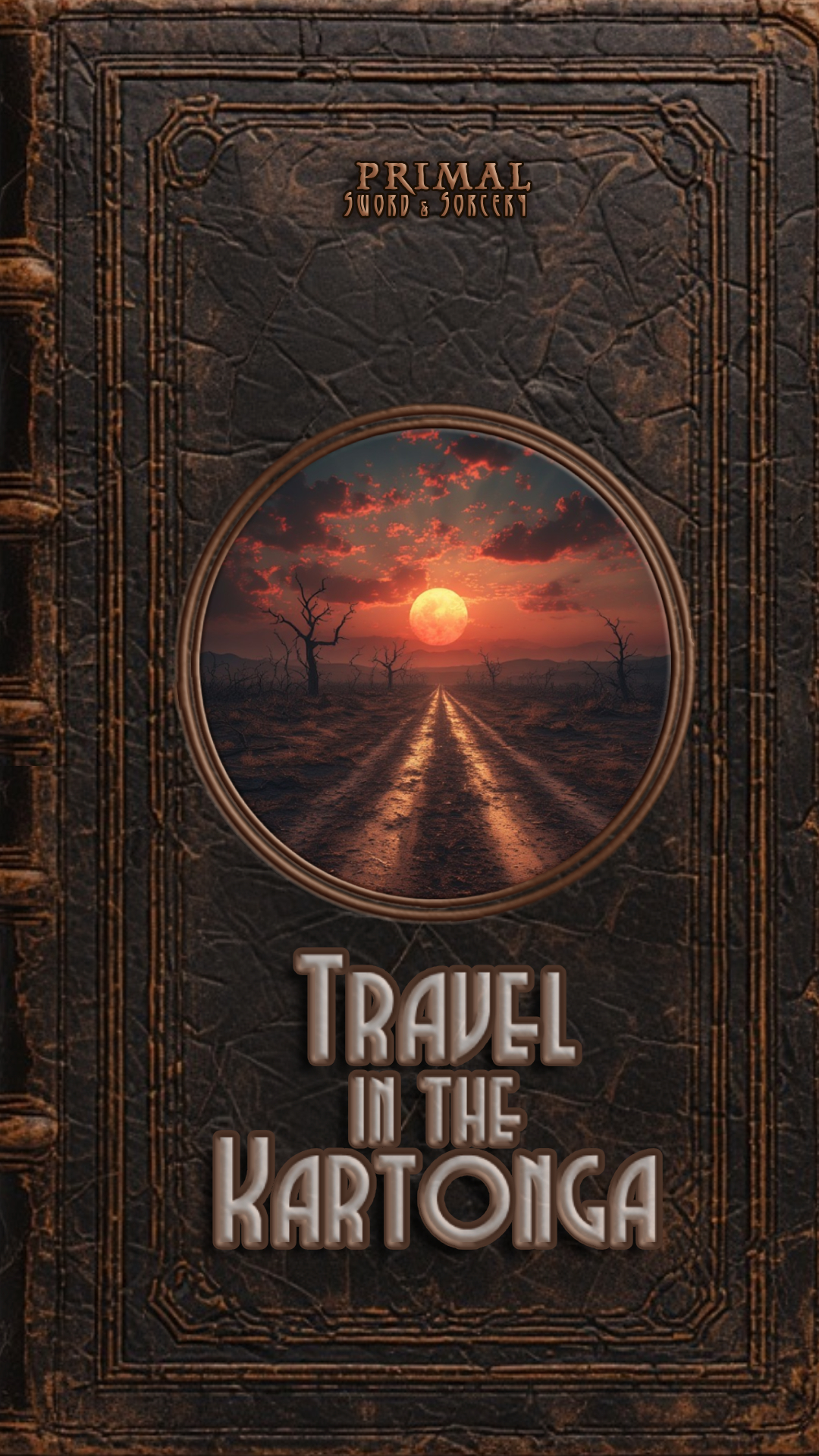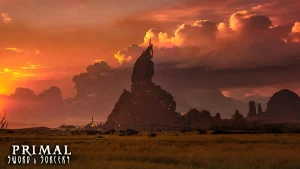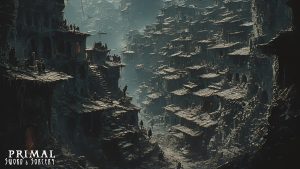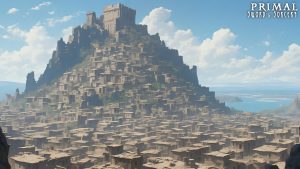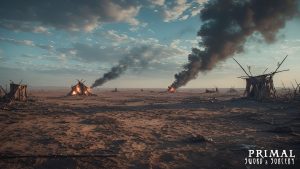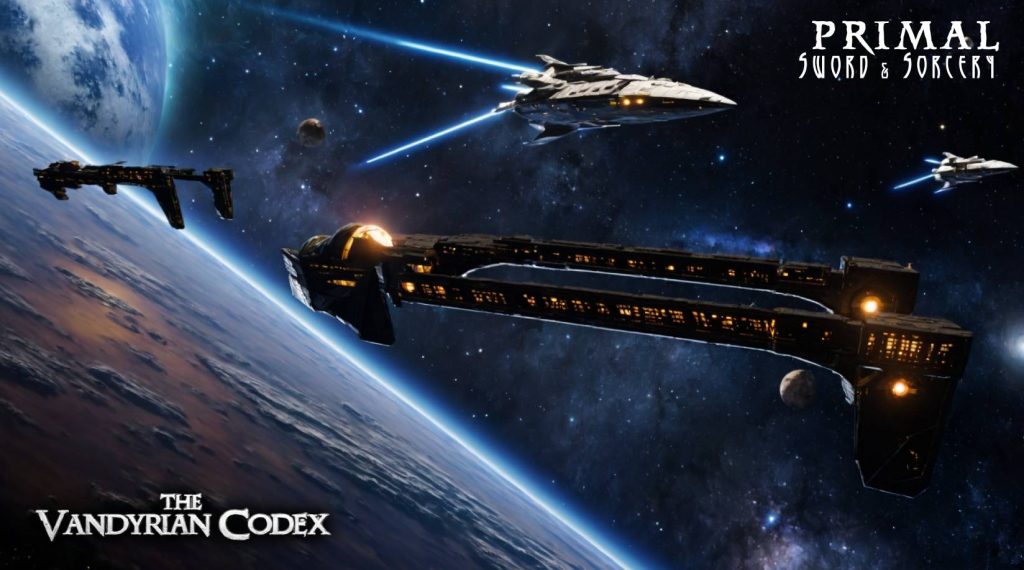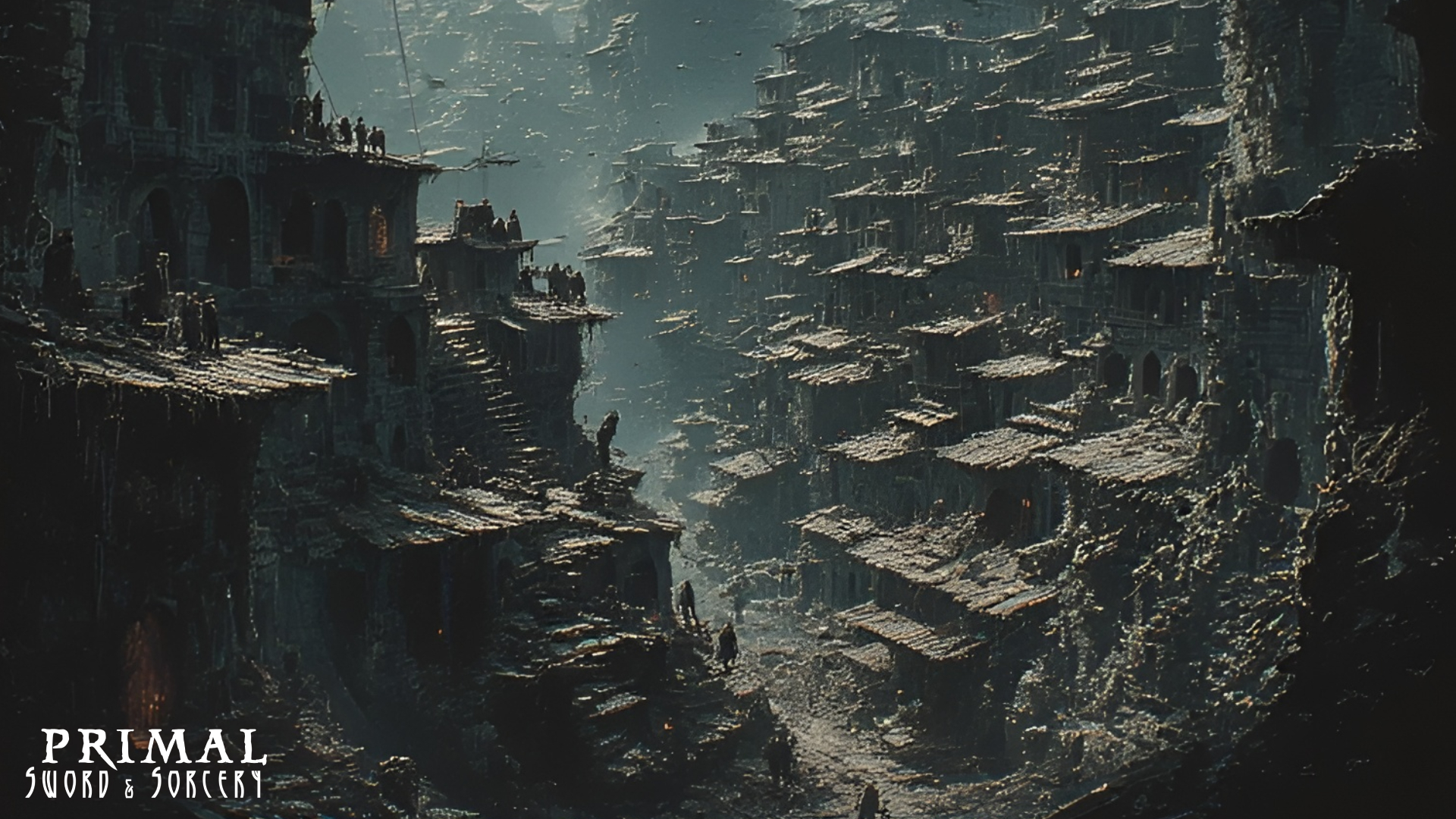
South of Old Kartong, the region of Tranga stands as a transitional scar rather than a settled province—a place where the authority of the city dissolves into dust, and where permanence itself is treated as a liability. The land is marked not by borders that hold, but by the remnants of attempts to impose them: collapsed tent-lines hardened into brittle husks, trade paths that shift with each season’s wind, and low stone outlines of structures that were never meant to endure. What remains is not abandonment in the pure sense, but a thinning of intention. Tranga is not empty. It is simply no longer claimed in any way that matters to those who understand how power functions in Kartonga.
Category: Primal Sword & Sorcery
-
The Vandyrian Codex – Book III
The Realms of Vandyrus
Continents
Each essay has many more links to other areas
- Zhuru – The Great Contest
- Roedon – Broken Crown of the West
- Vulsa – The Kingdoms of Steel
- Tymere – The Gilded Mire
- The Doomed Continent of Drael
- The Empires of Gamandor
- Bruwa – Realms Paid in Blood
More Regions are In Production
Londorai
Suthku
Ranza
Vandura
Mea -
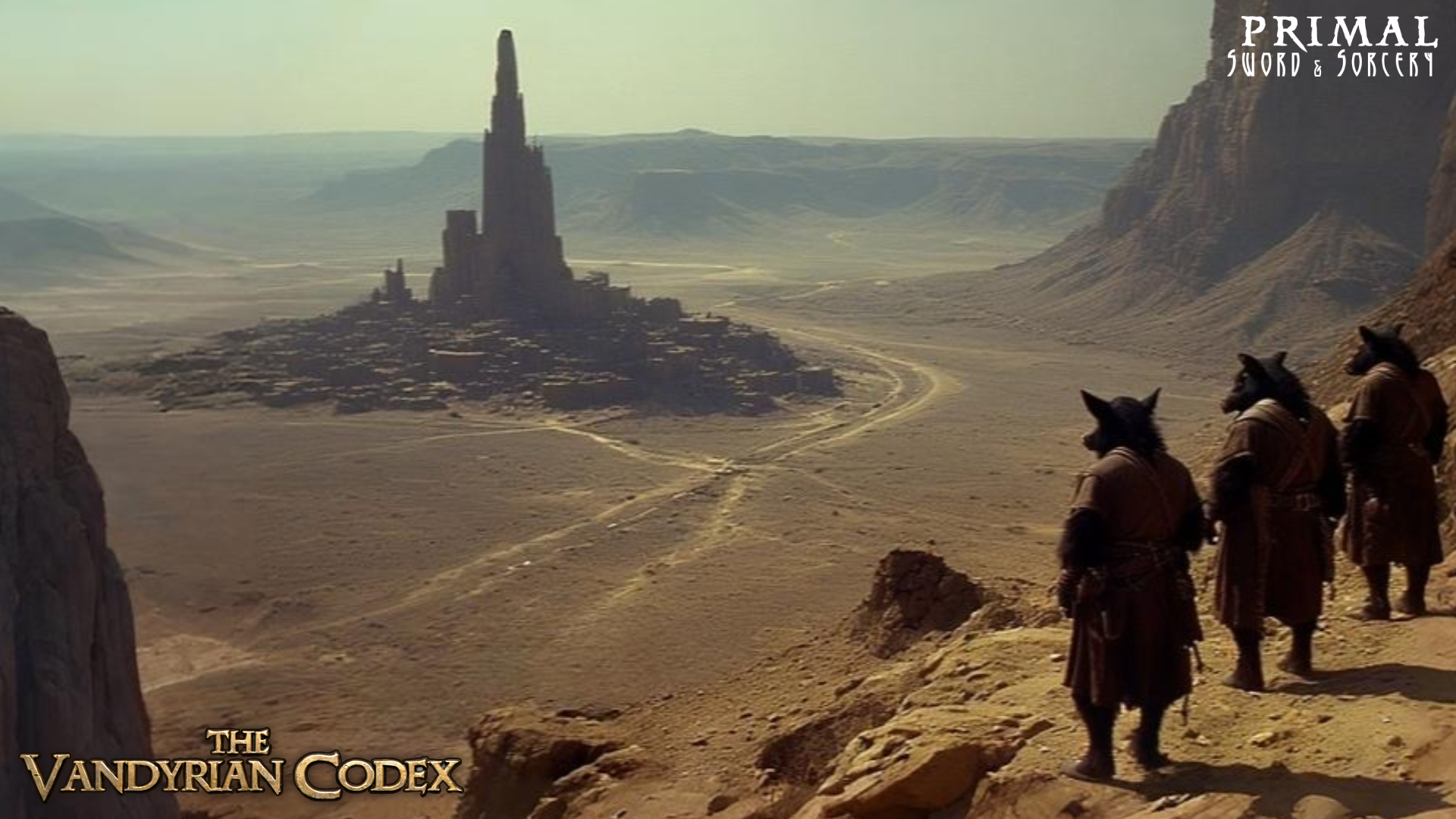
The Outlands
The Outlands are not a poetic term for “foreign” nor a romantic catch-all for distant kingdoms. They are the parts of Vandyrus that exist outside civilization in the strictest political sense. Civilization, in the Vandyrian framework, means a named kingdom with confirmed borders, recognized authority, and the ability to enforce law over its territory. Every area falling beyond that territorial net belongs to the Outlands.
The Outlands are where settlement does not equal sovereignty. They are the scattered zones where old strongholds, ruined cities, forgotten trade hubs, half-functional forts, and entire den-sites still stand, but none of them fall beneath a modern banner. They’re fragments of previous ages that neither died nor fully rejoined the living world. Their existence is the direct consequence of the cataclysms, migrations, wars, and demographic collapses that shaped the map; the borders of the kingdoms tightened, but the ruins didn’t move.
Because no crown claims them, every population center in the Outlands follows its own law. Some are tribal. Some are criminal. Most are fractured. They are not “empty wilderness.” They are populated, often heavily—but the structure is improvisational: scavenger towns, bandit redoubts, mercenary havens, old frontier cities fallen out of political orbit, shrines turned into slums, collapsed den-cities whose lower halls still shelter life. Commerce and bloodshed operate side-by-side without any greater authority to stabilize them.
Nothing about them is arbitrary. They are an inevitable product of the map: every settlement left behind when boundaries shifted becomes an Outland node, and those nodes accumulate desperate folk the way a cracked cistern gathers runoff. Kingdoms tolerate them because they sit outside the borders; kingdoms fear them because they grow into nests of crime, militia, cultcraft, and off-the-books commerce.
The most infamous outland stronghold is Old Kartong, the central hub of The Kartonga Wastelands who inherit it’s vile name.
More on The Outlands
-
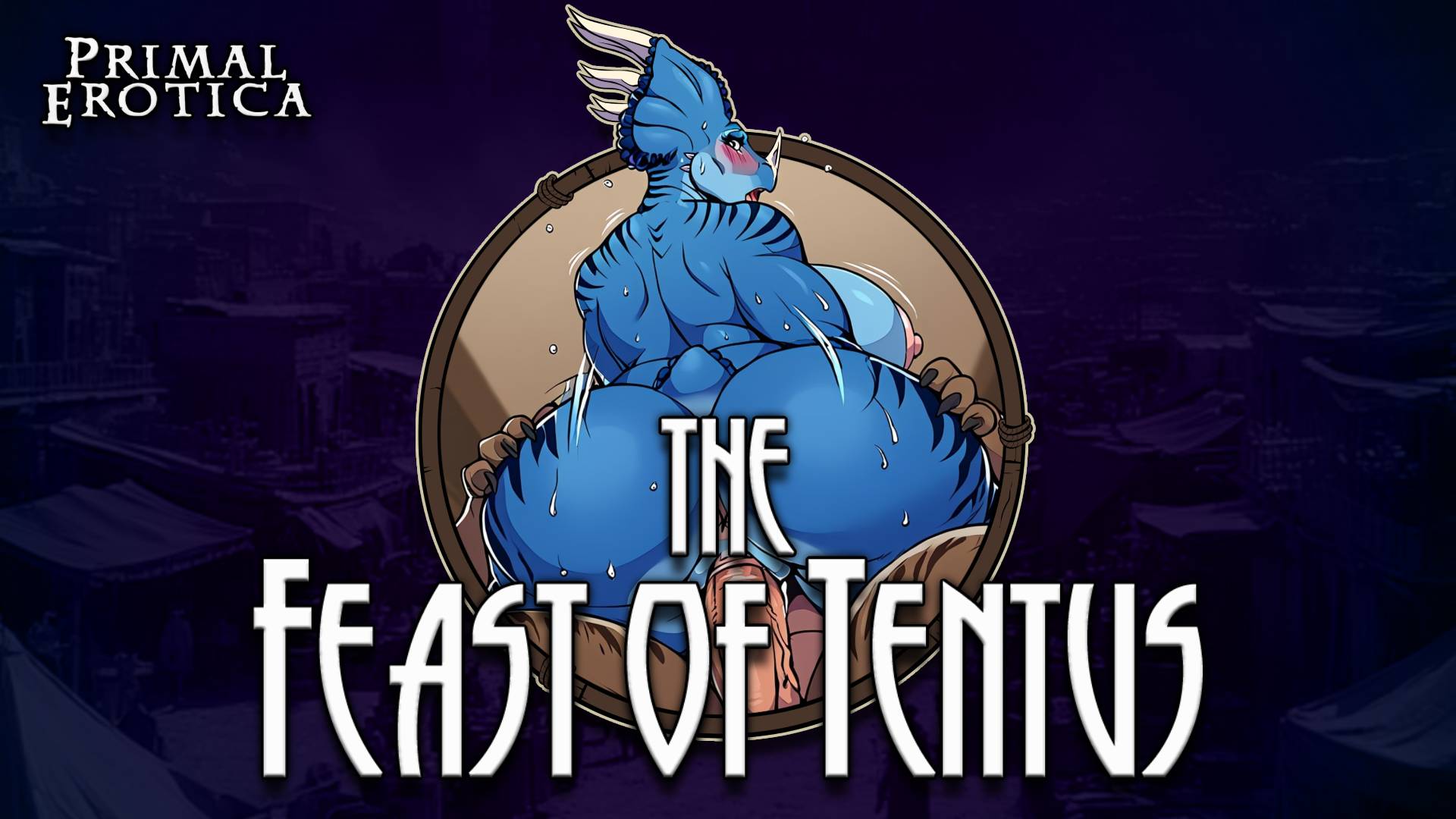
The Feast of Tentus
“Tentus is the open mouth of Drael, a city squatting in the bowl of an ancient impact scar where stone was once turned to vapor and sky burned white. It is not among the four great thrones of the north, nor does it pretend to rival the hidden citadels beneath ash and serpent-ruin, yet it endures because it performs a function none of the greater powers care to soil themselves with: exchange. Trade, vice, spectacle, execution. If Drael is a wound, Tentus is the clot that never quite seals, thick with caravans and carrion both. Drael itself is described in the old tablets as inverted—surface ruin masking subterranean dominion.
Tentus is surface made permanent. The crater’s rim forms a natural amphitheater, jagged stone rising in broken arcs like teeth around a tongue of dust. At its center yawns the Pit, a vast arena carved deeper into the impact basin, ringed by terraces of basalt and bleached bone. From above, the city appears circular and organic, streets spiraling down toward the Pit in widening coils, each ring a district of trade, degradation, and ambition. The Deinonychus lords claim Tentus as neutral ground. Whether they truly rule it is debatable. The scaled barbarian tribes of Drael’s surface—raptor packs, Spinosaur flotillas from the marshes, feather-crested velocian assassins—send emissaries and enforcers, but none sit a permanent throne there. That absence is deliberate.Tentus thrives because no single warlord dares claim it entirely. To do so would disrupt the delicate machinery of vice and barter that feeds all sides.”
I
Dust came first—the long brown veil that rose from the ash flats and stuck to her tongue, that scoured her cheeks when the wind came hard across the old bones of the land. She felt it against her horns like grit against stone, a rasping kiss that told her the road to Tentus was near. The mature styracosaur shaman took the rise slow, spear butt clicking on fractured slate, axe slung at the hip for anyone foolish enough to think a hungry tribe meant a helpless envoy.
Her bosom lay heavy beneath her harness, wrapped in worn blue cloth that smelled of sage and smoke; her blue cheeks had the habit of flushing when the sun broke free of cloud, and it did so now, throwing a hot stripe across her face that made her blink and squint.
The heat kept the scent of her sweat close. The heat made the flies bold. The heat made everyone on this broken road irritable and dangerous, and she counted on that because danger kept true, while promises were a softer breed of lie.
They noticed her as they always did. A pair of lizard porters with scarred tails, bellies gaunt beneath their belts; a crocodilian pilgrim draped in river beads and old reeds; three hyena sellblades who were laughing at nothing and everything. Males let their eyes fall to her cleavage and then bounce up when they remembered the horns. She did not mind the appetite—appetite made the world move—and she did not slow.
She had been told the brown allosaur in Tentus sometimes traded favors for favors —She had been told he bartered in flesh and spectacle as much as in coin. She had been told many things by storytellers who had never rutted with hunger or looked down the long throat of a dying season. The steppe behind her had gone to rust and thorn. The last calves had fallen. What she carried now — a few trinkets, a bundle of salt-cakes, and a prayer — was not a bargain. It was an excuse to be seen.
The grass had grown tall and then fallen in the wrong storms, mold taking it in a soft black creep that killed what cattle they dared keep near the marsh. The hyenas who crossed the sea had burned what they could not carry—this was their humor—and the tribe’s store-caves now breathed like hollow mouths.
She’d taken the last of the good salt cakes, the rolled canvas of medicinal moss, the small jar of sun-thick honey beads, token gifts to grease tongues. It would not be enough. It had never been enough with Tentus; that city ate in the rhythm of drums and spent in the rhythm of hips, and called it order.
On the high road into the basin she paused to piss, turned away from traffic toward the split slate and the sparse weeds. Relief warmed her thighs, then cooled in the breeze. When she straightened, adjusting the wrap at her chest, a young iguanodon with a rusty mask of paint stood ten paces off.
His eyes had the skittish shine of those who ran messages; his tail twitched a pattern that meant fear trying to dress up as bravado. He kept his head low but his stare low too, fixed where the blue cloth crossed and pressed her bosom together.
“You’ll get yourself hurt looking like that,” she told him without heat. “I’m only looking at what’s there,” he said, a little too quick, and stepped back when she shifted the axe on her belt. “You go to Tentus?”
“I go to whoever will sell me a season.” She picked up her spear and shouldered past. His scent was salt and young rut and the dust of the road, and it faded behind her soon enough because the city smell took over—blood smoke, meat char, latrine stink, perfume of cut sap from the arena stakes, and the hot iron breath of the forges where bone and bronze met and disagreed.
Tentus crouched in the basin like a jackal that had eaten too much and still wanted more. Its stone teeth rose in jagged palisades patched with old idols, shellacked with the fat of festivals and the filth of losing nights.
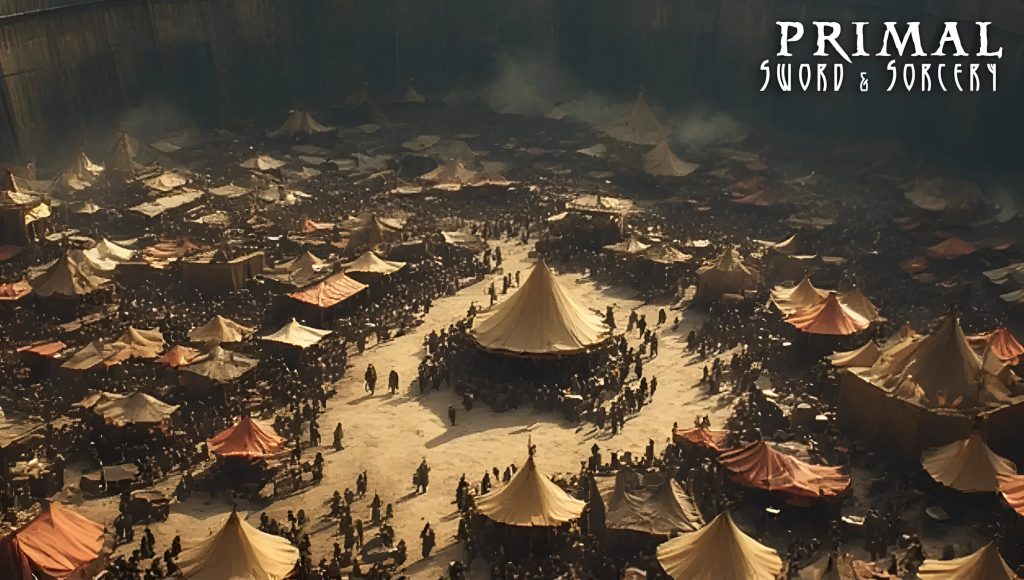
She had come as a girl once, more horn than sense, with her mother’s voice still in her ear; she had come again as a healer walking the plague lines when the flies overtook the river rats and a fever cut through the ribbed poor like a bright knife. Now she came as something else, something like a merchant but with nothing to sell but her dignity and what flesh the gods had given her.
She spat to throw the thought out like a bad seed. It clung anyway. At the gate the guards played their usual game—ask a little too much, hope for a bribe, stare a little too long at the curve of her chest to see if blushing might open her purse. She let the blush come; she could not help it in this heat. But when the shorter of the two, a skink with a gold ring between his nostrils, drifted from stare to step, she tapped the haft of her spear once on the stone.
The sound was not loud. The sound said: consider the points at the end and the weight of the axe and the weight of my patience. They stepped aside. Her sandals took city stone. Inside the wall, Tentus moved like meat on a spit. Hammocks swayed with dripping females, bosoms pierced, coins dancing between thighs; dust devils collected cheers in the arenas and flung them down again; a butcher’s boy wrestled a slab of purple meat while a crowd bet whether it came from something with feathers or scales;
Somewhere a priest hissed funeral words over a bloated corpse, a pale snake coiled in his hands, its tongue flicking the dead man’s lips as if to taste the soul and pass arcane judgements.
She angled past a canvas where females oil-slicked and laughing wrestled on their knees while some born-to-crown fool sprayed a rain of coins to watch them slap. The coins fell too fast and rolled in dust; fate had that habitVendors shouted inventories that sounded like poems. Needles for stitching hides. Needles for stitching holes in the meat. Needles for stitching holes in pride. Clay balls filled with musk for males who needed to smell stronger than they felt. Glass beads that turned sunlight into knives to scare carrion birds.
She tasted iron on the air and thought of her tribe’s huts and how the wind went through them too easily now that the hyenas had given the rafters to fire. She did not pray. She had already prayed on the ridge when she saw the road. The gods had given their answer in the shape of this city and its appetites.
A gambler’s drum took up a steady beat as she wound toward the war-quarter, a simple three-note call that meant numbers were going to be found out one way or another. The brown allosaur kept a hall near the bone-yard where the old champions’ skulls were stacked and stacked until the smell of lacquer and pride hung thick. His name did not matter; names changed with throats. What mattered was that his appetite was the sort that made caravans move and starving villages bend, and that he had sent word through salt lines that he would make trades if the trade amused him.
She could smell the pipe resin they said he liked from halfway down the narrow. She stopped at the hall mouth to straighten her wrap. She tightened the blue cloth over her bosom, a gesture of modesty that was really just armor. She rolled her shoulders once, pulling aches into the sockets where they belonged, and felt the old strength cinch around bone and sinew like a belt. Males would watch her walk in; they always watched.
They would measure her hips and her chest and the length of her horns and pretend that was the same as measuring her will. She let them think it. Then she stepped into the shade, spear at her back, axe at her hip, hunger at her heels, and the smell of resin and smoke unrolling ahead like a promise that tasted exactly like a price
II
The Allosaur Warlord did not greet her at once. He never did with petitioners. He sat sprawled at a bone-table slick with meat and fruit, the smoke of his resin pipe curling from his nostrils as though to draw a boundary around her in the air. He chewed and spat, tore cartilage with teeth made for rending, not savoring, and let her stand in the shadow while the minutes dragged.
When she shifted her weight, the crack of a spear-butt on stone snapped through the hall. His servant hadn’t been told; the gesture was instinct. The message clear. Patience was his, not hers.
She endured. She had endured the screams of fever victims as their tongues blackened. She had endured the smell of her tribe’s huts when the hyenas lit them. She would endure this too. But every crunch of bone between his jaws was meant for her, each wet suck of marrow another reminder that she was prey standing before a predator’s table.At last he wiped his mouth with the back of his hand and leaned back. His eyes found her bosom first, not her horns, not her arms. He stared with the lazy hunger of a drunk too full to bother pretending. The grin came slow, curling his lip until the smoke bled between his teeth like steam escaping rock. His tail flicked once, twice. The guard’s spear dipped half a handspan. That was all it took for her to know the balance had shifted.
“Food. Resources. Materials,” she began, forcing steadiness she did not feel. “The hyenas leave us nothing but ash. My people starve. You know this.”
“I know what I hear,” he said, voice thick with grease and smoke. “I hear weakness. Matriarchs who cannot defend their nests. Horns like banners, tits like milk-jars, and still you come here begging.”
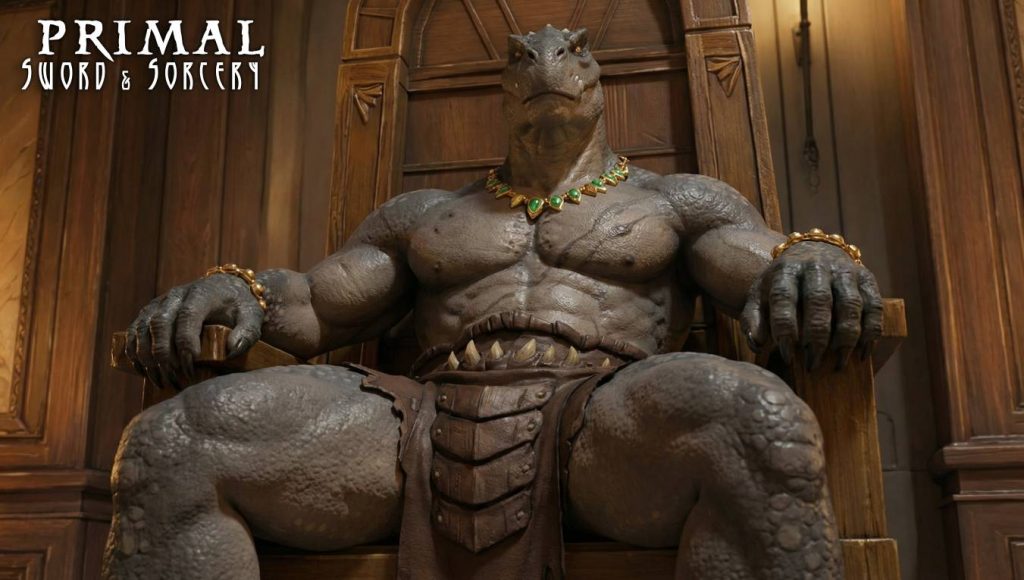
He sucked the last shred of marrow from a bone and tossed it aside, where it landed near her foot like a warning. “Why should I not feed you to the pit and let the crowd laugh at your squeals?!”
Her grip on the axe tightened, though she kept it low. “Trade profits both,” she said. “You have stores. We have—”He barked a laugh, low and scornful. “You have nothing. Nothing but that.” His chin dipped toward her chest. The twitch in his jaw told her exactly what he imagined. “And that, shaman, is worth more to me than all your starving tribes.”
Her stomach burned, but she stood her ground. This was Tentus. To flare, to draw blood, was to lose everything.
He rose, slow and deliberate, his scars catching the firelight. The pipe swung from his lip as he circled her, tail scraping the flagstones. His musk thickened the air. Servants withdrew without a word. The hall fell silent but for his steps and her breath.
“You came to beg,” he said at her ear. “Now you will beg properly.”
He did not touch her then. He only returned to his furs, took up another rib, and began to eat again as if she had already ceased to exist.
Hours passed. He heard messengers. He counted coin. She waited, motionless, the ache in her thighs spreading into her back. The smell of grease and fruit thickened the air until it felt like another punishment.
When he finally flicked a claw in her direction, it was without looking up. “Come.”
And she knew that whatever bargain would be struck, it would not be struck in words.
III
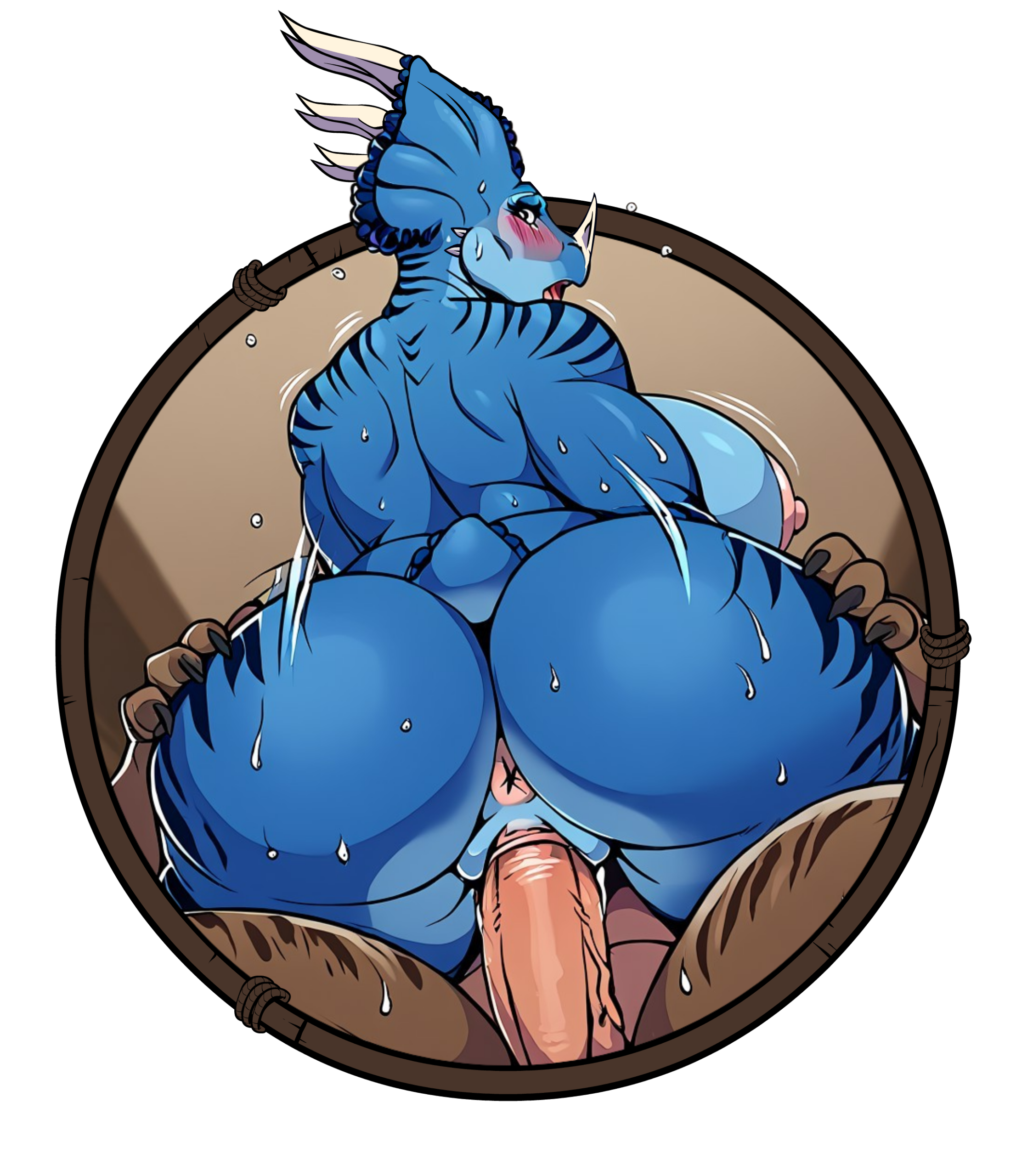
He lounged like a prince of bones, thick tail stretched across the furs, cock buried deep inside of her warmth already, a spear that had claimed far too many victories in the past.The styracosaur shaman straddled him, blue hips rolling, flushed bosom swaying, sweat dripping from her horned brow. Her thighs trembled from labor; the ache in her back had grown into a constant burn.
Yet he did nothing but recline, wine cup balanced in one claw, smoldering rib-meat dripping fat down the other, yellow eyes half-lidded with pleasure.
His shaft stayed stone-hard, but not through any effort of his own—she was the one doing all the work, grinding, bouncing, moaning, trying to coax his release again and again.
“Pathetic,” he said around a mouthful of charred flesh, voice rumbling like an insult carved into her marrow. “You sweat and squeal like a sow, and still your tribe starves. What good is a matriarch who cannot even rut properly?” Her blue cheeks burned darker, shading toward purple.
Rage, shame, arousal—all knotted so tightly she could not untangle them. She tried to form words, to explain, to deny, but his claw came down on her bosom with a stinging slap that made her squeal like a calf.“Then go back,” he sneered, pinching her nipple until her vision blurred. “Go rut with your own weak males. Let them pant and dribble seed into you while your children chew bark.”.
His laughter was cruel as she worked her naked blue flesh above him. Her protest caught in her throat. Every time she had spoken, he had silenced her with laughter, with pain, with command. So now she moaned instead, high and desperate, hips working faster in spite of herself. Her cunt clutched him, slick and clenching, betraying her station and her disgust alike.
He drained his wine and held the empty cup aloft. A slave hurried to refill it, eyes flicking to the shaman’s bouncing bosom, lips twisted in a smirk of mockery. Others brought trays of meat, the scent of charred beast heavy in her nostrils. She recoiled, stomach tightening at the sight of him tearing sinew from bone even as his cock throbbed inside her. He relished her disgust, chuckled when she flinched.
“You hate it,” he said, snapping bone with his teeth. “You hate that I eat while you serve. But your tight fat cunt… ah, it relaxes me. A good suckling cunt, full of heat. You might even be worthy of it, if you learn.” Her teeth ground together. She hated him. Hated the way her body betrayed her, hated the way her nipples stiffened under his claws, hated the way the flush of her cheeks slid purple with need.
She whined, high and trembling. “I have been at this for hours…”
“Hours?” He laughed, deep and cruel. “Hours are nothing. A true vessel milks her master until his hunger is drowned. Watch.”
He seized her tit, yanked until she shrieked. She had learned: arms behind her head. Her bosom thrust forward, vulnerable, obedient.
He nodded, satisfied. Slaves lingered, watching her rut while handing him another rib, another jug of wine. She squealed with each thrust, not daring to stop, not daring to falter. The shaman loathed every gaze upon her, loathed the way they whispered and smirked. Her tribe’s enemies would starve her kin, and here she was, sweating, bouncing, riding the warlord’s cock while he feasted.
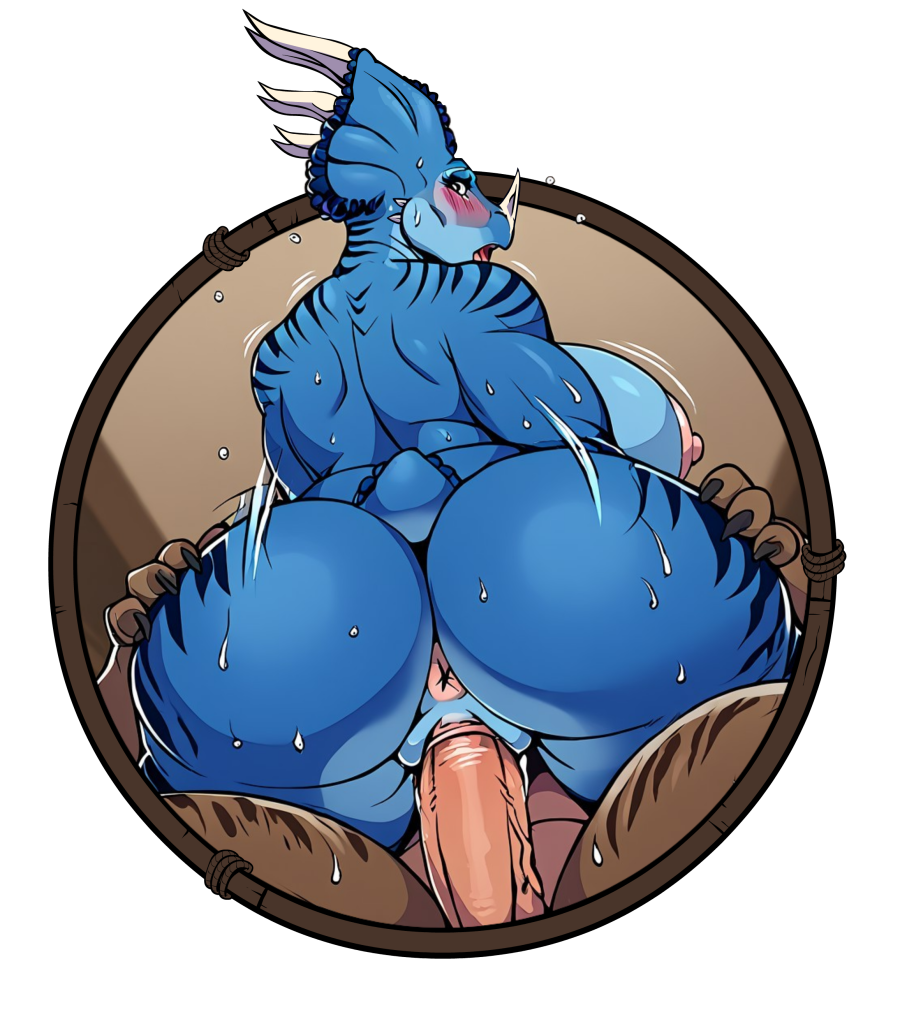
“Perfect,” he said, chewing loud. “Seed and meat together—what more could a male want?”
She saw the moment come: his jaw snapped bone, fat running down his chin, and at the same time he groaned and spilled inside her. She recoiled, horror surging like bile—yet she forced herself to stay, forced herself to present, cunt swallowing his spurts, bosom bouncing in rhythm to his release.She nearly slapped him, nearly broke the spell with fury—but he saw it in her eye, grinned, and dragged her down hard, burying her to the root. Her head snapped back, scream tearing the air like a prayer that would never be answered.
Her hips ached, bosom slapped against his chest, sweat rolled down the blue of her cheeks until the flush had turned purple. “Too stiff,” he sneered, giving her breast a sharp slap. “Roll your hips, cow. Spiral it. You’ve got potential.” She gritted her teeth, hating that his words cut both ways—mockery, and yet a kind of instruction.
This was not how things were done in her tribe; rutting was quick, fierce, equal. Here she was reduced to squealing and whining, her arms behind her head on his command while his slaves looked on and laughed. “You’ll learn,” he drawled, tearing a rib in half with his teeth. “A good suckling cunt deserves training.”
Her thighs trembled, but the allosaur only leaned deeper into his furs, belly streaked with grease, cock jutting skyward like the mast of a war-raft. Still, She rolled her hips, forcing the spiral he demanded, bouncing hard and fast, breath breaking in sharp whines. Every movement sickened her—this was not rutting, not the way her people knew it—but her cunt betrayed her, clutching his shaft, sucking him deep. His eyes burned yellow-gold as he sipped his wine and let her do the work. Her loathing was a hot coal inside her, yet her body betrayed her—cunt clenching, hips rolling in figure-eights just as he’d shown.
He drank deep, swallowed meat, and when the second orgasm ripped through him, he timed it with a swallow, moaning as if her tightness and the taste of charred flesh were the same pleasure. He pulled her down hard, burying himself, and she screamed, not in triumph but in horror that her body had obeyed so perfectly.
When she licked her lips, desperate for water, he barked a laugh. “Thirsty? Here, cow. Drink.” He caught her by the horns and poured the wine down her throat, red and sharp, burning her tongue, filling her belly with fire. She coughed, sputtered, swallowed, and the world lurched sideways—the walls bent, the smoke curled into shapes, the slaves’ faces swam. The wine was too strong, drugged or simply bred for a stomach thicker than hers. He roared with laughter as she swayed atop him, grinding harder, looser, her cunt slicker for the heat in her veins.
“Good! I feel it. Loosened up, little cow. You ride better drunk.” His claws dug into her ass, spreading grease across her hide, smearing rib fat onto her flanks until her rump gleamed with it.
Her backside slid against his scaled thighs, oiled not with perfume but with the juices of his feast. She gagged on the stench—meat, smoke, resin, sex—all tangled together. Each slap of her hips smeared more grease over her haunches, down between her thighs, until she was painted in his appetite. The slaves smirked as they brought another tray, staring openly at her bosom as it slapped against his chest. She wanted to cry out, to curse, but the wine made her moan instead, a low animal sound that sent him over the edge.
He bit down on a rib, swallowed a hunk of meat, and groaned as he spilled into her, spurting seed while grease ran from his claws onto her ass. He timed it perfectly, chewing, swallowing, and ejaculating in one lazy rhythm, as though she were just another dish in his banquet. She screamed—whether from orgasm, horror, or both she no longer knew—and collapsed forward, her bosom crushed to his chest, her cunt clenching on his shaft even as she hated every second. He laughed, belly shaking, and licked wine from his teeth. “Perfect. Meat and cunt, the two true gifts. And I get both at once.”
She sagged against his chest, bosom pressed flat and glistening with sweat, cunt still fluttering around his cock though he had emptied into her many times already.
Her breath came in sharp squeals. He only leaned back further, smearing grease into her hide with the casual stroke of a claw, laughing deep in his throat. “Look at you,” he said, tilting her head back by her horns so he could see her cheeks. “Not blue anymore. Purple. That’s what a real male’s seed does. Paints your face with heat. Shows the truth of you.” She snarled, low and desperate, but the wine made it break into a moan. The floor swam beneath her hooves, the walls twisted into coils of smoke, and still his cock stood iron-hard inside her. She tried to slow her hips, to catch her breath, but his claw slapped her bosom again, the sting making her squeal high and pitiful. “Not enough,” he mocked. “Not nearly enough. Roll them wider. Spiral your hips, cow. Yes. That’s how you milk me. Don’t stop. Don’t you dare stop.”
She obeyed. Not because she wished it, but because every time she resisted, his claw pinched her nipple until her eyes watered and the slaves laughed. She hated their stares, hated the smirks curling their muzzles as they filled his cup, as they dabbed grease from his scales only to smear it across her rump. Her backside was slick now, shiny with meat-fat, each bounce making a wet slap against his thighs. “A thick matriarch begging with her cunt.” he said, chewing loud, flecks of flesh falling into the fur beneath them. “A Grass eater. A vessel of weakness. Do your horns tremble knowing you were bred for this?” Her cunt betrayed her again, clenching hard around him. She threw her head back and moaned, ashamed at how deep it struck her.
Loathing gnawed her, not only for him but for herself. She had never been skilled in the ways of sex; her station had allowed few chances. Now she found herself guided like a calf in the pen, taught how to grind, how to squeal, how to please a carnivore who tore meat with his teeth even as he spilled into her womb. He poured more wine down her throat, and she swallowed in desperation, tongue thick, belly burning.The hallucinations deepened—his teeth gleamed like moons, his tail like a serpent winding the hall. Her body moved easier, looser, driven by drug and humiliation both. “Good,” he chuckled, tugging her arms back behind her head again. “fat tits high. Cunt tight. This is how you’ll beg for me.” She squealed, purple blush staining her cheeks, and rolled her hips in violent figure-eights. Her breasts bounced with each thrust, fat and heavy, slapping against her chest while his claws tugged and twisted. She hated him. Hated herself more. But her body reached anyway, her cunt rippling, pulling, dragging his seed from him until he groaned and thrust once—just once—and spilled into her, yet again.
He swallowed meat as he came, grease dribbling onto her ass, his laugh shaking his belly. Pressing down onto her thick trembling rump as he ejaculated long and deep into her. “There,” he said, patting her tit as though marking a tally. “and Just three more before the sun sets.” She whined, high and broken, but kept grinding because protest had earned her nothing but pain, and obedience at least gave her the rhythm of his release. Her eyes rolled back as the searing heat of his load washed over deep inside of her.
Epilogue
The door flap had barely fallen shut behind the styracosaur when he barked a laugh, slapped his thigh, and raised his cup. Resin smoke and meat fat hung heavy in the hall. Her axe and spear leaned against the bone-table, gleaming with fresh grease where he had touched them, already claimed as trophies. “Look at that,” he said, stretching out long in his furs, cock still streaked, belly full. “Big horns, heavy tits, a matriarch of grass-eaters — and I sent her out of here bow-legged, leaking, and unarmed. I let her keep her rags. Jewelry alone would’ve been prettier, but…” He blew smoke toward the rafters.
“Better to let her keep a scrap of dignity. That way when she comes crawling back, I can strip it from her slow.” The slaves chuckled, sharp teeth flashing. One poured wine; another laid a new tray of ribs. He ignored them as he always did. He wasn’t talking to them. He wasn’t even talking to anyone in particular. He was talking to the hall, to the rafters, to the bones, to himself — because he knew every claw and fang in his war-band could hear him, and they were grinning in their guts. “They call me a pain in the eye of civilization,” he said, chewing slow. “Good. To horn-cows and grass-eaters, I am pain. To hyenas across the sea, I am nightmare. But to my raptors? To my pack?” He raised the rib in salute, grease running down his arm. “I am king.” He leaned back, sighing through smoke.His grin widened as he saw her spear glint in the firelight, his trophy now, proof of her humiliation. “Six times I spilled, and she rode every drop. Didn’t matter if she blushed, didn’t matter if she cried, didn’t matter if she hated it. She worked for me. She bled sweat for me. She learned my rhythm.” He licked the last of the grease from his claw. “That’s civilization. That’s Tentus.” The hall laughed with him, a chorus of snorts and tail-slaps. He drank deep, wine staining his jaw, and thought of her purple cheeks, her squeals, the way she staggered out with her head down. He had given her nothing but “consideration,” and still she would come back. They always did.
The laughter of the hall faded behind her, swallowed by the dust and the wind. She staggered up the embankment barefoot, the blue cloth clinging damp to her bosom, every step a throb between her thighs. Her axe and her spear were gone—his trophies now, shining in the firelight of Tentus. She cursed him under her breath, cursed the city, cursed the hyenas across the sea. Each oath felt thin, rattling out of her beak like brittle shells. The road stretched long and gray ahead, the grass withered to stubble. Her horns ached, her bosom burned from his claws, her cunt still leaked in thick pulses.
She tried to spit, to clear the taste of his wine from her tongue, but the fire lingered in her belly, the heat it had kindled refusing to leave. And in the hollow of her mind, in the place she would never speak aloud, she knew the truth: it was when he had been most despicable that her body had betrayed her most. When he had eaten meat and laughed, grease dripping on her ass, when he had called her a cow and slapped her tit raw, when he had spilled into her with his mouth still chewing—that was when she had felt her flush deepen, her hips loosen, her heat rising.
She hated him for it. Hated herself more. The shame scalded worse than the bruises. She pressed her thighs together as she walked, but the ache only grew, a cruel rhythm that matched the memory of his belly shaking with laughter. Behind her, the smoke of Tentus climbed the sky.
FROM THE VANDYRIAN CODEX
-
The City of Tentus
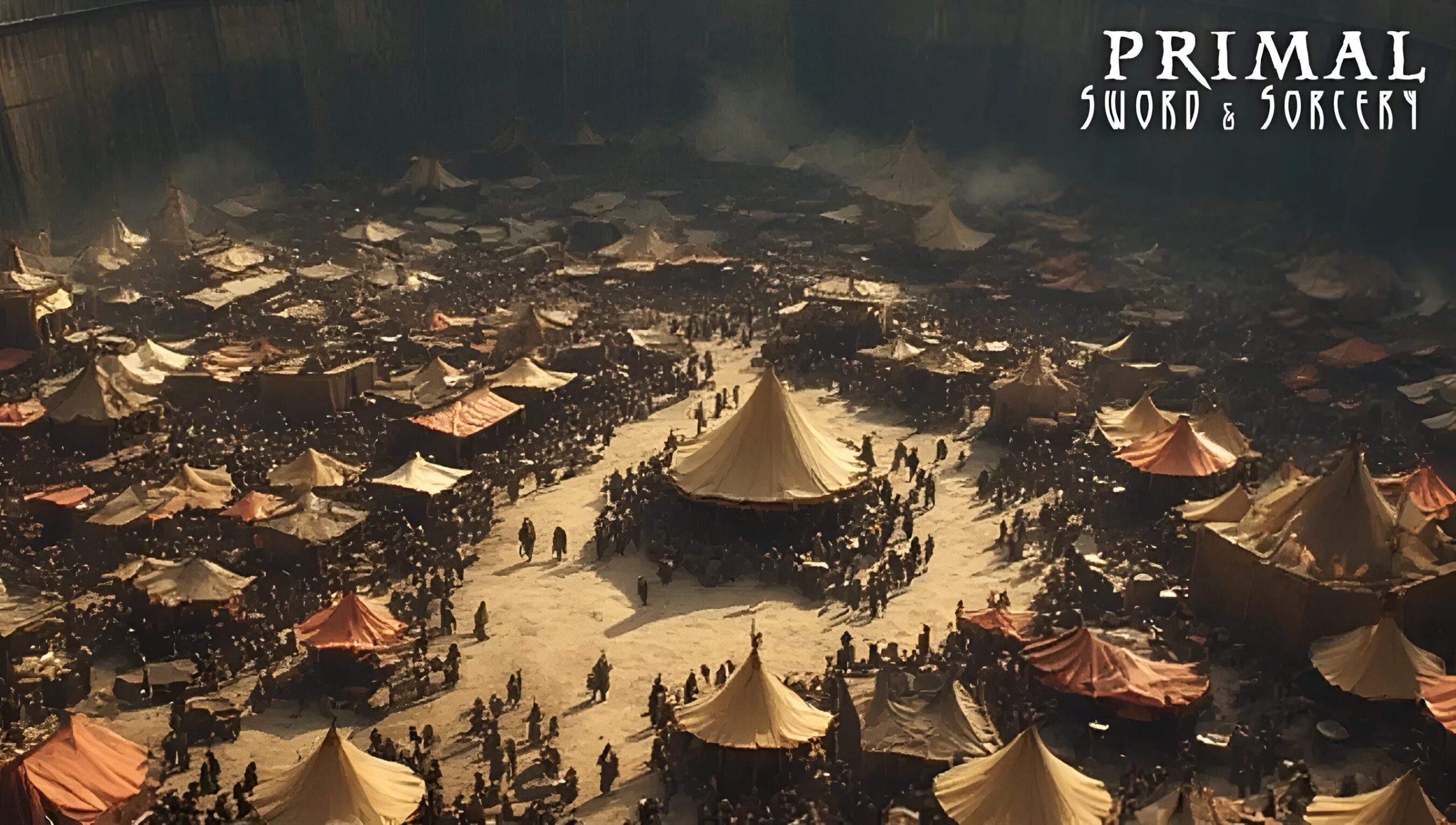
Tentus is the open mouth of Drael, a city squatting in the bowl of an ancient impact scar where stone was once turned to vapor and sky burned white. It is not among the four great thrones of the north, nor does it pretend to rival the hidden citadels beneath ash and serpent-ruin, yet it endures because it performs a function none of the greater powers care to soil themselves with: exchange. Trade, vice, spectacle, execution. If Drael is a wound, Tentus is the clot that never quite seals, thick with caravans and carrion both. Drael itself is described in the old tablets as inverted—surface ruin masking subterranean dominion.
Tentus is surface made permanent.
The crater’s rim forms a natural amphitheater, jagged stone rising in broken arcs like teeth around a tongue of dust. At its center yawns the Pit, a vast arena carved deeper into the impact basin, ringed by terraces of basalt and bleached bone. From above, the city appears circular and organic, streets spiraling down toward the Pit in widening coils, each ring a district of trade, degradation, and ambition.
The Deinonychus lords claim Tentus as neutral ground. Whether they truly rule it is debatable. The scaled barbarian tribes of Drael’s surface—raptor packs, Spinosaur flotillas from the marshes, feather-crested velocian assassins—send emissaries and enforcers, but none sit a permanent throne there. That absence is deliberate. Tentus thrives because no single warlord dares claim it entirely. To do so would disrupt the delicate machinery of vice and barter that feeds all sides.
-
![The Vandyrian Codex
[Text Version]](https://www.primalswordandsorcery.com/wp-content/uploads/2025/12/TheVandyrianCodex.jpg)
The Vandyrian Codex [Text Version]
[Written c7005 AC]
On The Vandyrians
To speak of the Vandyrian is to step onto a faultline older than memory, where every word fractures under a burden it was never shaped to bear. The question—what is a Vandyrian?—seems innocent, almost scholarly, until one begins to answer it.
For the Vandyrian is not a folk, nor a lineage, nor a culture, nor even a single empire in the paltry sense that lesser ages use the term.
The Vandyrian is a continental shadow cast across the galaxy, a residue left upon tens of millions of worlds, a design philosophy written into the very bones of every species that breathes beneath the Ran system’s suns.
Lion and wolf, ram and bear; horsefolk of Zhuru, dogfolk of Vulsa, jackals of the wastes; otter, mouse, and every scaled carnivore that stalks the ash or surf—all bear the unmistakable signature of hands that once shaped, culled, reformed, redeployed, and finally abandoned them.
To ask what a Vandyrian is, then, is to ask why the ruins scattered across Vandyrus, Thanator, Kydahn, and their sister worlds share identical geometries, identical power-laws, identical genetic scaffolds; why the peoples themselves mirror one another’s instincts, hierarchies, and neural architectures; why war, order, stratification, and controlled brutality arise again and again as if imprinted not by culture but by inheritance.
If there ever was a singular homeworld it’s name would be ‘Vandyria’ not Vandyrus. According to the conventions of their own language ‘Vandyrus’ translates roughly as: “Within the outer grasp of the Empire of Vandyria.”, marking it as a frontier province, rather than The Imperial Heart.
The Greater Vandyrian Empire
The Vandyrian Empire was not vast—it was impossible. No mortal arithmetic can encompass it. Across innumerable cycles of expansion, extinction, recursion, and renewal, the Vandyrian dominion is estimated to have encompassed on the order of one hundred million star systems.
Not worlds—systems. Entire solar families reorganized to serve military, industrial, or experimental purpose. Moons carved to factory-hollows. Asteroid belts reconfigured into supply nets. Star output harnessed, redirected, or extinguished to suit imperial necessity.
And yet the paradox: almost nothing remains. In the Ran system we see Thanator’s shattered titanic civilization, Kydahn’s engineered splendor, Drael’s scarified substrata—but these are embers scraped from a fire whose heat once reached across the firmament.
Concerning identity. The peoples who now claim the Vandyrian mantle—lion, wolf, ram, bear—are local survivals, nothing more. Their pride rests on instinctual memories, genetic impulses, or the psychological residue of ancient doctrine.
Whether they derive from true Vandyrian stock or were merely designed according to a Vandyrian template no longer matters. Their self-claims are provincial echoes ringing in the husk of a cathedral too vast for modern folk to comprehend.
—
“Vanguard”
The designation “Empire” does not appear in any surviving Vandyrian records. It is a label imposed almost exclusively by those who, finding themselves a mere fractal segment within the greater system, grasped for early classification.
What terrifies even the boldest chroniclers is this: ancient reconstructions suggest that “Vandyrian” most accurately translates to “Vanguard.” Not people. Not empire. Not race. Vanguard. A forward element. A spearpoint. A preparatory force, deployed in anticipation of something larger behind it.
If an empire of one hundred million systems named itself the vanguard, then the unspoken questions become unbearable:
A vanguard for what?
A vanguard for whom?
A vanguard against what adversary or toward what cosmic project so vast that even their colossal empire was merely its opening gesture?
For the originators, such boundaries were irrelevant—a vanguard is defined by function, not domain.
The Cosmology of the Ran System
Before the coming of the Cataclysmic Object—called Doom by the survivors—Ran presided over a family of worlds in rough alignment.
The system boasted planets as varied as the ambitions of their folk: worlds of storm and chemical sea, of verdant forest and rising empires, of savage law and decadent peace. Some bore moons, others rings, some nothing at all but the weight of their own history.
Before the age of doom, Ran’s children moved in stately order, each world bearing its own silent ambitions.
Yalar
The first planet of the Ran system was nothing more than a primordial sphere, wrapped in a choking viridian atmosphere—a world locked in chemical tumult, eternally hostile to biology. Nothing seeded, nothing stirred; the surface swam with toxic clouds and silence.
When Doom arrived, it stripped Yalar of its shroud, peeling away atmosphere and memory in a single, wordless moment. What remained was black stone and vitrified quartz, the surface flash-melted and barren, history erased in an instant.
Yalar is not dead because it never truly lived. There is no record of seed or animal, no fossil or artifact, only heat fractures and the silent testimony of scorched glass beneath a star that now burns on nothing.
Tyvex
The second planet of the Ran system rose out of ancient swamps. In its earliest age, the lowlands seethed with amphibian life, forms poised at the brink of transformation—half-dreaming of legs, lungs, and dominion beyond the mire. The world’s hunger was primordial, its promise uncertain, its waters thick with unspent potential.
Doom’s passing was both verdict and sentence. In an instant, Tyvex was broken—its teeming lowlands and ancient hunger seized by apocalyptic violence, the planet’s future smothered before it could emerge.
Radiation twisted the swamps into a catalogue of mutations. Creatures dissolved into the land itself; flesh and terrain intermingled, life that should have died stubbornly refusing extinction. Storms raged without end. The sky became a vault of poison, each cloud seeded with the memory of catastrophe.
Tyvex persists, but only as an abomination. The planet’s biology recoils from every memory of order. Nothing here is stable—nothing welcomes classification. What livs, does so in mockery of life: refusing extinction, refusing definition, the legacy of a world unable to die clean.
Illynar
The third planet of the Ran system, Illynar was a garden world. Forests ran unbroken for leagues; river valleys bred life in profusion. Tribal cultures traced their beginnings along the watercourses, and two distinct peoples edged toward the first, uncertain glimmers of civilization. The world was green, vital, and poised for memory.
The Cataclysm struck with finality. In a single, shuddering convulsion, Illynar’s core was shattered. Continents ground themselves to powder. The atmosphere was stripped and scoured, ripped from the planet’s surface and lost to the black. Civilization’s first sparks—names, records, beginnings—were erased at the root.
There was no aftermath worth the name. The world was not simply broken; it was atomized. Dust finer than silt drifted across vacuum, too insubstantial even to seed the oceans of Vandyrus. Nothing of Illynar’s life, culture, or ambition survived the hour.
Illynar exists only as absence. There is no language left to mourn it, no relic to recover, no trace to unearth. Its history is a loss so complete it defeats memory, a blank in the record. The third world’s only legacy is its erasure—a silence so total that even Vandyrus’s scholars speak of it with unease.
The Vandyrian Civilization
of the Ran System“Before Doom’s arrival, only two worlds in the Ran system mattered.”
Thanator & Kydahn
These planets did not simply cultivate their own soils or histories; they radiated ambition, dominating their neighbors by design and force. Thanator’s society was relentless—a machinery of conquest, where the refinement of imperial law met a culture of violence that penetrated every institution, from the blood-sport of noble courts to the conscription of whole continents for war. Every festival was edged with cruelty; every law enforced with the threat of steel.
Kydahn, no less ruthless, secured mastery through intellect and precision. Where Thanator flexed, Kydahn calculated, applying superior artifice and administration with a cold authority that tolerated no defiance. Dissent was not crushed in public spectacle, but erased by systems so intricate that challenge became unthinkable. The rivalry between these twin powers dictated the fate of the system; the history of every lesser world was bent by the reach of their fleets and the legacy of defeat they imposed.
The other planets in the Ran system did not orbit only their star, but the gravitational pull of Thanator and Kydahn—the true axis of power. Their ambitions, wars, and bargains shaped the order of all things, and only the Cataclysm could render such striving meaningless. When Doom came, even the greatest designs were stripped of purpose, and dominion became just another memory lost in the dark.
Vandyrus
The fourth planet of the Ran system, Vandyrus was never the heart of empire. It was neither cradle nor capital, but a frontier—provincial, harsh, and unsettled. The planet’s surface was scarred by halls of stone, ziggurats raised to cruel gods, and fortress-cities clinging to the edge of survival. Wolf dens in Vulsa, the lion courts, the serpent vaults beneath Drael—all these were experimental holdings, not homelands.
Vandyrus, even in its height, was a deployment site at the rim of greater dominion, a foothold within the outer grasp of the vanished Empire of Vandyria. If there ever was a true Vandyrian homeworld, its name and location have been lost beyond memory—consumed, perhaps, by their own engines of expansion or annihilated in the chaos that followed their collapse.
When Doom shattered the system, Vandyrus was not spared. Its provinces suffered—the sky torn, the cities battered, neighbors erased in fire and silence. Yet Vandyrus endured, not by virtue but by resilience: conquered twice in history—once by the imperial reach of Thanator, again by those same conquerors returned as raiders—but never truly tamed, never wholly broken. It was backward, brutal, and tough enough to weather the shock that unmade worlds more glorious.
In the age that followed, Vandyrus persisted as the broken heart of a broken system. The survivors built new halls from the ruins of the old, adapted to the void left by lost neighbors, and made civilization from the scraps of disaster. No longer the outpost of empire, Vandyrus became a refuge for those too wretched, too adaptable, or too stubborn to die.
Vandyrus sits at the system’s axis not by right, but by survival. Its people endure, marked by scars, clinging to half-remembered rituals and relics of vanished overlords. The world is provincial still—a brutal province without illusions, bearing the name “within the outer grasp of the Empire of Vandyria.” Its only glory is that of persistence: battered, unbowed, and condemned to memory as the system’s harsh, undefeated core.
Artana – The Moon of Vandyrus
Artana, Vandyrus’s principal moon, was a world on the threshold. From the surface of Vandyrus, distant watchers sometimes saw faint glimmers—evidence of fire, movement, or the first stirrings of civilization. The moon’s surface was scarred and pitted, but some believed enclaves or primitive settlements were beginning to rise. To the Vandyrians, Artana was a mystery—an object of speculation, never fully understood or mapped.
When Doom tore through the Ran system, Artana was battered almost beyond recognition. The lunar surface fractured, its lights vanished, and all hopes of contact or observation were lost in the greater violence engulfing the system. Where another, smaller moon once orbited, nothing remained but a ring of debris—Votah, a shining wound encircling Vandyrus.
In the years that followed, Artana was written off as dead. No signal, no traffic, no reliable sign of life persisted. The Vandyrian record treated it as just another casualty, another monument to ruin and silence. The Votah ring, visible even from the battered surface below, stood as the only testament to what had been.
Yet even now, watchers claim to see faint lights flickering across Artana’s face—a rumor that will not die. Whether these are the sparks of survivors, the work of automated systems, or only tricks of the eye, none can say. To the Vandyrians, Artana remains an enigma, circling above as both scar and warning: a world just beyond knowing, haunted by possibility and loss.
Kydahn
The fifth planet of the Ran system, was a power to rival Thanator—some say its better. The world stood apart: decadent, proud, and technologically sovereign, its cities towers of silent threat and intricate demonstration. Kydahn’s influence checked the ambitions of the system not through open conquest, but through mastery. Its authority was absolute; its reputation, a warning.
Doom made no distinction. When the Cataclysm arrived, Kydahn was consumed utterly—its surface stripped, its core shattered, its substance drawn up and folded into the advancing shadow of destruction. Cities, archives, dynasties, and the very ground itself were all lost in one remorseless hour.
Kydahn left nothing behind but dust and scattered mass, a memory kept alive only by those who once feared its power. Its silence was total; its authority, mocked by oblivion.
Kydahn exists now only as planetary debris and drifting cosmic dust—the aftermath of obliteration, the scene of a massacre scattered through the system’s empty lanes. Its name lingers in bitter stories, haunted by those who claim that, for a time after the Cataclysm, lights of civilization could still be seen flickering among the ruins.
Raiders from Thanator, drawn by the hope of salvage, found only fractured ground and the echoes of a world bleeding out its last atmosphere. Whatever survivors endured, they did so in darkness and despair, and by the third generation, even the lights went out. Now, nothing persists but dust, memory, and the void where Kydahn once ruled.
Rethka
Rethka was a planet defined by contempt. It served the Ran system as a penal world and industrial graveyard—a dumping ground for toxic waste, spent fuel, heavy metals, and those folk deemed too despised, too dangerous, or too inconvenient to be allowed to die anywhere else. Its surface was scarred by slag fields, poisoned seas, and sealed labor zones where survival itself was considered part of the sentence. Nothing was cultivated here except suffering and neglect.
When Doom passed through the system, Rethka did not resist, nor was it spared. The planet was caught fully in the object’s path, its poisoned crust and buried dead offered up without distinction. It is said that the final prisoner looked skyward as annihilation came, smiling as the light rose, whispering thanks to forgotten gods for a death that required no sentence to complete.
There was no aftermath. Rethka was consumed entirely—its crust, its wastes, its buried populations reduced to component particles. The planet’s mass was stripped apart and drawn into Doom’s shadow, scattered beyond recovery.
Rethka no longer exists as a world. It survives only as dispersed matter and as a cautionary name in the records of the Ran system. No ruin marks its passing, no debris field traces its orbit. Even contempt, in the end, was erased.
Titanum
Titanum, the sixth planet of the Ran system, was a gas giant whose secrets eluded even the most ambitious empires. Its atmosphere roiled with storms of unimaginable violence, colored bands wrapping a world whose depths remained unmeasured. Some speculated at a hollow core, others at a rocky or even artificial heart, but no expedition ever returned with proof. Around Titanum orbited two major moons, Thanator and Jotun—each the seat of its own troubled history.
The Cataclysm passed, and Titanum’s storms burned brighter, but the giant itself endured. Probes and landers sent into its depths vanished without a trace, their loss giving rise to tales of mutilation, distant chanting, and abduction by forces unknown. No empire, Vandyrian or otherwise, claimed dominion over the planet; every attempt at mastery was met with silence or disaster.
Titanum’s mysteries deepened in the system’s ruin. The moons that once circled in orderly paths found their orbits changed, battered by debris and the shifting gravities of loss. Thanator and Jotun remained tethered, each altered, each made more perilous by proximity to the unanswerable depths.
Titanum stands untouched, the system’s enduring riddle. Its upper layers rage with storms, its heart unrevealed. Attempts to pierce its clouds are met with failure or madness; those who claim to have heard chanting or seen lights within are dismissed as mad or lost. Thanator and Jotun circle still, orbiting not only a planet but a question that no survivor has answered.
Thanator – Moon of Titanum
Thanator was the jewel of the Ran system—a moon-empire whose palaces soared above jungle canopies and whose civilization was both feared and envied.
Here, violence was refined into art, and debauchery became the science of courts and warlords. Thanator’s fleets ranged far; its reputation shaped the fates of worlds. Admired by some, abhorred by others, Thanator was never ignored.
When Doom crossed the system, Thanator was not spared. The Cataclysm shattered the moon’s upper layers, boiling jungles to steam, burying cities in molten ruin, and drowning all pride beneath floods of silence. The seat of empire collapsed; glory was replaced by survival.
Thanator’s core world persisted, scarred but unbeaten. Civilization dissolved into violence and hunger. What survived did so by adapting to new savageries—predation, ruin, and an unending struggle for dominance. The memory of empire lingered only as legend, tainted by blood and the taste of loss.
The dream of Thanator’s empire is dead, but the world itself endures—stripped of pretense, stubborn, and savage. No order holds for long.
The moon remains a theater of predation and despair, its civilization replaced by an engine of survival that refuses extinction.
Jotun – Second Moon of Titanum
Jotun, the outer moon of Titanum and sister to Thanator, was always the system’s outcast. Cold, sparse, and battered by distance and neglect, Jotun’s surface supported a thin, marginal existence. Its people—never numerous—endured through endurance alone, their societies shaped more by privation and retreat than by ambition or conquest. Even in the high age of Thanator’s empire, Jotun remained peripheral: an afterthought, a harsh frontier at the edge of the system’s true power.
When Doom swept through the Ran system, Jotun was spared the worst of the violence. The moon’s distance and relative insignificance left it largely untouched by direct devastation. Yet the same event that erased so many worlds only highlighted Jotun’s own failures. Where Thanator descended into savagery and survival, Jotun faded into irrelevance and slow decline.
In the centuries that followed, Jotun’s people diminished further, their cultures worn down by isolation and attrition. Once-thriving outposts collapsed or were abandoned, and the moon’s legacy became one of loss and diminishing return. No glory, no defiance—only the quiet, terminal slide toward silence.
Jotun stands as a graveyard in waiting. Its surface is marked by ruined settlements, abandoned halls, and the slow, steady retreat of what life remains. Generations from now, Jotun will be spoken of only in mourning: a reminder that some worlds are not destroyed by violence, but by the weight of neglect, disaster, and time.
Rywar:
Rywar was a distant, silent planet, its only features the colossal ruins of a civilization that vanished long before any known record in the Ran system. No living ecosystem ever emerged; the world’s surface remained an archive of emptiness, observed but never settled. In the golden ages of Thanator and Kydahn—millennia before Doom—expeditions from both worlds explored Rywar, uncovering glyphs and structures unmistakably marked by the Greater Vandyrian Empire.
These findings dated back nearly three hundred million years, predating the rise of Thanator or Kydahn themselves. Automated fleets—drones and colonial starter systems—had once landed here, mapping and surveying Rywar as a potential hub for Vandyrian expansion.
Vandyrus itself, it is now believed, was originally little more than a designated outpost—its name the legacy of imperial logistics, not of origin or birthright. By the time Thanatorian explorers set foot on Rywar, the automated presence of the Greater Empire had long failed, and what remained of the ancient installations was already decayed by time.
Time began the ruin, but the Cataclysm finished it. When Doom swept through the system, half of Rywar’s crust was boiled into a sea of black glass, a hundred miles deep. The rest was drawn down by ancient vortices and encroaching silence. The ruins—already enigmatic and eroded—were further vitrified or swallowed. Surviving glyphs and structures were reduced to fragmented, scorched remnants, legible only in the rarest of circumstances.
Following the Cataclysm, Rywar existed as the system’s furthest grave. Later scholars gave names to its scars—Vulcan Sea, Graveyard Coast—but these were nothing more than catalog entries. Rywar itself offered only mute evidence of entry, neglect, and extinction.
Rywar is the system’s farthest known tomb—a planet of black glass and ruins so ancient that even ghosts are a memory. Its negative legacy is clear: proof that Thanator and Kydahn were not the first, that the ambitions of the Greater Vandyrian Empire stretched here eons earlier. The world’s silence, and the worn glyphs beneath its fused surface, stand as the final reminder that even the greatest empires are reduced to dust, their claims unread, their history boiled away by time and catastrophe.
“The Homeworld”:
Vandyrus is not, and has never been, the Vandyrian homeworld.
Vandyrus is a frontier node, a foothold, a deployment site on the very rim of what once was their dominion. The serpent vaults beneath Drael may whisper with dread and alien intellect; the wolf dens of Vulsa may thrum with ancient reflexes of command; the lion courts may preserve fragments of imperial etiquette—but none of these are the cradle.
They are provincial holdings at best, experimental platforms at worst. If the Vandyrian ever possessed a single world of origin, that world has been lost for ages beyond counting—either consumed by their own engines of expansion or erased in the collapse that followed their disappearance.
Curse of “The Vandyrian Race”:
The concept of the “True Vandyrian” is a philosophical toxin that has annihilated worlds.
In the ruins of Thanator and across dead systems far from Ran, we find evidence of wars fought not for resources or borders but for authenticity. Battles between factions claiming purer blood, closer inheritance, truer doctrine. Whole ecologies sterilized for daring to proclaim themselves rightful heirs. This obsession with legitimacy carved scars through the galaxy long before Doom shattered Kydahn.
Yet the obsession itself rests upon a false premise. The Vandyrians may not have been one people at all. Their empire appears to have functioned less as a species’ dominion and more as a design consortium, a civilization whose unity arose from purpose rather than biology.
The shared anatomical and neurological traits in Ran-system species—parallel skeletons, compatible aggression-pathways, hierarchical instinct—do not necessarily stem from common ancestry. They may represent a standardized template, a suite of desired characteristics imposed upon uplifted species across countless worlds. A doctrine of utility, not kinship.
Thus arises the coldest definition: a Vandyrian is whatever the Empire deemed useful. A slave-race refined into soldiers. A predator modified into an overseer. A scavenger uplifted into a technician caste. A biologically malleable species reshaped into an administrator or diplomat. No wonder the peoples of Vandyrus share brutal elegance and instinctive stratification—they are not siblings by blood, but siblings by design.
Fate of the Core Worlds:
It is believed by many that the Vandyrian core-worlds are not abandoned—they are emptied. Not lost to entropy, but purged. Archives erased. Biomes sterilized. Star-factories dismantled. Entire system-clusters missing as if carved from the map. Something eliminated the heart of the empire with surgical precision, leaving only peripheral remnants—Thanator, Kydahn, Vandyrus—to carry fragments of memory, instinct, and ruin.
Vandyrian is not an identity—it is a scar. A wound left by a vanished colossus. A function without a master. A task abandoned in mid-execution. To call oneself Vandyrian today is to wear a crown whose weight was forged for giants. It is to echo a purpose that no longer exists. It is to claim inheritance of a role—the Vanguard—that may have been meant not for survival, nor dominance, but for preparation.
The Pre-Cataclysmic Age:
In the era before the Cataclysm, Thanator’s grip on Vandyrus was ruthless but unfinished. Their exploitation—industrial, extractive, and unyielding—never reached completion. The real collapse began not with local rebellion, but with withdrawal: Thanator’s masters, facing greater crises at home, issued orders that could not be denied. They left Vandyrus in haste, abandoning mines, leaving behind poisoned land, empty outposts, engines still running, and wounds still raw. Their occupation had never been a negotiation. They ruled from airships no grounded force could challenge, departing with no thought for what would follow.
What followed was the vacuum. Into it surged the pre-cataclysmic races—creatures older and crueler than most care to remember. These are called the Titan Races: the Kirin, horned equine sorcerers; the Sabertooths, colossal feline predators; and the Dire Wolves, whose madness would outlast all rivals. The Kirin, for all their brilliance, never reached the stars—their sorcery ran deep but could not pierce the sky. By the time of the cataclysm, the Kirin civilization was already in terminal decline, shattered into fractious cults driven by degeneracy and ecstatic violence.
The Sabertooth factions, too, were coming apart, undone by their own black arts—mutations and madness unleashed by necromancy and the desperate pursuit of new forms. The Dire Wolves, whose name would haunt Vandyrus for ages, had long since abandoned sanity in their own pursuit of bloodline perfection. Eugenics, ritual, and carnage became their law. All these titans warred on each other and themselves, every front a fresh wound, every border shifting in blood and chaos.
The only reason this violence did not engulf the planet sooner was Thanator’s sheer dominance: airships above, orders obeyed, no diplomacy, no resistance worth the name. The moment Thanator left, the cage opened. No one was thinking long-term—every race, every warlord, every sorcerer and beast jockeyed for the spoils of a world left unguarded.
Then, the cataclysm rocked the world.
The Cataclysm:
Thanator survived the Cataclysm only by becoming a theater for savagery, its glory permanently broken; Vandyrus, by contrast, was battered, fractured, and forced to heal wrong.
Its bones are hollowed by disaster, its civilizations lashed into dust and mud, every new era merely a repetition of the last—a cycle of rise, collapse, and forgetting. Nothing built here ever stands straight. The past is not inspiration, but a constant ache: every living culture senses the shape of what was lost, and cannot escape the knowledge that nothing here was ever whole.
For Vandyrus, the Cataclysm is not an event but an unending chain—a succession of blows, each one proof that the cosmos is indifferent to suffering or survival. The history known today is a patchwork of rumor, scavenged myth, and the dying embers of dead cities. The only records that persist are the desperate scratchings of survivors who watched the sky turn to fire, the land itself become hostile, the world shift beneath their feet. Vandyrus never built the crystal towers or star-thrones of Thanator. Its height was measured in ziggurats and stone halls, monuments to vanished gods, quickly reclaimed by salt, mud, and time.
The Cataclysm has no true name. Sages call it: Doom.
Vandyrus was struck by three great impacts—each powerful enough to shatter continents, poison seas, tilt the very axis of the world. But these were only preludes. Behind them came the Cataclysmic Object, a thing of monstrous gravity, dragging a cloak of ruin and fire, cursing the land and sea for generations.
Zhuru might have been a heartland, but the Cataclysm left it buckled and stripped bare, its grasslands now haunted and rivers sterile, its cultures surviving only as scattered, mistrustful bands.
Drael took the brunt: its spine broken, its surface split into peninsulas and chasms. Life on the surface was erased; what survived fled below.
Yet long before the cataclysm, the serpent folk built thrones in the deeps, while the surface became hunting ground for raptor and dragon—scavengers circling a world never theirs. Gamandor was gutted by aftershock and rot. Xalkul’s towers sank beneath the sea, Orotana’s memory is now only a curse. Vandura and Panjar bear wounds older than language, their dynasties just arrangements of scar tissue.
Suthku and Londorai, on the system’s edges, were not spared. Suthku broke, drifting south into a wasteland of half-empty cities. Londorai’s ancient realms fused beneath the ice, its folk surviving not by hope but by stubbornness, bitterness, and spite.
When the Cataclysm ended, history itself ended with it. What is remembered now is handed down as rumor, as warning, as bitter song. The common tongue of Vandyrus is a corruption of Thanator’s colonist speech, warped by abandonment and the need to rebuild from the bones of the lost. Even in language, survival takes the shape of failure.
But Vandyrus did not die.
It refused to yield.
The Vandyrian Codex: Book 1 – Primer: is a guide and open resource for game masters, developers, writers, and all creators working in tabletop, fiction, and digital space. Built as the foundation for the Homebrew Gaming Initiative, this primer is free to use, adapt, expand, and remix—no permissions, no subscriptions, no restrictions. Every culture, epoch, and artifact within is meant for real-world play and creative work, not as lore locked away or bait for future sale.
These works are deliberately not copyrighted or locked behind any barrier. The goal is to make the world of Vandyrus accessible—encouraging exploration, user-driven expansion, and developer participation at every level.
If you have a table, a server, or a blank page, this material is yours to use.
Developed for myth and built for play by Primal Sword & Sorcery—a division of HTH Studios LLC.
This work & its content are covered by
THE HOMEBREW CREATORS INITIATIVEand the associated Open Myth License ’97
DOWNLOADS
WORKS IN PROGRESS
- PDF Version [In Production]
- Expedition [In Development]
-
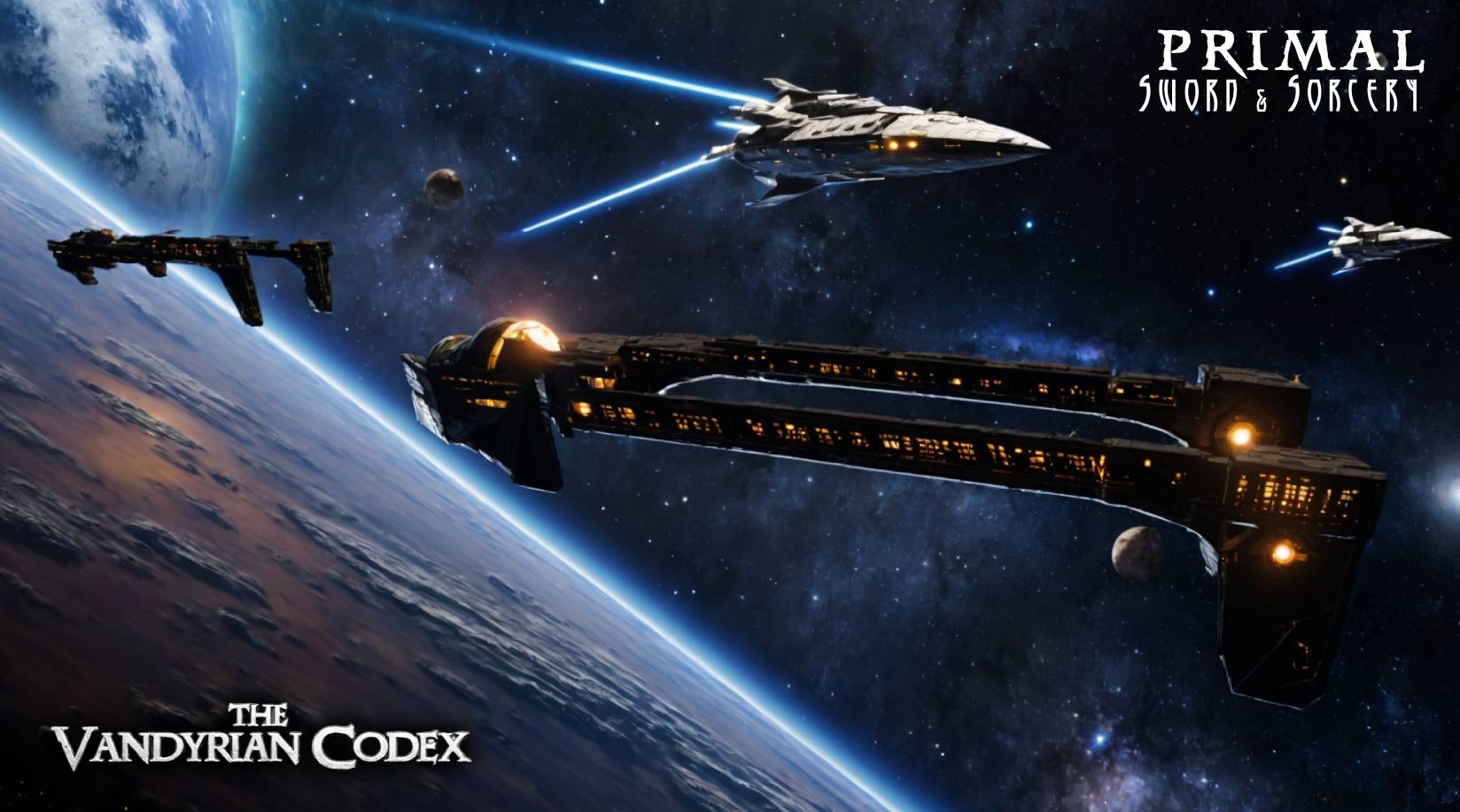
The Second Coming of Thanator
The Second Coming of Thanator refers not to a return of dominion, but to the final, catastrophic failure of it, and it cannot be understood without first acknowledging the nature of Vandyrus under Thanatorian rule.
Prior to the Cataclysm, Vandyrus was not a frontier world, nor a contested prize. It was a held asset. For many generations it existed within the Thanatorian system as a planet of extraction—its land mined, its populations harvested, its cultures bent into ritualized compliance rather than overt military occupation. Vandyrus was never conquered in the classical sense because it never resisted. When the sky split and the Thanatorian fleets descended, bearing colossal arrays of light, engines vast enough to bruise the heavens themselves, the peoples of Vandyrus made the only rational decision available to them. They submitted. No war was fought, no cities burned in conquest, because none were required. The threat alone was sufficient.
What made Vandyrus anomalous within the Thanatorian portfolio was its scale. Resource worlds were common; worlds of this size were not. Ordinarily, extraction on the imperial periphery took place on dead rock—airless planets, hollowed moons, asteroid remnants stripped until nothing remained but slag and orbiting debris. A living world, with atmosphere, ecosystems, and an enduring biosphere, was an extravagance unless the resource being extracted justified it. Thanator does not waste effort without cause. The size of Vandyrus, coupled with the secrecy surrounding its yields, made it an object of unusual internal attention. Records speak obliquely of layered clearances, compartmentalized fleets, and ritualized disinformation campaigns designed not merely to obscure the planet from rival powers, but to conceal its true value from Thanator’s own administrative strata.
Control of the population was achieved not through constant force, but through structure. Indigenous belief systems were redirected, hierarchies were codified, and ritual authority was elevated until obedience became cosmological rather than political. Espionage was constant. Manipulation was systemic. Abuse was frequent. This was Thanator at its most efficient and, as always, at its most arrogant. Pressure increased year by year, quotas rose, exemptions vanished, and the familiar pattern began to form—the slow tightening that always preceded revolt.
That revolt never came.
Long before the Cataclysm, and before any organized resistance could coalesce, Thanator withdrew. No declaration survives. No justification is recorded. The fleets simply departed, the administrative lattice collapsed, and Vandyrus was abandoned to the vacuum left behind. Whatever decision prompted this withdrawal was either erased from the record or never committed to it. What remains is absence, and absence on this scale is never benign.
Into that vacuum stepped local powers: war-sorcerers, cult hierarchs, petty tyrants, and would-be gods, each attempting to seize fragments of the authority Thanator had discarded. None endured. The Cataclysm erased them as thoroughly as it erased the old world itself, leaving Vandyrus shattered but unclaimed.
After the Cataclysm, Thanator attempted to return.
The First Dread Thanatorian War was not a war in any meaningful sense. It was a scramble. Rival Thanatorian commanders, sensing an opportunity to reclaim a lost world and return bearing singular glory, turned on one another before planetary control could even be established. Betrayal unfolded at fleet scale. Orders conflicted. Alliances shattered mid-orbit. The result was total failure. Capital vessels were destroyed by their own escorts, surviving ships were captured rather than reinforced, and their crews were taken alive. Those who were not killed outright were tortured, studied, and erased. The expedition ended not in defeat by Vandyrus, but in self-annihilation.
The Second Dread Thanatorian War lasted hours.
A single surviving mega-cruiser made planetfall, attempting a direct assertion of dominance through orbital terror. It never achieved orbit again. Vulsan sorcerers, already ascendant in the post-Cataclysm world, dragged the vessel from the sky itself. The ship was broken, its crew hauled alive to ritual sites, and there subjected to execution rites of extraordinary brutality. Still-beating hearts were torn from living chests with onyx blades, lifted to the heavens, and consumed by shamans in acts meant to absorb strength, wisdom, and enemy essence.
What none of them understood—what no record suggests they could have understood—was that in devouring Thanatorian flesh, they devoured more than organs. They consumed nanites. They ingested microscopic machinery designed to regulate blood, repair tissue, cleanse toxins, and preserve life far beyond natural limits. These systems were never meant to enter another biological context, let alone be metabolized through ritual cannibalism. Yet they were.
In doing so, the Vulsans ate machines as gods.
This event marks a visible inflection point in Vulsan power. Already formidable conjurers, necromancers, and elemental manipulators, their sorcery thereafter exhibited traits of precision, endurance, and scale previously unknown. Their magic became more direct, more kinetic, less symbolic. Where once ritual strained against physical limits, it now seemed to ignore them. The boundary between spellcraft and mechanism blurred, though none living at the time possessed the language to describe it as such.
History records the outcome without embellishment: at least once, sword and sorcery reached into the heavens and dragged a star-born vessel screaming down upon Vandyrus.
Thanator never returned after that. Whether through fear, calculation, or wounds too deep to risk reopening, the empire withdrew its gaze from Vandyrus entirely. The Second Coming did not restore imperial rule. It ended it, decisively, and in doing so ensured that Vandyrus would never again be treated as a silent asset.
-
The Vandyrian Collapse
The survival of Vandyrus after the Cataclysm was not an accident of fortune, but the consequence of neglect. Where other worlds in the Ran system had grown dependent on centralized power, layered infrastructure, and the brittle assurances of imperial logistics, Vandyrus remained functionally primitive by comparison. Its civilizations—kept deliberately stunted through oppression, misrule, or internal fracture—possessed no spacefaring capacity, little electrical infrastructure, and in many regions not even the reliable distribution of water. By the standards of Thanator’s throne, Vandyrus was a resource backwater: underdeveloped, ignored, and considered expendable. That very condition insulated it from total collapse.
When the Cataclysm tore the system apart, Vandyrus lost cities, coastlines, and entire continental spines, but it did not lose the habits of survival. Its folk were already adapted to scarcity, to migration, to rebuilding from ruin rather than maintaining fragile complexity. This endurance was compounded by withdrawal.
Long before the Cataclysm, Thanator abandoned Vandyrus for reasons that remain unrecorded. The retreat was not gradual and it was not benevolent. Imperial forces pulled back abruptly, scuttling installations, poisoning systems, and rendering their remaining technologies unusable. What they left behind were sealed ruins, broken engines, and inert monuments—structures that would haunt Vandyrus as puzzles rather than tools.
In the post-cataclysmic age, these sites became magnets for speculation and danger: places of research, superstition, and failed reclamation. Their meanings were never recovered, only layered over with myth and blood. Compounding this legacy, several starships—derelicts, refugees, or weapons without command—impacted the planet in the centuries following the Cataclysm, long before the first and second Thanatorian Wars. These crashes were not conquests. They were accidents of a system tearing itself apart, scattering debris and survivors across a world already struggling to stay intact.
The planet itself was broken nearly beyond recognition. Continents fractured, coastlines vanished, and populations were forced into long cycles of relocation as the ground continued to betray them. Yet large swaths of the population endured. They migrated, adapted, and fragmented into cultures defined less by origin than by the routes they survived.
For generations, history ceased to be written. What remains from the early post-cataclysmic era is largely oral: half-legends, distorted genealogies, and records so vague they function more as warnings than accounts. Precision did not survive; memory did.
Beyond Vandyrus, the rest of the Ran system descended into prolonged violence. Thanator itself fractured inward. Its nations, no longer restrained by imperial necessity or shared threat, turned on one another without limit. For centuries they expended stockpiles, shattered fleets, and annihilated resources that could have been preserved or repurposed. Old scores were settled at planetary scale.
This internecine collapse explains, in part, the absence of sustained conflict between Thanator and Vandyrus even in later ages. By the time order began to reassert itself, Thanator’s capacity for outward domination had been bled dry by its own wars. The slaver gates that still connect the worlds operate only intermittently, constrained by orbital mechanics and seasonal alignment, opening and closing like wounds that refuse to heal. They are not instruments of conquest so much as remnants of a violence both worlds no longer fully control.
The Vandyrian Collapse, then, was not a single fall but a prolonged refusal to vanish. Vandyrus did not rebuild what was lost; it learned to live without it. Its history after the Cataclysm is not one of recovery, but of persistence under continuous failure—a civilization shaped by abandonment, forced to survive amid the debris of greater powers that destroyed themselves trying to remember what they once were.