



An Introduction to The Book of Worlds
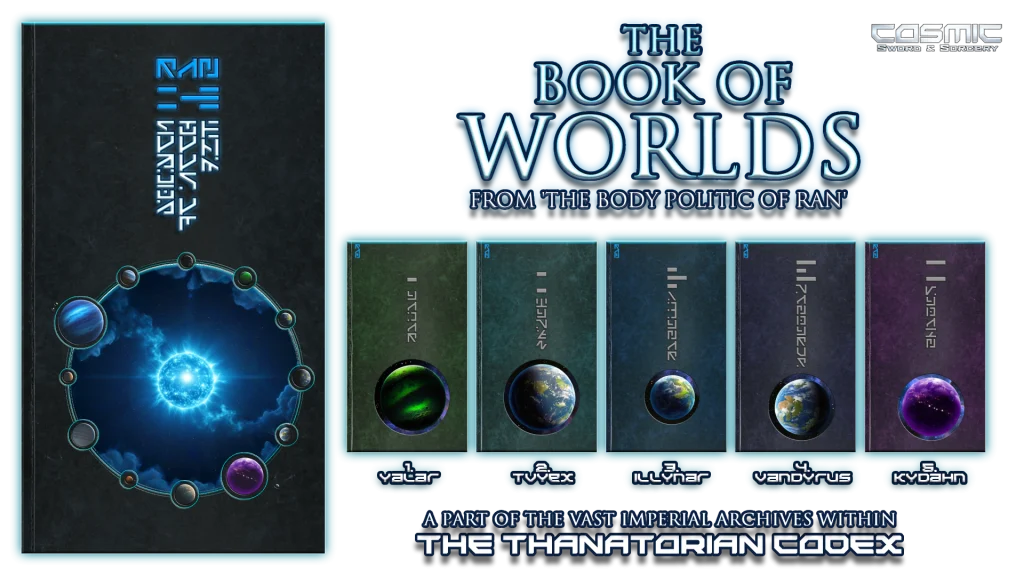
The designation Book of Worlds belongs not to a singular work, nor to any singular collection of worlds, but to a continuing registry of stellar surveys maintained within the greater body of the Imperial Codex. Each volume concerns itself with a designated stellar system, regional stellar association, or otherwise recognized astronomical jurisdiction, recording those worlds, stations, settlements, populations, institutions, territories, and material relationships considered significant to an understanding of that region at the time of compilation.
The volume presently held is therefore one among an innumerable company of such works, each bearing the name of the stellar domain to which its contents pertain, and each constituting only one portion of a much greater cartographic and civilizational record. No individual volume should consequently be mistaken for a declaration of completeness beyond the jurisdiction named upon it.
The worlds contained herein are neither the totality of known worlds nor presumed representative of those lying beyond their stellar boundaries. They are, simply, the worlds belonging to the present account.
Neither should The Book of Worlds be understood as a complete history of those worlds entered within its registry. Such histories belong properly to the chronicles, archives, archaeological records, dynastic accounts, institutional studies, local codices, and innumerable other works produced by the peoples to whom those histories belong. Historical material appears here where necessary to establish the origins, condition, relationships, or contemporary significance of a recorded place, but history itself is not the principal object of the work.
The Book of Worlds concerns itself foremost with the observable present: with the character of inhabited and significant worlds, the civilizations and populations established upon them, the jurisdictions by which they are governed, the economies by which they are sustained, the routes by which they are reached, and the relationships through which they participate in the greater stellar order. It is therefore a survey of a region as it exists within a particular period, preserving not an eternal description, but an ordered account of conditions recognized at the time represented by the volume.
This distinction is essential, for worlds are not immutable objects merely because their names survive them. Settlements rise and vanish, borders contract and expand, governments are replaced, populations migrate, routes of commerce change, industries exhaust themselves or become indispensable, and worlds once peripheral may become central to the affairs of civilizations that scarcely acknowledged them in preceding ages. For this reason, separate editions of The Book of Worlds may describe the same stellar domain differently without contradiction, each preserving the condition of that domain according to its own registered period. The chronological position applicable to the present volume is established in the sections immediately following this introduction and should be regarded as governing all subsequent entries unless an individual record explicitly states otherwise. References to earlier ages, vanished jurisdictions, extinct institutions, former names, or superseded conditions are included only insofar as they clarify the contemporary record.
Thus the title The Book of Worlds should be understood in its broadest and most literal Codex sense. Wherever worlds have been surveyed, wherever stellar regions have been entered into the greater registry, and wherever sufficient record exists to establish their contemporary condition, another such volume may stand beside this one. Its worlds may bear little resemblance to those described here. Its civilizations may possess different histories, different institutions, different measures of wealth and power, and entirely different relationships with the greater order surrounding them. Such difference is not an exception to the purpose of the registry, but the reason for its existence. No single stellar system can adequately represent the immensity of settled space, and no single volume could reasonably presume to contain it. Each Book of Worlds therefore records one portion of an incomparably greater whole: a stellar domain fixed for a moment in record, placed within the Codex, and preserved so that its worlds may be understood as they stood within their own time.