



The Great Flotillas
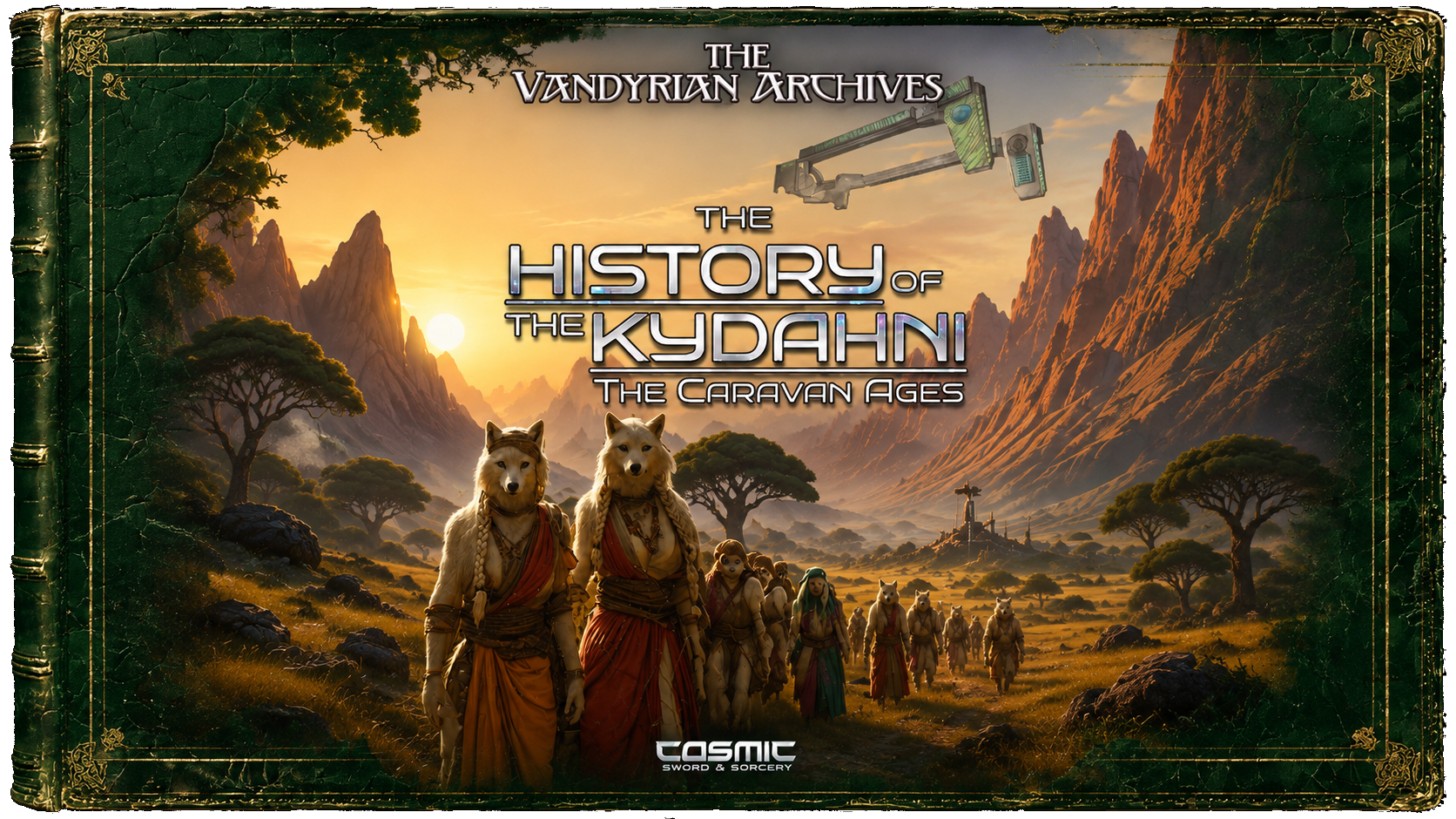
As Kydahni caravan populations expanded in both number and geographic reach, the relatively modest migratory communities of the earliest ages gradually developed into immense traveling flotillas capable of supporting populations across generations. These formations were far more than collections of merchant vessels traveling under common protection. At their greatest extent, they functioned as mobile settlements in their own right, carrying workshops, markets, residences, storehouses, schools, archives, entertainment houses, medical facilities, repair yards, and the countless smaller institutions required to sustain communities that could not depend upon permanent access to foreign worlds.
The flotilla became, in effect, territory made mobile. Where settled civilizations constructed cities upon planets and moons, the early Kydahni learned to construct much of the same social and economic complexity within communities capable of departing whenever circumstances demanded it.
No single model defined the Great Flotillas. Some remained relatively compact commercial formations organized around specialized trades, while others grew into sprawling associations of vessels, families, guilds, merchants, laborers, entertainers, specialists, and dependent communities whose combined populations rivaled those of established settlements.
Individual ships frequently served highly specialized purposes. Industrial vessels maintained machinery and fabricated replacement components. Agricultural and provisioning vessels extended the periods during which a flotilla could remain independent of planetary supply. Warehousing ships carried commodities intended for markets months or years farther along established routes. Residential vessels housed families whose members might be born, mature, raise offspring, and die without ever possessing a permanent planetary address. Larger formations could divide when commercial opportunities required it and reunite much later, allowing a single flotilla community to operate simultaneously across several neighboring regions without surrendering its collective identity.
This mobility fundamentally altered the relationship between the Kydahni and the territorial powers through which they traveled. A conventional foreign enclave could be surrounded, taxed, confiscated, or expelled while leaving its accumulated infrastructure behind. A flotilla represented a considerably more difficult proposition. Its population, commercial inventory, records, specialists, machinery, and productive capacity could depart together. When political conditions deteriorated, the Kydahni did not necessarily abandon the principal mechanisms of their prosperity. They carried them away. A ruler might revoke docking privileges or close a market, but doing so increasingly meant watching an entire commercial ecosystem redirect itself toward a rival port. The ability to leave therefore became one of the earliest forms of collective Kydahni leverage. Mobility was no longer merely a means of escaping danger. It had become economic power.
The flotillas consequently encouraged the development of internal authorities capable of functioning independently from the governments surrounding them. Disputes required arbitration while underway. Resources required allocation. Routes had to be negotiated, schedules coordinated, vessels maintained, births and deaths recorded, contracts witnessed, debts preserved, and collective decisions made concerning destinations and security.
Foreign laws might govern Kydahni conduct while docked within recognized jurisdictions, but those laws could change dramatically after a single journey. The flotillas therefore required systems capable of preserving continuity as they crossed from one legal order into another. Early councils, route authorities, commercial arbiters, shipmasters, record keepers, and clan representatives emerged to meet these requirements. They did not yet constitute a territorial state, but neither were the Great Flotillas politically formless. They represented some of the earliest durable Kydahni experiments in governance without geography. Their economic importance expanded accordingly. Because flotillas moved continuously between otherwise disconnected markets, they could identify shortages in one region and surpluses in another with an efficiency unavailable to many sedentary powers. Goods were only part of this exchange. Skilled labor, technical knowledge, entertainment, financial services, messages, diplomatic correspondence, and news traveled alongside physical cargo.
A flotilla arriving within an isolated system could bring information concerning political developments several jurisdictions away, introduce fashions and technologies previously unknown there, arrange contact with distant suppliers, and provide transportation to individuals whose own governments possessed no reliable means of reaching those regions. The Kydahni increasingly became not simply merchants operating upon existing trade routes, but connective infrastructure between civilizations whose political borders prevented them from developing equivalent networks themselves.
The Great Flotillas also transformed Kydahni identity. Individuals born aboard different vessels might spend years separated from one another, yet shared institutions, genealogical records, contractual customs, festivals, professional relationships, and recurring rendezvous maintained continuity across distance. Flotillas divided, merged, exchanged populations, and reorganized according to economic and political circumstances without necessarily losing their identities. A community therefore ceased to require continuous occupation of a particular location in order to remain recognizably itself. The Kydahni increasingly understood that institutions could survive movement, that authority could survive distance, and that a people could possess continuity even when the ground beneath them changed constantly. This principle would become one of the defining achievements of the Caravan Ages.
By the mature period, the largest flotillas had become institutions that neighboring powers could neither comfortably classify nor easily ignore. They were not sovereign worlds, yet they possessed populations, economies, internal authorities, productive systems, archives, and established relationships extending across multiple states. They were not conventional merchant houses, because entire communities traveled within them. They were not foreign governments, yet rulers negotiated with their representatives and frequently depended upon the services they provided. The Great Flotillas occupied the uncertain political space between commerce, community, and statehood, creating forms of organization for which the territorial civilizations of the period possessed few satisfactory equivalents.
It was within these immense mobile societies that the conditions necessary for the first great Kydahni broker clans fully matured. The flotillas had created networks spanning jurisdictions, accumulated relationships across generations, and demonstrated that influence did not require possession of territory. What remained was for particular families and commercial lineages to learn how to coordinate those networks across distances greater than any individual caravan could travel. From that development emerged a new form of Kydahni authority: not command over land, but command over connections.