


Thyuratahn, and Certain Geographical Misunderstandings
It has long been the habit of popular history to treat all territories lying north of ancient Ro’Edyne as though they constituted a single region. Such simplifications are understandable. They are also responsible for a remarkable quantity of confusion. The surviving records indicate that the geography of the ancient north was considerably more complex than many modern readers appreciate, and a proper understanding of the distinction between Ro’Edon, Northern Ro’Edyne, and Thyuratahn is essential to any serious discussion of the period.
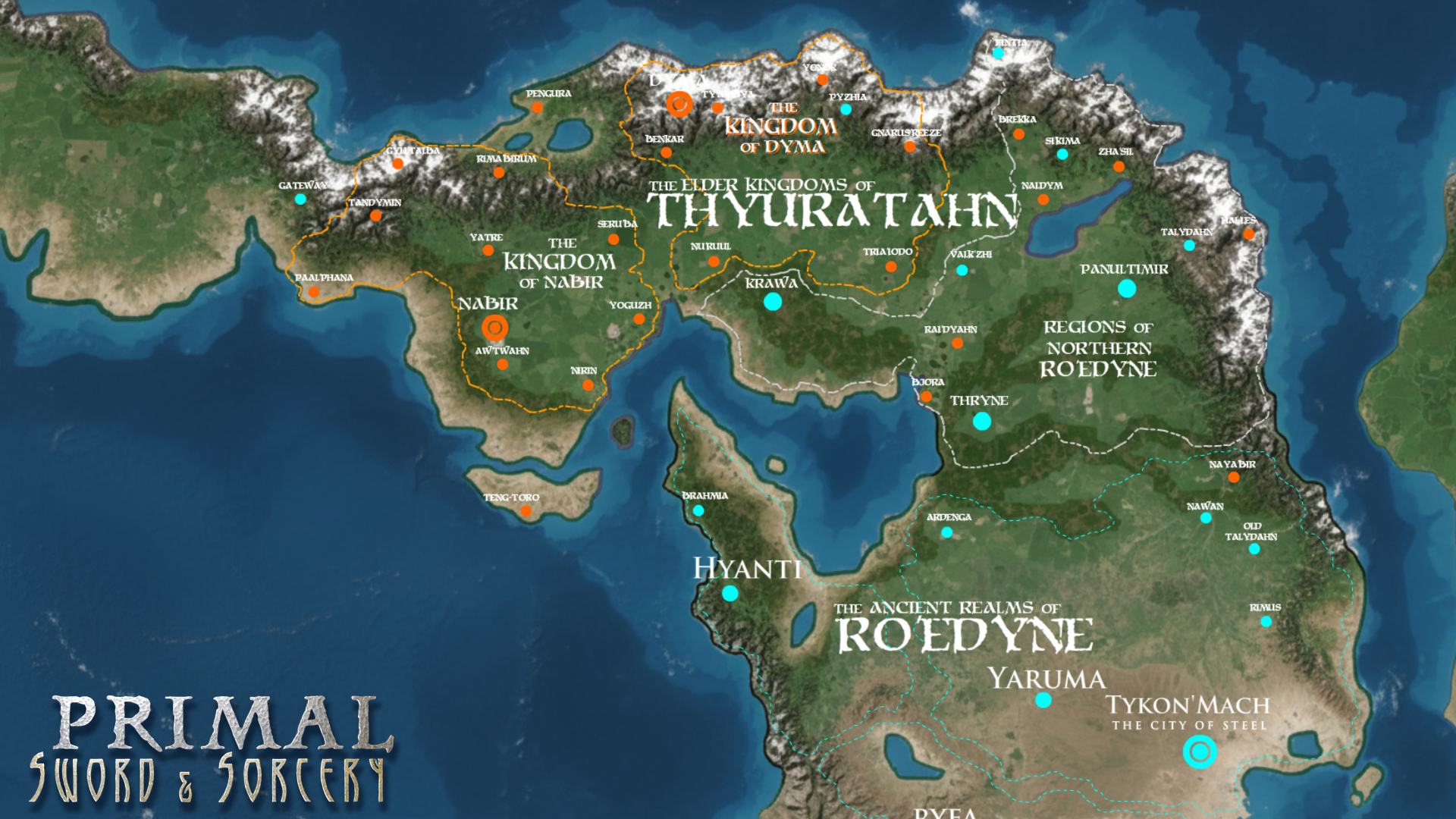
The continent of Ro’Edon formed the heartland of the Ro’Edyne civilization. Its great cities, administrative centers, trade networks, cultural institutions, and population centers occupied territories extending from the southern regions to the northern frontier. Among these northern territories stood Panultimir, Thiryne, Krawa, and numerous lesser settlements whose importance increased substantially during the later periods of expansion. These lands constituted the northernmost regions of Ro’Edyne proper. They belonged to the civilization, operated under its institutions, and participated directly in its political and economic systems.
This fact has occasionally produced the mistaken assumption that Panultimir itself formed part of Thyuratahn. The surviving evidence suggests otherwise. Panultimir was not a Thyuratahn city. It was a Ro’Edyne city facing Thyuratahn. The distinction may appear subtle at first glance, yet it is among the most important geographical realities of the ancient north. Panultimir occupied a frontier position at the very edge of ordinary Ro’Edyne administration. Beyond its northern approaches began territories increasingly dominated by independent kingdoms, mountain domains, clan territories, and frontier states whose histories, while frequently intertwined with those of Ro’Edyne, remained their own.
Beyond the northern frontier stretched the immense territorial expanse known as Thyuratahn. Modern descriptions often refer to it as a landbridge, though such terminology occasionally understates its scale. Thyuratahn was not merely a corridor connecting one region to another. It was a vast subcontinental territory containing its own kingdoms, cities, trade routes, cultural traditions, and political powers. The Kingdom of Nabir, the Kingdom of Dyma, and numerous lesser realms occupied substantial portions of these lands. During many periods they maintained close relations with Ro’Edyne. During others they pursued their own ambitions entirely independent of southern concerns. Their histories intersected frequently with those of Ro’Edyne, but they should not be mistaken for provinces of Ro’Edyne itself.
Panultimir consequently occupied a position of unusual importance. Virtually every major route connecting Ro’Edyne to Thyuratahn passed through or near the northern city. Merchants traveled through its gates. Diplomats conducted negotiations there. Military expeditions assembled within its districts. Explorers departed from its roads. Reports arriving from the northern kingdoms often reached the archives of Panultimir long before they reached any other repository within the southern territories. Over time the city became not merely a frontier settlement but the principal point of contact between two distinct worlds.
The situation becomes more complicated still when one considers that Thyuratahn was itself not the ultimate northern frontier. Surviving records speak of additional northern routes extending beyond the Elder Kingdoms toward the distant realms of Yiritahn and Londorais. These territories occupied the far northern reaches beyond the conventional limits of settlement and administration. Contemporary descriptions portray immense mountain ranges, isolated strongholds, severe climates, and populations whose customs frequently appeared strange even to seasoned travelers. Many accounts describe journeys measured not in days or weeks, but in seasons.
Particularly prominent within these northern traditions are references to the Elderbeards, ancient lords of the wolf clans who occupied portions of the high mountain territories beyond the settled frontiers. While later folklore frequently surrounds these clans with exaggeration, their repeated appearance throughout otherwise unrelated records suggests a political and cultural significance that should not be dismissed lightly. Surviving accounts describe powerful mountain domains, hereditary clan territories, and strongholds perched amidst some of the most inaccessible terrain known to the ancient world. Even during periods of imperial strength, these northern realms appear to have retained a distinct identity.
The eventual loss of Thyuratahn transformed the geography of the north beyond recognition. Most evidence suggests that substantial portions of the region disappeared prior to the Coming of Doom itself, though the exact sequence of events remains uncertain. Whatever the cause, the consequences proved profound. Routes that had once connected kingdoms vanished. Settlements became isolated. Trade networks collapsed. Entire regions disappeared beneath the sea, surviving only through surviving records, fragmentary maps, and the occasional archaeological discovery.
For this reason, modern readers must exercise caution when interpreting references to the ancient north. The geography visible today bears only partial resemblance to the geography known to the Ro’Edyne. Panultimir stood not within Thyuratahn but before it. Thyuratahn was not a province but a vast northern world unto itself. Beyond Thyuratahn lay still greater frontiers whose histories remain only partially understood. The ancient maps reveal a northern landscape considerably larger, more connected, and more complicated than the modern world might suggest.
Fortunately for historians, the records have proven somewhat more durable than the land itself.