



“Welcome to Yalar.”
The phrase was not spoken. It did not need to be. It existed in the way the world received the body. At nineteen cycles, Yanyay Tesivaar, a female caracal from the wreckage of Rethka’s long decline—fell from her capsule before the sequence had completed. A misfire. A clerical error somewhere far above her comprehension. She did not know it. She could not know it. Her mind still clung to the small, inflated myths of rebellion, of banners and causes, of scavenged victories tallied in rooms that smelled of cheap stimulants and purchased land rights. She had been raised among parasites who called themselves liberators, who measured triumph not in battlefields but in deeds and holdings. It had taught her nothing of consequence. She fell believing she would land among allies. She fell believing there would be time.
There was no parachute. The winds of Yalar did not howl—they seized. They took her like a hand takes refuse, dragging her through the thinning air as the surface rose to meet her with absolute indifference. There was no impact in the heroic sense, no bracing, no last-second realization granted the dignity of clarity. The ground simply arrived. Both knees ceased to exist. They did not break—they were erased. Bone shattered upward into the pelvis, soft tissue tore and stretched and hung in strands already blackening from heat and chemical reaction. Her lower form became a ruin before the rest of her had understood she had landed.
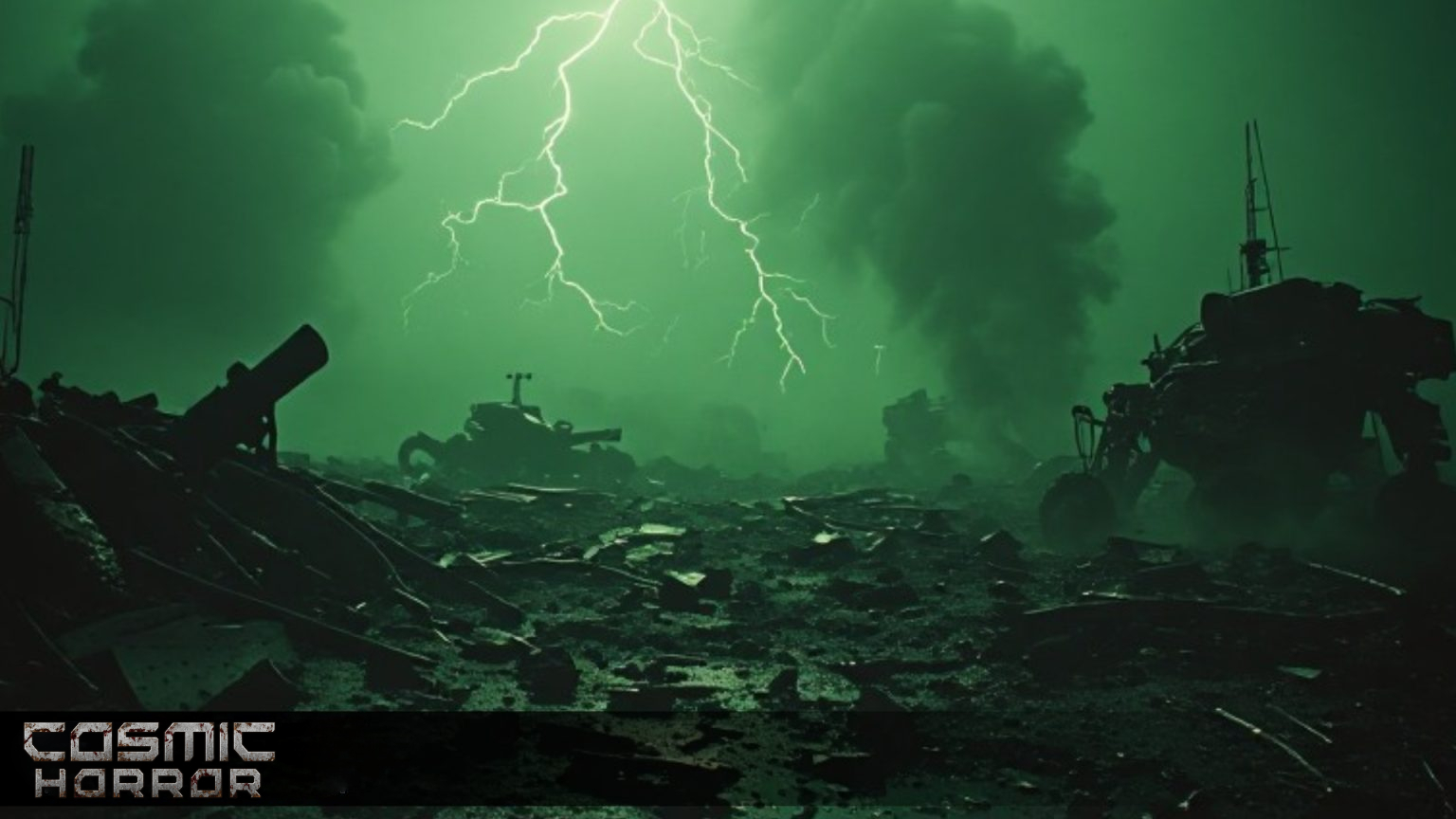
The scream that followed had nowhere to go. Her helmet caught it, swallowed it, and returned nothing. The microphone within had died long before her arrival, carrying with it the last voice of another fool who had believed this place could be survived. The slope took her. Yalar did not permit stillness. The winds dragged her broken body downslope, scraping armor and flesh alike against a surface that behaved less like terrain and more like an active mechanism. She left a streak behind her—dark, viscous, already thinning into vapor. At the basin, something moved.
A tank—autonomous, squat, and armored in dull, leaden plating—cut across her path with the steady inevitability of scheduled function. It did not see her. It did not need to. It existed for twelve hours at a time, then died, then was rebuilt by hands that never asked questions. A tool in rotation. A presence that would outlive her by hours only because it qualified as material. She saw it. Her remaining hand clawed forward, fingers trembling between seizure and collapse, reaching for something solid, something that obeyed rules she still believed in. Machinery. Weight. Purpose. Her fingers never made contact.
The ground answered first. Razor lace—thin, near-invisible filaments stretched across the slope—caught her hand mid-reach. They did not resist. They parted her. Fingers came away in segments, cleanly, efficiently, the wrist opening as though unzipped by a patient hand. The scream returned, higher now, stripped of any illusion of control. The slope did not release her. It fed her forward. Below, the field lay quiet. There was no warning. No flashing indicator, no audible cue. The mines did not announce themselves because they did not exist for her. They existed for yield control, for disruption, for the management of mass across an extraction zone that had been active longer than any living memory cared to measure.
Her body entered the grid. The first detonation removed what remained of her lower half. The second erased the rest of her mass as a recognizable form. The third was redundant. Sixteen seconds had passed since impact. Nothing on Yalar had acted with haste. Nothing had needed to. The wind carried what was left of her across the surface, thinning it, breaking it down, returning it to the processes that had been running long before she had been conceived in the backrooms of a failing polity that mistook decay for strategy.
Above, the sky held its colorless weight. Below, the systems continued. There were no rebels here. No footholds. No strongholds to be taken. Only machinery, and the quiet arithmetic of a world that did not recognize flesh as anything more than transient interference.
If the visor cracks, death comes in fifteen seconds. Not from flame. Not from force. From within. The body boils inside its own frame, fluids turning against themselves, eyes cooking in their sockets whether closed or open. The skeleton holds the shape for a moment longer, a cage preserving the outline of something that once believed it could arrive here and matter. Then even that is gone. Yalar does not kill. It processes.