

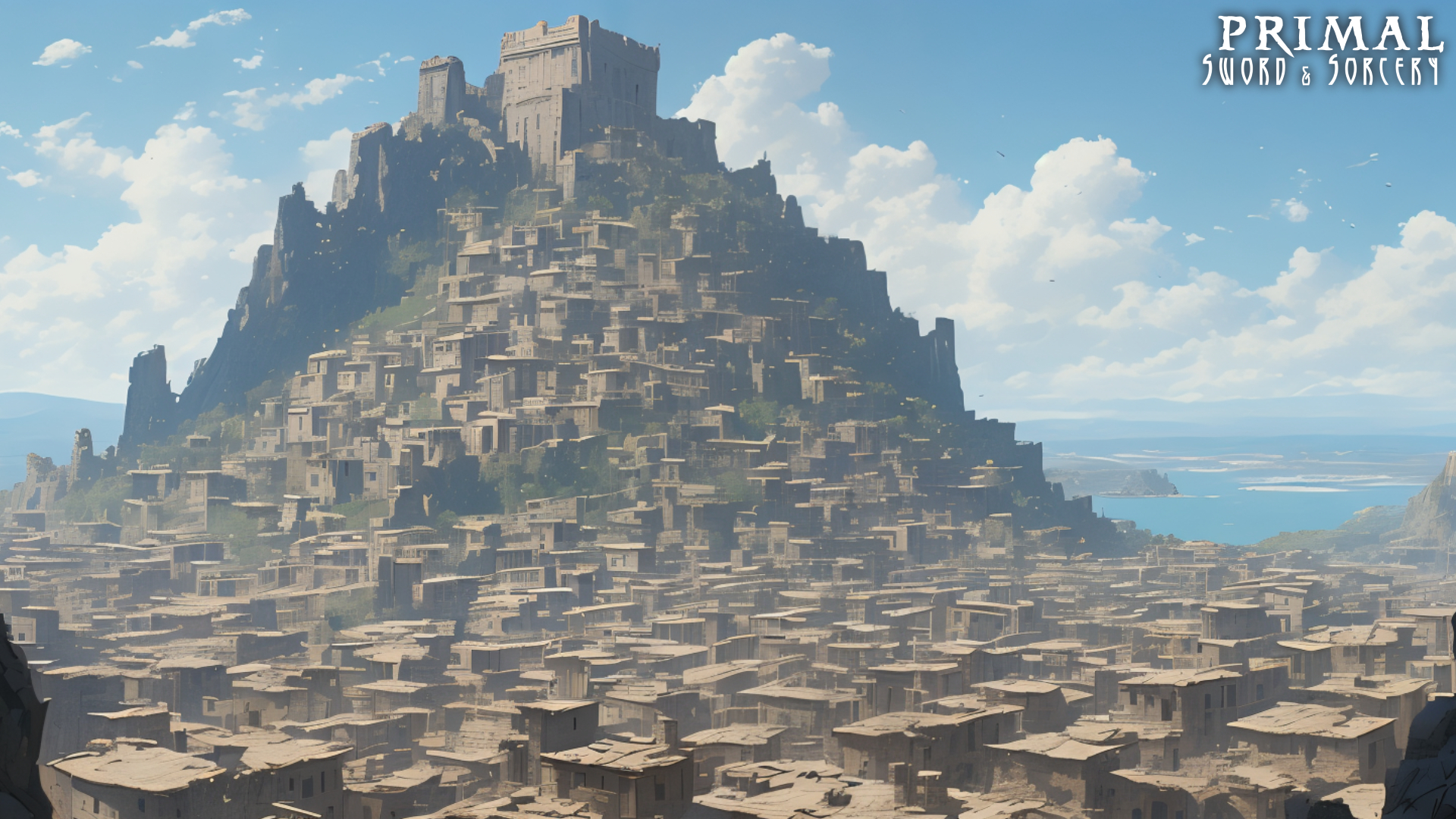
The coastal city that bears the same name exists in contrast to this interior decay, but not in contradiction. It has grown not by restoring the land, but by exploiting its condition. Built into the slope of a steep and stubborn hill, the city presents itself as a vertical accumulation of necessity rather than design. Its outer gates are heavy and deliberate, but once inside, structure gives way to density—layer upon layer of habitation, trade, concealment, and opportunism rising upward along carved terraces and half-collapsed foundations that predate any current occupation.
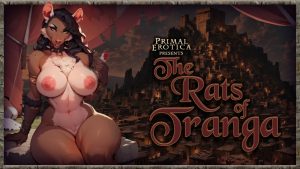
It is within this inherited skeleton that the ratfolk of central Kartonga have established their hold, not as rulers in the formal sense, but as those best suited to inhabit a place where certainty is impossible. Their dominance is practical, not ceremonial. They do not cleanse the city of its dangers; they navigate them. They do not unify its districts; they map the fractures and profit from them. In Tranga, survival favors those who can move through layers—social, physical, and economic—without becoming fixed in any one of them. The ratfolk excel here not through strength, but through continuity of presence. They are always there, in the walls, in the tunnels, in the exchanges that occur before any formal agreement is reached.
The city’s markets reflect this condition. The thieves’ quarter is not a district but a behavior that permeates every level of trade. Goods are not merely sold; they are circulated through hands that alter their value with each transaction, stripping origin and attaching new context. Poison makers operate openly, not because the city lacks law, but because the demand for quiet solutions is constant and widely understood. Their craft is not relegated to hidden dens but integrated into the economy itself, with mixtures tailored not only for killing, but for weakening, disorienting, or binding another to obligation. In Tranga, a poison is as likely to secure a contract as it is to end a life.
Financiers of a different kind move through this same structure—those who deal not in coin alone, but in leverage. Debt in Tranga is rarely written and never forgotten. It exists as a network of favors, threats, and mutual compromise, enforced not by a central authority but by the collective understanding that betrayal here is costly in ways that extend beyond the individual. Assassins and spies operate within this framework as extensions of that economy, their services indistinguishable from other forms of labor except in consequence. Information is traded alongside flesh and weaponry, and often proves more valuable than either.
The lower levels of the city, where the original structures are most intact, house the populations least visible to outsiders. Urchins move through these spaces with a familiarity that borders on instinct, acting as carriers of message, rumor, and stolen goods. They are not merely victims of circumstance but active participants in the city’s function, forming the connective tissue between its disparate elements. Above them, the trade in bodies continues with the same pragmatic tone that defines all else. Whores in Tranga are not set apart as a class of indulgence, but as another form of transaction within a system that values utility above all. Their position grants them access—to information, to influence, to survival—so long as they understand the terms under which they operate.