



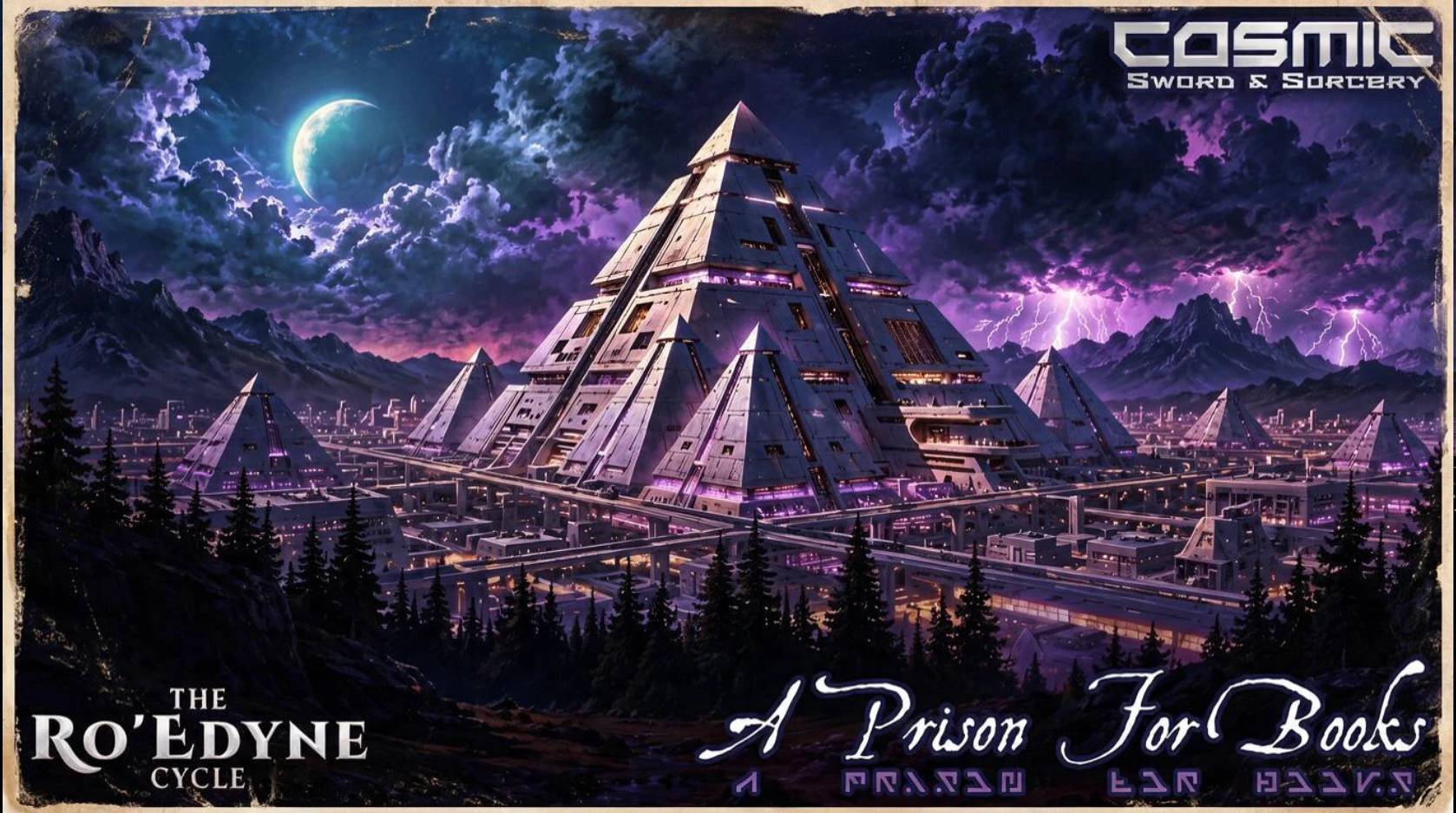
A Prison for Books
The account which follows was compiled from the surviving correspondence of Elder Archivist Maltahn of Tykon’Mach,supplemented by the testimony of the Magistrate of Panultimir, members of the Civic Watch, and those scholars who remained beyond the Inner Archive during the events of the Fifth Day.
Certain names have since been removed from public record by decree of the Council of Archives, while others survive only within restricted crystal repositories maintained under permanent seal.
The substance of the incident, however, has been preserved in its original sequence, for no clearer account has since been assembled.
Chapter 1 — The Fifth Day
The morning had scarcely reached its second bell when the great bronze doors of the Hall of Civic Administration were thrown open with sufficient force to silence every clerk, petitioner, magistrate, and attending scholar gathered beneath its vaulted ceiling. Conversation ceased almost immediately, not because of the violence of the entrance, but because every soul present recognized the figure now striding across the polished stone toward the council chamber.
Elder Librarian Harodan of Tykon’Mach entered without ceremony. Though advanced considerably in years, the old eagle retained the bearing of one who had spent an entire lifetime commanding silence rather than requesting it. His white feathers had long surrendered to age, but neither his eyes nor his temper had softened with them. Heavy black robes fell beneath a mantle embroidered with the silver sigils of the Grand Archive, while the great brass Master Key suspended from his belt struck rhythmically against the head of his walking staff with every measured step. Before Harodan had spoken a single word, the Magistrate of Panultimir had already risen from the council table. His expression suggested neither surprise nor irritation, but rather the weary patience of one who had anticipated this exact confrontation for several days.
“You have delayed this matter long enough,”
Harodan declared as he halted before the council table, dispensing with every courtesy ordinarily afforded between officers of comparable station.
“Five days have passed since my apprentice sealed the Inner Collections. Five days have passed while contradictory correspondence has accumulated, increasingly urgent reports have emerged from within the archive, and no satisfactory explanation has been offered to the office charged with its care. I have not come here to debate procedure, Magistrate. I have come to open my library.”
The Magistrate of Panultimir neither flinched nor answered immediately. When he finally spoke, his voice remained as measured as ever. “I have delayed nothing, Elder Librarian. I have obeyed the law as it stands. Until Elder Archivist Maltahn returns from the northern council, the emergency statutes remain in force, and the authority exercised by your acting Master Archivist remains legally recognized. Whether either of us finds that arrangement agreeable is irrelevant beside the obligations imposed upon this office.” Harodan rested both claws upon the head of his staff before answering. “The law was drafted for orderly mornings governed by ordinary circumstances. This has ceased to be an orderly morning, Magistrate, and whatever now occupies my apprentice has long since abandoned the orderly conduct anticipated by those statutes. Procedure exists to preserve civilization. It was never intended to become a prison built around indecision.”
A subdued murmur drifted through the assembled clerks before disappearing almost as quickly as it had begun. For five days the Grand Archive had remained partially sealed. Messages had continued to emerge from within its walls, each increasingly urgent, yet none described any calamity recognized by existing administrative doctrine. There had been no fire, no structural collapse, no armed intrusion, no plague, nor any other disaster for which established civic procedure provided an immediate response. The Head Archivist, Maltahn, remained absent in the north attending the Council of Histories, leaving operational authority divided between his senior apprentice and the Magistrate of Panultimir. Until that week the arrangement had functioned without incident. It had ceased functioning five days earlier.
“The acting Master Archivist invoked emergency preservation statutes under his own authority,” the Magistrate of Panultimir continued after allowing the room to settle into silence once more. “The Inner Collections were sealed immediately thereafter. Since that hour no individual has entered those chambers without his explicit written authorization, and no order bearing your authority has yet arrived sufficient to override those measures. I have enforced the law exactly as it presently exists.” Harodan regarded him steadily before replying. “No individual has entered? You mean to tell me that an apprentice archivist has imprisoned the heart of the greatest repository of knowledge in Ro’Edyne, and every official within this city has accepted that decision without challenge? Against whom were these emergency measures enacted? What enemy was named? What accusation was offered? What danger was described that justified closing the doors of an institution which has remained open through flood, siege, famine, and civil unrest?” The magistrate remained silent for several moments before drawing a slow breath. “No accusation was ever presented. No criminal complaint was filed. No declaration of sabotage, espionage, theft, or treason accompanied the order. The acting Master Archivist submitted only memoranda, each more urgent than the last, and each requesting actions that became progressively more difficult to explain.”
Crossing to a nearby table, the Magistrate of Panultimir gathered a neatly bound collection of folded correspondence secured beneath crimson archival cord before placing it carefully before the librarian.
“The first memorandum requested additional catalogues from the western vaults. The second requested specialists in comparative translation. The third instructed that the Inner Collections be isolated. The fourth directed that no further books, inventories, written correspondence, catalogues, research notes, or recording materials of any kind be delivered beyond the sealed doors under any circumstances.”
Those instructions were unusual, but they remained lawful.
“Every order fell within the authority temporarily vested in the acting Master Archivist, however extraordinary the reasoning behind them may have appeared. I questioned the wisdom of each request, Elder Librarian, but wisdom and legality have never been the same discipline.”
Harodan rested one claw upon the bundle without immediately opening it. His eyes lingered upon the crimson archival cord for several moments before he looked once more toward the Magistrate of Panultimir. “If the fourth memorandum prohibited all further written correspondence from entering the archive,” he asked quietly, “then why does this collection contain five memoranda rather than four? Either my apprentice contradicted his own instruction, or someone ignored it. I would know which before we continue.”
The Magistrate of Panultimir did not change expression. “We did not deliver another,” he answered without hesitation. Reaching once more into the bundle, he withdrew a final folded page and offered it to the old eagle with deliberate care, as though reluctant even to touch it. “The fifth memorandum appeared yesterday morning upon the registry table. No messenger entered the building. No courier departed. None of the guards stationed outside the Grand Archive observed anyone approaching the entrance, and every shift has since repeated the same account under formal questioning. Nevertheless, shortly after sunrise this document was discovered lying where incoming correspondence is ordinarily received. No one has yet explained how it arrived.”
Harodan accepted the folded sheet without comment and carefully unfolded it. His eyes crossed the page once, then again, lingering upon the same line as though expecting further words to reveal themselves through closer examination. The document contained no signature, no official seal, no date, no annotation, nor any identifying mark whatsoever. It consisted entirely of a single sentence.
Thank you. Your assistance has proven most valuable.
Without changing expression, the old librarian folded the page once more and returned it to the bundle exactly as he had found it. He offered neither conclusion nor speculation, yet none proved necessary. A subtle unease settled across the chamber with almost physical weight. Those standing too distant to overhear the exchange nevertheless sensed that the discussion had crossed some invisible threshold beyond ordinary administrative disagreement. Faces that had entered expecting another dispute over jurisdiction now found themselves quietly contemplating the possibility that no existing regulation adequately described whatever had begun unfolding inside the Grand Archive.
Four members of the Civic Watch remained standing before the eastern doors. They were not ordinary constables assigned to municipal duty but Bill Guards, each encased in polished steel nearly a thumb’s breadth thick. Their long hooked polearms rested comfortably against armored shoulders while silver-bound swords remained peace-locked within enchanted scabbards whose seals had not been broken in years. Such soldiers seldom appeared within civic halls except during periods of extraordinary unrest. Their presence implied that the Magistrate of Panultimir had anticipated the possibility of violence rather than bureaucratic disagreement, yet despite the authority standing before them they remained immovable, forming a silent barrier between Harodan and the road leading toward the eastern district.
The captain inclined his head respectfully before speaking. “No entry, Elder Librarian.
I recognize both your office and your authority, and under ordinary circumstances I would already have ordered the passage opened. My instructions, however, remain unchanged. Until relieved by the Magistrate, I cannot permit anyone to proceed beyond these doors, regardless of station.”
Harodan regarded the captain without anger, though neither did he attempt to disguise his growing impatience. “I possess the Master Key of the Grand Archive. I outrank every archivist presently breathing within this city, and no guard under heaven possesses greater authority over that institution than the Keeper entrusted with its care. You know this as well as I do. Therefore I ask again—not as a petitioner seeking favor—but as the lawful custodian of those collections, that you stand aside and allow me to enter the archive whose preservation has been entrusted to my office.”
The captain neither flinched nor lowered his eyes. “Everything you have said is true, Elder Librarian. Your authority remains unquestioned, and your office stands supreme within the Archive. Under ordinary circumstances these doors would already be open. These, however, are not ordinary circumstances. Until the Magistrate relieves me of my duty, I cannot permit anyone, including yourself, to pass beyond them. Should that decision ultimately prove mistaken, I shall answer for it personally. Until then, my orders remain.”
Before either the elder eagle or the captain of the Civic Watch could continue, another voice emerged quietly from the far side of the chamber. Its single word was spoken softly enough that it scarcely rose above conversation, yet it carried across the hall with startling clarity, drawing every eye present toward the shadowed colonnade from which it had come.
“Don’t.”
Every eye turned toward the speaker. Leaning heavily against one of the great stone columns stood a visiting archival scholar from Kydahn, a jackal whose reputation for relentless criticism, razor wit, and perpetual sarcasm had become familiar throughout the libraries of Tykon’Mach. Ordinarily he carried himself with the confidence—and occasional insufferability—of one who delighted in correcting an entire room without ever surrendering the faint smirk that inevitably accompanied the performance. Today that expression had vanished completely. His robes hung untidily from sleepless shoulders, his paws trembled visibly, and dark circles beneath his eyes suggested many nights had passed without meaningful rest. Whatever confidence had once defined him had been replaced by something far less comfortable to witness.
He crossed the chamber with slow, uncertain steps before stopping only a few paces from Harodan. His voice remained hoarse, forcing each word through a throat gone dry. “Seal it. Seal the entire archive before anything else leaves those walls.” The old librarian regarded him not with irritation but with measured curiosity. “You ask me to abandon the greatest archive in Ro’Edyne without explanation. Have you entered the Inner Collections yourself? Have you witnessed something sufficient to justify closing centuries of accumulated scholarship behind locked doors? If you expect me to condemn that institution, you must offer me more than fear.”
The jackal slowly shook his head. “No. I have not entered.” Harodan frowned, studying the scholar carefully before speaking again. “Then upon what authority do you make this request?” The jackal closed his eyes briefly before answering. “The authority of history. If you value this city, if you value every archive, temple, school, and library beyond these walls, then seal the building and leave it sealed until someone wiser than either of us can explain what has begun there. I do not ask because I understand it. I ask because fragments of older records suggest that others once failed to act quickly enough.”
Harodan continued studying him in silence. The old eagle had known scholars who were frightened before. He had seen researchers shaken by discoveries, historians disturbed by forgotten wars, and translators unnerved by blasphemous inscriptions recovered from ruined temples. This was something altogether different. Whatever stood before him had exhausted fear itself and left behind only grim conviction. “You are frightened,” Harodan observed quietly. “I am,” the jackal answered without hesitation. “Of what?” The scholar’s gaze drifted toward the eastern windows where, beyond rooftops and towers, the great dome of the Grand Archive rose proudly above the skyline. When he finally answered, his voice had become scarcely more than a whisper. “Do not burn it.”
Harodan’s brow furrowed. “Burn what?” The scholar slowly shook his head. “It doesn’t matter.” The old eagle took another measured step forward. “Then explain yourself.” The jackal swallowed hard before replying. “I cannot explain what I do not understand. I possess fragments, damaged records, scattered rumors, and the mistakes of my own civilization. I possess no certainty. I possess no complete account. I possess only enough to know that destroying the wrong thing may complete the very disaster one believes oneself to be preventing.”
“You refuse,” Harodan replied quietly. The jackal met his gaze without looking away. “I lack the knowledge necessary to refuse.”
Silence settled across the chamber once again. At length the jackal raised his eyes to meet those of the elderly librarian. “My people made that mistake once. Whatever has begun inside your archive, do not repeat it. Do not burn it. Do not attempt to destroy it until you understand exactly what it is you believe you are destroying, because if our histories retain even a fragment of the truth, certainty arrives only after the mistake has already been made, and by then the decision cannot be recalled.”
He bowed once with the weary dignity of one archivist acknowledging another before turning without further explanation and disappearing into the adjoining corridor. Harodan watched him leave for several silent moments before slowly returning his attention to the waiting guards. His gaze lingered upon the sealed eastern doors, then upon the Magistrate of Panultimir, before finally settling once more upon the captain of the Civic Watch. When he eventually spoke, his voice had become quiet enough that those nearest instinctively leaned forward to hear it.
“The doors.” The captain looked toward the Magistrate of Panultimir, who remained motionless for several long moments before finally inclining his head in silent assent. Without another word the guards raised their polearms and stepped aside, clearing the passage leading toward the eastern district.
Harodan adjusted the weight of the Master Key upon his belt before beginning the long walk toward the Grand Archive of Tykon’Mach, a building he had entered nearly every morning for more than sixty years and whose halls he knew with greater familiarity than his own home. Within those walls rested the accumulated memory of civilizations, dynasties, discoveries, languages, treaties, genealogies, philosophies, and generations of patient scholarship gathered across centuries of careful preservation.
To every citizen of Ro’Edyne it represented permanence, reason, and the triumph of ordered knowledge over the inevitable erosion of time itself. On that morning, however, Elder Librarian Harodan approached its doors burdened by a realization no keeper of books should ever be forced to entertain—that whatever awaited within had already begun changing the purpose for which the archive itself had been built, and that before the day ended he might find himself responsible not for preserving the greatest library in the world, but for determining whether it should ever again be permitted to open its doors.
Chapter 2 — The Silent Archive
The streets surrounding the Grand Archive of Tykon’Mach had never before known silence. Even during the darkest winters, when snow settled upon the bronze roofs and scholars hurried beneath heavy cloaks from lecture hall to reading chamber, the district remained alive with conversation.
Apprentices carried stacks of newly copied manuscripts between annexes, messengers hurried beneath the elevated galleries with sealed memoranda tucked beneath their arms, professors argued loudly over translations whose authors had been dead for millennia, and merchants supplying parchment, inks, oils, preservation salts, and crystalline storage housings maintained a steady procession through the eastern service gates from sunrise until well after dusk. Learning possessed its own rhythm, and the Archive had served as its heart for generations. Yet as Harodan, the Magistrate of Panultimir, four Bill Guards, and several accompanying archivists entered the eastern district, that rhythm had vanished so completely that even the sound of their own footsteps seemed intrusive.
The great plaza before the Archive stood deserted beneath the pale afternoon light. Hundreds of stone benches circled ornamental fountains whose waters continued flowing exactly as they always had, while the banners of the Grand Archive drifted lazily above entrances through which no scholars now passed. Delivery wagons remained abandoned where they had been left several days earlier. One still carried tightly wrapped bundles of fresh parchment beneath waterproof canvas, while another bore sealed crates of imported crystalline recording matrices awaiting cataloguing. Neither had been unloaded. Nearby, a handcart lay overturned beside the eastern colonnade, its contents scattered neatly across the paving stones. Several bound journals rested where they had fallen, untouched despite five days of exposure to wind and rain, and Harodan found himself looking at them longer than he wished, for abandoned books in the open air offended him in a manner far deeper than disorder alone could explain.
Harodan paused only briefly before mounting the broad marble staircase leading toward the principal entrance. The immense bronze doors already stood open, and that detail troubled him immediately. The Grand Archive had never closed its public entrance during daylight hours except by direct order of the Elder Archivist himself, yet neither did the open doors suggest ordinary operation. No reception attendants greeted arriving scholars. No registrars occupied the great oak counters beyond the vestibule.
The entry hall, crowded from dawn until evening, appeared strangely vacant, as though every individual occupying the building had departed in the middle of some unfinished task without ever returning to complete it. Inside, the silence deepened, not as an absence of sound alone, but as a pressure settled upon the galleries, pressing down upon every lamp, desk, ledger, and breathing soul who crossed the threshold.
Rows of registry desks stretched across the entrance chamber exactly as Harodan remembered them, each piled high with accession records, inventory ledgers, untranslated manuscripts, and correspondence awaiting classification. Oil lamps continued burning above every station despite the broad afternoon light pouring through the high stained-glass windows. Wax had overflowed several brass holders, forming pale rivers across polished wood, suggesting that no attendant had replenished or extinguished them for many hours. Quills rested where they had been dropped. Open ledgers remained half-completed. Inkpots had long since dried where they stood. One chair lay overturned beside a writing desk, while another had been pushed back so abruptly that its rear legs rested against a neighboring table. Everywhere Harodan looked he found evidence not of panic, but interruption.
The Magistrate slowly surveyed the chamber before speaking in a low voice.
“There was no order to evacuate,” he said, as though reciting a fact already known to both of them but made more troubling by repetition. Harodan answered without looking away from the nearest ledger.
“No.” The magistrate’s gaze moved toward the overturned chair, then to the abandoned counters, then to the wide central passage leading deeper into the building.
“No attack was reported.” Harodan lowered one claw to the registry book before him, where the final entry ended midway through a sentence and the ink simply stopped.
“No.” The magistrate drew a slow breath.
“and no alarm.” Harodan closed the ledger with more care than the moment seemed to require.
“No,” he said once more, and without further discussion the party advanced deeper into the Archive.
The corridors beyond retained the familiar geometry Harodan had walked nearly every morning for six decades, yet subtle inconsistencies began revealing themselves almost immediately.
Memoranda lay scattered throughout the galleries in steadily increasing numbers, some carefully folded and bearing official archival seals, others hastily scribbled upon scraps of cataloguing paper clearly written in moments of mounting urgency. Several remained pinned to notice boards where no one had returned to remove them. Others had simply fallen where exhausted paws had released them.
Every few dozen paces Harodan stopped to examine another page before silently placing it back exactly where he had found it, and each page seemed less like correspondence than a footprint left by thought retreating from something it no longer understood.
The earliest messages retained their professional tone. One requested additional comparative lexicons from Western Vault Three. Another asked that the Valusian transcription index be forwarded without delay. A third noted that several additional specialists would be required if the newly discovered material proved as difficult as preliminary examination suggested. The requests indicated little beyond scholarly enthusiasm. Someone had discovered an unusual document and wished to examine it properly. Such correspondence appeared hundreds of times each year within the Grand Archive, and under ordinary circumstances Harodan would have considered the matter routine, even promising, had the surrounding silence not already stripped every explanation of its comfort.
Farther inward the language began to change. Orders appeared directing ordinary catalogue operations to be suspended until further notice, instructing that no additional assistants enter without authorization, and requiring Collection Hall Seven to be sealed.
One memorandum specifically demanded that no further manuscripts be delivered to the working chamber, while another added inventories, reference catalogues, study notes, blank journals, and recording crystals to the prohibition. The handwriting remained recognizable, but the confidence behind it had begun to erode. What had first appeared as research had become containment, though no one had yet written the word plainly enough for the law to understand it.
Still farther inward the pages ceased resembling memoranda altogether. One sheet bore only the words, “Everything copies,” written three times in a hand that became less steady with each repetition. Another warned, “Do not answer written questions.” A third had been folded and unfolded so many times that the paper nearly separated along the creases, and upon it someone had written, “Destroy nothing. Nothing leaves. No more books.” The final pages bore almost no punctuation and less certainty. “No notes,” one read. “No records,” read another. The last, written in cramped script beside the dry smear of an overturned inkpot, said only, “Please stop sending paper.”
Harodan said nothing as he folded the final sheet and returned it gently to the floor. The Magistrate required no explanation. Together they had reconstructed nearly the entire progression of events without a single witness needing to speak. Whatever had begun five days earlier had first been approached as scholarship, then as an unusual preservation problem, then as an emergency requiring isolation, and finally as something for which no language possessed suitable administrative terminology. The deeper they traveled, the less the Archive resembled an institution overwhelmed by disaster and the more it resembled an institution that had attempted, piece by piece, to amputate its own functions in order to survive.
They continued toward the Inner Collections, passing through chambers where the evidence of increasingly desperate improvisation became impossible to mistake. Entire reading rooms had been stripped of blank paper. Cabinets ordinarily stocked with fresh journals stood empty. Storage rooms containing wax tablets, writing slates, and crystal recording prisms had been sealed from within using improvised barricades assembled from shelving and furniture. Every measure suggested not defense against intrusion, but the deliberate removal of anything capable of receiving additional written information. The pattern disturbed Harodan more profoundly than any corpse might have done, for every decision reflected careful reasoning rather than panic. Someone inside the Archive had arrived at conclusions so alarming that they had willingly dismantled the normal functioning of the greatest library in Ro’Edyne in order to obey them.
The first living scholar appeared without warning when the side door of a translation chamber burst open with startling violence and a young male ferret stumbled into the corridor with one paw pressed tightly across his mouth. He managed only three unsteady steps before collapsing beside one of the marble columns, where violent retching overtook him. Thick black fluid splattered across the stone floor before draining sluggishly into the grooves between the polished tiles. He remained there several moments, trembling violently, until at last he forced himself upright and lurched toward one of the decorative fountains occupying the central gallery. Without appearing to notice the newcomers, he plunged both paws repeatedly into the water, scrubbing them with frantic determination until the skin beneath his fur had become raw. Again and again he washed them, pausing only to stare at them in mute disbelief before beginning the process anew, as though whatever he believed remained upon them plainly refused to disappear beneath water.
Harodan approached slowly, careful not to startle him further. “My son,” the old eagle said, keeping his voice low. The ferret recoiled so violently that he nearly lost his footing, one wet paw striking the rim of the fountain as he stumbled backward. “No,” he gasped, his breathing coming in ragged, uneven bursts. “No, don’t come closer.” Harodan stopped at once and raised one claw in a gesture of restraint rather than command.
“Elder Librarian Harodan,” he answered calmly.
“You are safe. Tell me what happened.”
The ferret blinked several times without recognition. His eyes moved across the assembled guards, the Magistrate, the scholars, then back toward Harodan as though struggling to remember where he stood or why any of them had come. For several long moments he simply stared, and then his expression collapsed. “You shouldn’t be here,” he whispered. “You should have stayed outside.”
Harodan remained where he stood, neither advancing nor retreating.
“What happened inside?” The ferret slowly shook his head. His mouth opened, closed, then opened again, as if every answer available to him had become unusable the moment he attempted to speak it. At length he managed, “It isn’t right anymore.” The words seemed inadequate even to himself. He looked desperately toward the Inner Collections before continuing in fragments that came from him like broken pieces of a single thought. “The shelves are changing. The words don’t stay. They don’t stay where they’re written.” He squeezed both eyes shut as though struggling against some memory that refused to remain coherent, while the water from his soaked paws dripped steadily onto the stone floor between them.
The Magistrate stepped forward only far enough to be heard.
“How many remain inside?” he asked.
The ferret stared blankly, then answered, “I don’t know.”
The Magistrate’s voice remained level, but his expression tightened.
“You were working there. How many remained when you left?” The question seemed to frighten the young scholar more than the corridor itself.
“I knew,” he said, pressing both paws against the sides of his head. “I knew yesterday. I think yesterday. I don’t know what day it is.”
His breathing became rapid once more, and for a moment Harodan feared he would collapse entirely. The silence that followed proved heavier than anything yet encountered within the Archive, for the answer had revealed more than any count of survivors could have done. The building had not merely endangered its occupants. It had begun to compromise the order by which they understood their own memories.
Finally the ferret lowered his trembling paws and looked directly toward Harodan with an expression emptied almost entirely of hope.
“Please,” his voice cracking beneath the effort of remaining coherent. “Please don’t go in there.”
Harodan regarded him quietly before asking,
“Why?” The answer emerged almost involuntarily, stripped of ornament, doctrine, and explanation.
“Because reality is coming apart.”
No one replied, and the ferret looked from one face to another before suddenly realizing that none of them understood what he meant. “I don’t know how else to say it,” he continued, taking several uncertain steps backward. “The library is forgetting how to be a library.” Without another word he turned and hurried down the adjoining corridor, calling hoarsely for additional guards as he disappeared into the distance. His voice echoed through the galleries for several long moments before silence reclaimed the building once again.
No member of the party attempted to follow him, for his warning had already performed whatever service remained within his power to offer. Instead Harodan continued walking, and the others followed because no official duty, no civic order, and no preservation statute now possessed any meaning unless someone could reach the sealed heart of the Archive and learn what had become of it. The corridors narrowed as they approached the oldest foundations of the Grand Archive. Here the architecture changed noticeably. Modern reading halls gave way to immense circular chambers constructed centuries earlier when the Archive itself had first been founded. Massive pillars supported vaulted ceilings lost within darkness above, while concentric galleries overlooked the central preservation vaults where the oldest surviving manuscripts of Ro’Edyne had rested safely for generations. At the far end of the final gallery stood the reinforced crystal security partition protecting the entrance to the Inner Collections.
The partition had been sealed, though the condition of the barrier suggested that sealing alone had not preserved it. The transparent crystal had become almost entirely opaque beneath spreading layers of glossy black resin clinging to its inner surface. Veins of the same substance threaded slowly outward beneath the heavy bronze doors before disappearing into the stone joints of the surrounding floor. Lamps positioned outside the partition still burned steadily, their warm light reflecting dimly across a surface that no longer behaved like crystal but resembled darkened glass submerged beneath layers of living varnish. Standing before the entrance, scarcely able to remain upright, waited Archivist Yabesa. The elderly giraffe’s normally immaculate robes had become stained with dried ink and dust, while every visible tremor passing through her hands suggested that whatever duty had kept her standing before the sealed doors had long ago exceeded the limits of endurance. She turned at the sound of approaching footsteps, saw Harodan, and whatever composure she had preserved over the preceding five days dissolved instantly.
Yabesa crossed the remaining distance toward him and stopped only because her legs threatened to fail beneath her. Tears had already begun to gather in her exhausted eyes. “Elder Librarian,” she said, though the title nearly broke apart in her throat before she finished it. Harodan caught her gently by the shoulders, steadying rather than restraining her. She glanced once over her shoulder toward the darkened partition and shuddered. “I tried,” she whispered. “I couldn’t leave him. I couldn’t leave any of them, but I couldn’t go back in. I heard him through the crystal. He kept calling for catalogues after he had no mouth left to speak with. I don’t know whether he was asking for help or whether something was using his voice because it remembered that voices are useful.” The words struck the gathered company with more force than any scream could have done, and even the Bill Guards shifted uneasily within their steel.
Harodan rested one feathered claw gently upon Yabesa’s shoulder before raising his eyes toward the great crystal barrier separating the Archive from whatever now occupied its innermost chambers. Without haste, he reached beneath his robes and withdrew the ancient brass Master Key entrusted to every Elder Librarian since the founding of Tykon’Mach.
The heavy wards surrounding the security partition recognized its presence immediately.
Deep within the surrounding stonework, mechanisms untouched for generations awakened one by one with slow metallic certainty. Bronze locking bars began withdrawing into the walls.
Ancient preservation sigils kindled softly beneath the floor. Somewhere beyond the darkened crystal, muffled and indistinct, something answered with a sound too distant to identify, though every soul present understood that it had heard them.
No one spoke.
No one moved.
As the final locking mechanism released with a resonant echo that rolled through the silent galleries, Harodan extended one claw toward the control lever set beside the crystal doors, and for the first time in five days, the Inner Collections began to open.
Chapter 3 — A Prison for Books
The security shutter descended only halfway before binding against some unseen obstruction. Thick strands of black resin, glistening beneath the lantern light, had crept upward from the seams of the floor and across the reinforced frame, sealing portions of the mechanism into an organic mass whose texture resembled neither wood nor flesh.
The observation glass beyond had long since become opaque, not through smoke or soot, but beneath countless overlapping layers of dark vascular growth that pulsed with faint violet luminescence somewhere deep within. Yabesa stood several paces behind the others, trembling uncontrollably despite every attempt to steady herself. The Head Librarian placed one weathered hand against the emergency release while the magistrate silently rested his grip upon the pommel of his sword. Neither expected what waited beyond. Both nevertheless understood that whatever answers remained in the archive existed only on the opposite side of that door.
The glass partition slid aside with a wet, reluctant groan. An odor unlike anything either scholar had encountered escaped immediately into the corridor. It carried no familiar scent of decay, smoke, blood, or alchemical contamination. Instead, it possessed the strange sweetness of damp paper left forgotten for generations, mingled with the metallic tang of fresh ink and something faintly botanical that no member of the party could identify.
Before anyone spoke, before anyone crossed the threshold, every eye was drawn toward the impossible growth occupying what had once been the central reading chamber.
The assistant archivist still lived.
Recognition came not because he remained unchanged, but because fragments of the scholar still persisted beneath the transformation. His robes had fused into black resin that anchored him against the far wall. His arms no longer supported his own weight, having disappeared beneath great fibrous cords that disappeared into shelves, desks, ladders, and countless swollen masses hanging throughout the chamber. His face retained enough of its former shape for the Head Librarian to recognize his apprentice, yet the eyes had become empty cavities filled only with drifting violet light. His mouth remained open in permanent agony, producing a low, ceaseless wail that echoed through the chamber not as speech, but as the slow exhalation of lungs that no longer belonged to him.
Then his back moved. The spine split silently from the base of the neck downward, not with violence but with the measured certainty of a flower opening beneath the morning sun.
Vertebrae unfolded one after another into layered structures resembling enormous black petals whose surfaces shimmered with countless lines of luminous script.
Between those impossible leaves flowed thick streams of dark resin carrying fragments of parchment, splinters of shelving, shattered bindings, and shredded pages that had become inseparable from the living structure itself. The Head Librarian watched in horrified silence as words slowly emerged beneath the archivist’s skin, climbing upward along his neck, disappearing across his jaw, and continuing into the flowering mass behind him until flesh, language, and vegetation had become impossible to distinguish from one another. The library itself had ceased to exist.
Shelves no longer stood as orderly repositories of accumulated scholarship. They had become the trunks of an expanding organism whose root-like tendrils passed effortlessly through stone, timber, glass, and iron alike. Thousands of books remained visible throughout the chamber, but none retained their former purpose.
Some had swollen into leathery pods suspended from resinous vines. Others had split open into layered cocoons whose interiors revealed structures resembling folded organs rather than paper. Entire walls had disappeared beneath overlapping sheets of black growth whose surfaces bore impressions of calligraphy that continuously shifted as though language itself had become vascular tissue. Everywhere the eye settled, knowledge had surrendered its former shape and entered some terrible new biology. A muffled crack echoed somewhere above.
One of the hanging pods slowly separated along its seam before unfurling like overripe fruit. From within emerged a creature roughly the size of a parrot, though no naturalist would ever have mistaken it for a bird. Six articulated limbs unfolded from a body armored in overlapping black plates whose joints resembled ancient book hinges fashioned from dark brass. Its wings stretched outward upon translucent membranes veined with branching patterns that looked disturbingly similar to illuminated script viewed through stained glass.
Where compound eyes should have rested sat polished spheres of obsidian reflecting the chamber in impossible distortions. It perched upon the flowering stalk for only a heartbeat before another pod opened, then another, until dozens of the silent arthropods began crawling carefully across the expanding organism, tending resinous growths, gathering drifting fragments of parchment, and disappearing into hidden passages woven throughout the living archive. They ignored the intruders completely. Their purpose lay elsewhere.
Yabesa collapsed to her knees.
“What… what are we going to do?” she cried, her voice breaking beneath the impossible weight of what stood before them. “Please… tell me what are we going to do.” No answer came immediately. The magistrate slowly lowered his sword. The Head Librarian did not move toward the apprentice. He did not order the guards forward. He did not call for oil, torches, axes, or demolition charges. Every instinct learned through a lifetime of protecting books demanded that he preserve the archive before him. Every instinct learned through that same lifetime now told him the archive no longer existed. What remained was something altogether different, something that had merely chosen the likeness of scholarship as fertile ground. For several long moments he listened only to the mournful breathing of his apprentice and the quiet rustling of pages that were no longer pages.
Finally, the old eagle spoke. “We seal it.” The magistrate looked toward him in disbelief. “We do not burn it,” the librarian continued, his voice low and unwavering. “If fire could solve this, another civilization would already have solved it. We do not remove the book. We do not recover the collection. We do not preserve another page. We seal every entrance. Every corridor. Every vault. We abandon this archive today, and from this hour onward no scholar, no magistrate, no council, and no emperor shall ever again cross this threshold.”
No one argued.
Epilogue
The order spread through Tykon’Mach before sunset. Stoneworkers replaced librarians, engineers replaced scholars, and architects replaced historians. Every resource the city could command was redirected toward a single purpose. The great library ceased to exist as an institution of learning and became instead the foundation of the largest containment structure the city had ever conceived. Layer upon layer of dressed stone descended over the abandoned archive, while reinforced galleries, inspection chambers, pressure vaults, and isolated maintenance passages were incorporated into a design intended not to honor what lay beneath, but to deny it passage back into the world above.
Public records spoke only of structural reconstruction following an unspecified disaster. The surviving crystal archives quietly absorbed what knowledge could safely be preserved, while the remaining documents vanished from official history. Questions received no answers, and rumors found no confirmation. Even the visiting Kydahni archivist departed without ever learning the fate of the apprentice whose desperate memoranda had summoned them home.
Many generations later, travelers would stand before the Second Great Pyramid of Tykon’Mach and admire only its impossible scale, elegant geometry, and monumental engineering. Scholars would attribute its construction to dynastic ambition, religious symbolism, civic prestige, or the familiar vanities that had produced so many other wonders throughout the history of the Greater Vandyrian Civilization. They would measure its foundations, debate its chronology, compare its architecture to neighboring pyramids, and fill countless shelves with competing theories regarding the motives of those who commissioned it. None would suspect that beneath millions of tons of carefully fitted stone rested neither king nor treasury, neither temple nor observatory, but a library whose final duty had become the imprisonment of its own contents.
The Book of Librion remained exactly where it had first been discovered, untouched by flame and undisturbed by those who had condemned its resting place to eternal darkness. It was never burned, nor was it ever removed. The archive had not been destroyed, but had simply been given a different purpose, becoming not the greatest house of knowledge in Tykon’Mach, but the first and largest prison ever built for books.
