


X. The Last Fortress:
X. The Last Fortress:
Emergent Myth as Weapon
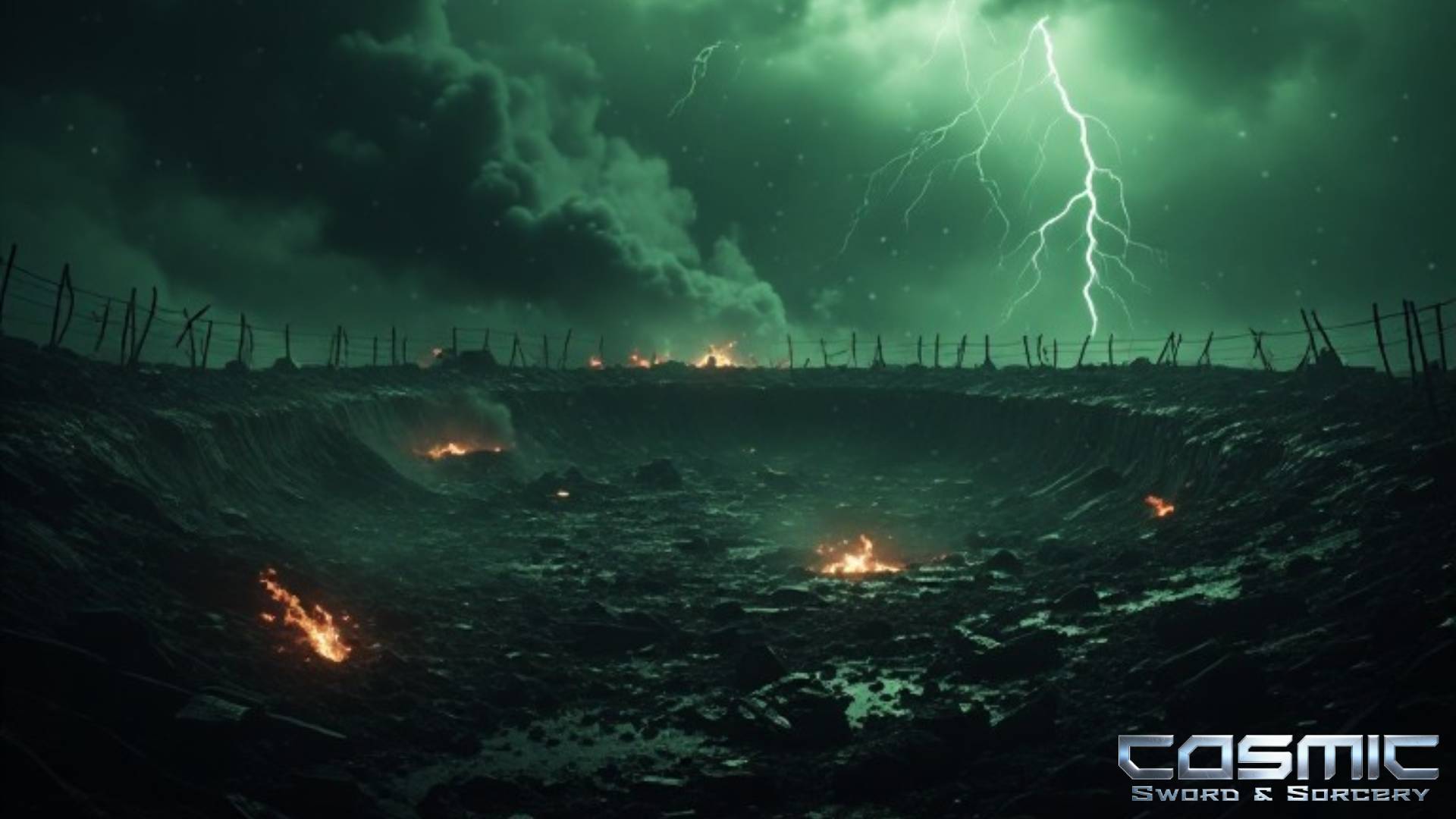
Among the many cruelties of Yalar, few endure so persistently—or so deliberately—as the myth of the “Last Fortress.” It is not an installation, not a refuge, not a functioning remnant of Vandyrian engineering. It is a crater.
From distance and angle, particularly through dust-choked visors and malfunctioning optics, the formation appears unmistakably artificial. A ringed perimeter. A visible aperture. A central pad-like plateau that, in the shimmer of refracted toxins, resembles a docking field or atmospheric intake hub. Desperate combatants, their oxygen counters blinking toward zero, have charted courses toward it believing it to be a final bastion—an intact settlement abandoned by the Empire yet still structurally viable.
It is nothing of the sort. The depression measures nearly eight miles across. Its rim is steep but climbable, a silhouette that from afar mimics engineered geometry. Its interior is bare rock and particulate slurry. No refill pylons. No emergency vaults. No shielded corridors. Only emptiness shaped by coincidence.
The cruelty lies not in the geology but in the culture surrounding it. Convict networks, long adapted to the psychological warfare of oxygen scarcity, perpetuate the fiction. False telemetry pings are broadcast toward the crater. Fabricated grid coordinates circulate on open channels. “Beacon readings” are seeded into shared maps. The myth is reinforced by the occasional suit cam feed showing silhouettes at the rim—figures waving, calling out that air remains inside.
There is no air inside. Many who make the final sprint toward the so-called fortress arrive with seconds remaining on their tanks. They crest the rim in triumph, only to look down into the vast nothingness. Bodies lie scattered across the interior slope, suits cracked open by impact or clawed at by gloved hands that tried to dig into solid rock as if burrowing might produce oxygen. The last moments of many are recorded in audio logs: disbelief turning to rage, rage to hysterical laughter, curses hurled at an indifferent sky.
Worse still are the live taunts. Some convicts, positioned safely near functioning refill modules, monitor the desperate approach of others via shared channels. They encourage the doomed to keep running, assure them the fortress is real, promise that air waits just beyond the rim. Laughter sometimes follows the final silence of a cut transmission. In more grotesque instances, scavengers harvest the abandoned rations and suit components of those who perish there, thanking them over open comms for the “donation.”
The Empire did not design the Last Fortress. It is not an official construct. It is a lie born of environmental ambiguity and maintained by those who understand that on Yalar, hope itself can be weaponized. Thanatorian observers have cataloged the site in operational briefings, marking it clearly as nonviable terrain. Kydahni telemetry during machine deployment cycles has occasionally flagged the crater as a “natural anomaly.” Neither classification captures its true function.
The Last Fortress is the psychological endpoint of Yalar’s design philosophy. When air is scarce, when infrastructure is unreliable, when survival depends on reaching the next refill node before breath fails, any silhouette becomes salvation. The crater exploits that reflex. It stands as a monument not to imperial malice but to the evolution of cruelty among the condemned. Yalar remains undeveloped by intention. It does not require monuments of stone. Its greatest structures are illusions, and its most enduring weapon is false hope measured in minutes of breathable air.