



XI. Orbital Containment
XI. Orbital Containment
The Doctrine of ‘No Exit‘
One of the most deliberately vicious elements of Yalar is not the poison sky, not the refill scarcity, not the machine deployments or convict cruelty. It is the absolute finality of arrival. Yalar is engineered to eliminate the very concept of escape.
Condemned combatants are not deployed with ceremony or transport escort. They are dropped. Crated. Encased in single-use atmospheric shells with cheap ablative shielding designed to survive only the descent burn and surface impact. The external padding chars, cracks, and peels away within minutes of touchdown. What remains is the suit, the weapon, and whatever rations were packed into the crate. No recall beacon. No evac protocol. No secondary insertion schedule. You are not stationed on Yalar. You are discarded onto it.
The crates do not land near infrastructure by accident. They are scattered—sometimes miles from refill modules, sometimes within contested zones, sometimes in regions already marked by machine patrol telemetry. It is not random; it is distribution as attrition. The surface receives bodies the way a furnace receives fuel.
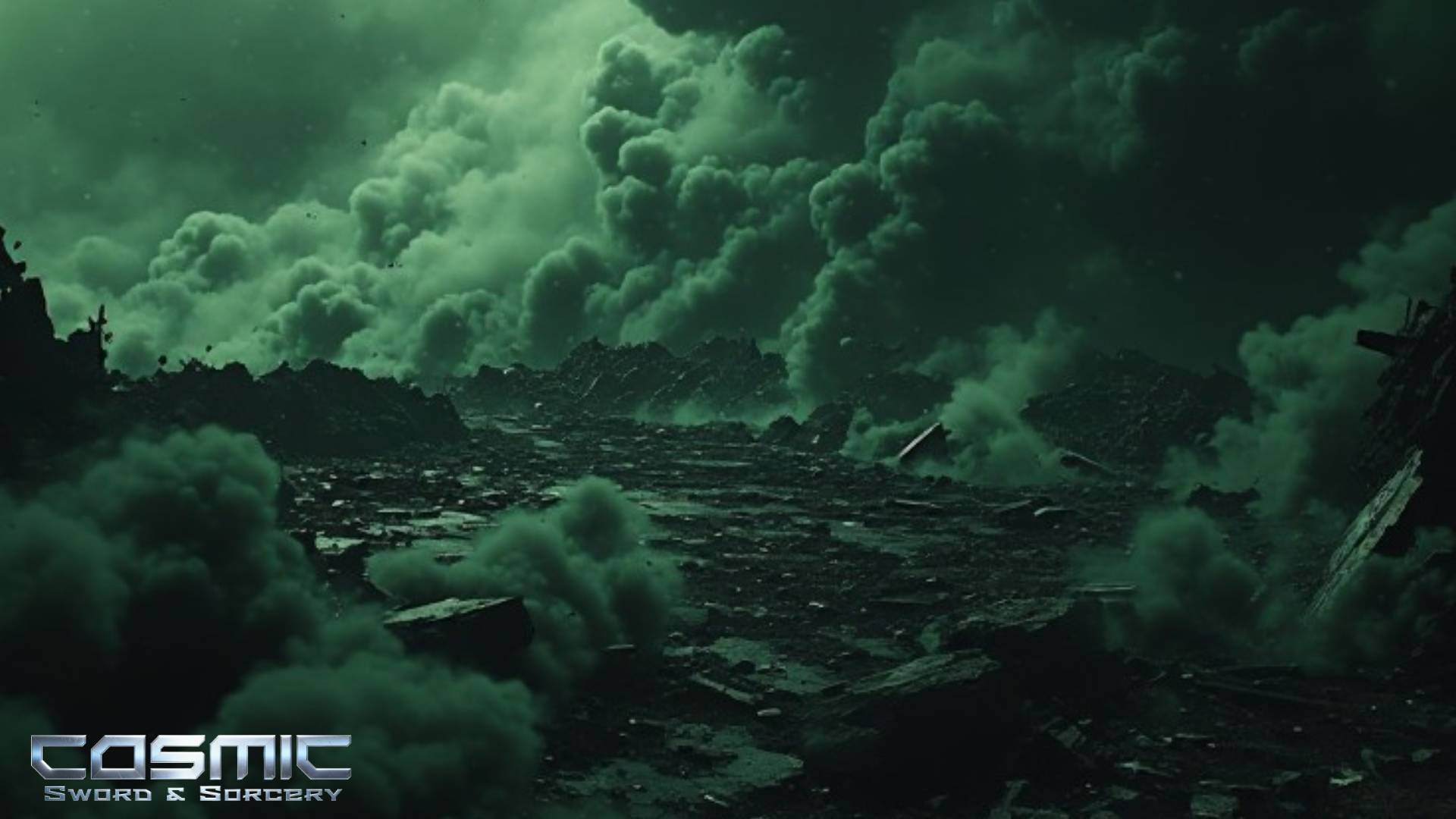
Escape fantasies die quickly. There are no abandoned shuttle pads hidden beneath the dust. No smuggler skiffs waiting behind a ridge. No secret extraction deals brokered mid-battle. The orbital perimeter is sterile and absolute. Drones maintain constant geostationary patrol arcs. Any unauthorized ascent—improvised rocket, hijacked transport drone, massed signal spike—triggers immediate suppression. Surface-to-orbit weaponry is non-existent by design. No one is foolish enough to land a crewed vessel. No one is reckless enough to descend below drone envelope range. Yalar’s orbit is cleaner than its surface.
Even if a surface combatant were to seize equipment capable of vertical thrust, the atmospheric instability and toxin saturation render navigation nearly impossible without secure uplink guidance. And uplink guidance is controlled exclusively by orbital systems that do not answer to the condemned. Thus escape becomes not merely improbable but structurally impossible.
This absence of exit alters behavior. It eliminates long-term insurgency logic. It collapses strategic horizons into immediate survival. There is no rebellion to plan toward extraction. No promise that endurance earns return. No negotiation leverage through hostage-taking or territorial control. Victory on Yalar means temporary oxygen security. Nothing more.
The psychological effect is profound. Convicts do not fight for freedom. They fight for the next refill. They do not imagine rescue. They imagine minutes. Hope narrows to breath count and suit integrity. Even myths such as the Last Fortress gain traction only because escape is so completely denied that the mind invents an endpoint where none exists.
Yalar is not a prison in the conventional sense. Prisons imply walls and gates. Yalar is open sky and open ground with no path upward. Its cruelty lies in exposure without exit—an endless battlefield under surveillance, where arrival is permanent and departure is a statistical anomaly bordering on fiction. You are dropped. You remain. You run out of air.