
Environmental Hostility
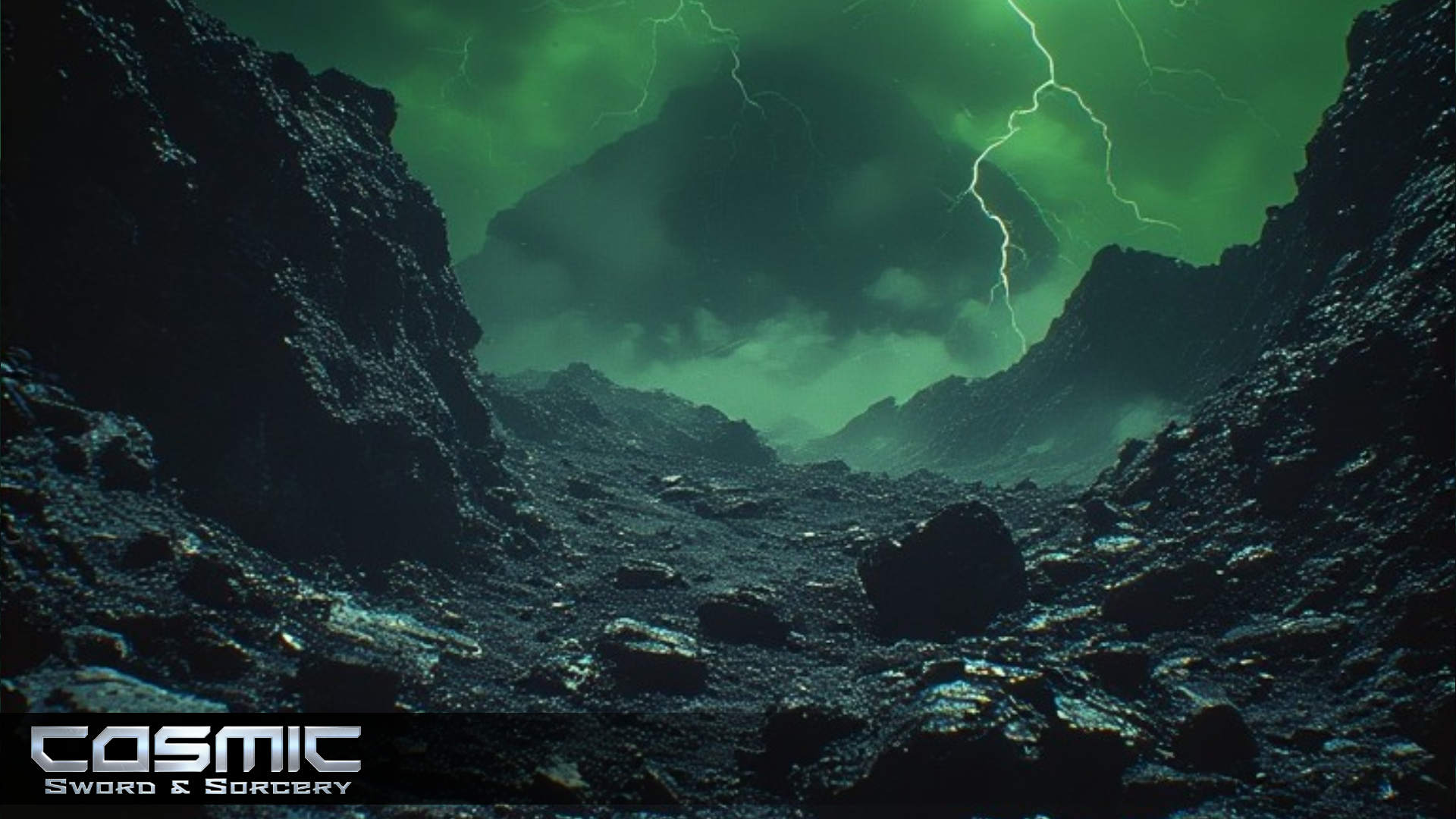
Yalar—the first planet of the Ran system—was never simply a sterile rock lost to imperial indifference. Its choking viridian atmosphere, laced with poisons and scoured by permanent electrical storms, rendered it utterly inimical to biology: no garden, no ancient seed, no native myth. Yet for all its chemical hostility, Yalar was never ignored. It was a world whose only worth was what could be extracted by force or cunning—a sphere of perpetual resource war, never civilization, always conflict.
At first glance, Yalar offered little: a battered crust, skies awash in toxic green haze, surface pressure and composition that laughed at the prospect of organic settlement. But beneath its storm-wracked veneer, automated outposts clung to the blackened ground, mining what they could—helium in industrial volumes, hydrogen for the fleets, silver for circuit and coin, exotics for whatever the imperial technologists demanded that century. The economics were almost always a losing proposition; the plants ran at a deficit, held together by imperial decree and the inertia of ancient supply contracts, yet the fact of Yalar’s production ensured that someone, somewhere, would always see a margin worth fighting for.
This alone might have left Yalar a cautionary tale of resource overreach. Instead, it became the setting for some of the most brutal, least-memorialized conflicts in system history. For most of its ages, Yalar was not “ruled” by any civilization—no banners of Thanator, no statuary of Kydahn, no sigils of Rethka graced its surface except as brands upon machinery, quickly burned away by acid rain or erased by sabotage. Instead, three powers—Thanator, Kydahn, and the fractious nations of Rethka—waged a slow war of supply and denial, station against station, pipeline against relay, drone swarms clashing in the gloom, sometimes for centuries at a time.
This was not the theater of heroes. It was an industrial hellscape: lightning-ripped black-green skies serving as a stage for the sudden flare of reactor sabotage, the violet pulse of weapons fire, the eerie teal glow that marked a lost plant or a failed breach. Outposts changed hands with monotonous regularity, rarely rebuilt, more often left to rot as a warning to the next would-be extractor. No settlements rose, only temporary barracks for engineers and conscripts condemned to serve out tours in a place whose only memory was the echo of failed ambitions and the constant thrum of extraction.
The battles for Yalar were not limited to Thanator and Kydahn. Rethka, though fractured, was for a time a true contender, its splintered nations mobilizing flotillas and sabotage teams in doomed attempts to cut off imperial supply lines or wrest a fleeting advantage. Their efforts, though valiant, proved disastrous; every campaign left Rethka weaker, its political unity further corroded by defeat and attrition, until the nations that once vied for Yalar’s spoils were themselves reduced to vassalage—a fate sealed not on the fields of glory but in the toxic mists of this merciless world.
For all this sacrifice, Yalar never transformed. It did not yield civilization; it absorbed hope, ambition, and flesh, repaying all equally with the same green-tinged oblivion. Even as the centuries turned and the wars ebbed, the automated plants continued their endless, near-pointless harvest, pulling gas from the poisoned air, bleeding silver and hydrogen for the now-consolidated imperial networks. The world remained, as it always had: an object lesson in the limits of conquest, a prize that punished every attempt to claim it with losses no faction could ever quite justify, yet none could ever abandon.
To this day, Yalar’s horizon is broken only by the silhouette of mining rigs and the distant flicker of arc lights, skies still streaked with storm and violence, still haunted by the memory of battles fought for a promise that never delivered. Each generation’s would-be conquerors convince themselves that “this time, things will be different,” only to leave the planet as they found it—strip-mined, contested, and perpetually consuming all who dared to believe they could force it to serve. Yalar endures, not as a world to be tamed, but as the system’s perennial open wound—a place where only necessity and delusion dare to linger.