



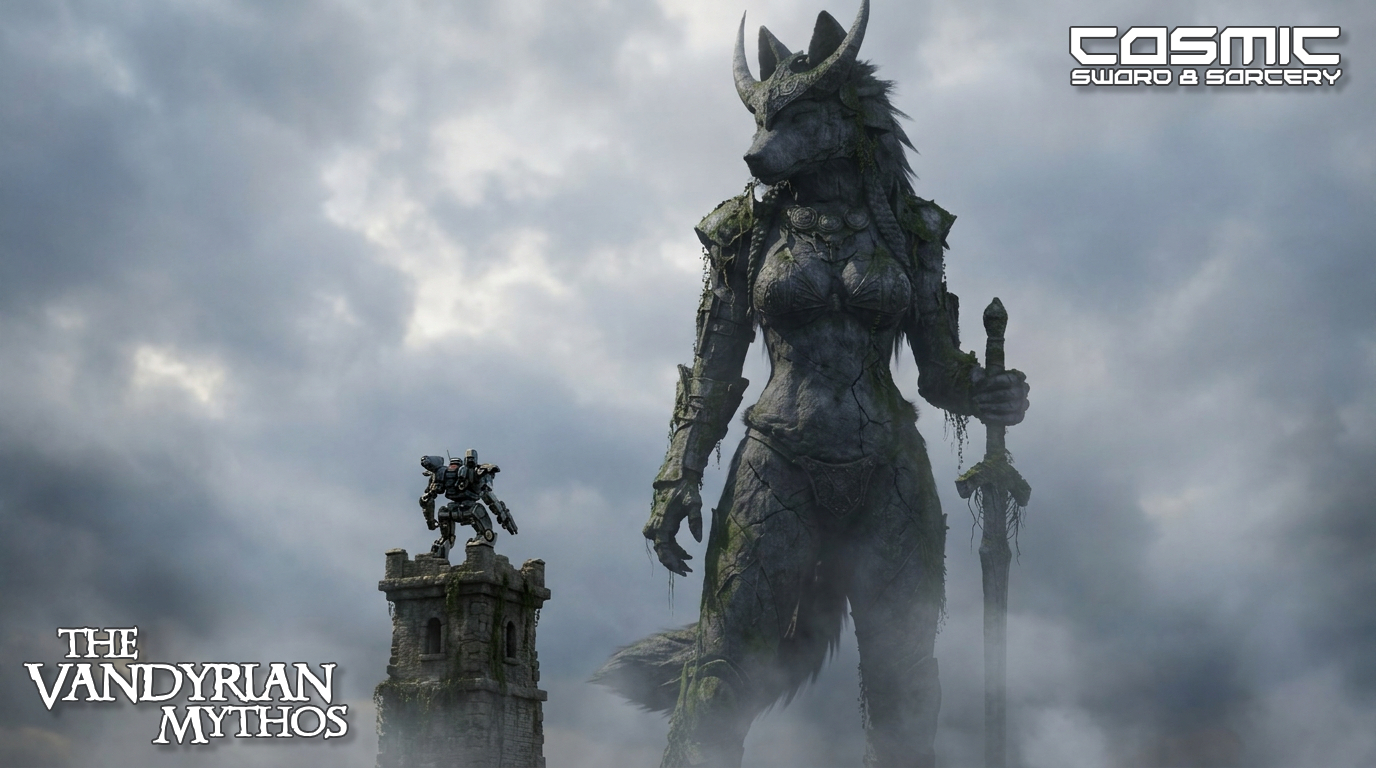
“During the War on the Nolphimian frontier, the leaders of these forces attempted to buy time.
Sacrificing flesh and generational blood on black altars to summon forces of the abyss
… in the hopes they could sway the tide of war.”
Demons At The Gate
Here, along the contested borders of empire, the world lay wracked beneath the cold regard of targeting arrays. Green lightning crawled the western skies, the herald of a war goddess who had never asked for prayer or offering from those who would die under her name. Belief was a luxury for lesser gods. Hers demanded only that warriors stand, bleed, and be measured against the final geometry of her wrath.
From the blackened outlines of the cities it was plain that most had fled. Those who remained had learned the price of the arrays: their blood filled the terraces of the arcologies in dark, cooling pools, and the smoke that rose from the wreckage carried the stink of fused concrete and cooked meat. The goddess did not care. She moved through the ruin as she always had, older than the empires that claimed these lands and indifferent to the machines that now marked her coming.
In the high places the survivors watched the skies and counted the remaining batteries. They knew the next strike would not come as myth or omen, but as a calculated fall of fire—precise, terminal, and absolute. Still they waited. In the end, even the targeting arrays answered to something older than code, and the goddess would have her due whether the living believed or simply stood long enough to be named among the dead.
West of the Greater Nolphimeus, the cobbles still ran dark with blood that no one had yet scraped away. Bodies lay where the fighting had ended them—some stacked in the concrete pits where construction had stalled months before, others simply left against the low walls, blackening under ash. The air itself had turned foul enough that the remaining soldiers spoke little and spat often. What the Heathen War Queens of the Vandyrians had left behind was not a city but a tally, and the small remnant stood upon the broken levels of the outer wall to make it.
Three of them had become the last who could still give orders, though none had earned the place by any measure the old Nolphimeus would have recognized. Rank had come the only way it still came when whole cohorts were cut down in a single night: by surviving the officers who had held it before. Tynn Pralma stood at the center of the three, still in the scarred plate he had worn through the eight promotions that had carried him here. He did not speak. He watched the pits being filled and remembered the lectures his grandfather and every officer above him had given—that “total war” was only the lie a commander told when he needed others to die for a border that would not hold. The Vandyrians had never needed to tell that lie. They had simply brought the thing down upon the spine of the world and left the rest to count what remained.
To his left stood Yalran Guul, the sleeve of his coat knotted above the stump where his arm had been taken at the shoulder. He kept his jaw tight and said nothing; language felt like a thing that would only make the smell worse. On the right, Volkzhi Mirs leaned against the parapet with his remaining eye half-lidded against the grit, the ruined side of his mouth showing the gaps where teeth had been knocked free. Of the three hundred and ninety who had once sworn the grey oath and stood ready for the Vandyrian host, these were the ones who had not been carried off or burned where they fell. The two wolves could already smell what was coming on the wind from the west. They had not been part of the betrayal. They had only been left to live with it.
It was the swine-priest who broke the silence. Bronnabus Leer still wore the soot-stained vestments of Oor’Us, the Nolphian war-goddess, and he spoke as if the walls had not already been breached once. “Now is the hour to act, my lords,” he said. “Now is the hour to make ready. The demon-queen of the Vandyrian filth is drawn westward by the schemes of our departed General Ny’Momph. She will not look back. We must not sit idle while the gods still grant us breath.”
Yalran Guul turned his head just far enough to fix the priest with the hard stare of a wolf who had already spent every soft word he owned. “Then put on your armor,” he said, teeth bared, “and pick up a sword.” The other two did not smile.
Below them the pits were nearly full, and the ash kept falling. The three who remained on the wall already knew the next blow would not wait for their preparations.
Somewhere beyond the western ridges the targeting arrays still turned, patient and precise. Something older than either god or machine was already gathering the lion-hordes and the black-wolf slayers beneath a single banner. If the gods still believed in anything at all, they were leading their thrice-refined enemy straight into the teeth of the capran hordes—the same goat-demons the previous generation had summoned, settled, and turned loose against the green-eyed bitch of the empire.
Bronnabus Leer could not let the silence hold. “Vandyria makes war upon the horned heathen,” he said. “We must act. Strike! Please!”
Tynn Pralma’s patience snapped. He seized the priest by the front of his soot-stained vestments, lifted him clear of the parapet, and drove him face-first into the stone. The sound that left Leer was half squeal, half choke.
“With what!?!” Pralma roared. “What league? What nation? What army? Strike the fangs of industrial murder with the likes of this?” His free hand swept the wall and the broken levels below, where a few hundred exhausted soldiers still dragged the dead. “Look at them.”
Volkzhi Mirs caught his wrist before the blow could fall a second time. The remaining eye cut toward the soldiers who could hear every word. When he spoke it was through cracked fangs, low and final. “We wait. For riders and word. We let the dead burn. We have little else.”
Leer pushed himself up, wiping blood and grit from his lip. “Begging your pardon, my lord. I would never wish to argue tactics with you.”
“Aye,” Mirs said. His own gumline still wept thick red. “But your damned goddess of the sword well did. Look at that now. And she expects to sit at the table.”
“Our divine goddess makes of the world complex plans—”
“And the heathen bitch of the Vandyrians laughs at your mighty winged queen,” Yalran Guul cut in. His remaining arm was knotted tight against his side. Patience had already frayed past the point of courtesy. They had entered the city three hours earlier. It had taken them that long to reach the wall. From the high place little remained that was worth defending. This would not be a city they could save. The generals of their age had known it. Now the soldiers hauling corpses into the pits knew it as well.
Pralma shoved past the priest. Guul followed and spat once at the hoof of Leer’s boot. The swine-priest stayed where he was, devout and practical still. Oor’Us had never let any city truly fall; a city was only the blood and will of its people. It was a comforting thought. An arrow took him through the skull. The arrowhead punched through the back of the eye socket. Leer clutched at the ruined face, voice climbing into a pitched squeal, then dropped into convulsion and filth upon the stone. The others had already started down the stairs. They came back at a run, ignored the twitching priest, and tore the shaft free. Inside the black cylinder a single scrap of hide carried one word. “RUN!”
By the time they rose and turned toward what had been only a sickly smear on the horizon, the west was already fire. The armies of Vandyria closed the distance at a speed that left no room for sense or order. Lions of the midnight host ran with the black-wolf slayers, and among them the capran hordes that had once been their enemy now ran as well—horned, braying, and folded into the same chant that rolled ahead of the whole accursed mass. There was no interval in which a defender might count their numbers or decide where the wall still stood.
Artillery of a kind the Nolphimeus had never named struck the southern and western reaches at once. The impact turned stone to shrapnel. Yalran Guul was still half-turned when the blast took him; what remained of the one-armed wolf became blood and ruin across the parapet, nothing left that could be called a body. Volkzhi Mirs lunged for the stairs. The wall beneath him gave way with a sound like the breaking of a great bone. He fell with the rubble, one eye still open, and was gone before the dust settled.
Tynn Pralma stood a moment longer. He looked at the priest still convulsing in his own filth, at the blood that had been Guul pooling toward the broken edge, at the horizon that was now a single sheet of flame and chanting figures. Something in him cracked. He dropped to his knees on the trembling stone and wept, unable to form words.
The wall did not wait. It sheared away beneath him and carried him down with the rest of the cascade, nine hundred feet to the rocks below.
Artillery and gunfire from afar cut down those who fled. The roads out of the city became killing ground under sustained fire, and the columns of refugees and broken companies were destroyed in turn before they could clear the outer districts. Beasts fell in the open, and those who dropped their burdens to run faster only made clearer targets against the ash and the dust.
Long black carriers descended from the sky and released a greater host. The craft hung low over the ruins, their ramps dropping troops and the heavier machines of the Vandyrian advance into the streets already choked with the dead. The new arrivals moved with the same measured pace as those already closing from the west, and the chant that had come with the lions and the wolves and the horned warriors rose again beneath them.
Explosive hellfire at scale cut down the remaining walls. Sections of the outer defenses that had not yet fallen were reduced in successive bursts, the stone giving way in sheets and the defenders still upon them vanishing into the rubble. The carriers and the ground formations worked in concert, and the city that had once measured its strength by the height of its fortifications found those fortifications no longer standing between the enemy and the streets.
They entered the city amidst explosions and screaming. Capran warriors and black-wolf slayers moved through the breaches while the lion-hordes secured the principal roads, and the sound of the advance mixed with the cries of those still trapped among the falling buildings. Horns broke the stained glass of the Temple of the Winged Goddess, the shards falling among the benches and the altars as the host passed through the doors that no longer held.
Many tried to flee. Some tried to surrender. It made no difference. Those who ran were overtaken in the alleys and on the open ground beyond the last standing structures. Those who laid down their arms or raised empty hands were cut down with the same professional indifference shown to the walls and the batteries. Organized resistance had ceased within the first hour, but the killing continued until the light began to fail.
“The city fell in less than an hour.
By nightfall Vandyria walked the emptied streets.
By morning the host had already moved on, leaving only ash, the cooling pits, and the silence of a small civilization that had once believed itself brazen enough to survive her notice.”