

This volume stands as the dark overture to the saga of Bantos
A region and a people who would come to define rebellion, kinship, and survival in the age after empires. What is set down here is not a direct chronicle of Bantos itself, but the marrow and sinew of its ancestry: the fractured histories, doomed settlements, and desperate migrations that seeded its birth.
This is the precursor text—the record of struggle, collapse, and crude alliances that forged the first Bantos folk from the wreckage of failed kingdoms and half-remembered oaths.
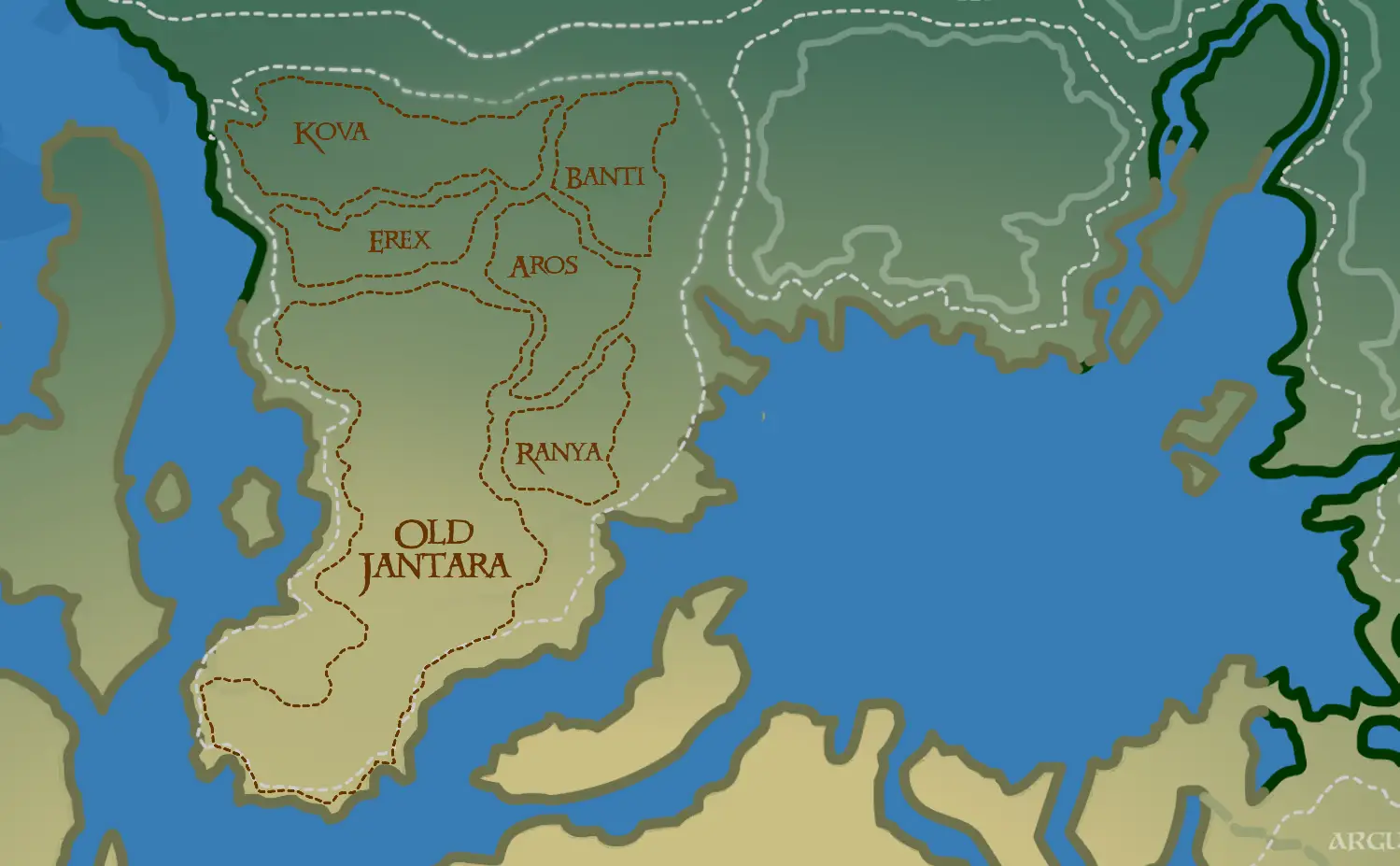
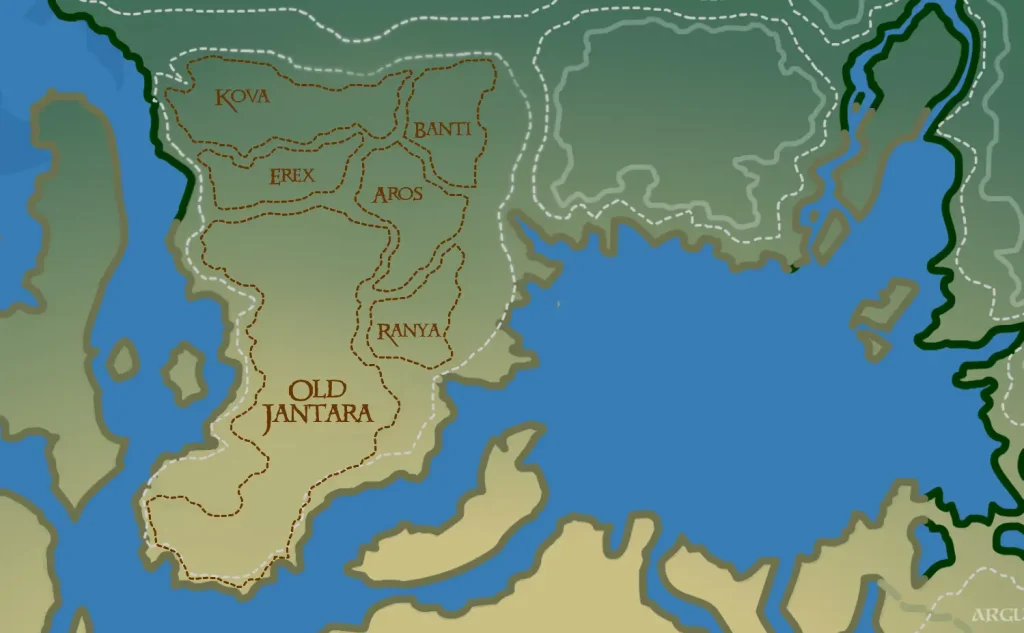
The Northern Doglands were never a kingdom of their own, nor did they emerge from a single lineage or heroic age. They existed as the battered remnant of Old Jantara’s conquests—a stretch of land marked by devastation, forced migration, and a patchwork of ruined subkingdoms, each with its own bitter history of betrayal, humiliation, and subjugation.
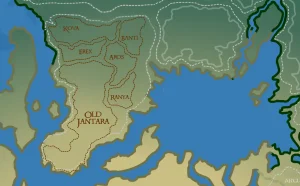
In the last centuries of Old Jantara’s rule, the region was divided between five subject realms:
Kova, Erex, Aros, Banti, and Ranya. These were not allies, nor even stable rivals, but desperate neighbors—each doomed in their own way as the jackal lords tightened their grip and the machinery of oppression ground out every last ounce of resistance or hope.
Kova had been the first to fall. Once a loose alliance of three small kingdoms, its leaders failed to unite against the oncoming jackal hosts. Jackal armies overwhelmed them in less than a year. The leaders of Kova were slaughtered, their resistance shattered, and their people cast into servitude or scattered to the wind.
Erex collapsed next, and not by force of arms, but through treachery. Its ruling council, promised mercy in exchange for surrender, capitulated—only to be burned alive in public squares, their families chained and sent south to serve as living reminders of jackal “leniency.” The betrayal of Erex became a lesson repeated in Dogfolk stories for generations: every promise from a jackal lord was a noose.
Aros did not fall in battle, but through famine. Jackal governors poisoned wells, burned stores, and blockaded the valleys until hunger drove the defenders to submission. Even then, those who surrendered were offered no clemency. The armies of Aros, mustered as a show of fealty, were ambushed and slaughtered; their homes, already emptied, were burned behind them.
Ranya stood longest in the south, a land of fortified valleys and river towns held together by desperation. The folk of Ranya endured repeated assaults, losing ground village by village until, at last, the survivors were hunted down or driven out. Their names and stories survived only in the genealogies of later Dogfolk clans, and in the ruins they left behind.
Banti was the outlier, the last and most stubborn of the northern realms. Backed quietly by the Ruseloni beyond the border, Banti’s people waged a persistent, bloody resistance, using their forests and hills as shelter for generations. Some claimed Banti never truly surrendered, and that it remained a thorn in the jackal’s side, the heart of Dogfolk defiance, even as the rest of the region fell to ruin.
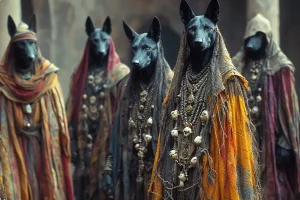
As these kingdoms fell, the jackal conquerors did not simply absorb their lands. They relocated and broke apart entire populations—not by lineage, but by labor needs and convenience. Folk from every subkingdom found themselves uprooted, resettled in tent cities, makeshift camps, and squalid shantytowns. The old ties of kin and place unraveled, replaced by a new, shared identity built on the trauma of dispossession.
These grim settlements were the cradle of what would become the Northern Doglands: a land of exiles and survivors, ruled not by law but by the logic of necessity. The traditions of Kova, Erex, Aros, Ranya, and Banti endured only in fragments—songs half-remembered, rituals practiced in secret, grudges passed down with each telling. In time, these broken peoples forged a kind of solidarity, not through shared history, but through the stubborn will to outlast their oppressors.
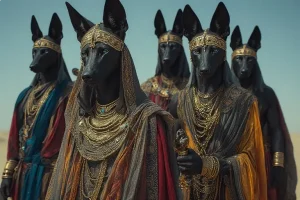
The Later Jantaran Union was a kingdom in name only, ruled for nearly sixteen centuries by the so-called Pheryn Dynasties—cold, calculating warlords and sorcerers who claimed lineage from Elder Jantara without possessing its discipline, doctrine, or restraint. They adopted the symbols of the old league but not its substance, wearing masks as intimidation rather than ritual, hoarding gold instead of circulating it.
This was a civilization of ledgers and lies. Its histories were self-authored, exaggerated, and mutually contradictory. Guilds recorded grievances instead of laws. Faith was replaced with mysticism weaponized for control. Its end came abruptly.
In a single mass poisoning—still unexplained—half a city died in one night. Thrones fell together. Rulers, courtiers, and priests collapsed in confusion and terror. The aftermath was not revolution, but slaughter. What followed was carved obsessively into frescoes for two centuries: betrayal, fire, beheading, and ritual humiliation of the dead.
Yet even this did not birth Bantos.
The usurpers who followed clung to the carcass of the Union for another three hundred years, until they too failed. Their fall left behind a vacuum, not a successor. For centuries after, the lands of ancient Jantara were little more than caravan corridors—crossed, exploited, and ignored by Zhuru’s wider powers.
By this point, even the jackals themselves admitted the truth: Elder Jantara had been real. What came after were not heirs, but parasites.
The fall of the jackals is not tragic because they were defeated. It is tragic because they fell so far, and because the descent took so long that its end was barely noticed when it finally came. Elder Jantara did not die screaming beneath foreign blades, nor was it erased by some singular cataclysmic betrayal. It thinned. It softened. It dimmed itself over generations, trading vigilance for refinement, ritual for repetition, certainty for indulgence. By the time its last true heirs vanished, the world had already grown accustomed to the absence of jackal greatness.
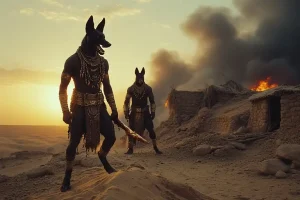
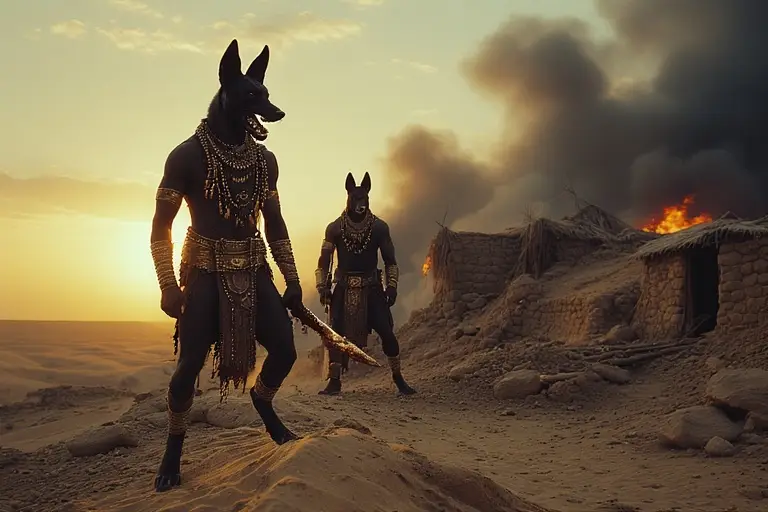
This is what makes the modern jackal such a bitter sight. The jackal grunt of the present age is a scavenger in rags, clutching a chipped blade, half-feral in speech and habit, bleeding on command for the amusement or favor of despotic kings who rule by terror rather than covenant. There is no philosophy left in him, no discipline beyond hunger, no loyalty beyond fear. He is used as expendable muscle, a body to be thrown at walls or into ambushes, promised scraps of plunder or access to rut as payment for obedience. He knows no law but dominance, no past but rumor, no future but the next wound.
The Starved Inhabitants of the Yorozhian Wastes
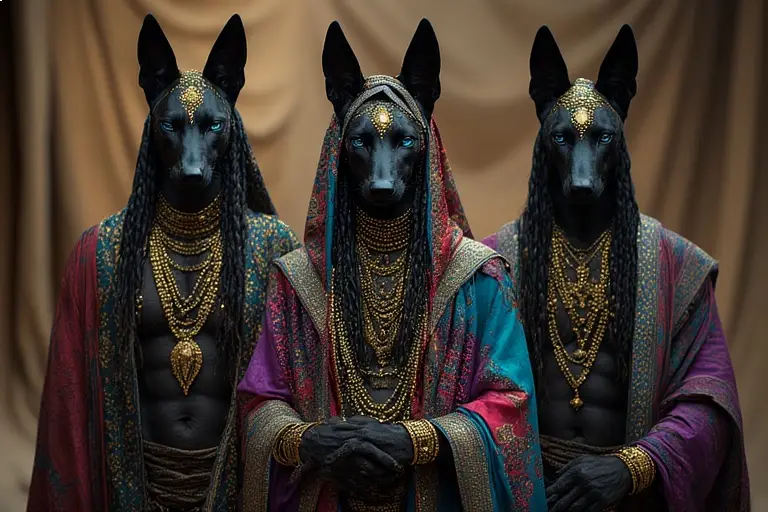
Against this stands the memory of Elder Jantara, and the contrast is almost unbearable. The jackals of that elder age were tall, composed, and unmistakably deliberate. They were mystics of trade and restraint, wielders of commerce as a civilizing force rather than a predatory one. Their discipline was not born of terror but of doctrine, reinforced by faith and symbol rather than lash. They governed themselves as much as they governed others, bound by internal codes that prized control over excess and reputation over conquest. Where the modern jackal lunges, the elder jackal measured.
Nowhere was this more evident than in the Elder Jantaran blades. These warriors were not mere soldiers for hire, but mercenaries of singular renown, sought across the southern realms for a loyalty that exceeded coin. They were bound not only to their pay, but to the spoken word of the lord or baron they served.
Once committed, an Elder Jantaran blade did not retreat. Accounts speak of them locking shields with their own bodies, standing firm beneath arrow fire to shelter those they had sworn to protect, dying in place rather than breaking oath. To hire them was to purchase certainty, not cruelty.
So trusted were the institutions of Elder Jantara that neighboring kingdoms entrusted their own offspring to Jantaran Bardasi 💎, the merchant-philosophers of that age. Sons and daughters traveled with jackal caravans not merely to learn trade, but to absorb a worldview that balanced honor with guile, profit with restraint, curiosity with discipline.
These youths returned changed, sharpened by exposure to a culture that treated commerce as both moral test and civic duty. That such trust once existed makes the present suspicion of jackals all the more damning.Even their physical presence has passed into near-myth.
The Elder Jackals were said to be arrestingly beautiful, the females statuesque and severe, the males exemplars of southern canine grace—lean, powerful, and proportioned with an almost architectural harmony. Their bodies reflected the same restraint that governed their culture: nothing wasted, nothing excessive.
Desire was acknowledged, not denied, and their society was open in its acceptance of bisexuality among both males and females. Love, rut, and pleasure were not treated as shameful impulses, but as forces to be understood, moderated, and woven into social order rather than allowed to dominate it.
The relics they left behind only deepen the sense of loss. Elder Jantaran sapphires and swords are artifacts of a craft no longer replicated, not merely because of lost technique, but because the civilizational conditions that produced them no longer exist. A single sapphire of Elder Jantaran cut is worth a hundred times its weight in gold, not for rarity alone, but because it embodies an ethic as much as a material mastery. These were not ornaments of vanity, but anchors of moral identity, symbols of restraint forged into stone and steel. Their blades, too, carry a balance and permanence unseen in ten thousand years of declining returns.
Thus the tragedy is complete. The jackals did not merely lose territory, power, or prestige. They lost continuity. What survives today is not a corrupted version of Elder Jantara, but a negation of it—a people stripped of memory, discipline, and form, left with only hunger and cruelty where philosophy once stood. The world mourns Elder Jantara not because it was perfect, but because it proved that jackals were once capable of something far greater than what now stalks the dust.
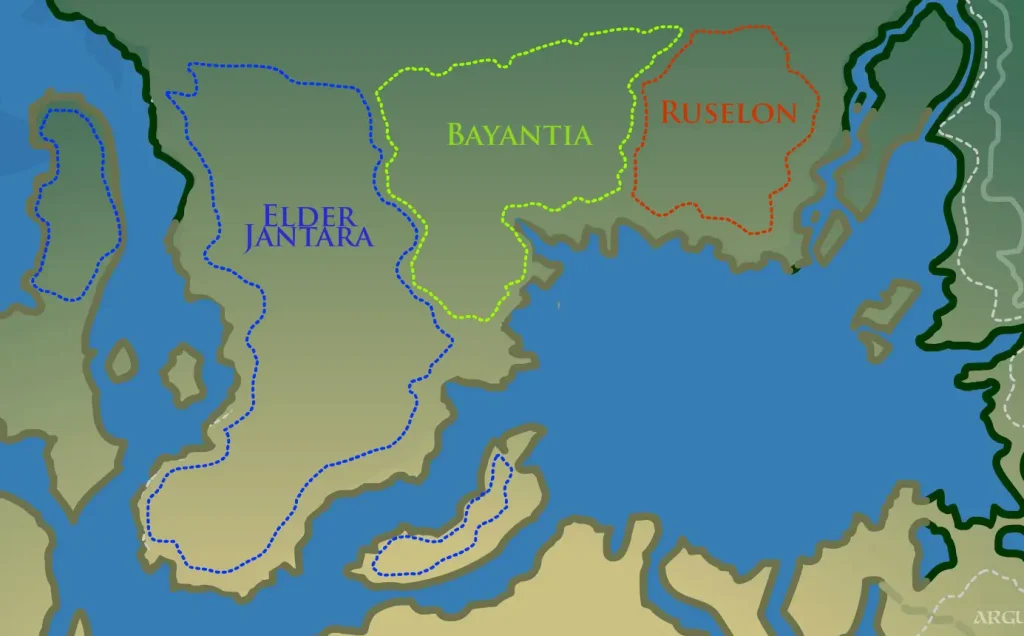
The Ancient Jantaran League, sometimes called Elder Jantara, was real. Of this there is no longer serious dispute. Though poorly recorded and often mythologized, it existed as a concentrated jackal civilization spanning much of what is now central and southern Bantos, with reach into the easternmost margins of Bruwa.
Elder Jantara, Bayantia & Ruselon
Unlike later jackal regimes, Elder Jantara was not defined by constant raiding or slaver economies. Contemporary accounts describe a people who were strange, insular, and ceremonial, yet broadly non-hostile.
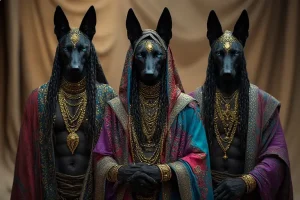
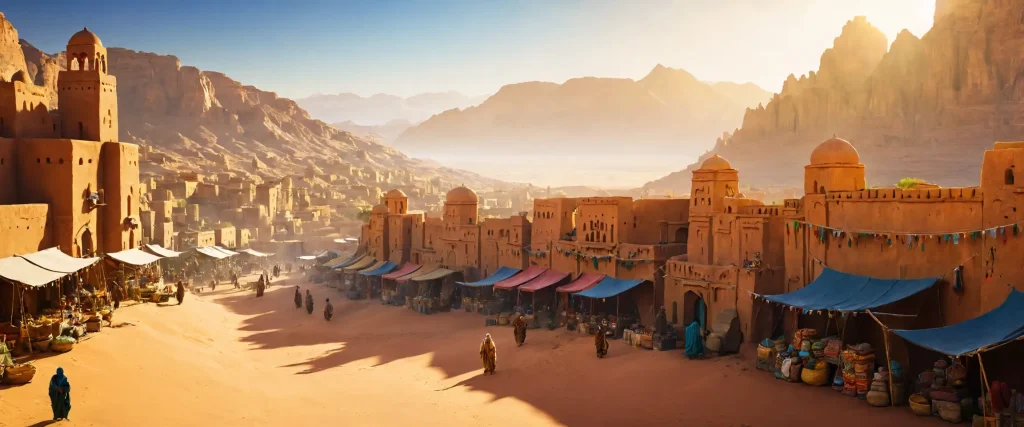
They wore gilded masks and long robes, spoke a language that resisted translation, and traded widely and fairly. Their caravans moved along stable routes, their camels bearing goods rather than captives.
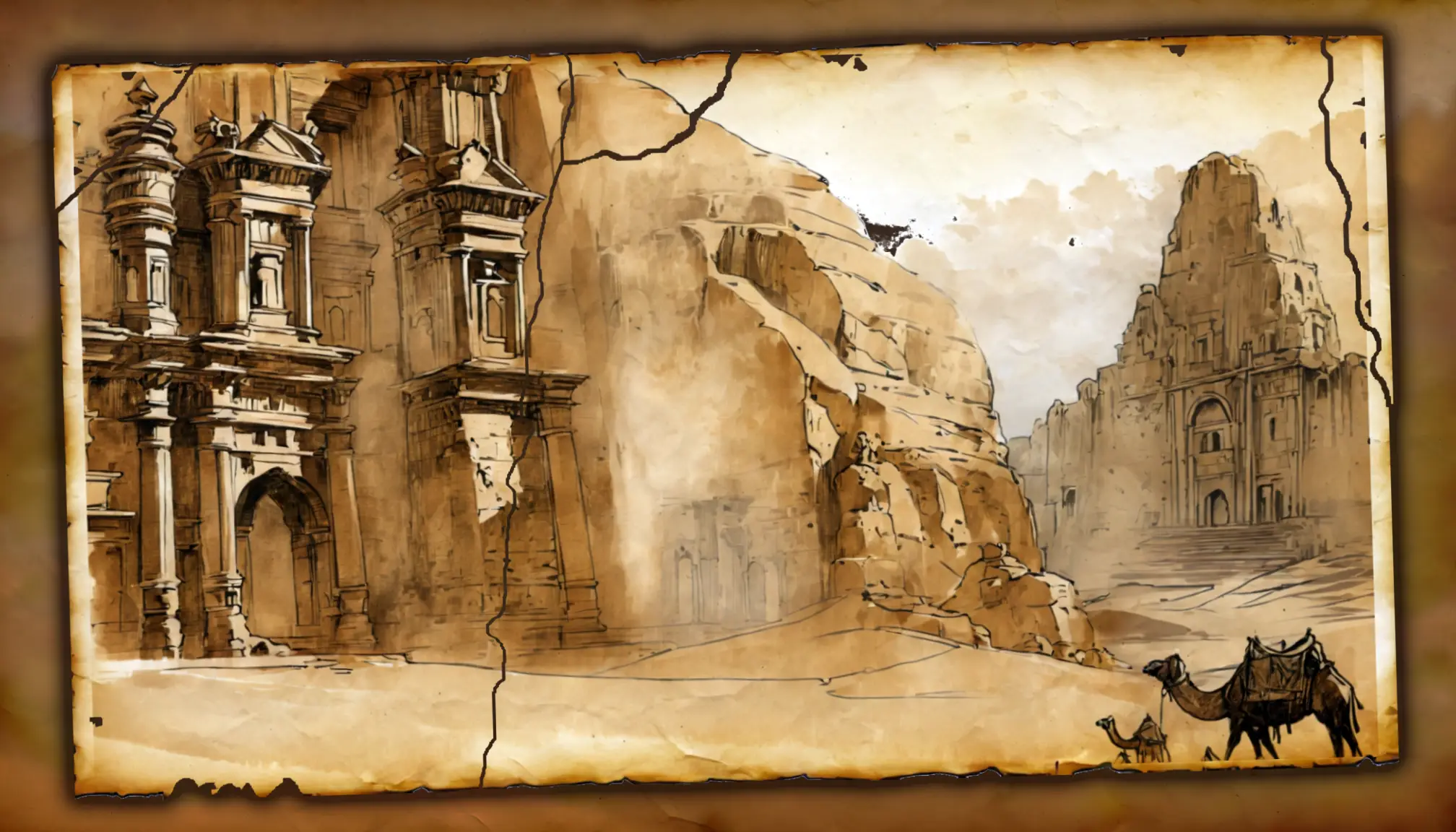
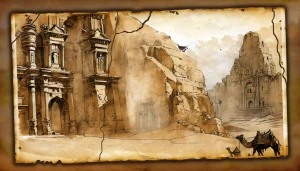
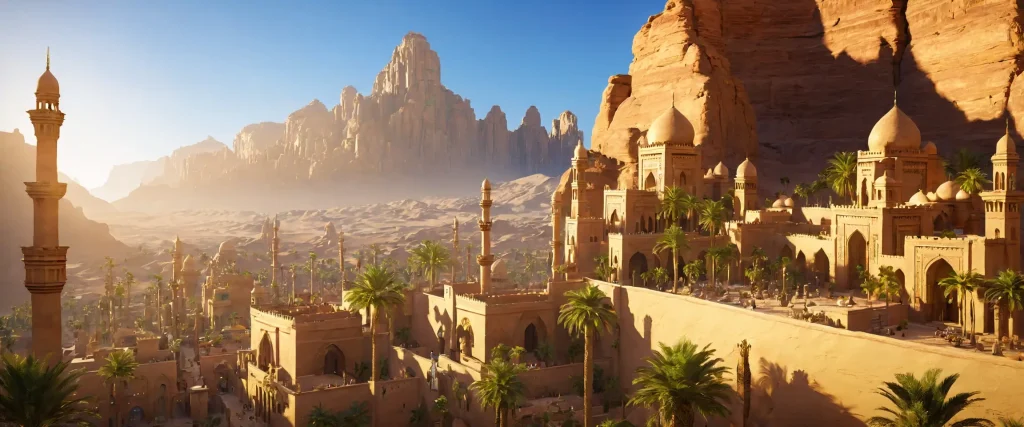
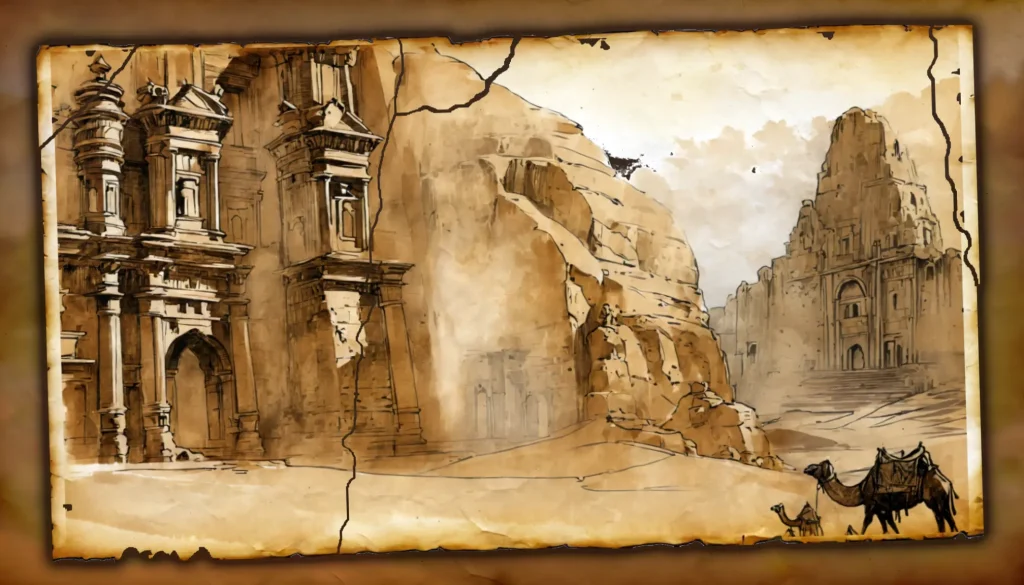
Their southern settlements were built into rock formations closer to what would later become the Kartongan wastes, though the exact extent of these cities is lost.
The Merchant Class of Jantara lived in comparative luxury to later descendants.
Their rulers were described consistently: tall, piercing blue-eyed, deep-voiced figures whose presence commanded without brutality. They followed an esoteric religious order centered on gemstones, particularly sapphire, not as ornament, but as symbolic moral anchors. Later scholars argue this gemstone reverence functioned as a metaphysical restraint, a cultural doctrine that limited cruelty and enforced internal discipline. Whatever its nature, it worked.
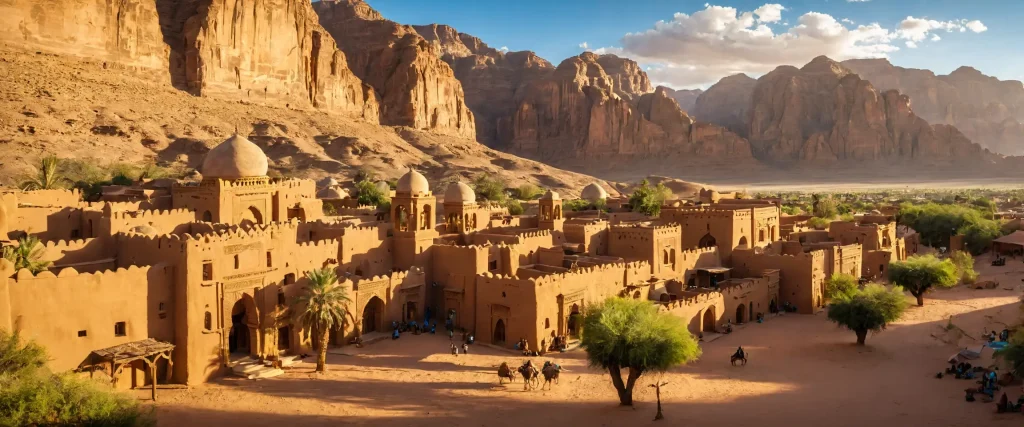
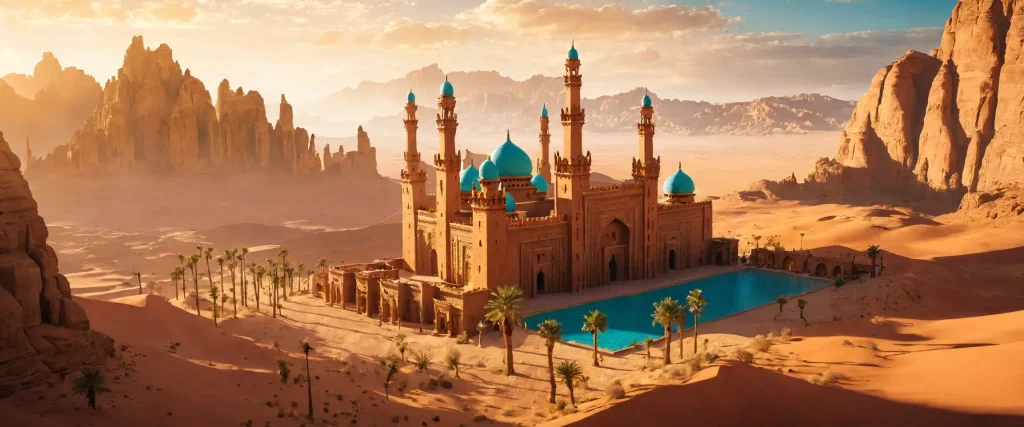
The Cerulean Palace of Elder Jantara
Elder Jantara endured for roughly two thousand years after the Cataclysm, withdrawing gradually into decadent obscurity rather than collapsing in fire. Its neighbors prospered alongside it. Trade enriched surrounding regions. Stability followed jackal roads.
Then it ended.
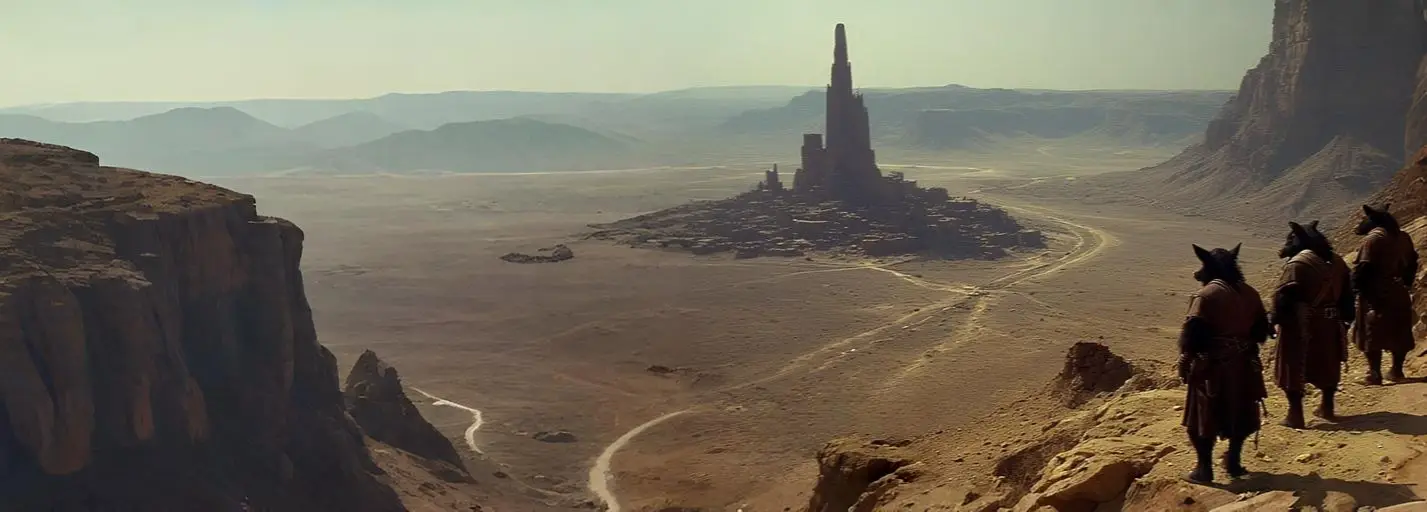
The Western Border of The Elder Jantaran Realms
No heirs survived into the modern age. No dynasties persisted. The culture vanished not with a final war, but with a long extinguishing—like embers smothered beneath their own excess. What remained was memory, and the temptation to claim descent from something greater.
The lands now called Bantos were not born in peace, nor founded in idealism. They were carved out of a long failure, layered with lies, impostures, and the slow rot of a people who mistook cleverness for permanence.
Once, the northern expanse between the Doglands and the wastes of Kartonga belonged to the jackals. They ruled it with thin hands and sharper minds, cunning traders, sly governors, and merciless raiders who mistook fear for dominion.
To understand Bantos, one must first understand Jantara—not as a single nation, but as three successive conditions of jackal rule: the Elder Union, the Later Union, and the long, diseased husk known as Old Jantara. Only after these did the dogs rise, and only then did the land become something new.