Category: Primal Horror

  • Yaraldgus of Krothuum

    Yaraldgus of Krothuum

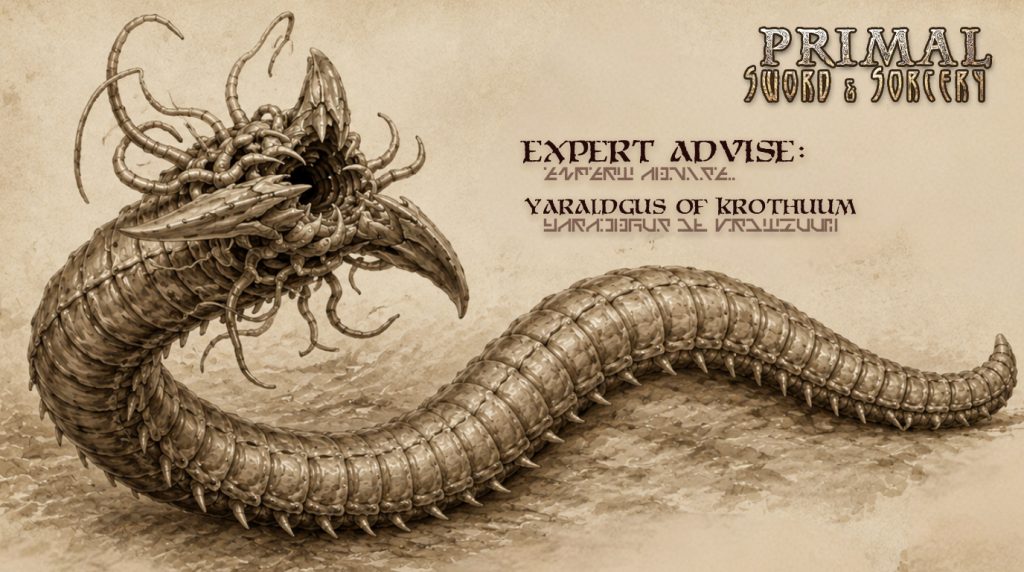
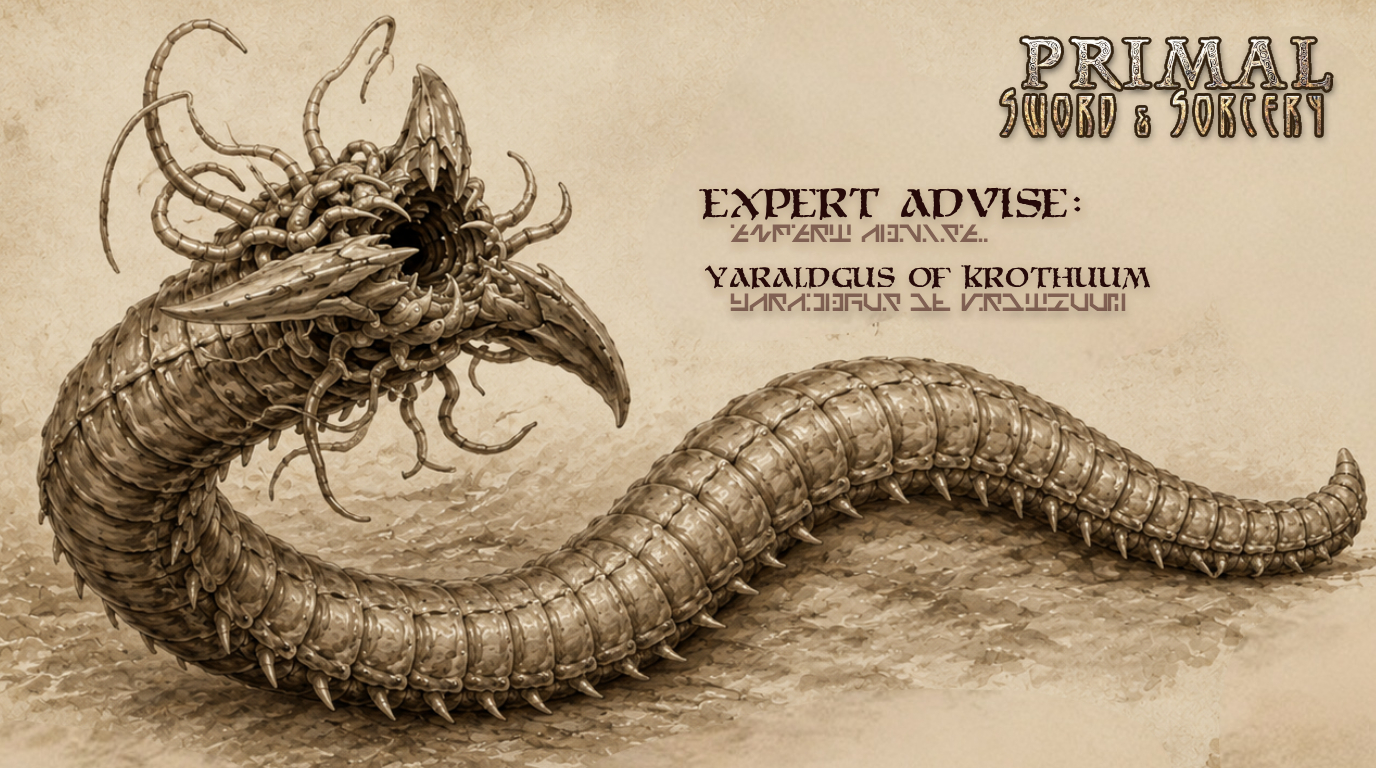
    Expert Advise: Yaraldgus of Krothuum


    The old hyena squinted through the haze of his workshop, hands black with soot, claws yellowed from years of tinctures and fumes. His mane was gone to patches, his muzzle scarred by acid burns, and when he spoke, it was with the gravel of someone who’d inhaled too much forge-smoke and grave-dust.
    “You want my advice, you listen close, and you don’t mistake it for rumor.”

    He jabbed a claw into the table hard enough to make the bottles rattle. “If the Worm-Smith’s seed takes root in you, gods help ye’, because no medicine and no herb will. You can drink all the powders, chew all the roots, bleed yourself from now till next season, and it won’t make a whit of difference. Once the worms are in your belly, they’re in your blood, in your guts, in your lungs. You don’t drive them out. You don’t even slow them down.”

    He leaned closer, eyes burning amber in the dim light. “They bide their time, and by the time you feel the first cramps, it’s already too late. Some rot slow, coughing and pissing their lives away. Some swell like overripe gourds until they pop, spraying half the quarter with their filth. But all of them die screaming. All of them die laughingstocks.”

    He spat into the coals, the hiss echoing like a curse. “So here’s your warning, and don’t say you weren’t told: if you spread for Rathgur, you’re not buying steel — you’re buying worms. And there ain’t a potion brewed in Varduun that’ll save you once they’ve got you.”
  • ‘Worms of the Dirt’

    ‘Worms of the Dirt’

    ‘Worms of the Dirt’

    She left Krothuum with her sword on her back and her pride in tatters, amber eyes burning with vengeance. For weeks she walked the roads of Zhuru with fury in her belly, swearing she would return, swearing she would kill Rathgur, swearing Krothuum would choke on her blade. But as the months passed, fury turned to weakness. Her belly swelled, not with cub nor with strength, but with fever.
    At first she thought it an injury, a poison, a curse perhaps.

    But when the blood came, thick and foul, and when the cramps tore her body from within, she knew something worse had taken root. She dreamed of coils, of squirming shapes gnawing her from inside. She woke with sweat cold on her fur, her thighs slick with rot. By the ninth month, she could no longer walk with the strength of a barbarian. Her legs buckled. Her once-muscular frame sagged under the weight of the sickness. And when she finally collapsed in a roadside tavern, writhing on the planks, the truth spilled from her in blood and pus and writhing larvae.

    The Vulture Worms, seeded in her womb by Rathgur’s thrust, had bloomed. She died screaming, clawing at her own belly, as the crowd backed away in horror. Not one came to her aid. Not one offered pity.

    The tale was already forming in their mouths before her body cooled. And so the story traveled. From Zhanti’s whore dens to Kansubar’s smoke halls, from Ul’Thadaar’s ruin-stairs to Zarnack’s silken chambers, the tale grew sharper with each retelling. She was no longer the black wolf who lost her sword. She was the fool who carried Krothuum’s worms, who thought she could walk away from hyena laughter, only to rot from the inside. And in Krothuum itself, Rathgur raised his tankard and laughed the loudest.

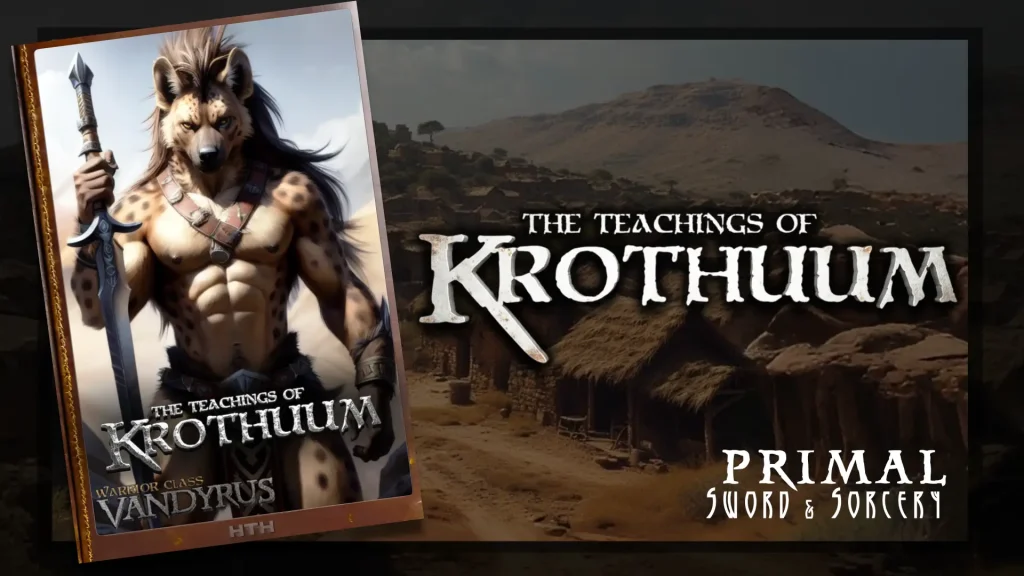
    “The bitch learned her lesson,” he roared, and the forge shook with cackling. “The worms teach harder than I ever could.” Thus ended her tale. Thus was her pride devoured. Thus was another line etched into the scripture of humiliation that folk call The Teachings of Krothuum.


    Related

  • Lost To Londorai

    Lost To Londorai

    The girl ran through the frost-bitten woods, her limbs a blur against the whitening dusk. Behind her, the trees rose like the ribs of some colossal carcass, each one rimed in blue ice, each one echoing her passage with the hollow, brittle music of the cold.

    Above, the sky was a vast bruise—darkening, deepening—and through it drifted the faint glow of the departing airship, already no larger than a drifting coal in the distance. Its engines were fading, the last tremor of living sound swallowed by the wind. She stumbled, fell, and the snow accepted her with the indifference of the dead.

    For a moment she tried to rise, but her body no longer obeyed its own commands. Her lungs burned; her breath burst in clouds that froze before they fell.

    Around her stretched the desolation of Londorai—an endless continent of cold, cruelty, and silence. No light but the auroral pulse of the storm-sky. No warmth but the fever of panic still thrumming in her chest.

    The airship was gone now, sliding toward the horizon like a memory being erased. She watched until even its vapor trail was lost among the clouds.

    Then she bowed her head.

    Her sobs came without sound.

    The frost took them too.

    She pressed her muzzle into the snow, trembling beneath the gaze of a world that did not care whether she lived or died.

    Londorai was vast and without mercy. The wind carried no scent of rescue, no echo of clan or kin. Only the deep, endless cold, and the promise of teeth. Above her, the aurora shivered once—green fire on a frozen sea—then vanished into night.

    At 14, It was her first year in the guild without her sire. He would never have let them lift from the ice without her aboard. But he was gone now, and the others had already weighed her worth and found it light. She had complained it was harsh, that the cold bit too deep, that the beasts came too close at night. They had laughed. Now the shares were six instead of seven.
    They would speak of her softly, perhaps once, in the warmth of the galley, then let the silence swallow her name as the wind had swallowed her cries. The airship would reach the southern cities in a week—if the storms did not tear its hull apart first.


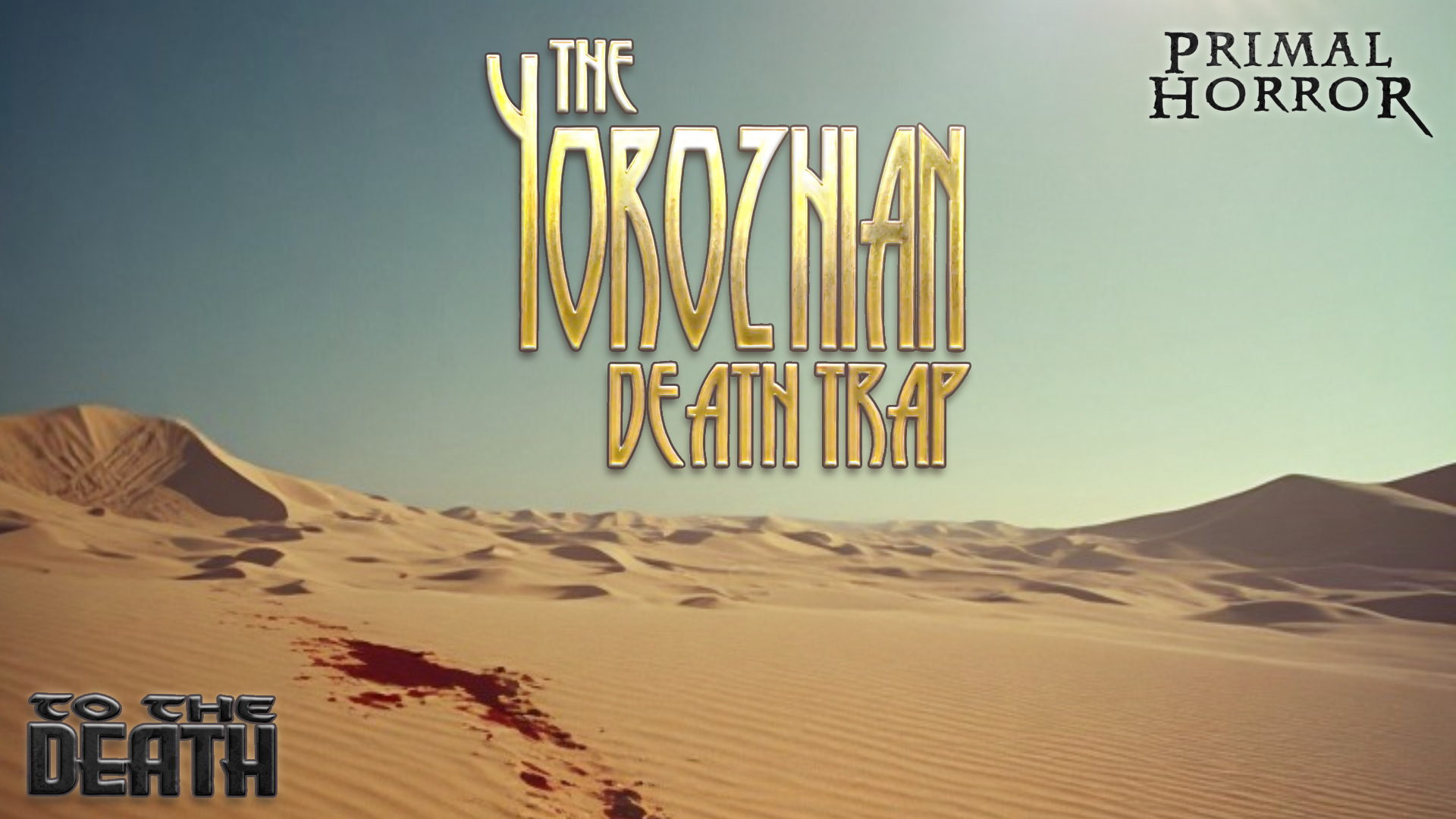
  • The Yorozhian Death Trap

    The Yorozhian Death Trap


    “Tokotahn, the wizard-city of the Tiger Highlands, was a hidden gem of the emerald-spired kingdoms: decadent, luxuriant, and cruel. A curated paradise of temple-monasteries and cloud-bridging causeways that had withstood more than one Sundering and several shakings of the world. Its long halls housed alchemical craft-mills and meaderies. Silk merchants fattened along the polished walkways.
    It was an ancient city. Respected. Heralded.

    And full of death and treason.”


    Tafu Tahn, apprentice to Induzh Rai of the Obsidian Court—the great and most-feared conjurer of the district—now stepped lightly over the old tiger’s corpse. Face-down in his study, choked on poisoned rice. A “peasant’s trick”.
    Fitting. He had called her peasant when she failed. Peasant when she did well. Peasant when she poured his drink or bit her lip beneath his gaze. When his noble hand slid down her back toward her ass, it was always with that same smug disdain. But he had not touched her. He knew his limits. Now, he was dead. She sneered.
    Death by rice. How common.

    She had coveted his library for years. That would be her first act—taking it. He had grown too arrogant in his isolation, boasting in recent months that he was the last of his order, the sole living master of Tokotahn’s fading magical lineage. Now she was the last. And everything he thought would die with him? Would not.

    She stole his key and spat on the back of his rotting head.
    He had lifted her out of the gutters, yes.
    Taught her magic. But at the price of her name, her pride, her flesh. She had paid it. She had taken the pain. And now she took his place. The library was silent when she opened it. Silent and hers. And of course, the very first thing she did was the one thing he had forbidden.

    “Never open the emerald case. Never touch the glass. Never disturb the volumes within.” She opened it. The glass chimed like a bell. The air grew tight. She reached for the golden-bound volume he had once pointed out to her, long ago, when she was too young and scared to feign disinterest.
    “And mind you, young one,” his cruel voice echoed in memory, biting like a curse.
    “Should you ever think yourself clever—some thieving little peasant whore—this book, The Curses and Death-Traps of Most Barbarous Yorozh, will be your end. The book itself—and all its kind—have sworn that my magic dies with me. Should you try… they will see to it.”
    She grinned and picked it up.

    Damned.

    She did not even have time to scream. The pages shredded in her hands—turning to sand, light, and wind—and a golden portal yawned open, dragging her forward in a burst of light and fury. She hit cracked stone and heat. The scream burst out of her just as the portal closed…

    Severing her feet at the ankles.

    Pain ripped through her like fire and ice braided together. She screamed again—but bit off the tip of her own tongue in the panic. Blood sprayed from her mouth. She tried to crawl, but her nerves would not obey. Her limbs twitched, dumb with shock, her thoughts shattered like glass. Her body went cold even as the sand baked her raw. Only then, writhing, bleeding out, did she realize how damned she was.

    I cannot tell you where she landed in Yorozh—because no king, no clan, no mapmaker, and no living war-shaman sane enough to speak has ever charted that place. Yorozh is not a desert. It is a curse.

    In the elder Izhanian tongue, Yorozh means “Place Host to the God of Death.” And so, once again, it had been used.


    Weeks later, in the quiet study of Induzh Rai—now reeking of mold and flybuzz—the ministers of the Obsidian Court finally arrived to investigate his silence. They found his corpse. Cold. Familiar. And beneath the emerald-glass case in the high library, they found nothing missing save for a pair of severed legs, Clothed in silk.

    Wearing the shoes of a well-dressed peasant.


    Related

  • To The Death

    To The Death

    Entries


    Next


    Set across the savage realms of Vandyrus and Thanator, TO THE DEATH is built around a simple certainty: sooner or later, somebody loses.

    The series is absolutely a collection of grisly vignettes—failed hunts, doomed expeditions, battles that turn badly, predators finding easier prey than expected, warriors discovering that courage is not armor—but the bloodshed has a larger purpose.

    TO THE DEATH is also a practical guide to what “GAME OVER” actually means in an Age of Primal Sword & Sorcery. These worlds do not politely fade to black when the dice go wrong. They continue without you. The beast finishes feeding. The enemy takes the field. The wounded warrior bleeds beneath an indifferent sky. A bad decision made three hours earlier finally collects its price.

    Vandyrus in particular is a world where survival remains provisional, where settlements and roads exist within landscapes that have never truly been subdued, and where endurance rather than permanent security defines much of civilization.

    Each vignette establishes consequence. It shows writers, players, artists, and game masters how defeat belongs inside this setting: sometimes heroic, sometimes ugly, sometimes frighteningly fast, sometimes absurdly unfair, and occasionally the perfectly logical conclusion of somebody who should have known when to run. There is no requirement that death arrive with dignity, narrative importance, or enough warning to prepare a final speech. The same brutal world capable of producing kingdoms, ancient roads, Den-Cities, warriors, cults, monsters and forgotten ruins remains perfectly capable of reducing an individual life to another set of bones beside the trail.


    Entries

  • ‘The Carnivore Sea’

    ‘The Carnivore Sea’

    ‘The Carnivore Sea’

    The lion’s mane was a dark banner, soaked with brine and sweat, when the shadow of the sky-reptile fell across him. His broadsword flashed once, twice, and with a roar of effort he hewed the tip from the pterodactyl’s beak. Black ichor fountained, but the wound only enraged the monster. Its talons closed around his torso, crushing his ribs like kindling, and with a wet crack his arm was snapped in three places. Splinters of white bone jutted through skin and fur as he screamed, his blade tumbling from his grasp into the abyss below.

    The creature hauled him aloft, wings beating like storm-sails. Half-mad from agony, the barbarian reached up with his good hand, plunging his claws into the wet orb of its eye. With a feral snarl he crushed it to pulp. The pterodactyl shrieked, spasmed, and dipped too low—skimming the steel-dark surface of the sea. In its thrashing, his ruined arm tore loose, flesh and sinew parting with a sickening rip.

    He fell into the waves howling, the salt water boiling red around him.

    But the ocean had its own hungers. From beneath, jaws vast as a canyon clamped down. A mosasaur, titan of the deeps, took both barbarian and beast in its maw. The pterodactyl vanished in a single gulp, while the lion was raked across razored teeth, his legs severed clean at the knees. He burst back to the surface, a wreck of a warrior, bellowing through froth and blood as his own armor dragged him down. A buckle caught on the leviathan’s scale; he was tethered to his devourer, drowning by inches.

    Then the sea itself split apart. Tentacles thicker than oak masts coiled upward, latching onto the mosasaur with obscene strength. The deep gave voice to its oldest horror—the kraken had come. Its beak, monstrous and unholy, yawned open wider than a fortress gate. The sea boiled as titan fought titan, and amid the clash of gods the lion was nothing more than garnish.

    He managed one last scream, bubbles streaking from his lips, before the tendrils wrapped him in their cold embrace. Armor, flesh, and broken bones alike were rolled into the titanic jaws. A lion, a lizard, and a sky-thing all vanished together into the black maw of the abyss—an offering swallowed whole by the blind hunger of the Carnivore Sea.