Category: Sources, Archives & Libraries

  • On the Matter of the Northern Ro’Edyne Kingdoms

    On the Matter of the Northern Ro’Edyne Kingdoms

    Thyuratahn, and Certain Geographical Misunderstandings

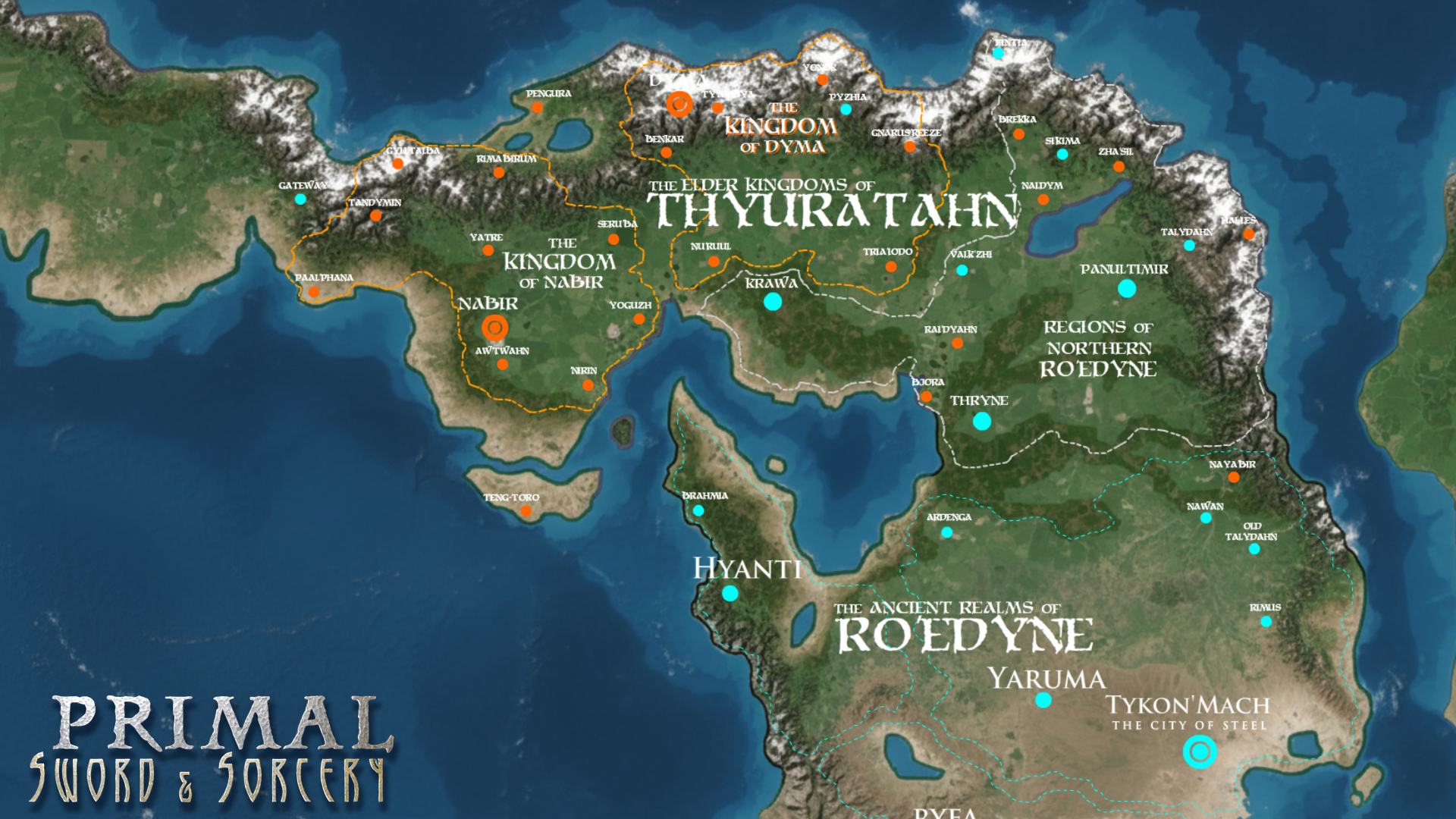
    It has long been the habit of popular history to treat all territories lying north of ancient Ro’Edyne as though they constituted a single region. Such simplifications are understandable. They are also responsible for a remarkable quantity of confusion. The surviving records indicate that the geography of the ancient north was considerably more complex than many modern readers appreciate, and a proper understanding of the distinction between Ro’Edon, Northern Ro’Edyne, and Thyuratahn is essential to any serious discussion of the period.

    The continent of Ro’Edon formed the heartland of the Ro’Edyne civilization. Its great cities, administrative centers, trade networks, cultural institutions, and population centers occupied territories extending from the southern regions to the northern frontier. Among these northern territories stood Panultimir, Thiryne, Krawa, and numerous lesser settlements whose importance increased substantially during the later periods of expansion. These lands constituted the northernmost regions of Ro’Edyne proper. They belonged to the civilization, operated under its institutions, and participated directly in its political and economic systems.

    This fact has occasionally produced the mistaken assumption that Panultimir itself formed part of Thyuratahn. The surviving evidence suggests otherwise. Panultimir was not a Thyuratahn city. It was a Ro’Edyne city facing Thyuratahn. The distinction may appear subtle at first glance, yet it is among the most important geographical realities of the ancient north. Panultimir occupied a frontier position at the very edge of ordinary Ro’Edyne administration. Beyond its northern approaches began territories increasingly dominated by independent kingdoms, mountain domains, clan territories, and frontier states whose histories, while frequently intertwined with those of Ro’Edyne, remained their own.

    Beyond the northern frontier stretched the immense territorial expanse known as Thyuratahn. Modern descriptions often refer to it as a landbridge, though such terminology occasionally understates its scale. Thyuratahn was not merely a corridor connecting one region to another. It was a vast subcontinental territory containing its own kingdoms, cities, trade routes, cultural traditions, and political powers. The Kingdom of Nabir, the Kingdom of Dyma, and numerous lesser realms occupied substantial portions of these lands. During many periods they maintained close relations with Ro’Edyne. During others they pursued their own ambitions entirely independent of southern concerns. Their histories intersected frequently with those of Ro’Edyne, but they should not be mistaken for provinces of Ro’Edyne itself.

    Panultimir consequently occupied a position of unusual importance. Virtually every major route connecting Ro’Edyne to Thyuratahn passed through or near the northern city. Merchants traveled through its gates. Diplomats conducted negotiations there. Military expeditions assembled within its districts. Explorers departed from its roads. Reports arriving from the northern kingdoms often reached the archives of Panultimir long before they reached any other repository within the southern territories. Over time the city became not merely a frontier settlement but the principal point of contact between two distinct worlds.

    The situation becomes more complicated still when one considers that Thyuratahn was itself not the ultimate northern frontier. Surviving records speak of additional northern routes extending beyond the Elder Kingdoms toward the distant realms of Yiritahn and Londorais. These territories occupied the far northern reaches beyond the conventional limits of settlement and administration. Contemporary descriptions portray immense mountain ranges, isolated strongholds, severe climates, and populations whose customs frequently appeared strange even to seasoned travelers. Many accounts describe journeys measured not in days or weeks, but in seasons.

    Particularly prominent within these northern traditions are references to the Elderbeards, ancient lords of the wolf clans who occupied portions of the high mountain territories beyond the settled frontiers. While later folklore frequently surrounds these clans with exaggeration, their repeated appearance throughout otherwise unrelated records suggests a political and cultural significance that should not be dismissed lightly. Surviving accounts describe powerful mountain domains, hereditary clan territories, and strongholds perched amidst some of the most inaccessible terrain known to the ancient world. Even during periods of imperial strength, these northern realms appear to have retained a distinct identity.

    The eventual loss of Thyuratahn transformed the geography of the north beyond recognition. Most evidence suggests that substantial portions of the region disappeared prior to the Coming of Doom itself, though the exact sequence of events remains uncertain. Whatever the cause, the consequences proved profound. Routes that had once connected kingdoms vanished. Settlements became isolated. Trade networks collapsed. Entire regions disappeared beneath the sea, surviving only through surviving records, fragmentary maps, and the occasional archaeological discovery.

    For this reason, modern readers must exercise caution when interpreting references to the ancient north. The geography visible today bears only partial resemblance to the geography known to the Ro’Edyne. Panultimir stood not within Thyuratahn but before it. Thyuratahn was not a province but a vast northern world unto itself. Beyond Thyuratahn lay still greater frontiers whose histories remain only partially understood. The ancient maps reveal a northern landscape considerably larger, more connected, and more complicated than the modern world might suggest.

    Fortunately for historians, the records have proven somewhat more durable than the land itself.

  • On the Matter of the Panultimir Archives

    On the Matter of the Panultimir Archives

    and Their Preservation Within Prandwir

    The question of why so substantial a collection of Panultimir records resides within modern Prandwir rather than among the scattered remnants of the ancient northern capital itself is hardly new or even uncalled for. The inquiry is understandable. To many observers, particularly those encountering the collections for the first time, the arrangement appears unusual. The explanation, however, is considerably less mysterious than popular speculation occasionally suggests.

    The decision was entirely deliberate. During the early consolidation of the northern kingdoms, it became apparent that a substantial portion of the surviving records recovered from the Panultimir region remained vulnerable to deterioration, theft, weather damage, and the various forms of enthusiastic mishandling frequently practiced by treasure hunters who mistake archives for vaults. Following consultation with regional scholars and archivists, the Crown ordered that surviving collections judged of exceptional historical value be transferred to secure repositories within Prandwir, where suitable facilities existed for their preservation, cataloguing, and study. While the policy was not universally celebrated at the time, subsequent centuries have demonstrated its wisdom with considerable clarity.

    Thousands of documents, maps, correspondence records, census accounts, land charters, trade agreements, expedition journals, military inventories, linguistic studies, and historical chronicles survived that might otherwise have vanished forever. Modern understanding of northern history depends heavily upon these collections, many of which exist nowhere else. Entire periods of regional development would remain poorly understood without their preservation. Numerous settlements known today only through archival references would likely have disappeared from historical memory altogether had their records not been transferred and maintained.

    The transfer has occasionally attracted criticism from those who maintain that such materials ought properly to remain nearer their place of origin. While such sentiments possess a certain romantic appeal, one may reasonably observe that documents preserved within secure archival repositories demonstrate a significantly greater tendency toward long-term survival than documents left unattended beneath collapsing ruins exposed to weather, vermin, opportunistic collectors, and the passage of centuries. History has repeatedly demonstrated that preservation and sentiment are not always compatible objectives.

    A more curious criticism emerges periodically from certain foreign commentators, particularly among portions of the Tymere-speaking world. According to this school of thought, the preservation of the Panultimir Archives constitutes evidence of northern insecurity. The argument generally proceeds from the assumption that Roedon possesses little meaningful history of its own and therefore seeks legitimacy through exaggerated attachment to ancient records. This interpretation has never enjoyed significant popularity among those who have actually visited the archives. The position becomes difficult to maintain while standing amidst several hundred thousand surviving documents, many of which predate entire contemporary states.

    His Majesty has expressed particular dissatisfaction with such claims over the years, regarding them as examples of ignorance elevated to confidence. While royal language on the subject is traditionally more colorful than is appropriate for archival publication, the underlying sentiment remains understandable. The Kingdom of Prandwir did not preserve the Panultimir Archives because Roedon lacks history. The Kingdom preserved the Panultimir Archives because Roedon possesses history, and a considerable quantity of it besides.

    Indeed, one might reasonably suggest that preserving records remains among the more reliable methods of demonstrating the existence of a historical tradition. The alternative approach, favored by some critics, appears to involve dismissing documents without reading them, a methodology whose scholarly value remains difficult to assess. While such practices may save time, they rarely improve accuracy.

    It should further be noted that the archives themselves constitute only a fraction of the surviving historical material associated with the ancient north. Archaeological remains, recovered inscriptions, architectural foundations, road systems, harbor works, fortifications, and numerous secondary collections continue to provide valuable information regarding the development of the region across successive ages. The Panultimir Archives merely represent the largest surviving concentration of such material and therefore attract a disproportionate share of attention.

    Consequently, when one encounters the assertion that Roedon possesses no history, it is generally advisable to inquire whether the speaker has consulted any of the available records. The answer frequently proves illuminating.

    Should uncertainty persist, the archives remain open to qualified scholars, visiting researchers, and any sufficiently determined individual willing to spend several months examining the evidence firsthand. The collection occupies multiple wings, several annexes, and an alarming quantity of shelf space. Those intending a comprehensive review may therefore wish to bring provisions.

  • The Archives of Panultimir

    The Archives of Panultimir

    Among the many repositories of knowledge maintained throughout the northern realms, few possess a reputation equal to that of the Archives of Panultimir. Situated within the upland mountains of the Kingdom of Prandwir upon the Isles of Roedon, the institution occupies a location as unusual as its history. Unlike the larger archival complexes of the southern cities, the Panultimir Archives stand isolated among high ridges, ancient forests, and winding mountain roads that become increasingly difficult to traverse during the winter months. Visitors frequently remark upon the remoteness of the site, though this isolation has proven one of the principal reasons for its survival.
    The origins of the structure remain the subject of ongoing debate. Archaeological examination suggests that portions of the foundation substantially predate the modern kingdom itself. Most scholars believe the central tower around which the archives were later constructed originally served as a military installation of some form.

    Whether this installation functioned as a watchtower, signal station, frontier fortification, or administrative outpost remains uncertain. The surviving foundations are consistent with several possibilities, while the loss of many contemporary records has prevented a definitive conclusion. What appears beyond dispute is that the site occupied a position of strategic significance during the final centuries preceding the Coming of Doom.


    The destruction of the ancient world altered the northern landscape profoundly. Entire regions vanished. Trade routes disappeared. Settlements were abandoned or destroyed. Yet the upland position of the future archives spared it from much of the devastation that afflicted lower territories. While the surrounding civilization collapsed, the mountain stronghold endured. Damaged but standing, isolated but accessible, the structure remained among the few surviving installations capable of supporting long-term occupation during the difficult centuries that followed.
    As northern society gradually recovered, the site acquired a new purpose. The practical advantages that had once recommended it as a military position now recommended it equally for preservation. Its elevation offered protection from flooding. Its remoteness discouraged looting. Its stone construction provided unusual durability.

    Most importantly, it stood upon stable ground at a time when much of the surviving population remained preoccupied with the immediate demands of survival. The earliest custodians of the collection recognized these advantages and began transferring surviving records recovered from the surrounding regions into the complex. Over subsequent centuries the institution expanded repeatedly. Additional wings were constructed. Storage vaults were excavated into the surrounding stone. Cataloguing chambers, reading halls, preservation facilities, and secure repositories gradually transformed the old stronghold into one of the most important historical collections in the north.
    Although modest in size compared to the vast archival complexes maintained elsewhere within the Kingdom of Prandwir, the Panultimir Archives acquired a distinct reputation owing to the unusual character of their holdings. Many collections preserve copies. The Panultimir Archives preserve originals.

    The institution houses surviving charters, census records, correspondence collections, trade accounts, administrative ledgers, maps, legal documents, military records, and countless other materials associated with the ancient northern territories. In numerous cases these documents represent the earliest surviving versions known to scholars. Entire fields of northern historical research depend heavily upon collections preserved within the archives.
    Without them, substantial portions of Roedon’s pre-cataclysmic and early post-cataclysmic history would remain poorly understood.


    The archives also serve as a physical reminder of continuity across the ages. More than seven thousand two hundred years have passed since the Coming of Doom. Kingdoms have risen and fallen. Dynasties have appeared and vanished. Borders have shifted repeatedly. Yet the old mountain stronghold remains occupied. Though altered extensively by generations of archivists, builders, scholars, and custodians, portions of the original structure continue to form the heart of the complex. Visitors entering the oldest halls frequently pass through stonework whose origins may extend to the final centuries of the ancient world itself.

    Today the Archives of Panultimir function as both historical repository and scholarly institution. Researchers from throughout the northern realms travel to the site in pursuit of records unavailable elsewhere. Historians, genealogists, linguists, archaeologists, and chroniclers regularly consult its collections. While its remote location continues to present logistical challenges, many archivists regard the isolation as a small price to pay for seven millennia of uninterrupted preservation. Whether viewed as a library, a fortress, a monument, or a relic of another age, the Archives of Panultimir remain among the most enduring institutions of post-cataclysmic Roedon. Their survival stands as a testament not merely to the durability of stone, but to the determination of successive generations who understood that civilizations endure only so long as their memory does.


    from The Panultimir Archives