![The History of Ro’Edyne [Production Audiobook]](https://www.primalswordandsorcery.com/wp-content/uploads/2026/06/The-History-of-RoEdyne-Audiobook-PRODUCTION.jpg)
185th Edition
265,000 AC
“The Antique Ro’Edyne”
“Ere upon ages and eras of old,
aye, upon these grey steel cliffs,
these roving meadows of violet bloom
and the scent of the towerpine borders,
these waning isles of lore and leisure,
these isles of the Ro’Edyne,
nearer to the stars than I.”
Chapter 1: Tales of the Antique Ro’Edyne
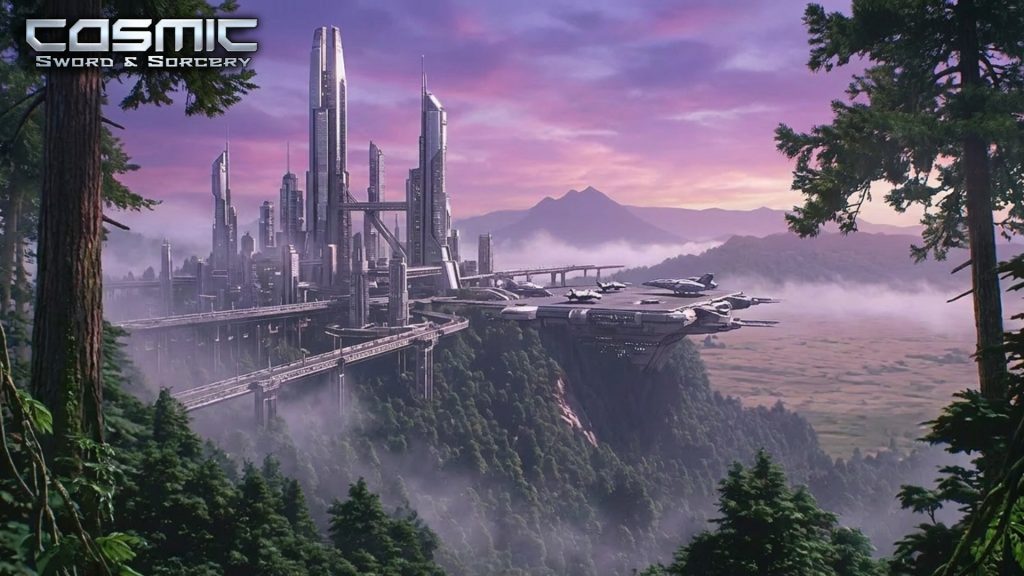
Ro’Edyne stands among the oldest civilized territories of southern Vandyrus, though the true age of its earliest foundations remains disputed even within the higher imperial archives. Long before the modern provincial cultures of Vandyrus emerged from tribal isolation, the southern continental belts of Ro’Edyne had already entered successive ages of hydraulic engineering, monumental construction, and interregional administration. The oldest preserved records of Tykon’Mach, the City of Steel, speak casually of caravan routes crossing territories now claimed by the Vulsan seas, suggesting that the continental arrangement of Vandyrus itself differed considerably during the earliest recognized periods of Ro’Edyne expansion.
Unlike the harsher northern territories of Vandyrus, the Ro’Edyne regions developed within warm subtropical climatic belts fed by dense river systems, inland rainfall currents, and stabilized coastal weather patterns.
The Southern Gardens
Great fern valleys, mountain jungles, flooded terraces, acacia groves, and engineered watercourses dominated the southern reaches of the continent. Later foreign visitors frequently compared portions of Ro’Edyne to the old garden-worlds of the inner Vandyrian systems, owing to the unusual integration between civic infrastructure and surrounding ecological systems. Rivers, cliffs, terraces, and monumental architecture were rarely treated as separate domains within Ro’Edyne planning doctrine.
Ro’Edyne maintained uninterrupted alignment with the Greater Vandyrian imperial spheres across multiple recognized Ages, becoming one of the principal southern continuity-states upon Vandyrus. Though many lesser planetary cultures viewed the civilization as anomalous or impossibly advanced, such disparity was largely the result of uneven imperial integration across the world itself. While isolated northern and interior territories continued to experience cyclical collapse, localized warfare, and infrastructural decline, Ro’Edyne retained direct access to orbital commerce, interstellar administration, imperial transit networks, and offworld educational systems. Spaceports, aerial transit lanes, holographic civic systems, synthetic administrative intelligences, and orbital trade infrastructure were commonplace throughout the greater metropolitan corridors of the southern territories.
This disparity produced a considerable cultural divide between Ro’Edyne and the surrounding planetary civilizations. Contemporary accounts from outer provincial visitors frequently describe the southern cities as disorienting or unreal, comparing them less to conventional planetary capitals and more to independent imperial worlds transplanted onto the surface of Vandyrus itself. The common imperial citizen of Ro’Edyne possessed greater practical access to interstellar movement than many noble houses beyond the southern territories. Travel between worlds, off-system employment transfer, and imperial civil placement were regarded as ordinary aspects of metropolitan life.
The great cities of Ro’Edyne developed according to continuity principles preserved across immense spans of time. Monumental stepped pyramids, elevated water structures, white alloy civic towers, sacred administrative complexes, and vertically integrated terrace districts became recurring architectural constants throughout nearly every recognized Ro’Edyne Age. Rather than abandoning older forms during periods of technological advancement, the civilization continuously refined and re-integrated ancestral structural geometries into newer civic systems. By the later imperial periods, spaceports themselves resembled ceremonial temple districts, while orbital administrative towers retained proportions and visual motifs traceable to some of the oldest surviving southern records.
At the center of the southern territories stood Tykon’Mach, the City of Steel, oldest among the major Ro’Edyne metropolitan continuities and among the most historically significant urban centers ever established upon Vandyrus. Imperial archive estimates place portions of the city at over four hundred thousand years in age, though deeper geological and structural surveys conducted beneath the lower administrative strata suggest that sections of the region may predate even the earliest recognized Ranar imperial periods.
Ages Preserved
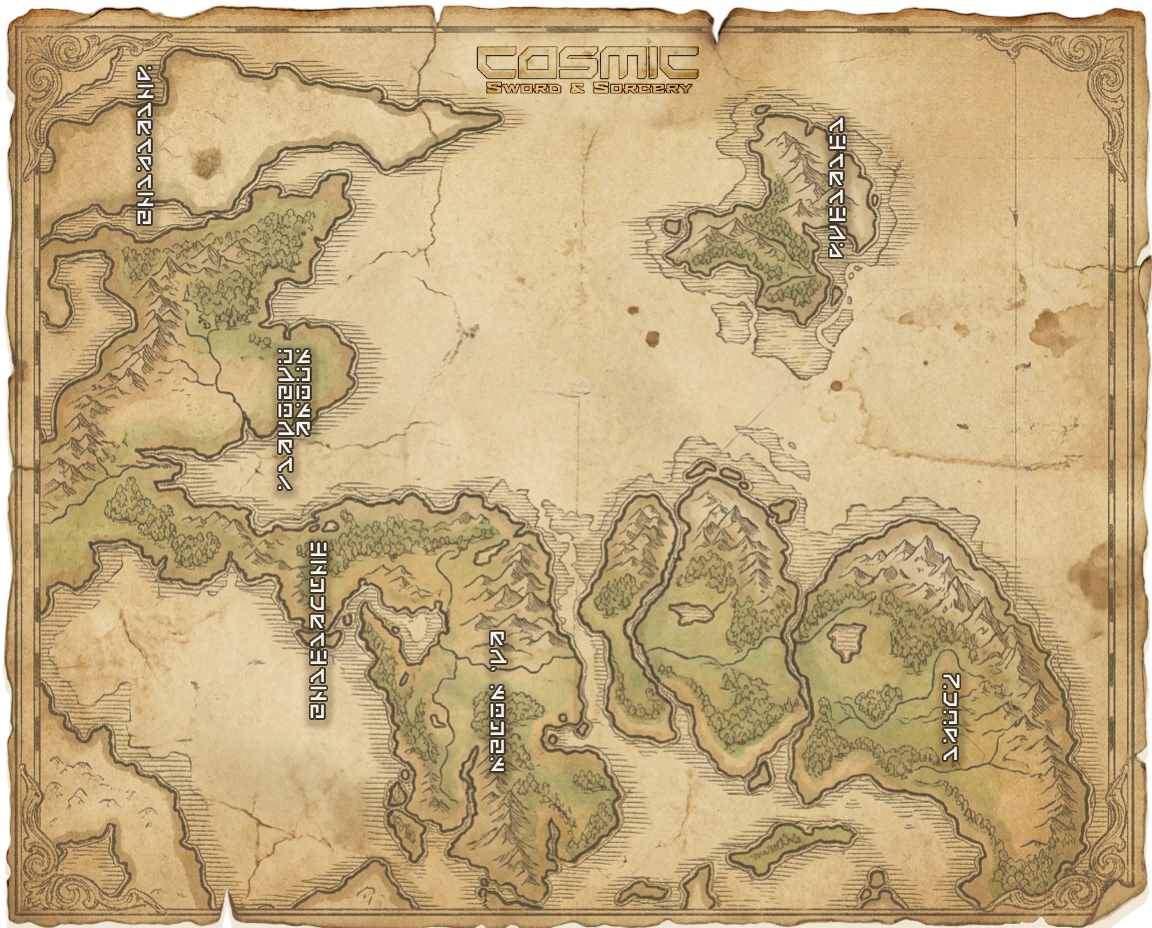
Successive civilizations rebuilt, expanded, and restructured the city repeatedly across the Ages until the distinction between original foundation and later construction became effectively impossible to determine.
Ro’Edyne’s longevity profoundly shaped its cultural psychology. Unlike younger imperial worlds driven by expansionary ambition or dynastic competition, the southern territories increasingly viewed civilization itself as an act of preservation against time, erosion, and planetary instability. Historical memory, environmental continuity, cartographic preservation, and ancestral civic maintenance became central pillars of Ro’Edyne administrative culture. The civilization produced some of the most extensive archival systems in the known imperial spheres, preserving territorial, climatic, and demographic records stretching across periods many outer systems considered mythological.
Among the more unusual features of Ro’Edyne culture was the persistence of extremely ancient linguistic and ceremonial structures alongside highly advanced administrative systems. Ancient Vandyrian remained preserved within liturgical, musical, and governmental contexts long after regional dialects evolved into simplified provincial forms. Many of the oldest surviving ceremonial songs of the southern territories continued to be performed in archaic sung dialects whose grammatical structures were already considered ancient during the later imperial periods themselves.
Though formally aligned to the greater imperial structure, Ro’Edyne maintained considerable regional distinctiveness throughout its history. The southern territories developed reputations for philosophical conservatism, monumental civic aesthetics, environmental ceremonialism, and unusually long continuity traditions compared to younger imperial systems. Foreign administrators often remarked that Ro’Edyne behaved less like a frontier world and more like an ancient inner imperial state whose civilization simply happened to exist upon Vandyrus.
Chapter 2: Time & Changes
Before the Cataclysm, Ro’Edyne bore almost no resemblance to the colder continental territories that would later emerge from the long planetary collapse. The modern age remembers Ro’Edyne as a realm of pine-choked valleys, cold mountain rain, misted escarpments, and immense northern timberlands stretching across broken terrain shaped by geological violence and climatic instability. Yet the older Ages record an entirely different world. The southern territories of ancient Vandyrus existed beneath far warmer atmospheric conditions, their continental belts wrapped in immense humid jungles, sweeping inland grasslands, drowned mangrove deltas, and subtropical floodplains whose scale dwarfed many later kingdoms entirely.
The environmental conditions of the southern Ages produced ecosystems of extraordinary biological density. Vast herds of towering saurian megafauna migrated across the grasslands beyond the major metropolitan corridors, while predatory species dominated the river systems, marshes, and interior jungles. Diplodocus moved through the southern floodplains in migratory groups large enough to alter entire river courses through repeated passage alone. Stegosaurian species occupied the drier inland plains and elevated fern valleys. Spinosaurids and Baryonyx variants prowled the swamps, estuaries, and deep river channels where the dense vegetation concealed movement even from advanced aerial reconnaissance systems. Much of this megafauna vanished during the planetary instability surrounding the Cataclysm, surviving only within isolated ecological pockets hidden deep beyond the modern frontiers.
The Emerald Divide
The central territories of ancient Ro’Edyne became especially infamous throughout the later imperial periods due to the enormous equatorial jungles occupying the continental interior. These forests stretched for immense distances uninterrupted by civilization, forming layered canopies so dense that even advanced orbital imaging systems frequently failed to penetrate them with consistency. Atmospheric interference, thermal distortion, biological overgrowth, and strange electromagnetic anomalies rendered large portions of the interior effectively unreadable to long-range scanning technologies. Imperial surveys often described the jungles as resistant to observation itself. Mapping expeditions disappeared with enough regularity that the phenomenon became institutionalized within southern administrative planning.
Numerous patrols, scientific ventures, military reconnaissance groups, and exploratory expeditions entered the central jungles across multiple Ages seeking to determine the true extent of the interior territories. Many transmitted partial findings before vanishing entirely. Some recovered recordings described enormous unidentified lifeforms moving beneath the canopy layers, cyclopean ruins reclaimed by vegetation, collapsed transit systems buried beneath roots and mud, and isolated populations living wholly detached from greater imperial authority. Others simply ceased communication without explanation. The southern archives preserve hundreds of fragmented reports concerning the interior regions, though very few offer coherent conclusions. Even during the height of Ro’Edyne’s technological sophistication, vast portions of the continent remained fundamentally unknown.
The southern reaches beyond the major metropolitan zones were dominated not by cities but by unstable ecological regions shaped continuously by water movement. Great grasslands merged into drowned flood marshes and mangrove forests stretching toward the southern coasts where the land itself fractured into chains of unstable islands, tidal wetlands, and shifting mud territories. These regions proved catastrophically difficult for large-scale naval invasion. Shorelines altered constantly through flooding, erosion, and tectonic instability, while thick mangrove systems rendered conventional landing operations nearly impossible. Foreign strategists throughout the imperial periods often concluded that the southern coasts functioned less as viable invasion corridors and more as natural defensive labyrinths hostile to organized military movement altogether.
The island chains themselves remained sparsely inhabited despite repeated attempts at settlement and development. Violent storms, unstable ground conditions, dense predator populations, and tidal irregularities prevented sustained urbanization across much of the southern archipelagos. Small ceremonial outposts, fisheries, weather stations, and military observation facilities existed intermittently, though many required continual reconstruction simply to remain operational. Certain older records imply that portions of these southern islands submerged and re-emerged repeatedly across successive Ages, contributing to the widespread Ro’Edyne belief that Vandyrus itself was never geologically stable in the manner of the greater inner imperial worlds.
The northern territories of pre-Cataclysmic Ro’Edyne more closely resembled fragments of the landscape recognized today, though even these regions existed in far more primeval forms. Great redwood forests occupied isolated northern mountain belts where colder climates prevailed along the highest elevations. These forests, immense even by later standards, remained largely confined to northern highlands during the earlier Ages and had not yet spread southward across the continent. The colder climates that would eventually allow the pine forests of the modern era to dominate most of Ro’Edyne had not yet emerged. Instead, the northlands existed as transitional territories where alpine forests, stone highlands, river valleys, and elevated grass plains intersected beneath cooler skies.
Before the rise of the later imperial continuity-states, numerous highland kingdoms occupied these northern regions. Their settlements were often constructed atop cliffs, elevated plateaus, and fortified ridges overlooking the lower plains below. Unlike the immense metropolitan continuities of the southern civic belts, these northern polities developed around defensive isolation, mountain trade, and territorial autonomy. Great grazing beasts migrated seasonally from the southern grasslands into the northern elevations, shaping both the economy and military structures of many early highland cultures. Some of the oldest surviving northern myths speak of enormous horned herd-creatures darkening entire valleys during migratory seasons, accompanied by predators large enough to threaten fortified settlements directly.
The climatic transformation that followed the Cataclysm permanently altered these ancient ecological balances. Cooling atmospheric systems, ash dispersal, tectonic upheaval, orbital instability, and long-term environmental collapse reshaped the continent over immense spans of time. The jungles receded. The southern wetlands collapsed or hardened into colder marsh territories. Redwood species expanded far beyond their former isolated northern ranges. Grasslands gave way to colder forests, rocky highlands, and harsher continental weather systems. Entire migratory ecosystems disappeared. River systems changed course. Inland seas receded or flooded. Mountain ranges fractured and rose where fertile valleys once stood.
Bones of the Elder World
By the later post-Cataclysmic eras, only fragments of the old southern world remained visible beneath the transformed landscape. Fossilized remains of gigantic saurian species emerged from canyon walls and frozen escarpments. Buried transit corridors surfaced beneath root systems kilometers from any known ruins. Ancient flood-control structures stood stranded high above dried valleys whose rivers had vanished tens of thousands of years earlier. The people of later Vandyrus inherited a broken continent haunted constantly by evidence that the world itself had once been fundamentally different.
For this reason, many later scholars of Ro’Edyne regarded the Cataclysm not merely as a civilizational collapse but as the death of an entire planetary age. The destruction was not limited to governments, empires, or cities. Whole climates vanished. Entire ecological epochs disappeared alongside the civilizations that once inhabited them. The ancient warm south of Vandyrus — the jungled Ro’Edyne of the great Ages — survived afterward only in fragmented archive records, ceremonial songs, geological anomalies, and the impossible ruins buried beneath the forests of the modern world.
Chapter 3: Secrets from the Sky
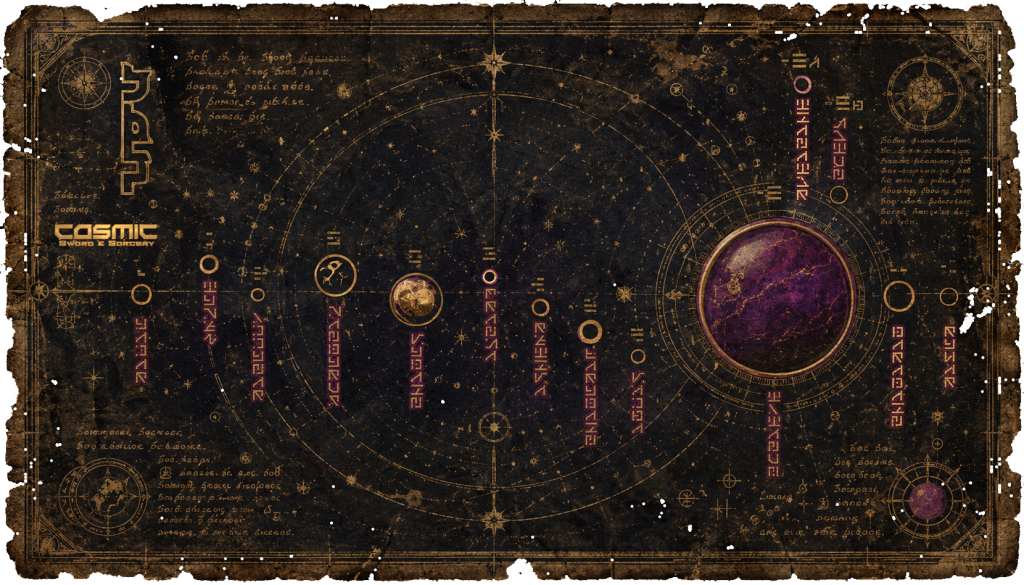
Ancient star charts recovered from the southern vaults of Ro’Edyne remained among the great unresolved mysteries of the early post-collapse ages. For centuries following the long restoration of literacy and astronomical study across Vandyrus, surviving observatories struggled to reconcile the positions recorded within the old imperial charts against the heavens visible in the modern era. Entire stellar reference paths appeared displaced.
Seasonal tracking systems failed outright. Ancient navigation tables produced impossible results when applied to the contemporary skies. At first, many scholars concluded the Ro’Edyne records themselves must have been ceremonial, symbolic, or corrupted through successive archival degradation. Others proposed that the imperial astronomers of the southern territories had employed alternative stellar conventions no longer understood by modern observers. Yet as more fragments emerged from drowned archives, collapsed observatories, and surviving orbital records, a far more disturbing conclusion gradually took shape. The skies themselves had changed.
Comparative astronomical reconstruction eventually demonstrated that Vandyrus no longer occupied the orbital alignment reflected in the oldest Ro’Edyne records. The planet’s axial orientation had shifted catastrophically at some point during the great collapse periods of antiquity, producing widespread climatic destabilization across the world. Seasonal durations altered. Oceanic circulation patterns failed. Entire continental weather systems reorganized themselves across subsequent centuries. This revelation resolved numerous long-standing historical contradictions preserved within older southern records. Regions once described as humid subtropical territories now lay beneath snow and northern forest. Ancient accounts of warm coastal valleys, monsoon rainfall systems, jungle escarpments, and fern-covered mountain terraces conflicted sharply with the cold maritime climates occupying those same regions in the modern age. For generations such descriptions had been dismissed as exaggeration, poetic embellishment, or symbolic language inherited from lost religious traditions.
The star charts proved otherwise. Pre-collapse Vandyrus had been a warmer, wetter, and significantly more hydrologically active world than the one inherited by later civilizations. The great southern territories of Ro’Edyne existed beneath skies unfamiliar to the modern era, their climates stabilized by planetary conditions no longer present after the orbital disruption. The redwood expanses, frozen highlands, and northern fog systems characteristic of later Vandyrus appear to have expanded only gradually across the cooling world during the long centuries following the collapse.
Among the more unsettling implications of the reconstructed charts was the realization that many post-collapse cultures had unknowingly built their understanding of “natural” Vandyrus atop the aftermath of planetary trauma. Entire civilizations emerged believing the colder world to be the original state of creation itself, unaware that the forests, coastlines, and seasonal cycles surrounding them represented only the latest condition of a much older and radically transformed planetary body.
Chapter 4: Thyuratahn
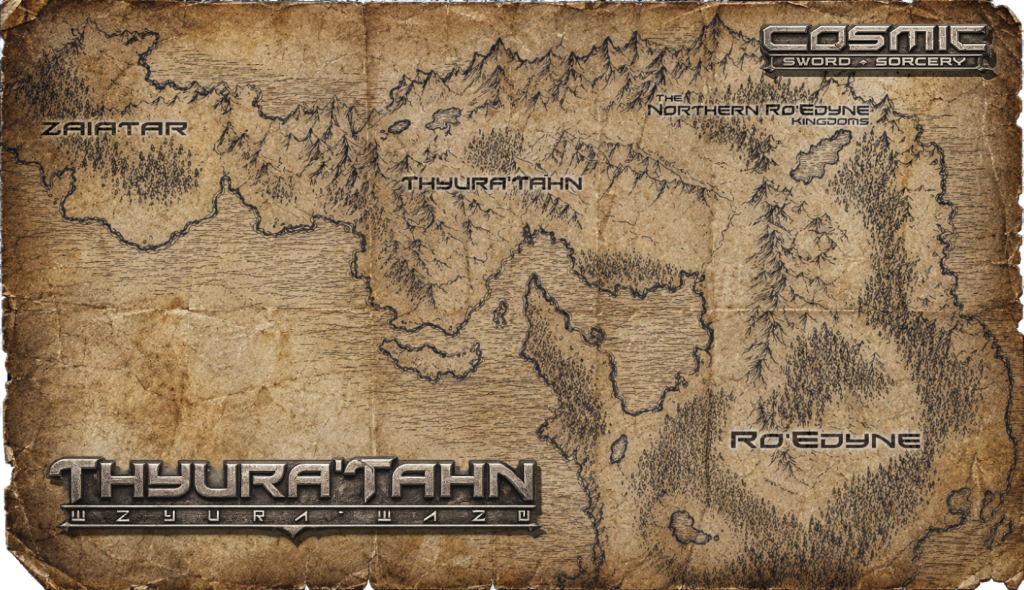
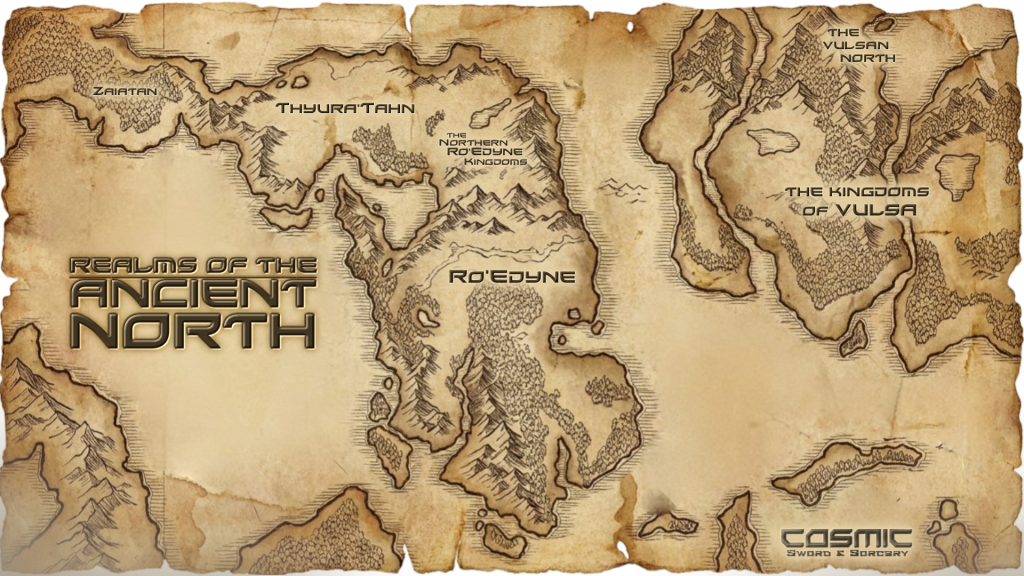
Even among the oldest surviving southern records, references persist to a northern continental dominion known variously as Thyuratahn, the Central Dominion, or in certain later Londorai reconstructions, simply the Lost North. The antiquity of these accounts greatly exceeds that of most surviving native historical traditions upon Vandyrus.
Certain preserved records attributed to the later Ro’Edyne archive periods already describe Thyuratahn as ancient, suggesting the kingdom had passed partially into legend even during the height of the southern imperial ages. The surviving references are made stranger still by the geography they describe. Numerous records speak casually of northern overland crossings between Ro’Edyne and regions now separated entirely by the Vulsan sea. At first these passages were dismissed by restoration scholars as symbolic, mythological, or ceremonial in nature. Yet successive discoveries of older navigational charts and fragmented territorial records complicated such interpretations considerably. Some among these materials appear to predate even the oldest linguistically understood Ro’Edyne dialects currently known to modern scholarship.
This remains among the more troubling aspects of the Thyuratahn material. Ro’Edyne itself already represents one of the deepest and most difficult linguistic continuities in surviving Vandyrian history, yet portions of the northern records appear to originate from structures older still. Certain inscriptions recovered from drowned northern shelf regions do not conform fully to any recognized Ro’Edyne linguistic family, though partial symbolic overlap remains sufficient to suggest some degree of ancestral relation.
Accounts concerning Thyuratahn vary considerably between surviving cultural traditions: Surviving records portray Thyuratahn less as a singular kingdom and more as a vast continental sphere containing numerous aligned polities, trade federations, dynastic territories, and ceremonial states spread across the central northern expanses. Unlike many later northern civilizations which emerged in relative isolation following the collapse periods, the peoples of Thyuratahn appear to have maintained direct cultural and administrative contact with both Greater Londorai and the southern continuities of Ro’Edyne across immense stretches of time. The oldest surviving descriptions portray the dominant populations of the region as physically imposing even by Vandyrian standards, their ruling castes frequently described within southern records as “high blooded” or “sky-allied” owing to extensive offworld admixture among the upper dynastic lines.
Imperial genealogical fragments recovered from later Ro’Edyne archives suggest that portions of the Thyuratahn aristocracy possessed direct ancestral links not only to the greater Vandyrian imperial spheres, but to colonial bloodlines originating beyond Vandyrus itself. Certain northern houses reportedly maintained ceremonial kinship ties to Jotunic colonial administrations, while others traced their ancestry to interstellar dynastic lines associated with the core worlds of the greater imperial systems. Though much of this material remains fragmentary, the surviving evidence strongly suggests that Thyuratahn functioned not as an isolated northern kingdom, but as a heavily integrated frontier continuity-state positioned between multiple spheres of imperial influence.
Chapter 5: The Kingdoms of The Mythic North
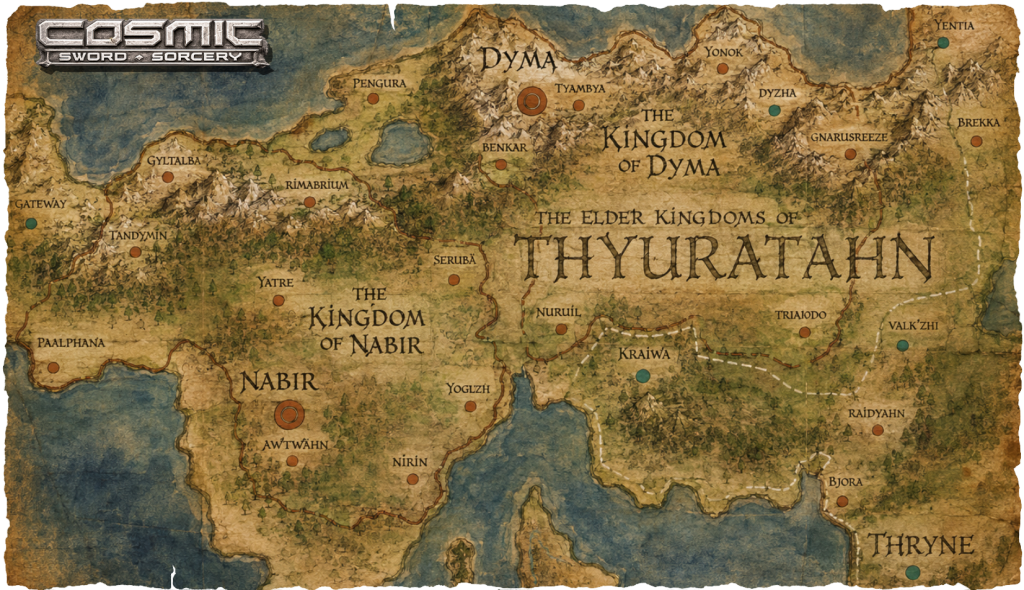
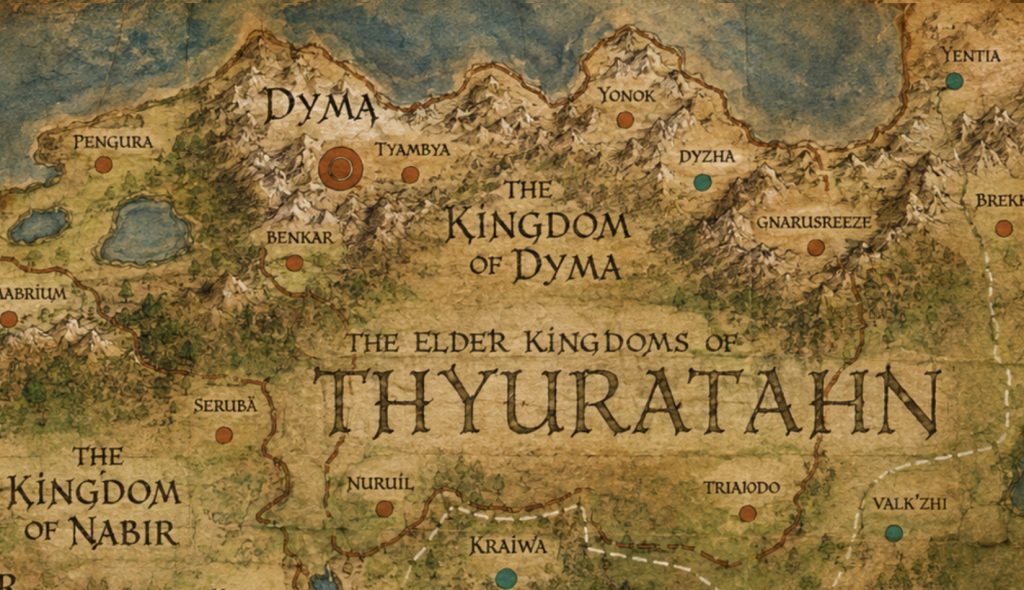
Among the most frequently referenced powers within the region were the kingdoms of Dyma and Nabir, both of which appear repeatedly throughout surviving trade records, migratory charts, astronomical schedules, and ceremonial exchange documents preserved across later southern archives. These kingdoms occupied critical transit territories linking the northern highlands, central steppe systems, and southern continental corridors. Over time they developed into major commercial and cultural centers whose influence extended far beyond their immediate territorial boundaries.
Dyma in particular became associated with monumental trade architecture and long-distance overland caravan systems stretching across the northern plains. Surviving references describe immense elevated roadways, geothermal rest-stations, and fortified transit cities constructed along migratory and commercial routes extending for thousands of miles across the central territories.
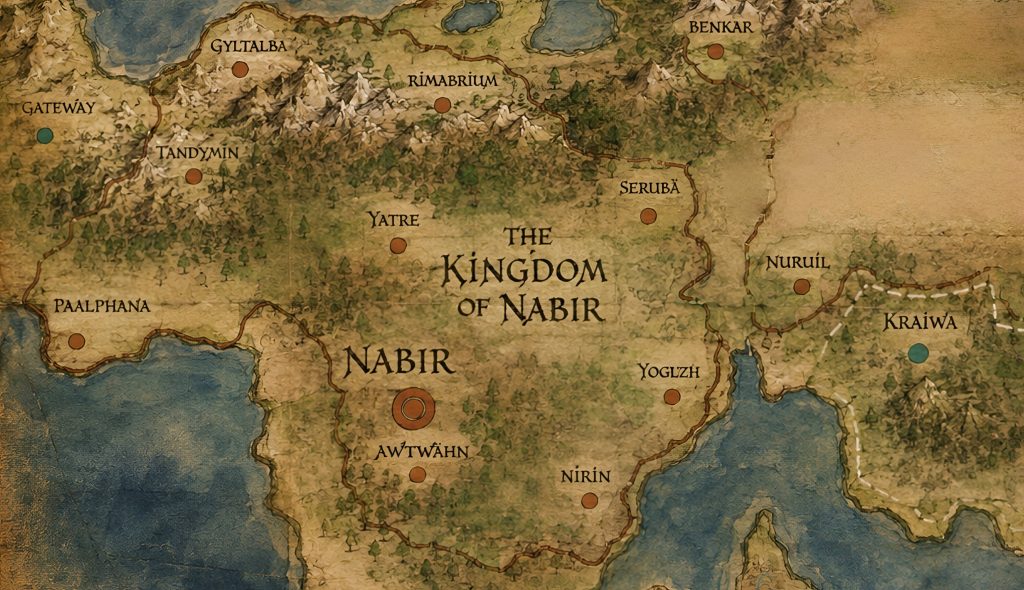
Nabir meanwhile appears more frequently in relation to educational institutions, astronomical observatories, archive complexes, and ceremonial diplomacy between the northern dynasties and southern imperial continuities. The geography of Thyuratahn itself contributed heavily to the unusual character of the region.
What remains difficult to dismiss, however, is the increasing convergence between the oldest cartographic reconstructions, submerged geological surveys, and the persistent recurrence of northern territorial references appearing independently across otherwise unrelated historical traditions. Though much concerning Thyuratahn remains uncertain, few serious scholars now dispute that substantial landmasses once existed across regions presently claimed by the northern seas, nor that civilizations of considerable sophistication may once have occupied them long before the modern age of Vandyrus.
Yet Thyuratahn was not merely a northern grassland corridor through which migrations and trade passed between the southern continuities and the distant northern reaches of Vandyrus. During the elder Ages, the region itself possessed a dense and unusually layered civilizational structure, serving as one of the great intermediary cultural belts of the pre-cataclysmic world.
Chapter 6: Into The Lost Realms
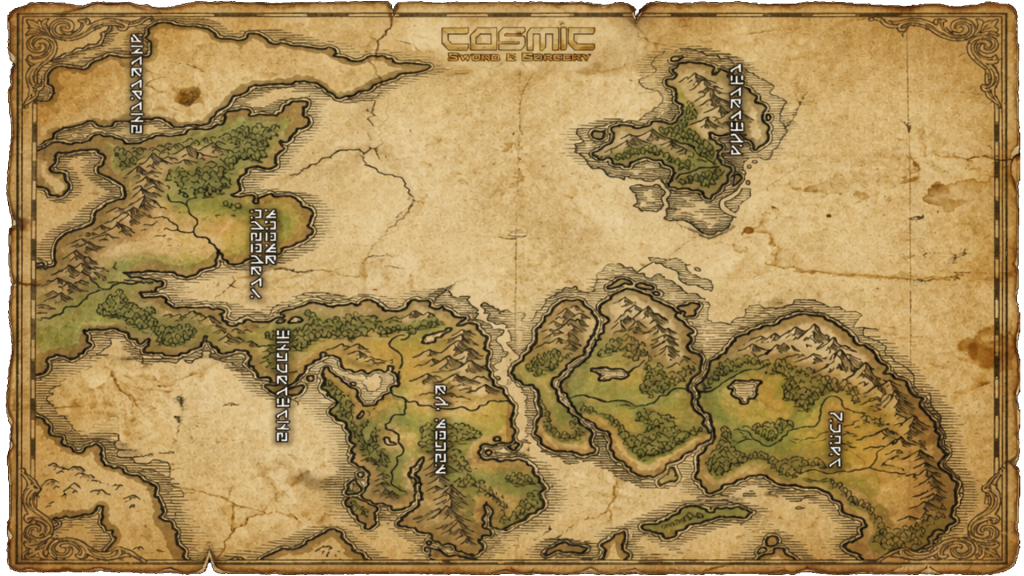
The discovery of the southern Ro’Edyne archives, independent from the surviving Vandyrian imperial record systems, opened numerous unsettling points of comparison between later restoration histories and realms previously dismissed as allegorical, ceremonial, or wholly mythic in nature. Civilizations such as the great fortress nations of the Ataratoz and the distant northern realms of Zarhanda emerged repeatedly across otherwise unrelated historical strata separated by immense spans of time.
Though never fully rediscovered in any complete archaeological sense, these lost powers persisted through fragmented cartography, dynastic references, military accounts, migratory records, and obscure archive correspondences preserved deep within the southern vault systems. They left treaties, trade corridors, battlefield records, astronomical observations, and territorial disputes embedded throughout the long chronology of elder Vandyrus, suggesting that many civilizations once regarded as purely legendary may instead represent the shattered remnants of continuity-states whose worlds vanished beneath the planetary upheavals of the collapse ages, leaving modern history to glimpse them only faintly across the abyss of time.
Among the older Vulsan tribal cycles, Zarhanda is described as the location of the Gates Beyond, a northern island-realm where fallen warriors were granted continued dominion among their ancestors and retained council with the living world. Later folkloric interpretations increasingly transformed Zarhanda into a spiritual or funerary concept, though earlier records appear markedly less symbolic in tone.
More ancient references describe Zarhanda not merely as an afterlife construct, but as a physical northern territory associated with knowledge acquisition, advanced healing practices, directed light weaponry, and crystalline matrix systems beyond the understanding of later restoration-age cultures. Several surviving fragments from the southern archive traditions refer to Zarhanda specifically as an island nation aligned in kinship with Ro’Edyne “amidst stellar reckoning,” a phrase whose precise meaning remains disputed among contemporary scholars.
Some later Londorai natural philosophers proposed that these northern accounts may preserve distorted memory traces of an earlier continuity-state predating the later Ro’Edyne imperial periods entirely. Others argue that Thyuratahn may instead represent a northern administrative or scientific branch of the broader southern civilization whose records became fragmented following successive continental collapses and marine inundations across the northern shelves. No consensus presently exists.
Positionally, Zarhanda appears to have existed well beyond the primary continental reaches of both Thyuratahn and Ro’Edyne proper, situated far to the north amidst the colder outer seas beyond the Vulsan territories and eastward of the elder Londorai spheres. Surviving geographic references consistently associate the region with freezing climates, violent northern waters, volcanic shelf instability, and long seasonal darkness unlike the warmer central dominions further south. Later post-cataclysmic accounts frequently describe the island as barren, storm-ridden, or partially wastelanded, though earlier records suggest this condition may represent the aftermath of successive collapse periods rather than the original state of the territory. The isolation of Zarhanda, combined with its apparent association with unusually advanced knowledge systems and surviving pre-collapse continuities, likely contributed heavily to its gradual transformation within later Vulsan traditions from a distant northern island-state into a mythologized realm of the dead and ancestral beyond.
Chapter 7: Sunderings of the North
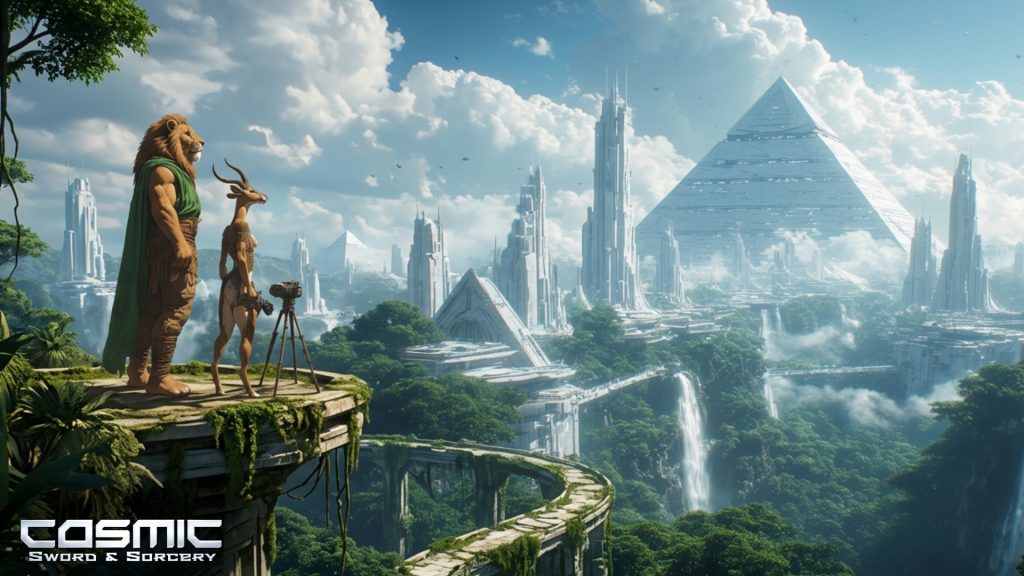
Unlike the colder northern territories that would emerge after the Cataclysm, the elder central dominion existed beneath warmer and considerably more volatile planetary conditions. Much of the territory rested atop geologically unstable zones shaped by tectonic movement, geothermal pressure, volcanic uplift, and deep subterranean fracture systems. Great geyser fields, steaming river valleys, sulfur plains, and heated jungle basins divided immense stretches of open grassland and steppe country.
Travelers from the southern territories frequently remarked upon the immense scale of the Thyuratahn plains. Long rolling steppelands extended beyond visible horizons before gradually transitioning into grass seas stretching for extraordinary distances uninterrupted by major forest growth. Migratory megafauna traversed these territories seasonally in colossal numbers, accompanied by both mounted pastoral cultures and large predatory species adapted to the open plains. In wetter regions, dense jungles emerged abruptly around geothermal basins and volcanic waterways, creating strange transitional ecosystems where tropical vegetation, heated stone terraces, and open grasslands existed within close proximity.
This environmental diversity appears to have profoundly shaped the fragmented political structure of the region. Rather than consolidating into a singular uninterrupted empire, Thyuratahn developed as a network of interdependent kingdoms, dynastic territories, ceremonial leagues, and migratory protectorates bound together through trade infrastructure, shared astronomical systems, and common high cultural traditions inherited from older imperial contact.
Many later Ro’Edyne scholars considered Thyuratahn one of the clearest examples of the “middle civilizations” of elder Vandyrus — societies existing between the direct metropolitan continuities of the southern imperial spheres and the more isolated native polities occupying the distant frontiers. They possessed advanced infrastructural systems, extensive trade integration, and partial offworld continuity, yet retained strong regional identities distinct from both Ro’Edyne and the greater Vandyrian core administrations.
By the post-cataclysmic ages, however, much of Thyuratahn had vanished almost completely from the known world. The grasslands fractured. The geothermal belts collapsed or froze. Sea levels altered. Northern shelf systems disappeared beneath new oceans and glacial waters. Trade routes ended in broken cliffs and drowned territories. Entire migratory corridors ceased to exist. Of the great kingdoms themselves, little remained beyond fragmented oral traditions, scattered dynastic references, corrupted star charts, and the strange persistence of names surviving long after the civilizations attached to them had vanished entirely from history.
Chapter 8: The City of Steel
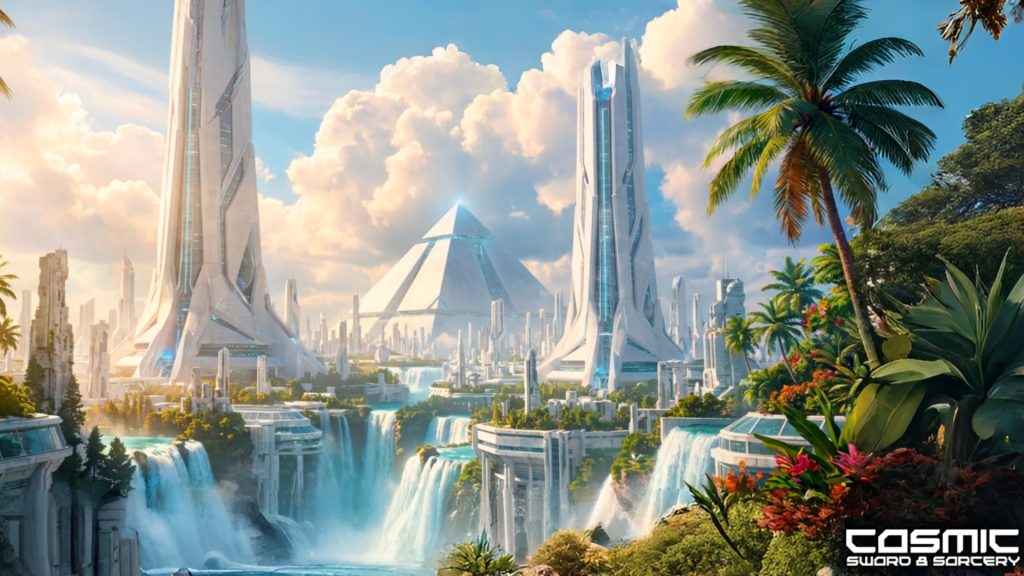
For centuries and countless generations, the City of Steel remained among the great unresolved mysteries of the old southern world. The surviving descriptions preserved within Ro’Edyne records spoke of impossible skylines, towering districts, elevated causeways, and colossal structures forged from steel and white alloy upon a scale no surviving civilization could easily reconcile. Even among the more educated restorationist courts of the later ages, many regarded such accounts with skepticism. Great cities might fall, certainly, but cities do not simply vanish. The absence of ruins surrounding the supposed site of Tykon’Mach became one of the principal arguments against the more extravagant southern chronicles.
As later inquiry would reveal, the truth proved considerably worse than the speculation.
It is now believed that portions of the greater southern territories survived the first violence of the collapse periods, though only briefly and in fractured form. What followed the arrival of DOOM appears increasingly distinct from the wider devastation occurring elsewhere across Vandyrus. Surviving reconstruction models suggest that a smaller fragment separated from the greater mass and descended directly into the southern continental belts at tremendous velocity, striking within proximity of the City of Steel itself.
The force of the impact exceeded anything previously imagined by the natural philosophers of the restoration eras. Modern geological examination suggests the temperatures generated during the strike vitrified enormous sections of the surrounding territory almost instantaneously. Rock formations became glass. Structural metals liquefied. The crust beneath the southern basin fractured catastrophically, opening vast fissures across the region. Much of the city itself, together with surrounding terrain and infrastructure, appears to have been drawn downward into the ruptured mantle zones beneath the impact region.
The unusual geography of the central Roedon straits had long troubled earlier scholars even before the southern impact theories gained wider acceptance. The depth, shape, and structural irregularity of the formation differed significantly from conventional marine erosion patterns observed elsewhere across Vandyrus. Early explanations ranged from tectonic collapse to ancient glacial flooding events, though none fully accounted for the scale or violence implied by the surrounding geological damage.
Remnants Beneath the Pines
The southern impact theory remained controversial for many generations. Many considered it an attempt to force mythological narratives onto natural history. Yet later sub-surface scans directed into the deepest portions of the fissure produced results that proved difficult to dismiss. Beneath layers of collapsed stone and vitrified material appeared massive concentrations of steel, glass, and artificial structural density inconsistent with any known natural formation. Certain scan returns suggested repeating geometric profiles buried far below the modern seabed, including angular formations later compared against surviving Ro’Edyne architectural records.
Most significant among these discoveries was the identification of Vandyrium signatures deep within the collapsed strata. Fragments displaying the unmistakable resonance patterns associated with the ancient imperial material provided the first widely accepted evidence that the southern records describing Ro’Edyne monumental construction had not been entirely allegorical. Among the more widely circulated scan reproductions was the partially exposed upper section of what many scholars believe may have been one of the great stepped pyramid complexes described within later imperial accounts.
No serious excavation attempts were undertaken during the early restoration ages. The depth of the collapse zones, combined with the instability of the surrounding geological structures, placed the remains well beyond the reach of contemporary mining capability. Even had such operations been possible, many scholars argued that the buried remains of Tykon’Mach no longer existed in any meaningful architectural sense, but rather as a fused mass of liquefied alloy, collapsed stone, and vitrified continental material compressed deep beneath the modern straits. Thus the City of Steel passed from history into a stranger category entirely. Not ruined. Not abandoned. Buried beneath the wounded geography of Vandyrus itself.
“Ro’Edyne’s Beauty”

“Sing, sing to me sages and spirits of glory and grace,
of Anything but clear, cool water runs now through Ro’edon’s veins,
Sing, Brown with peat and memory, heavy with old rains.
Once it sang from high stone hollows where the hawks knew every name,
Now it crawls beneath the bridges like a thing that feels the shame.
I remember silver mornings on the broken mountain’s brow,
Mist like wool around the pines that aren’t there now.
Heather burned in purple fire where the long grass used to lie,
And the wind knew every footstep of the folk who’ve all gone by.
The highlands bowed to centuries, to hunger, war, and rust,
To walls that learned to crumble and to oaths that turned to dust.
What was sung as living truth became a story told too low,
Until even the stories tired, and let themselves go.
Once, long, long ago,
Back in the days,
When people believed,
My home and its kindred existed—
Before the fog took the names,
Before the stones learned to grieve,
Once, long, long ago,
Ro’edon still lived.
The old roads sink like questions no one bothers to ask,
Cart-ruts filled with rain and leaves, and promises gone slack.
There were feasts that shook the rafters,
there were laughs that split the night,
Now the hills just hold their breath
and wait for another light.
They say the age rolled on without us, never turned its head,
Built its future on the bones of all the quiet dead.
But sometimes when the west wind cuts just right across the loch,
You can hear a half-remembered tune knock once… and knock.
Once, long, long ago,
Back in the days,
When people believed,
My home and its kindred existed—
Before the banners were torn,
Before belief learned to leave,
Once, long, long ago,
Ro’edon still breathed.
So pour me anything but clear, cool water for this cup,
Let it taste of loss and lichen and the ground that won’t give up.
If the world has moved on laughing, let it go its way alone—
I’ll stay here with the rivers
that still remember home.”