![The Body Politic of Ran
[ARCHIVAL INDEX]](https://www.primalswordandsorcery.com/wp-content/uploads/2026/02/TheBodyPoliticOfRanPAGE.jpg)
As a system of exceptional longevity and prolonged internal development, the twenty-seventh Age of the Thanatorian branch of the Greater Vandyrian Empire is properly understood as an era of excess, acceleration, and managed entropy. This was not decline, nor collapse, but a condition intrinsic to scale: momentum outpacing restraint, abundance compounding upon itself, and complexity breeding secondary instabilities even as imperial power remained absolute.
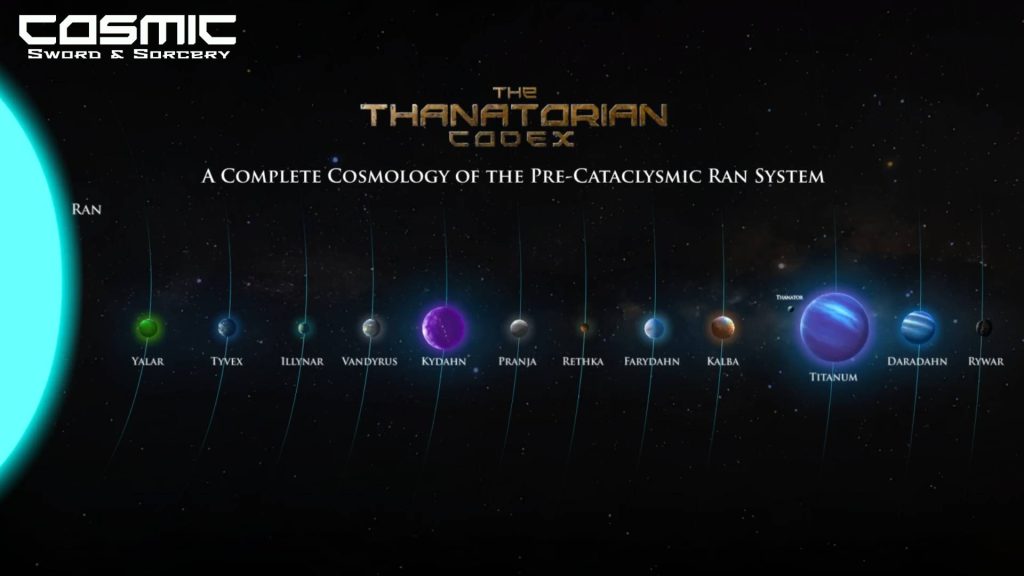
Thanator governed from the iron globe at the core, its authority uncontested in doctrine if not always in motion. Kydahn and its allied orders, bound by treaty and history, advanced their own interests with customary discretion, their maneuvers rarely overt yet never insignificant. These internal tensions were further drawn into the greater schism when one accounts for Titanum, which, as in every age of record, remained the most wretched of hives—an accumulation of scum and villainy elevated to planetary scale. Beyond Titanum lay the outer rabble worlds, and beyond them liabilities, failed holdings, adversarial polities, and the administratively damned: systems catalogued, monitored, and written off in equal measure.
At the far reach of the Zhiria sector, civilizational resumes persisted in allied orders among Vandyrian-descended peoples, most notably upon the world of Gaiwara and the dwarf planet Tjena’thahn, whose continued alignment stood as evidence of imperial legacy rather than active governance. Beyond even these lay ruins of immeasurable antiquity, structures and remnants predating all known imperial lineages, whose presence rendered any inquest unsettling. These were not merely old worlds, but artifacts of forgotten orders, resistant to classification and uncooperative with history itself.
During The Golden Age…
Imperial mandates still bound Thanator and Kydahn—siblings in power, yet never in trust. The great laws of the Empire, handed down from the Administrates and enforced by the shadow of the Throne, ensured that no single world could openly prey upon another, no matter how fierce the rivalries, no matter how sharp the ambition. Thanator and Kydahn, for all their history of competition and quiet sabotage, remained like kin forced to share a feast under their father’s watchful eye: daggers ready, eyes locked, but with hands kept from violence by the certainty of retribution.
Neither side could ever strike first without risking the empire’s full wrath—resources seized, markets closed, fleets dissolved, or, at worst, the sanction of extinction. In this enforced peace, the games grew subtle. Theirs was a rivalry fought in proxies and whispers, in maneuvered alliances, economic pressure, and the cultivation of influence within the imperial bureaucracy. No matter how closely they circled, no matter how often one sought the other’s throat, the mandates held them apart—frustrated, calculating, forever seeking the advantage that might one day tip the balance if ever the father’s back was turned for good.
Yet it was this very tension, this perpetual testing and containment, that defined the era’s stability. The Empire’s Golden Age depended on rivals too strong to subdue, too proud to submit, and too closely watched to risk open war. So Thanator and Kydahn endured, sharpening their knives in secret and waiting for the table to empty, knowing that the first breach would set the pattern for the next age of blood.
Placement
The state of any Imperial world, no matter its place or purpose, diverges rapidly from the condition granted to it by mere nature. Geography, climate, and native history are only the substrate upon which power operates; once drawn into the imperial lattice, a world’s true character is determined less by what it is than by how it is used. Designation precedes destiny. To be named a resource, a vassal, a buffer, a prison, or an ally is to enter a political metabolism that reshapes land, culture, and population according to external need, not internal coherence.
Empire does not rule uniformly, nor does it rule consistently. Each world is subjected to a different mixture of neglect, interference, patronage, coercion, and administrative fiction, calibrated not for justice or stability but for efficiency at scale. Some planets are strangled slowly through bureaucracy; others are bled openly through extraction or war. A few are rewarded with comfort and protection, not as a sign of favor, but because their compliance is cheaper than their suppression. In every case, governance is less a matter of law than of positioning—who owns whom on paper, who controls whom in practice, and which authority is willing to pay the cost of enforcement.
What follows, then, is not a catalog of policies or decrees, but an examination of consequence. Each world’s political condition is the residue of long negotiations it did not initiate, conflicts it did not choose, and classifications it could not refuse. Rebellion and obedience alike are filtered through the same imperial logic, producing outcomes that often appear contradictory to those living within them. Worlds are elevated, abandoned, protected, ruined, or erased not because of what they deserve, but because of where they sit within the machinery at a given moment.
This section serves as a lens, not a verdict. It establishes the common framework within which the individual histories must be read: an empire that governs by process rather than intent, that mistakes stability for virtue and disruption for pathology, and that leaves behind a trail of worlds convinced—often incorrectly—that their fate was the result of choice. Only by understanding this broader political ecology can the specific machinations of each world be seen clearly, not as isolated tragedies or successes, but as expressions of the same indifferent system operating at different points of pressure.
Vandanium
A Vandanium is any planetary body, natural or constructed, that bears the industrial or technological signature of the Greater Vandyrian Empire, regardless of size, origin, or primary function. The term encompasses resource moons, engineered asteroids, orbital manufactories, atmospheric harvesters, and all worlds or artificial structures marked by the presence of Vandyrian extractive infrastructure, industrial works, or machine networks. Vandanium status is conferred when a body is brought into the logistical, mechanical, or energetic lattice of the Empire; it is a designation of technical dominion, not of culture or governance. In most records, the distinction is a practical one: to be classed as Vandanium is to be worked, surveilled, and transformed for the needs of the imperial engine, but not necessarily to be inhabited or administered in the Vandyrian mode.
Vandaxium
A Vandaxium is any planetary body, natural or constructed, that bears the administrative, cultural, or societal signature of the Vandyrian Imperium, regardless of size or primary function. Unlike Vandanium, which denotes technical reach, Vandaxium implies a thorough assimilation into the civilizational order of the Imperium: courts, academies, archives, permanent settlements, and the presence of Vandyrian law, language, or lineage.
Vandaxiums may have begun as Vandaniums, but the distinction is formal—here, the empire’s administrative apparatus takes root, its cultural codes and social hierarchies are established, and its banner is more than a matter of resource exploitation. To be named a Vandaxium is to be counted among the living provinces of the Imperium, with all the rights, duties, and complexities that status entails.
Process
A mature imperium reveals itself not in the names it shouts, but in the names it no longer needs. “Resource Worlds” are not the invention of a young empire drunk on conquest or spectacle; they are the vocabulary of one that has endured long enough to grow bored with terror as theater. Such a civilization does not waste breath on melodramatic epithets like deathworld or forbidden zone. It does not threaten. It categorizes.
Condemnation, in this mode, is administrative—quiet, bloodless on paper, and carried out without ceremony. Worlds are not destroyed; they are processed. Peoples are not punished; they are assigned. The violence is real, but it is abstracted, diffused into procedure until it no longer resembles cruelty, only throughput. To be sent to a resource world is not to be executed, nor even to be judged, but to be removed from relevance.
Whether one expires scraping a living from a no-atmosphere warfront or a thousand miles beneath the crust of a collapsing planet, harvesting nitron or transuranium in the dark, is of no consequence to history—and that is precisely the design. These places exist to consume lives without producing narratives, to end stories without leaving ruins worth studying. They are fit neither for inquiry nor for civilization, and that too is intentional. A resource world is not meant to be remembered. It is meant to function, then vanish, leaving behind only balanced ledgers and the comforting illusion that nothing improper ever occurred.


![Rywar’s Mysteries
[COMPLETE]](https://www.primalswordandsorcery.com/wp-content/uploads/2026/02/Rywars-Mysteries-PAGE-1536x864-COSMIC.webp)