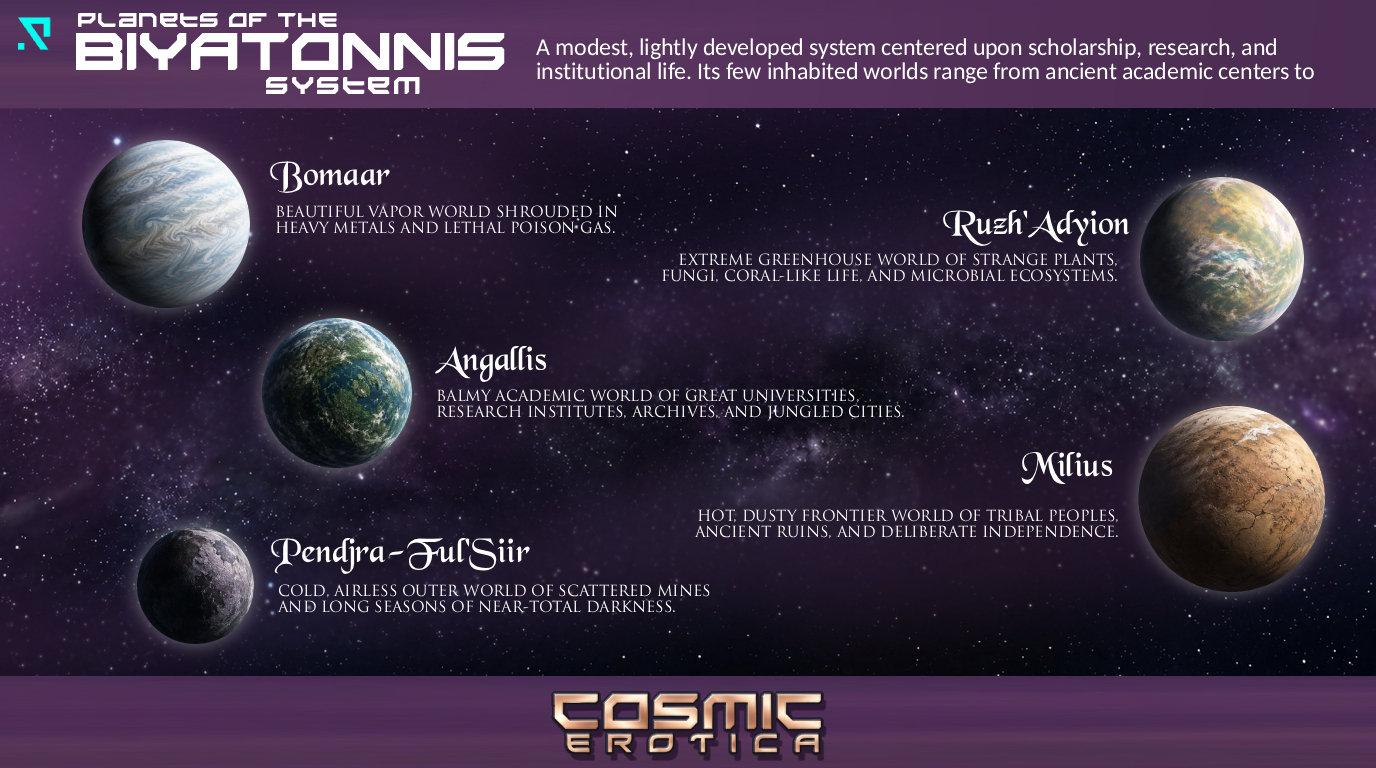
STAR CHART: Planets of the Biyatonnis System
While much of Biyatonnis remains sparsely inhabited or entirely unsettled, its worlds encompass an unusual range of environments, from the poisonous metallic atmosphere of Bomaar and the strange plant-dominated biosphere of Ruzh'Adyion to the dry tribal territories of Milius and the cold mining settlements of distant Pendjra-Ful'Siir. Between these extremes stands Angallis, whose universities, archives, academies, research institutions, and scholarly traditions have made it one of the Empire's great centers of accumulated knowledge.
The result is a system whose significance rests less upon what it produces materially than upon what it preserves, studies, and teaches. Generations of scholars, researchers, administrators, and visiting academics have passed through Angallis, while the Moon of Tylir and the Great Station of Novaron connect this otherwise lightly developed system to the administrative and infrastructural networks of the wider Empire.
Biyatonnis is consequently best understood not as a unified economic complex, but as a small and geographically varied stellar community dominated by a single world of exceptional civilizational importance. Beyond Angallis, Imperial presence diminishes rapidly, leaving much of the system quiet, sparsely populated, and only lightly integrated into the enormous civilization surrounding it.
Angallis
The Academic World
Angallis has long been regarded throughout the Greater Vandyrian Empire as one of civilization's great institutional heartlands, a world whose prestige rests upon accumulated scholarship rather than industrial output, commercial dominance, or political authority. Across successive ages its universities, academies, archives, observatories, museums, and philosophical schools accumulated traditions of research and instruction extending across generations, until the planet itself became inseparable from the wider intellectual history of Imperial civilization.
The world is balmy, humid, and extensively jungled, with its major cities deliberately planned around enormous academic precincts rather than conventional commercial or industrial centers. Universities merge gradually into libraries, botanical gardens, laboratories, debating halls, residential districts, museums, and public forums, producing cities whose organization frequently resembles that of immense interconnected campuses.
Scholars, researchers, academics, students, archivists, and specialist personnel consequently form an unusually large proportion of the population, while institutions that elsewhere might occupy individual buildings or districts have developed upon Angallis into communities possessing their own traditions, estates, administrative structures, and uninterrupted histories measured across immense spans of time. It is this extraordinary continuity that accounts for Angallis's influence beyond the otherwise modest Biyatonnis System.