



Chapter 3
By the time the lord and his household reached the great hall, the young princeling had already installed himself comfortably within it, one boot resting upon a carved chair, the fortress’ finest brandy held carelessly in one paw while he conversed with the surviving guards as though entertaining honored guests rather than broken veterans. Every soul present disliked the little aristocrat with remarkable consistency. Still, Tulvus accepted the sight with exhausted resignation rather than surprise. If disaster truly had ended, it seemed only fitting that politics should immediately arrive to reclaim what the battlefield had left unfinished.
Kal’Nyus proved incapable of sensing the mood surrounding him. His questions arrived in eager succession, each more foolish than the last, all circling the same subject. Had they truly slain the Wolf Queen? Had anyone confirmed the body? Had they dragged her somewhere secure? Had anyone thought to separate the head from the shoulders, simply to be certain? The veterans answered only with brief acknowledgements, neither encouraging nor correcting him. They themselves possessed no answers beyond what Tulvus had witnessed upon the battlefield. They had seen the arrow strike. They had seen her fall. They had seen enough to believe the matter finished. Beyond that, certainty became increasingly difficult to measure. The prince, however, required no such restraint. Possessing the confidence unique to those who had survived none of the campaign they discussed, he gradually transformed polite inquiry into self-congratulation, lifting the bottle in broad gestures while congratulating the assembled commanders as though their triumph somehow reflected the wisdom of the royal court that had remained comfortably distant from the fighting.
The hall accepted his speech with remarkable silence. Servants continued removing shattered furniture. Masons quietly measured cracked columns. Physicians crossed the chamber carrying fresh bandages and bowls of steaming water stained pink by recent use. No applause greeted the prince’s declarations. No cups rose in celebration. The campaign had consumed too many years and too many lives for victory to resemble the cheerful endings favored by poets. Tulvus scarcely listened. His attention wandered toward the great western windows overlooking smoke-blackened rooftops and distant hills slowly disappearing beneath evening mist. Somewhere beyond those ridges rested battlefields still crowded with the unburied. Somewhere farther still lay the place where the emerald-eyed queen had finally fallen. He raised the bottle once more, deciding that silence paired considerably better with good brandy than with speeches.The first horn echoed faintly enough that many mistook it for another hunting party returning from the western forests. The second carried farther, lower and longer, causing nearly every veteran present to lift their heads instinctively before conscious thought had caught up with old habit.
A third answered from much farther south. Then came the sound that none within the hall had expected—or wished—to hear again. Boots struck stone in frantic succession. Doors burst open. Breathless messengers stumbled across the threshold, scarcely able to force words through exhausted lungs. The report itself needed only three words before every cup lowered and every conversation ceased.
“Vandyria is attacking!”.
For several heartbeats the chamber simply stood motionless. No one shouted. No one denied the possibility. Tulvus looked first toward Jan’Rymus, then toward the surviving thanes, discovering precisely the same expression mirrored upon every weathered face. None of them believed such a thing should have been possible. None of them, however, possessed sufficient confidence to dismiss it outright. Three years had educated them thoroughly regarding impossible things. Kal’Nyus alone appeared offended by the very suggestion. Tossing his cloak back with theatrical confidence, he strode toward the center of the chamber wearing the expression of one preparing to rescue lesser intellects from unnecessary panic. He laughed openly, pointing toward the frightened messenger before turning dramatically toward the assembled veterans, as though addressing nervous recruits rather than warriors who had survived the campaign he had observed only from comfortable palaces.
“Lads,” he declared, lifting the bottle high as though offering a toast, “don’t let her get inside your heads. Look at yourselves. They send one female carrying a sword, and already seasoned warriors tremble as though the realms themselves were ending. Let me ask you something.” His grin broadened while he swept one arm grandly across the hall, delighting in the sound of his own voice. “At the end of the day, she is only one female. Tell me honestly. what can one female do?”
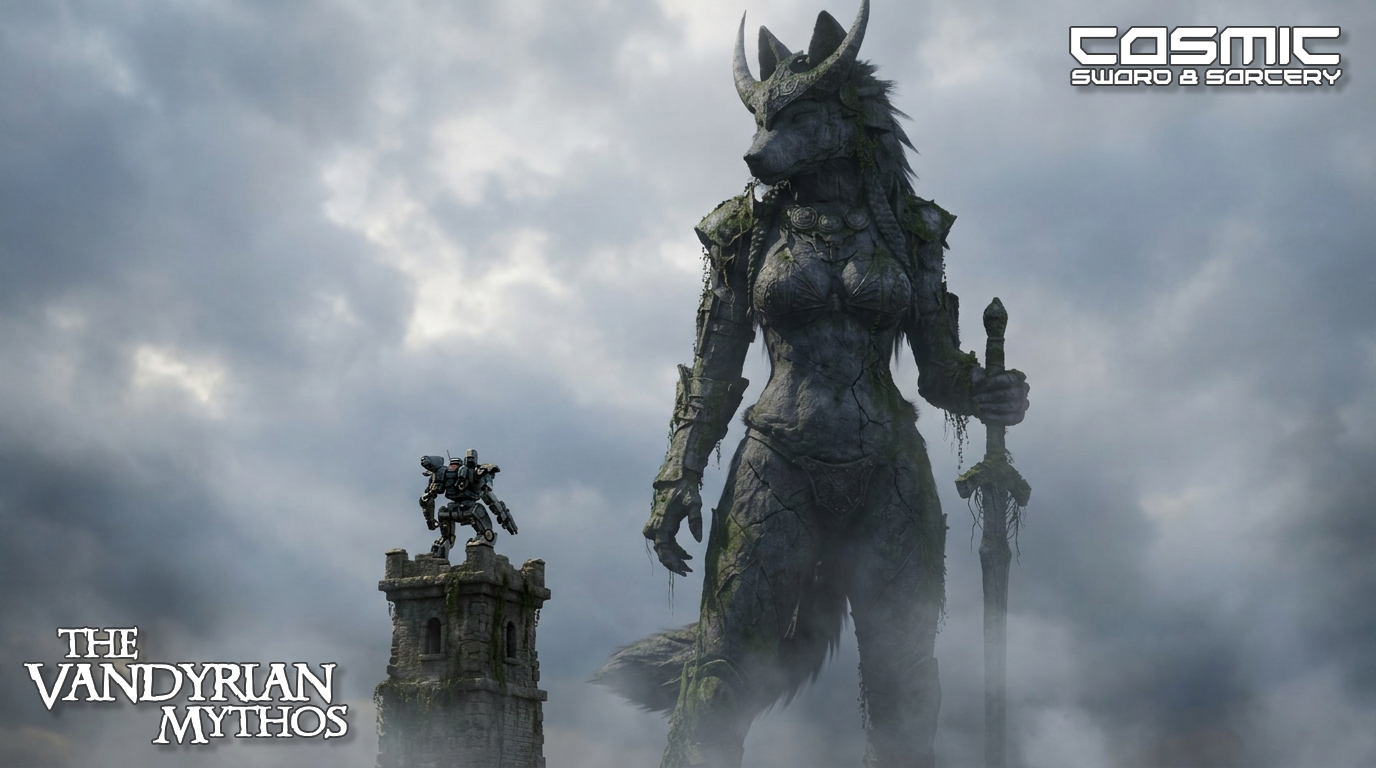
The final syllable had scarcely escaped his lips before steel erupted cleanly through his chest. The broadsword drove entirely through his body with such force that his paws left the floor, the bottle slipping from nerveless fingers to shatter across the stone beneath him. For one impossible instant nobody moved. Kal’Nyus stared downward in bewilderment at the blood spreading across embroidered silks before his voice disappeared forever beneath the blade that had opened him. Behind the suspended princeling stood Vandyria. The silver-and-steel crown rested crookedly upon dark fur matted with smoke and dried blood.
The arrow that Tulvus himself had watched bury into her still protruded from the wound, snapped shorter than before yet unmistakably present. Emerald eyes surveyed the chamber with almost casual irritation while the fool impaled upon her sword instinctively clutched the blade, desperately attempting to free himself. She answered the effort by wrenching the weapon backward in one brutal motion. Fingers scattered across the floor before the prince collapsed to his knees, clutching foolishly with pulsing crimson stumps at ruined hands that no longer obeyed him.
Then she spoke:
“Any other stupid questions?”
Tulvus could not entirely suppress the bitter laugh that escaped his throat. Not amusement. Recognition. Of course… of course. The impossible had merely been delayed again!
Kal’Nyus looked upward, still trying to form words through lungs rapidly filling with blood, when Vandyria stepped past him with almost contemptuous indifference. One smooth sweep of the broadsword removed his head entirely. It bounced once across the polished stone before disappearing into the central fountain with a hollow splash, while the body remained upright for one absurd heartbeat longer before collapsing face-first beside it. The corpse came to rest as the prince himself had lived—ignoble, undignified and entirely convinced until the final instant that the world revolved around him. Vandyria flicked the remaining blood from her blade with practiced ease before resting its point lightly against the floor. Around her, the hall remained frozen between disbelief and terror. She allowed the silence to linger only long enough to become uncomfortable before slowly turning her gaze across every surviving commander gathered within Mi’Zhaat. Her eyes eventually settled upon Tulvus himself. Neither hatred nor triumph occupied her expression. Only the faintest suggestion of exhausted amusement. Then, she charged in! Blade swinging, eyes of emerald Hellfire and a voice raw with the intent of carnage.
Panic broke the spell immediately. Half the hall fled for the gates without waiting for orders, only to discover that every obvious avenue of escape already belonged to the Vandyrians. Warriors hidden among the tree lines, concealed within drifting evening mist and buried patiently along the approaches emerged together as though answering some silent summons. Others chose to stand beside Tulvus and draw steel, convincing themselves that dying with weapons in their hands remained preferable to fleeing beneath arrows. Their courage altered nothing. The slaughter unfolded with the same ruthless efficiency that had characterized every previous encounter with the Wolf Queen.
Within six weeks the organized resistance of Ul’Zhandoma ceased to exist.
The wider continental conflict lingered another six years, though by then it resembled little more than the careful accounting of victories already secured through patience, reconnaissance and relentless momentum.
Long afterward, historians would remember Mi’Zhaat not as the place where Vandyria died, but as yet another place where the world discovered that reports concerning the death of the War Goddess possessed an unfortunate habit of arriving far too early.