



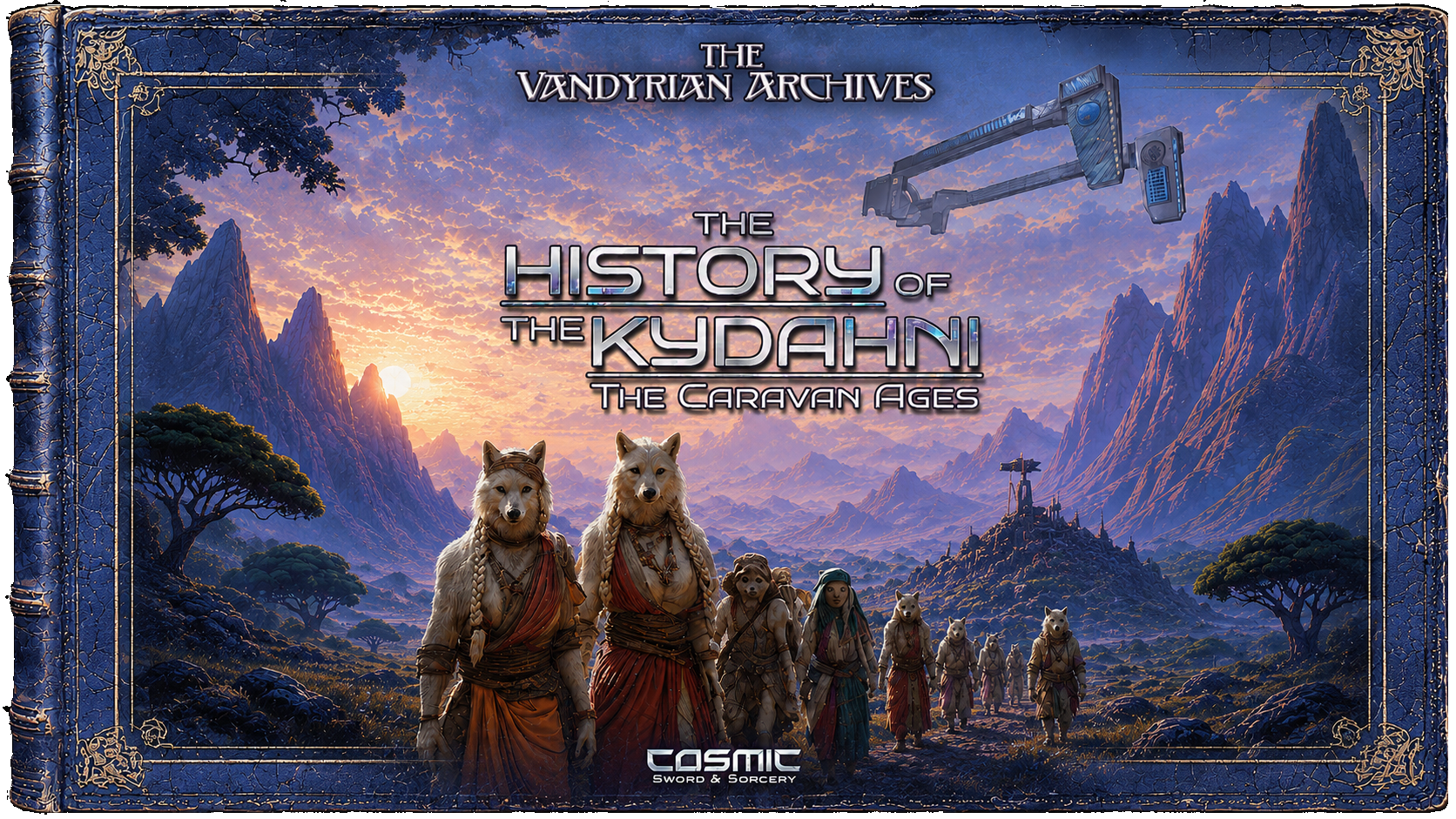
The Formation of Kydahni Identity
From these conditions emerged the foundation of Kydahni civilization itself. The White Wolves were not forged through conquest, territorial expansion, or dynastic certainty. They were shaped by movement, adaptation, memory, and survival. Their earliest institutions developed not to govern worlds, but to navigate uncertainty. Their first authorities managed relationships rather than territories. Their first political structures emphasized continuity over possession.
By the closing centuries of the Caravan Ages, however, these institutions had ceased to represent merely the survival mechanisms of a displaced people. The flotillas, Broker Houses, enclaves, legal authorities, information networks, financial systems, and transport infrastructure together constituted a civilization of immense scale whose political influence was increasingly difficult to distinguish from conventional power. The Kydahni still lacked the territorial state that surrounding civilizations associated with sovereignty, but they no longer lacked the means through which sovereignty was ordinarily exercised.
The resulting identity differed fundamentally from that of neighboring powers. While many civilizations defined themselves through geography, the Kydahni defined themselves through persistence. Their sense of continuity did not depend upon a particular world, government, or ruling house. It depended upon the survival of the people and the systems that connected them. A port could close without closing the route. An enclave could be expelled without destroying the community. A government could collapse without erasing the obligations recorded beneath it. A House could lose property in one jurisdiction while possessing relationships, assets, archives, and credit extending through dozens more. The Kydahni increasingly understood themselves not as a people awaiting the restoration of conditions enjoyed by territorial civilizations, but as a civilization whose own institutions had rendered many of those conditions unnecessary. They had spent generations learning how to possess the advantages of permanence without becoming dependent upon permanent possession.
Yet success gradually changed the scale upon which these principles operated. As Kydahni populations moved deeper into the Core Worlds, migration increasingly became concentration. Enclaves that had once functioned primarily as temporary points of exchange grew into substantial communities. Broker Houses established permanent offices alongside ancient dynastic institutions. Financial interests accumulated around major ports, industrial centers, entertainment districts, transport exchanges, and administrative capitals. Kydahni specialists entered increasingly sophisticated professions, while their legal representatives became familiar presences within commercial and political disputes. Flotillas continued to arrive from the outer networks, feeding populations already established within the Core and carrying with them additional wealth, labor, information, commodities, technical expertise, and family connections. What earlier ages had distributed across enormous distances was beginning to accumulate within the richest and most politically consequential region of the Vandyrian spheres.
With concentration came a corresponding change in Kydahni power. Silver had always been among their preferred instruments, but silver increasingly traveled beside steel. The later caravans were already far better armed than their predecessors, and the Houses entering the Core possessed sufficient wealth to acquire guards, vessels, weapons, fortified commercial properties, private security formations, and the increasingly formidable defensive apparatus required to protect assets of enormous value. This did not yet constitute the great military civilization of later Kydahn. The distinction remained important. The White Wolves had not abandoned brokerage in favor of conquest. Rather, they had reached the point at which their commercial and social position could justify the organized use of force in its own defense. A House capable of financing dynasties, transporting strategic commodities, maintaining communities across several systems, and carrying generations of accumulated wealth was no longer content to entrust its security entirely to whichever foreign ruler happened to possess jurisdiction over the nearest port. For the first time on a significant scale, Kydahni influence could arrive with contracts in one hand and armed capability behind the other.
This development alarmed portions of the Core Worlds, particularly those aristocracies already suspicious of Kydahni commercial influence. To them, the transformation appeared obvious and dangerous. The itinerant merchants had become financiers. The financiers had become institutional powers. Those institutional powers now possessed populations, law, intelligence, infrastructure, foreign relationships, extraordinary capital, and an increasing capacity to defend themselves. Critics warned that the White Wolves were acquiring the functional components of statehood without accepting the geographic limitations ordinarily imposed upon states. A territorial dynasty could be contained by borders, blockaded through known approaches, stripped of provinces, or defeated through seizure of its capital. What, precisely, constituted the equivalent pressure point against a civilization whose assets and population existed across the territories of numerous other powers? The very adaptations that had allowed the Kydahni to survive the Caravan Ages now made their growing power deeply unsettling to those accustomed to understanding political threats through maps.
The mistake of these early opponents was assuming that their alarm would necessarily be shared throughout the Core. The Core Worlds were vast, ancient, wealthy, and governed through the immense architecture of the Imperial Systema, but they were hardly politically unified. Dynasties competed. Aristocracies resented one another. Commercial blocs sought advantages over neighboring systems. Old rivalries survived beneath Imperial administration, and local interests frequently mattered more than abstract solidarity between Core powers. The arrival of wealthy Kydahni Houses therefore produced opportunity alongside fear. A ruler whose rival condemned Kydahni financiers might welcome them simply to gain access to capital his rival had rejected. A port threatened by a neighboring commercial center could offer the White Wolves favorable terms and watch caravan traffic redirect toward its own markets. Industrial interests wanted transport. Aristocrats wanted credit. Courts wanted luxuries. Governments wanted intermediaries. Merchants wanted access to networks reaching beyond their own political horizons. And some simply enjoyed the satisfaction of watching an old enemy become furious as Kydahni silver flowed into the treasury next door.
Consequently, attempts to present the expanding Kydahni presence as a common threat repeatedly encountered a simple political reality: enormous portions of the Core Worlds were making money from them. In many regions the White Wolves were not intruders but valued clients, creditors, commercial partners, transport providers, entertainers, suppliers, legal intermediaries, investors, and increasingly important constituents of local economic life. Roughly half the surrounding powers might regard deeper Kydahni integration with enthusiasm or at least practical approval, even while others regarded precisely the same development as intolerable. The disagreement itself benefited the Houses. Every attempt to restrict them created another jurisdiction willing to attract the business being driven away. Every aristocracy that denounced their influence strengthened the bargaining position of an aristocracy prepared to welcome it. The political fragmentation of the Core transformed hostility from an existential barrier into another market condition to be appraised.
The Kydahni understood the significance of this division immediately. Their security no longer depended solely upon convincing suspicious powers that they were harmless. They could make themselves valuable to competing powers and allow those powers’ own interests to defend the relationship. A dynasty contemplating confiscation might discover that neighboring governments were eager to receive the displaced capital. A commercial restriction could enrich a rival port. Expelled specialists could strengthen another industrial center. A House denied access to one court could finance its competitor. The old Caravan principle of departure had therefore acquired vastly greater consequences within the Core Worlds. When the Kydahni had possessed little, expulsion had meant survival elsewhere. Now that they controlled substantial capital, expertise, traffic, and institutional relationships, their departure could alter the balance between the powers that remained behind.
This environment also changed the Kydahni themselves. Generations of operating around foreign authority had taught them how institutions worked; residence within the Core brought them into sustained contact with institutions operating at the highest levels of Imperial civilization. Their Houses learned not merely how to negotiate with rulers, but how rulers were made, constrained, financed, embarrassed, protected, and replaced. Their lawyers encountered ancient bodies of Imperial law. Their financiers entered markets of previously unimaginable scale. Their information networks penetrated societies whose political rivalries generated endless demand for discreet intermediaries. Their armed retainers encountered military traditions considerably more sophisticated than those of the peripheral territories through which earlier caravans had traveled. Their offspring increasingly grew up not upon the margins of great civilizations, but within their capitals, surrounded by the machinery of power and increasingly conscious that nothing within that machinery was inherently inaccessible to them.
Thus the closing of the Caravan Ages did not represent the abandonment of Kydahni identity but its maturation into something capable of pursuing power on an entirely different scale. The habits remained recognizable: Appraisal, mobility, contractual continuity, information discipline, institutional redundancy, commercial aggression, guarded memory, and the preference for becoming indispensable before becoming dominant. What changed was the environment in which those habits now operated. The White Wolves had entered the richest political arena available to them carrying the accumulated institutional experience of generations spent surviving among foreign powers. They now possessed enough wealth to influence those powers, enough population to become a political constituency within them, enough information to understand their divisions, and increasingly enough steel to ensure that silver did not stand undefended.
This distinction explains much about the civilization they would later become. The Kydahni tendency toward networks, influence structures, brokerage systems, logistical integration, and indirect forms of authority can all be traced to the conditions of their origin. Long before they ruled empires, they learned to survive within them. Long before they commanded worlds, they mastered the spaces between them.
The Core Worlds would provide the next transformation, because there the White Wolves encountered something the Caravan Ages had never offered them in sufficient concentration: the possibility that the civilization between civilizations might cease merely passing through the structures of power and begin acquiring a permanent place among those who controlled them.
By the time the White Wolves eventually ascended to positions of power, the psychological and institutional foundations of their civilization had therefore already been established. Beneath the imperial grandeur, the executive dynasties, the armies, and the silver towers of later ages remained the enduring legacy of the caravan peoples: a civilization that never forgot what it meant to be unwanted, and which consequently dedicated itself to becoming impossible to remove. The White Wolves entered the Core without a Throneworld and without a recognized place among its ancient dynasties, but they no longer entered it as refugees dependent upon the tolerance of their hosts. They arrived as an immense migrant civilization carrying its own law, wealth, institutions, networks, memory, and increasingly its own capacity for violence. Some among the Core saw what that might eventually mean and recoiled. Others looked upon the same rising power, calculated what might be gained from it, and opened the gates.