



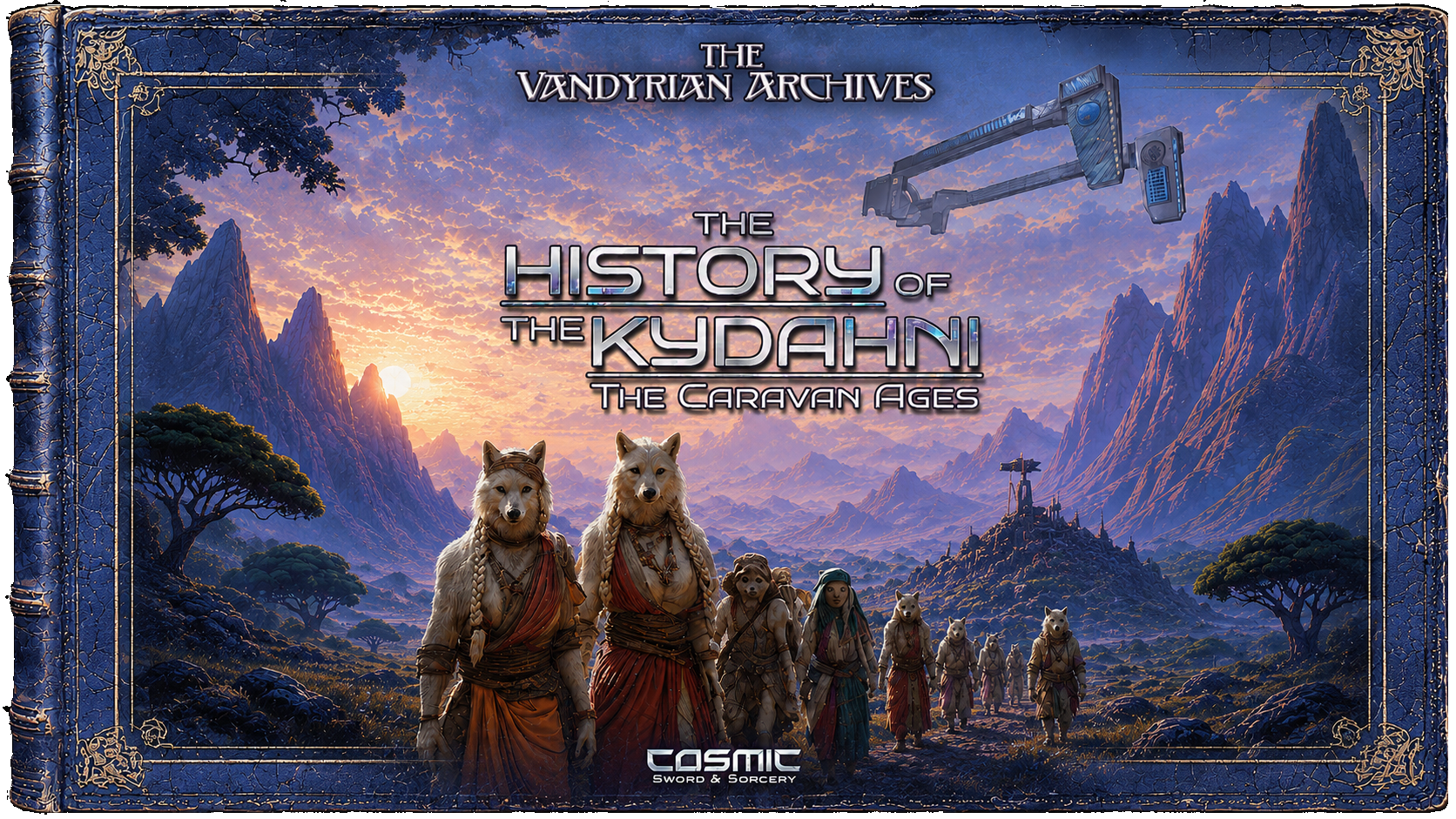
The Civilization Between Civilizations
By the final centuries of the Caravan Ages, the Kydahni could no longer be adequately described as scattered migratory populations. Their communities remained dispersed across enormous regions, but the institutions connecting those communities had grown increasingly sophisticated, standardized, and permanent. Great flotillas traveled established circuits between foreign states. Broker Houses maintained commercial relationships spanning generations. Diasporic enclaves provided fixed points of exchange without severing themselves from the mobile population. Kydahni law followed individuals across jurisdictions, while archives, financial ledgers, route records, communications networks, and shared systems of obligation preserved continuity between populations separated by extraordinary distances. What had begun as survival without territory had matured into something far greater: a civilization whose geography consisted not of borders, but of connections.
The scale of this civilization was frequently underestimated by the territorial powers surrounding it. No map displayed a Kydahni state. No continuous frontier marked the limits of Kydahni authority. No single throneworld contained the majority of their population or institutions. Viewed from within any individual kingdom, the White Wolves might appear merely as a prosperous enclave, a familiar merchant population, a visiting flotilla, or several influential commercial families. Only when the totality of these communities was considered together did their true scale become apparent. Kydahni populations existed across hundreds of jurisdictions while remaining connected through shared law, finance, genealogy, culture, information, transportation, and obligation. Their civilization had become enormous without ever becoming territorially contiguous.
This condition produced one of the great paradoxes of the late Caravan Ages. The Kydahni possessed comparatively little sovereign territory, yet increasingly operated infrastructure upon which territorial civilizations depended. They maintained routes between powers that rarely communicated directly. Their Houses extended credit across political boundaries. Their flotillas moved populations and commodities between otherwise disconnected markets. Their enclaves served as points of contact between local economies and networks extending far beyond them. Their archives preserved agreements after the governments that signed them had disappeared. Their information systems could recognize political changes across regions faster than many established authorities could communicate with their own distant possessions. The White Wolves remained guests almost everywhere, yet the systems maintained by those guests had become part of the ordinary functioning of interstellar civilization.
Nor were the Kydahni any longer merely adapting themselves to foreign institutions. Increasingly, foreign institutions adapted themselves to the Kydahni. Ports created procedures specifically for caravan traffic. Governments recognized Kydahni arbiters because doing so simplified disputes they had little ability to resolve themselves. Merchants learned Kydahni commercial practices in order to gain access to wider markets. Dynasties cultivated relationships with particular Broker Houses because those relationships could provide resources unavailable through formal diplomacy. Settled populations came to depend upon regular flotilla arrivals, while isolated regions measured prosperity partly according to their proximity to established Kydahni routes. A civilization once permitted to exist because it was useful had made its usefulness structural.
Yet the greatest transformation occurred among the White Wolves themselves. The endless movement of the Caravan Ages had created populations capable of imagining community at scales that no longer required physical proximity. A Kydahni born aboard a flotilla beyond one imperial frontier could possess obligations, relatives, commercial partners, legal protections, and cultural affiliations extending through territories he or she had never personally visited. Houses separated by vast distances nevertheless participated within common systems. Enclaves destroyed in one generation could be remembered and reconstructed by populations living elsewhere. The civilization had ceased to depend upon the continued existence of any particular settlement, route, government, or region. The Kydahni had become a people distributed across civilizations without becoming divisible by them.
It was during this late period that movement toward the Core Worlds accelerated dramatically. The reasons were numerous and rarely coordinated from any single authority. The Core offered extraordinary concentrations of wealth, population, industry, political influence, and commercial opportunity. Ancient routes increasingly terminated there. Broker Houses expanded their operations inward. Existing enclaves attracted relatives, specialists, merchants, laborers, entertainers, financiers, and craftsmen from more distant populations. Flotillas altered their circuits to service growing markets. Infrastructure followed traffic, and additional traffic followed infrastructure. What began as commercial migration gradually became demographic convergence.
The scale of that convergence was unprecedented in Kydahni history. Individual flotillas arrived carrying populations comparable to cities. Smaller caravans merged into established circuits. Houses relocated portions of their archives and commercial operations inward while retaining networks extending far beyond the Core. Entire communities followed routes opened generations earlier by merchants and intermediaries. The White Wolves did not enter the Core Worlds as a single invading host, nor did they arrive under the command of a sovereign ruler. They came through a thousand ports, a thousand contracts, a thousand enclaves, and a thousand migrations, carrying with them the accumulated institutions of the Caravan Ages.
Thus the first great age of Kydahni history ended not with the abandonment of the caravan civilization, but with its concentration. The White Wolves entered the Core Worlds as an immense migrant people already possessing sophisticated law, finance, industry, transportation, information networks, social institutions, commercial Houses, and a civilizational identity capable of surviving without territorial unity. They did not yet possess a throne. They did not yet possess a recognized homeland. They did not yet possess the territorial authority enjoyed by the ancient dynasties among whom they now increasingly lived.